Caitlin Shamberg

Bargain gifts for the outdoor adventurer

Affordable goodies to thrill the backpacker, snowboarder, skier or cyclist on your list.

  • more
    • All Share Services

Bargain gifts for the outdoor adventurer

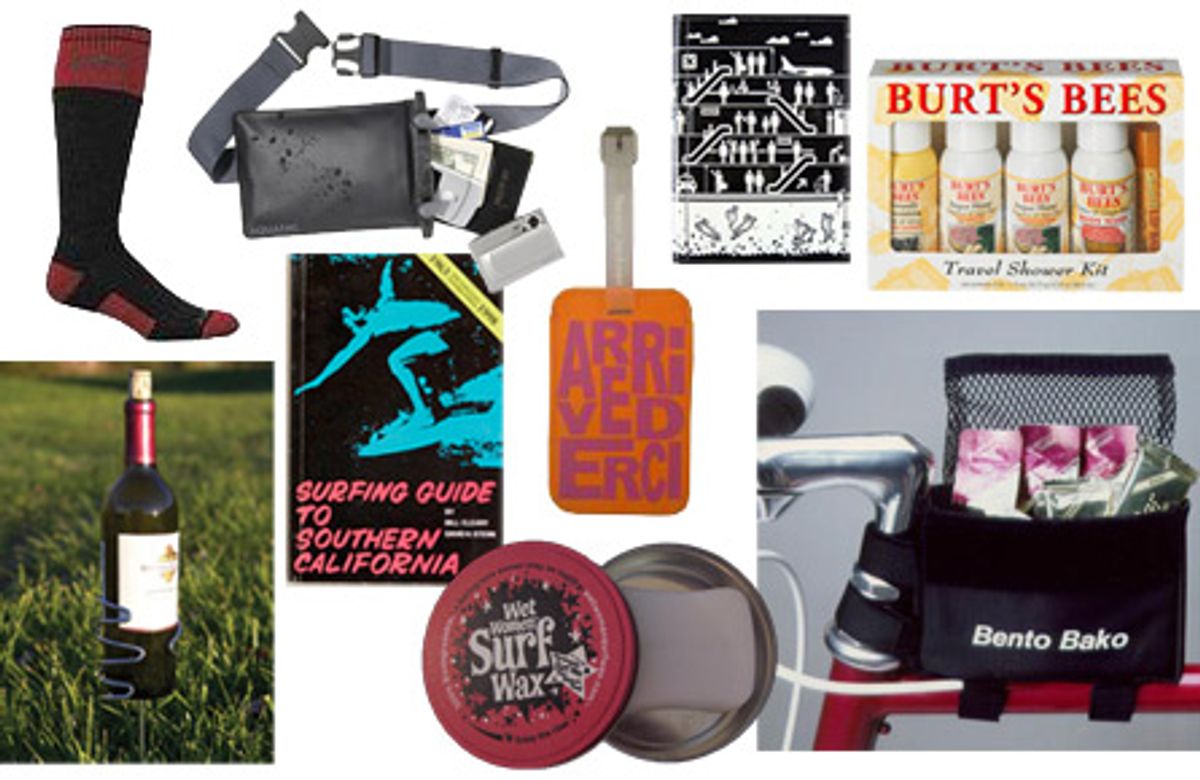
Fill the adventurer’s soft, cozy wool hiking sock ($19.95) — er, stocking — with  eco-friendly supplies, like Burt’s Bees’  chemical-free sunscreen and travel kits ($13-$30). Send your favorite beach bum a supply of  fish-friendly surfboard wax ($4), or these waterproof cases ($34.99) for passports, cameras and phones.

For the nostalgic surfer, you can buy great collections of movies from the ’60s and ’70s as well as the original “Surfing Guide to Southern California” ($12) from San Francisco’s Mollusk Surf Shop. I like its funky, water-worshipping T-shirt designs ($20-$30), too!

What  wine-loving picnicker wouldn’t appreciate this wine bottle holder ($14.49), which keeps a bottle secure on uneven ground? The stainless steel structure plugs right into the earth. You can upgrade this present, of course, by throwing in one of your favorite bottles.

Whether your adventurer is going snorkeling in Belize or helicopter skiing in Austria, send them on their way with these hip, colorful luggage tags ($7-$17) and passport covers ($20). (If you’re feeling extra generous, remember that you can always gift your frequent flier miles and help your favorite explorer fly farther afield for less.)

Where bicycle accessories are concerned, simple is best. So why strap a chunky Day-Glo bag to your machine, when you could get one of these sleek babies? The Bento Bako ($14.95-$15.95) sits serenely on your top tube next to the handlebar stem. The small version — which I prefer — is just big enough for a power bar, a map, my iPhone and a chunk of Irish cheddar. Instead of having to dig around in my jersey pockets or under the seat when I need these items, I just dip into the Bento Box. No need to stop pedaling since it’s sitting right at hand. The boxy shape, topped with a soft mesh cover, keeps my belongings organized. And it looks good — well, as good as any nylon and Velcro item can — on my beloved Lemond. The grande version holds more of the same, plus a paperback, for those who like hauling around more stuff.

What Joe Jackson knows about Michael

Joe Jackson appeared on "Larry King Live" to talk about his grandchildren and his (bad) relationship with his son

  • more
    • All Share Services

What Joe Jackson knows about Michael

Larry King  interviewed  Joe Jackson last night, and it took several strange turns.  (Read the whole transcript on CNN).  Jackson and his son, Michael,  were clearly estranged (Joe admits he was barred from his son’s home) and as King probed into their relationship the conversation veered into a weird territory.  Here’s an early exchange:

KING: Where is — where is Michael’s body?

JACKSON: I don’t know. You’d have to ask somebody that knows. I don’t know. All I know is that…

KING: You’re the father.

Later, King, having established that the father and son didn’t have anything to do with eachother, pushed Joe Jackson on whether he was an abusive father.

JACKSON: Let me handle this. The media keep hollering about saying that I beat Michael. That’s not true. You know what this beat started — beat started in the slavery days. Where they used to beat the slaves and then they used to torture them.

That’s where these beating started. These slave masters, and that’s where that come from. But, hey, there’s a lot of people in America, Larry, a lot of people in America spank their kids, you know? They say they don’t, they’re lying. They’re lying.

Now, Michael was never beaten by me, I’ve never beaten at all.

KING: Ok, you’re on record.

Watch:

Continue Reading Close

Obama talks personal responsibility to NAACP

The nation's first black president addresses one of the organizations that made it possible

  • more
    • All Share Services

If, somewhere, there’s a rating system for coincidences — a scale ranging from the ordinary to the almost miraculous — then the one that played out when President Obama spoke to the NAACP on on Thursday night has to rank pretty high. That the first black man to be elected president of the United States could speak to the NAACP ‘s annual convention was miracle enough, of course. But this convention also just happened to mark the great civil rights organization’s centennial.

Obama, obviously, went out of his way to recognize the milestone, and to acknowledge the role the NAACP had played in his election.

“What we celebrate tonight is not simply the journey the NAACP has traveled, but the journey that we, as Americans, have traveled over the past one hundred years,” the president said at the beginning of his address, according to his prepared remarks.

Speaking of civil rights leaders and workers from the NAACP, Obama continued, “Because of what they did, we are a more perfect union. Because Jim Crow laws were overturned, black CEOs today run Fortune 500 companies. Because civil rights laws were passed, black mayors, governors, and Members of Congress serve in places where they might once have been unable to vote. And because ordinary people made the civil rights movement their own, I made a trip to Springfield a couple years ago — where Lincoln once lived, and race riots once raged — and began the journey that has led me here tonight as the 44th President of the United States of America.”

But Obama’s speech wasn’t all about accomplishments — it was largely about the work that remains to be done for bringing about full equality in the U.S. The president kept to a familiar message on this front; his speeches to the black community have always focused on personal responsibility, and Thursday night was no different.

“All these innovative programs and expanded opportunities will not, in and of themselves, make a difference if each of us, as parents and as community leaders, fail to do our part by encouraging excellence in our children,” Obama said. “Government programs alone won’t get our children to the Promised Land. We need a new mindset, a new set of attitudes — because one of the most durable and destructive legacies of discrimination is the way that we have internalized a sense of limitation; how so many in our community have come to expect so little of ourselves.

“We have to say to our children, Yes, if you’re African American, the odds of growing up amid crime and gangs are higher. Yes, if you live in a poor neighborhood, you will face challenges that someone in a wealthy suburb does not. But that’s not a reason to get bad grades, that’s not a reason to cut class, that’s not a reason to give up on your education and drop out of school. No one has written your destiny for you. Your destiny is in your hands — and don’t you forget that.”

This kind of speech from Obama has always played better in the national media than it has with leaders in the black community — witness, for example, Jesse Jackson caught on a hot mic last summer saying he wanted to “cut [Obama's] nuts off” and that Obama “talked down” to black people. But the reaction in the room this time around was positive, and afterwards, NAACP leaders who spoke to reporters also had good things to say, though they did spin the speech a little.

“He seemed to me to be saying that you don’t get anywhere unless you put some effort into it,” Julian Bond, the chair of the group’s board of directors, said. (Video below.) “You can’t expect it to happen just because you want it to happen, you have to do something about it. The NAACP is one of the groups that does something about it, did something about it and is gonna do something about it.”

Below, Salon video of Bond and NAACP President Benjamin Jealous responding to Obama, and video of the president’s speech.


Continue Reading Close

“I’ve spent the last five days crying in Argentina”

Gov. Sanford admits his affair -- and we have just the musical accompaniment

  • more
    • All Share Services

During Mark Sanford’s strange, addled press conference Wednesday, he explained his sudden disappearance from South Carolina by admitting he hadn’t been hiking the Appalachian Trail after all but had instead been much further South visiting with a “special friend,” i.e., cheating on his wife. In fact, he made reference to having “spent the last five days crying in Argentina.” Was the wayward Governor really unaware that he had lapsed into showtunes? Did he mean to quote Evita? Because he had every right — the overlap between his own emotional turmoil and that of the imagined Mrs. Peron is uncanny. Just read the lyrics to “Don’t Cry for Me, Argentina”: “I had to change/I chose freedom/Running around, trying everything new.” Better yet, pay homage as Broadway diva Patti Lupone sings them, below. (But first, listen to the inimitable Charlotte Greenwood “Sing to Your Senorita,” from the musical “Down Argentine Way”!)


The dark side of the moon

Sam Rockwell and Duncan Jones talk about their new space movie and the pleasures of 1970s science fiction films.

  • more
    • All Share Services

The dark side of the moonSam Rockwell

Today’s science fiction usually features big stars, big budgets and big explosions, but a small independent film with only one star has found a place in the summer release schedule. “Moon,” starring Sam Rockwell, is a quiet study in loneliness and isolation, revolving around the idea that an astronaut is just a working man stuck on the moon.

First-time director Duncan Jones (who happens to be the son of “Starman” David Bowie) says he wanted to make a movie like “Alien” or “Silent Running” — films he couldn’t get enough of when he was a kid. His vision for space is not the slick shiny world of the future, but a gritty industrial park. The spaceship is a messy lived-in space; worn out photographs are tacked to the wall, and the bed is unmade. This is where we find Sam Bell (Rockwell), a blue-collar mechanic who runs the space station and mines helium-3. He spends his days driving around the moon in a clunky vehicle gathering canisters of refined He-3 back to launch back to Earth. His only companion is an unsophisticated-looking robot named Gerty (voiced by Kevin Spacey). Despite the obvious HAL comparisons, we learn very early on that Gerty is devoid of human emotion, existing solely to serve Sam.

Sam’s three-year contract is up, and he is getting ready to go back to Earth, where his wife and young daughter live. But instead of going home, he begins to fall apart. When he is rescued by a newer version of himself — a clone — things really get strange. Suddenly there’s Sam 1, Sam 2 (a hotheaded version of Sam 1) and Gerty vying for space on the ship. It’s a good role for Rockwell, who plays off what he calls this “extraordinary circumstance” with humor and humility. He brings a realism to the relationship between the clones as they evolve from barely tolerating each other to forming a tender connection.

Salon talked to Jones and Rockwell in New York about making a science fiction movie that brings back the geeky thrill of seeing outer space for the first time.

Your choice to de-romanticize the astronaut really came across. I responded to this idea that he’s kind of a regular dude, like a car mechanic.

Duncan Jones: That was actually one of [Sam’s] initial ideas … that we try and do a blue-collar character. I think the main reason for that was that the science fiction films we were both excited about growing up … “Outland” and “Alien” — they really do have these blue-collar characters.

Sam Rockwell: I think a lot of times in horror movies or science fiction movies, they cast these very attractive people and they’re up in space. And I think movies like “Alien,” they have these character actors like Harry Dean Stanton and Yaphet Kotto, and there was a kind of Cassavetes realism to it. The same thing with “John Carpenter’s the Thing” or “Silent Running” or “Outland,” there was this kind of blue-collar element to it, which I think pulls you in immediately to the reality, so when the monster arrives you go with it a little easier.

Talk about the two versions of Sam in the film.

SR: Well they’re really the same person — the only difference is the three years on the moon. The argument that we’re making is that your environment can change you. Three years on the moon by yourself is maybe the equivalent of three years in isolation in prison or a prison camp or something. It’s a little different — you get Ping-Pong and a robot, and you don’t get raped in the shower — but I think he goes a little Robinson Crusoe crazy. And I think he learns about himself up there. So he’s a humbler, sweeter, more sensitive man than his original self because that experience has changed him a little bit.

At first I thought they were going to try to kill each other, but that seemed too easy. They almost become brothers up there.

DJ: Absolutely. “Brothers” is a good way to put it. Even though they are clones, their experience has made them into two very separate characters. I think the genius of what Sam did is that he found what made those two guys different and then found ways to really bring the conflict in between the two of them. And we did it in a way where it wasn’t good guy, bad guy. It was just two guys who had different agendas and were in different stages in their lives. One was still kind of young and aggressive and angry, and the other one had spent a lot of time on his own and had come to understand what his own faults were and had tried to work on them.

And he’s named Sam.

DJ: Well, I did that on purpose. The film was written for Sam, but I kept the name Sam because it’s all about cloning and it’s all about the awkwardness of having to deal with yourself. And the most obvious way for me to make Sam go through that was to call the character Sam.

Can you talk about the technical aspects of filming “Moon”?

SR: The set was really amazing. It was kind of like you were on a space station. I mean the whole thing was closed off — the fourth wall was there, it was four walls, so it wasn’t like a set. It was kind of like going on location. We felt like we were in this little space station. It was in Shepperton [Studios] where they shot “Alien” and “Star Wars,” so there was this lineage there.

 Duncan, your father is David Bowie, and I did go into this film thinking about “The Man Who Fell to Earth.” Your film is quite a different take on space, but … was there something going on in your house?

DJ: Why we’re all obsessed with not being on Earth? No, I’m a product of my upbringing, so I was surrounded by the things that interested my dad at the time, whether that’s films he was watching or music he was listening to or playing. I can’t avoid the fact that that had an effect on making me the person I am. That idea of experience making you who you are is very much what “Moon” is about. But no, I don’t know if we have a genetic disposition to making us want to talk about space. I think there’s something interesting about science fiction in general — that when you do a human story, and you put it in a science fiction setting, you actually see the person a lot more clearly because the environment is so alien. Anything subtle about the human being really stands out, and the thing that makes them human and the things that are natural about them really stick out in this alien environment, this unusual environment.

Why didn’t you show Earth in the film?

DJ: Initially it was budgetary, because we wanted to maintain all of our shoot within our soundstage, but as the film progressed, I got advice from other people. I have some friends who are writers, and they were saying, wow, you should show the epilogue, show what happens when he gets back. We started playing around with it and writing some scenes and talking about it. And we even shot a little segment, but as soon as we put it in the edit it seemed so wrong, because it immediately broke the intimacy of the film that we made. It really just felt bolted on to the end. It didn’t seem appropriate.

What were the challenges of working with the robot?

SR: Well I didn’t work with Kevin [Spacey], because he signed on after the movie was made. The script supervisor would read Gerty’s lines.

That sounds challenging, since Gerty has a specific persona.

SR: I knew what the voice represented. I knew that we talked about the different relationships. The first clone, Sam 1, had been up there with Gerty for three years, so it had become his friend and a mother, and there was so much transference with that robot and the first clone. But the second clone is new to Gerty, and Gerty is new to him, so we talked about making that relationship more like a butler or a servant, so the second clone dismissed him and didn’t treat him as well.

Obviously, this film is sort of a throwback, but do you think it adds to the science fiction genre in any way?

DJ: I think it moves the genre today in a different direction. If it had come out in the late ’70s or early ’80s, hopefully it would have fit right in there with the films that were coming out. I think TV is almost ahead of film right now as far as science fiction goes. They’re telling much more interesting human stories than films have been up until now. But it does seem that there is a new wave of science fiction on the horizon of slightly smarter, more human-centric science fiction. Hopefully, we’re one of the first of this new wave of films.

Continue Reading Close

Isn’t the torture debate over?

The president is speaking; the former vice president should listen.

  • more
    • All Share Services

Isn't the torture debate over?

It’s unfortunate that President Obama is being pitted against the former vice president as if there’s a country-wide debate raging between them.

Earlier today, Dick Cheney in a televised speech tried to convince America that enhanced interrogation methods keep us safe and that our current President is leading us off course. But Obama spoke first and he spoke louder — he is, after all, the one setting the nation’s policy right now.

If you missed it, here’s a bit from the two speeches, side by side:

Page 1 of 9 in Caitlin Shamberg