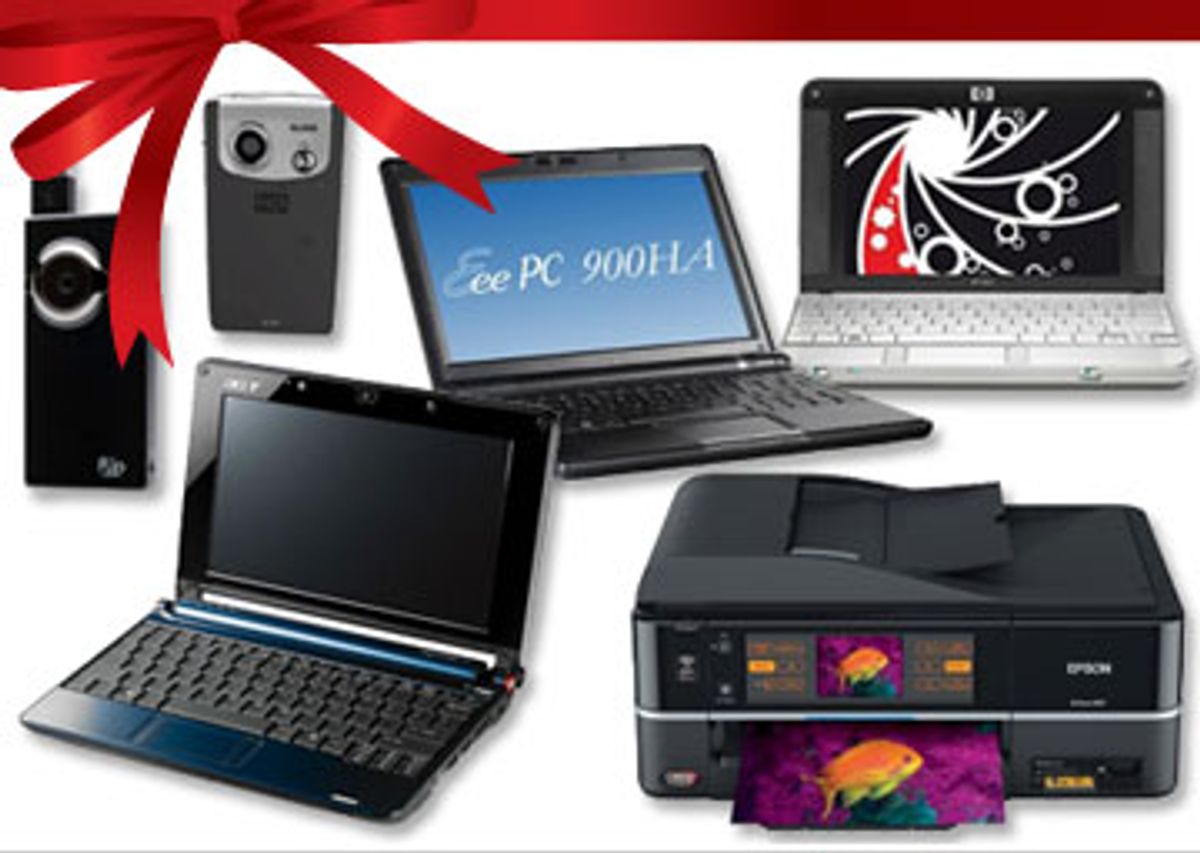
Luxury gifts for the gadget guru
If you don't mind paying big, think small. Small laptops, camcorders and printers, that is.
On the subject of little, cute and (relatively) cheap, the title of Most Adorable Mini-Camcorder of the season is being hotly contested between two new entries: the Kodak Zi6 ($179.99) and the Flip MinoHD ($229). I haven’t gotten to play with both of them long enough to render a final verdict, so here’s what you need to know: Both are irresistible little take-anywheres, no bigger than an iPod. They’re ideal for YouTube-generating teens, families at the zoo, video diarists, bloggers and similar users (and if a zero-budget feature hasn’t been shot yet with one of these, it soon will be). No one’s likely to confuse the picture quality with that of, say, Canon’s VIXIA series (which starts around $600), but contrary to some Internet grumping you’ll run across, yes, the Zi6 and the MinoHD shoot genuine hi-def video (just not at the highest possible resolution). Getting a steady image when your camera weighs less than 4 ounces (!) is a challenge, but uploading, editing and TV playback is easy on both. Both arrive with adequate software packages and slightly different rechargeable battery configurations. Here’s the biggest difference: the Zi6 pretty much requires the purchase of an SD/SDHC memory card (up to 32GB), while the MinoHD has 4GB of on-board flash memory (for about 60 minutes of HD-quality video). If one thing tips me toward the Flip, it’s the swingin’ array of available designs (you can even customize it with your own photo). Both will make for a giggly gift-opening morning.
Are you as sick as I am of suffering chronic shoulder injuries from hauling around that heavy object so wittily referred to as a lightweight laptop? Are you burned out on half-assed stopgap solutions? (I went to the Cannes Film Festival armed only with a Palm TX hand-held and a wireless keyboard, and boy, was I sorry.) If so, here’s a 2008 holiday gift that really means something: It’s the year the mini-laptop was finally ready for prime time (at a price that won’t make your eyes bleed). Sure, someday fairly soon the iPhone may do almost everything a PC can do, but between then and now there are several intriguing and truly lightweight options, ranging from the OQO Model 02, a 5-inch palmtop that weighs less than a pound (and costs $1,250) down to the three low-cost machines that have shifted the market: the Acer Aspire One ($399), the ASUS Eee ($328.20) and the HP 2133 ($399.99) (all available in various configurations). While the Aspire One and the Eee are near-clones — they have the same 8.9-inch screen and the same Intel Atom processor, along with 1GB RAM, a 160GB HDD and an on-board webcam — I lean slightly toward the former on features, design and weight. The Aspire is about 6 ounces lighter, at 2.2 pounds. That said, the Eee is about $80 lighter on your wallet.
But if this is a good year to gift your loved one with a downsized computer, it’s also a good one to upgrade his or her irritating and disappointing printer. (Everybody I know has got one of those.) In this age of ultracheap inkjet all-in-ones, it might seem imprudent to pay $300 or so for Epson’s new Artisan 800 printer ($261) — but that’s because you haven’t seen it in action. Scanning, copying and ordinary printing are all outstanding on this stylish machine — at its highest speed, the Artisan can print black text or graphics at 38 pages per minute — and setting it up on my home wireless network, while not exactly a breeze (extensive software installation was involved) was reasonably straightforward. But what makes the Artisan awfully close to a category-killer at this price point is the fact that, to put it directly, you’ll never order photographic prints again. Its dazzling, professional-quality UltraHD photos have vivid, natural, smudge-resistant colors, and look like nothing you’ve ever seen come out of an affordable inkjet.
Pick of the week: Haunting, gorgeous “Oslo, August 31st”
Pick of the week: "Oslo, August 31st" is a wrenching voyage of discovery in Norway's suddenly trendy capital
“Oslo, August 31st” is, as the title suggests, an evocation of one day in the Norwegian capital, as experienced by a troubled young man who’s facing the end of summer and the end of his youth. It’s a marvelously constructed personal journey, both wrenching and bittersweet, whose emotional ripple effects stay with you for days and weeks afterward. While much of international art cinema can seem overly talky or conceptually alien to American viewers, this second feature film from Norwegian director Joachim Trier is a dynamic, even breathtaking visual experience without much dialogue or any philosophical heavy lifting, following the bony, handsome, exceedingly vulnerable Anders (Anders Danielsen Lie) through coffee shops, nightclubs and bodies of water, en route to an ambiguous final destination.
Continue Reading Close“Moonrise Kingdom”: Wes Anderson’s mid-’60s love story
Bruce Willis and Ed Norton are at their best in the rapturous summer fantasy "Moonrise Kingdom"
Tilda Swinton, Bruce Willis and Edward Norton in "Moonrise Kingdom" All the details of Wes Anderson’s rapturous and hilarious mid-1960s New England summer romance “Moonrise Kingdom,” taken one at a time, are plausible. Indeed they are more than plausible; they’re perfect, from the fitted uniforms and yellow canvas tents of the troop of “Khaki Scouts” headed by cigarette-smoking Edward Norton to the achingly picturesque island home where the brood of children belonging to Bill Murray and Frances McDormand sit around listening to the Leonard Bernstein recording of “A Young Person’s Guide to the Orchestra.” (I’m not going to bother questioning whether that record existed in 1965; some production intern probably spent half a day tracking down its history.)
Continue Reading Close“The Intouchables”: Racial comedy, French style
"The Intouchables" is the biggest foreign-language film of all time. Some critics say it's also racist
A still from "The Intouchables" Here’s a startling news item: “The Intouchables,” a lively if largely predictable Parisian comedy about a wealthy quadriplegic and his ne’er-do-well immigrant caretaker, has become the biggest international success in the history of French cinema. Indeed, according to some sources — and these things are notoriously difficult to measure on a global and historical scale — “The Intouchables” is now the biggest non-Anglophone film of all time, with a worldwide gross approaching $300 million.
Continue Reading CloseMale grooming: The movie
From beard contests to ball cream, Morgan Spurlock's "Mansome" goofs through modern-day male narcissism
Jack Passion in "Mansome" American men are bewildered about their place in the cosmos, or so we have been told repeatedly over the last 20 years. They don’t know whether to thread their eyebrows or wield a welding torch, and end up trying to do both at once (which is inadvisable). As comedian Adam Carolla laments in a scene from Morgan Spurlock’s documentary “Mansome,” the old-time certainties of gender identity have melted away: Women are flying fighter jets and men work at the hair salon; there are no longer “chick jobs and guy jobs.”
Continue Reading CloseMaggie Gyllenhaal on sexual liberation
The beloved indie star tells Salon about her "vibrator movie" and why she loves playing transgressive women
Maggie Gyllenhaal (Credit: Reuters/Mark Blinch) When I met Maggie Gyllenhaal about six weeks ago, she was enormously and gloriously pregnant, stretching out on a sofa with her shoes off and feet up in a Manhattan office building. (Since that time, Gyllenhaal and husband Peter Sarsgaard have welcomed their second daughter, Gloria Ray, to the world.) We were there to talk about “Hysteria,” the charming, lightweight feminist farce from director Tanya Wexler that explores a key event in the history of female sexuality: the invention of the vibrator by Mortimer Granville, a Victorian doctor who was seeking to cure the mysterious “female malady” that lends the movie its title.
Continue Reading ClosePage 1 of 233 in Andrew O'Hehir