Iraq war
Who wants to visit Saddam’s house?
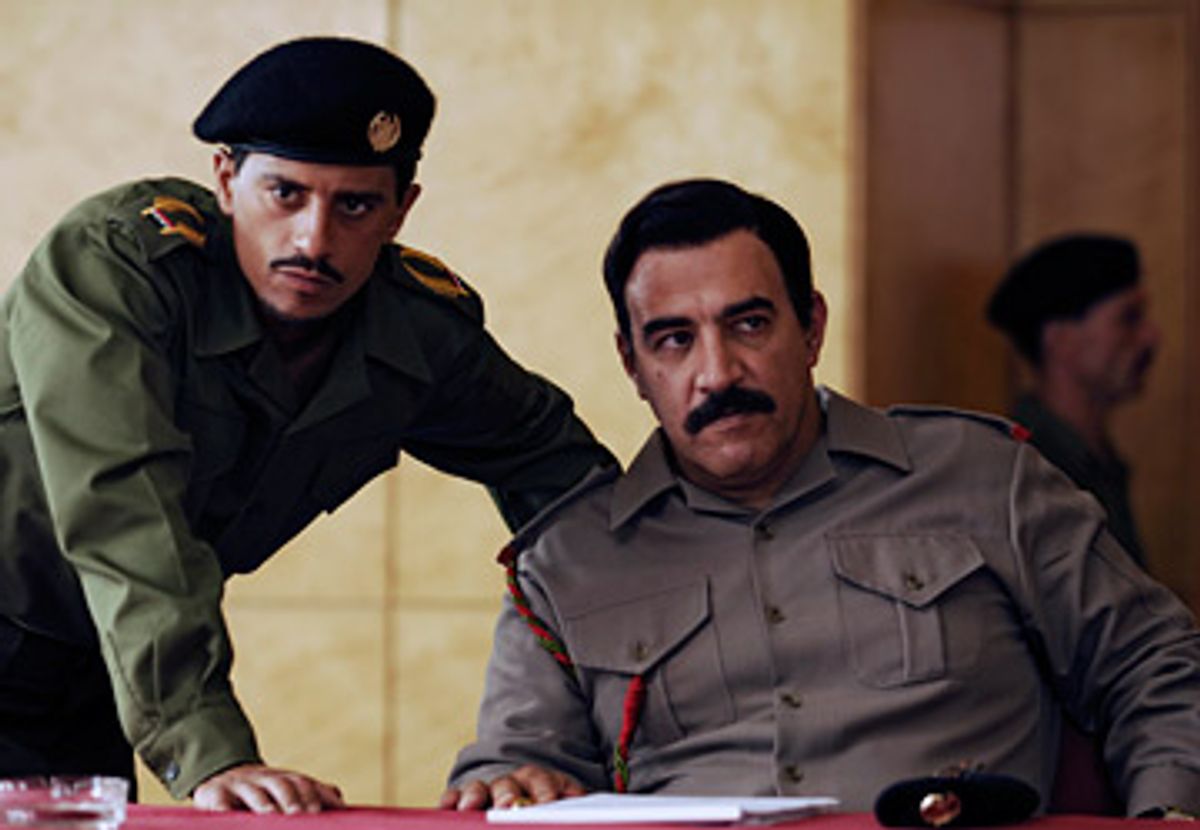
The Iraqi president does his best Darth Vader imitation in HBO's miniseries "House of Saddam."
“The man who can sacrifice even his best friend is a man without weakness. In the eyes of my enemies, I am stronger now.” — Saddam Hussein in HBO’s “House of Saddam”
Imagine the “Star Wars” trilogy, minus the good side of the Force. Take out those whimsical but inspiring scenes between Yoda and Luke on Dagoba or the colorful insults and witty banter of Han and Leia on Endor, and replace it with nothing but Darth Vader, striding menacingly through the halls of the Star Destroyer, choking the life out of one general after another.
Now remove this very dark picture from the realm of fantasy and place it in a historical context, and you’ve got HBO’s four-hour miniseries “House of Saddam” (premieres 9 p.m. Sunday, Dec. 7), in which bellowing tyrant Saddam Hussein seizes power, sniffs out every whiff of dissension within his ranks, and rules with a twitchily paranoid iron fist. Hussein smells opposition everywhere among his trusted friends, throughout his country’s populace, in the governing bodies of neighboring countries, in the drawl of a loathed U.S. president, and he doesn’t hesitate to do everything in his power to stomp it out. Those who tell him his actions are reckless and ill-considered inevitably end up with a loaded pistol pressed to their temple, begging for their lives and pledging undying loyalty to their malevolent leader.
Yes, we knew this story wouldn’t be filled with puppies, rainbows and butterflies. But even so, witnessing every ugly twist in Hussein’s long and arduous path to self-destruction is more grueling than you’d expect, in part because this script doesn’t paint Hussein in very many shades other than the pitch black of pure evil. Even when Sajida (played by Shohreh Aghdashloo from “House of Sand and Fog” and “24″), Saddam’s first wife, parades his daughters and grandchildren into his quarters and tearily confronts him about his latest murder of a perceived traitor, the president appears unmoved. “Here he is, children. Your hero father.” Hussein stares at her stoically. “Adnan was your friend! He loved you and you needed him! Now look who you are left with, men who are nothing but afraid of you!”
“Sajida, go shopping,” Hussein says, finally. We don’t see the slightest hint of second-guessing or self-doubt within the man. His wife leaves, and the president briskly tells his men, “At this meeting of the Arab League, nothing can be left to chance!” Dum dum dum, dum, da dum, dum, da dum!
With the deep, imposing voice of Vader himself, it’s tough for Igal Naor, who plays the Iraqi leader, to avoid making the man look like a cartoon. Although he embodies the tyrant’s imposing nature and his temper with an admirable degree of restraint, we rarely see even a glimmer of mixed feelings in his eyes. The only vaguely human glimpses we get of Hussein come at the very beginning of the story, when his children are young, and then again at the end, when his fate and the fate of his sons has been sealed.
There is one scene, early in the first hour of the miniseries, that offers a rare look at the ideals that fueled this despot’s rise to power. Hussein and his young son are hunting rabbits in the desert, and they stop for a minute on a high perch to take in the vast landscape spread out before them.
Hussein proudly tells his son, “Look around you. The land between two rivers. The first great armies and empires were founded here! Do you know the first laws were written here? We have the birthplace of civilization beneath our feet. We will make it great again, you and I! We are lucky men. We have a land to die for.”
“Father, I’m hot,” his son responds, and you half expect Hussein to push him over the cliff on the spot.
“Have you heard a word I’ve said? You are your mother’s son. Of course you’re hot! We are in the desert! Drink some water!” Saddam shouts at him, and storms off. But we don’t see Hussein raise a hand against him; his stepfather beat him, and he refuses to follow the same path. (Murdering your closest confidants in cold blood is one thing, but smacking your son across the face is an entirely different matter.)
But this grumpy idealist is soon replaced by a suspicious, soulless lunatic. And while that may be the most realistic portrait that could possibly be painted by the filmmakers, who interviewed scores of people who knew the man well, it doesn’t make for the most vivid or entertaining story. Instead, the narrative feels flat: Saddam seethes and schemes, his family weeps and worries, his associates flinch and shiver and exchange weary glances.
Even one of the more interesting subplots, the defection of Hussein Kamel (Amr Waked), Saddam Hussein’s son-in-law and minister of military industries, is tackled without a particularly poignant exchange in the mix.
Kamel makes a hasty decision to flee to Jordan, leaving his wife (the president’s daughter) shocked and not all that optimistic about their future prospects: “All this time you worked with my father, and you still think you can win? You know nothing about him.” She’s right, of course. Kamel is doomed.
But everyone is doomed in this sad tale. And even with plenty of built-in drama, it all plays out in the most predictable manner imaginable. Forget the princess and the guy with the light saber; we just need a few reflective moments and a little stirring dialogue along the way to keep us engaged. Instead, “House of Saddam” is more like a house of horrors, governed by a sadistic but not all that creative maniac. Only a masochist would consider stopping by for a visit.
Heather Havrilesky is Salon's TV critic and author of the rabbit blog. Her memoir, "Disaster Preparedness," published in 2010. More Heather Havrilesky.
America’s real Hunger Games
Young people are already being sacrificed at the whims of the 1%. Just look at Iraq and Afghanistan
U.S. Army soldiers respond after a suicide attack on the US..-led provincial reconstruction team (PRT) compound in the Behsood district of Jalalabad, east of Kabul Afghanistan, on Sunday, April 15, 15 2012. (Credit: AP Phot/Rahmat Gul) When I was growing up, I ate books for breakfast, lunch and dinner, and since I was constantly running out of reading material, I read everyone else’s — which for a girl with older brothers meant science fiction. The books were supposed to be about the future, but they always turned out to be very much about this very moment.
Some of them — Robert Heinlein’s “Stranger in a Strange Land” — were comically of their time: that novel’s vision of the good life seemed to owe an awful lot to the Playboy Mansion in its prime, only with telepathy and being nice added in. Frank Herbert’s “Dune” had similarly sixties social mores, but its vision of an intergalactic world of disciplined desert jihadis and a great game for the substance that made all long-distance transit possible is even more relevant now. Think: drug cartels meet the oil industry in the deep desert.
Continue Reading CloseRebecca Solnit grew up in California public libraries and is thrilled to be revisiting them all over the state as part of the Cal Humanities California Reads project, which is now featuring five books, including her A Paradise Built in Hell: The Extraordinary Communities That Arise in Disaster. More Rebecca Solnit.
Neocons’ new lie
You thought they were gone, but now they're popping up to claim that Iraq inspired the Arab Spring
Dick Cheney, left, and Elliott Abrams (Credit: AP/Pablo Martinez Monsivais) The rulebook for conservative punditry is straightforward. Push for a policy. When it turns into a disaster, defend it. When the defense becomes untenable, ignore it. Finally, when something unrelated but positive occurs, take credit for it.
The newest conservative myth is that the upheavals in the Middle East — called the Arab Spring but occurring too in non-Arab countries like Iran — are a result of the Iraq War. The “freedom” that George W. Bush brought to Iraq had a domino effect on other countries in the region, the argument goes. Neocon Robert Kagan told Salon recently that “there were repeated free elections in Iraq and that undoubtedly had some effect on how neighboring people views their government.” Said Kagan: “I think Egyptians said. ‘If the Iraqis can have elections, why can’t we have elections?’”
Continue Reading CloseJordan Michael Smith writes about U.S. foreign policy for Salon. He has written for the New York Times, Boston Globe and Washington Post. More Jordan Michael Smith.
“War crime” delusions
A WikiLeaks video of an Iraq war massacre raises questions about international laws governing armed conflict
Still of Namir Noor-Eldeen, a 22-year-old war photographer, from WikiLeaks' Collateral Murder video Anyone who would like to witness a vivid example of modern warfare that adheres to the laws of war — that corpus of regulations developed painstakingly over centuries by jurists, humanitarians, and soldiers, a body of rules that is now an essential, institutionalized part of the U.S. armed forces and indeed all modern militaries — should simply click here and watch the video.
Wait a minute: that’s the WikiLeaks “Collateral Murder” video! The gunsight view of an Apache helicopter opening fire from half a mile high on a crowd of Iraqis — a few armed men, but mostly unarmed civilians, including a couple of Reuters employees — as they unsuspectingly walked the streets of a Baghdad suburb one July day in 2007.
Continue Reading CloseChase Madar, is a lawyer in New York, a contributor to the London Review of Books and Le Monde diplomatique and the author of a new book, The Passion of Bradley Manning (OR Books). More Chase Madar.
Our real Iraq losses
We left their nation in turmoil and our own country entangled in an endless "national security" nightmare
A man, left, inspects his destroyed vehicle at the scene of a car bomb attack in Ramadi, 70 miles (115 kilometers) west of Baghdad, Iraq, Tuesday, March 20, 2012. Officials say attacks across Iraq have killed and wounded scores of people in a spate of violence that was dreaded in the days before Baghdad hosts the Arab world's top leaders. (AP Photo) (Credit: AP) People ask the question in various ways, sometimes hesitantly, often via a long digression, but my answer is always the same: no regrets.
In some 24 years of government service, I experienced my share of dissonance when it came to what was said in public and what the government did behind the public’s back. In most cases, the gap was filled with scared little men and women, and what was left unsaid just hid the mistakes and flaws of those anonymous functionaries.
What I saw while serving the State Department at a forward operating base in Iraq was, however, different. There, the space between what we were doing (the eye-watering waste and mismanagement), and what we were saying (the endless claims of success and progress), was filled with numb soldiers and devastated Iraqis, not scaredy-cat bureaucrats.
Continue Reading ClosePeter Van Buren spent a year in Iraq as a State Department Foreign Service Officer serving as Team Leader for two Provincial Reconstruction Teams (PRTs). Now in Washington, he writes about Iraq and the Middle East at his blog, We Meant Well. His book, We Meant Well: How I Helped Lose the Battle for the Hearts and Minds of the Iraqi People (The American Empire Project, Metropolitan Books), will be published this September. More Peter Van Buren.
He was our eyes
The tragic death of Anthony Shadid has made the world a little darker
The late Anthony Shadid I was stunned and saddened to learn of the death of Anthony Shadid, the great New York Times reporter who covered the Middle East. Shadid was quite simply the best mainstream reporter working the most important foreign beat in the world. From his superb coverage of Iraq to his groundbreaking reporting on the Arab Spring, he set the journalistic standard. Shadid’s profound knowledge of the Arab world, his even-handedness, his historical sophistication, and above all his empathy for the ordinary people he wrote about, made him indispensable.
Continue Reading CloseGary Kamiya is a Salon contributing writer. More Gary Kamiya.
Page 1 of 299 in Iraq war