Sex, pornography, masturbation, Donald Sutherland's buttocks -- for 11 years, Nerve.com has treated such topics not as material for padlocked diaries but as fodder for sexy-smart cultural coverage. The online magazine features searing personal essays and fiction -- with contributions from such marquee writers as A.M. Homes, Rick Moody and Jonathan Safran Foer -- alongside regular sex advice from a variety of professions (last week it was glassblowers) and an array of artful nudie pics. Now, some of the best of this "literate smut," as the online magazine originally billed itself, can be found in the new anthology "Nerve: The First Ten Years."

Beyond just bringing legitimacy to sex writing and online photography, Nerve has turned the sex-segregated worlds of erotica and pornography into one coed Brooklyn-hip orgy -- and the nauseating clichés and mechanical in-and-out of either genre are not welcome. (Neither are the trite Carrie Bradshaws or Julia Allisons of the world.) The site has given birth to Nerve Personals, a matchmaking service for urban singles that helped make online dating cool, and the über-hip parenting site Babble. The magazine has also launched several media careers, like those of former sex and relationship columnists Em & Lo and writer Grant Stoddard (whose memoir "Working Stiff" is based on his popular sexual guinea-pig column "I Did It for Science").
But while Nerve has successfully introduced conversations about money shots and smelly bodily functions into the literate mainstream, the last thing the magazine wants is to do away with shame entirely. After all, shame is part of what makes sex interesting. That couldn't be clearer in the new anthology, in which the magazine's co-founders, Genevieve Field and Rufus Griscom, write: "We prefer to gnaw on [taboos] like squeaky dog toys." That brazen delight in sexual embarrassment is apparent even in the book's packaging. The muted colors of its cover, which features an unabashedly naked woman reclining in bed, is wrapped in a hot-pink plastic book jacket. (The effect is similar to slapping a glittery Playboy logo on the cover of the Kama Sutra.)
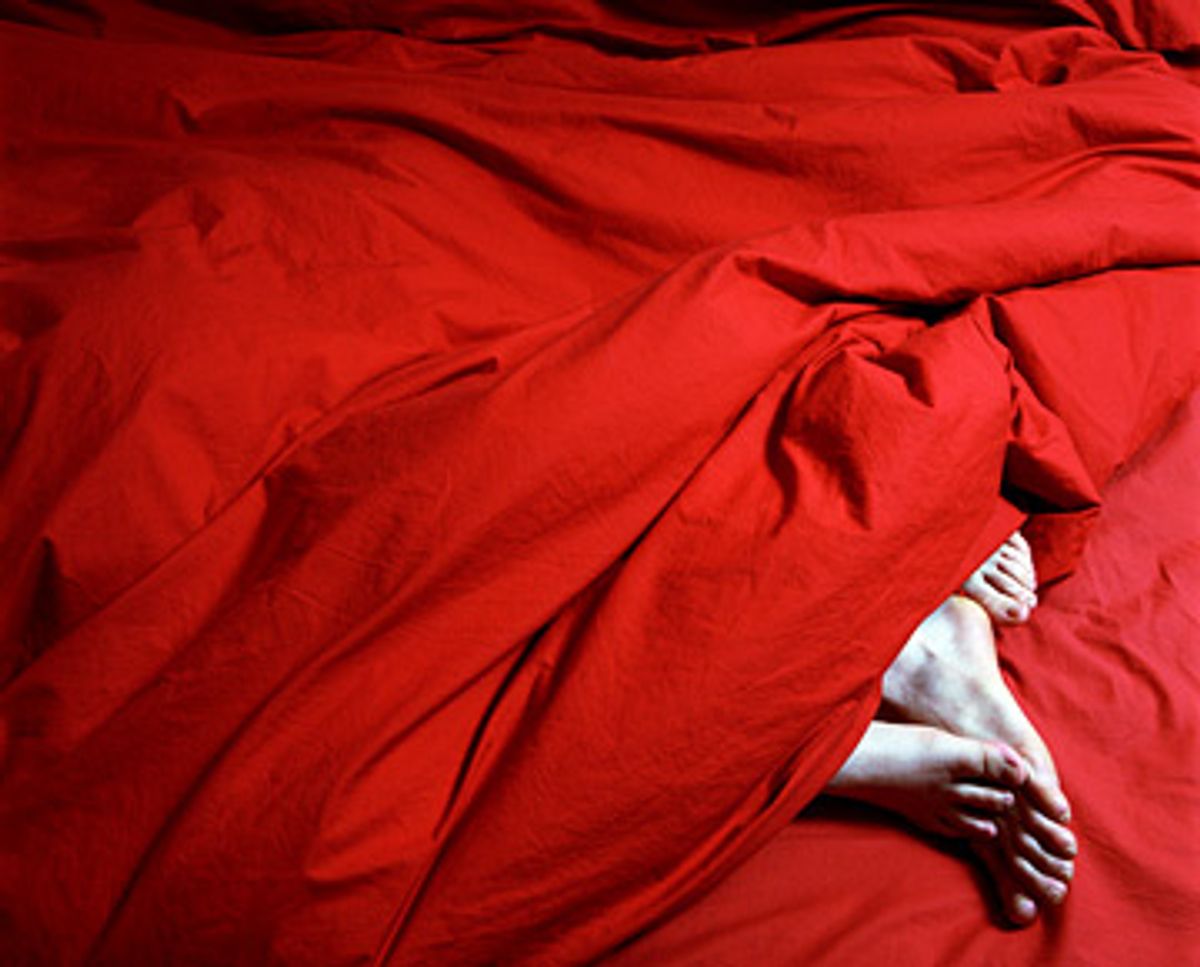
Inside, the happy dissonance continues: Touching essays about being a 28-year-old virgin ("Innocence in Extremis," Debra Boxer) and having sex with an HIV-positive partner ("Fear Factor," Paul Festa) are sandwiched between photos of a literal sex machine, penis puppetry, golden showers and a young woman cavorting around naked alongside her silver-haired grandmother. There are also lighthearted articles (for example, a confession of sexual fantasies about NPR by Salon's Sarah Hepola), and photographs that, unlike mainstream porn, are jarring in their familiarity (bare feet touching just beyond the edge of a blanket and a woman's toes tugging down a man's pants). The anthology is rounded out by pieces by celebrated authors like Alice Sebold and Chuck Palahniuk and interviews with Norman Mailer and Mary Gaitskill.
The book, which is also available online in its entirety, challenges readers to hold in harmony all of the conflicted thoughts and feelings that it arouses. One moment, I was in slack-jawed awe at a brilliant essay by Lucy Grealy about using sex to overcome a physical deformity; the next, my face was scarlet as I quickly flipped past a photo of a woman boldly holding a mirror between her legs for my viewing pleasure. At times, I felt like I was reading an X-rated New Yorker; at other times, like I was flipping through Hustler. The book made me feel alternately like a well-rounded intellectual and an embarrassed adolescent -- and, often enough, it made me squirm in my seat for reasons that have very little to do with shame.
It's sex in all of its various incarnations: innocent, dirty, ugly, beautiful, moving and hilarious. As Griscom, now CEO of Nerve's parent company Material Media, writes in the book's preface, sex "is a crucible human experience, sometimes humbling, other times triumphant, in which we push up against the limits of sentience and quite literally the limits of ourselves, the places where we end and others begin."
Salon spoke with Griscom, who has two sons with his wife, Alisa Volkman, co-publisher of Babble, from his office in New York about the anniversary collection.
In the book's preface, you write that Nerve is a reaction to the sad extremes of the smut spectrum: pornography and erotica. Why hasn't either genre managed to get it right?
Most sex writing and photography -- either on the porn or erotica side -- has a very narrow objective, which is to arouse people. It's an important service, and there's nothing wrong with it. But turning people on, particularly men, is just not very complicated. It's kind of like making lampshades. That's not what we wanted to do.
It's hard to write well about sex. It's also hard to take truly original photographs of naked people. There's a minefield of clichés and euphemisms out there.
Nerve has managed to attract some literary lions over the years. Why do these people want to write about a topic with such huge potential for failure and embarrassment?
I think a lot of great writers are attracted to the challenge. Of course, we've had some cases where people have brought pieces to us and then said, "You know what? On second thought, I just can't publish this." We have also had quite a few writers publish under pseudonyms. Many people haven't gotten over the embarrassment factor. It's in those moments when you have to sort of massage writers into gathering the confidence to put themselves out there, where I feel most proud of the writers themselves, and happy that we've been able to provide a venue for them.
Is there a particular piece that stands out in that respect?
One that comes to mind is Lucy Grealy's "Autobiography of a Body." Lucy, who later died, wrote a piece about her struggles with jaw cancer, and about how she went through a period of wearing shorter skirts and being more risqué. [She wrote about] how she grappled with the relationship between her sexuality and her disfigurement, and it was one of these pieces that took a lot of courage to publish. It's a very powerful few thousand words.
What makes sex writing good?
I think what makes sex writing interesting is the fact that we still -- despite all these many decades of sexual liberation -- struggle with taboos and a sense of guilt and shame over parts of our sexualities. One of the ways Nerve has always been different from the pro-sex contingent is that we think the taboos are what make sex interesting. Sure, if you get rid of all the taboos, you'd have a lot more people having a lot more sex, but it would be much less interesting to write about. It would just be another form of calisthenics; the reason it's more than that is the shame and taboos.
All the best pieces we've published deal with what I refer to as the blush zone. If either the writer or editor loses their ability to blush, then it's boring and they should get out of the business. Appreciating and teasing out the subtleties and complexities of the writer's relationship to internalized taboos and their own sense of shame is the beauty of the exercise. If they can simultaneously throw in some humor and some poignant revelations about the human condition then that's a masterwork. That's the Holy Grail.
A recent string of sex columnist layoffs sparked debate about whether sex, in written form, still sells. I wonder whether you think that it might have something to do with the removal of shame.
That's interesting. I think there are cycles of novelty, and there was a sex writer trend that was new and novel. Gradually, over time, publications have become more comfortable pushing boundaries -- for instance, New York magazine published a topless photo of Lindsay Lohan. Maybe the sex writers just kind of pushed all the obvious boundaries that could be pushed in a conventional print format.
I think it doesn't help when there are periods of time when our society is more interested in whimsy, and when we're more interested in our collective mourning over the economy. There are cultural factors playing out right now.
So how does Nerve thrive in the age of NSFW warnings?
I think NSFW warnings are fantastic. There are probably very few combinations of four letters that generate clicks more consistently than NSFW. It's like, we've always hoped we would have a picket line in front of our office protesting the vile smut peddled upstairs. It's never happened. It's very disappointing.
What's the most controversial thing that Nerve has published?
We published a piece by Peter Singer, a Princeton University ethicist, called "Heavy Petting." He made the case that it's not logically consistent to agree that we're going to eat animals that go through extreme pain and mistreatment and think that is OK, and then think it's horrendously appalling that somebody gets their kitten off with an oven mitt. The piece addressed sexual abuse of animals in context. Singer is known for being controversial, but, at the same time, very logical and smart.
Do most people visit Nerve to think or to be turned on?
I think both simultaneously. If they visited Nerve just to be turned on we'd probably have 10 million readers instead of 1 and a half million. There are many places to go online that are more effective at just pure arousal. I think what's always been distinctive about Nerve is that we do both things at the exact same time.
How did you choose the pieces in the collection?
Oh my God. It was such a harrowing, painful process. I was lying awake at night. It was like choosing children, it was so excruciating. We e-mailed every editor who has ever worked at Nerve and had everybody submit their favorites. We had a list of hundreds of nominations and gradually winnowed it down. There were pieces that got dropped. I had long phone calls with our publisher, begging and pleading for extra pages, and it did end up being longer than it was at the outset. Still, half a dozen pieces got cut that I still lose sleep over.
What about selecting the photography in the book?
Qualities we look for in photography are boldness, originality and heat -- the ability to redirect blood flow. The classic Titian Venus and the classic "erotica" photograph show a soft, supplicant, supine woman, reclined and apparently awaiting instructions. Nerve photos classically depict a woman in control, a woman challenging the viewer in some way. We also like images that express spontaneity and joy. These qualities are often more important to us than classic artistic criteria.
What is Nerve's place in a post-Carrie Bradshaw age, where sex blogs and college sex columns are everywhere?
The memoir was ascendant when we first launched in 1997 -- the whole blog phenomenon had not yet begun. But we're obviously starting to do a lot more with blogs. Our photo blogs are some of the more interesting and daring stuff that we're doing. People are sharing not only their lives in writing but in photographs and in the same spirit of bravery -- or what some people might call reputational suicide.
The bone marrow or soul of Nerve is still pretty distinctive and hard to find elsewhere. That's the simultaneously sexy and gut-wrenching confessional essay, which is very core to our mission. Confessional writing has arguably been on the rise for decades, and I think it's good for the genre that there is this continually building wave of interest.
Who is doing good sex writing outside of Nerve?
All the best publications occasionally publish a piece that causes us to say: "Oh my God, we should have run that." Whether it's in the New Yorker or New York magazine, there are occasionally exceptional pieces that appear. Probably some of the best sex writing occurs not in anthologies of sex writing -- excepting our own, of course -- but in novels. There are a lot of beautiful moments in contemporary fiction.
Playgirl magazine recently folded after 35 years. Any thoughts on what went wrong?
I can't believe it took so long. I'm just grateful that we aren't in the print magazine business. It was a hard business five years ago, and it's a much harder business today. Even more so for the more prurient publications. They're totally unnecessary.
Do we have as many political sex scandals to look forward to once the Democrats return to power?
I sure hope not. Of course, from a business perspective it would probably be good. But I would be very surprised if we see a sex scandal in the White House in the next 30 to 40 years, because I think Bill Clinton learned a pretty powerful lesson for a lot of politicians. I'm sure we'll see lots of colorfully misguided sex antics among our congressmen for many, many years to come, because it's clearly very easy for them to have a megalomaniacal delusion that causes them to think they can do whatever they want.
And seeing other politicians get nabbed doesn't seem to diminish that delusion.
Right. It speaks to the power of that delusion. It's extraordinary how persistent a phenomenon it is.
Shares