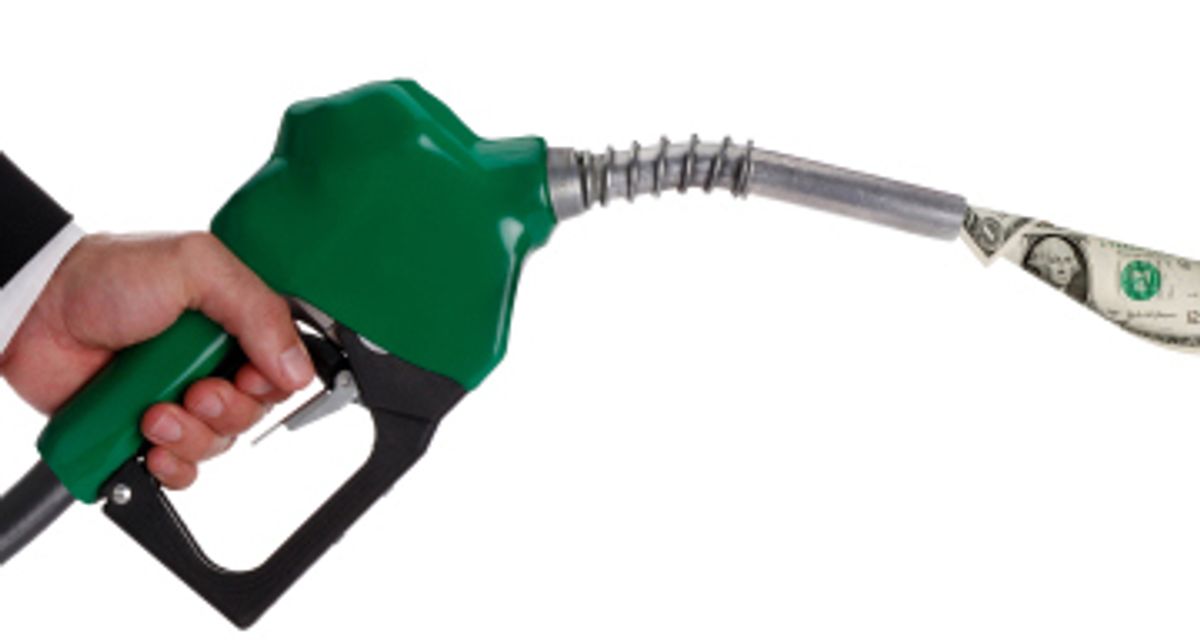
Only yesterday, it seems, we were bemoaning the high price of oil. Under the headline "Oil's Rapid Rise Stirs Talk of $200 a Barrel This Year," the July 7 issue of the Wall Street Journal warned that prices that high would put "extreme strains on large sectors of the U.S. economy." Today, oil, at over $40 a barrel, costs less than one-third what it did in July, and some economists have predicted that it could fall as low as $25 a barrel in 2009.
Prices that low -- and their equivalents at the gas pump -- will no doubt be viewed as a godsend by many hard-hit American consumers, even if they ensure severe economic hardship in oil-producing countries like Nigeria, Russia, Iran, Kuwait, and Venezuela that depend on energy exports for a large share of their national income. Here, however, is a simple but crucial reality to keep in mind: No matter how much it costs, whether it's rising or falling, oil has a profound impact on the world we inhabit -- and this will be no less true in 2009 than in 2008.
The main reason? In good times and bad, oil will continue to supply the largest share of the world's energy supply. For all the talk of alternatives, petroleum will remain the No. 1 source of energy for at least the next several decades. According to December 2008 projections from the U.S. Department of Energy (DoE), petroleum products will still make up 38 percent of America's total energy supply in 2015; natural gas and coal only 23 percent each. Oil's overall share is expected to decline slightly as biofuels (and other alternatives) take on a larger percentage of the total, but even in 2030 -- the furthest the DoE is currently willing to project -- it will still remain the dominant fuel.
A similar pattern holds for the planet as a whole: Although biofuels and other renewable sources of energy are expected to play a growing role in the global energy equation, don't expect oil to be anything but the world's leading source of fuel for decades to come.
Keep your eye on the politics of oil and you'll always know a lot about what's actually happening on this planet. Low prices, as at present, are bad for producers, and so will hurt a number of countries that the U.S. government considers hostile, including Venezuela, Iran, and even that natural-gas-and-oil giant Russia. All of them have, in recent years, used their soaring oil income to finance political endeavors considered inimical to U.S. interests. However, dwindling prices could also shake the very foundations of oil allies like Mexico, Nigeria, and Saudi Arabia, which could experience internal unrest as oil revenues, and so state expenditures, decline.
No less important, diminished oil prices discourage investment in complex oil ventures like deep-offshore drilling, as well as investment in the development of alternatives to oil like advanced (non-food) biofuels. Perhaps most disastrously, in a cheap oil moment, investment in non-polluting, non-climate-altering alternatives like solar, wind, and tidal energy is also likely to dwindle. In the longer term, what this means is that, once a global economic recovery begins, we can expect a fresh oil price shock as future energy options prove painfully limited.
Clearly, there is no escaping oil's influence. Yet it's hard to know just what forms this influence will take in the year. Nevertheless, here are three provisional observations on oil's fate -- and so ours -- in the year ahead.
1. The Price of Oil Will Remain Low Until It Begins to Rise Again. I know, I know: This sounds totally inane. It's just that there's no other way to put it. The price of oil has essentially dropped through the floor because, in the past four months, demand collapsed due to the onset of a staggering global recession. It is not likely to approach the record levels of spring and summer 2008 again until demand picks up and/or the global oil supply is curbed dramatically. At this point, unfortunately, no crystal ball can predict just when either of those events will occur.
The contraction in international demand has indeed been stunning. After rising for much of last summer, demand plunged in the early fall by several hundred thousand barrels per day, producing a net decline for 2008 of 50,000 barrels per day. This year, the Department of Energy projects global demand to fall by a far more impressive 450,000 barrels per day -- "the first time in three decades that world consumption would decline in two consecutive years."
Needless to say, these declines were unexpected. Believing that international demand would continue to grow -- as had been the case in almost every year since the last big recession of 1980 -- the global oil industry steadily added to production capacity and was gearing up for more of the same in 2009 and beyond. Indeed, under intense pressure from the Bush administration, the Saudis had indicated last June that they would gradually add to their capacity until they reached an extra 2.5 million barrels per day.
Today, the industry is burdened with excess output and insufficient demand -- a surefire recipe for plunging oil prices. Even the Dec. 17 decision by members of the Organization of the Petroleum Exporting Countries (OPEC) to reduce their collective output by 2.2 million barrels per day has failed to lead to a significant increase in prices. (Saudi Arabia's King Abdullah said recently that he considers $75 a barrel a "fair price" for oil.)
How long will the imbalance between demand and supply last? Until the middle of 2009, if not the end of the year, most analysts believe. Others suspect that a true global recovery will not even get under way until 2010, or later. It all depends on how deep and prolonged you expect the recession – or any coming depression -- to be.
A critical factor will be China's ability to absorb oil. After all, between 2002 and 2007, that country accounted for 35 percent of the total increase in world oil consumption -- and, according to the DoE, it is expected to claim at least another 24 percent of any global increase in the coming decade. The upsurge in Chinese consumption, combined with unremitting demand from older industrialized nations and significant price speculation on oil futures, largely explained the astronomical way prices were driven up until last summer. But with the Chinese economy visibly faltering, such projections no longer seem valid. Many analysts now predict that a sharp drop-off in Chinese demand will only accelerate the downward journey of global energy prices. Under these conditions, an early price turnaround appears increasingly unlikely.
2. When Prices Do Rise Again, They Will Rise Sharply. At present, the world enjoys the (relatively) unfamiliar prospect of a global oil-production surplus, but there's a problematic aspect to this. As long as prices remain low, oil companies have no incentive to invest in costly new production ventures, which means no new capacity is being added to global inventories, while available capacity continues to be drained. Simply put, what this means is that, when demand begins to surge again, global output is likely to prove inadequate. As Ed Crooks of the Financial Times has suggested, "The plunging oil price is like a dangerously addictive painkiller: short-term relief is being provided at a cost of serious long-term harm."
Signs of a slowdown in oil-output investment are already multiplying fast. Saudi Arabia, for example, has announced delays in four major energy projects in what appears to be a broad retreat from its promise to increase future output. Among the projects being delayed are a $1.2 billion venture to restart the historic Damman oil field, development of the 900,000 barrel per day Manifa oil field, and construction of new refineries at Yanbu and Jubail. In each case, the delays are being attributed to reduced international demand. "We are going back to our partners and discussing with them the new economic circumstances," explained Kaled al-Buraik, an official of Saudi Aramco.
In addition, most "easy oil" reservoirs have now been exhausted, which means that virtually all remaining global reserves are going to be of the "tough oil" variety. These require extraction technology far too costly to be profitable at a moment when the per barrel price remains under $50. Principal among these are exploitation of the tar sands of Canada and of deep offshore fields in the Gulf of Mexico, the Gulf of Guinea, and waters off Brazil. While such potential reserves undoubtedly harbor significant supplies of petroleum, they won't return a profit until the price of oil reaches $80 or more per barrel -- nearly twice what it is fetching today. Under these circumstances, it is hardly surprising that the oil majors are canceling or postponing plans for new projects in Canada and these offshore locations.
"Low oil prices are very dangerous for the world economy," commented Mohamed Bin Dhaen Al Hamli, the United Arab Emirates' energy minister, at a London oil-industry conference in October. With prices dropping, he noted, "a lot of projects that are in the pipeline are going to be reassessed."
With industry cutting back on investment, there will be less capacity to meet rising demand when the world economy does rebound. At that time, expect the present situation to change with predictably startling rapidity, as rising demand suddenly finds itself chasing inadequate supply in an energy-deficit world.
When this will occur and how high oil prices will then climb cannot, of course, be known, but expect gas-pump shock. It's possible that the energy shock to come will be no less fierce than the present global recession and energy price collapse. The Department of Energy, in its most recent projections, predicts that oil will reach an average of $78 per barrel in 2010, $110 in 2015, and $116 in 2020. Other analysts suggest that prices could go much higher much faster, especially if demand picks up quickly and the oil companies are slow to restart projects now being put on hold.
3. Low Oil Prices Like High Ones Will Have Significant Worldwide Political Implications. The steady run-up in oil prices between 2003 and 2008 was the result of a sharp increase in global demand as well as a perception that the international energy industry was having difficulty bringing sufficient new sources of supply online. Many analysts spoke of the imminent arrival of "peak oil," the moment at which global output would commence an irreversible decline. All this fueled fierce efforts by major consuming nations to secure control over as many foreign sources of petroleum as they could, including frenzied attempts by U.S., European, and Chinese firms to gobble up oil concessions in Africa and the Caspian Sea basin -- the theme of my latest book, "Rising Powers, Shrinking Planet."
With the plunge in oil prices and a growing sense (however temporary) of oil plenty, this dog-eat-dog competition is likely to abate. The current absence of intense competition does not, however, mean that oil prices will cease to have an impact on global politics. Far from it. In fact, low prices are just as likely to roil the international landscape, only in new ways. While competition among consuming states may lessen, negative political conditions within producing nations are sure to be magnified.
Many of these nations, including Angola, Iran, Iraq, Mexico, Nigeria, Russia, Saudi Arabia, and Venezuela, among others, rely on income from oil exports for a large part of their government expenditures, using this money to finance health and education, infrastructure improvements, food and energy subsidies, and social welfare programs. Soaring energy prices, for instance, allowed many producer countries to reduce high youth unemployment -- and so potential unrest. As prices come crashing down, governments are being forced to cut back on programs that aid the poor, the middle class, and the unemployed, which is already producing waves of instability in many parts of the world.
Russia's state budget, for example, remains balanced only when oil prices stay at or above $70 per barrel. With government income dwindling, the Kremlin has been forced to dig into accumulated reserves in order to meet its obligations and prop up sinking companies as well as the sinking ruble. The nation hailed as an energy giant is running out of money quickly. Unemployment is on the rise, and many firms are reducing work hours to save cash. Although Prime Minister Vladimir Putin remains popular, the first signs of public discontent have begun to appear, including scattered protests against increased tariffs on imported goods, rising public transit fees, and other such measures.
The decline in oil prices has been particularly damaging to natural gas behemoth Gazprom, Russia's biggest company and the source (in good times) of approximately one quarter of government tax income. Because the price of natural gas is usually pegged to that of oil, declining oil prices have hit the company hard: Last summer, CEO Alexei Miller estimated its market value at $360 billion; today, it's $85 billion.
In the past, the Russians have used gas shut-offs to neighboring states to extend their political clout. Given the steep drop in gas prices, however, Gazprom's Jan. 1 decision to sever gas supplies to Ukraine (for failure to pay for $1.5 billion in past deliveries) is, at least in part, finance-based. Though the decision has triggered energy shortages in Europe -- 25 percent of its natural gas arrives via Gazprom-fueled pipelines that traverse Ukraine -- Moscow shows no sign of backing down in the price dispute. "They do need the money," observed Chris Weafer of UralSib Bank in Moscow. "That is the bottom line."
Plunging oil prices are also expected to place severe strains on the governments of Iran, Saudi Arabia, and Venezuela, all of which benefited from the record prices of the past few years to finance public works, subsidize basic necessities, and generate employment. Like Russia, these countries adopted expansive budgets on the assumption that a world of $70 or more per barrel gas prices would continue indefinitely. Now, like other affected producers, they must dip into accumulated reserves, borrow at a premium, and cut back on social spending -- all of which risk a rise in political opposition and unrest at home.
The government of Iran, for example, has announced plans to eliminate subsidies on energy (gasoline now costs 36 cents per gallon) -- a move expected to spark widespread protests in a country where unemployment rates and living costs are rising precipitously. The Saudi government has promised to avoid budget cuts for the time being by drawing on accumulated reserves, but unemployment is growing there as well.
Diminished spending in oil-producing states like Kuwait, Saudi Arabia, and the United Arab Emirates will also affect non-producing countries like Egypt, Jordan, and Yemen because young men from these countries migrate to the oil kingdoms when times are flush in search of higher-paying jobs. When times are rough, however, they are the first to be laid off and are often sent back to their homelands where few jobs await them.
All this is occurring against the backdrop of an upsurge in the popularity of Islam, including its more militant forms that reject the "collaborationist" politics of pro-U.S. regimes like those of Hosni Mubarak of Egypt and King Abdullah II of Jordan. Combine this with the recent devastating Israeli air attacks on, and ground invasion of, Gaza as well as the seemingly lukewarm response of moderate Arab regimes to the plight of the 1.5 million Palestinians trapped in that tiny strip of land, and the stage may be set for a major upsurge in anti-government unrest and violence. If so, no one will see this as oil-related, and yet that, in part, is what it will be.
In the context of a planet caught in the grip of a fierce economic downturn, other stormy energy scenarios involving key oil-producing countries are easy enough to imagine. When and where they will arise cannot be foreseen, but such eruptions are only likely to make any future era of rising energy prices all that much more difficult. And, indeed, prices will eventually rise again, perhaps some year soon, swiftly and to new record heights. At that point, we will be confronted with the sort of problems we faced in the spring and summer of 2008, when raging demand and inadequate supply drove petroleum costs ever skyward. In the meantime, it's important to remember that, even with prices as low as they are, we cannot escape the consequences of our addiction to oil.
Shares