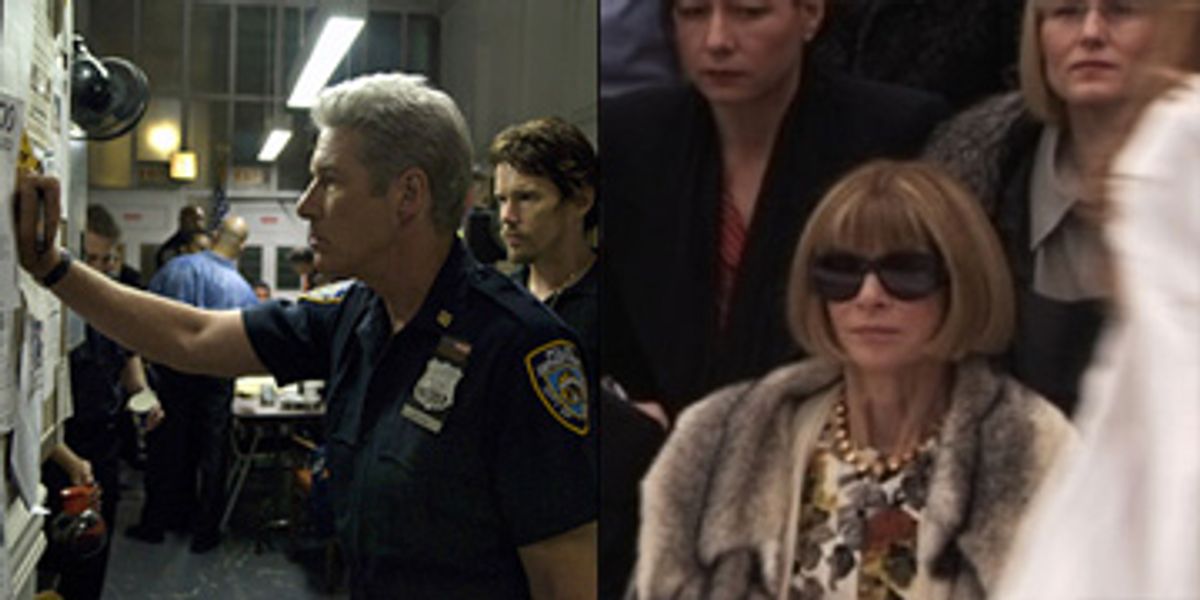
Ashton Kutcher sells body but not soul in dark, sexy "Spread"; Ethan Hawke, Richard Gere and Don Cheadle play good-cop, bad-cop; Anna Wintour, human being!

Richard Gere and Ethan Hawke in “Brooklyn’s Finest,” (left) and Vogue editor Anna Wintour in “The September Issue.”
PARK CITY, Utah — None of the usual musing and pondering from me this time; it’s time for some discipline around here. As I write this, it’s midnight on the Saturday of a crazy-busy Sundance weekend. Partygoers are just getting cranked up, but I’ve been going since early morning and before I crash out I’ve got to file this piece and watch a little of a Slamdance entry called “I Sell the Dead.” I don’t know, it just seemed like a great thing to watch when I’m all alone in a second-rate condo on an isolated mountain road in the dead of winter.
So with the proviso that all these things deserve more attention than they’re getting, I’ve got one news update and several movie premieres of greater or lesser merit to discuss. First off, some readers have raised the question of whether I or Salon or anybody with something approaching a conscience should be gracing the Beehive State with our presence this year after the Mormon church’s much-publicized support for California’s Prop. 8. Rather than just brushing away the question in high-handed fashion (well, OK, I did that too), I dropped by the GLAAD-hosted Queer Lounge on Main Street on Saturday — always one of Park City’s best vibes — to swill a pomegranate soda and talk to folks there about it.
I’m paraphrasing here, but basically GLAAD decided to come back to Park City this year because Sundance and Slamdance have been historically friendly places for lesbian/gay films and filmmakers, and because the gay community in Utah asked them to. If that sounds like a joke it totally isn’t; Salt Lake City (which is just half an hour away and hosts many Sundance screenings and events) has a booming gay and lesbian scene, and Park City is after all an international resort destination. It’s true that the rest of the state is predominantly Mormon and conservative, but boycotting Sundance would disproportionately hurt the most progressive Utah communities.
Now to this weekend’s extremely tasty batch of new films, in descending order of perceived newsworthiness:
“Spread” This guilty pleasure premiered to a packed house on Saturday night and was pretty much a smash. “Spread” is the first American-made movie for fast-rising Scottish director David Mackenzie (“Asylum” and “Mister Foe”) and it stars Ashton Kutcher as a Hollywood gigolo who makes a living by latching on, literally and figuratively, to older women. I’m not even going to try to make some joke connecting that to Kutcher’s real love life because A) I bet somebody’s already come up with a killer line about that, and B) Kutcher’s love life actually bears no relationship to this film.
Kutcher turns out to have terrific acting chops well beyond the doofus self-mockery of his TV-host and pitchman personas. His character, Rikki, is an all-American pretty boy grown worldly-wise before his years, who narrates part of the movie after the fashion of William Holden in “Sunset Boulevard.” Although that’s a definite influence it’s not a spoiler (i.e., Rikki isn’t dead). An impressive inverted triangle of gym-toned muscle but not exactly the brightest bulb in the palm tree, Rikki at first seems to have all the morals and all the insight of a great white shark. He spots a single, long-legged, pushing-40 professional woman in a nightclub (it’s Anne Heche). Confirming that she’s got a house in the Hollywood hills and a Mercedes SUV, he moves in for the kill.
As calculated as Rikki’s entire approach is — he has rules for first-night sex (not too good), for how to wake up the first morning (don’t) and for a self-scored points system that gradually ensnares the victim (cooking her dinner is good, but cooking her a bad dinner is better) — a few micrograms of his soul are still swimming around in there. Otherwise there wouldn’t be a story to tell. Mackenzie delivers that story as a blend of sex comedy, dark satire, and morality tale that recalls various aspects of “Shampoo” and “Less Than Zero” and “The Graduate,” but has a couple of nifty surprises and a poisonous sting in its tail that’s all its own. Heche is tremendous in a difficult role, but Margarita Levieva is too much of a cipher as the eventual Perfect Girl who captures Rikki’s heart and turns his thoughts away from courtesanship.
There’ll be more to say about this movie, qua movie, in due course. For now, even in a down market it’ll be a hot acquisition target. As I left the screening I watched some guy make a beeline across the parking lot, talking fast into his phone in his lower-middle-class English accent about how “Mick” had to drop whatever he was doing on Sunday morning and come see this ” really fucking good movie.” I have no idea what Mick he was talking to or about, but hop to it, mate. Time’s a-wasting.
“Brooklyn’s Finest” A dark, deterministic cop opera that verges on self-caricature at times, this is also a mightily impressive visual spectacle that re-establishes director Antoine Fuqua’s claim to be the hip-hop generation’s heir to Martin Scorsese. Focusing on a trio of troubled New York cops, each devoured by the job in different ways, whose paths eventually intersect by accident, “Brooklyn’s Finest” is a brooding, violent, slow-digesting tragedy of considerable power, if not quite the crackerjack narrative intensity of Fuqua’s 2001 “Training Day.”
For my money, Richard Gere gives one of his best performances in years as an embittered, depressed beat cop in his last week before retirement, fighting a losing battle against his own disgust and apathy. Ethan Hawke, although surrendering to a hackneyed “yo, Vinny” Italian-American accent, provides a complicated portrayal of a family man and star narcotics officer who uses his position to steal drug money and mete out vigilante justice. Don Cheadle, excellent as always, plays a star detective who’s gone way too deep undercover inside a drug gang in Brooklyn’s most dangerous projects.
Fuqua’s dandy supporting cast includes Wesley Snipes, also doing his best work in years as a charismatic drug lord with an amazing wardrobe, and Ellen Barkin, who gets just two scenes as a queen-bitch FBI agent and eats them whole. But if Fuqua is unusually skilled at unleashing actors, he has more trouble managing scripts, and I think this one (by Michael C. Martin and Brad Caleb Kane) gets away from him, becoming a construction just as mechanical as “Crash,” if far more fatalistic. A simple edit would fix one of the biggest problems, but more on that later. Worth seeing flaws and all, and you should get your chance pretty soon. (UPDATE: Since I first posted this, “Brooklyn’s Finest” has been acquired by Senator Entertainment, a new company backed by German money and headed by former THINKFilm president Mark Urman.)
“The September Issue” Delicious would be the best word for reality-TV pioneer R.J. Cutler’s documentary look inside the production of the fashion world’s annual bible, the September issue of Vogue. Editor Anna Wintour, the legendary fashion sphinx burlesqued in “The Devil Wears Prada,” granted Cutler and his crew amazing access throughout what’s nearly a nine-month process. We travel to haute-couture shows and photo shoots, private breakfasts with major advertisers, and even into Wintour’s office for her tense aesthetic and financial standoffs with Grace Coddington, the onetime swinging-London model who is now Vogue’s creative director.
I’m sure this movie will appeal most strongly to fashion buffs (and Vogue’s September issue usually sells about 13 million copies) but I found it completely addictive and haven’t even glanced at a fashion mag in years. Whether or not you think what they do is meaningful, Cutler captures the intense passion Wintour and Coddington bring to their work. While some people in the magazine’s orbit come off like total poltroons (photographer Marco Testoni) or comic figures (“editor at large” André Leon Talley), the central duo don’t. Wintour is obviously an extremely intelligent and focused person, as well as exceptionally difficult to work for, but by the end of the film she’s also become identifiably human. At one point she looks at a photo and murmurs affectlessly, “That’s very pretty,” and you want to gasp. What an amazing compliment!
“Thriller in Manila” This riveting documentary from Britain’s Channel 4 is bound for HBO broadcast, and no boxing fan, sports fan or 1970s culture buff should miss it. In retelling the story of the legendary Muhammad Ali-Joe Frazier fight of 1975 from Frazier’s point of view, director John Dower manages an almost Hegelian inversion of both sports history and African-American history, making me feel that almost everything I thought I knew about the so-called Thrilla in Manila (an event I can remember) was wrong.
An authentic representative of working-class black America who had grown up in dire rural poverty, Frazier was demonized by Ali as an ignorant, ugly Uncle Tom (and yes, Ali used all those words). Meanwhile the light-skinned, handsome Ali, who had been a relaively privileged star athlete since childhood, became an embodiment of black nationalism and self-empowerment. Of course that doesn’t tell you the whole story: Ali was indeed a Black Muslim, while Frazier’s boxing career was bankrolled by a group of white Philadelphia businessmen. Such was the bitter racial crucible in which the three history-making Ali-Frazier fights played out.
Dower gradually builds up to the fateful encounter in the Philippines, a fight of amazing brutality that left both men bloodied and battered. Although Ali won the fight he took an atrocious beating, one that Frazier (still harboring a substantial grudge) contributed to Ali’s later neurological disease. Frazier, who lost the fight, remains reasonably lucid and mobile in his mid-60s. On the other hand, Ali is a multimillionaire, and his onetime nemesis lives in a one-bedroom apartment behind his boxing gym, underneath a Philadelphia railroad trestle.
Art, commerce, Anna Wintour and “The September Issue”
Director R.J. Cutler on Anna Wintour, Grace Coddington and the backstage fashion dramas of "The September Issue"
R.J. Cutler, director of "The September Issue."

Courtesy of Roadside Attractions
R.J. Cutler, director of “The September Issue.”
When filmmaker R.J. Cutler first met Grace Coddington, the striking, red-haired former London hippie who is now the creative director of Vogue magazine, Coddington told Cutler to go away. But as a leading practitioner of the documentary technique known as cinéma vérité, which involves direct observation and no narration, and strives to keep the filmmaker behind the camera, Cutler didn’t go away. He just hung around and hung around — he had permission from Vogue’s legendary editor, Anna Wintour, to document the process of creating the magazine’s September 2007 issue, a fashion-industry bible — and finally Coddington got used to him. If anything, she’s the central figure in Cutler’s remarkable film The September Issue,” or at least a central countervailing force to the inscrutable, seemingly capricious and notoriously hard-to-please Wintour.
When I met Cutler last January at the Sundance Film Festival, he did not look like a guy overly concerned with fashion. He’s a cheerful, slightly disheveled fellow in his mid-40s, who was wearing jeans and a chain-store button-down shirt that hadn’t seen an iron for some time. By his own admission, in fact, Cutler began working on the film knowing very little about Vogue or Anna Wintour, or the arena of international fashion she dominates as a semi-official tyrant. He only knew enough to want to know more.
Cutler made his early reputation with “The War Room,” the now-legendary documentary about Bill Clinton’s presidential campaign, which he produced but did not direct. He also made a film about Oliver North’s short-lived venture into politics, “The Perfect Candidate,” and has produced or directed various efforts in what he calls “serious reality” television, including the groundbreaking 2000 series “American High” and the more recent series “Black. White.” and “30 Days.”
“The September Issue” is Cutler’s first theatrical film in more than a decade, and it’s a deliciously subtle, highly addictive documentary that follows the palpable, almost electrical tension that surrounds Wintour as she moves from Vogue’s Times Square office to New York’s Fashion Week, couture shows in Paris and Milan, breakfast meetings with advertisers and even into conversations with her daughter at their weekend Hamptons retreat. (Wintour’s daughter wants to go to law school, while Mom wishes she’d do something practical and sensible, like edit a fashion magazine.)
Of course one can make a case that the fashion world, and the internal dramas of a fashion magazine, are trivial and superficial matters, totally undeserving of Cutler’s attention or ours. But speaking as someone with almost no interest in the field myself, the more I watched “The September Issue” the more I was drawn in — and the more the movie seemed to be about fundamental aspects of life under capitalism, such as the collision (and collusion) of art and commerce, the role of individual taste and judgment, and the buying and selling of beauty.
What follows, just below the YouTube trailer for “The September Issue,”is an edited version of my January conversation with Cutler, conducted over coffee in the back room of a Park City, Utah, art gallery. You can read the full transcript, as originally published, here, and listen to the entire interview here.
OK, R.J., so your film is called “The September Issue.” The September issue of what? And why is it important?
The September issue of Vogue magazine, edited by Anna Wintour and creative-directed by Grace Coddington, the single largest issue of any magazine that’s ever been published. It broke records when it came out in September of 2007, and that record, thanks to the global economy, remains to this day.
That issue ended up being what, 800-some pages?
About 830 pages. It weighed about 4 1/3 pounds.
Obviously for people who are interested in the world of fashion or magazines this is going to be a fascinating film. But I found it really engrossing even if you don’t care much about fashion and don’t really know who Anna Wintour is.
I hope that I’ve told a compelling, engaging, entertaining story about two extraordinary people — Anna Wintour and Grace Coddington — and their relationship, the dynamic between them. And the fashion world is the landscape for the storytelling.
I’m amazed that you got such free access. Anna Wintour has this sort of ice-princess mystique, and she gave you incredible access during the eight- or nine-month process of putting this issue together.
She did. And I’ll be honest, the secret to my success was asking. It was a remarkably smooth process to get Anna to agree to let us in. She has said that she was partially motivated as a fan of my work, which is very flattering. Also, my sense was that the idea appealed to her as a way of telling the real story of what it’s like. And quite honestly, the very specific idea of structuring the film around the September issue was hers. She brought it up to me, when we had already been discussing for some time what we might do together.
You really don’t pull any punches. There are scenes that don’t make Anna look so great, or that justify her reputation for ferocity. But over the course of the film I feel like she becomes a recognizable human character.
Yeah, she is. That’s the great thing about the vérité process; if the subject will trust you and open up, even if they are very controlled, as she is, then you get to see them as real people. And Anna is not only a ferocious and phenomenal businesswoman, editor, journalist and figure in American society and world culture, but she’s also a mom, she’s also a sister, she’s also a daughter. And those things play into the narrative of the film, and our understanding of her. And I think people will be surprised. They will see what they’ve heard, certainly, but they will also see behind the curtain, if you will.
The scenes between Anna and her daughter, and the scenes where she talks about her family background in London, those are very revealing. She didn’t seem to be holding back at all.
Listen, the whole process of making these films, every day you’re earning your subject’s trust. The day I met Grace Coddington, the first thing she said to me was, “Go away.” It was a couple of months into this nine-month process before Grace was willing to give us a chance and let us film her. Anna told me yesterday that Grace threatened to quit over the film. She didn’t quit, but she did tell us to stay away — often. And she was scary. She really didn’t like the idea. And having seen the film, you can understand why, because media and celebrity, that’s anathema to her. She wants to do her work and work with beautiful clothes and brilliant photographers and create beautiful imagery, and she doesn’t want a camera getting in her way.
But we got her to look at other films that I had worked on, other films that Bob Richman, our director of photography had worked on, including “My Architect,” a beautiful film that Bob shot. I had a sense that Grace would connect with Bob as a photographer. And I said to him, “You’re gonna have to take the lead on this, in terms of making a connection with her, because this is a woman who loves photographers and loves photography.” Sometimes directing is about knowing or guessing, figuring out how to best earn the subject’s trust.
The portrait you paint of Grace is very compelling. With Grace and Anna you get this conflict that’s really archetypal. The world of fashion, like the world of filmmaking, involves business and art and craft, all those things. What you see between them in the film are the collisions between the person who’s passionate about it as an art and a craft and the person who has the vision of it as a business.
Exactly, exactly. And yet, I think what’s so awesome is that they both acknowledge — and it takes Anna until the last possible second — but before the film is over they both acknowledge that they couldn’t do it without the other.
I learned a lot about how the fashion business works. Like when you see that breakfast scene in Paris, where Anna and other people from Vogue are meeting with the CEO of Neiman Marcus …
That’s Neiman Marcus/Bergdorf Goodman, the largest luxury goods retailer in the country. And yes, they’re fundamentally telling Burt Tansky, the CEO, what to put on his shelves.
I was sitting there thinking, “The handful of people in that room are deciding what’s going to be sold throughout the fall season.”
Right there, they’re deciding what people will wear. That’s what they do. You know, when the minister of finance for Louis XIV convinced him that France should become a major exporter of fashion, that it should be one of the leading industries, he appointed a minister of fashion. And that minister of fashion would decide where the hemlines were and what the fashion in the court would be, every year. That decision affected the world’s fashion because it was exported from France to the rest of the world. This is what Anna is doing! She’s sitting there as minister of fashion of the world, with her associates, and declaring what we shall wear.
And even if, like the vast majority of people, you buy your clothes for $10 or $20 rather than $2,000, those decisions are going to trickle down to the Target level.
Exactly. You not only see her advising Neiman Marcus on what to buy, you see her selecting the designers who will design for the Gap and the clothes that they will design. Of course, that is part of the genius of Anna Wintour — she contributed so much by putting the Gap on the cover of Vogue all those years ago, by combining high and low fashion. She made the luxury marketplace something that everybody could get ahold of. And that’s why you’ve got A-list designers now at Target, and you’ve got Thakoon [designer Thakoon Panichgul] at the Gap.
Yeah, that’s another amazing sequence, when Anna essentially picks Thakoon for this very lucrative, high-profile job at the Gap. That was a moment that I really helps to humanize her, in the sense that you really feel her being generous towards this Asian-American kid, who I believe is the child of immigrants, with no real foothold in the industry, until she gives him this tremendous break.
Yeah, he grew up in Omaha. Of course, this is something that Anna does in her work with the CFDA Fashion Fund, which identifies young designers. It was her conviction that the American design industry needed to do more to support the work of young designers. As Vogue publisher Tom Florio says, “When Anna supports you, your career moves forward.”
Did you have any personal interest in the world of fashion, or did you come to this as an outsider?
Everything I’ve said to you about fashion in this interview, I didn’t know until we made the film. That’s what’s awesome about my job. I get to float into these worlds — and I get to float out of them when I’m done. And while I’m there, I get to be curious and fascinated and kind of live in a state of wonder.
“The September Issue” opens Aug. 28 in New York and Sept. 11 in Los Angeles and other major cities, with wider release to follow.
The best of Sundance ’09
Park City's hottest films, from a glittering early-'60s girlhood to a pulse-pounding Mexican gang thriller, Jim Carrey as a gay con man, the Wounded Knee occupation and more.

Courtesy Sundance Film Festival
Top row, from left: “Burma VJ,” “The Cove” and “An Education.” Middle row, from left: “I Love You Phillip Morris,” “Sin Nombre” and “Thriller in Manila.” Bottom row, from left: “Wounded Knee,” “We Live in Public” and “You Won’t Miss Me.”
PARK CITY, Utah — One of my housemates here, Patrick McGavin of Screen International magazine, reports encountering something this year he’s never seen in 17 years at Sundance. Rain. Yes, as the underslept, overpartied hordes prepared to depart Park City after a week of glorious weather — and an erratic but highly enjoyable film festival — the streets ran with snowmelt and the air was filled with the unmistakable odor of thawing mud. Spring had come to the Wasatch Range, if only temporarily and almost three months early. Although it makes for a great metaphor in this season of national renewal, etc., as reality it’s more than a little creepy.
Accompanying the wacky weather was a roster of movies impossible to summarize with a pithy phrase or identify as a coherent meme. Among the narrative films, there was more genre work at Sundance this year and more old-fashioned storytelling; the downbeat, ultra-sincere minimalism of the previous few indie-film seasons was notably absent. To put it politely, Sundance has a mixed record in premiering bigger, more commercially-oriented films, but this year seemed to offer several potential hits. The cop opera “Brooklyn’s Finest,” the coming-of-age yarn “An Education” and the James Gandolfini-starring political farce “In the Loop” were rapidly snapped up by distributors; “Spread” and “I Love You Phillip Morris” are certain to follow.
On the other hand, Katherine Dieckmann’s much-anticipated “Motherhood,” a “Sex and the City”-inflected comedy with Uma Thurman playing a harried Manhattan mom, was a major disappointment, while the Polish brothers’ farce “Manure,” based on its reception, might have the most infelicitous title of the year. Mind you, both of those films looked like the work of Jean Renoir next to “The Informers,” a wallow in the depravity of early-’80s L.A. with a roster of indistinguishably odious people.
As the marquee offerings grew more mediocre, more familiar kinds of low-budget, Sundancey indies began to assert themselves, from the appealing New York Latino love story “Don’t Let Me Drown” to the harrowing, female-meltdown saga “You Won’t Miss Me” to “Brief Interviews With Hideous Men,” John Krasinski’s alternately baffling and thrilling David Foster Wallace adaptation. Overshadowed by glitzy narratives in the first few days, the Sundance tradition of documentary excellence reasserted itself with works ranging from R.J. Cutler’s delectable “The September Issue” to the haunting and disturbing dolphin-slaughter doc “The Cove” to the guerrilla journalism of “Burma VJ” and the peculiar early-Internet saga of “We Live in Public.”
Sundance handed out its official awards on Saturday night — the major jury prizes went to “Push” (drama) and “We Live in Public” (documentary) — but given the minimal marketplace impact and cultural cachet of those awards, I’m going to stick with a one-year-old tradition and hand out my own. (I’m selecting from all Sundance premieres, not just the films in competition.) I was sorely tempted to declare a tie in the narrative category — maybe even a three- or four-way tie — but, my fellow Americans, you’ve got to stand for something, and today I stand for witty English comedy set in the early 1960s. Herewith the Beyond the Multiplex grand jury prizes in the dramatic and documentary categories, with my list of 10 (or so) other Sundance flicks not to miss.
DRAMATIC GRAND PRIZE: “An Education”
An almost painfully perfect recreation of early-’60s London — before it really became ’60s London, that is — and a starmaking performance from Carey Mulligan as mouthy, precocious, cello-playing and French-speaking 16-year-old Jenny, so eager to escape her suburban family that she falls for suave, older, Mr. Obvious Bad News (Peter Sarsgaard). Scripted by English novelist Nick Hornby (“High Fidelity”) and directed by Danish helmer Lone Scherfig (“Italian for Beginners”), this is marvelously well-constructed period entertainment with a feminist bite. One can argue it’s less substantial than the next three films on my list, each completely different from “An Education” and from each other. But the way to settle a four-way tie is with your heart, and I loved this film as I loved no other at Sundance this year. Sony Pictures Classics apparently felt the same way, which is why “An Education” should reach theaters later this year.
FIVE MORE TO WATCH
“Sin Nombre” This harrowing, pulse-pounding thriller, shot entirely in Mexico by young American hotshot director Cary Joji Fukunaga, looks like the debut film of the year. Born from a documentary impulse, but made with the fervor and precision of the best genre movies, “Sin Nombre” is both a violent nightmare and a love story, in which a repentant Mexican gang member and an innocent Honduran girl find each other aboard a freight train bound for the United States border. At the screening I attended, three women sitting next to me fled after the first killing; those who stayed were spellbound by Fukunaga’s precocious blend of storytelling and technique.
“Humpday” We’ve hyped this one adequately; let’s just say that writer-director Lynn Shelton’s witty and well-constructed yarn about two old college buds, both straight, who decide to make a porn film together is neither as farcical or as confrontational as it sounds. Instead, it’s a terrific low-budget relationship drama in the best indie tradition.
“I Love You Phillip Morris” Yeah, this stars Jim Carrey and Ewan McGregor as gay lovers, but that only begins to hint at the profound, candy-colored weirdness of Glenn Ficarra and John Requa’s insane, torn-from-the-headlines romantic farce (romarce?), which is based on the somewhat-true story of Texas con man Steven Russell (Carrey) and his eponymous boyfriend Phillip Morris (McGregor). Pitched in such a hysterical key it rubbed my nerves raw, ILYPM struck many observers as the one work of genuine genius we saw at Sundance this year, and they might be right.
“Adventureland” As in “Superbad” and “The Daytrippers,” director Greg Mottola plows the salted fields of conventional movieland comedy — in this case that means hormone-crazed youth, summer jobs, an amusement park — and comes up with something startlingly fresh and amazingly unstupid. An absolutely note-perfect rendering of early-’80s nowheresville boredom, great lead performances by Jesse Eisenberg and Kirsten Stewart and an irresistible supporting cast of convincing suburban archetypes. You’ll believe you were there — and quite possibly you were.
“You Won’t Miss Me” From the ultra-indie underbelly comes young New York director Ry Russo-Young’s semi-improvised feature, a wrenching and beautifully shot character study of a charismatic but almost unbearably narcissistic young woman struggling with some undefined personal meltdown. With its aggressive, tour-de-force performance by Stella Schnabel (Julian Schnabel’s daughter), its deliberately ambiguous structure and its memorable compositions, “You Won’t Miss Me” is not aiming to be widely liked. But it’s a vast leap forward from Russo-Young’s debut, “Orphans,” and confirms that she’s an uncompromising, individual voice who demands to be taken seriously.
WISH I’D SEEN: “Push,” a reportedly powerful adaptation of Sapphire novel that won the Grand Jury Prize and sparked arguments about whether mainstream audiences would avoid it; “Bronson” is an art-damaged, ultraviolent action thriller from Danish director Nicolas Winding Refn that viewers either loved or loathed; “Taking Chance” stars Kevin Bacon as a military escort officer accompanying a dead Marine’s body back to Wyoming.
DOCUMENTARY GRAND PRIZE: “The Cove”
This devastating, beautifully shot and occasionally hilarious filmmaking debut from longtime National Geographic photographer Louie Psihoyos wins on “Inconvenient Truth” points, as the Sundance film most likely to shift public opinion. James Bond meets Jacques Cousteau in this cloak-and-dagger investigation of the dolphin slaughter of Taiji, Japan — and along the way Psihoyos crafts a moving portrait of former “Flipper” trainer Ric O’Barry, now an activist seeking to destroy the entire “dolphinarium” business. This was a tough call, in that other Sundance docs on my list were more coherent and more rigorous. But documentary audiences are looking for passion, emotion and memorable images, and “The Cove” supplies plenty to spare while making its case, which goes well beyond dolphins to encompass the overall fate of the world’s oceans.
FIVE MORE TO WATCH
“The September Issue” Sure, R.J. Cutler’s film about the creation of Vogue’s largest-ever issue will most appeal to fashion junkies, but his nine months of you-are-there reporting finds something deeper and more archetypal in the symbiosis between Vogue’s notorious she-dragon editor, Anna Wintour, and the redheaded onetime swinging-London model, Grace Coddington, who serves as Vogue’s creative director and Wintour’s artistic conscience.
“Burma VJ” Officially directed by Danish filmmaker Anders Østergaard, “Burma VJ” is largely told through the inspiring and ultimately tragic footage shot by the Democratic Voice of Burma, a team of guerrilla video reporters who literally risked their lives to document the 2007 uprising against that country’s military dictatorship led by Buddhist monks and students. Thrilling and terrifying, the film suggests that even the most autocratic regime can’t stop the news from getting out — but also that getting the news out still isn’t enough.
“We Live in Public” Oddly hypnotic story of late-’90s New York Internet pioneer Josh Harris (founder and owner of Pseudo) and his bizarre voyeuristic and/or exhibitionistic schemes, which included establishing an underground hive of more than 100 people whose entire lives were conducted online, and later rigging his own apartment with motion-controlled cameras so *he* had no privacy. Director Ondi Timoner also captures Harris’ mental collapse (which seems inevitable in retrospect) and his subsequent retreat into rural life. This won the documentary grand-jury prize, and it’s no wonder; a bit like “The Great Gatsby,” set during the first Web boom (and in the Twilight Zone).
“Thriller in Manila” This fascinating British-made sports doc offers a revisionist retelling of the third and final Muhammad Ali-Joe Frazier fight in the Philippines in 1975, then and probably still the biggest event in boxing history. Director John Dower finds Frazier, today living in obscurity behind his Philadelphia gym, and recasts him as the unfairly maligned villain of the story, a man who should have been a legitimate African-American hero and was typecast by Ali in ugly, racially inflammatory terms. (Ali constantly ridiculed Frazier as an ugly, stupid Uncle Tom.) The fight itself was an unbelievably brutal slugfest, and even the question of which man won — and what it means to “win” such a bloodbath — becomes ambiguous.
“Wounded Knee” In February 1973, American Indian activists took over the town of Wounded Knee, S.D. — a few miles from the site of the infamous massacre of 1890 — and held it against government forces for 71 days. Even in the radicalized landscape of the early ’70s, this was an extraordinary event, and no one’s better than director Stanley Nelson at exploring those moments when massive cracks appear in American history. Not as devastating as Nelson’s “Jonestown,” one of the great documentaries of recent years, but a valuable study of a half-forgotten event that galvanized Native Americans and their supporters from coast to coast.
WISH I’D SEEN: “Reporter” offers a portrait of the New York Times’ redoubtable Nicholas Kristof, and a defense of his dying profession; “The Queen and I” follows a left-wing Iranian exile’s hit-and-miss friendship with Empress Farah, widow of the deposed Shah; “The Yes Men Fix the World” captures the often-hilarious further adventures of anti-corporate political pranksters Andy Bichlbaum and Mike Bonanno.
Downsizing hits Sundance
I'm off to the mysteriously non-cold Utah slopes to see Jim Carrey go gay, Ashton Kutcher play a gigolo and Paul Giamatti sell his soul. Did somebody say recession?

From left, Jim Carrey in “I Love You Phillip Morris,” Ashton Kutcher in “Spread,” and Paul Giamatti in “Cold Souls.”
As you read this, I’m in midair en route to the Sundance Film Festival, which always gets the year in movies off to a sudden and clattering start, just as we’re all semi-recovered from the holidays. This year at least I’ll spare you my traditional whining about the deep-freeze weather — at the moment, the weekend forecast for Utah’s Wasatch Range is for sunny skies and temps in the mid-40s. That’s a hell of a lot nicer than it’ll be back home in New York.
Sundance kicks off on Thursday night with the premiere of an Australian claymation film called “Mary and Max” (featuring the voices of Philip Seymour Hoffman and Toni Collette), and if that sounds like an odd opening-night selection, well, I suspect we’re in for an odd festival. For obvious reasons, this year’s celebrity quotient should be dimmer, the “gifting lounges” of Main Street should be fewer and tamer, and you’ll be reading few if any stories about late-night bidding wars breaking out over previously unknown films.
I have to confess to some ambivalence about all this. Of course Sundance had gotten pretty ridiculous in the early 2000s, and repeated examples have proved that dazzling elite audiences in the rarefied air of Park City means exactly nothing to actual paying moviegoers. (Last year’s highest-priced acquisition? “Hamlet 2.” The year before? “Son of Rambow.”) It was gratifying to see the festival come back to basics in 2008, when most of the better films were frankly uncommercial and many of the packaged wannabe-indie hits (e.g., “What Just Happened,” “The Deal,” “The Year of Getting to Know Us”) fell completely flat.
This year’s lineup actually looks terrific, at least on paper, and by recent Sundance standards, not especially downbeat. (Maybe now that civilization as we know it really has gone down the tubes, there’s less reason to worry.) Head programmer Geoff Gilmore and his staff have assembled a healthy roster of Indiewood name-brand premieres and intriguing new dramas, along with the expected lineup of excellent documentaries. I’ve said this before, but over the last three or four years, with the Wall Street-funded indie boom gradually fading and now totally gone, Sundance has become an outstanding festival for documentary premieres, and a hit-and-miss, overstuffed event when it comes to narrative features.
Still, when Sundance was at its apogee, something else rode shotgun with the free facial tonics and Zunes and sunglasses given away on Main Street, with every random sighting of Eli Manning or Eliza Dushku. That other thing was the sense that Park City was a place where the Zeitgeist, corrupt and faux-profound as it might be, was being created. Now it’s just the first and most important American film festival of the year, rather than an all-consuming, all-media event held in extremely cold weather. Even the cold, it appears, has been downsized for 2009.
I’ll check in Friday with my first report from Sundance. What follows is the usual personal guesstimation of what looks most exciting and newsworthy on this year’s Park City agenda, which may or may not bear any relationship to what I think after I actually see them. (I have seen two films mentioned herein, “The Cove” and “Burma VJ.”) Sadly, I did not make room on this list for the zombie film “Rosencrantz and Guildenstern Are Undead,” which premieres in the bratty kid-sister fest Slamdance (whose function, never clear to begin with, is now truly puzzling). I’m merely following the arbitrary and exception-riddled “Snakes on a Plane” rule, which dictates that any movie with a truly ingenious title is disproportionately likely to suck rocks.
So here are 10 dramas and 10 documentaries, drawn willy-nilly from both the Premieres section, which showcases semi-major films likely to find wide release, and the various Sundance competitions, which generally spotlight lesser-known pics seeking distribution. See you on the sun-kissed slopes!
DRAMATIC FILMS
“Brief Interviews With Hideous Men” In one of those cases of eerie good-bad timing, writer-director-actor John Krasinski’s adaptation of an especially dark David Foster Wallace short story reaches the marketplace a few months after the author’s suicide. You may know Krasinski as Jim Halpert on TV’s “The Office,” but advance word here is that he’s crafted an ingenious dark comedy. Julianne Nicholson stars as the jilted anthropologist who convinces male members of the species to come clean about their dark secrets; co-stars include Krasinski, Bobby Cannavale and Ben Shenkman.
“Brooklyn’s Finest” The last time Ethan Hawke and director Antoine Fuqua got together, the result was 2001′s “Training Day,” one of the great hard-boiled cop movies of recent American vintage. So why not an encore? Both have bumbled around the industry not quite fulfilling their potential in recent years, and a gritty police drama in the Borough of Kings might be just the ticket. Hawke, Richard Gere and Don Cheadle star; the veteran supporting cast includes Wesley Snipes and Ellen Barkin.
“Cold Souls” It’s another of those movies with a name actor playing himself! This time, we’re someplace in the near future and struggling theater actor Paul Giamatti (uh, Paul Giamatti) has his soul frozen — only to see it stolen and sold to a soap-opera actress in Russia. I really have no idea what to think. Directing debut from Sophie Barthes co-stars Dina Korzun, David Strathairn, Emily Watson and Lauren Ambrose.
“Humpday” High-concept dude-humor movies finally scale the Berlin Wall of homo-ness! Well, OK, let’s face it, they all do that, but some are more sub-rosa than others. (And then there’s always “Chuck and Buck.”) Writer-director Lynn Shelton — a chick, naturally — is the brains behind this one, which stars Mark Duplass and Joshua Leonard as one-time college buds, both hetero, who end up daring each other to make a porn film. As in, them making it together. Without other participants. I hear it’s both hilarious and squirm-inducing. Has “indie sleeper hit” written all over it.
“I Love You Phillip Morris” One of the most-buzzed big-name premieres at Park City, this farce from “Bad Santa” writers Glenn Ficarra and John Requa stars Jim Carrey as a married Texas cop turned outrageous gay con man, who meets the love of his life (Ewan McGregor) while in prison. That’s right, ladies and germs — this movie features Carrey and McGregor, complete with tasteful clothes and silly haircuts, snogging like maniacs.
“The Informers” Ready for a Bret Easton Ellis vision of L.A. decadence in the early ’80s? You know you are. Nothing on this year’s list has quite the hype factor of this adaptation of Ellis’ novel, directed by Gregor Jordan and starring Billy Bob Thornton, Kim Basinger, the suddenly hot Mickey Rourke and the inevitable Winona Ryder as its ensemble of rock stars, newscasters, Wilshire Boulevard doormen and associated degenerates.
“Rudo y Cursi” Mexican superstars Gael García Bernal and Diego Luna have their first big-screen reunion since “Y Tu Mamá También” in this comedy from Carlos Cuarón (brother of Alfonso Cuarón, who produces). They play a pair of low-wattage banana-ranch workers whose dream of soccer stardom and attendant riches comes true in unlikely fashion after they’re discovered by a talent scout.
“Sin Nombre” This teen-gang thriller set in the U.S.-Mexican borderlands marks the feature debut of young American writer-director Cary Joji Fukunaga, who’s been the film world’s Next Big Thing for what seems like half a decade. What’s the hype about? Purportedly this noir-inflected drama, shot entirely in Spanish with nonprofessional actors from Central America, is a prodigious blend of style and storytelling, complete with an epic freight-train action sequence.
“Spread” Let’s not oversell this; I’ll just give you the ingredients. Ashton Kutcher as a Hollywood gigolo, Anne Heche as his affluent middle-aged client, and an underappreciated British director (David Mackenzie of “Asylum” and “Mister Foe”) with a tremendous sense of style. That should do it, right? We’re good on this one? Hot damn.
“Spring Breakdown” If you want the perhaps-overcooked-high-concept comedy of the fest, try this one on. Amy Poehler, Parker Posey and Rachel Dratch as a trio of pushin’-middle-age homebodies who don their wet T-shirts, down some Jell-O shots and join the spring-break revelry on South Padre Island, Texas. Does director and co-writer Ryan Shiraki’s latest sound like “Old School” for gals? Yes, it does. But I don’t mean that in a bad way.
DOCUMENTARIES
“Art & Copy” Come to think of it, it’s amazing that nobody’s made a major documentary about the advertising business before. Are some phenomena just so powerful and ubiquitous we stop thinking about them? Now acclaimed doc-maker Doug Pray goes inside the ever-revolutionary world of post-’60s advertising, profiling such legendary figures as Doug Wieden (“Just do it”), Hal Riney (“It’s morning in America”) and Cliff Freeman (“Where’s the beef?”) and inquiring where the boundaries lie between art, salesmanship and brainwashing.
“Big River Man” This Crazy Human Tricks doc focuses on Slovenian-born long-distance swimmer Martin Strel, an overweight wine-guzzler in his 50s who swims the entire length of major rivers — the Mississippi, the Danube, the Yangtze — in his worldwide anti-pollution crusade. Director John Maringouin follows Strel’s quixotic effort to swim all 3,375 miles of the Amazon while battling piranhas and crocodiles, floating raw sewage and his own deteriorating mental and physical condition.
“Burma VJ” An exciting look inside one of the world’s last closed nations, “Burma VJ” follows the inspiring and ultimately agonizing adventures of a band of guerrilla reporters known as the Democratic Voice of Burma as they brought the world footage of a 2007 uprising led by Buddhist monks and students against that nation’s military dictatorship. Danish director Anders Ostergaard compiles DVB’s shaky hand-held footage into a narrative with the rhythm of drama and the undeniable adrenaline-pulse of reality.
“The Cove” In the years since training TV’s Flipper (actually two different female dolphins), Ric O’Barry has become the globe’s leading activist against dolphin captivity. “The Cove” captures O’Barry’s extraordinary “Ocean’s Eleven”-style raid on a secluded cove in the small Japanese coastal city of Taiji, where hundreds of dolphins are captured and sold every year — and thousands more are gratuitously slaughtered. Louie Psihoyos’ elegiac and enraging film connects the impotence of international bureaucracy, the bizarre cultural nationalism of Japan, the poisoning and decimation of the world’s oceans, and the evidence that we are cruelly mistreating an intelligent and self-aware fellow species.
“Good Hair” The film’s title comes from a question posed by comedian Chris Rock’s daughter: “Daddy, why don’t I have good hair?” With director Jeff Stilson, co-writer Rock leads a tour through the history and cultural significance of black hair — with stops to interview Ice-T, Kerry Washington, Maya Angelou, the Rev. Al Sharpton and others — in search of a way to answer his little girl’s question.
“The Queen and I” Filmmaker Nahid Persson Sarvestani is an Iranian exile who has lived in Sweden since her teen years, when she was driven out of Ayatollah Khomeini’s Iran as a young Marxist revolutionary. Farah Pahlavi is exiled from Iran for other reasons — better known as Queen (or Empress) Farah, she was married to the deposed Shah, perhaps the one figure Persson Sarvestani loathed more than Khomeini. In the self-conscious tradition of so much recent documentary, “The Queen and I” follows the fascinating story of Persson Sarvestani’s quest to make a film about Farah, and the unlikely friendship that develops between the two.
“Reporter” Anyone who has followed the peripatetic career of New York Times reporter and columnist Nicholas D. Kristof knows that he has his blind spots, but Kristof remains a journalist of unparalleled skill and commitment, who almost single-handedly focused at least a little American attention on the humanitarian and political disaster of Darfur. Eric Daniel Metzgar’s doc follows Kristof to the Congo in 2007, and also engages in a debate about the future and meaning of old-school journalism in a world that claims to no longer need it.
“The September Issue” You-are-there documentarian R.J. Cutler (“The War Room,” etc.) takes us inside the creation of Vogue’s annual and enormous September issue, which possesses quasi-biblical status in the fashion world. Granted full access to editorial meetings, photo shoots and Fashion Week events by Vogue editor Anna Wintour, Cutler spent nine months at Vogue, documenting a monumental process that more closely resembles a political campaign or a sports team’s season than the publication of a single magazine.
“Thriller in Manila” Can there ever be enough Muhammad Ali documentaries? Maybe not, especially since John Dower’s doc actually tells the story of the legendary October 1975 Ali-Frazier fight in the Philippines from the point of view of Joe Frazier, the former champ turned demonized opponent. Along with unpacking the final bout in one of boxing’s most famous rivalries, Dower apparently argues that Ali’s taunting of Frazier was especially vicious and tainted by unpleasant racial coding.
“Wounded Knee” OK, the world might not much notice this one, but you and I will. Latest doc from the always-terrific Stanley Nelson (“Jonestown”) uses archives of rarely seen file footage and contemporary interviews to recount the 71-day occupation of Wounded Knee, S.D., by American Indian activists in 1973. A half-forgotten and little-understood event with complicated resonance both in the Native American world and the larger society, Wounded Knee should prove a perfect subject for Nelson’s rigorous, insightful and profoundly moral mode of inquiry.
Currently In Salon
-
Whitney Houston dies at 48
-
Didn’t she almost have it all?
-
Porn’s taboo transsexual stars
-
The Internet makes magic disappear
-
The case for a global currency
-
Bridging the Irish-Italian divide
-
Paul Gauguin’s Polynesian “paradise”
-
Taking sex out of the city
-
“Walking Dead” creator: Get ready for breakneck pace
-
Female soldiers fight the brass ceiling


