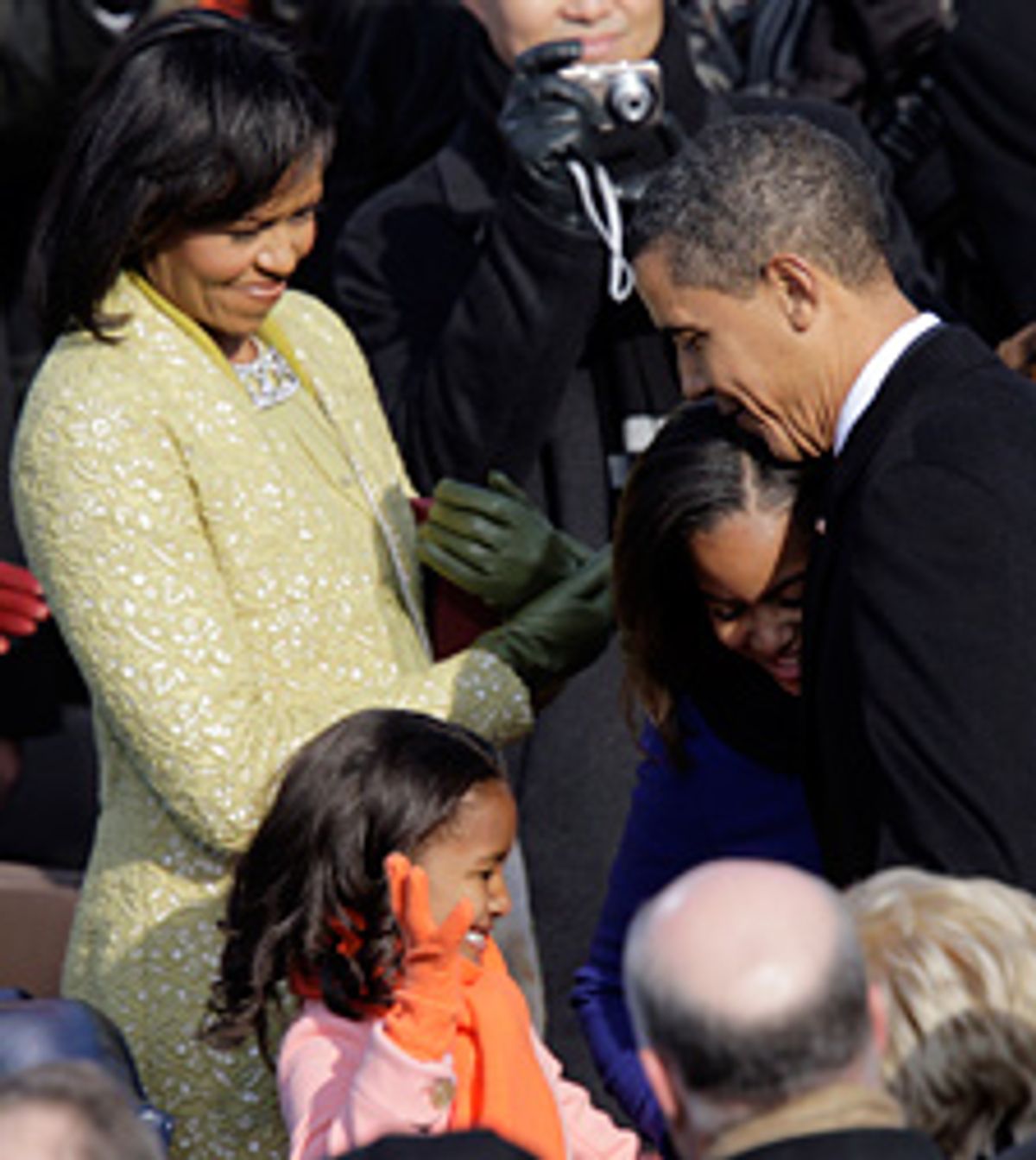
Fashionistas are in a fever pitch over the first lady's inaugural ensemble.

AP Photo/Jae C. Hong
President-elect Barack Obama embraces his daughter Malia as his wife, Michelle, and younger daughter, Sasha, look on as they arrive for the inauguration ceremony Tuesday.
Today’s news is dominated by reports on the 1 million-plus crowd at the National Mall for Inauguration Day, the significance of this historic moment in civil rights and reactions to Obama’s first speech as president. But, as I write this, the second top headline on Google News is: “First Lady Michelle Obama’s inaugural outfit.” Below the headline is a link leading to all 685 related news articles.
In other words: Not only is sartorial chatter defining today’s commentary on our new first lady, it’s also leading the Inauguration Day news at large. Today, everyone has an opinion on Michelle’s inaugural appearance — from the arc of her eyebrows to her shimmering yellow-gold dress by designer Isabel Toledo, which will go on sale this March at Barney’s for roughly $1,500. A sampling:
Examiner: “I am loving how Michelle is being bold with her apparel choices. This color is optimistic and is ambitious in terms of style. It’s not that conservative, but it is still chic and proves that the first lady has a cunning sense of style.”
TIME: “Although the First Lady’s office repeatedly said that Obama would not decide on her outfit until this morning, the choice — including the color, fabric and accessories — shows a lot of confidence and planning on the wearer’s part.”
Allure: “Let’s analyze: the shape and structure are conservative; the color and texture are bold — in that way, sort of like Barack Obama’s cabinet. Michelle O’s clothes will certainly make her stand out in the crowd, not that she needs any help in that department. The color is cheerful, sunny, optimistic, and that’s a welcome message today.”
Glamour: “Tres chic! Only thing is that she stepped out with no gloves, no hat, no earmuffs — nada! Clearly she’s ready to brave the cold — and her new role — in style.”
Washington Post: The “excitement about Michelle Obama is emblematic of a wider appeal, the carefully honed image connoting an all-American archetype. It’s functional-family time. J. Crew spams us with pop-up ads for the outfit Obama wore on ‘The Tonight Show,’ and the Donna Ricco dress she wears on ‘The View’ sells out at White House/Black Market.”
Politico: “To fashionistas, she’s Michelle O, the new Jackie – and they hope she’ll send women to the malls in droves, looking to match her style … her dazzling turn on The View wearing a black and white summer dress (some read the pattern as some coded comment about integration), caused a run on the dress. Fashion experts say she is a bridge-builder when it comes to what to wear—she mixes off the rack with couture.”
Stylelist.com: “The perfectly arched eyebrows you see at today’s Inauguration stand in stark contrast to the brows she sported earlier in the presidential campaign. Michelle’s eyebrows began making news late last summer — for their overly-arched shape that gave her a severe, angry look … Obama’s brows today are thinner and more filled in with a lighter brow pencil than they were this summer. The arch does not seem to be any less prominent, but since the inner brows are thinner than before, the arch appears less severe.”
So far, she has managed to escape the scathing attacks inspired by her election-night ensemble. But, keep in mind, First Lady Fashion Watch has only … just … begun.
What happened to Broadsheet?
Wednesday, Dec 22, 2010 12:20 AM UTCDid the recession prevent teen motherhood?
Some thank the economy for a decline in teenagers giving birth, but contraception is the likelier savior
Teen births hit a record low last year, according to a CDC report released Tuesday, and the narrative quickly taking hold in the media is that we have the recession to thank. It’s a surprising idea, that teenagers are keeping it in their pants because a baby isn’t a prudent choice in the current economic environment. Foresight isn’t what we expect from those creatures of impulse — and, indeed, when is a baby a practical economic choice for a teen? It also struck me that the teen birth rate isn’t the same as the teen pregnancy rate, if you catch my drift (my drift being … abortion). I took my questions to a couple of experts in hopes of some clarity.
“The recession is everyone’s favorite causal explanation for things happening right now,” said Rachel Jones of the Guttmacher Institute. “Other than people conjecturing, there is no evidence that the recession has had a direct impact on teen sexual behaviors.” What we do know, however, is that contraceptive use increased among teens between 2007 and 2009. “We don’t know the reason for that increase,” she explains, and, in fact, it could be the recession — but, again, the truth is we just don’t know. Her no-nonsense take: “It seems if we want to look for reasons for patterns in teen birth rates, [birth control use] is the one indicator that offers us practical insights.”
Bill Albert of the National Campaign to Prevent Teen Pregnancy shared my initial skepticism about the economic explanation: “I just simply do not know many 16-year-olds who are thinking about bank statements when they hop in the sack.” But he pointed out that while roughly eight out of 10 teen pregnancies are unplanned, “there is a mushy middle ground [of teens who] say, ‘Well, yeah, I wouldn’t want to get pregnant, but it wouldn’t be the worst thing that happened.’” Call it the “mush” factor: Perhaps those ambivalent teens were swayed by firsthand experience of the economic meltdown: “Their parents might be struggling to make house payments,” he said. “They might know neighbors who have lost jobs and can’t find jobs.”
As for the question of whether a decrease in teen births might be linked to an increase in teen abortions, there is a bummer of a data lag: Guttmacher isn’t releasing 2008 stats on pregnancy terminations until early next year. However, says Albert, “if the past is prologue, the answer is probably no. What we have seen over the past two decades is that teen birth rates have gone down because the underlying pregnancy rate has gone down. Put another way, all three — pregnancy, abortion, birth — all tended to be going down at the same time.” Jones agrees: “Teen births and abortions seem to follow the same trajectory,” she said. “We haven’t seen any indicators that abortions have gone a different direction than births.”
You might recall that there was a troubling and unexplained rise in the teen birth rate in 2006 and 2007. Albert says the 2009 finding — which followed a 2008 decrease — suggests the uptick was “an abnormal blip” and that we’re now “resuming a nearly two decade trend toward fewer teen pregnancies and fewer births.” Inexplicably, some abstinence advocates think this report has “exonerated their approach,” reports the Washington Post. Valerie Huber of the National Abstinence Education Association told the paper, “This latest evidence shows that teen behaviors increasingly mirror the skills they are taught in a successful abstinence education program.” Except that … it doesn’t. Says Guttmacher’s Rachel Jones, “The levels of teen sexual activity haven’t changed, which would suggest that there isn’t more abstinence out there — but there was a change in contraceptive use.”
Olbermann still doesn’t get it
The MSNBC host is back on Twitter with a response to his critics -- but he ignores their key complaint
Update: Olbermann has responded on Twitter by blocking me and tweeting, “Your article embarrasses you and your site.”
Back from his self-imposed Twitter timeout, Keith Olbermann is lashing out at his feminist critics. As Sady Doyle explained last week in Salon, the online protest was started in response to Michael Moore’s mischaracterization of the allegations against Julian Assange. Olbermann became a target after retweeting a link from Bianca Jagger that incorrectly claimed “the term ‘rape’ in Sweden includes consensual sex without a condom,” and that named Assange’s accuser (which is generally a journalistic no-no). Overwhelmed by the Twitter campaign, which was waged with the hashtag “mooreandme,” Olbermann quit the microblogging site in a huff. This afternoon, after a few days of calm reflection, he tweeted a link to his thoughts on the matter:
I endorse, sympathize with, and empathize with, the rape consciousness goals of #mooreandme, and have already apologized accordingly. But I cannot defend and will not accept their tactics which mirror so many of the attitudes and threats they fight. I do not know of what Julian Assange is guilty, if anything, and neither does anybody else. But given the extraordinary efforts by Sweden to extradite him, to say he is benefiting from some form of rape apologism is not fact-based. It is also unfair to condemn as anti-feminist those who merely address the juxtaposition of this prosecution to the fact that Assange threatens the secret and nefarious activities of dozens of governments.
But, of course, his antagonists are not condemning him for “merely address[ing] the juxtaposition” (a point Kate Harding made clear in her Salon piece about “the rush to smear Assange’s accuser”). They allege that he spread misinformation about the accusations against Assange. As Doyle wrote, “People trust journalists: If a journalist says something, like ‘the term “rape” in Sweden includes consensual sex without a condom’ (Olbermann’s own, demonstrably false, as-yet-unredacted words), most people will believe that what he has said is true, and act as if it is true, without doing further research.” The protest has consisted of frequent calls for Olbermann to issue a simple correction, to set the record straight for his many followers.
Instead of doing that, though, Olbermann continues: “And I will not engage those who suggest that those who do not prioritize one issue to the exclusion of all others should succumb to forced financial contributions, or should ‘kill themselves.’” He followed up by retweeting one of the messages in question, which read in part, “Seriously, kill yourself.” Then he retweeted a call for him to donate $20,000 to the anti-rape organization RAINN as atonement. His antagonists have been quick to point out that he cherry-picked the “kill yourself” tweet, which is an exception in the thread, and that the call for “financial contributions” is simply in the interest of rape victims. One user wrote, “we WILL NOT be satisfied UNTIL you retract the false information you publicized re: Assange allegations.” Olbermann responded, “you’ll have to accept a block instead.”
It seems Olbermann’s Twitter vacation didn’t help him to raise the level of discourse or realize that, as Doyle put it, his “style of old-media authority doesn’t hold up” online.
Save the children from Hooters?
NOW calls on the breast-obsessed chain to stop serving kids
The National Organization for Women is protesting Hooters. I know: Yawn. Next I’ll be interrupting major sporting events with breaking news that Gloria Steinem isn’t a fan of the “Girls Gone Wild” franchise. But, seriously, the argument at play here is more interesting than it at first seems. It isn’t the breast-obsessed chain’s existence that is being challenged, but rather the fact that Hooters serves children. Clearly, there is abundant evidence that Hooters is guilty of poor taste (see: restaurant name) — but should the chain be forced to card customers at the door and turn away anyone younger than 18? Several California chapters of NOW have filed official complaints alleging just that.
Hooters is described in official business filings as a provider of “vicarious sexual entertainment.” NOW points out that the chain has “used this designation as a way to avoid compliance with regulations against sexual discrimination in the workplace.” The official employment manual warns that a waitress is, as NOW paraphrases, “employed as a sexual entertainer and as part of her employment can expect to be subjected to various sexual jokes by customers and such potential contacts as buttocks slaps.” At the same time, however, Hooters is marketed as a family-friendly restaurant. It offers a kid’s menu, high chairs, booster seats and all sorts of merchandise for little tykes — like a “Life begins at Hooters” T-shirt, an “I’m a boob man” onesie and a “Your crib or mine?” bib.
We could argue over whether Hooters has a healthy impact on a kid’s developing view of women and sex, but I tend to think entertainment and dining decisions should be left up to individual parents. More important, that isn’t the issue at hand. In this case, NOW (which hasn’t always been a model of moderate thinking) has taken the exceedingly reasonable position that Hooters shouldn’t be allowed to have the best of both worlds: Either it functions exclusively as an adult venue, and continues to protect itself (somewhat) from sexual discrimination claims, or it’s held to the same standards as any ol’ family restaurant and gets to keep on serving the kiddies tater tots and creepy onesies.
Why do serial killers target sex workers?
The question is raised after four female bodies are found on a Long Island beach
Authorities search in the brush by the side of the road at Cedar Beach, near Babylon, N.Y., Tuesday, Dec. 14, 2010. Police looking for a missing prostitute on Long Island's Fire Island have discovered three bodies and a set of skeletal remains near Oak Beach since Saturday. Investigators are considering the possibility that a serial killer may have dumped four bodies along the same quarter-mile stretch of beachside road, a police chief said Tuesday. (AP Photo/Seth Wenig) (Credit: AP)
As New York confronts the possibility that there’s a serial killer on the loose, many have taken note that this case looks a lot like what we see in the movies: The victims are all women, and at least one is suspected to be a sex worker. When it comes to serial murder, it turns out fiction really does reflect reality. A report was released last month finding that 70 percent of known victims of serial killers are women (consider that only 22 percent of homicide victims in general are female); and it turns out sex workers are 18 times more likely than “normal” women to be murdered. Why might this be? Well, in the words of the Green River Killer, who targeted prostitutes:
I picked prostitutes as victims because they were easy to pick up without being noticed. I knew they would not be reported missing right away and might never be reported missing. I picked prostitutes because I thought I could kill as many of them as I wanted without getting caught.
Since they’re doing illegal work, sex workers have to be secretive and discreet. They often work in isolated and industrial areas. They get in cars with strangers. There are rarely detailed records of transactions. Many are drug addicts and estranged from their families, so they are less likely to be reported missing. Anyone who knows anything about a girl’s whereabouts is likely involved in the trade themselves, so they aren’t super eager to speak with police. What’s more, as we saw with the Robert Pickton case in Vancouver, police sometimes discount tips from working girls (all the more reason to not risk talking to them in the first place).
It just so happens that Friday is International Day to End Violence Against Sex Workers, which was created in memory of the victims of Gary Ridgeway, a.k.a the Green River Killer. Similar to the Pickton case, local sex workers knew Ridgeway’s identity, but, as prostitute-turned-performance artist Annie Sprinkle puts it, they “were afraid to come forward for fear of getting arrested, or the police didn’t believe those that did come forward, or the police didn’t seem to care.”
Page 1 of 1031 in Broadsheet

“We don’t need someone to think”
How rough it’s gotten for Mitt
The Grammy’s most memorable moments
A passport to utopia
“The Fault in Our Stars” and “There Is No Dog”: Not kids’ stuff
Ricky Gervais: My conscience never takes a day off
Lessons of a very sexy pirate costume
America’s failed promise of equal opportunity
Is gay literature over?
A voice that touched us all 

