Coming home: The Army's fatal neglect

“The Death Dealers took my life!”

Adam Lieberman tried to kill himself when he returned from Iraq. Only then did the Army take his mental health seriously.

  • more
    • All Share Services

Topics: , , ,

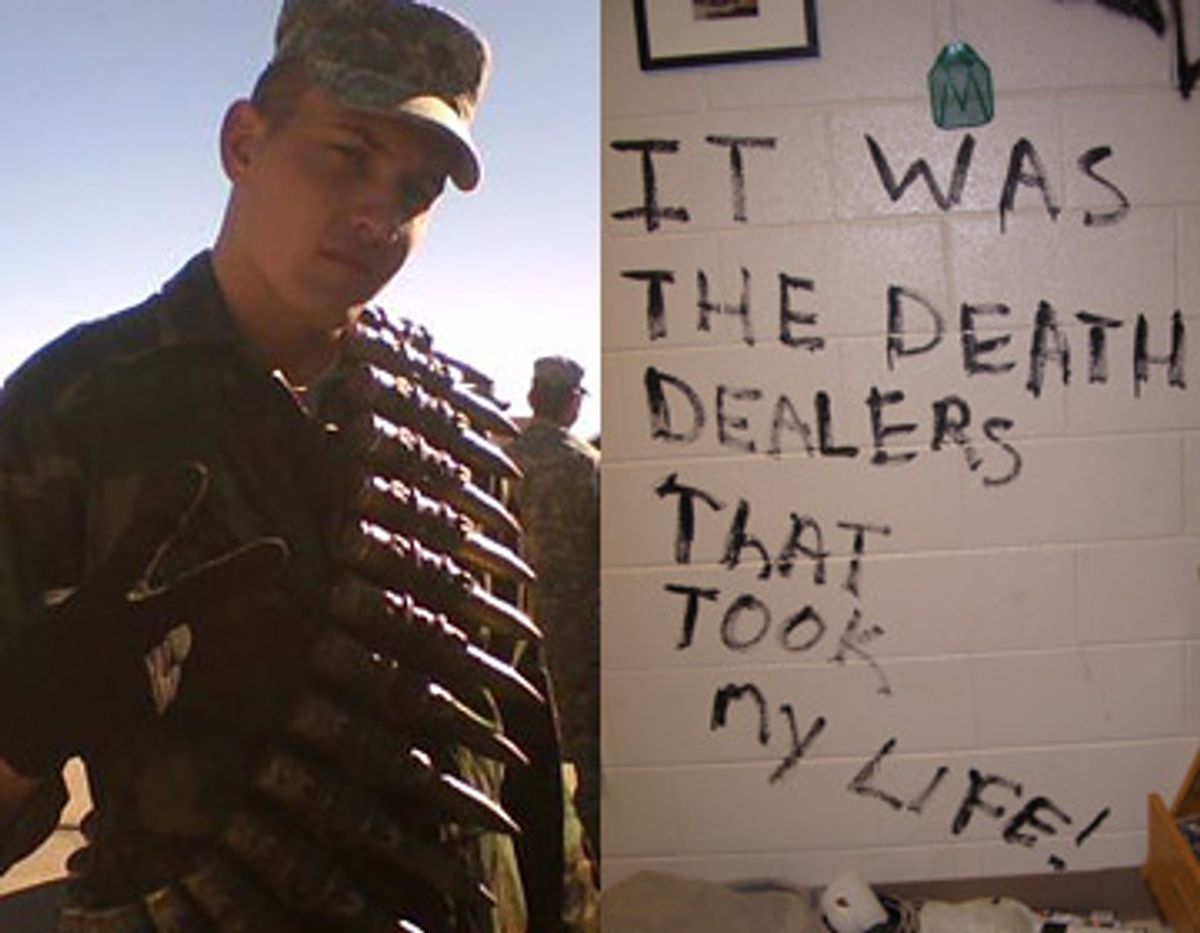
The day before Halloween 2008, Army Pvt. Adam Lieberman swallowed handfuls of prescription pain pills and psychotropic drugs. Then he picked up a can of black paint and smeared onto the wall of his room in the Fort Carson barracks what he thought would be his last words to the world.

“I FACED THE ENEMY AND LIVED!” Lieberman painted on the wall in big, black letters. “IT WAS THE DEATH DEALERS THAT TOOK MY LIFE!”

Soldiers called Lieberman’s unit, the 1st Battalion, 67th Armored Regiment, the Death Dealers. Adam suffered serious mental health problems after a year of combat in Iraq. The Army, however, blamed his problems on a personality disorder, anxiety disorder or alcohol abuse — anything but the war. Instead of receiving treatment from the Army for his war-related problems, Adam faced something more akin to harassment. He was punished and demoted for his bad behavior, but not treated effectively for its cause. The Army’s fervent tough-guy atmosphere discouraged Adam from seeking help. Eventually he saw no other way out. Now, in what was to be his last message, he pointed the finger at the Army for his death.

It would be a voice from beyond the grave, he thought, screaming in uppercase letters. The last words, “THAT TOOK MY LIFE!” tilted down the wall in a slur, as the concoction of drugs seeped into Adam’s brain.

Late last month the Army released figures showing the highest suicide rate among soldiers in three decades. The Army says 128 soldiers committed suicide in 2008 with another 15 still under investigation. “Why do the numbers keep going up?” Army Secretary Pete Geren said at a Pentagon news conference Jan. 29. “We can’t tell you.” The Army announced a $50 million study to figure it out.

It is not just the suicides spiraling out of control. Salon assembled a sample of 25 cases of suicide, prescription drug overdoses or murder involving Fort Carson soldiers over the past four years, by no means a comprehensive list. In-depth study of 10 of those cases revealed a pattern of preventable deaths. In most cases, the deaths seemed avoidable if the Army had better handled garden-variety combat stress reactions.

Interviews, Army documents and medical records suggest that Adam might not have attempted suicide if he had received a proper diagnosis and treatment. His suicide attempt seems avoidable. But the Army’s mistreatment extended well into its aftermath.

- – - – - – - – - – - -

At the last minute on Oct. 30, Lieberman stumbled out of his room and dialed 911. He lived.

Five days later Adam’s mother, Heidi Lieberman, sat opposite the desk of Lieberman’s battalion commander, Lt. Col. Lance Kohler, at Fort Carson. Nobody from the Army had bothered to call her in Rochester, N.Y., to tell her about Adam’s suicide attempt. There was no requirement to alert parents of an attempt, the Army said, only a successful suicide.

Heidi had watched her son’s mental health deteriorate precipitously after he returned from Iraq in late 2006. He had suffered from a laundry list of symptoms typical of post-traumatic stress disorder, including insomnia, depression, panic attacks and flashes of violent anger.

Two days after he swallowed the pills, Adam called his mother himself from the hospital. With her son still slurring his words from the effect of the meds, Heidi could barely understand him. When Heidi asked him where he was, Adam had to ask someone.

Sitting across from the lieutenant colonel’s desk, Heidi wanted to know why the Army had not moved her son into a unit supposedly dedicated to healthcare where he might get better treatment.

“Well, he has legals,” Kohler told her. Legal trouble. She knew Adam was struggling. Mostly Adam had been silencing his demons with 30 beers a day plus some Jameson. He’d puke in a bucket and start over. Mental health professionals call it self-medicating when a soldier comes back from war and turns to booze when he can’t get help, another typical reaction. Just as predictable is the bad behavior that comes with it.

To Heidi, Kohler’s response showed that the Army considered Adam a discipline problem, but didn’t seem particularly concerned about why.

“What legals?” Heidi asked.

Adam had broken into a candy machine, so petty larceny. He had also gone AWOL for a short time to say goodbye to an Army buddy in Texas headed off to a second tour in Iraq. The Army denied Adam’s request for leave. He went anyway.

“And defacing government property,” Kohler added to the list.

“When did he do this?”

“Within the last couple of days,” Kohler responded, staring.

Heidi thought. No. Couldn’t be.

“What did he deface?”

Kohler stared. “The wall in his bedroom.”

Heidi met his stare, exasperated. “You mean his suicide note?” Kohler just looked at her.

The next day Heidi called Adam’s company commander, Capt. Phelps.

“You know,” Heidi fired at Phelps, “I still have a hard time wrapping my mind around the fact that my son is being charged with defacing government property and you people are more concerned about your wall than my son,” she stammered. Then she threatened, half jokingly, “I will paint that wall and make this stupidity go away.”

A pause, and then Phelps snapped, “We’ll contact supply and have them bring you the matching paint.”

And so, the Army allowed a mother to paint over her son’s suicide note. Heidi’s handicapped sister helped.

“I was kind of surprised that they took me up on that,” she said late last year sitting at her dining room table in her home in Rochester, N.Y. Heidi’s sister took photos of her, paint roller in hand, erasing what was supposed to be her son’s last message. “He agreed that if I painted that wall that charge would go away,” she recalled about her talk with Adam’s captain. “It didn’t.”

Just before Christmas, MPs fingerprinted and booked Adam for defacing government property.

- – - – - – - – - – - -

A blondish crew cut tops Adam Lieberman’s lanky, lumbering 6-foot-6 frame. He makes little eye contact. Adam joined the Army at age 17. In late 2005 he deployed to Iraq with the 4th Infantry Division as a forward observer, a radioman. He is all of 21 now.

More than two years after his return from Iraq, where several close explosions rocked his skull, his memory sometimes fails him. He carries a notebook to keep track of appointments. He still writes the occasional letter backward.

Adam is now at the stage of digesting (or at least sharing) his experiences in Iraq in a passive tense — he describes things happening to him and around him, rather than by him. He arrived at the scene of a roadside bomb attack on other U.S. troops in Sadr City in Baghdad. “A guy’s face was blown off from his nose to his chin,” he said as we sat at his dining room table with Heidi while he was home on leave recently. The U.S. soldier was gagging, drowning in blood without a mouth or nose. A medic performed an emergency tracheotomy. The soldier died anyway.

Adam didn’t even bother to inspect the nearby Humvee that took a direct hit. He could see through the windows that inside the vehicle, “It was blood soup.”

During another engagement a gunner atop Adam’s Humvee suddenly collapsed in Adam’s lap. Only a thin flap of skin attached the gunner’s head and torso. Beheaded. Adam vomited.

He once saw the lower half of a friend’s body sheared off by a roadside bomb. In the seconds that followed before he died, his friend still moved his right arm and tried to talk. He looked at Adam. Adam described the look in his eyes as “terror.”

Adam once took a sniper’s bullet to the chest. It shattered his digital camera and hit his body armor. On two separate occasions he lost consciousness because of head blows.

Heidi noticed a difference in Adam when she met him at the airport in December 2006. “When he got off the plane and we were walking, I saw his eyes shifting through the crowd,” she remembered.

Crowds freaked him out. Adam had a panic attack in a Wal-Mart. He started getting into fights at bars. He couldn’t sleep. “You become a new person,” he explained. “You are raised as a person and they send us over there and we become a new person.”

The Army “screened” Adam for mental health problems upon his return from Iraq, a process Adam describes as, “You stand in a line and go to a bunch of tables where people are sitting.” He filled out some forms. Some soldiers aren’t yet aware of their problems at that point. Some lie because they just want to go home with their wives. Others say they report problems but receive little follow-up.

“Nobody is willing to help anybody,” he said about his experience at Fort Carson after returning from Iraq. “You have to understand. We are just pieces of equipment.”

The Army says it is working hard to erase the stigma of seeking mental healthcare. It isn’t working at Fort Carson. Adam says he was actively discouraged from looking for help.

“If you have a problem, you are going to be a problem,” he explained. “You don’t ask for help — ever. That is just the Army’s way. Always will be.”

A document obtained from another unit at Fort Carson supports Adam’s description of a culture that discourages “weakness.” Someone in the 3rd Brigade Combat Team prepared a mock official form called a “Hurt Feelings Report,” and left a stack of copies near a sheet where soldiers sign out to see a doctor. (View it here.)

“Reasons for filing this report: Please circle Yes or No,” the Hurt Feelings Report directs. Options include: I am thin skinned; I am a pussy; I have woman-like hormones; I am a queer; I am a little bitch; I am a cry baby; I want my mommy; All of the above. A blank appears after, “Name of ‘Real Man’ who hurt your sensitive feelings.”

Maj. Gen. Mark Graham, the Fort Carson commander, admits that the attitude of Army personnel toward mental healthcare needs work. “Because of the focus we have had on behavioral health, we have seen an increase in soldiers coming forward to get help,” he told me. “Is it as many as we think are out there? No, it is not. Do I think that we still have a stigma challenge here? Absolutely, we do.”

By December of 2007, Adam was getting increasingly violent. “I fucking punched a guy,” he recalled about a fight in the barracks. “I dragged him out of my room and threw him down the stairs.” On Dec. 20, 2007, he filled out an Army “PTSD checklist.” He checked off being “extremely bothered” by flashbacks, nightmares, bad memories, emotional numbness, insomnia and angry outbursts. He also reported panic attacks and jumpiness, among other things.

Col. Elspeth Ritchie, the Army’s top psychiatrist, ticks off a series of initiatives to improve Army mental healthcare, including the hiring of 250 new mental health providers through civilian contracts and more than 40 marriage and family therapists since the spring of 2007. Ritchie said an August 2007 Army directive ensures PTSD screenings for soldiers with disciplinary problems so serious the Army wants them out. She added that the Army surgeon general issued a memo in May 2008 requiring additional review of any diagnoses short of PTSD to make sure the Army gets it right. “We’ve really tried to enhance our access to care,” she said in a telephone interview.

Though Adam filled out his checklist in late 2007, the initiatives Ritchie describes did not trickle down to him. Throughout this entire period, Adam’s medical records show, the Army focused almost completely on his misbehavior, like drinking and fighting, and demoted him from specialist to private, but did not address the root cause. The Army enrolled Adam in an Army substance abuse program he called a “joke.” The Army wanted him to work on anger management. “I was like, ‘I don’t have anger problems. You people are causing me to be angry.’”


By the spring of 2008, Adam’s condition had deteriorated. “He called me in April and said he really wanted to die,” Heidi recalled. “He told me he had his Mustang up to 120 and pointed at a cliff. I told him he needed to get help now. No more dealing with it on his own.”

This time Adam checked himself into a private facility. A doctor soon informed him he had PTSD from his experience in Iraq. “That’s when I started figuring it out myself,” Adam told me. “I realized I was not an alcoholic, I was just self-medicating.”

After a few weeks, however, Adam had to return to Fort Carson, where the Army still basically considered him a drunk and a discipline problem.

That’s contrary to proper treatment of PTSD. “The best way to treat it is to identify it appropriately,” said Dr. Anthony Ng, a psychiatrist and board member of Mental Health America.

In addition to hundreds of pages of medical records he gave me, Adam agreed to hand over a copy of his illustrated journal. An undated entry from after his private hospitalization notes that, “Since returning from the hospital my ball of twine has been unraveling fast. … The woman at [Fort Carson's] mental health dismissed me as if I were a bum asking for money,” he wrote, and then recorded one of those flashes of anger common to soldiers with PTSD. “I wanted to rip her jaw off and scrape the skin off her face with her Goddamn teeth.”

“But I wasn’t surprised,” Adam’s entry continues. “That’s Army health care.”

In June or July 2008, he got a call from an Army psychologist. “She didn’t even know my name,” he told me. “I’d seen her three times. How is she going to help me if she can’t even remember my name?”

The Army also seems to have resisted recognizing Adam’s likely traumatic brain injury, given his head blows in Iraq and subsequent memory loss and other symptoms. The Army put him through a battery of tests on Oct. 15 to determine if he might be eligible for disability pay for a brain injury. Adam tested “within normal limits,” his medical records show. “There is no evidence of clinically significant cognitive impairments.”

(Civilian neurosurgeons generally say that doctors should stash the tests and MRI exams for the most part, since TBI is notoriously difficult to pin down that way, and look to behavior instead. Patients with a history of head trauma who present with obvious symptoms should receive swift treatment for TBI).

Adam’s Army medical records from Oct. 30, the day of his suicide attempt, look similar to all of his Army medical records. The Army psychologist noted “alcohol dependence with continuous drinking behavior,” depression and anxiety disorder — his problems, not the Army’s.

A diagnosis of PTSD from combat would require the Army to pay Adam a lifetime of benefit checks. The Army would not have to pay if a doctor were to find instead that his mental problems were preexisting and/or unrelated to his Army service. Adam said his Army psychologist “has been trying to give me a personality disorder since Day One, that I wanted to kill people before I got into the Army.” Soldiers also don’t get benefits if they are ushered out the door with dishonorable discharges for misbehaving.

On Oct. 30 the Army psychologist noted “homicidal ideation,” or thinking about murder, but “no homicidal plans.” She also noted “no suicidal ideation.”

Adam admitted he lied on that one. He had made up his mind. “I didn’t want her to interfere,” he said. “I was thinking about killing myself, but I was restricted to post for drinking on duty so I could not get my gun. I went to my room and swallowed all my pills.”

Adam painted his note on the wall. And then he changed his mind. An ambulance rushed him to the hospital. He “remember[s] them trying to get me to drink this charcoal stuff” at the hospital, but not much more. “I woke up and I was chained to the bed.”

Nine days after Adam’s suicide attempt, the Army psychologist changed her diagnosis, according to Adam’s medical records. He had “chronic post-traumatic stress disorder.” It was the first time the Army seemed willing to admit that a year of war caused Adam’s problems. “It took me trying to kill myself for her to put it on there,” Adam told me.

- – - – - – - – - – - -

Unfortunately, the problem likely goes beyond Fort Carson. Maj. Gen. Graham, the Fort Carson commander, makes noted efforts to recognize and address the problems. “Our goal is to get in front of this,” Graham said in a telephone interview. “Instead of doing the investigation following a suicide, to find out how this happened and how we could have prevented it, what we want to do is actually prevent them and get in front of this and figure out how you help a soldier before it gets to a point of critical mass and something horrible is going to happen,” he added. “Are we perfect? No. Are we trying? We are. Can we do better? Of course we can.”

Graham’s power to do better is limited, however. The Army Medical Command runs medical care at Fort Carson and other Army posts. MEDCOM reports to the Army surgeon general, Lt. Gen. Eric Schoomaker, not Graham.

And some Army fighting units, or “line” units, stationed at Graham’s post have failed to incorporate the prevention, recognition and treatment of combat stress into their wartime mission. At Fort Carson a mental problem from combat is still a scarlet letter.

Meanwhile, the deaths keep coming. At least three Fort Carson soldiers died in apparent suicides in January. (Fort Carson quibbles with this statistic, claiming that one of the three had not completed the paperwork to be officially stationed at Fort Carson. The death of a second soldier, found dead in his home from a “drug interaction,” is still under investigation.)

(The second installment in Salon’s “Coming Home” series will appear tomorrow.)


Continue Reading Close

Mark Benjamin is a national correspondent for Salon based in Washington, D.C. Read his other articles here.

Michael de Yoanna is a journalist and documentary filmmaker who won an Edward R. Murrow award for investigative radio journalism in 2011. You can view his past work at Salon here, visit his personal website here, and follow him on Twitter @mdy1.

Soldier in “Coming Home” series dies after surgery

Charged with murdering his girlfriend, John Needham's war wounds went untreated (includes slideshow)

  • more
    • All Share Services

Topics: , ,

Soldier in

Michael de Yoanna first met John Needham when the troubled soldier stepped off a plane near Fort Carson, Colo., in November 2007. De Yoanna didn’t know it at the time, but a year later Needham would be part of a lengthy Salon series about soldiers involved in murders or suicides as the Army neglected their psychological war wounds. Reporters de Yoanna and Mark Benjamin documented Needham’s tale as part of the “Coming Home” series, after Needham was arrested for allegedly beating his girlfriend to death in late 2008.

Now Needham is gone too. He died on Feb. 19, about 10 days after back surgery at a Veteran’s Affairs hospital in Tucson, Ariz. The circumstances surrounding Needham’s death are unclear. According to his father, Mike Needham, an older brother discovered John Needham slumped over his bed at his mother’s house in Arizona, his face blue. Efforts by his brother, and then rescuers, to revive him were unsuccessful.

Needham, a tall, blond, sturdy California surfer and house painter, was deployed to Iraq in 2006. Not long after arriving, his life turned into a blur of roadside bombs, bloodshed and confusion. He was knocked unconscious by a grenade, suffering a brain injury. Shrapnel ripped into his legs. His back eventually gave him problems. He got a Purple Heart.

The damage to Needham wasn’t just physical. He also suffered from mental wounds. In Iraq in September 2007, when the carnage he had witnessed and participated in became too much, Needham pointed a pistol at his head and pulled the trigger. It would have ended there if a friend had not leaped forward to push the gun aside. The bullet hit a wall. Needham, who had a clean bill of health when he entered the Army, was shipped home.

When de Yoanna met him briefly in the airport in Colorado, Needham seemed nervous. He’d spent several weeks receiving care at Walter Reed Army Medical Center. Back at Fort Carson in Colorado Springs, Needham complained about punishment instead of treatment for his mental issues. His commanders threatened him with charges for discharging his weapon in his suicide attempt. Superiors also harassed him for falling asleep while heavily medicated. He was called a pussy. Though he had been diagnosed with post-traumatic stress disorder, Needham was punished for showing symptoms: failing to appear in formation, insubordination to superiors, and other problems.

With the advocacy of his father and others fighting behind the scenes, the charges against Needham disappeared and in July of 2008, the Army had washed its hands of him. He received an honorable discharge and a partial disability — but his benefits didn’t provide full access to mental health treatment, a critical gap in his care.

Had he received such care, things might have been different just weeks later. In September 2008, Needham made headlines across the country after allegedly beating his girlfriend, 19-year-old aspiring model Jacqwelyn Villagomez, to death in his San Clemente, Calif., condo.

After 10 months in a maximum-security jail cell awaiting trial, Mike Needham raised the $1 million needed to bail his son out to prepare for the murder trial.

Based in Colorado, de Yoanna traveled to California last summer and spent several days with Needham — part of Salon’s ongoing effort to understand veterans struggling with the hidden wounds of war.

Needham told de Yoanna during that visit that he couldn’t provide specifics about his case, fearing any statements he made to the press might become ammunition for prosecutors. He emphasized, however, that he was “not the murderer” authorities and the press had made him out to be. Looking over the crashing waves he loved to surf, the war veteran also said he had become an outcast and wanted to leave his home and live somewhere on the California coast where nobody would know him.

So he lived in the present, often on the beach. He surfed some, hoping the ocean would restore his body, but the pain in his lower back persisted.

After a first V.A. surgery on his back in Los Angeles that did not go as planned in late November, Needham struggled with severe pain. He developed an addiction to painkillers and was hospitalized in Long Beach in the following weeks to deal with it. Then his family brought him to Tucson, hoping the V.A. hospital near his mother’s home would do better. There was another surgery a few weeks later and one more — Needham’s third – earlier this month. Each was an effort to repair Needham’s deteriorating lower back.

Though Needham had a serious infection after his last surgery and a “tumor the size of a grapefruit” on his back, according to his father, he was only cared for by a visiting nurse while staying at his mother’s home at the time he died.

Autopsy and toxicology reports are being completed; medical investigators did not return a call to Salon by deadline.

Needham’s father feels the Army and perhaps the V.A. let his son down. “He never got correct care in the Army and, in my opinion, never got correct care from the V.A. either,” Mike Needham said. “What if they helped him when he first struggled after the explosions in Iraq? Instead, they sent him into battle day after day and harassed him when he struggled. As for the V.A., I think they’re the medical authority and responsible. I question why he was on outpatient status with a tumor the size of a grapefruit on his back.”

Mike Needham plans to join with family and friends in a small private ceremony to scatter the ashes of his son at the beach where he loved to surf. “That’s our spiritual altar — the ocean.”

View a slide show

Continue Reading Close

Michael de Yoanna is a journalist and documentary filmmaker who won an Edward R. Murrow award for investigative radio journalism in 2011. You can view his past work at Salon here, visit his personal website here, and follow him on Twitter @mdy1.

Mark Benjamin is a national correspondent for Salon based in Washington, D.C. Read his other articles here.

Camp Lejeune whistle-blower fired

A psychiatrist who tried to prevent Fort Hood-style violence among Marines about to "lose it" instead loses his job

  • more
    • All Share Services

Topics: , ,

Camp Lejeune whistle-blower fired

Last April, two Marines at Camp Lejeune predicted to a psychiatrist that some Marine back from war was going to “lose it.” Concerned, the psychiatrist asked what that meant. One of the Marines responded, “One of these guys is liable to come back with a loaded weapon and open fire.”

They weren’t talking about Marines suffering from a tangle of mental and religious angst, like news reports suggest haunted the alleged Fort Hood shooter, Maj. Nidal Malik Hasan. The risk they reported at Camp Lejeune was broader and systemic. Upon returning home, troops suffering mental health problems were getting dumped into an overwhelmed healthcare system that responded ineptly to their crises, the men reported, and they also faced harassment from Marine Corps superiors ignorant of the severity of their problems and disdainful of those who sought psychiatric help.

As Dr. Kernan Manion investigated the two Marines’ claims about conditions at the North Carolina military base, the largest Marine base on the East Coast, he found they were true. Manion, a psychiatrist hired last January to treat Marines coming home from war with acute mental problems, warned his superiors of looming trouble at Camp Lejeune in a series of increasingly urgent memos.

But instead of being praised for preventing what might have been another Fort Hood massacre, Manion was fired by the contractor that hired him, NiteLines Kuhana LLC. A spokeswoman for the firm says it let Manion go at the Navy’s behest. The Navy declined to comment on this story.

While military officials and the media examine whether the Army missed warning signs that might have indicated an unhinged Nidal Hasan was capable of killing 13 people at Fort Hood, Manion’s Camp Lejeune story is a cautionary tale of what happens to those who blow the whistle on conditions for military personnel with mental problems.

Manion says the April incident with the two Marines was just one of a series of disturbing events and serious problems with mental healthcare he saw at Camp Lejeune, a base that may be best known for a water contamination scandal that led to high rates of cancer and birth defects among Marines and their families who lived there. He was particularly concerned to see that troubled Marines were stricken with the overwhelming impulse to commit suicide or murder, telltale signs of severe combat stress.

In a telephone interview from his Surf City, N.C., home, Manion talked of overburdened staff and inadequate resources at the Naval hospital at Camp Lejeune. The psychiatrist charged that medical officials failed to study and discuss violent events among returning Marines in an effort to prevent further, similar events, and did little planning to improve handling distraught Marines who were killing themselves and others in shocking numbers. In 2008, for example, 42 Marines committed suicide and 146 attempted to do so, according to the Marine Corps.

Coincidentally or not, within 12 hours of Hasan’s shooting spree, Camp Lejeune officials discovered the body of one Marine and took into custody another Marine, Pvt. Jonathan Law, who is accused of killing his colleague. Law, who had served a seven-month tour in Iraq, was suffering from self-inflicted wounds when arrested.

Mirroring reports from military installations across the country, Manion also reported harassment of Marines seeking mental help. The psychiatrist began to worry about the possibility of a major outburst of violence on the base.

“A significant number of Navy medical officials and Marine commanders do not get it,” a frustrated Manion said about the situation at Camp Lejeune. “They do not understand the implications of what happens if somebody loses it,” explained Manion, who has 25 years of experience as a psychiatrist and who also specializes in traumatic brain injury — exactly the kinds of skills needed so desperately at military hospitals, because mental problems and brain injuries are the signature wounds of the ongoing wars. “People either commit suicide, commit homicide, get drunk, beat up the wife, all these things. I’ve seen it,” he added. “That is how serious this is and they just don’t get it.”

Manion believes he likely prevented a “Columbine-style attack” late last April after the two Marines who warned that someone might “lose it” directed him to a third Marine who seemed on the verge of violence. Manion also provided his superiors with documentation showing troubling incidents and neglect for the needs of returning Marines that could easily precipitate violence. Maybe not on the scale of the massacre at Fort Hood, but more like the rampage by a frustrated Sgt. John Russell, who gunned down five fellow soldiers at a military mental health facility in Baghdad last May.

Manion provided to Salon a stack of correspondence with superiors, a virtual crystal ball predicting dire consequences if mental healthcare at Camp Lejeune isn’t immediately improved.

In an April 24 memo to his superiors, including Cmdr. Robert O’Byrne, head of mental health for the Camp Lejeune Naval Hospital, Manion describes a frustrated Marine punching a telephone pole with his bare fists outside a treatment clinic, then storming around, cursing, with a piece of lumber with a nail in it, though nothing was done to ensure he didn’t hurt himself, again, or others. In another case, a severely homicidal and suicidal Marine pounded his fists into a table and stormed out of treatment. Yet the hospital, Manion complained to his superiors, made no efforts to discuss these cases or how to better handle similar events in the future.

“There was — and continues to be — no means of discussion of high-intensity/dangerous cases such as this,” a desperate Manion wrote on April 24. He warned of “immediate concerns of physical safety” at the base’s mental health facilities. Manion wanted to set up special protocols for handling intense situations, such as having specially trained MPs ready to intercede if things got bad, and a plan to hospitalize potentially violent patients quickly. “They dragged their feet on that,” he told me.

Within days that April, Manion intervened with the two Marines who’d warned of colleagues potentially losing it. They directed him to a third Marine who they believed was going to go on a shooting rampage. Manion worked hard to get that Marine into treatment, possibly averting bloodshed. The two Marines involved also reported harassment for working limited duty while seeking mental healthcare for themselves. They heatedly claimed that two noncommissioned officers had recently told them, “I don’t care why you are on [limited duty]. You are nothing but worthless pieces of shit,” according to an April 29 e-mail Manion sent to O’Byrne and others, complaining about such attitudes.

Like many healthcare providers at military bases across the country, Manion technically worked for a military contractor, Spectrum Healthcare Resources, a subcontractor for  NiteLines Kuhana LLC.

On June 24, a supervisor for the contractor warned Manion to stop making trouble. “Kernan Manion, it is requested that you cease and desist all further correspondence with the government,” the supervisor with NiteLines, Pamela Friend, wrote to Manion.

But Manion was still frustrated that Camp Lejeune did not seem to be taking these risks seriously. On Aug. 30, he appealed to a series of military inspectors general in a written complaint. He warned of an “immediate threat of loss of life and/or harm to service members’ selves or others” if conditions did not improve. He complained of a “complete disregard for … implications for patient safety and well-being.” He decried that officials at Lejeune had ignored “repeated overt and emphatically stated concerns about the very safety and overall welfare of the affected patients.” And he warned that “many patients’ lives are imminently at risk.”

Four days later, the contractor fired Manion “effective immediately,” according to his termination e-mail. The note provides no reason for the firing. Manion was directed to clean out his office the next day, under the watchful eye of a chief petty officer, and have no further contact with his patients.

In a statement to Salon, NiteLines said the Navy wanted Manion fired, but did not explain why. “The treatment facility at Camp Lejeune notified (Nitelines) that Dr. Manion did not meet the Government’s requirements in accordance with the contract, and they directed he be removed from the schedule,” it reads.

Salon e-mailed the spokesman for the Naval Hospital Camp Lejeune, Raymond Applewhite, with details of this story and then described some of these facts with him in a follow-up telephone call, requesting an interview with O’Byrne. The Navy did not respond further.

Manion left Camp Lejeune after he got fired, but he did not stop worrying about the potential for violence there. In mid-September, Manion filed a 14-page complaint with the Department of Defense inspector general. On Sept. 29, he warned the Navy’s Bureau of Medicine and Surgery inspector general in writing of “serious mismanagement of post-deployment mental health services that was both endangering patient, staff and community safety as well as severely compromising the quality of care” for returning Marines. Manion noted that the poor care at Camp Lejeune continued despite “the ever present threat of life-threatening violence by distraught service members towards themselves or others.”

Finally, Manion wrote President Obama that same day. “Frankly, in my more than 25 years of clinical practice, I’ve never seen such immense emotional suffering and psychological brokenness — literally a relentless stream of courageous, well-trained and formerly strong Marines deeply wounded psychologically by the immensity of their combat experience,” he wrote to the president. Manion added, however, that at Camp Lejeune, that immense problem was being met with “inadequate treatment” and “callous indifference.”

He still worries. “I don’t like seeing these guys mistreated,” Manion said. “This is akin to somebody dying on the battlefield and not being attended to,” he added. “These guys are saying they are broken and need help, and the system is saying, ‘next, next, next.’” 

Continue Reading Close

Mark Benjamin is a national correspondent for Salon based in Washington, D.C. Read his other articles here.

Woody Harrelson on war, death, LBJ and Obama

The one-time "Cheers" star turned eco-radical climbs into bed to talk about his new film, and the new James Dean

  • more
    • All Share Services

Topics: , , , ,

Woody Harrelson on war, death, LBJ and ObamaWoody Harrelson in "The Messenger"

Woody Harrelson began our interview by climbing barefoot onto the interior windowsill of his hotel room overlooking New York’s Union Square to point out an apartment across the square where he lived briefly, 15 or 20 years ago. (It’s in the building that houses the Heartland Brewery, if you know the neighborhood. On the second or third floor, he couldn’t remember.) Then he got into bed.

There wasn’t an ounce of pretense about any of this, I swear. He was curious to get a look at that old apartment, and felt like telling me about it. He was tired, so he got into bed. When you meet Harrelson, you get a momentary glimpse of what a strange and exhausting job it must be to be famous. The job involves meeting an endless ocean of people you don’t know and most likely will never see again. The obvious solution would be to retreat behind a well-rehearsed performance of your persona, to recycle a handful of gestures and mannerisms.

Harrelson, on the other hand, seems like a guy totally determined not to let the artificiality of these interactions impinge on his sense of who he is. Perversely, the fact that he is frank and thoughtful, and known to hold unorthodox political opinions he doesn’t keep to himself, has only augmented his fame. You can’t throw an empty Chardonnay bottle out your car window in west L.A. without hitting a Hollywood liberal, but Harrelson is something much rarer: a vegan, raw-foodist, antiwar, anti-capitalist, pro-marijuana, eco-funky, genuine radical who happens to be a beloved character actor with a good-ol’-boy demeanor.

Like the other journalists who showed up to talk to him about his role in “The Messenger,” writer-director Oren Moverman’s film about the United States Army’s Combat Notification Unit (i.e., the dreaded door-knockers who show up with really bad news), I was asked by the publicists to restrict my questions to the film and Harrelson’s acting career. It’s a laughable request anyway, but in fact I would have needed to tie Harrelson up and gag him if I didn’t want to hear his opinions about the wars in Iraq and Afghanistan, the dangers of capitalism and the looming possibility that Barack Obama could become a second LBJ.

For the first half of this decade, Harrelson was mostly absent from the movie screen; he did some theater and TV, a fair amount of environmental and pro-cannabis activism — his illegal banner-drop from the Golden Gate Bridge goes back to 1996 — and a lot of time with his family. (He lives most of the year on Maui with his wife and three daughters.) It seemed entirely plausible that the one-time “Cheers” star and Oscar nominee (for “The People vs. Larry Flynt”) had burned up his 15 minutes, and then some.

It doesn’t look that way now. Harrelson has appeared in more than two dozen films over the past three years, with more in the pipeline, and three of them are piling up on top of each other this fall. He co-stars in the action-comedy “Zombieland” and the apocalypse-thriller “2012,” both of them likely to gross more in a single weekend than “The Messenger” will in its entire history. But Moverman’s low-budget, high-intensity drama about the social and psychological costs of war is clearly “a labor of love” for all concerned, as Harrelson puts it.

In “The Messenger,” Harrelson plays Capt. Tony Stone, a damaged, middle-aged hardass assigned to mentor the younger Sgt. Will Montgomery (Ben Foster), a decorated and wounded Iraq vet, as they take on the uniquely difficult task of informing civilians that their loved ones serving overseas won’t be coming home. If that sounds wrenching, well, it is. But the acting is superlative — Harrelson’s right when he says that Foster’s starring role has echoes of James Dean or the young De Niro — and the half-improvised quality of the filmmaking feels dangerous and intimate but never showoffy.

When Stone and Montgomery are assigned to notify an NOK — that’s “next of kin,” in Army parlance — Foster and Harrelson literally went into the scene not knowing what would happen. They hadn’t even met the actors playing the bereaved-civilian roles, and weren’t sure whether they would break down in tears or respond with physical violence. (Moverman and co-writer Alessandro Camon partly based his screenplay on stories they heard from casualty-notification soldiers.) The story of what Stone and Montgomery have to do, and how it affects them, offers an intimate, human-scale portrait of the real costs of warfare.

Once Harrelson was safely tucked under the covers, wearing an Army T-shirt and a pair of blue jeans, I put my tape recorder on top of the duvet and we got talking. It was a nice big bed, and looked extra-comfy. Woody probably wouldn’t have taken it the wrong way. I can’t say I wasn’t tempted.

This movie isn’t connected to the Fort Hood shooting in any way, but still. It’s kind of intense to be talking about this subject, about death and the military, right after that.

It’s related in the sense that it’s another sad story connected to this war. There’s a lot of those, and that one’s pretty devastating. I feel really terrible for those families.

And then I just happened to notice, on the same page of today’s New York Times as that story, two more of those names in bold-face type. Two more soldiers whose families are going to be getting visits from guys like the one you play in the movie. [Just to put names to them, they were Spc. Tony Carrasco Jr., of Berino, N.M., and Staff Sgt. Amy C. Tirador of Albany, N.Y.]

It really is a devastating thing. I’ve had an evolution of sorts in terms of my attitude toward the war. Not in the sense of the war itself, which I do continue to think is wrong — and I think it’s pretty obvious what the war is about, both of them. During the course of making this, I had the opportunity to spend time with a bunch of soldiers and hear a bunch of stories, and you know, just start to feel a great deal of empathy and compassion toward the men and women who are over there working their asses off every day, not getting paid much and just putting their lives on the line for love of country. I do think that a big part of supporting the troops would be the concept of not sending them into battle in a war for resources.

So you think both Iraq and Afghanistan are wars over resources?

Iraq’s about the oil and Afghanistan’s about a pipeline. It always has been. They started building a pipeline as soon as there was a moment to do so. They started building a pipeline to the Caspian Sea, that’s always been their directive. The guys from Chevron went in and met with the Taliban and realized those guys just weren’t in control enough. That’s why they wanted to oust them. Otherwise it’s an absurd concept: You’re going to war because a guy from some other country, a Saudi, is living somewhere in the mountains? So we’re going to bomb Kabul, bomb the cities? That’s absurd. It’s a foreign policy gone way wrong. But that’s how it always is. American foreign policy has always been, not about spreading democracy, but about spreading capitalism.

It does feel sometimes like our government suffers from some kind of amnesia or OCD. It’s like they keep making the same foreign policy mistakes and just hoping it won’t turn out quite as badly the next time.

I’m hoping that other countries look at us and say, “OK, there’s the government and then there’s the people.” Granted, you’d like the will of the government to be conjoined with the will of the people. But it’s the same way I’ve made the evolutionary step of looking at the war as separate from the soldiers. When I look at Russia, I don’t look at Putin as representing the Russian people. I’m sure they’d love to get him out of there. Regardless, the Bushes and their various oligarchies have gotten us into a situation that’s just very unfortunate.

At least at this point, it appears that Obama is pushing onward with the war in Afghanistan. Is he just constrained by geopolitics? Is he simply not free to say, “Look, we’re not going to do this anymore”?

I think there’s a lot of persuasive and powerful people around Obama. For a president to make his own decisions, I think that’s a rarity. Even someone who we think of as our guy — this is a guy with integrity, a guy who cares, for the first time in a long time — in the Oval Office, even with him we don’t really know who’s pulling the strings. I think of every president as being a marionette. Whether he’s any different, I don’t know. Certainly his military advisors all want him to prosecute this war to the end, just as they did in Vietnam with LBJ.

It’s just too depressing, I think we’re going to have to hit the streets. Obama has the chance of becoming JFK or LBJ. I think JFK was one of our last great presidents, although I thought Carter was pretty great too. LBJ could have been a great president if he hadn’t gotten bogged down in war, but that was quite a war to get bogged down in. Notwithstanding the fact that the war was wrong and they were talking about the Red Scare and the domino effect, if you go and read the Pentagon Papers they were also talking about rubber, tin and oil. They killed 2 and a half million people. What was it all for? In Korea they killed 4 and a half million. Like, we’re liberating these people?

Well, one of the things this movie engages, in a way, is the fact that the combined U.S. fatalities in Iraq and Afghanistan are still below 4,500. Not that that’s not terrible for those families, but it’s not a number that has affected every town and every neighborhood, the way other wars did.

Yeah, but it’s got to be more than 10 times that in terms of people with injuries, people strongly affected by it. I’m not sure what’s going to make people hit the street, and, you know, I’m one of those people who’s not on the street. I recognize that I’m just a guy bitching about it, not a guy who’s doing anything.

The thing I love about this movie is that it really takes into account the consequences of going to war. It’s been gratifying to me to hear from people who say, “Before it was just a thing in the news, a statistic.” You’re not really seeing a blown-up body, or seeing the coffins at Dover. I think it’s a good thing that it puts a human face on it.

On one level I really dreaded those scenes where you and Ben went to knock on people’s doors, do the notifications. They were hard to sit through. But on the other hand, I kind of needed that emotional catharsis. And they’re very intense. In the first scene we see, the woman completely goes nuts and attacks you.

That was cool because of the way Oren shot it. We really didn’t know what was going to happen. I didn’t know she was going to hit me. You don’t know what level the people are going to, the way they’ll manage their grief. I think it made those scenes much more realistic. We never rehearsed, and never even met the people ahead of time. We shot those in one shot. All of that was really good.

They weren’t all done in one shot, were they?

No, there’s only two notification scenes that are actually one shot as you see them in the movie. One is Steve Buscemi’s and then there’s another one. But they were all shot as a one-camera, single-shot thing, with one camera following the action. Later on, if Oren did three takes or whatever, he’d join the different takes together, find whatever worked better. But they were designed to be one-shot takes, and it felt very real. It kept us right on our toes, and on edge.

That guy that you’re playing felt very real to me. He’s this hardass military lifer, an Army guy, and he’s really messed up in ways he doesn’t even recognize. I mean, this guy badly needs a hug.

[Laughter.] That’s the best description yet. He badly needs a hug. That’s true.

I thought there was terrific chemistry between you and Ben Foster, who plays your younger tag-team partner. Obviously you guys are pros so it can be hard to tell, but it felt like there was something real happening there.

Oh, it was incredible. I feel like he’s my brother, I really love him. And as an actor, he’s one of the best I’ve ever worked with, if not the best. Total immersion in the mind-set of the character, and constantly reminding himself of the significance of what we’re doing. Just before a scene, maybe I’m not completely grounded, and he hands me these pictures of soldiers smiling or hanging with their kids, and they’re marked with the dates they died, 2003, 2004, whatever. You can’t help but be full of the emotion, with what this movie’s connected to. It’s one of the few times that I’ve felt emotional pretense really skirting on emotional reality. I don’t think I said that right. It’s just, you know, we’re pretending, but the reality of it is big.

I’ve seen him in other movies, but people are really going to notice him this time, if they haven’t already.

I think he’s one of the most amazing actors. It’s like I’m working with James Dean before people know that he’s James Dean. I feel like I just did “East of Eden” with James Dean. His talent is so expansive, he’s got a huge career ahead of him.

You took several years off, and for a while there it didn’t seem clear whether you wanted to make Hollywood movies anymore. I guess you’re at peace with them now! I’m not ranking on you for making movies. You’re an actor. But does it help you somehow to do a smaller project like this one alongside a big movie like “2012,” which can pay a lot of bills?

You know, I don’t feel like a movie has to have a message, necessarily. If a movie’s fun and funny and just great entertainment, that’s enough. But it’s nice to do a movie like “The Messenger” where you feel like people watch it and it’s initiating conversations that are important. What more could you hope for?

I did take a long time off. I wasn’t planning on taking that long, it just kind of happened. Five years. I did keep my hand in, in terms of doing some plays. I wasn’t entirely out of the loop. But it was a good thing. I needed to spend some time with my kids. I needed to get away from it. I wasn’t liking the whole, I guess you would say, business-y side of it. I came into acting initially because I loved theater, I wanted to be on Broadway. You know, I would have been on Broadway, but I ended up doing this show.

I’ve heard about that! Apparently you were on TV for a few years.

Yeah. Otherwise I just would have been here in New York. I love theater, that is where my passion is. There was a lot about “The Messenger” that felt very theatrical. Just really being in a scene with a fucking serious actor, like a young De Niro type of actor. It was just a great experience all the way around. I feel super lucky to be a part of this movie.

“The Messenger” opens Nov. 13 at the Angelika Film Center and Lincoln Plaza Cinemas in New York, with wider release to follow.

Continue Reading Close

The Army denies that combat stress causes homicide

An Army report seems to confirm a Salon investigation linking battle stress to murder. But the Army begs to differ

  • more
    • All Share Services

Topics: , , , , ,

The Army denies that combat stress causes homicideMaj. Gen. Mark Graham (right), Fort Carson's commander, speaks to members of the press on Wednesday. Behind him are the Army's chief of personnel, Lt. Gen. Michael Rochelle (left), and, Army Surgeon General Eric Schoomaker.

The harsh combat in Iraq, including potential war crimes that were witnessed by soldiers, contributed to a series of brutal murders by soldiers based at this Army post near Colorado Springs after they returned home, according to a hard-hitting Army study released Wednesday. Many of the findings in the study, which was announced by senior Army brass at a press conference on the post, mirror those in Salon’s Coming Home series, which identified a pattern of preventable homicides and suicides at Fort Carson among soldiers who served in Iraq with combat stress and failed to receive proper medical treatment.

According to the report, “Survey data from this investigation suggest a possible association between increasing levels of combat exposure and risk for negative behavioral outcomes.” The study also says that “combat intensity/exposure . . . may have increased the risk for violent behaviors” and that its “findings are consistent with recent research on combat exposure and subsequent behavior outcomes among Soldiers.”

Salon’s Coming Home series showed that soldiers who returned from combat duty with symptoms of stress were often ridiculed or otherwise discouraged from seeking help, were overmedicated or misdiagnosed, or chose to self-medicate with drugs and alcohol. Many had been deployed even though they were already displaying signs of combat stress. Additionally, some of the soldiers involved in violence against themselves or others had preexisting conditions that should have disqualified them from service, but were allowed into a military hard-pressed for new recruits via waivers.

The 126-page report issued by the Army Wednesday — an epidemiological study, or EPICON in military lingo — focused largely on 14 of the Army post’s soldiers allegedly involved in murders since 2005. Ordered by Fort Carson commander Maj. Gen. Mark Graham in the wake of the slayings, it is studded with statistical evidence that buttresses Salon’s investigation. The numbers point to a link between violent behavior and substance abuse, repeated deployments, exposure to combat and enlistment waivers. In addition, many of the 14 soldiers allegedly involved in murders witnessed incidents described in the report as War Crimes. Five either heard of or witnessed the “murdering/killing” of non-combatants; three, “detainee abuse;” and, two, “fabricating evidence to justify attacks or criminal acts.”

Yet the Army officials presenting the report denied that it established any cause-and-effect relationships. Eric Schoomaker, the Army’s surgeon general, waved his hands across his chest under clear blue skies during the outdoor press conference, dismissing the notion that the report proved a tie between soldier-involved killings and the horrors those soldiers experienced in the war.

“While this is probably the most intensive and in-depth investigation on the clustering of violent-on-violent crimes in the Army that we’ve ever seen or are aware of,” said Schoomaker, “it is still in many respects preliminary.”

Without causation, there is no way to establish how the murders could’ve been prevented. “We would all like to look back at the cluster of misconduct and criminal activities,” said Schoomaker, “that resulted in devastating human tragedies here in Colorado and be able to say, ‘This is the reason they happened and we know exactly what could have been done to prevent them,’ but that’s rarely the way things work when dealing with human behavior.”

Without causation, there is also limited accountability. While commanders were blamed for standing in the way of soldiers receiving mental health and substance-abuse care, Lt. Gen. Michael Rochelle, the Army’s director of personnel, said the report “was not a tool that was intended to be used to either fix accountability or to be used for any sort of disciplinary action that may follow.”

Schoomaker, Rochelle and Maj. Gen. Graham, who was also on the podium Wednesday, were able to deny cause-and-effect because of caveats in the study. The authors of the report, a 24-member team assembled the Army’s Center for Health Promotion and Preventive Medicine, issued recommendations to stop the belittling of soldiers who seek mental health care and to identify units with high exposure to combat. They stopped short, however, of positing causation, saying that “”the cross-sectional nature of the study does not allow for making causal inferences.”

Thus Schoomaker could say, truthfully, “It’s pointing the finger to levels of causation, but we don’t know direct causation yet. … I’m very reluctant to put cause and effect there. In fact, the authors [of the report] are very careful to say these are correlations … not necessarily one causing the other.”

Yet Schoomaker also seemed to place some blame on the soldiers themselves for failing to seek help. He suggested that units where the soldiers were more willing to get help were less likely to be plagued with violence. The study, he noted, analyzed two brigades at Fort Carson, the 4th and the 3rd. “What did seem to differ between the two was the willingness and ability of those soldiers within the unit where crimes were committed to seek and get effective care for emerging behavioral health problems — alcohol and drug problems — and prompt attention to misconduct.”

But Schoomaker also claimed that the experiences of the 4th and 3rd Brigades in combat were “similar.” That’s not what’s indicated in the report — the 4th Brigade, where the murder suspects were clustered, had eight times more combat deaths than the 3rd. Moreover, the report indicated that the Army itself played a role in denying care to the soldiers — half, some with suicide issues, were sent back to Iraq “early,” according to the report.

U.S. Senator Mark Udall, a Colorado Democrat, who met on Tuesday with Schoomaker, issued a statement following the release of the report, noting it raises “serious questions about whether the military is doing enough to help service members transition from battle back into civilian life.”

“This is a matter of life and death, for our service members – and civilians,” Udall stated. “We must do everything in our power to ensure that the military is providing all necessary treatment and support to protect our service members, their families, and our communities.”

That could be a long road. The report indicated that “overall staffing” for behavioral health at Fort Carson’s Evans Army Community Hospital between 2006 and 2008 was just 65 percent of authorized positions.


Continue Reading Close

Michael de Yoanna is a journalist and documentary filmmaker who won an Edward R. Murrow award for investigative radio journalism in 2011. You can view his past work at Salon here, visit his personal website here, and follow him on Twitter @mdy1.

Mark Benjamin is a national correspondent for Salon based in Washington, D.C. Read his other articles here.

“They felt naked without a weapon”

Read excerpts from the Army report that shows a link between combat stress and murder

  • more
    • All Share Services

Topics: ,

Earlier this year, Salon published a multipart series called “Coming Home” exploring homicides and suicides among soldiers based at the Army’s Fort Carson who had returned from war. The Salon articles found that most of the soldiers were suffering the telltale symptoms of combat stress or post-traumatic stress disorder on their return from deployments to Iraq and Afghanistan.

Instead of receiving proper care, however, these soldiers were ridiculed, discouraged from seeking care, misdiagnosed and given handfuls of medication and not much else for their symptoms. Others self-medicated with alcohol or drugs. Salon also found that some soldiers had troubled pasts and probably should never have been in the Army in the first place.

A new Army investigation of homicides at Fort Carson, released at a press conference at the Colorado Army post today, confirms these findings. According to the 126-page report, researchers found “higher levels of combat intensity” among soldiers who later ended up in trouble (p. 8). They also found “a strong theme of soldiers using alcohol or drugs to self medicate” after returning from war (p. 13). The troops reported problems getting proper healthcare, ridicule for trying, and complained about “an over-reliance on pharmacotherapy” when they did access healthcare (p. 16). A significant number of the soldiers being studied also witnessed incidents described by the report as “War Crimes.”

Excerpts from the report follow, beginning with the introduction to the executive summary, which describes how the study was commissioned after “8 [alleged] homicides in the previous 12 months.”


Continue Reading Close

Mark Benjamin is a national correspondent for Salon based in Washington, D.C. Read his other articles here.

Page 1 of 4 in Coming home: The Army's fatal neglect