Democratic Party
Wherein I break one of my rules
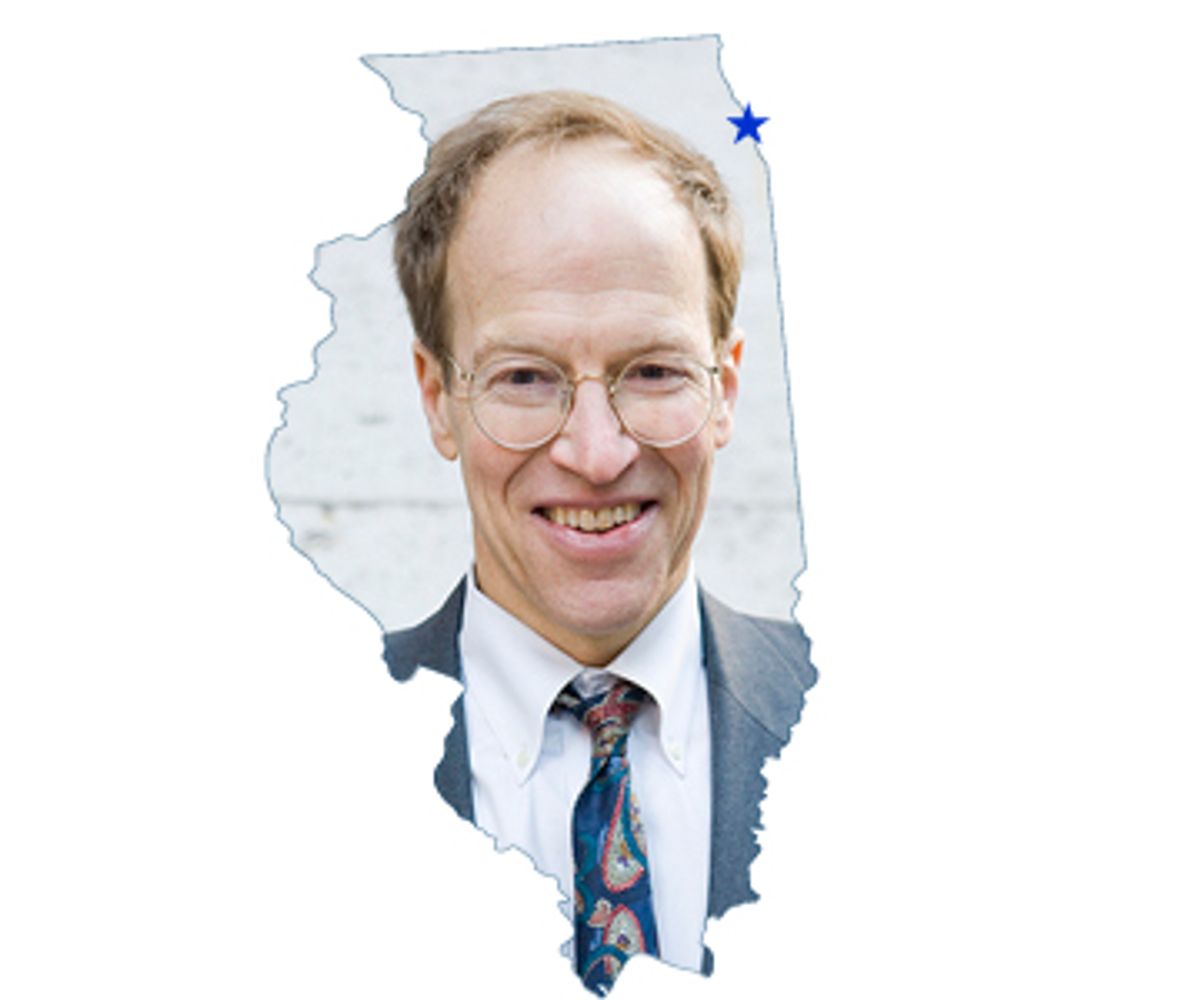
For a lot of reasons I never endorse candidates, but I'm backing Tom Geoghegan for Rahm Emanuel's old House seat in Chicago.
As a rule I don’t endorse candidates for public office — partly out of a habit formed under the rules of legacy journalism, and partly because my general preferences ought to be clear enough for anyone who cares. For me, it’s a good rule. But then someone like Tom Geoghegan runs for Congress, and suddenly it looks like a rule that needs to be broken, or at least bent.
Next Tuesday, voters on the North Side of Chicago will have an opportunity to choose Geoghegan from a ridiculously large field in the special primary election to fill the seat of Rahm Emanuel, who resigned from Congress to serve as Barack Obama’s chief of staff. Not knowing much about any of the 15 or 16 other candidates in Illinois’ 5th Congressional District, I can’t suggest any reason to reject them. I can only offer what I know about Tom and why I think that Chicago — and the rest of the country — will be fortunate if he wins.
Geoghegan is a labor lawyer and an author who has excelled in both endeavors. He is a streetwise thinker who has devoted himself for 30 years to the advancement of working people, a fearless advocate who has never hesitated to confront their enemies, from crooked Teamster officials to marauding corporate executives.
He has walked the progressive walk without becoming a cliché or a bore, as demonstrated repeatedly in his long series of engaging books, articles and columns, most notably “Which Side Are You On?” — which may be the smartest (and most readable) book on the troubles of the American labor movement written by anybody during the past two decades. Witty, candid, unsentimental and yet stubbornly idealistic in a landscape of defeat and cynicism, Tom displayed in that memoir of life as a labor lawyer all the qualities that could make him an exceptional figure in Washington.
He possesses a certain kind of plain-spoken eloquence that will quickly make him an important spokesman on substantive issues. Nobody will do a better job of explaining why we need labor law reform or single-payer healthcare reform, because he has represented workers against union-busting companies and sued the big insurance companies too.
In personal terms, Tom could scarcely be more different from the man he has set out to succeed. He is polite, thoughtful, usually soft-spoken and almost painfully principled — in short, not much like the stereotype of a Chicago pol, except that for a nice guy he is also exceptionally tough. He has grit that is rare among intellectuals and academics but not so rare in labor, where the going is hard for anybody who doesn’t just go along.
Without breaking a confidence, I can offer an example from my own knowledge of Tom’s work. Not so long ago, he took the case of a group of workers who, like so many others in the declining industrial companies of the Midwest, had been screwed out of their pensions and healthcare in a corporate takeover. What made the case different is that among the new owners, there happened to be a very prominent Democratic investor who is accustomed to having liberals smooch his ring (or some other place). Tom had very little to gain by taking on those obscure workers as his clients, not only because they probably couldn’t pay him much, if anything, and weren’t at all likely to win against a phalanx of expensive corporate attorneys, but also because he might well make a very powerful enemy for himself. He didn’t care at all, any more than he worried when he fought the local Teamster chieftains who sent goons around to intimidate him from time to time (but never did). He didn’t court publicity, didn’t call any grandstanding press conference; he just fulfilled what he saw as his commitment to people who are forgotten or unrepresented or screwed over.
But there is another reason I am compelled to say a few words about Tom. It feels as though someone is looking over my shoulder. That would be Maria Leavey, my late friend who was also a close friend of Geoghegan’s and spoke about him often to me. Like him, she was a believer against all odds, a fighter who dedicated herself to the long, hard, grinding and often unrewarding work of progressive politics. If she were still here, Maria would not have let a single day go by without hectoring me to write something about Tom, and she would have been right, as she almost always was. He will fight like crazy for the universal health insurance that just might have saved her life.
The thing about voting for Geoghegan, if you happen to live in that Chicago district, is that you can accomplish two worthwhile objectives at once. Shine up the city’s political image (previous congressmen from IL-5 were named Rostenkowski and Blagojevich) by electing someone who is superior without being snobby. And send someone to Congress who was made for this historic moment, when the nation’s dispossessed need as many strong voices as they can get.
Joe Conason blogs in Salon several times a week and writes a weekly column for the New York Observer. His latest book is "It Can Happen Here: Authoritarian Peril in the Age of Bush." More Joe Conason.
Senate Democrats heroically fund TSA
Democrats score the dumbest political victory of 2012
(Credit: Reuters/Frank Polich) On Tuesday, a Senate Appropriations Committee vote effectively highlighted everything that is stupid about politics.
The Transportation Security Administration, a universally loathed government agency, is facing a shortfall, despite its more than $8 billion budget. Instead of having a debate over what effective airport security might actually look like and how much should reasonably be spent on the honestly rare threat of commercial-air-travel-based terrorism, there was a debate over how best to come up with the money needed for all the radioactive naked picture machines and bomb-sniffing dogs. The Democrats suggested passing on the cost of ineffective, cumbersome and intrusive security theater to citizens, via higher fees on airfares. The Republicans, even more predictably, suggested cutting spending that directly helps poor people to ensure there is enough to spend on stopping imaginary future 9/11s.
Continue Reading Close
Alex Pareene writes about politics for Salon and is the author of "The Rude Guide to Mitt." Email him at apareene@salon.com and follow him on Twitter @pareene More Alex Pareene.
The Democratic Senate might just survive
A Senate map that looked bleak a year ago is now littered with surprise pick-up opportunities
Charles Schumer and Harry Reid (Credit: Reuters/Jonathan Ernst) The growing likelihood that Richard Lugar will lose next Tuesday’s Indiana Republican Senate primary is the latest in a string of unexpected developments that have bolstered Democrats chances of hanging on to the Senate.
As I wrote yesterday, Lugar’s conservative primary challenger, state Treasurer Richard Mourdock, lacks the incumbent’s broad cross-partisan appeal and is closely identified with Tea Party-flavored Republicanism. Democrats, meanwhile, are poised to nominate Joe Donnelly, a moderate third-term congressman who defied the odds to hold onto his seat in the GOP tide of 2010. Mourdock would still probably be the favorite over Donnelly in the fall, just because of Indiana’s red tint, but the seat would be in play – something that would never be the case with Lugar as the GOP nominee.
Continue Reading Close
Steve Kornacki writes about politics for Salon. Reach him by email at SKornacki@salon.com and follow him on Twitter @SteveKornacki More Steve Kornacki.
Dems desert the left
Why aren't Democratic candidates for Senate promoting liberal causes on their websites?
Victories in two Pennsylvania House districts over two conservative Democrats who voted against healthcare reform gave liberals something to cheer about this week. And they’re quite right to focus on primary elections: Nomination contests are really fights over who will control the political parties. And yet liberals appear to be missing some major opportunities to influence the next round of Democratic senators, just when they have the chance to do so. A look at the websites of the 10 Democratic candidates most likely to become U.S. senators reveals that few of them are interested in several of the issues that have been the hallmark of liberal activism and often frustration during the Obama years: marriage equality, a public option on healthcare, filibuster reform and civil liberties.
Continue Reading CloseJonathan Bernstein writes at a Plain Blog About Politics. Follow him at @jbplainblog More Jonathan Bernstein.
All for none and none for all
Forty years of culture wars and racial battles wrecked the country and the GOP – but it's not too late to change
(Credit: AP Photo/Gregory Bull) My March 4 post “What’s the matter with white people?” was Salon’s top story that week, and it got a lot of comments and online attention. I went on vacation a few days later, but I’ve wanted to address a few arguments, if belatedly.
I asked “What’s the matter with white people?” because my people are increasingly coming under fire from the right and the left. Republicans have begun to blame not the economy but “dependency” on government and rising rates of single parenthood for the economic troubles of the white working class. On the left, meanwhile, whites are dismissed as the backward base of the increasingly radical GOP, and working class whites, in particular, are derided as racists who won’t vote for Democrats because the party is now led by a black man (ignoring the fact that a larger share of working class whites voted for Barack Obama than for Caucasians John Kerry, Al Gore or Bill Clinton.)
Continue Reading CloseJoan Walsh is Salon's editor at large. More Joan Walsh.
The economic story Obama must tell
We need government investment to restore prosperity. The president needs to explain that in a way that makes sense
(Credit: AP Photo/Susan Walsh) Look at it this way: If the Wall Street banking crisis had taken place in 2007 instead of 2008, George W. Bush wouldn’t be able to leave home without being jeered. (As it is, he rarely leaves Texas.) Hardly anybody would buy the brand of tycoonomics GOP presidential candidates are selling. People would understand that save-the-millionaires tax cuts and deregulation had dramatically failed. President Obama would get more credit for pulling the economy out of a nose dive.
Alas, people have short attention spans and a weak understanding of abstract economic issues. You have to tell them a story. The failure of policymakers to do that has been driving progressive MVP Paul Krugman crazy. How can it be, he asks, that governments foreign and domestic are repeating the mistakes of the early 1930s — slashing government spending to reduce budget deficits, putting more people out of work, reducing demand, and inadvertently increasing deficits? Rinse and repeat.
Continue Reading CloseArkansas Times columnist Gene Lyons is a National Magazine Award winner and co-author of "The Hunting of the President" (St. Martin's Press, 2000). You can e-mail Lyons at eugenelyons2@yahoo.com. More Gene Lyons.
Page 1 of 165 in Democratic Party