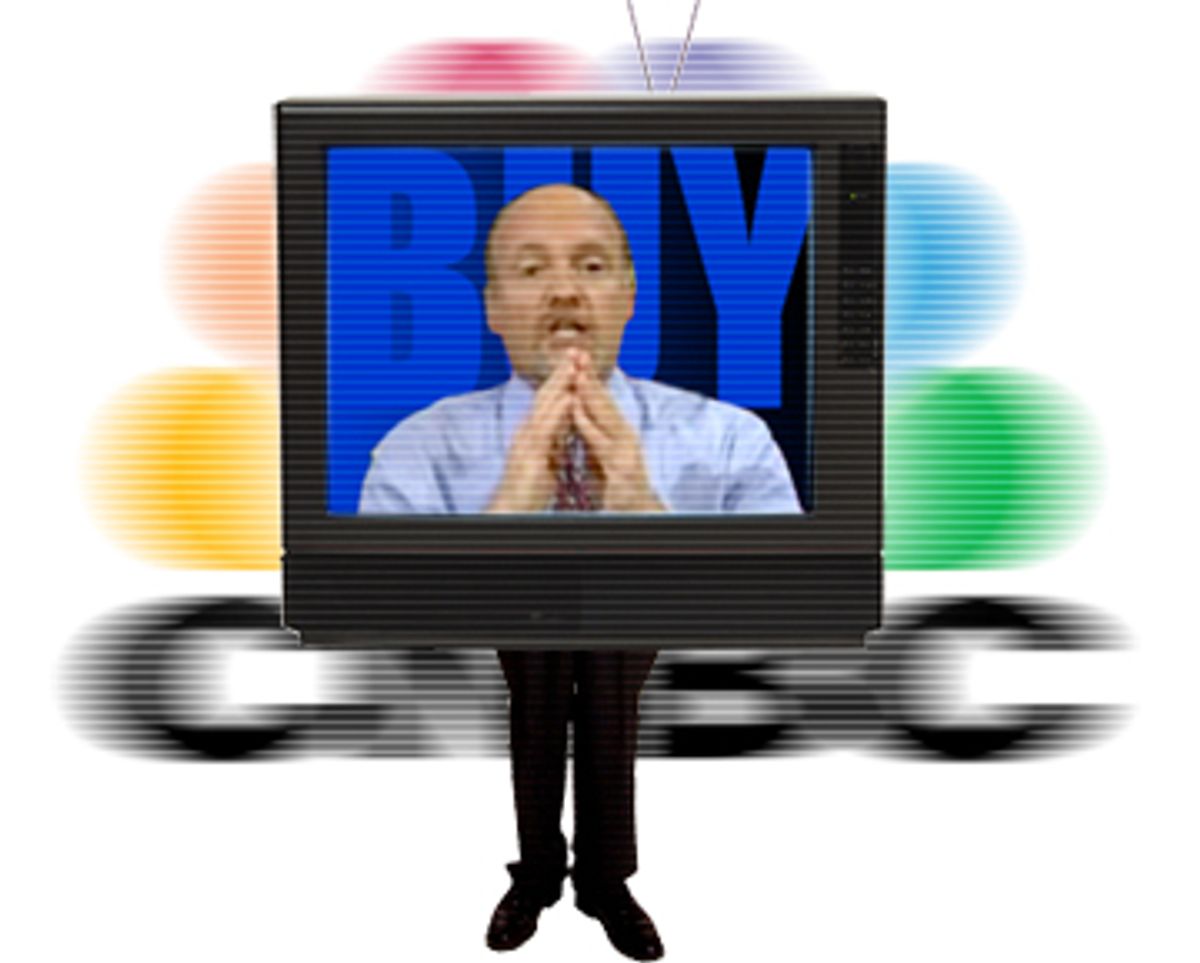
On Monday, at 8:30 a.m., I turned on CNBC and started watching the business channel for the first time in my life. Twelve hours later, a long stare through the peacock-colored looking glass had shaken me. I was huddled in the corner of my living room couch, arms hugging my knees, wondering why the angry faces on-screen were yelling at me.
Since the dawn of the Obama administration, not even two months ago, CNBC has become notorious as a redoubt of talking -- no, shouting -- heads who insist that the market is tanking because the new president is an incompetent lefty. A Bolshevik even, according to Bloviator-in-Chief Jim Cramer. A squish who hands out free mortgage do-overs to "losers," according to Chicago trading-floor populist Rick Santelli. Twice in the past week, "The Daily Show's" Jon Stewart has responded with blistering mash-ups of the same talking heads talking out of their behinds. Larry Kudlow and Jim Cramer and others were seen, in CNBC footage assembled by "The Daily Show," making absurd, toxic and ultimately tragic predictions about how awesomely awesome the market was about to be, how Bear Stearns would never fail, how turnaround was coming, how it was time to buy. Maria Bartiromo and various on-air soldier ants were also shown sucking up to assorted titans of business in the golden days before the recession began to seem like something worse.
Jim Cramer has responded by noting, angrily, that Jon Stewart is a comedian, which apparently makes Stewart unqualified to judge when someone is making a fool of himself. But rather than rely on "The Daily Show" for our opinions, even though we usually do, we at Salon decided to spend a day glued to CNBC and judge the network for ourselves. That is, my boss made me watch it.
What I found was a paradox at the channel's core -- one that seemed, late on the afternoon of Monday, March 9, to make Jim Cramer want to claw his own skin off. The station's business model rests on its claim to insider wisdom and market smarts. CNBC's army of analysts marshals a host of data to tell the daily story of the markets in the language of the markets. From that angle, the disorienting effect that hours of watching had on me is not surprising: I only sort of understand what derivatives are. No wonder my head was spinning.
At the same time, however, the network depends on a particular industry, and thrives on good economic news, which is in short supply. Nobody wants to tune in to cable day after day to hear yet another dirge for yet another one of their stocks. There is a financial imperative for the pundits to keep their core audience of investors coming back, and therefore an obligation for the pundits to distort empirical reality to make a grim future seem manageable. Or, as one commercial puts it, "In an unpredictable market, one man has the answers, the vision, the experience you can trust. In Cramer we trust."
And yet the financial future is starting to seem unmanageable, even to the all-knowing pundits of CNBC. Someone must be to blame. Thus the essence of CNBC circa 2009 is an uneasy mixture of despair and boosterism, made to cohere with the liberal application of pure venom. And the venom is directed at the most convenient target: Barack Obama.
CNBC's day starts off in the wee hours, with "Worldwide Exchange," a largely unwatched look at world markets. By sunrise, "Squawk Box" is on, the first of the day's many indistinguishable talking-heads panels. "Squawk" generally gives a look at what's coming up on the markets that day, which on Monday was pharmaceutical giant Merck's $41 billion acquisition of rival Schering-Plough. Monday's was a very special episode of "Squawk Box" for another reason: Reporter Becky Quick was in an Omaha, Neb., furniture store, interviewing Warren Buffett. The normally reassuring, Obama-supporting "Oracle of Omaha" showed up uncharacteristically jittery about the economy, which Buffett said had "fallen off a cliff ... not only has the economy slowed down a lot, people have really changed their behavior like nothing I've ever seen."
At 9 a.m., the action shifts to CNBC's field team, "Squawk on the Street," who are waiting for the 9:30 bell to open trading in New York. "We are at the nerve center!" marvels anchor Mark Haines. "The raw, shingles-infested nerve center," Erin Burnett responds. The Dow starts the day at 6,625, and though the Schering-Plough acquisition is supposed to juice the markets, it doesn't seem to be happening. As, somewhere outside my apartment and far from the glow of the TV, the sun gets higher in the sky, it becomes clear that there is no pharmaceutical fix for the Dow. It will be another bad day at the market for CNBC to explain. "This was a long time coming. Consolidation in the sector is inevitable, but the market is clearly saying, 'We hate it,'" puzzled one of the many interchangeable CNBC talkers.
As the morning goes on, the market continues to jitter, and the "Squawks" give way to "The Call," which features ongoing, real-time analysis. Co-host Larry Kudlow (who will reappear later) laments the Dow's gradual sinking. "In the morning, I wake up, I have a special Google alert to the Baltic dry shipping index, because I'm trying to glom onto something positive." Kudlow sees nothing positive about Obama's plans. "They are spending their tuchises off!" he shouts. "That's the problem! It's Keynesian stimulus! What we need is tax cuts, lower tax rates." At noon, "The Call" moves over for the two-hour "Power Lunch," which is basically the same idea, but at lunchtime.
By now, I have noticed that I speak a different language than the people on this channel. Or maybe I'm just not as smart as they are. "I've decided that flat is the new up," declares one talking head. "If they can't get their heads together, there's no way we're going to get meat on the bone," warns another. Their braying seems to mean something to their target audience, but not to me. Even most-esteemed sage Warren Buffett wasn't immune. He spoke in an un-CNBC-like volume, but said things like, "It's a lot better to have a goose that keeps laying eggs than a goose that just sits there and eats insurance." Now, that is easy to understand, and probably true. Plus, can you imagine how gross that pâté would taste?
I have also noticed, by "Power Lunch," that the seemingly endless market slide is posing a profound problem for cable news experts. As the hardheaded veterans, these guys are full of disdain for the weekday warriors who expect to work the market and make a quick buck. That's how you know you can trust them. "Right now, attempts at stock-picking, for six months, have been completely unsuccessful," warns Bob Pisani, standing on the trading floor. Guest Vern Hayden advises, "People have to not worry so much about missing the turn!" Bob Griffeth, agreeing, shakes his head in consternation at "human nature, wanting to get that last downtick."
A heartbeat later, Sue Herera is asking Hayden, "What's the signal of the turn, for you?" Because CNBC is aimed at making its viewers feel like masters of the universe, it has to offer them this bizarre sweet-and-sour cocktail of happy-days-around-the-corner optimism and I'm-no-sap flintiness.
When "Power Lunch" clears out, Erin Burnett of the "Squawk" series comes back to anchor "Street Signs." This, too, is basically more of the same. With the trading day starting to wind down, Burnett pauses to try to place the day's mediocre results in some larger analytical perspective; is it too late for an afternoon rebound? (Most likely.) What sectors have done OK? (Retail.) Which have taken a beating? (Finance.) Should investors fear "all-out class war"? (Probably not.)
Then Jim Cramer stops by at the end of her show, and turns in one of the more tortured and conflicted television performances I have ever seen. He personifies, in his very body, the war between boosterism and reality that lends CNBC such an air of anxiety. Dripping with contempt for Burnett, he berates her for citing a positive -- and, one should note, true -- statistic about Ford. "I could make you look really horrible on this show," Cramer shouts. And then he admits that he's just as guilty of searching desperately for silver linings. "Every night," he barks, "I try to come out and say something good, but it's difficult. It's difficult, because it spits in the face of people who've lost so much."
Cramer is in pain, and he's taking it out on Burnett. By the end of six of the more excruciating minutes I've witnessed on television, Burnett was scrambling for a graceful way out. "We can let everybody know, that now they know, that we have very real, frank discussions and disagreements in this segment. As people can do." She changes the subject to his nightly show, which on Monday will cover carbon cap-and-trades. "And I believe you're talking energy tonight?" offers Burnett, helpfully. "Some degree," huffs Cramer. He's just openly wrestled with the dilemmas of his job, and come out the loser. Burnett is visibly relieved to sign off for the day.
Maria Bartiromo, the famous "Money Honey" who was once the subject of a Ramones song, follows Burnett with "Closing Bell," which runs from 3 p.m. to 5. Today, Bartiromo's big draw is an interview with John McCain. Where should the president's attention be, Senator? "I would focus on the pork-barrel spending." I experience a strangely familiar urge to nap. Wall Street's closing bell rings at 4:00, under Bartiromo's watch. The Dow has sunk 79 points, to 6,547. Bartiromo sums up, and steps aside.
"Fast Money" comes on after Bartiromo, to kill an hour until the network's true stars start to shine at 6. The show professes to arm its viewers with insight and analysis gleaned from the day's gyrations. "Faster than a New York minute, Dylan Ratigan and the 'Fast Money' traders give you the information normally reserved for the Wall Street trading floor," promises the Web site. This claim might be true, if the Wall Street trading floor is secretly run by Lewis Carroll. The hosts have all affected epithets like "the Commissioner," "the Pit Boss" and "the Ambassador." And they seemed, to an outsider's ear, to speak nonsense, at an auctioneer's manic pace, with exclamation points. "Look at Google at 290!" snapped the Ambassador. "Did you buy it?" beeped a voice off-screen. "I did look at it, I didn't buy a share!" "Why not?" "I like to look at it!"
Then the Commissioner explained it all. "One company's going to buy another company, and this company's going to buy the company that's going to buy that company."
After "Fast Money," it's time for the channel's marquee names to make sense of the day's fiscal carnage. At 6 o'clock Eastern, two hours after the closing bell, Cramer is back on camera, this time as the host of his own show, "Mad Money." I was vaguely aware that Cramer's shtick involved high-volume, manic behavior and sound effects. I did not expect it to involve a confession of fallibility and ignorance. "My job is not just to entertain you but to educate you," he says. "You know what drives market pros and grizzled veterans crazy about this particular market? It's that no pattern that we've had before, ever, nothing that worked before, is working now."
"We're like navigators operating without a map or compass." Now, with the Dow below 7,000, he tells us.
Never having seen the show before, I'm astonished, even though Cramer's conniptions earlier in the day should've warned me. I thought the whole premise was that Cramer had a compass, and knew where he was taking us. Jon Stewart's whole point in his criticisms of Cramer was that the guy gets things wrong all the damn time. Yet the show depends on his almost violent assertion of his own authority. He has to acknowledge that he's been wrong if he wants to seem like a serious analyst, but he also has to keep pointing the way forward. A caller asks him if it's a good time for new investors to break in. Cramer says there's no hard-and-fast rule, we've got to go case-by-case, and then, without missing a beat, or seeking any further information, says, "Buy Verizon."
Nobody knows what they're doing, but hey, here's what you should do. How can CNBC square this circle? The answer is, as Jon Stewart called it, cheap populism. That's where Barack Obama comes in.
According to CNBC's evening punditocracy, nightly tasked with explaining why another day has ended in the toilet, it's not the market's fault, it's the government. Cramer warns that the Obama administration might cause another Great Depression, accuses the administration of "wealth destruction," and compares Obama's cap-and-trade carbon pricing scheme to the McCarthyite House Un-American Activities Committee. "It's time to join the witch hunt against known polluters," he snarks. "Will the Democrats carbon blacklist this company, unless it names names?"
Economist Larry Kudlow, whose hour-long "Kudlow & Company" follows "Mad Money" Monday through Friday at 7 Eastern, has even less shame than Cramer. Kudlow accuses Obama of "waging war against businesses and investors and entrepreneurs." He tees up guest Art Laffer, a wholly discredited economist, who claims, "The political process started in late 2007. Since that time, the markets have been down 55 percent. Markets are forward-looking, not backward-looking. They saw what was coming in the election. They were anticipating what this guy would do, and they caused a slowdown."
Got that? It's not our fault none of the models are working. The economy collapsed because the government broke it. Buy Verizon. If it goes up, Cramer and Kudlow and Santelli are geniuses. If it goes down, it's Obama's fault. Either way CNBC wins.
CNBC's audience is not a demographic cross section of America. If it was a cross section, the network wouldn't make any money; CNBC attracts advertisers not with the size of its audience but with its maleness and its affluence. The network gets about a quarter million viewers a day, a tiny fraction of the U.S. population, but those viewers have a median household net worth of more than $1.2 million. Still, the financial pundits flatter viewers into thinking, as Rick Santelli put it during his famous trading floor rant, that they are "a pretty good statistical cross-section of America." For these guys, investors are America. Jim Cramer asked at one point, of the Obama administration, "Who do they think owns stocks?" As if the obvious answer is, "Everybody!" Obama, Cramer complained, "seemed proud that he ignored the [market] averages, as if they're some sort of distraction, and not a precursor of the economy."
I'm not going to argue that the Dow Jones is irrelevant to the economy, but the fundamental problem of the bubble years was that the Dow Jones was growing and our actual assets were not. We weren't really getting richer. We were just pretending to get richer.
In mistaking themselves for the country at large, and the bouncing of the market for the health of the economy as a whole, Cramer, Kudlow and the whole talking-head crew give the lie to Rick Santelli's assertion about a "silent majority." CNBC feels like bizarro world because, in an important sense, it is.
Shares