U.S. Economy
Take this bonus and shove it
President Obama is raising his voice to condemn AIG executives. But singing an angry song may be all he can do about the fat paychecks.
“Bonus” doesn’t quite seem like the right word for the payouts that AIG executives got late last week. The insurance company lost $108 billion in 2008; the federal government, which forked over $170 billion to keep it in business since last fall, now owns 80 percent of the company. But AIG officials still felt compelled to pay $165 million in “retention bonuses” to people whose dealings in bizarre financial derivatives helped unravel the company and the global economy along with it. After such a dynamite performance, “plunder” or “booty” might do a better job of describing the extra pay.
No matter what you call it, though, whoever got the bonuses probably ought to cash the checks pronto, and then go hide. By nightfall Monday, politicians in both parties were on the verge of assembling a posse to go looking for the executives to tear them limb from limb. And the sheriff at the head of the unruly mob was none other than President Barack Obama.
”How do they justify this outrage to the taxpayers who are keeping the company afloat?” Obama asked at an afternoon event that was supposed to focus on the administration’s aid to small-business owners. Late in the morning, White House aides stuck the AIG lines into the top of his prepared remarks and then alerted reporters to look out for them. The administration has obviously realized, along with everyone else in Washington who depends on the approval of voters to keep their jobs, that AIG executives are the hottest target going right now for government wrath. “In the last six months, AIG has received substantial sums from the U.S. Treasury,” Obama said. “And I’ve asked [the Treasury Department] to use that leverage and pursue every single legal avenue to block these bonuses and make the American taxpayers whole.”
But saying the government will get the money back, and doing it, might be two different things. Before the public outrage, AIG officials reportedly argued, and the Treasury reportedly agreed, that they were legally required to pay the bonuses by the contracts they’d signed with the recipients. On Capitol Hill, aides who looked at the laws involved weren’t sure what the administration would be able to do about the payments. White House spokesman Robert Gibbs said Obama had ordered a review of options, which didn’t exactly inspire confidence that officials would soon be swooping in with the rescued money. AIG is still drawing money from the $700 billion corporate bailout fund Congress approved last fall, so the administration’s new rules limiting executive pay don’t apply.
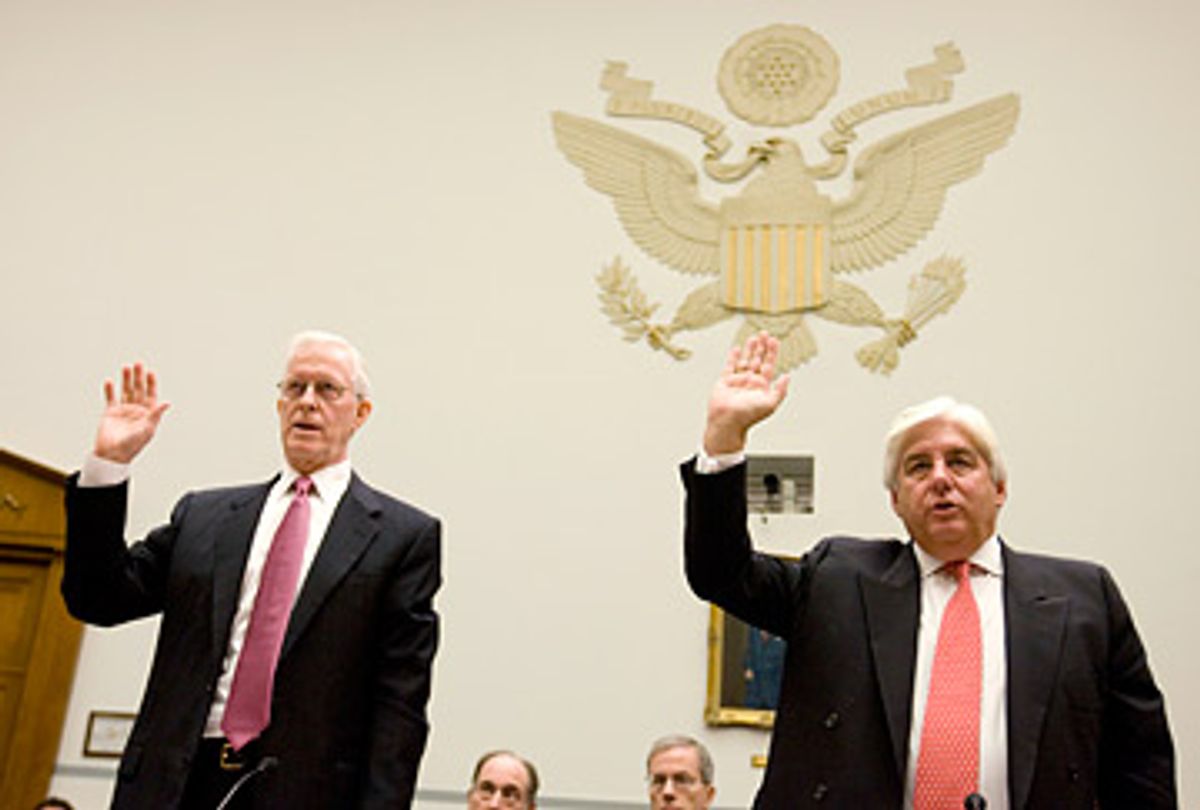
That’s not to say the government won’t make a show of trying, even if the effort fails. The bonuses inspired the kind of bipartisan harmony that has eluded the administration on most issues. Rep. Barney Frank, D-Mass., told NBC’s “Today” show the top management at AIG should be fired for “rewarding incompetence.” A subcommittee of the House Financial Services panel scheduled a hearing Wednesday to hear from AIG CEO Edward Liddy and others about the company. House Minority Leader John Boehner, R-Ohio, chimed in, demanding an “exit strategy” from the entire business of bailing out Wall Street firms. Senate Majority Leader Harry Reid, D-Nev., took to the Senate floor to declare the bonuses “a breach of public trust,” and House Speaker Nancy Pelosi said Treasury should “use whatever tools at its disposal to make AIG repay taxpayers” — which conjured up images of Treasury Secretary Timothy Geithner playing the Laurence Olivier role in a remake of “Marathon Man.”
Even outside Washington, politicians seized the chance to look tough. New York Attorney General Andrew Cuomo, who may be trying to move up to governor by this time next year, subpoenaed AIG officials to find out who got the bonus money. “If the taxpayer didn’t bail out AIG, those contracts wouldn’t be worth the paper they’re printed on,” Cuomo told reporters. “Just because there’s a contract doesn’t mean there’s no way around the contract.”
It’s not hard to see why the bonuses made the insurance giant public enemy No. 1. Voters are so furious about taxpayer money going to Wall Street, and so resentful that financial wizards still took down seven-figure salaries last year while 401K accounts evaporated, that there’s no political downside to attacking anyone connected to it all.
“[Voters] wouldn’t mind seeing some of the executives hanging from lampposts on Wall Street,” said Glen Bolger, a Republican pollster. If the administration is going to have to come back to Congress to ask for more money to help stabilize banks — a prospect officials seem resigned to doing — bashing excessive pay can’t hurt. What’s harder to figure out is why AIG didn’t try harder to find some way around the contracts. “These guys apparently were not reading the newspaper the day the auto execs came to Washington in their private jets,” said Democratic pollster Mark Mellman. “It’s a difference between running a private company and being in the public light — they’re just not used to it. For anybody who’s worked in politics — for anybody who’s ever read a newspaper, let alone working for one — this is a no-brainer.”
But apparently not for financial honchos. When Obama announced the plans to cap salaries, bonuses and corporate expenses for companies that take bailouts in the future, administration officials said they didn’t need to worry too much about putting tough enforcement mechanisms into the proposal; publicly airing news of lavish bashes or embarrassing pay deals would help shame companies out of such behavior in the future.
AIG sent its checks out on Friday the 13th, less than two weeks after the government gave it another $30 billion in aid. The company has been even more profligate with money it disbursed to other financial firms than it has with its bonus payments — it sent $75 billion to other foreign and domestic companies with whom it traded esoteric derivative securities.
If there’s any point the bonus brouhaha should drive home, once and for all, inside the Beltway, it’s that the financial collapse has gone way past the point of “shame on you.” Unless the government gets tougher with the banks it now owns huge stakes in, the Obama administration itself may be soon be bellowing “shame on me.”
Mike Madden is Salon's Washington correspondent. A complete listing of his articles is here. Follow him on Twitter here. More Mike Madden.
Is America’s age of discovery over?
A small group of ambitious institutions gave us the Internet, lasers and TV. Now they're dwindling. Are we doomed?
(Credit: wavebreakmedia ltd and Christian Delbert via Shutterstock) Not so long ago, the core skill of the United States was new industry creation. And at the same time — not coincidentally — the country boasted the world’s largest and fastest-growing economy. During the 1920s, 1930s, 1940s, 1950s, and 1960s, scientific and technological breakthroughs from the United States produced a steady stream of extraordinary new industries and products. These industries stimulated consumer demand and, by providing high-paying jobs, enabled it.
That stream of basic discoveries was produced not mainly by self-funded geniuses in backyard garages but rather by a quite unusual and focused machine for discovery and innovation — a network of institutions deliberately founded, organized, and run for the purpose of fueling scientific and technological insight. Including such legendary institutions as Bell Labs, Xerox PARC, RCA Laboratories, DARPA, and others, this network consisted of public, private, nonprofit, and for-profit efforts working in combination. Programs with clear commercial potential were supported alongside efforts at “pure science,” with the two streams resonating with and feeding off each other. This discovery and innovation machine existed because of a business and political culture that supported invention independent of immediate practical applications, as being “good for the country.”
Continue Reading CloseThe folly of a Chinese trade war
American workers need China's economy to grow faster. Tariff threats from the U.S. Senate won't accomplish that VIDEO
A child poses in front of a giant red lantern on display at Beijing's Tiananmen Square on China's National Day. (Credit: Reuters/Jason Lee) Moments before China successfully launched its Tiangong “Heavenly Palace” space lab on Sept. 29 — a key step toward the goal of a manned Chinese space station in orbit by the end of the decade — China’s largest television network broadcast a 90-second long animation describing the spacecraft’s journey into orbit, with the uplifting music of “America the Beautiful” as soundtrack.
Some observers considered the juxtaposition a howling blunder; others regarded the move as a calculated insult from a rising superpower to an empire in decline. But whatever the real story, of one thing there could be no doubt: In the same year that the United States retreated from space, shutting down its Space Shuttle program, China declared that the sky would be no limit to its own ambitions.
Continue Reading Close
Andrew Leonard is a staff writer at Salon. On Twitter, @koxinga21. More Andrew Leonard.
America’s lost economic decade
The once-powerful middle class has collapsed, and the poor have it even worse. Will the U.S. ever recover?
(Credit: Jim Barber via Shutterstock) Food pantries picked over. Incomes drying up. Shelters bursting with the homeless. Job seekers spilling out the doors of employment centers. College grads moving back in with their parents. The angry and disillusioned filling the streets.
Pan your camera from one coast to the other, from city to suburb to farm and back again, and you’ll witness scenes like these. They are the legacy of the Great Recession, the Lesser Depression, or whatever you choose to call it.
Continue Reading CloseAndy Kroll is a reporter in the D.C. bureau of Mother Jones magazine and an associate editor at TomDispatch. His writing has appeared at the Nation.com, Alternet, CNN.com, CBSNews,com, and Truthout, among other places. He welcomes feedback, and can be reached at his website, http://www.andykroll.com/ More Andy Kroll.
The end of the dollar standard
The currency's grip on the world economy is rapidly slipping -- and that could mean bad things for us
(Credit: jokerpro via Shutterstock) “It’s China’s World. We Just Live in It,” Fortune announced in October 2009. The accompanying article described a prospecting trip in Africa by officials of the China National Offshore Oil Corporation. Nigeria was renewing production licenses in its oil fields, and CNOOC was aiming to elbow aside such traditional players as Exxon Mobil and Royal Dutch Shell. “The Beijing-based company wants to secure no less than one-sixth of the African nation’s production,” the article asserted. “And CNOOC, apparently, isn’t screwing around.” China’s sudden appearance distressed the existing licensees but delighted the Nigerians. “We love this kind of competition,” a spokesman for the government said.
Continue Reading CloseWhy Bernanke’s worried about Europe’s debt
How the EU crisis could lead to another giant Wall Street bailout
(Credit: AP Photo/Evan Vucci) On Tuesday, Ben Bernanke added his voice to those who are worried about Europe’s debt crisis.
But why exactly should America be so concerned? Yes, we export to Europe – but those exports aren’t going to dry up. And in any event, they’re tiny compared to the size of the U.S. economy.
If you want the real reason, follow the money. A Greek (or Irish or Spanish or Italian or Portugese) default would have roughly the same effect on our financial system as the implosion of Lehman Brothers in 2008.
Continue Reading CloseRobert Reich, one of the nation’s leading experts on work and the economy, is Chancellor’s Professor of Public Policy at the Goldman School of Public Policy at the University of California at Berkeley. He has served in three national administrations, most recently as secretary of labor under President Bill Clinton. Time Magazine has named him one of the ten most effective cabinet secretaries of the last century. He has written 13 books, including his latest best-seller, “Aftershock: The Next Economy and America’s Future;” “The Work of Nations,” which has been translated into 22 languages; and his newest, an e-book, “Beyond Outrage.” His syndicated columns, television appearances, and public radio commentaries reach millions of people each week. He is also a founding editor of the American Prospect magazine, and Chairman of the citizen’s group Common Cause. His widely-read blog can be found at www.robertreich.org. More Robert Reich.
Page 1 of 217 in U.S. Economy