Democratic Party
With friends like these, who needs Republicans?
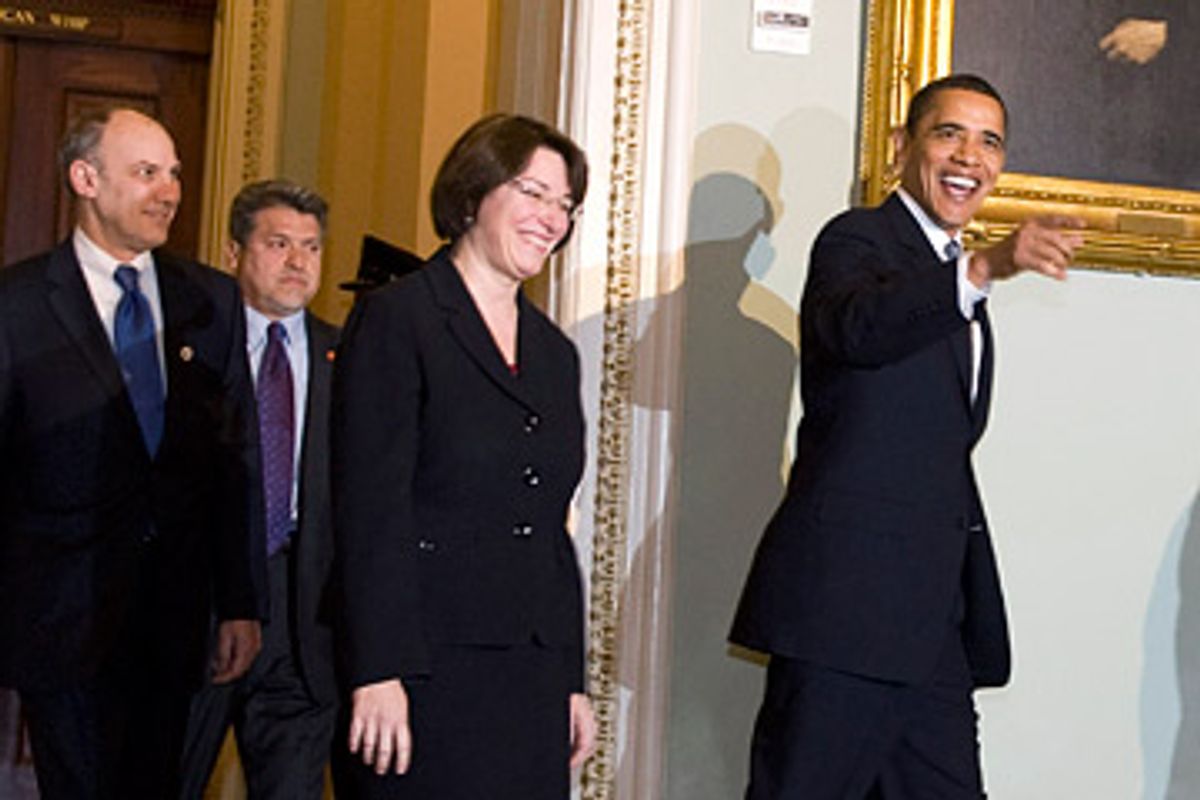
After a successful press conference, the president works a tougher crowd –- congressional Democrats.
Apparently the easy part was bumping “American Idol” off the air and battling CNN’s Ed Henry on live TV. For President Barack Obama, the hard part of selling his budget might turn out to be persuading conservative Democrats not to get in the way.
Facing opposition on Capitol Hill from Republicans (which you might expect) and from his own party (which you might not), Obama is ratcheting up a push to get Congress to go along with his plans to invest heavily in healthcare, alternative energy and education, even if it means the government has to borrow a great deal in the process. So the day after his prime-time press conference, Obama’s motorcade ferried him up Pennsylvania Avenue to lunch with his former colleagues in the Senate Democratic Caucus. He’ll be back to have lunch with House Democrats Monday. A “virtual town hall” planned for Thursday is also intended to get Obama’s message out, as was a canvassing effort that the Democratic National Committee organized over the weekend. Despite all that, the official story Wednesday was that everyone is getting along fine.
The president “is enormously pleased with the progress that both the House and the Senate are making on working toward a budget that reflects the priorities and the investments that he wanted to see in a budget,” White House press secretary Robert Gibbs said later in the day. Senate Majority Leader Harry Reid was equally sanguine. “It was vintage Obama,” he said after meeting with the president. “He made us all feel content and inspired by where we need to go.” The budget fight matters less substantively than politically. The resolution that Congress is working on isn’t binding, and Obama doesn’t have to sign it, so the debate now is mostly a test of whether the administration and Congress have the same broad priorities.
Nonetheless, behind the scenes the administration appeared to be troubled by early indications that there might be some conflict. An estimate last week by the nonpartisan Congressional Budget Office, which Obama’s own budget director used to run, said the proposal that the White House put out last month would lead to cumulative deficits of $9.3 trillion over the next decade, far more than the $7 trillion the administration predicted. Since even the smaller number had already panicked some Democrats, and put the scent of blood in the water for circling Republicans, the estimate didn’t help things.
On Wednesday morning, the House and Senate budget committees released their own proposals to counter Obama’s. They trimmed the White House plan significantly, dropping some middle-class tax cuts and aiming to cut the overall deficit faster than Obama has proposed. Republicans have already started hammering the administration on spending, and some Democrats — like Sen. Ben Nelson of Nebraska, Sen. Evan Bayh of Indiana and a slew of “Blue Dogs” in the House — are getting a little queasy in response. Kent Conrad, D-N.D., who chairs the Senate Budget Committee, made clear over the weekend that he didn’t like the deficits in Obama’s plan, and his proposal reflected that.
Administration officials, hoping to head off a media narrative that Obama and Democrats in Congress were at odds, decided to stay positive. Aides set up a morning conference call with reporters and budget director Peter Orszag, who declared everything was fine. “[The House and Senate plans] are 98 percent the same as the budget proposal the president sent up in February,” he said. The outreach by Obama himself was proactive, rather than reactive. He spent most of his lunchtime visit, senators said afterward, making a pitch to keep the “core values” of the budget intact; cut here and there if you must, but don’t lose sight of the goals. Vice President Biden got involved, too, meeting House Democrats for lunch and stopping by the Senate while he was in the building.
The White House may not be concerned enough to go public with pressure on Democrats yet, but liberal allies are. The Campaign for America’s Future is organizing a “Dog the Dogs” campaign to call conservative Democrats and demand they side with Obama. Another group, Americans United for Change, is running TV ads targeting selected Democratic lawmakers. MoveOn.org is running radio ads with a similar goal. “It is our hope that Congress gets the boost it needs to stand up to the special interests that will do anything to maintain the failed policies of the last eight years,” said Tom McMahon, the acting head of Americans United for Change.
So far, that effort may not be having the desired effect. “I think it’s helping the media industry in Nebraska,” Nelson told Salon Wednesday afternoon. “I never feel pressure from that kind of influence attempt. The only pressure I feel is pressure to do what’s right, and pressure to reflect the values of people from Nebraska, not from Washington, D.C.”
Still, Nelson and other moderates, like Sen. Mary Landrieu, D-La., were careful to minimize whatever differences they might have with the White House after hearing from Obama. “He’s very realistic,” Nelson said. “He has great expectations, but he doesn’t have impossible expectations.”
As for Republicans, they were already digging their heels in as hard as they could, as they have on most proposals out of the Obama White House. As one GOP leadership aide put it, it’s not hard to figure out what the Republican message on any given day is: They’ll be grousing that Obama wants to spend too much money. Late Wednesday afternoon, Judd Gregg — the New Hampshire Republican who bailed on an offer to join the administration — joined Senate GOP boss Mitch McConnell for another in what’s becoming a never-ending series of press conferences whining about Obama’s economic policies. “He intends to take this government hard left,” Gregg said. At least Obama knows where they stand. As Wednesday’s public show of affection for Senate Democrats proved, getting his own party to agree with his policies could take a lot more handholding over the next few weeks.
Mike Madden is Salon's Washington correspondent. A complete listing of his articles is here. Follow him on Twitter here. More Mike Madden.
Senate Democrats heroically fund TSA
Democrats score the dumbest political victory of 2012
(Credit: Reuters/Frank Polich) On Tuesday, a Senate Appropriations Committee vote effectively highlighted everything that is stupid about politics.
The Transportation Security Administration, a universally loathed government agency, is facing a shortfall, despite its more than $8 billion budget. Instead of having a debate over what effective airport security might actually look like and how much should reasonably be spent on the honestly rare threat of commercial-air-travel-based terrorism, there was a debate over how best to come up with the money needed for all the radioactive naked picture machines and bomb-sniffing dogs. The Democrats suggested passing on the cost of ineffective, cumbersome and intrusive security theater to citizens, via higher fees on airfares. The Republicans, even more predictably, suggested cutting spending that directly helps poor people to ensure there is enough to spend on stopping imaginary future 9/11s.
Continue Reading Close
Alex Pareene writes about politics for Salon and is the author of "The Rude Guide to Mitt." Email him at apareene@salon.com and follow him on Twitter @pareene More Alex Pareene.
The Democratic Senate might just survive
A Senate map that looked bleak a year ago is now littered with surprise pick-up opportunities
Charles Schumer and Harry Reid (Credit: Reuters/Jonathan Ernst) The growing likelihood that Richard Lugar will lose next Tuesday’s Indiana Republican Senate primary is the latest in a string of unexpected developments that have bolstered Democrats chances of hanging on to the Senate.
As I wrote yesterday, Lugar’s conservative primary challenger, state Treasurer Richard Mourdock, lacks the incumbent’s broad cross-partisan appeal and is closely identified with Tea Party-flavored Republicanism. Democrats, meanwhile, are poised to nominate Joe Donnelly, a moderate third-term congressman who defied the odds to hold onto his seat in the GOP tide of 2010. Mourdock would still probably be the favorite over Donnelly in the fall, just because of Indiana’s red tint, but the seat would be in play – something that would never be the case with Lugar as the GOP nominee.
Continue Reading Close
Steve Kornacki writes about politics for Salon. Reach him by email at SKornacki@salon.com and follow him on Twitter @SteveKornacki More Steve Kornacki.
Dems desert the left
Why aren't Democratic candidates for Senate promoting liberal causes on their websites?
Victories in two Pennsylvania House districts over two conservative Democrats who voted against healthcare reform gave liberals something to cheer about this week. And they’re quite right to focus on primary elections: Nomination contests are really fights over who will control the political parties. And yet liberals appear to be missing some major opportunities to influence the next round of Democratic senators, just when they have the chance to do so. A look at the websites of the 10 Democratic candidates most likely to become U.S. senators reveals that few of them are interested in several of the issues that have been the hallmark of liberal activism and often frustration during the Obama years: marriage equality, a public option on healthcare, filibuster reform and civil liberties.
Continue Reading CloseJonathan Bernstein writes at a Plain Blog About Politics. Follow him at @jbplainblog More Jonathan Bernstein.
All for none and none for all
Forty years of culture wars and racial battles wrecked the country and the GOP – but it's not too late to change
(Credit: AP Photo/Gregory Bull) My March 4 post “What’s the matter with white people?” was Salon’s top story that week, and it got a lot of comments and online attention. I went on vacation a few days later, but I’ve wanted to address a few arguments, if belatedly.
I asked “What’s the matter with white people?” because my people are increasingly coming under fire from the right and the left. Republicans have begun to blame not the economy but “dependency” on government and rising rates of single parenthood for the economic troubles of the white working class. On the left, meanwhile, whites are dismissed as the backward base of the increasingly radical GOP, and working class whites, in particular, are derided as racists who won’t vote for Democrats because the party is now led by a black man (ignoring the fact that a larger share of working class whites voted for Barack Obama than for Caucasians John Kerry, Al Gore or Bill Clinton.)
Continue Reading CloseJoan Walsh is Salon's editor at large. More Joan Walsh.
The economic story Obama must tell
We need government investment to restore prosperity. The president needs to explain that in a way that makes sense
(Credit: AP Photo/Susan Walsh) Look at it this way: If the Wall Street banking crisis had taken place in 2007 instead of 2008, George W. Bush wouldn’t be able to leave home without being jeered. (As it is, he rarely leaves Texas.) Hardly anybody would buy the brand of tycoonomics GOP presidential candidates are selling. People would understand that save-the-millionaires tax cuts and deregulation had dramatically failed. President Obama would get more credit for pulling the economy out of a nose dive.
Alas, people have short attention spans and a weak understanding of abstract economic issues. You have to tell them a story. The failure of policymakers to do that has been driving progressive MVP Paul Krugman crazy. How can it be, he asks, that governments foreign and domestic are repeating the mistakes of the early 1930s — slashing government spending to reduce budget deficits, putting more people out of work, reducing demand, and inadvertently increasing deficits? Rinse and repeat.
Continue Reading CloseArkansas Times columnist Gene Lyons is a National Magazine Award winner and co-author of "The Hunting of the President" (St. Martin's Press, 2000). You can e-mail Lyons at eugenelyons2@yahoo.com. More Gene Lyons.
Page 1 of 165 in Democratic Party