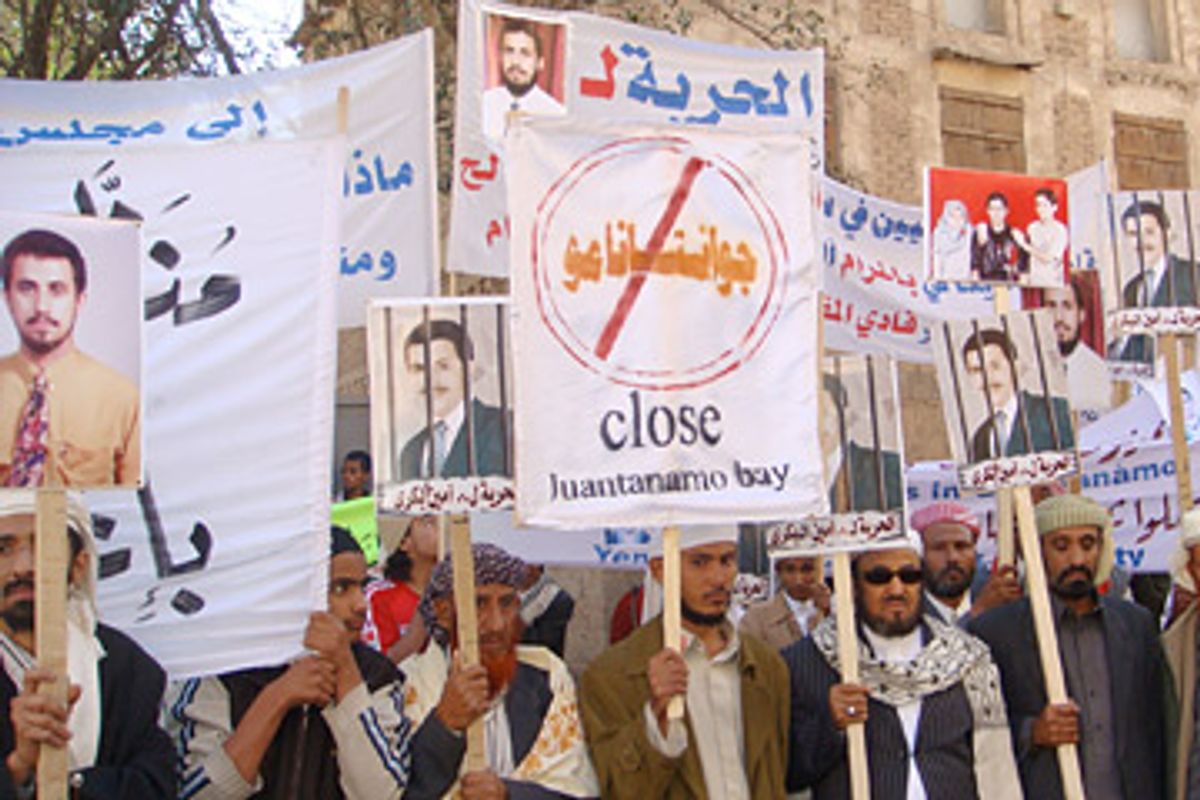
Omar Fawza can't find a wife. The 20-something Yemeni reveals his bachelor status with a sigh that suggests it's the most painful experience of his life -- worse even than the five years he spent in U.S. captivity at Guantánamo Bay and in Afghanistan, where he says he was treated "like a dog."
For Fawza, thwarted marital bliss has become the symbol of his rotten existence since U.S. forces scooped him up in Pakistan shortly after the Sept. 11 attacks. Fawza, who had gone to Afghanistan to fight with the Taliban against their domestic rivals long before 9/11 but never saw combat, was locked up by the Americans as part of "the worst of the worst," and then abruptly sent back to Yemen in 2006. Like most of the 14 Yemenis shipped home from Guantánamo so far, he's been stigmatized in his own country as a terrorist ever since, though he was never charged with a crime.
"Guantánamo has destroyed a big part of my life," he told me in a soft voice over cups of syrupy tea in an office in Yemen. (I have given Fawza a pseudonym and kept our exact meeting place secret to spare him additional grief.) "But I have done nothing wrong."
As soon as the U.S. deposited Fawza back in his homeland, Yemeni security agents threw him in prison for another six weeks. Once again, he was never charged. Since his release, security agents have kept him under constant surveillance. Barred from leaving Yemen, he can't travel outside his hometown without government permission. Old friends and relatives treat him like toxic waste. No one will give him a job, and as for the girl he'd like to marry, "I can't ask her father for her hand because I don't have bride money or a way to support her."
Unless President Obama and Yemeni President Ali Abdullah Saleh agree on a humane repatriation plan for an estimated 100 Yemenis still stuck at Guantánamo, many of them could end up dumped with no help in Yemen like Fawza, or worse -- detained indefinitely without charge under the guise of rehabilitation.
The largest remaining group among Guantánamo's approximately 241 detainees, the Yemenis also are the main obstacle to Obama's pledge to close the notorious prison by next January. A few Yemenis are believed to have committed terrorist acts and probably won't ever leave U.S. custody -- men like Ramzi bin al-Shibh, who openly boasted to a military panel at Guantánamo of helping plan the Sept. 11 attacks. Others may be tried for crimes in Yemen. But the vast majority of Yemenis have never been charged with anything, and some were cleared for release as far back as 2005.
Even though they say that most of the Yemenis should be sent home, U.S. and Yemeni officials appear deadlocked on how to address concerns that they might "join the fight" once they get there. The fears don't come in a vacuum. Al-Qaida is growing in Yemen, a rugged, dirt-poor, politically unstable country on the tip of the Arabian Peninsula where guns outnumber people 3-to-1. Too much has been made about the fact that Yemen is Osama bin Laden's ancestral homeland, but there is no denying that a rite of passage for many young Yemenis has been a stint with the Taliban in Afghanistan or with Sunni insurgents in Iraq. Al-Qaida recently announced it intends to make Yemen a regional base. It doesn't help that Yemen is a stone's throw across the pirate-infested Gulf of Aden from Somalia, a country mired in humanitarian crisis and civil war.
Earlier this month, an al-Qaida suicide bomber blew up four Korean tourists and their Yemeni driver while they visited the ancient, walled Yemeni city of Shibam. Last September, the group claimed responsibility for a double-suicide bombing at the gates of the U.S. Embassy in the capital of Sanaa that killed 18 people.
When I visited Yemen in December, the U.S. Embassy complex looked like a fortress -- encircled with sandbags, concertina wire and hordes of Marines and Yemeni security agents. A clean-cut U.S. Embassy official who met with me was blunt. The Yemeni detainees, he said, must be repatriated in a way that "the threat that they pose has been mitigated to the largest extent possible." That will require rehabilitation, he said, but preferably in "a prison-like facility with a programmatic aspect."
American officials caution that any detention must be in accordance with Yemeni law. But as Murad Zafir, the deputy head of the Yemeni office of the National Democratic Institute, observed over lunch in Sanaa, "Laws in Yemen are like Arabian horses: Good to look at but not to ride."
Most decisions in Yemen are made by President Saleh, whose official portraits adorn every public square and office building, usually with rays of light bouncing off his giant jambiya, the ornate, curved dagger that juts from a Yemeni man's embroidered belt in a potent symbol of status and virility. In vast swaths of territory outside Saleh's grasp, powerful tribal leaders call the shots. Reputable Yemeni human rights groups like the National Organization for Defending Rights and Freedom, or HOOD, say Saleh and sheiks hold hundreds of terror suspects, political rivals and just plain unlucky folk without charge, sometimes for years.
One of the agencies that HOOD and others accuse of abusive roundups is the National Security Bureau, whose deputy chief is Col. Amar Saleh, the president's nephew. A tall man with bulging biceps who looked used to having his way, Amar Saleh tsk-tsked allegations of abuse. Any Yemenis the United States sends home from Guantánamo will receive "red-carpet treatment," he said, adding: "The Americans want us to keep some of them in jail but unfortunately we don't have the [U.S.] files with any of the evidence. That is why we have refused."
Watching guards snap to attention at Amar Saleh's every move, I thought of Fahmi Muhammad, another Yemeni repatriated from Guantánamo. All 14 men were imprisoned in Yemen for some time upon their return, most without charge, and then released with no money, no counseling, no nothing. But Muhammad -- not his real name -- appears to have received the worst treatment by far. Held without charge for two years, often in a dungeon, he said he was routinely beaten by security agents who accused him of being sent home to spy for the United States.
"I told them, if you're going to torture me, it won't be anything new," Muhammad recalled. "The Americans already put me through torture."
If the United States foots most of the bill, the colonel said, Yemen will place future Guantánamo returnees in a rehabilitation camp where they will be provided with sports and cultural activities, counseling, medical care, skills like woodworking, and religious dialogue designed to dissuade them of violence. Relatives will be welcome to visit, and once participants are "rehabilitated," the government will free them and, "give them jobs."
But the "camp" would be locked. Asked who would decide when the men were "rehabilitated," and how long might that take, Amar Saleh provided scant detail, but revealed that "some people could spend a couple of months, others could spend a year or more."
On the drive back from Saleh's gleaming offices, I passed the Political Security Organization, the scene of a spectacular jailbreak in 2006 by 23 al-Qaida members and suspected affiliates -- including two men on the FBI's most-wanted list of terrorists. The prisoners allegedly tunneled into the women's room of a nearby mosque. Many Yemen political experts suspect the inmates had inside help. Both of the men wanted by the FBI subsequently resurfaced and roamed freely for months until the U.S. demanded they be rejailed. Last fall, a Yemeni judge halved on of the two men's 10-year sentences on terrorism related charges.
The jailbreak comes up almost invariably in conversations with U.S. officials. The implication: Even a "prison-like facility with a programmatic aspect" might not be enough to assuage U.S. concerns about sending Yemenis home from Guantánamo.
The prevailing theory is that President Saleh is deliberately engaged in a balancing act between Islamic militants and the so-called Global War on Terror: While occasionally rounding up the usual terrorist suspects to appease Washington, he also gives al-Qaida occasional leeway because he has enlisted many Yemenis who fought in Afghanistan and other foreign jihads in his domestic military adventures. Moreover, many al-Qaida members belong to influential tribes whose loyalty Saleh needs to retain power. But the balance may be tipping toward al-Qaida, which sees Yemen as a potential regional headquarters. Earlier this year, Yemeni al-Qaida leaders announced they were expanding their franchise to include Saudi militants, and named a Saudi who had been released from Guantánamo as their new deputy.
If the Obama administration can't find a way to repatriate the Yemenis that assuages security concerns, it may try to send some of the men to an existing, locked-door rehabilitation center in Saudi Arabia, or move them and the Guantánamo-like system of detention without charge to the U.S. mainland. Though Saleh insists he wants the detainees back, there is widespread suspicion that he would be relieved if the United States finds someplace else to put them.
Many Yemenis wish the men would remain elsewhere as well. "The Guantánamo detainees, you can have them," said a dapper Yemeni engineer named Amir. He suggested, without evidence, that the detainees were probably guilty of something. Amir shared his views at a khat chew, a gathering where Yemenis munch on leaves and stems of the indigenous khat plant until they form a wad in one cheek and release a mild stimulant. Khat is controversial but legal and wildly popular in Yemen, and chews are often the scene of lively and wide-ranging discussions.
"Why are you even concerned about a small detail like the Guantánamo detainees when there are huge human rights problems all across this country?" Amir persisted. Between chomps, Amir and several journalists, human rights workers and scholars lounging on low, brocade couches listed the violations -- civilian deaths and injury from the civil armed conflict in the north, child marriage, zealous application of the death penalty, persecution of journalists and political opponents.
The detainees' fate may not be a big deal for Yemen, I told Amir, but it should be a big deal for President Obama, who has pledged to regain the moral authority the United States lost by having locked up hundreds of men for years without charge at Guantánamo. Any so-called solution that ends up prolonging the detainees' mistreatment will risk fueling anti-American sentiment and giving groups like al-Qaida a powerful tool to persuade disaffected youths to join their cause.
If the detainees are to have a chance of any kind of normal life after Guantánamo, the United States will have to spearhead a long-term, comprehensive rehabilitation program of counseling, job training and other help. Authorities may need to monitor some of the men to allay security concerns, but they shouldn't do so in ways that are functionally equivalent to punishments imposed on convicted criminals and that increase the stigma of Guantánamo.
The U.S. should foot most of the reintegration costs. It's the least it can do after locking up many of these men for more than seven years without charge -- men like Fawza, who still shivers when he talks about how his guards at Guantánamo locked him in a room for hours with the air conditioning on full blast when he refused to answer questions he'd already answered dozens of times before.
Fawza told U.S. military authorities he had traveled to Afghanistan in early 2001 to fight with the Taliban, and that U.S. forces were not even in the country then. He fled to Pakistan and surrendered soon after the United States invaded Afghanistan. His dreams are simple: to attend college, find a good job, and find a way to win that bride.
"All I want is to rebuild my life," he said. "I don't want what happened to me to happen to the others when they come back from Guantánamo."
Shares