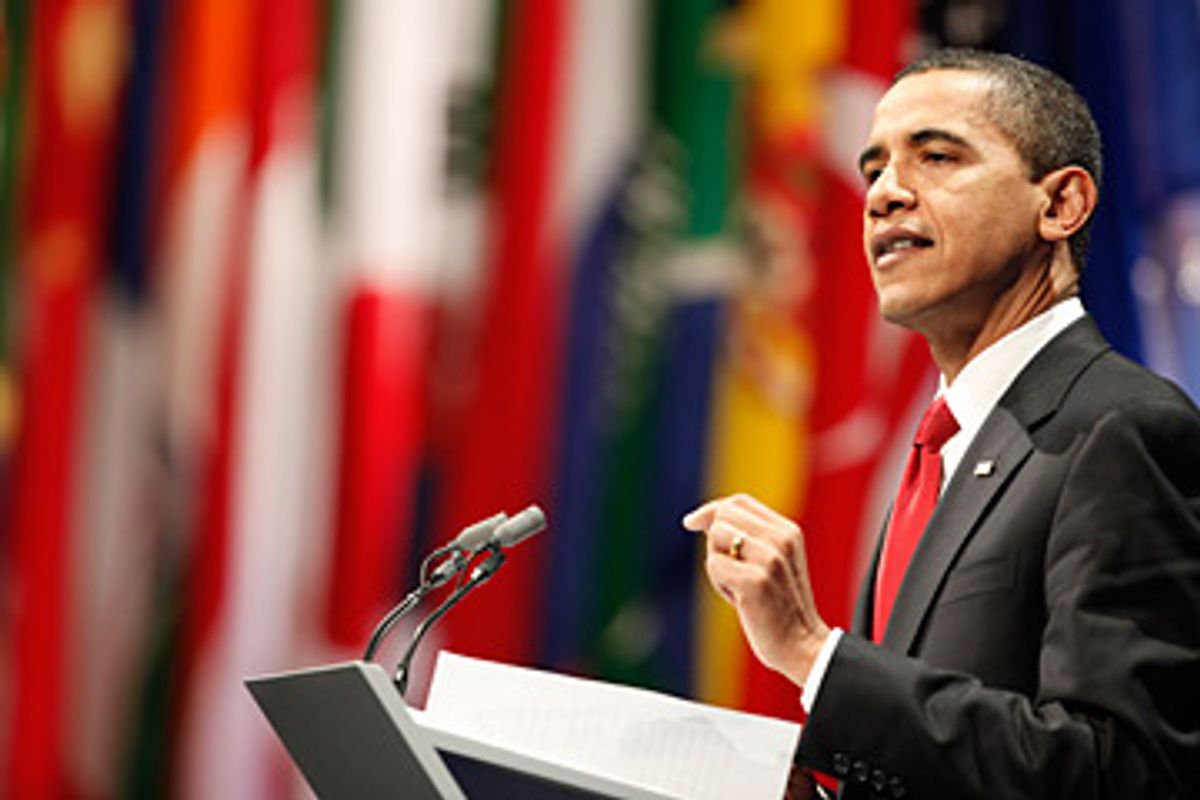
If the world is no longer enthralled by the “old Washington consensus” of privatization, deregulation and weak government, as British Prime Minister Gordon Brown proclaimed at the London G-20 summit, then now it is surely time to reconsider what that consensus has meant for us over the past three decades. We could begin by looking across the Atlantic at the “social market” nations of Europe — where support for families and children is less rhetorical and more real than here.
Most coverage of the summit failed to observe the stinging irony of the debate over stimulus spending that brought the United States into conflict with France and Germany. Today’s American demand that the French and Germans (along with the rest of wealthy Europe) should spend much more on government programs and infrastructure contrasts rather starkly with the traditional American criticism of Europeans for spending too much.
Not that the Obama administration’s complaint about the French and the Germans is necessarily wrong; the Europeans and especially France and Germany should overcome their fear of inflation and spend more to help relieve the global recession. But then we almost always have some complaint against the French — and the French often turn out to be right, as they were when they objected to the invasion of Iraq.
So when the French and other Europeans note pointedly that their societies routinely spend much more than ours to protect workers, women, the young, the elderly, and the poor from economic trouble, they’re merely making a factual observation. (France spends as much as 1.5 percent of GDP annually on childcare and maternity benefits alone.) Different as we are in culture and history, we might even learn something from their example, now that the blinding ideology of the past has been swept away.
By now, most Americans ought to know that Europeans treat healthcare as a public good and a human right, which means that they spend billions of tax dollars annually to insure everyone (although they spend less overall on the medical sector than we do). What most Americans probably still don’t know is that those European medical systems are highly varied, with private medicine and insurance playing different roles in different countries. Expensive as universal quality care has inevitably become, as technology improves and populations age, the Europeans broadly believe in their social security systems — because they provide competitive advantage as well as moral superiority.
From Europe’s perspective, the same can be said of the support its governments provide to families, from the entitlements available to pregnant women and new mothers and fathers, to universal child care and tuition-free higher education, to the special benefits that assist single parents. The challenges that working families face in a globalizing world where both parents work are mitigated by policies designed to encourage balance between home and workplace and adequate attention to children.
These “socialist” measures to protect families are far more effective, of course, than all of the Sunday shouting from American pulpits about the Biblical way of life. Perhaps the leadership of the religious right, still obsessed with stigmatizing gay couples, should take note.
To Americans unfamiliar with the “social market” approach to public policy, the specifics of the European programs are stunning. In France, for instance, women are entitled to 16 weeks of paid maternity leave following the birth of their first and second child — and 26 weeks paid leave following the birth of each subsequent child, at 100-percent of their pre-maternity wages. Men are entitled to 11 days of fully-paid paternity leave, and both mom and dad can take advantage of an additional three years of parental leave with lower benefits. Childcare is subsidized by the state as early as 18 months and by the time children are 30 months old, they are guaranteed a place in France’s free public preschools, which are staffed by well-paid teachers with graduate training in early childhood education. Similar systems and benefits can be found in countries across Western Europe (with the exception of the United Kingdom) — and the effects on educational performance can be seen in many comparative studies. They’re happier, too, by the way (and evangelicals please note that the divorce rate in Norway has fallen by six percent over the past decade, possibly as a result of reduced pressure on families).
In the Nordic countries, benefits are even more generous in certain respects. Sweden provides parents with 15 months of paid parental leave that can be divided as mom and dad think best, and they also can choose to work six hours per day, at pro-rated pay, until their children reach their eighth birthday. (In other words, one or both parents can be home every day when school gets out.)
Like most of their continental neighbors, the nations of the north provide free or highly subsidized, high-quality child care that begins as soon as new mothers return to work. Nearly every child between the ages of three and six is enrolled in the public child care system, because it is staffed by well-paid and well-trained workers overseen by the national ministry of education. The results include not only better socialization and education of young children, but far lower poverty rates, especially among single mothers. And the security of European families is enhanced as well by the universal provision of decent old-age pensions and health care, which relieves the financial burden of supporting elderly parents while trying to raise children. So does free or low-cost university education.
It is true that globalization, aging and immigration have imposed severe pressure on the budgets of European countries, and the trend of increasing benefits that continued until a decade ago has been reversed. But it is also undeniable that despite those pressures, public and political support for the social market economy remains strong across Europe, and that free-market fundamentalism is a thoroughly discredited alternative. The old argument that the social market is unsustainable and hinders growth was never persuasive on close inspection. And the old expectation that outmoded European systems would eventually collapse into imitating ours has been swept away, along with the rest of the Washington consensus. Now perhaps we can honestly consider what America might learn from them.
Dozens of America’s wealthiest taxpayers — including hedge fund legend Michael Steinhardt, super trial lawyer Guy Saperstein, and Ben Cohen of Ben & Jerry’s fame — have appealed to President Obama not to renew the Bush tax cuts for anyone earning more than $1 million a year. Calling themselves “Patriotic Millionaires for Fiscal Strength,” the 40-plus signers today launched a website and a campaign that they hope will draw support from others who agree that fiscal responsibility should begin with those who can best afford it — as their letter to Obama explains:
We are writing to urge you to stand firm against those who would put politics ahead of their country.
For the fiscal health of our nation and the well-being of our fellow citizens, we ask that you allow tax cuts on incomes over $1,000,000 to expire at the end of this year as scheduled.
We make this request as loyal citizens who now or in the past earned an income of $1,000,000 per year or more.
We have done very well over the last several years. Now, during our nation’s moment of need, we are eager to do our fair share. We don’t need more tax cuts, and we understand that cutting our taxes will increase the deficit and the debt burden carried by other taxpayers. The country needs to meet its financial obligations in a just and responsible way.
Letting tax cuts for incomes over $1,000,000 expire, is an important step in that direction.
The Patriotic Millionaires campaign, pulled together quickly by the Agenda Project in New York City, just happens to appear on the same day as a new study from the Center for Responsive Politics revealing that half of the members of the House and the Senate are millionaires. That contrasts sharply with the general population, of whom fewer than 1 percent can claim millionaire status.
Not surprisingly, some of the super-rich declined to join the Patriotic Millionaires when the Agenda Project reached out to them. At least two airily dismissed the Bush tax cuts for millionaires and above — which will cost well over $700 billion over the coming decade — as “small potatoes.” And a Manhattan hedge fund billionaire said he believes the cuts should be extended and added that “the moneys should be used to pay down debt” — which sounds like the magical Republican plan to simultaneously cut taxes, wage war and drastically reduce the deficit. The same investor also complained that “anyone who has money is made to feel that they’re bad.”
Bad? Only if they’d rather force Grandma to eat cat food than pay their fair share.
Continue Reading
Close
On the same day that the House Ethics Committee convicted Rep. Charles Rangel of nearly a dozen violations of congressional rules, Sen. Mitch McConnell announced that under pressure from fellow Republicans, he will surrender his beloved earmarks. This is a notable coincidence because, like Rangel, McConnell has rewarded corporate donors to an academic center named after him — and used earmarks for that purpose. The top corporate recipient of earmarks from the Kentucky Republican in the 2010 budget not only happens to be a donor to the McConnell Center for Political Leadership at the University of Louisville, but one of the largest and most corrupt defense contractors in the world.
Topping the list of Rangel’s transgressions was the misuse of his congressional clout to raise money for a vanity academic “center” named after him at the City University of New York from private donors. Yet somehow McConnell got away with the same kind of dubious dealings at the University of Louisville — and was allowed to reward BAE Systems, donor of $500,000 to the McConnell Center, with $17 million worth of defense earmarks.
For years, the long list of corporate donors to the university’s McConnell Center for Political Leadership was kept secret, presumably out of deference to the senator and his well-heeled friends, including Toyota, AIG, RJ Reynolds and Philip Morris, among others. Perhaps the most questionable gift came from United Defense, a subsidiary of BAE Systems, the Pentagon contractor that finally settled a huge, transatlantic bribery case with the Justice Department last spring. United Defense gave $500,000 to the McConnell Center, and the senator has continued to perform for the company ever since, even while BAE was subject to a federal investigation that led to a record $450 million fine and three years of monitoring by a court-appointed “compliance officer.” Ironically, the chief accusations against BAE involved bribery of public officials (in Saudi Arabia, not Kentucky).
Everyone knew that BAE was suspected of serious corruption — and under investigation not only here but in Britain and Austria as well — when McConnell sponsored $25 million of earmarks for the company back in 2007. By the time he pushed through the FY 2010 earmarks last year, both the United Kingdom’s Serious Fraud Office and the Justice Department were preparing to file criminal charges. BAE’s sales tactics in the Mideast and Central Europe were not only crooked but interfered with American oversight of sensitive defense technology, according to Justice Department officials.
So while McConnell and his caucus are (temporarily and reluctantly) giving up their power to reward dubious donors like BAE with earmarks, it is hard not to wonder how the stringent “reformers” of the Tea Party can support his reelection as Republican leader.
Continue Reading
Close
How Darrell Issa will conduct the vital business of the House Oversight Committee when he takes over as chairman isn’t clear yet. When the California Republican describes his plans in the mainstream media, he strives to sound reasonable, bipartisan and public-spirited; but when speaking with media outlets and personalities, such as Rush Limbaugh, he sounds like a hard-line right-winger aiming to revive the paranoid partisan style of the Gingrich era — which would be more in keeping with the reputation he has already established. He displayed the fugue state that preoccupies him when he denounced President Obama on CNN as “the most corrupt” occupant of the Oval Office in modern times – and then withdrew that accusation with an apology.
Now Issa has announced that he expects the Oversight committee and its subcommittees to hold nearly three times as many investigative hearings over the next two years as Henry Waxman, an active and successful chairman, ran during the final years of the Bush administration. He may consider the federal government (and the White House) to be bottomless pits of waste, fraud and abuse, but are there really three times as many troubling issues for Issa and his colleagues to study now as there were in the Bush years?
The answer is yes, so long as the threshold for investigation is absurdly low, such as the question of whether federal agencies are spending too much money on signs to identify construction projects funded by stimulus money under the American Recovery and Reinvestment Act.
Road signs displaying the names of various government officials and agencies are neither new nor scandalous, but local Republicans have been whining about the erection of signs bearing the president’s name and the Recovery Act logo as examples of Soviet-style propaganda. For months, Issa has been riding this issue, promoting stories in local newspapers that suggest waste, wrongdoing and political misuse of funds, with hints that the Recovery Act symbol bears a suspicious resemblance to the 2008 Obama campaign logo. Last August, World Net Daily, which did so much to promote phony scandals a decade ago, urged its gullible readers to “report” the ARRA signs to Issa’s office (under the byline of the foul-mouthed Swift boat hoaxter Jerome Corsi).
This week, Issa indicated that he will continue to pursue such small-time, seemingly bogus concerns with a tweet linking to an article complaining about stimulus project signage in the Greeley Gazette: “Citizen-watchdogs & new technology made this (http://tinyurl.com/28egdr5) possible … how can we do more of this? Would love your thoughts.”
It is hard to imagine that road signs represent more than a minuscule fraction of 1 percent of the $787 billion stimulus budget, but then again Republicans constantly bemoan minor spending items — such as congressional earmarks — that actually have almost no real fiscal impact. Perhaps their budgetary record is historically so miserable because they just can’t do the arithmetic. But that can scarcely be true of Issa, an entrepreneur who earned his own huge fortune and is still the wealthiest member of Congress.
Certainly Issa should provide serious oversight of the stimulus spending, which is a fundamental congressional responsibility assigned to his committee. He ought to stop taking potshots at road signs — and instead start examining the administration’s record in selecting and contracting projects.
Of course, that might not be quite as much fun as stirring up the Tea Party rubes with diversions like the road sign “issue.” According to the independent watchdogs at Pro Publica and Politifact, the administration has succeeded in contracting stimulus projects at considerably lower cost than originally anticipated so far. Lower bidding has meant millions of dollars saved, with those saved funds in turn financing thousands of additional projects — and many thousands of jobs — across the country.
Continue Reading
Close
Long before the dismal results of Tuesday’s election were complete, one especially dog-eared bit of guidance for President Obama was getting wide circulation in the mainstream: He must now emulate Bill Clinton, who “shifted to the center” after the electoral debacle of November 1994, “triangulated” his way to compromise with the Republicans, and won a second term.
Among the reasons why such advice is outdated and useless, the most obvious may be that Obama’s position today is stronger than Clinton’s after 1994. Today, unlike then, the Democrats can look forward to retaining control of the Senate. But there are two other overriding reasons why Obama shouldn’t seek to imitate Clinton by immediately seeking compromises with the Republicans.
The first is that he has tried vainly from the beginning of his presidency to engage the Republicans in negotiation over vital reforms, only to learn again and again that they aren’t really interested in anything but sabotage. The second is that compromising with the Republicans isn’t exactly what Clinton did — or not at first, anyway. Before he could do anything else, he had to push back.
Yes, Clinton made a rhetorical gesture toward the Gingrich “revolution” when he said that “the era of big government is over.” As things turned out, however, that remark was studded with asterisks, footnotes, and exceptions that gave “big government” a meaning entirely different from the standard conservative interpretation. Yes, he eventually signed a welfare reform bill — ending the family support entitlement “as we know it” — which he had promised to do in his 1992 campaign (although he later emended many of that bill’s worst features). And yes, he sought to balance the federal budget at a time when that seemed a heresy to the Democratic base.
Yet the most important political events in the first year following the ’94 midterm were not compromises over policy, but confrontations that swiftly became disruptive, angry, polarizing — and that Clinton won. When the Gingrich Republicans twice shut down the government at the end of 1995 in order to win their way on the budget, the president faced them down and portrayed them as right-wing extremists whose ideology portended chaos. He kept that message alive not only as he confronted the Republicans in Washington, but in a series of stealthy political commercials heralding his reelection bid that started airing in the summer of 1995, nearly a year and a half before the 1996 election.
Therein lies the pointed lesson that Obama might learn from his Democratic predecessor, and use to navigate the political and economic landscape after the midterm. What worked so well for Clinton was to recognize public concern over the leviathan of spending — and to defend popular social, health, and environmental programs at the same time.
Similarly, Obama can acknowledge the importance of long-term deficit reduction, while challenging the Republicans to show how balance can be achieved without taxing the wealthy whose pockets they invariably protect. The answer is that it can be done only with big tax increases on everyone else and programmatic cutbacks that would raise howls of protest from many Republican constituencies — starting with the elderly and rural voters that gave them their latest victory.
While the president need not endorse every recommendation of his bipartisan fiscal advisory commission — dubbed the “Catfood Commission” for its expected endorsement of cuts in Social Security — he can use their findings to insist that the House Republicans no longer attempt to “repeal arithmetic,” as Clinton himself often put it during this campaign.
Against that background, Obama should insist that Rep. Paul Ryan (R-Wisc.), the incoming House Budget committee chair, name the specific programs that he thinks should be cut to finance continuing the Bush tax cuts for the wealthiest one percent.
He should make sure Ryan explains that his plan would not simply cut Medicare costs — a feature of the health reform bill that Republicans have loudly opposed all year – but would actually abolish Medicare, Medicaid and the Children’s Health Insurance Program altogether and replace those programs with inadequate private vouchers. He should tweak Ryan over the remarkable “bailout” provision in his Social Security proposal, which would leave taxpayers responsible for ensuring that privatized accounts be guaranteed against stock market declines, a vast potential liability that represents a gigantic gift to those same Wall Street houses supposedly hated by the Tea Party.
Perhaps most important, the president should ask Ryan to outline his plan for a 23 percent value-added tax — the equivalent of a national sales tax — while cutting taxes to historic lows for the very top brackets. He should question how the Ryan plan will reduce the deficit, when experts say it will actually make matters much worse. And he can point out that his own tax cuts, which were part of the stimulus package, were far more broad-based and fair.
By emphasizing those issues in the context of a budget-balancing debate, Obama can underline contradictions between the Tea Party radicals and the Republican establishment. By doing so, he may even tempt the Tea Party to overreach for another government shutdown, even though John Boehner (R-Ohio) , the incoming House Speaker, has vowed not to step into that trap again.
Perhaps he won’t — and perhaps he won’t be pushed by the Tea Party. But Obama should nevertheless seek to draw contrasts at every step, using his rhetorical gifts to outline the extremist Republican policies that an overwrought and furious electorate never meant to endorse. If he can competently expose what is behind the false promises of his Congressional opponents — who remain considerably less popular than he is — then the fickle independents will start to turn away from them, the enthusiasm gap will shrink, and he will have taken the first step toward reelection.
Continue Reading
Close
As Bill Clinton began the last day of the midterm campaign on a chilly morning in Saratoga Springs, not far from New York’s border with Canada, he confided jokingly that he had originally expected only “to do a few events this year to honor the people who had supported us,” noting that his wife, as secretary of state, is prohibited by law and custom from partisan politicking.
“This is my 127th event,” he recalled as the crowd of 1500 upstate Democrats laughed appreciatively. “And I’ve kept going because I am so concerned that in the fact-free environment of this election, people are going to choose exactly what they don’t want.” That concern spurred him on a grueling, 18-hour series of jet hops from two stops in the northern reaches of his adopted state on to McKeesport, Pennsylvania, then Beckley, West Virginia, Louisville, Kentucky, and finally Orlando, Florida for a late-night rally.
The former president always draws enthusiastic crowds, and they listened raptly to his latest political pitch, which included point by point explanations of the student loan reform, healthcare reform and the banking bill to his argument that he and his fellow Democrats — not the Republicans — deserve the affections of the Tea Party.
Repeatedly, he complained about the “cowardice” of the “Anonymously financed advertising” that has targeted Democratic candidates, courtesy of Karl Rove and the Supreme Court — and the real reasons why the funders of those ads want to remain unknown. “When I was growing up, my mother always told me that if I had a problem with someone, I should go straight up to them, put my shoulders back, make sure they knew my name, and say whatever I had to say — and not sneak around behind somebody’s back,” he said as he stood beside West Virginia Governor Joe Manchin, the embattled Democratic candidate for U.S. Senate. “The reason they don’t want you to know who’s paying for those ads against Joe is because if you knew who they were, it would make you more likely to vote for him.”
Like most Clinton speeches, the final version of his midterm pitch included pithy riffs on broad variety of policy issues — because, as he said later on the plane, the American people “are starving for explanations. They want someone to tell them what the hell is going on. And in the present media environment it is imperative to repeat the same message again and again for anyone to hear it.”
The reason that Democrats face such dire prospects in this campaign, he continued, is that the party’s elected leaders have spent the past year enduring a crescendo of attacks from Republican politicians and right-wing media — without answering them. He seemed mystified that the Democratic leaders had done so little to justify and promote their legislative achievements, which he has been touting at every stop. Conceding that “we made mistakes” that led to his party’s loss of 54 House seats in the 1994 midterm, he added that “now we know a midterm election can be nationalized and should act accordingly.”
That is why he tried to frame the election as a set of choices between destructive Republican policies that favor “people like me, who make more than a million dollars a year” and the great majority of Americans who don’t. In full populist mode, he concluded nearly every stop with a riff on fiscal responsibility, recent presidential history, and the false consciousness of the Tea Party.
“Last weekend, I read a touching story article about two ladies who started the Tea Party movement,” he said, referring to a profile in the Wall Street Journal. “They were outraged by the bailout. And who wasn’t? President Bush told me that signing the bailout made him sick.”
Yet the bank reform bill pushed through by the White House and the Democrats, against Republican opposition, will “outlaw” future bailouts and make financial executives and shareholders pay if they recklessly squander their assets. “So why would the Tea Party support the Republicans, who have promised to repeal that bill because their friends on Wall Street don’t like it?” he wondered.
But beyond that, he said, the Tea Party ought to look more closely at the past 28 years of American history before they reject the Democrats and embrace the Republicans. “During the 12 years before I took office, the Republicans quadrupled the national debt,” he said. “I balanced the budget after four years and left a surplus that would have erased the national debt by 2015 if they had left my budget in place.” Instead, the second Bush administration doubled the national debt again, bequeathed the nation a series of future deficits — and failed to create one-tenth as many jobs as Clinton did, while shrinking the size of government as a portion of the national economy.
And, he noted, it was President Obama and the Democrats in Congress who have actually cut taxes for most Americans in the stimulus bill — not the Republicans. If the Tea Party movement wants more jobs, balanced budgets, lower taxes and smaller government, he insisted, they should be supporting Democrats.
“Where is the love?” he cried. “I ought to be the Tea Party’s poster child.”
The crowds roared every time.
Continue Reading
Close