Afghanistan
“I believe that I did have PTSD”
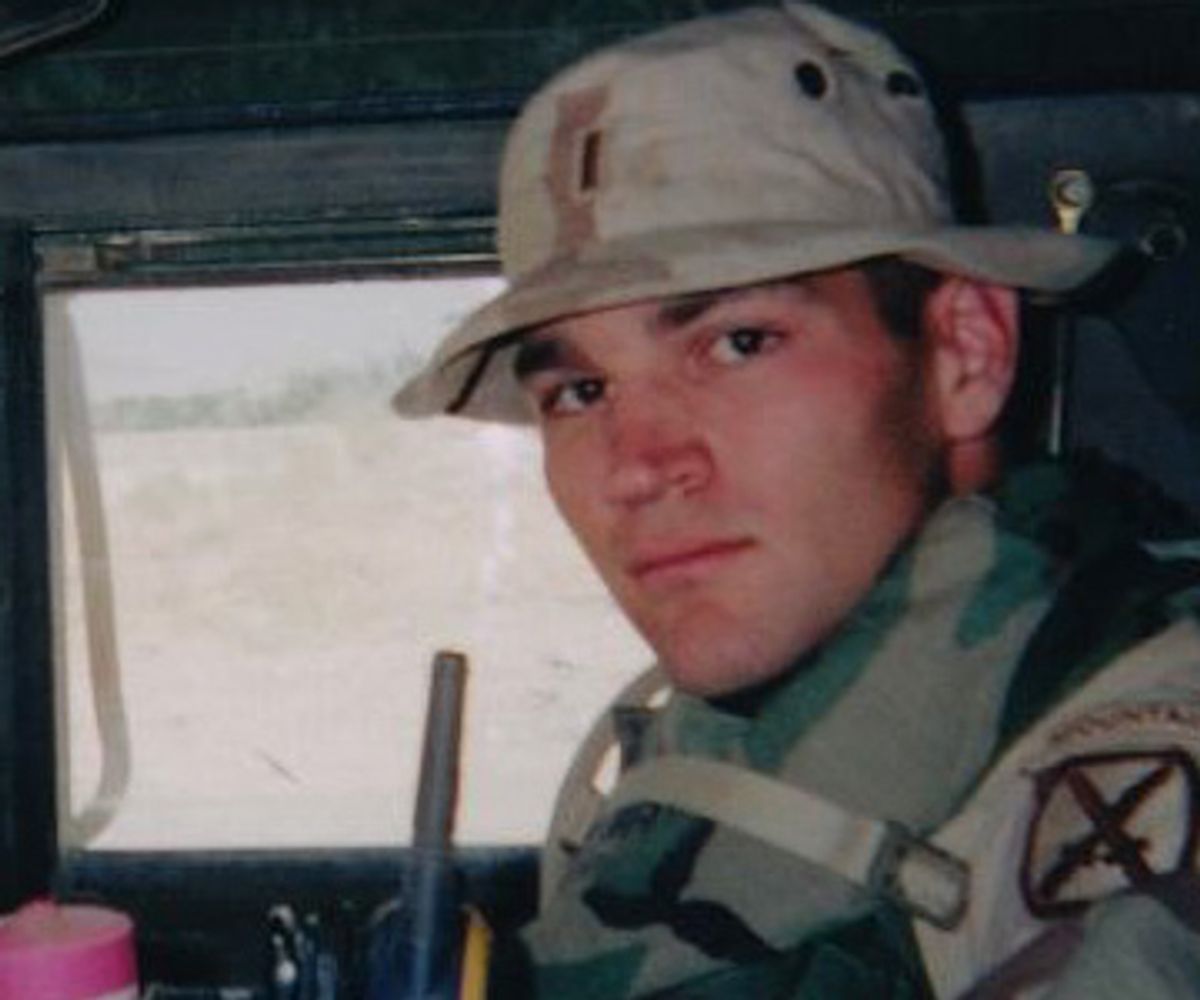
Matthew Marino was sent back to Afghanistan for a second tour of duty after the Army diagnosed him with "anxiety disorder" instead of post-traumatic stress disorder.
Matthew Marino served five years in the Army and was deployed to fight in Afghanistan twice. He began to suffer from symptoms typical of post-traumatic stress disorder following his first tour. After returning to Fort Drum, N.Y. in late 2004, he couldn’t lose the hyper-alertness he’d developed in Afghanistan. He had thoughts of suicide, was nervous, had nightmares, couldn’t sleep, and stayed away from family and friends.
Despite his symptoms, however, the Army diagnosed the first lieutenant with anxiety disorder instead of PTSD. He was also diagnosed with depression and given antidepressants. The Army then “stop-lossed” Marino, to prevent him from leaving the Army although his time was up. He was shipped back to Afghanistan for a second tour in 2006. A diagnosis of PTSD might have kept him from being redeployed and sent back into combat; a diagnosis of anxiety disorder did not.
In two stories published this week, Salon has described how a soldier secretly taped an Army psychologist named Douglas McNinch saying that the Army was exerting pressure on him not to diagnose soldiers with post-traumatic stress disorder. According to McNinch, the Army preferred that he diagnose soldiers with anxiety disorder instead — the same diagnosis Marino received. Marino’s experience is a case study in what happens when Army medical care is influenced by the need to keep soldiers on the battlefield and the need to hold down the cost of long-term disability payments.
Marino returned to the States from his second tour in Afghanistan at the beginning of 2007 with symptoms nearly identical to those he’d experienced after his first tour. But the Army processed him out by Feb. 10, 2007 without a real medical examination. Marino recalls filling out a written questionnaire and then being discharged. “They didn’t spend any time checking me when I went out the door.”
When Marino left the Army, all he had were his anti-depression pills and a vague diagnosis from the Army. The diagnosis said, essentially, that Marino was anxious and depressed, but that neither his anxiety nor his depression were necessarily caused by the war. His condition worsened. “My wife was pushing me to go to therapy over and over again,” he said.
And he did. This time, however, Marino went to a facility in Boston run by the Department of Veterans Affairs, the government agency responsible for pay and benefits for service members after they leave the military. There, doctors diagnosed him with PTSD from the war. This means he can receive therapy tailored to help ameliorate the symptoms of combat stress. He also now receives financial benefits from the VA for his mental wounds.
There is no way of knowing for certain whether the Army misdiagnosed Marino with anxiety disorder instead of PTSD after his initial deployment in Afghanistan. His symptoms, however, suggest that that’s exactly what happened. “If you want my opinion,” says Marino, “I believe that I did have PTSD after the first tour.” Marino thinks the Army misdiagnosed him with anxiety disorder, but “I can’t say whether it was by intent or negligence that it was misdiagnosed.”
If Marino had not gone to the VA clinic in Boston and asked for help, who knows how long he would have gone on with the wrong diagnosis and without proper benefits. “There are probably plenty of people walking around with the same thing,” he said. “PTSD has caused me a lot of hardship. If I can help anyone else with my story I’m happy to do it.”
Mark Benjamin is a national correspondent for Salon based in Washington, D.C. Read his other articles here. More Mark Benjamin.
Michael de Yoanna is a journalist and documentary filmmaker who won an Edward R. Murrow award for investigative radio journalism in 2011. You can view his past work at Salon here, visit his personal website here, and follow him on Twitter @mdy1. More Michael de Yoanna.
Memorial Day’s lessons in amnesia
If nothing else, the holiday allows us to reflect on our commitment to forgetting bloody conflicts
(Credit: Carly Rose Hennigan via Shutterstock) It’s the saddest reading around: the little announcements that dribble out of the Pentagon every day or two — those terse, relatively uninformative death notices: rank; name; age; small town, suburb, or second-level city of origin; means of death (“small arms fire,” “improvised explosive device,” “the result of gunshot wounds inflicted by an individual wearing an Afghan National Army uniform,” or sometimes something vaguer like “while conducting combat operations,” “supporting Operation Enduring Freedom,” or simply no explanation at all); and the unit the dead soldier belonged to. They are seldom 100 words, even with the usual opening line: “The Department of Defense announced today the death of a soldier who was supporting Operation Enduring Freedom.” Sometimes they include more than one death.
Continue Reading CloseTom Engelhardt, co-founder of the American Empire Project, runs the Nation Institute's TomDispatch.com. His latest book, "The United States of Fear" (Haymarket Books), has just been published. More Tom Engelhardt.
Where the wounded are
Wars don't just cause casualties among soldiers, they drain medical staff. I traveled to see the costs firsthand
A soldier is prepared for an operation at Landstuhl Regional Medical Center. (Credit: Reuters/Kai Pfaffenbach) The weather’s getting warmer in Afghanistan and the war there is heating up again. That means – as it has meant every year for more than a decade — that the pace will quicken at the Landstuhl Regional Medical Center in Germany. More casualties will be brought to this largest American military hospital outside the United States. The Critical Care Air Transport teams and their C-17 Globemasters will fly in from “downrange,” as they call the Afghan battleground, and the injured will be brought by ambulance bus from nearby Ramstein Air Force Base to the hospital front door.
Continue Reading CloseMichael Winship is senior writing fellow at Demos and a senior writer of the new series, Moyers & Company, airing on public television. More Michael Winship.
NATO invites Pakistan to summit
A sign that Islamabad is ready to reopen its western border to NATO troops on their way to Afghanistan
Oil tankers, which were used to transport NATO fuel supplies to Afghanistan, are parked at a compound in Karachi, Pakistan, Tuesday, May 15, 2012. NATO on Tuesday invited Pakistani President Asif Ali Zardari to the alliance's summit in Chicago, after signs that the country could be moving to reopen its Afghan border to NATO military supplies. (AP Photo/Shakil Adil)(Credit: AP) ISLAMABAD (AP) — NATO on Tuesday invited Pakistan’s president to the upcoming Chicago summit on Afghanistan, the strongest sign yet that Islamabad is ready to reopen its western border to U.S. and NATO military supplies heading to the war in the neighboring country.
Pakistan blocked the routes in November after American airstrikes killed 24 of its troops on the Afghan border. The attack sent ties between Washington and Islamabad to new lows, threatening regional cooperation needed for negotiating an end to the Afghan war.
Continue Reading CloseAfghanistan, I can’t quit you
My mom pushed me to join the Marines. Now that she's gone, I'm still drawn to war zones
A child flies a kite in Kabul on Tuesday Mar. 27, 2012. (Credit: Geoffrey Ingersoll) The heat. That’s what I remember most. Shimmery and bright. Blinding. Stifling. Heeee-eeaat.
The kind that’s not just on you, wrapped around you, but balled up and pulsing inside you — a desert blanket with teeth. It’s a type of heat that makes your skin cry and your eyeballs sweat, even in the shade; heat like a predator you can’t run away from.
I notice it right as I get off the plane — not just the degrees but also the dust. Dust you can smell, kicked up by a thousand years of struggle. In a region this old, I’m sure each breath carries a dose of unintended history: Inhale, Alexander the Great; exhale, the Ottoman Empire; inhale, the USSR; exhale, the Taliban.
Continue Reading CloseGeoffrey Ingersoll is a freelance journalist, documentarian, writer, photographer, and veteran of Operation Iraqi Freedom. He is the recipient of the Sam Stavisky Award for Combat Reporting. More Geoffrey Ingersoll.
What Obama didn’t mention in Kabul
Just outside the Afghan capital, the Taliban is in control and preparing for a wider war
President Barack Obama addresses troops at Bagram Air Field, Afghanistan, Wednesday, May 2, 2012. (AP Photo/Charles Dharapak)(Credit: AP) MAHMUD RAQI, Afghanistan — The office of Kapisa’s governor sits high on a hilltop overlooking the provincial capital, Mahmud Raqi. It has a beautiful view of the river below and the mountains, trees and fields that stretch into the distance.
Beneath the tranquil surface, however, lies a grim truth. Just outside town roadside bombs are planted to target NATO convoys.
Page 1 of 122 in Afghanistan