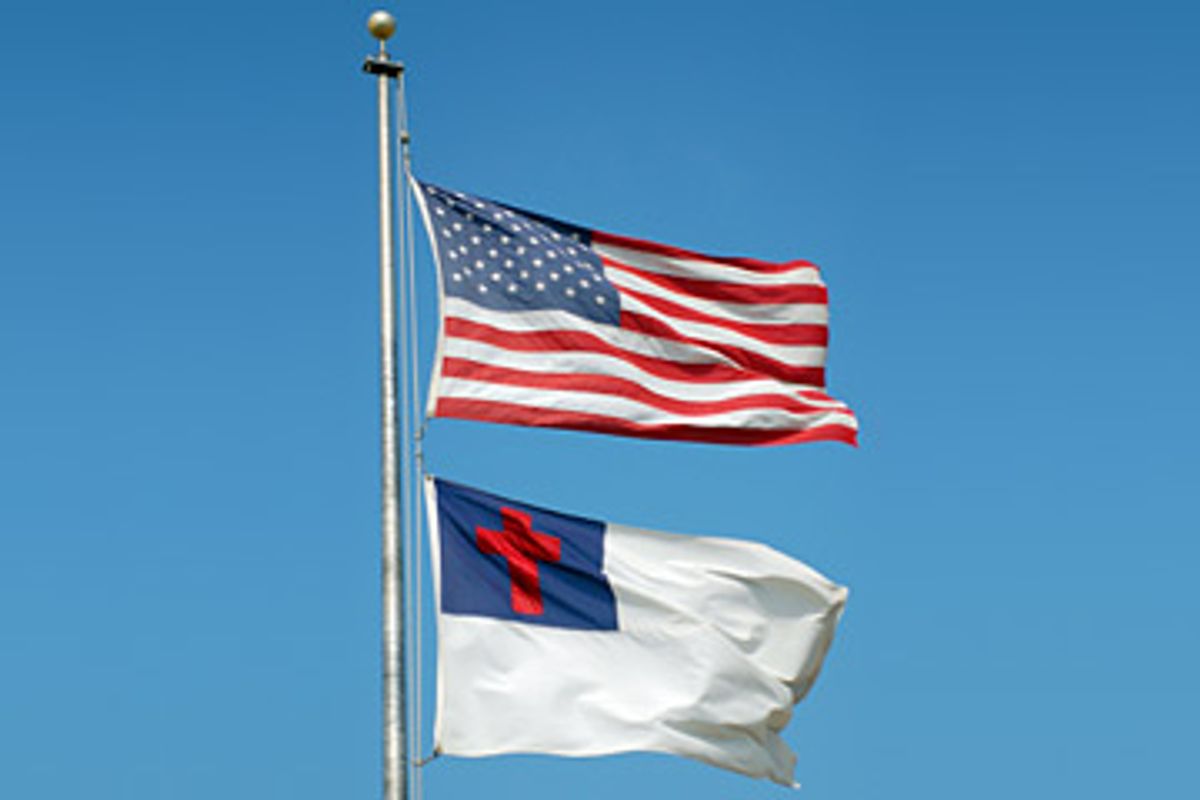
Is America a Christian nation, as many conservatives claim it is? One American doesn't think so. In his press conference on April 6 in Turkey, President Obama explained: "One of the great strengths of the United States is … we have a very large Christian population -- we do not consider ourselves a Christian nation or a Jewish nation or a Muslim nation. We consider ourselves a nation of citizens who are bound by ideals and a set of values."
Predictably, Obama's remarks have enraged conservative talking heads. But Obama's observations have ample precedent in American diplomacy and constitutional thought. The most striking is the Treaty of Tripoli, ratified by the U.S. Senate in 1797. Article 11 states: "As the Government of the United States of America is not, in any sense, founded on the Christian religion; as it has in itself no character of enmity against the laws, religion, or tranquility [sic], of Mussulmen [Muslims]; and, as the said States never have entered into any war, or act of hostility against any Mahometan nation, it is declared by the parties, that no pretext arising from religious opinions, shall ever produce an interruption of the harmony existing between the two countries."
Conservatives who claim that the U.S. is a "Christian nation" sometimes dismiss the Treaty of Tripoli because it was authored by the U.S. diplomat Joel Barlow, an Enlightenment freethinker. Well, then, how about the tenth president, John Tyler, in an 1843 letter: "The United States have adventured upon a great and noble experiment, which is believed to have been hazarded in the absence of all previous precedent -- that of total separation of Church and State. No religious establishment by law exists among us. The conscience is left free from all restraint and each is permitted to worship his Maker after his own judgment. The offices of the Government are open alike to all. No tithes are levied to support an established Hierarchy, nor is the fallible judgment of man set up as the sure and infallible creed of faith. The Mohammedan, if he will to come among us would have the privilege guaranteed to him by the constitution to worship according to the Koran; and the East Indian might erect a shrine to Brahma, if it so pleased him. Such is the spirit of toleration inculcated by our political Institutions."
Was Tyler too minor a president to be considered an authority on whether the U.S. is a Christian republic or not? Here's George Washington in a letter to the Hebrew Congregation of Newport, Rhode Island in 1790: "The citizens of the United States of America have a right to applaud themselves for having given to mankind examples of an enlarged and liberal policy -- a policy worthy of imitation. All possess alike liberty of conscience and immunities of citizenship. It is now no more that toleration is spoken of as if it were the indulgence of one class of people that another enjoyed the exercise of their inherent natural rights, for, happily, the Government of the United States, which gives to bigotry no sanction, to persecution no assistance, requires only that they who live under its protection should demean themselves as good citizens in giving it on all occasions their effectual support ... May the children of the stock of Abraham who dwell in this land continue to merit and enjoy the good will of the other inhabitants -- while every one shall sit in safety under his own vine and fig tree and there shall be none to make him afraid."
Eloquent as he is, Barack Obama could not have put it better.
Contrast this with John McCain's interview with Beliefnet during the 2008 presidential campaign: "But I think the number one issue people should make [in the] selection of the President of the United States is, 'Will this person carry on in the Judeo Christian principled tradition that has made this nation the greatest experiment in the history of mankind?'" Asked whether this would rule out a Muslim candidate for the presidency, McCain answered, "But, no, I just have to say in all candor that since this nation was founded primarily on Christian principles ... personally, I prefer someone who I know has a solid grounding in my faith. But that doesn't mean that I'm sure that someone who is a Muslim would not make a good president. I don't say that we would rule out under any circumstances someone of a different faith. I just would -- I just feel that that's an important part of our qualifications to lead."
Conservatives who, like McCain, assert that the U.S. is in some sense a Christian or Judeo-Christian nation tend to make one of four arguments. The first is anthropological: The majority of Americans describe themselves as Christians, even though the number of voters who describe themselves as religiously unaffiliated has grown from 5.3 percent in 1988 to 12 percent in 2008. But the ratio of Christians to non-Christians in American society as a whole is irrelevant to the question of whether American government is Christian.
The second argument is that the constitution itself is somehow Christian in character. On that point, candidate McCain said: "I would probably have to say yes, that the Constitution established the United States as a Christian nation." Is McCain right? Is the U.S. a Christian republic in the sense that according to their constitutions Iran, Iraq and Afghanistan are all now officially Islamic republics? What does the Constitution say? Article VI states that "no religious test shall ever be required as a qualification to any office or public trust in the United States." Then there is the First Amendment: "Congress shall make no law respecting an establishment of religion, or prohibiting the free exercise thereof ... "
True, over the years since the founding, Christian nationalists have won a few victories -- inserting "In God We Trust" on our money during the Civil War in 1863, adding "under God" to the Pledge of Allegiance during the Cold War in 1954. And there are legislative and military chaplains and ceremonial days of thanksgiving. But these are pretty feeble foundations on which to claim that the U.S. is a Christian republic. ("Judeo-Christian" is a weaselly term used by Christian nationalists to avoid offending Jews; it should be translated as "Christian.")
The third argument holds that while the U.S. government itself may not be formally Christian, the Lockean natural rights theory on which American republicanism rests is supported, in its turn, by Christian theology. Jefferson summarized Lockean natural rights liberalism in the Preamble to the Declaration of Independence: "We hold these truths to be self-evident, that all men are created equal, that they are endowed by their Creator with certain unalienable rights … that to secure these rights, governments are instituted among men, deriving their just powers from the consent of the governed …" Many conservatives assert that to be a good Lockean natural nights liberal, one must believe that the Creator who is endowing these rights is the personal God of the Abrahamic religions.
This conflation of Christianity and natural rights liberalism helps to explain one of John McCain's more muddled answers in his Beliefnet interview: "[The] United States of America was founded on the values of Judeo-Christian values [sic], which were translated by our founding fathers which is basically the rights of human dignity and human rights." The same idea lies behind then-Attorney General John Ashcroft's statement to religious broadcasters: "Civilized individuals, Christians, Jews and Muslims" -- sorry, Hindus and Buddhists! -- "all understand that the source of freedom and human dignity is the Creator."
In reality, neither Jewish nor Christian traditions know anything of the ideas of natural rights and social contract found in Hobbes, Gassendi and Locke. That's because those ideas were inspired by themes found in non-Christian Greek and Roman philosophy. Ideas of the social contract were anticipated in the fourth and fifth centuries BC by the sophists Glaucon and Lycophron, according to Plato and Aristotle, and by Epicurus, who banished divine activity from a universe explained by natural forces and taught that justice is an agreement among people neither to harm nor be harmed. The idea that all human beings are equal by nature also comes from the Greek sophists and was planted by the Roman jurist Ulpian in Roman law: "quod ad ius naturale attinet, omnes homines aequales sunt" -- according to the law of nature, all human beings are equal.
Desperate to obscure the actual intellectual roots of the Declaration of Independence in Greek philosophy and Roman law, Christian apologists have sought to identify the "Creator" who endows everyone with unalienable rights with the revealed, personal God of Moses and Jesus. But a few sentences earlier, the Declaration refers to "the Laws of Nature and of Nature's God." Adherents of natural rights liberalism often have dropped "Nature's God" and relied solely on "Nature" as the source of natural rights.
In any event, in order to be a good American citizen one need not subscribe to Lockean liberalism. Jefferson, a Lockean liberal himself, did not impose any philosophical or religious test on good citizenship. In his "Notes on the State of Virginia," he wrote: "The legitimate powers of government extend to such acts as are injurious to others. But it does me no injury for my neighbor to say there are twenty gods, or no god. It neither picks my pocket nor breaks my leg."
The fourth and final argument made in favor of a "Christian America" by religious conservatives is the best-grounded in history but also the weakest. They point out that American leaders from the founders to the present have seen a role for otherwise privatized and personal religion in turning out moral, law-abiding citizens. As George Washington wrote in his 1796 Farewell Address:
"Of all the dispositions and habits, which lead to political prosperity, Religion and Morality are indispensable supports. In vain would that man claim the tribute of Patriotism, who should labor to subvert these great pillars of human happiness, these firmest props of the duties of Men and Citizens. The mere Politician, equally with the pious man, ought to respect and to cherish them."
In Washington's day, it may have been reasonable for the elite to worry that only fear of hellfire kept the masses from running amok, but in the 21st century it is clear that democracy as a form of government does not require citizens who believe in supernatural religion. Most of the world's stable democracies are in Europe, where the population is largely post-Christian and secular, and in East Asian countries like Japan where the "Judeo-Christian tradition" has never been part of the majority culture.
The idea that religion is important because it educates democratic citizens in morality is actually quite demeaning to religion. It imposes a political test on religion, as it were -- religions are not true or false, but merely useful or dangerous, when it comes to encouraging the civic virtues that are desirable in citizens of a constitutional, democratic republic. Washington's instrumental view of religion as a kind of prop was agreeable to another two-term American president more than a century and a half later. "[O]ur form of government has no sense unless it is founded on a deeply felt religious faith," said Dwight Eisenhower, "and I don't care what it is." And it's indistinguishable from Edward Gibbon's description of Roman religion in his famous multi-volume "Decline and Fall": "The various modes of worship, which prevailed in the Roman world, were all considered by the people, as equally true; by the philosopher, as equally false; and by the magistrate, as equally useful. And thus toleration produced not only mutual indulgence, but even religious concord."
President Obama, then, is right. The American republic, as distinct from the American population, is not post-Christian because it was never Christian. In the president's words: "We consider ourselves a nation of citizens who are bound by ideals and a set of values." And for that we should thank the gods. All 20 of them.
Shares