
Salon Home
Topic

Supreme Court

Friday, May 1, 2009 2:30 AM UTC2009-05-01T02:30:00Zl, M j, Y g:i A T

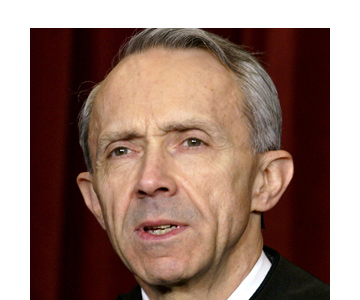
Report: Supreme Court Justice Souter will retire

The move is unlikely to change the court's ideological makeup but could lead to a rough political battle.

Report: Supreme Court Justice Souter will retire

Supreme Court Justice David Souter plans to retire at the end of the court’s term this summer, NPR reports. Souter would reportedly remain on the bench until a replacement can be confirmed, even if that doesn’t happen before the court reconvenes in the fall, and has already informed the White House of his decision.

Souter was appointed to the court by former President George H.W. Bush, but disappointed conservatives by becoming a dependable member of SCOTUS’ liberal voting bloc. Unless his eventual replacement experiences a similar ideological shift during his or her time on the bench, Souter’s decision is unlikely to have any significant effect on the ideological make-up of the court. The balance of power currently tips towards the right, in part because Justice Anthony Kennedy tends to be more conservative than the previous swing vote, former Justice Sandra Day O’Connor.

That doesn’t mean, however, that President Obama’s choice to replace Souter will go unopposed. Because of Democratic dominance in the Senate, it’s likely that the actual confirmation vote will be fairly easy, unless Republicans decide to break with their previous stance on using the filibuster of judicial nominees. But even if they can’t do anything to block the nominee, they can certainly muster quite a bit of opposition, especially if whoever Obama picks has a paper trail on hot-button issues for the right like abortion or gun control.

Alex Koppelman is a staff writer for Salon.  More Alex Koppelman

Monday, Feb 13, 2012 7:00 PM UTC2012-02-13T19:00:00Zl, M j, Y g:i A T

Ruth Bader Ginsburg’s alternative abortion history

The Supreme Court justice reflects on her legacy -- and the little-known case she wishes had preceded Roe v. Wade

US Supreme Court Associate Justice Ruth Bader Ginsburg at Columbia Law School, February 10, 2012.

US Supreme Court Associate Justice Ruth Bader Ginsburg at Columbia Law School, February 10, 2012.  (Credit: Eileen Barroso)

Last Friday, some of the most distinguished scholars and litigants working on gender and the law gathered to honor a foremother and inspiration, Ruth Bader Ginsburg, as Columbia University Law School marked the 40th anniversary of Ginsburg becoming the first tenured female professor there.

But there was another 40th anniversary as well, one less-known, but very much on Ginsburg’s mind. It has been 40 years since she filed a brief before the Supreme Court for a case she wishes had established the abortion right instead of Roe v. Wade.

Continue Reading

Irin Carmon is a staff writer for Salon. Follow her on Twitter at @irincarmon or email her at icarmon@salon.com.  More Irin Carmon

Wednesday, Feb 8, 2012 7:45 PM UTC2012-02-08T19:45:00Zl, M j, Y g:i A T

On Proposition 8, two judges rule

One judge's decision builds support for marriage equality by appealing to another judge: Justice Anthony Kennedy

Judges Anthony Kennedy and Steven Reinhardt

Judges Anthony Kennedy and Steven Reinhardt  (Credit: AP/Charles Dharapak/Stephanie Turner)

Save the confetti.

The two Democratic appointees to the 9th Circuit Court of Appeals ruled Tuesday that the California prohibition of gay marriage — the infamous Proposition 8 — violated the U.S. Constitution. Following the cautious counsel of a group of friends of the court, seasoned activists not part of the new litigation group that brought the suit, longtime liberal giant Judge Stephen Reinhardt passed up the opportunity to produce the gay Brown v. Board of Education.

Instead Reinhardt ruled on the narrowest possible grounds that Proposition 8 was unconstitutional, because it took away gays’ preexisting right to marry, extended to them a few months before by the California Supreme Court. No other state, not even the other states in the territory covered by the 9th Circuit, is affected by the ruling.

Continue Reading

Linda Hirshman is the author of “Victory: The Triumphant Gay Revolution,” forthcoming in June 2012. Follow her on Twitter @LindaHirshman1  More Linda Hirshman

Wednesday, Jan 11, 2012 1:00 PM UTC2012-01-11T13:00:00Zl, M j, Y g:i A T

Obama’s new weapon v. Citizens United

The business lobby is up in arms about a proposed executive order to shed light on corporate campaign contributions

Rep. Anna Eshoo wants to shed light

Rep. Anna Eshoo wants to shed light (Credit: AP/Charles Dharapak)

This originally appeared on AlterNet.

A executive order requiring that federal contractors disclose their electoral spending—by top officers and as corporations—is being reconsidered by the White House despite stiff opposition from the business lobby after it was first proposed last spring, according to civil rights attorneys working on the issue.

AlterNet

“There’s a lot of movement at the White House,” said Craig Holman, government affairs lobbyist for Public Citizen. “I just had a meeting at the White House counsel’s office, trying to encourage them to move forward with the executive order. They have the perfect window of opportunity to get the executive order done.”

Continue Reading

  More Steven Rosenfeld

Friday, Jan 6, 2012 5:16 PM UTC2012-01-06T17:16:00Zl, M j, Y g:i A T

The biggest threat to Citizens United

The Montana AG explains why his state's challenge to the controversial decision could hold up in the Supreme Court

Steve Bullock

Montana Attorney General Steve Bullock  (Credit: AP/Matthew Brown)

Last week, while the national press corps was busy pretending the tiny Iowa caucus was the only news in America, a major ruling out of Montana paved the way for a likely U.S. Supreme Court showdown over the role of corporate money in politics.

In the case, which was spearheaded by the state’s Democratic Attorney General Steve Bullock, Montana’s top court restored Big Sky country’s century-old law banning corporations from directly spending on political candidates or committees. Legal experts believe that upon appeal, this case will come before the nation’s highest court. While there, it could serve as the first test of the precedents in the infamous Citizens United decision that essentially allows unfettered corporate spending in campaigns.

Continue Reading
David Sirota

David Sirota is a best-selling author of the new book "Back to Our Future: How the 1980s Explain the World We Live In Now." He hosts the morning show on AM760 in Colorado. E-mail him at ds@davidsirota.com, follow him on Twitter @davidsirota or visit his website at www.davidsirota.com.  More David Sirota

Tuesday, Nov 1, 2011 12:00 PM UTC2011-11-01T12:00:00Zl, M j, Y g:i A T

Our ethically permissive Supreme Court

Conservative justices wink at their own conflicts of interest

Antonin Scalia, Clarence Thomas and Samuel Alito

Antonin Scalia, Clarence Thomas and Samuel Alito  (Credit: AP)

Topics:

It is “do-as-I-say, not what-I-do” time at the U.S. Supreme Court. In a majority opinion in a 2009 case involving the conflict of interest of a state Supreme Court justice in West Virginia, Justice Anthony Kennedy wrote:

Courts, in our system, elaborate principles of law in the course of resolving disputes. The power and the prerogative of a court to perform this function rest, in the end, upon the respect accorded to its judgments. The citizen’s respect for judgments depends in turn upon the issuing court’s absolute probity. Judicial integrity is, in consequence, a state interest of the highest order. 

Continue Reading

  More Ronald Goldfarb

Page 1 of 100 in Supreme Court

Other News