Supreme Court
What the White House knew about Souter
Justice David Souter's upcoming departure wasn't entirely a secret in Washington. The administration had already started planning for a Supreme Court vacancy before the news broke.
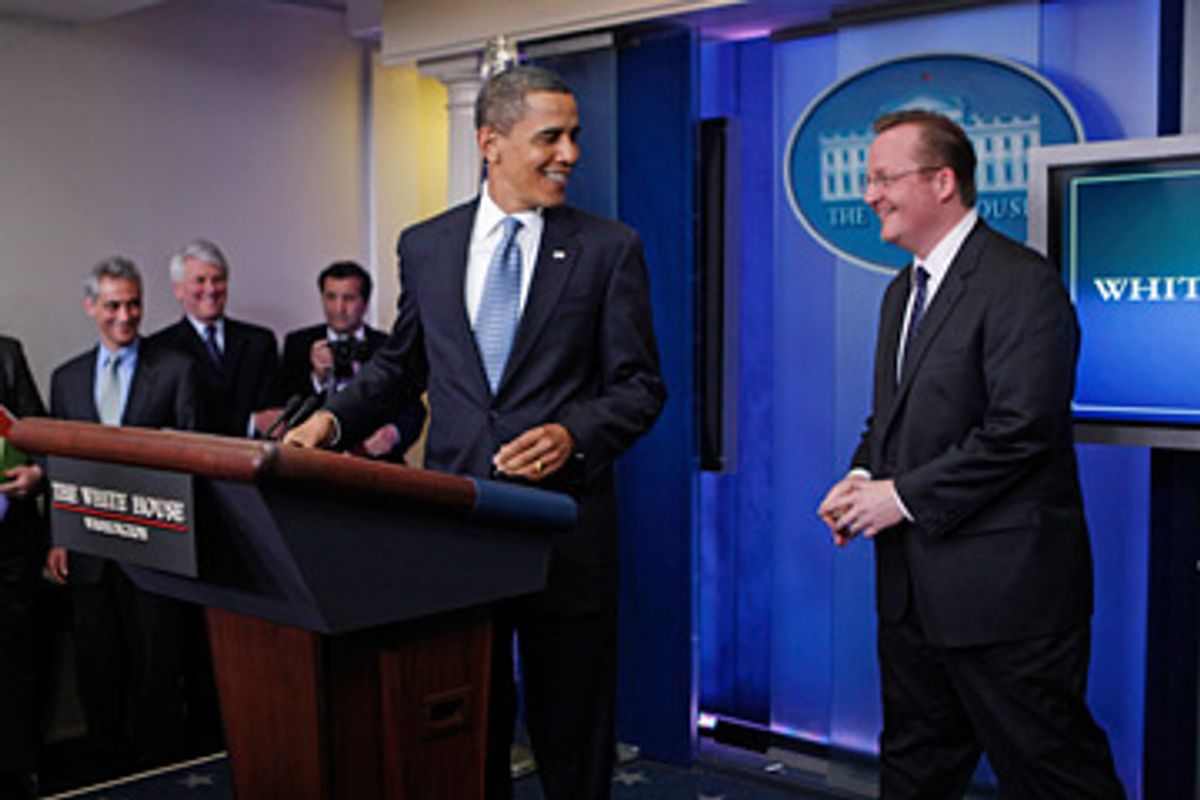
The White House press secretary, Robert Gibbs, was going through one of those silly charades on Friday afternoon that the capital sometimes seems to specialize in. The world had learned hours before that Justice David Souter would be stepping down from the Supreme Court, but apparently Souter hadn’t gotten around to formally notifying President Barack Obama — or his aides — of his intentions.
So even as the administration began to put together a system to choose Souter’s replacement and get that person confirmed by the Senate, Gibbs spent the first half of his midafternoon news briefing pretending there was nothing to talk about and refusing to give anything but the very broadest answers to questions about a Supreme Court nomination. “Is it weird that you haven’t heard from Justice Souter?” a reporter asked Gibbs. “No,” he answered, “it’s weird that I’m talking about this not having heard from him.”
Just a few minutes later, the games came to an end. “Hey,” Obama said, strolling into the briefing room to the surprise of just about everyone in it, reporters and aides alike. “I’m sorry, but Gibbs is screwing this thing up,” Obama said, teasing his press secretary. “There’s a job to do, you got to do it yourself.” Souter had just sent the White House a letter announcing his plans to step down and spoken to Obama on the phone; the president decided to break the news in person, interrupting Gibbs in the process.
“The process of selecting someone to replace Justice Souter is among my most serious responsibilities as president,” Obama said. “So I will seek somebody with a sharp and independent mind and a record of excellence and integrity. I will seek someone who understands that justice isn’t about some abstract legal theory or footnote in a casebook; it is also about how our laws affect the daily realities of people’s lives.” Pointedly, he said he wanted Souter’s replacement to be sworn in “in time for him or her” to join the court when it starts its new session on the first Monday in October.
That was about all the White House would say officially about the news. But behind the scenes, aides had long ago started planning how to fill a vacant spot on the Supreme Court — which, considering that Souter, at 69, is younger than five of his nine colleagues, was probably smart. Soon after the election, an administration official said, Obama’s transition team set up a working group on judicial nominations, which picked out potential candidates for U.S. Court of Appeals and Supreme Court spots. Obama met with them several times in December, suggesting the names of people he might want to consider. (Officials wouldn’t say whose names were brought up.) Senior White House aides met Thursday — before the Souter news broke — to talk about setting up a strategy for selecting and winning confirmation for a Supreme Court nominee.
The administration official, who requested anonymity to speak more freely about the judicial nomination process, said the timing of that meeting was a coincidence (if that’s true, whoever planned it might want to buy a lottery ticket soon). But Souter had already given a few key players around Washington an idea that he might not stay on the court for long. A Senate source told Salon that about a month ago, Souter met with Sen. Patrick Leahy, D-Vt., who chairs the Judiciary Committee, telling Leahy he might retire. (ABC’s George Stephanopoulos reported that Souter gave Senate Majority Leader Harry Reid a tip as well.) Leahy spoke to Obama Friday morning, before the White House had officially acknowledged that there would be a vacancy, and the two of them had also discussed judicial nominations during last year’s campaign and after the election.
Obama has already nominated three judges for different circuit courts, acting more quickly, the administration official said, than the Clinton or the Bush administration did in sending judicial picks to the Senate. None of the three have been confirmed yet, though. Ironically, Arlen Specter’s switch from Republican to Democrat — which should make it easier for Obama’s picks to make it through the Senate, by putting Democrats close to 60 votes — may slow things down even more.
That’s because Specter had been the top Republican on the Judiciary Committee, which will have the first crack at questioning, and voting on, whomever Obama chooses. But picking his replacement won’t be so easy for the GOP. The next in line, Orrin Hatch of Utah, is barred by internal rules from becoming the ranking member because he chaired the committee recently. After him comes Chuck Grassley of Iowa, who can’t take over the top GOP spot on Judiciary because he’s already the highest-ranking Republican on the Finance Committee. Jon Kyl of Arizona can’t take the job either, because he’s the Senate’s deputy GOP leader. Which means Alabama’s Jeff Sessions, a conservative who sometimes looks and sounds like an angry Southern leprechaun, might take over the job. Hatch could step up if the GOP caucus gives him a waiver. A leadership aide said Republicans would probably vote on the committee spot early next week.
Obama promised Friday that he would reach out to whoever takes over, to get advice before seeking the Senate’s consent to a nomination. Vice President Joe Biden, who ran confirmation hearings for several Supreme Court justices when he chaired the Senate Judiciary Committee, may play a major role in helping Obama and his aides figure out how to get the nominee through the panel (though a senior administration official told Salon that reports that Biden would run the process were overblown).
First, though, the administration has to come up with a nominee. It’s only May 1, but time sometimes flies in Washington. That first Monday in October could be here before Obama and his aides know it.
Mike Madden is Salon's Washington correspondent. A complete listing of his articles is here. Follow him on Twitter here. More Mike Madden.
John Roberts’ Gilded Age SCOTUS
Jeffrey Toobin shows how the Citizens United ruling challenged a century of efforts to rein in corporate power
John Roberts (Credit: AP/Pablo Martinez Monsivais) The most important revelation in Jeffrey Toobin’s 10,000-word New Yorker piece on Chief Justice John Roberts’ takedown of campaign finance laws in the Citizens United case is the extent to which modern conservatism is trying to restore the Gilded Age. That was a time when corporations had more rights than individuals, when a conservative Supreme Court did its best to protect those corporate rights, and wealth and corruption ran unchecked. Of course, we live in a neo-Gilded Age, when income inequality is more pronounced than at any time since the Great Depression, and the Roberts court’s decisions in the Citizens United case helps bring us all the way back to those bad old days.
Continue Reading CloseJoan Walsh is Salon's editor at large. More Joan Walsh.
Obama destroys Constitution with mild Supreme Court criticism
Conservatives and moderates declare SCOTUS-bashing to be "intimidation"
(Credit: AP) Ruth Marcus is unsettled. Maybe even queasy. There is probably some light nausea. What has her worried for the future of the nation, today? President Obama’s shameful, horrific, vicious attacks on those nice people in the Supreme Court.
Obama said that the court overturning Congress’ healthcare reform law would be a textbook example of “judicial activism” as “conservative commentators” define it: “that an unelected group of people would somehow overturn a duly constituted and passed law.” And hey, that seems like an eminently defensible and not particularly unsettling point! Conservatives made “judicial activism” into a talking point and rallying cry and defined it vaguely enough to encompass judges striking down basically any law or statute.
Continue Reading Close
Alex Pareene writes about politics for Salon and is the author of "The Rude Guide to Mitt." Email him at apareene@salon.com and follow him on Twitter @pareene More Alex Pareene.
Justices run amok: Fixing the Supreme Court
Judges on the right and left legislate from the bench. So why don't we just elect them?
Antonin Scalia, John Roberts and Clarence Thomas On Monday, we had another example of the Supreme Court’s ideological division: a 5-4 ruling, along partisan lines, giving police the right to conduct strip searches for any offense. This came on the heels of last week’s oral arguments before the Supreme Court about the constitutionality of the individual mandate provision of the Affordable Care Act, which led many observers to predict that the nation’s highest judicial body will strike down part or all of the controversial healthcare reform package. But the hearings were instructive in other ways. They showed once again that political partisanship is closely correlated to a justice’s view of the law. And they proved that the Supreme Court once again is functioning, not as a court, but as a third house of the federal legislature.
Continue Reading CloseMichael Lind’s new book, "Land of Promise: An Economic History of the United States", will be published in April and can be pre-ordered at Amazon.com. More Michael Lind.
Why I need Obamacare
I'm sick, and I will be for the rest of my life. Knowing I won't be denied the insurance I need matters
Supporters of health care reform stand in front of the Supreme Court in Washington, Wednesday, March 28, 2012, on the final day of arguments regarding the health care law signed by President Barack Obama. (AP Photo/Charles Dharapak)(Credit: AP) Dear healthy people,
It’s great that you’re deriving intellectual pleasure from debating Obamacare. I love that this theoretical dance you’re engaged in has no repercussions to you, a healthy individual. I would love to join you some evening for a spirited discussion on the pros and cons of healthcare reform. Maybe over a glass of wine? Heck — over two or three glasses of wine. I’d love to lean forward, my arched brows furrowed, my full lips purple with the stain of a good Zinfandel, and throw out statistics and well-crafted one-liners about the plight of the uninsured, the underinsured, the sick. Those poor, poor sick.
Continue Reading CloseCedar Burnett is a freelance writer and toddler wrangler living in Seattle. She is currently working on a book about living with ulcerative colitis. More Cedar Burnett.
The conservative grip on power
A ruthless GOP power grab, centered around the Supreme Court, has cemented conservative control in Washington
Clarence Thomas, George W. Bush and Antonin Scalia (Credit: AP) Writing in Salon, Natasha Lennard proposes that with the warm weather we can again expect the Occupy movement to shoot up. Arab Spring, American Spring. She’s right about one thing: Like in the decades before the Arab Spring, it has been a long, cold, American winter. In the 30 years since coming to power here, Republicans have used their initial ascent to power to seal themselves into office as tightly as the pharaohs. Smart commentators have noted how lawless the conservatives are in making substantive decisions, but that’s not the worst of it. The worst of it is how they use their tenure to make it increasingly impossible to oust them.
Continue Reading CloseLinda Hirshman is the author of “Victory: The Triumphant Gay Revolution,” forthcoming in June 2012. Follow her on Twitter @LindaHirshman1 More Linda Hirshman.
Page 1 of 102 in Supreme Court
