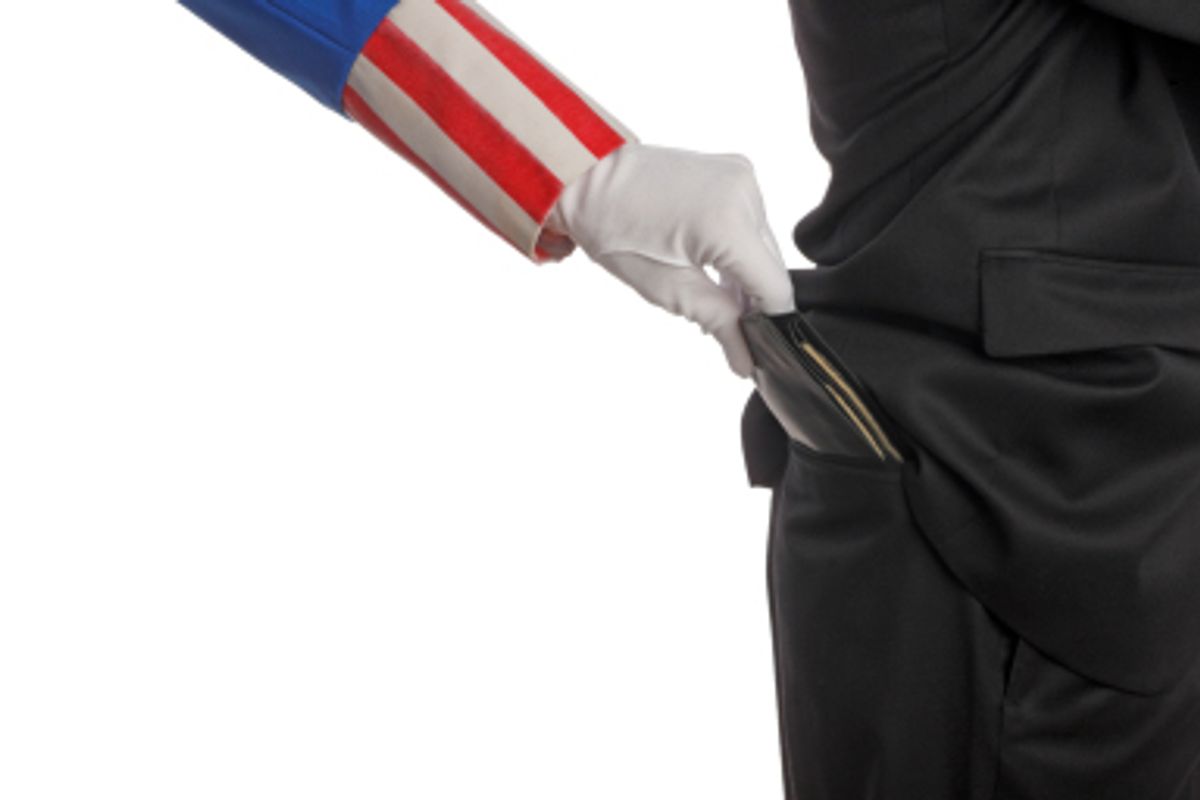
On Oct. 3, as the spreading economic meltdown threatened to topple financial behemoths like American International Group (AIG) and Bank of America and plunged global markets into free fall, the U.S. government responded with the largest bailout in American history. The Emergency Economic Stabilization Act of 2008, better known as the Troubled Asset Relief Program (TARP), authorized the use of $700 billion to stabilize the nation's failing financial systems and restore the flow of credit in the economy.
The legislation's guidelines for crafting the rescue plan were clear: The TARP should protect home values and consumer savings, help citizens keep their homes, and create jobs. Above all, with the government poised to invest hundreds of billions of taxpayer dollars in various financial institutions, the legislation urged the bailout's architects to maximize returns to the American people.
That $700 billion bailout has since grown into a more than $12 trillion commitment by the U.S. government and the Federal Reserve. About $1.1 trillion of that is taxpayer money -- the TARP money and an additional $400 billion rescue of mortgage companies Fannie Mae and Freddie Mac. The TARP now includes 12 separate programs, and recipients range from megabanks like Citigroup and JPMorgan Chase to automakers Chrysler and General Motors.
Seven months in, the bailout's impact is unclear. The Treasury Department has used the recent "stress test" results it applied to 19 of the nation's largest banks to suggest that the worst might be over; yet the International Monetary Fund as well as economists like New York University professor and economist Nouriel Roubini and New York Times columnist Paul Krugman predict greater losses in U.S. markets, rising unemployment, and generally tougher economic times ahead.
What cannot be disputed, however, is the financial bailout's biggest loser: the American taxpayer. The U.S. government, led by the Treasury Department, has done little, if anything, to maximize returns on its trillion-dollar, taxpayer-funded investment. So far, the bailout has favored rescued financial institutions by subsidizing their losses to the tune of $356 billion, shying away from much-needed management changes and -- with the exception of the automakers -- letting companies take taxpayer money without a coherent plan for how they might return to viability.
The bailout's perks have been no less favorable for private investors who are now picking over the economy's still-smoking rubble at the taxpayers' expense. The newer bailout programs rolled out by Treasury Secretary Timothy Geithner give private equity firms, hedge funds, and other private investors significant leverage to buy "toxic" or distressed assets, while leaving taxpayers stuck with the lion's share of the risk and potential losses.
Given the lack of transparency and accountability, don't expect taxpayers to be able to object too much. After all, remarkably little is known about how TARP recipients have used the government aid received. Nonetheless, recent government reports, congressional testimony, and commentaries offer those patient enough to pore over hundreds of pages of material glimpses of just how Wall Street-friendly the bailout actually is. Here, then, based on the most definitive data and analyses available, are six of the most blatant and alarming ways taxpayers have been scammed by the government's $1.1 trillion, publicly funded bailout.
1. By overpaying for its TARP investments, the Treasury Department provided bailout recipients with generous subsidies at the taxpayer's expense.
When the Treasury Department ditched its initial plan to buy up "toxic" assets and instead invest directly in financial institutions, then-Treasury Secretary Henry Paulson Jr. assured Americans that they'd get a fair deal. "This is an investment, not an expenditure, and there is no reason to expect this program will cost taxpayers anything," he said in October 2008.
Yet the Congressional Oversight Panel (COP), a five-person group tasked with ensuring that the Treasury Department acts in the public's best interest, concluded in its monthly report for February that the department had significantly overpaid by tens of billions of dollars for its investments. For the 10 largest TARP investments made in 2008, totaling $184.2 billion, Treasury received on average only $66 worth of assets for every $100 invested. Based on that shortfall, the panel calculated that Treasury had received only $176 billion in assets for its $254 billion investment, leaving a $78 billion hole in taxpayer pockets.
Not all investors subsidized the struggling banks so heavily while investing in them. The COP report notes that private investors received much closer to fair-market value in investments made at the time of the early TARP transactions. When, for instance, Berkshire Hathaway invested $5 billion in Goldman Sachs in September, the Omaha-based company received securities worth $110 for each $100 invested. And when Mitsubishi invested in Morgan Stanley that same month, it received securities worth $91 for every $100 invested.
As of May 15, according to the Ethisphere TARP Index, which tracks the government's bailout investments, its various investments had depreciated in value by almost $147.7 billion. In other words, TARP's losses come out to almost $1,300 per American taxpaying household.
2. As the government has no real oversight over bailout funds, taxpayers remain in the dark about how their money has been used and if it has made any difference.
While the Treasury Department can make TARP recipients report on just how they spend their government bailout funds, it has chosen not to do so. As a result, it's unclear whether institutions receiving such funds are using that money to increase lending -- which would, in turn, boost the economy -- or merely to fill in holes in their balance sheets.
Neil M. Barofsky, the special inspector general for TARP, summed the situation up this way in his office's April quarterly report to Congress: "The American people have a right to know how their tax dollars are being used, particularly as billions of dollars are going to institutions for which banking is certainly not part of the institution's core business and may be little more than a way to gain access to the low-cost capital provided under TARP."
This lack of transparency makes the bailout process highly susceptible to fraud and corruption. Barofsky's report stated that 20 separate criminal investigations were already under way involving corporate fraud, insider trading and public corruption. He also told the Financial Times that his office was investigating whether banks manipulated their books to secure bailout funds. "I hope we don't find a single bank that's cooked its books to try to get money, but I don't think that's going to be the case."
Economist Dean Baker, co-director of the Center for Economic and Policy Research in Washington, suggested to TomDispatch in an interview that the opaque and complicated nature of the bailout may not be entirely unintentional, given the difficulties it raises for anyone wanting to follow the trail of taxpayer dollars from the government to the banks. "[Government officials] see this all as a Three Card Monte, moving everything around really quickly so the public won't understand that this really is an elaborate way to subsidize the banks," Baker says, adding that the public "won't realize we gave money away to some of the richest people."
3. The bailout's newer programs heavily favor the private sector, giving investors an opportunity to earn lucrative profits and leaving taxpayers with most of the risk.
Under Treasury Secretary Geithner, the Treasury Department has greatly expanded the financial bailout to troubling new programs like the Public-Private Investment Program (PPIP) and the Term Asset-Backed-Securities Loan Facility (TALF). The PPIP, for example, encourages private investors to buy "toxic" or risky assets on the books of struggling banks. Doing so, we're told, will get banks lending again because the burdensome assets won't weigh them down. Unfortunately, the incentives the Treasury Department is offering to get private investors to participate are so generous that the government -- and, by extension, American taxpayers -- are left with all the downside.
Joseph Stiglitz, the Nobel Prize-winning economist, described the PPIP program in a New York Times Op-Ed this way:
"Consider an asset that has a 50-50 chance of being worth either zero or $200 in a year's time. The average 'value' of the asset is $100. Ignoring interest, this is what the asset would sell for in a competitive market. It is what the asset is 'worth.' Under the plan by Treasury Secretary Timothy Geithner, the government would provide about 92 percent of the money to buy the asset but would stand to receive only 50 percent of any gains, and would absorb almost all of the losses. Some partnership!
"Assume that one of the public-private partnerships the Treasury has promised to create is willing to pay $150 for the asset. That's 50 percent more than its true value, and the bank is more than happy to sell. So the private partner puts up $12, and the government supplies the rest -- $12 in 'equity' plus $126 in the form of a guaranteed loan.
"If, in a year's time, it turns out that the true value of the asset is zero, the private partner loses the $12, and the government loses $138. If the true value is $200, the government and the private partner split the $74 that's left over after paying back the $126 loan. In that rosy scenario, the private partner more than triples his $12 investment. But the taxpayer, having risked $138, gains a mere $37."
Worse still, the PPIP can be easily manipulated for private gain. As economist Jeffrey Sachs has described it, a bank with worthless toxic assets on its books could actually set up its own public-private fund to bid on those assets. Since no true bidder would pay for a worthless asset, the bank's public-private fund would win the bid, essentially using government money for the purchase. All the public-private fund would then have to do is quietly declare bankruptcy and disappear, leaving the bank to make off with the government money it received. With the PPIP deals set to begin in the coming months, time will tell whether private investors actually take advantage of the program's flaws in this fashion.
The Treasury Department's TALF program offers equally enticing possibilities for potential bailout profiteers, providing investors with a chance to double, triple, or even quadruple their investments. And like the PPIP, if the deal goes bad, taxpayers absorb most of the losses. "It beats any financing that the private sector could ever come up with," a Wall Street trader commented in a recent Fortune magazine story. "I almost want to say it is irresponsible."
4. The government has no coherent plan for returning failing financial institutions to profitability and maximizing returns on taxpayers' investments.
Compare the treatment of the auto industry and the financial sector, and a troubling double standard emerges: As a condition for taking bailout aid, the government required Chrysler and General Motors to present detailed plans on how the companies would return to profitability. Yet the Treasury Department attached minimal conditions to the billions injected into the largest bailed-out financial institutions. Moreover, neither Geithner nor Lawrence Summers, one of President Barack Obama's top economic advisors, nor the president himself has articulated any substantive plan or vision for how the bailout will help these institutions recover and, hopefully, maximize taxpayers' investment returns.
The Congressional Oversight Panel highlighted the absence of such a comprehensive plan in its January report. Three months into the bailout, the Treasury Department "has not yet explained its strategy," the report stated. "Treasury has identified its goals and announced its programs, but it has not yet explained how the programs chosen constitute a coherent plan to achieve those goals."
Today, the department's endgame for the bailout still remains vague. Thomas Hoenig, president of the Federal Reserve Bank of Kansas City, wrote in the Financial Times in May that the government's response to the financial meltdown has been "ad hoc, resulting in inequitable outcomes among firms, creditors, and investors." Rather than perpetually prop up banks with endless taxpayer funds, Hoenig suggests that the government should allow banks to fail. Only then, he believes, can crippled financial institutions and systems be fixed. "Because we still have far to go in this crisis, there remains time to define a clear process for resolving large institutional failure. Without one, the consequences will involve a series of short-term events and far more uncertainty for the global economy in the long run."
The healthier and more profitable bailout recipients are once financial markets rebound, the more taxpayers will earn on their investments. Without a plan, however, banks may limp back to viability while taxpayers lose their investments or even absorb further losses.
5. The bailout's focus on Wall Street mega-banks ignores smaller banks serving millions of American taxpayers that face an equally uncertain future.
The government may not have a long-term strategy for its trillion-dollar bailout, but its guiding principle, however misguided, is clear: What's good for Wall Street will be best for the rest of the country.
On the day the mega-bank stress tests were officially released, another set of stress-test results came out to much less fanfare. In its quarterly report on the health of individual banks and the banking industry as a whole, Institutional Risk Analytics (IRA), a respected financial services organization, found that the stress levels among more than 7,500 FDIC-reporting banks nationwide had risen dramatically. For 1,575 of the banks, net incomes had turned negative due to decreased lending and less risk-taking.
The conclusion IRA drew was telling: "Our overall observation is that U.S. policy makers may very well have been distracted by focusing on 19 large stress test banks designed to save Wall Street and the world's central bank bondholders, this while a trend is emerging of a going concern viability crash taking shape under the radar." The report concluded with a question: "Has the time come to shift the policy focus away from the things that we love, namely big zombie banks, to tackle things that are truly hurting us?"
6. The bailout encourages the very behaviors that created the economic crisis in the first place instead of overhauling our broken financial system and helping the individuals most affected by the crisis.
As Joseph Stiglitz explained in the New York Times, one major cause of the economic crisis was bank overleveraging. "[U]sing relatively little capital of their own," he wrote, "[banks] borrowed heavily to buy extremely risky real estate assets. In the process, they used overly complex instruments like collateralized debt obligations." Financial institutions engaged in overleveraging in pursuit of the lucrative profits such deals promised -- even if those profits came with staggering levels of risk.
Sound familiar? It should, because in the PPIP and TALF bailout programs the Treasury Department has essentially replicated the very overleveraged, risky, complex system that got us into this mess in the first place: In other words, the government hopes to repair our financial system by using the flawed practices that caused this crisis.
Then there are the institutions deemed "too big to fail." These financial giants -- among them AIG, Citigroup and Bank of America -- have been kept afloat by billions of dollars in bottomless bailout aid. Yet reinforcing the notion that any institution is "too big to fail" is dangerous to the economy. When a company like AIG grows so large that it becomes "too big to fail," the risk it carries is systemic, meaning failure could drag down the entire economy. The government should force "too big to fail" institutions to slim down to a safer, more modest size; instead, the Treasury Department continues to subsidize these financial giants, reinforcing their place in our economy.
Of even greater concern is the message the bailout sends to banks and lenders -- namely, that the risky investments that crippled the economy are fair game in the future. After all, if banks fail and teeter at the edge of collapse, the government promises to be there with a taxpayer-funded, potentially profitable safety net.
The handling of the bailout makes at least one thing clear, however: It's not your health that the government is focused on, it's theirs -- the very banks and lenders whose convoluted financial systems provided the underpinnings for staggering salaries and bonuses while bringing our economy to the brink of another Great Depression.
Shares