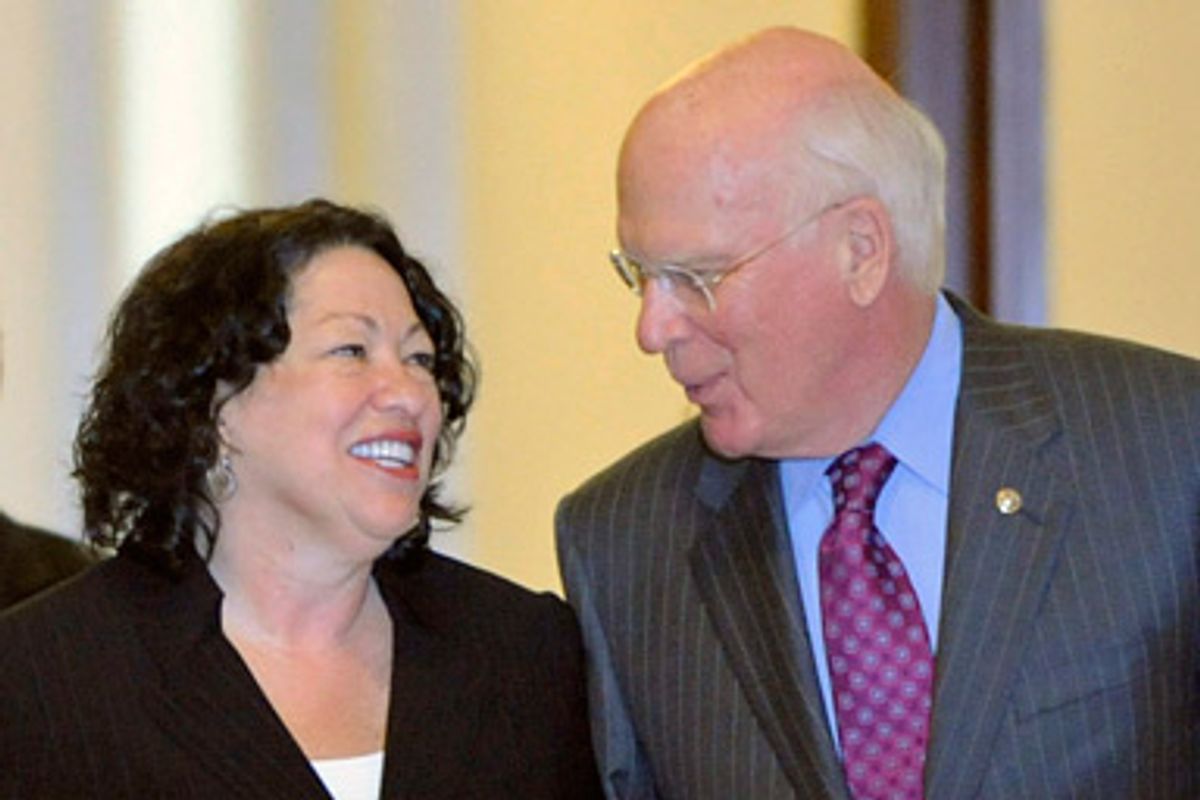
The Vermont senator says Sotomayor attacks are "vicious" and "outrageous." But the GOP may well "Bork" itself.
Senate Judiciary Committee Chairman Pat Leahy (D-VT) (right) walks with US Supreme Court nominee Judge Sonia Sotomayor (left) before meeting in his office at the US Capitol in Washington June 2, 2009.

Reuters/Jonathan Ernst
Supreme Court nominee Sonia Sotomayor and Senate Judiciary Chairman Patrick Leahy meet in Washington Tuesday.
Bravo, Pat Leahy. The chairman of the Senate Judiciary Committee succumbed to an outbreak of passion and candor today, fiercely defending Supreme Court nominee Sonia Sotomayor from personal, fact-free right-wing attacks. Leahy called the assault on Sotomayor “unbelievable” and “vicious,” and pledged to move up her confirmation hearings – Republicans want to delay them, to have more time to scrutinize her record — if the attacks continue.
“I’ll tell you one thing that will motivate me to go sooner, rather than later,” Leahy said, according to Mike Madden. “When you have vicious attacks by leading Republicans call her the equivalent of the head of the Ku Klux Klan, and call her a bigot, totally false and outrageous charges, and there’s only one place she can answer those charges would be in a hearing, we want her to have a chance to answer those charges.”
On “Hardball” today, Pat Buchanan said he agreed the right should “stop the name-calling” — that’s the same Buchanan who’s called Sotomayor an “affirmative action pick,” “a lightweight” and “an anti-white judge,” and mocked her for mastering English by reading children’s books while in college. Now Buchanan says conservatives should stop the slurs and instead focus on her “long record of race-based justice.”
Buchanan’s attack illustrates the fact-free nature of the right’s assault on Sotomayor, because, of course, he can’t name one case in which she made a race-based decision, except to cite the vexing complaint of Frank Ricci in New Haven. In that case, Sotomayor was part of a majority that voted not to hear the case, upholding the city’s findings and a lower-court decision — a relatively conservative, status-quo judicial move, not at all a radical or race-based stance.
In fact, as Tom Goldstein reported on SCOTUSblog, a survey of Sotomayor’s rulings in 96 race-discrimination cases showed her voting against the plaintiff 80 percent of the time. And of the 10 cases where she did side with the plaintiff, nine decisions were unanimous. Glenn Greenwald himself has focused on two specific cases where Sotomayor made decisions that should make Buchanan smile: ruling against Glenn’s own client, a sympathetic African-American nurse suing a hospital (and a later court decision actually found for Glenn’s plaintiff with a seven-figure award), and the case of a white New York Police Department desk worker who was fired for using racial slurs in work e-mails. (Sotomayor dissented in that case, siding with the white employee and finding his First Amendment rights had been violated by his firing.)
Any cursory review of Sotomayor’s judicial record shows she is not an ideologue. In fact, she will — and she should — face questions from liberals about her views on abortion, the right to privacy and Roe v. Wade, about executive privilege and state secrets; about gay rights. But the race-based jihad against Sotomayor is silly and, frankly, racist.
Still, it’s fun to watch the Republican Party self-destruct. Manuel Miranda, the former chief of staff to former Sen. Bill Frist forced to resign for hacking Democratic staffers’ e-mail accounts, is leading a crusade to make Senate Republicans filibuster Sotomayor — even though he led the charge to make it impossible for Democrats to filibuster Republican judicial nominees back when he worked for the GOP Senate majority. Got that? I guess the irrepressible Miranda just doesn’t have time for consistency.
But Miranda is not merely insulting Sotomayor, insisting “she could Bork herself” because “she has a temper” and “an attitude.” (Oh, and Jeffrey Rosen? Miranda says he’s based his case against Sotomayor on your reporting. No more blogging for you!) In an interview with Politico, Miranda also slurred Senate GOP leader Mitch McConnell as “limp-wristed” for refusing to fight Sotomayor more viciously. Snap! McConnell actually voted against Sotomayor in 1998 when Bill Clinton promoted her, because he believed “she’d bring pre-existing personal and political beliefs into the courtroom,” he told Politico, and he added, “many of the same concerns I had about Judge Sotomayor 11 years ago persist.”
So how much more negative does Miranda need McConnell to get? Does the minority leader need to call her a racist and belittle her intelligence, as Rush Limbaugh and Pat Buchanan have, to be man enough for Miranda? This is going to be worse on Republicans than it will be on Sotomayor, trust me. They are in the process of Borking their whole party, for years to come.
Freedom of religion is freedom from religion
Obama's contraception compromise is a rare practical solution to America's perennial church-state tensions
(Credit: © Jason Reed / Reuters)
The president did something agile and wise the other day. And something quite important to the health of our politics. He reached up and snuffed out what some folks wanted to make into a cosmic battle between good and evil. No, said the president, we’re not going to turn the argument over contraception into Armageddon, this is an honest difference between Americans, and I’ll not see it escalated into a holy war. So instead of the government requiring Catholic hospitals and other faith-based institutions to provide employees with health coverage involving contraceptives, the insurance companies will offer that coverage, and offer it free.
The Catholic bishops had cast the president’s intended policy as an infringement on their religious freedom; they hold birth control to be a mortal sin, and were incensed that the government might coerce them to treat it otherwise. The president in effect said: No quarrel there; no one’s going to force you to violate your doctrine. But Catholics are also Americans, and if an individual Catholic worker wants coverage, she should have access to it — just like any other American citizen. Under the new plan, she will. She can go directly to the insurer, and the religious institution is off the hook.
When the president announced his new plan, the bishops were caught flat-footed. It was so … so reasonable. In fact, leaders of several large, Catholic organizations have now said yes to the idea. But the bishops have since regrouped, and are now opposing any mandate to provide contraceptives even if their institutions are not required to pay for them. And for their own reasons, Republican leaders in Congress have weighed in on the bishops’ side. They’re demanding, and will get, a vote in the Senate.
Sen. Mitch McConnell, R-Ky., says:
The fact that the White House thinks this is about contraception is the whole problem. This is about freedom of religion. It’s right there in the First Amendment. You can’t miss it, right there in the very First Amendment to our Constitution. And the government doesn’t get to decide for religious people what their religious beliefs are. They get to decide that.
But here’s what Republicans don’t get, or won’t tell you. And what Obama manifestly does get. First, the war’s already lost: 98 percent of Catholic women of child-bearing age have used contraceptives. Second, on many major issues, the bishops are on Obama’s side — not least on extending unemployment benefits, which they call “a moral obligation.” Truth to tell, on economic issues, the bishops are often to the left of some leading Democrats, even if both sides are loathe to admit it. Furthermore — and shhh, don’t repeat this, even if the president already has — the Catholic Church funded Obama’s first community organizing, back in Chicago.
Ah, politics.
So the battle over contraception no longer seems apocalyptic. No heavenly hosts pitted against the forces of Satan. It’s a political brawl, not a crusade of believers or infidels. The president skillfully negotiated the line between respect for the religious sphere and protection of the spiritual dignity and freedom of individuals. If you had listened carefully to the speech Barack Obama made in 2009 at the University of Notre Dame, you could have seen it coming:
The soldier and the lawyer may both love this country with equal passion, and yet reach very different conclusions on the specific steps needed to protect us from harm. The gay activist and the evangelical pastor may both deplore the ravages of HIV/AIDS, but find themselves unable to bridge the cultural divide that might unite their efforts. Those who speak out against stem-cell research may be rooted in an admirable conviction about the sacredness of life, but so are the parents of a child with juvenile diabetes who are convinced that their son’s or daughter’s hardships might be relieved. The question then is, “How do we work through these conflicts?”
We Americans have wrestled with that question from the beginning. Some of our forebearers feared the church would corrupt the state. Others feared the state would corrupt the church. It’s been a real tug-of-war, sometimes quite ugly. Churches and religious zealots did get punitive laws passed against what they said were moral and religious evils: blasphemy, breaking the Sabbath, alcohol, gambling, books, movies, plays … and yes, contraception. But churches also fought to end slavery, help workers organize and pass progressive laws. Of course, government had its favorites at times; for much of our history, it privileged the Protestant majority. And in my lifetime alone, it’s gone back and forth on how to apply the First Amendment to ever-changing circumstances among people so different from each other. The Supreme Court, for example, first denied, then affirmed, the right of the children of Jehovah’s Witnesses to refuse, on religious grounds, to salute the flag.
So here we are once again, arguing over how to honor religious liberty without it becoming the liberty to impose on others moral beliefs they don’t share. Our practical solution is the one Barack Obama embraced the other day: protect freedom of religion — and freedom from religion. Can’t get more American than that.
My thanks to Julie Leininger Pycior, professor of history at Manhattan College, for her insights and counsel on this essay
Obama to unions: See you later
His labor allies are undermined as the president signs a law that will discourage workers from organizing
What me worry about unions? (Credit: AP/Susan Walsh)
On Tuesday President Obama signed a bill that will make it harder for workers to form a union. This bill, the FAA Reauthorization Act, passed Congress last week despite an outcry from major unions. Dozens of House Democrats voted for it, as did most Democratic senators.
To appreciate what that means, try to imagine a Republican president and Republican Senate majority leader signing off on a bill with pro-union language despite thundering objections from most big businesses. Your imagination may not be good enough to picture that, which tells you everything you need to know about the asymmetry between Democrats and Republicans when it comes to labor.
The signing of the FAA bill ends a long-running legislative fight. It began with something President Obama did right: He appointed members to the National Mediation Board who, in 2010, adopted a new rule governing elections for railroad and airline workers seeking to unionize. Such workers are covered by the 1935 Railway Labor Act, rather than the National Labor Relations Act that covers most American workers.
For decades, one downside of the RLA regime was the requirement that, in order to succeed in an election, a union had to win a majority of all potential voters in a bargaining unit, rather than just a majority of all voters. (Wisconsin Gov. Scott Walker imposed a similar requirement on public workers as part of his anti-union bill last year.) If political elections were counted the same way – with all non-voters counted as “no” votes — very few of our current members of Congress would be in office.
The new rule from Obama’s appointees changed that. Now, votes are counted in RLA elections the way they are in other union elections, or in presidential elections: Whichever side gets the most votes wins. Predictably, Republicans were furious. In a series of showdowns over the past year, the GOP insisted that the Federal Aviation Administration Reauthorization, which funds FAA functions like air traffic control, be amended to include language overriding the National Mediation Board’s new rule. Democrats resisted, and President Obama threatened to veto any FAA bill with such a provision. The short-term politics of these showdowns – one of which included a 13-day FAA shutdown last summer — were never great for the GOP, and each one ended with a short-term extension.
On Jan. 20, with both parties saying it was time to resolve the issue once and for all, Senate Majority Leader Harry Reid announced a compromise with the GOP: The FAA bill would stay silent on how union election votes are counted – meaning the NMB rule stays in place until future NMB appointees reverse it. But labor will face a steeper obstacle earlier in the process. Rather than being required to submit signatures from 35 percent of workers in a bargaining unit to trigger an election (as had been required), unions would have to submit signatures from a majority just for a vote to be held. It wasn’t immediately obvious what was so bad about this; in most cases, filing for a union election without a strong majority committed to vote yes is organizing malpractice. Many unions were slow to issue reactions, and a few voiced support.
But the devil was in the details. In a Jan. 30 letter, 18 international unions called on the House and Senate to reject the deal, writing that otherwise “Airline and rail workers would suffer significant losses as contracts are jettisoned, collective bargaining rights are cut and legal hurdles will be placed in the way of gaining a voice at work.” (Full disclosure: I used to work at UNITE HERE, one of the signing organizations.)
“This is our Wisconsin,” Association of Flight Attendants-CWA President Veda Shook told a Communications Workers of America crowd before Congress voted on the deal. Shook said that while “Reid and Republicans are falsely claiming” the compromise would only require unions to win majority support, its effect would be much worse than advertised: By packing an employee list with ex-workers or challenging voter eligibility, management would have new opportunities to delay or avert an election despite majority support. By legislating election rules, the bill would enable management to call workers who signed cards to be questioned as part of discovery in an anti-union lawsuit. When a larger non-union company merged with a smaller unionized company, the bill would make it possible for management to cease recognizing the union, with no election at all.
In a furious speech, CWA International president Larry Cohen charged that Democratic leaders had refused past requests to attach pro-union provisions to appropriations bills, but were allowing Republicans to use the FAA appropriation to force an anti-union change.
“The leadership in the Senate didn’t even see fit to include [the pro-labor NMB rule] in this gutting of the statute …” yelled Cohen. “Our little crumb of an advancement is left as a rule, so the day that there’s ever a Republican president elected … they’re going to strip the rule. The statute will remain. It’s worse than it’s ever been.”
The Democrats passed the bill and the president signed it.
A White House official defended the deal, via email, saying, “While it is unfortunate that Republicans in Congress have injected extraneous ideological measures into this important legislation that will create jobs and improve air traffic safety, the provision referenced in our veto threat has been removed and the President will sign the compromise bill.”
The White House is unlikely to expect tremendous blowback from the bill, given that the AFL-CIO took no public stance on the FAA deal. An AFL-CIO spokesperson declined to comment, but the federation’s silence may be related to the lack of unanimity among the 22 unions in its Transportation Division: While most were opposed, a few came out in support of the bill.
In a statement following its Senate passage, Air Line Pilots Association president Lee Moak said the bill “could have been improved by omitting provisions unrelated to aviation safety, but that compromise was necessary … to garner the very real benefits” of a reauthorization.
Unions’ division on this question illustrates U.S. labor’s political predicament as compared with Europe. Labor’s political influence over either major party is “180 degrees opposite from Germany, where both parties have a connection to the labor movement,” author and labor attorney Tom Geoghegan says. “It’s a very sad and dangerous thing.”
Even with a presidential election looming, historian Steve Fraser says the Democratic Party understandably takes labor’s support for granted, because “the labor movement sees it has no other option, so its loyalty can be counted on.”
Indeed, the Republican primary campaign provides daily reminders of how much worse the political leadership in Washington could be: stacking the National Labor Relations Board with professional union-busters, refusing to bargain with public workers, reviving child labor.
The decline in union density, argues Fraser, creates a vicious cycle of decreasing power and increasing dependence. “A big part of the picture is the sense that there’s no exit from this strategy … The weaker they get, the more that they feel boxed in.”
On Feb. 2, four days before the FAA deal passed the Senate, CWA officially endorsed Obama’s re-lection.
There are many factors that explain the willingness of prominent Democrats to back a deal that makes union organizing harder: the broken Senate; the influence of big money; questionable tactics from all sides. But the most fundamental one is the half-century decline in unionization, and with it, in labor’s role in American life. Episodes like this one offer a stark challenge to those still hoping that transformed political fortunes will be the cause – rather than the consequence – of the labor movement’s revival.
Obama’s unprecedented war on whistleblowers
From Manning to Kiriakou, critics are aggressively targeted as the White House turns a blind eye to abuses
Former CIA officer John Kiriakou and Bradley Manning (Credit: AP)
On January 23rd, the Obama administration charged former CIA officer John Kiriakou under the Espionage Act for disclosing classified information to journalists about the waterboarding of al-Qaida suspects. His is just the latest prosecution in an unprecedented assault on government whistleblowers and leakers of every sort.
Kiriakou’s plight will clearly be but one more battle in a broader war to ensure that government actions and sunshine policies don’t go together. By now, there can be little doubt that government retaliation against whistleblowers is not an isolated event, nor even an agency-by-agency practice. The number of cases in play suggests an organized strategy to deprive Americans of knowledge of the more disreputable things that their government does. How it plays out in court and elsewhere will significantly affect our democracy.
Punish the Whistleblowers
The Obama administration has already charged more people — six — under the Espionage Act for alleged mishandling of classified information than all past presidencies combined. (Prior to Obama, there were only three such cases in American history.)
Kiriakou, in particular, is accused of giving information about the CIA’s torture programs to reporters two years ago. Like the other five whistleblowers, he has been charged under the draconian World War I-era Espionage Act.
That Act has a sordid history, having once been used against the government’s political opponents. Targets included labor leaders and radicals like Eugene V. Debs, Bill Haywood, Philip Randolph, Victor Berger, John Reed, Max Eastman and Emma Goldman. Debs, a union leader and socialist candidate for the presidency, was, in fact, sentenced to 10 years in jail for a speech attacking the Espionage Act itself. The Nixon administration infamously (and unsuccessfully) invoked the Act to bar the New York Times from continuing to publish the classified Pentagon Papers.
Yet, extreme as use of the Espionage Act against government insiders and whistleblowers may be, it’s only one part of the Obama administration’s attempt to sideline, if not always put away, those it wants to silence. Increasingly, federal agencies or departments intent on punishing a whistleblower are also resorting to extra-legal means. They are, for instance, manipulating personnel rules that cannot be easily challenged and do not require the production of evidence. And sometimes, they are moving beyond traditional notions of “punishment” and simply seeking to destroy the lives of those who dissent.
The well-reported case of Thomas Drake is an example. As an employee, Drake revealed to the press that the National Security Agency (NSA) spent $1.2 billion on a contract for a data collection program called Trailblazer when the work could have been done in-house for $3 million. The NSA’s response? Drake’s home was raided at gunpoint and the agency forced him out of his job.
“The government convinced themselves I was a bad guy, an enemy of the state, and went after me with everything they had seeking to destroy my life, my livelihood and my person — the politics of personal destruction, while also engaging in abject, cutthroat character assassination and complete fabrication and frame up,” Drake told Antiwar.com. “Marriages are strained, and spouses’ professional lives suffer as much as their personal lives. Too often, whistleblowers end up broken, blacklisted and bankrupted,” said the attorney who represents Drake.
In Kiriakou’s case, the CIA found an excuse to fire his wife, also employed by the Agency, while she was on maternity leave. Whistleblower Bradley Manning, accused of leaking Army and State Department documents to the website WikiLeaks, spent more than a year in the worst of punitive conditions in a U.S. Marine prison and was denied the chance even to appear in court to defend himself until almost two years after his arrest. Former chief military prosecutor at Guantanamo Morris Davis lost his career as a researcher at the Library of Congress for writing a critical op-ed for the Wall Street Journal and a letter to the editor at the Washington Post on double standards at the infamous prison, as did Robert MacClean for blowing the whistle on the Transportation Security Administration.
Four employees of the Air Force Mortuary in Dover, Delaware, attempted to address shortcomings at the facility, which handles the remains of all American service members who die overseas. Retaliation against them included firings, the placing of employees on indefinite administrative leave, and the imposition of five-day suspensions. The story repeats itself in the context of whistleblowers now suing the Food and Drug Administration for electronically spying on them when they tried to alert Congress about misconduct at the agency. We are waiting to see the Army’s reaction to whistleblower Lieutenant Colonel Daniel Davis, who documented publicly this week that senior leaders of the Department of Defense intentionally and consistently misled the American people and Congress on the conduct and progress of the Afghan War.
And this remains the most partial of lists, when it comes to recent examples of non-judicial government retaliation against whistleblowers.
Government bureaucrats know that this sort of slow-drip intimidation keeps people in line. It may, in the end, be less about disciplining a troublemaker than offering visible warning to other employees. They are meant to see what’s happening and say, “Not me, not my mortgage, not my family!” — and remain silent. Of course, creative, thoughtful people also see this and simply avoid government service.
In this way, such a system can become a self-fulfilling mechanism in which ever more of the “right kind” of people chose government service, while future “troublemakers” self-select out — a system in which the punishment of leakers becomes the pre-censorship of potential leakers. At the moment, in fact, the Obama administration might as well translate the famed aphorism “all that is necessary for evil to triumph is for good people to remain silent” into Latin and carve it into the stone walls of the CIA’s headquarters in Langley, Virginia, or NSA headquarters at Fort Meade, or the main office of the State Department at Foggy Bottom where I still fight to keep my job.
Silent State
I am told that, in its 223 years of existence, I am the only Foreign Service Officer ever to have written a critical book about the State Department while still employed there. “We Meant Well: How I Helped Lose the Battle for the Hearts and Minds of the Iraqi People“ exposed what State did not want people to know: that they had wasted enormous amounts of money in Iraq, mostly due to ignorance and a desire for short-term successes that could be trumpeted back home. For the crime of writing this book and maintaining a blog that occasionally embarrasses, State Department officials destroyed my career, even as they confirm my thesis, and their own failure, by reducing the Baghdad Embassy to half its size in the face of Iraq’s unraveling.
“The State Department was aware of Mr. Van Buren’s book long prior to its release,” explains attorney Jesslyn Radack, who now represents me. “Yet instead of addressing the ample evidence of fraud, waste and abuse in the book, State targeted the whistleblower. The State Department’s retaliatory actions are a transparent attempt to intimidate and silence an employee whose critique of fraudulent, wasteful and mismanaged U.S. reconstruction efforts in Iraq embarrassed the agency.”
Without allowing any rebuttal or defense, State suspended my security clearance, claiming my blogging was an example of “poor judgment,” transferred me from a substantive job into a meaningless telework position, threatened felony conviction over alleged disclosure of classified information, illegally banned me from entering the building where I supposedly work, and continues to try to harass and intimidate me.
My travel vouchers from as far back as the law allows have come under “routine” re-examination. My Internet activity is the subject of daily reports. My credit reports have been examined for who knows what. Department friends who email me on topical issues have been questioned by agents of Diplomatic Security, the State Department’s internal police. My Freedom of Information Act request for documents to help defend myself and force State to explain its actions has been buried.
Without a security clearance, and with my Diplomatic Passport impounded, I will never serve overseas again, the lifeblood of being a Foreign Service Officer (FSO). A career that typically would extend another 10 years will be cut short in retaliation for my attempt to tell the truth about how taxpayer money was squandered in Iraq.
All of this has taken place in such a way that I cannot challenge it (except by writing and speaking about it in public — at additional risk). The State Department has standard disciplinary procedures that it could have invoked against me, but those leave room for public challenges and, in some cases, would allow me to force documents into the open that State would rather not share with you.
Hall Walkers: Ghosts in the Machine
Before “telework” existed as an option that allowed undesirable employees to be sent home and into a kind of benign house arrest, people like me at State were called “hall walkers.” They were the ones whom the Department no longer wanted as employees, but who could not be fired due to lack of evidence. So they would have their security clearances suspended without recourse, be removed from their assignments, and yet told that, to get paid, they needed to be physically present in the main State building eight hours a day.
Since they were not assigned to an office, State was wholly unconcerned about how they occupied themselves during those long empty days. And though as a “teleworker” I am not one, the hall walkers are still with us.
The main State building is enormous, with literally miles and miles of corridors, and the hall walker might wander them, kill time at the library, have a long lunch, stop in to chat with former colleagues still willing to be seen in his or her company. Even in the first FSO training course called A-100, young diplomats are advised that the most ignominious end to a career is not failing at your job, but being thrown into the purgatory of hall walking — still on the payroll but no longer a member of the tribe. Disowned, shunned, exiled in the ancient Greek tradition.
Hall walking is a far cry from being dragged through a trial or spending two years in solitary, but it exists on the same continuum. No one at State will say how many employees still exist in the shadow world of hall walking, but at least dozens is a reasonable guess.
I am told as well that State Department officials are increasingly moving to suspend security clearances for acts wholly outside the realm of security, like blogging they find offensive. One State Department Human Resources employee confided to me that this has, in fact, become the go-to strategy for winnowing out unwanted employees in the too-hard-to-fire category, a sad evolution, given the sorry history of the State Department in the McCarthy era.
Fighting Back
For a government employee being punished extra-legally by an agency ignoring its own rules, there is still one recourse: the Office of the Special Counsel. Created in 1979, it was to be an ombudsman meant to keep an eye on governmental nastiness and ensure the implementation of the Whistleblower Protection Act. Empowered, among other things, to investigate and “make right” instances of federal retaliation against legitimate whistleblowers, the office was sidelined through several administrations.
Under George W. Bush, it was embroiled in scandal when its head, Special Counsel Scott Bloch, instead purged its staff of lawyers who disagreed with him and announced that he would not follow up on cases of discrimination based on sexual orientation. Last summer, Bloch pleaded guilty to deleting evidence from his computer while under investigation for retaliating against his own staff.
At a moment when government extra-legal retaliation against whistleblowers and leakers is on the rise, call it ironic, but the Office of the Special Counsel has seen a rebirth under its current head, Obama appointee Carolyn Lerner. As the Washington Post recently described her, Lerner has “gone to the mat and tried to expand the boundaries of the law’s protections for whistleblowers. She has lifted long-sagging morale at an agency that, instead of behaving as an independent watchdog, has treaded water for much of its existence.”
Specifically, Lerner reassignedstaff members to review a backlog of cases against whistleblowers facing reprisals, including “veterans’ hospital staff members reporting poor lab procedures [and] air traffic controllers claiming flight-pattern dangers.” She has enforced a 60-day limit on responses from federal agencies. The Office seems to have re-embraced its mission. “She’s a pit bull,” saysTom Devine, legal director of the Government Accountability Project, which defends whistleblowers.
There are other signs of resistance in Washington to the urge to cloak the government in silence. For example, Senator Charles Grassley (R-IA) launchedan investigation into the Food and Drug Administration’s secret email monitoring of scientists warning that unsafe medical devices were being approved over their objections. Whistleblowers, said Grassley, often are treated “like skunks at a picnic.”
The Senator demanded that FDA Commissioner Margaret Hamburg disclose who authorized the monitoring, how many employees were targeted, and whether the agency obtained passwords to personal email accounts, allowing communications on private computers to be intercepted. He also wants to know whether the agency’s two-year surveillance campaign is still ongoing.
In another recent case, the Office of the Special Counsel formally asked the Air Force to take harsher disciplinary action against supervisors at the Dover mortuary who had tried to fire two whistleblowers who raised accusations about the mishandling of soldiers’ remains.
The Government Accountability Project has filed a complaint on my behalf with the Office of the Special Counsel demanding that the State Department cease its retaliatory personnel practices against me. The Department is particularly vulnerable, given its drumbeat of support for the rights of bloggers and other dissidents in the Middle East and China. State has already been forced to readmit me to the building and return my access badge. I remain an optimist, believing that my complaint will succeed and that, someday, I will return to work at a State Department where employees can talk openly about the bad as well as the good.
It Matters
Americans, who elect and pay for their government in Washington, deserve to know exactly what it does there — and elsewhere around the world — with their dollars. As in my case in Iraq, such information often is only available if some insider, shocked or disturbed by what he or she has seen, decides to speak out, either directly, in front of Congress, or through a journalist.
The Obama administration, which arrived in Washington promoting “sunshine” in government, turned out to be committed to silence and the censoring of less-than-positive news about its workings. While it has pursued no prosecutions against CIA torturers, senior leaders responsible for Abu Ghraib or other war crimes, or anyone connected with the illegal surveillance of American citizens, it has gone after whistleblowers and leakers with ever increasing fierceness, both in court and inside the halls of various government agencies.
There is a barely visible but still significant war raging between a government obsessed with secrecy and whistleblowers seeking to expose waste, fraud and wrongdoing. Right now, it is a largely one-sided struggle and the jobs of those of us who are experiencing retaliation are the least of what’s at stake.
Think of those victims of retaliatory personnel practices and imprisoned whistleblowers as the canaries in the deep mineshaft of federal Washington, clear evidence of a government that serves its people poorly and has no interest in being held accountable for that fact. This administration fears the noise of democracy, preferring the silence of compliance.
[Disclaimer: The views expressed here are solely those of the author in his private capacity and do not in any way represent the views of the Department of State, the Department of Defense or any other entity of the U.S. government. The Department of State most certainly does not approve, endorse or authorize this article.]
To stay on top of important articles like these, sign up to receive the latest updates from TomDispatch.com here.
Obama’s winning hand on religion
Policies based on science and reason are the best way to protect free exercise of religious belief
A special deal for the churches? (Credit: AP/Charles Dharapak)
President Obama’s strategy of “reaching out to” or “appealing to” religious voters has proven to be ineffective electorally and counterproductive for policymaking. As much as Obama seems to understand the complexities of American religion, he listens too much to the voices of religious leaders who want the government to accommodate their edicts regardless of the impact on everyone else. The spoils go to the ones with access, to those who sit in the valued “seat at the table” in Washington.
After decisively issuing the contraception coverage rule last week, the administration took only a few news cycles, dominated by liberal Catholics like E.J. Dionne fretting about how Obama “botched” the issue, to dispatch surrogates to assuage the U.S. Conference of Catholic Bishops.
“There are conversations right now to arrange a meeting to talk with folks about how this policy can be nuanced,” pastor Joel Hunter, a conservative evangelical who is close to the president, told the Washington Post on Tuesday. “This is so fixable, and we just want to get into the conversation.” The bishops promptly signaled that they would reject the floated compromise out of hand.
Obama would do better to govern and to run for reelection as a frankly secular candidate: the president who will ensure that policy is made based on reason and science, not religion. And he should make clear that he comes to this position precisely because he cherishes the free exercise of religion (or not) of all Americans. While this might cause indignation among some of those with a seat at the Washington table and set off fainting spells on cable news, it would not cause Obama to lose critical swing constituencies such as white Catholics or moderate evangelicals.
Getting into the conversation hasn’t been a problem for conservative Catholics and evangelicals. Obama’s signature faith initiative — the Office of Faith-Based and Neighborhood Partnerships — exists today largely in the form that these conservative religious leaders demanded. Back in 2008, candidate Obama nearly spelled the end of a carefully cultivated alliance with some religious leaders when he pledged in a speech to fix the constitutional inadequacies of George W. Bush’s Faith-Based Initiative. These livid religious leaders extracted a promise from the campaign: Don’t make a fuss about the speech now, and Obama will not make the changes he promised.
True to his word to the religionists, Obama has retained, among other things, a Bush-era rule, which permits faith-based organizations receiving federal aid to discriminate based on religion or religious belief in hiring employees. Because the rule remains in place, such taxpayer-funded, religious organizations can fire or refuse to hire applicants based on their religion, or even for being the sort of person their religion considers sinful, like a lesbian or a single mother.
Obama’s refusal to budge on this issue has infuriated advocates for church-state separation (many of whom represent religious organizations and/or are ordained clergy in the Coalition Against Religious Discrimination) for his entire White House tenure. But Obama knows that without the ability to discriminate in hiring, many of the biggest recipients of federal dollars (who euphemistically call this “co-religionist hiring”) will walk away from the faith-based project.
Good riddance, you might say, if they’re using your tax dollars to discriminate. But Obama the constitutional lawyer has been swallowed whole by the religionists on this issue.
Regardless of his stance on religion, the reaction from the fever swamps — the conspiracy theorists who insist he’s a Muslim or a secret agent of a special anti-American branch of Kenyan socialism, or Newt Gingrich, who claims he is a “secular socialist” — will not go away. Even after the supposedly respectable enclave of the National Prayer Breakfast, Obama was disparaged by conservatives for deigning to acknowledge the similarities between Christianity and other religions. He was abused for his suggestion that Jesus had ideas other than succeeding in business without really trying.
Never mind that Obama fondly recalled a visit with Billy Graham, or made note of which evangelical pastors he prayed with. There’s no winning the Christian exceptionalists. Mark Joseph, writing in the National Review, derided Obama for not realizing that the speaker who preceded him, Veggie Tales alumnus Eric Metaxas, would preemptively mock the president with his critique of “phony religiosity.” But for conservatives, Metaxas’ speech was even more damning than a dig at Obama’s supposedly less than rigorous Christianity.
“Metaxas’s most blistering attack,” Joseph wrote, “was his careful but dogged determination to link previous attitudes among churchgoers toward slavery and Nazism with those of some present day churchgoers toward abortion.”
The Obama administration — not unlike its predecessors of both parties — looks out with blinders at the religion landscape. The blinders extend no further than the religious groups with lobbyists (like the bishops) in Washington, who claim to represent their entire religion, even when, for example, 98 percent of Catholic women don’t seem to care that the bishops insist contraception is a sin. As a recent study by the Pew Forum on Religion and Public Life showed, the money to lobby can buy you access to ensure your religious views — even if they contradict medicine, science or public health — shape policy. As Catholics for Choice has pointed out, though, Archbishop Timothy Dolan doesn’t represent all American Catholics, but rather the 271 American bishops.
I recently was talking with a friend, whose 84-year-old mother, a lifelong and devoted Catholic, recently stopped going to Mass. She was fed up, he said, with the “anti-Obama” lectures she heard at church. I would love to see Obama invite my friend’s mother — from a Midwestern swing state, by the way — to the White House for a meeting.
The religious outreach gurus will no doubt ask, How many people does she represent? Oh, I don’t know. Tens of millions?
Israel’s real target: Obama
Prime Minister Netanyahu's threats have more to do with challenging Washington than with actually attacking Iran
Israeli Prime Minister Benjamin Netanyahu and President Obama (Credit: AP)
After being elected in large part because he’d opposed a “dumb” war in Iraq, President Obama finds himself confronting an even dumber one in Iran. Exponentially dumber, actually.
Dumb because like the targeted assassinations of Iranian nuclear scientists rarely cited by columnist commandoes, bombing raids alone can’t achieve the alleged goal: preventing the Ayatollahs from acquiring nuclear weapons.
Slow them down, probably. Stop them, no. Short of a full-scale invasion and occupation of a nation three times larger than neighboring Iraq in population and five times larger in land area, that can’t be done. Global disapproval didn’t stop North Korea, Pakistan or, for that matter, Israel.
Exponentially dumb because it could set the entire Middle East aflame.
You’d think the Israelis, of all people, would recognize that threatening a people with death and destruction hardens their resolve. Yet the New York Times reports that Israeli Prime Minister Benjamin Netanyahu “told visitors that he believes the Tehran government to be deeply unpopular, indeed despised, and that a careful attack on its nuclear facilities might even be welcomed by Iranian citizens.”
Yes, and Dick Cheney predicted that U.S. forces invading Iraq would be greeted with candy and flowers. “Most analysts [in Jerusalem] and abroad,” the Times noted cautiously, “take a different view.” Indeed, historical examples of civilian populations cheering on aerial bombardments are rare, if not nonexistent. Despite his and Cheney’s obvious affinities, one would expect Netanyahu to be made of saner stuff.
Assuming that the Israeli prime minister’s motives for threatening a unilateral Israeli strike against Iranian nuclear facilities are as reported. I suspect they are not. To put it bluntly, it’s not so much the regime in Tehran that Netanyahu is keen to destabilize as the one in Washington. The question now is how far he’s willing to take it.
Despite media chatter about “red lines” being crossed, it’s hard to point to anything the Iranians have done to provoke the current crisis. They’ve been trash-talking since 1979. Otherwise, no Iranian armies are massing. With its navy badly outgunned in the Persian Gulf, and a vestigial air force scarcely capable of defending against Israeli bombers, Iran sits surrounded by U.S. bases in Turkey, Saudi Arabia, Iraq, Pakistan, Afghanistan — well, everywhere.
Iran’s last military action of any consequence was its catastrophic 1980s war with Saddam Hussein’s Iraq, during which it suffered more than a million dead. The Persians haven’t actually invaded anybody for more than 300 years. The Shiite regime’s expanded regional influence came about as an unintended consequence of the U.S. invasion of Iraq.
For what it’s worth, the Ayatollahs deny any intention of attacking the “Zionist Entity”— despite frequently wishing that it would vanish from the earth. Even Iranian clients Hezbollah and Hamas have been mostly quiet. With Iran’s economy faltering under economic sanctions engineered by the Obama administration, and much of its population seething with resentment amid an acrimonious feud between President Ahmadinejad and Supreme Leader Khameni, the Tehran regime’s got all it can do to survive, much less to start a suicidal conflict with Israel — not to mention the United States.
But when articles invoking the Holocaust and urging “creative destruction” in Iran appear on the same day (Feb. 7) in the Washington Post, Wall Street Journal, Newsweek and Bloomberg News, a skeptical observer might be forgiven for suspecting a well-coordinated propaganda campaign.
Writing in Beirut-based Al-Akhbar, American journalist Max Blumenthal dates its inception to a Jan. 3 article in Israel Hayom revealing that Israel’s National Security Council — basically Netanyahu’s closest political allies — had concluded that “U.S. President Barack Obama is ‘naive’” and fails to understand Israel’s precarious position. Deemed a Likud Party organ, the newspaper is owned by multibillionaire Las Vegas casino tycoon Sheldon Adelson, who bankrolls Netanyahu and serves as Newt Gingrich’s Sugar Daddy too.
Netanyahu appears to see an Obama second term as an impediment to further Israeli expansion into the West Bank — or “Judea” and “Samaria,” as Likudniks style it — and has cast his lot with the Republican right. He’s made public appearances with notables like Glenn Beck and “End Times” evangelist John Hagee. Adelson himself has pledged his vast resources to Obama’s defeat.
In his State of the Union speech, President Obama reiterated his determination to prevent Iran’s getting nuclear weapons. He said he was “taking no options off the table.” But he also expressed hope that international sanctions could lead to a peaceful resolution.
On cue, Washington Post columnist Richard Cohen called this “startlingly naïve.” Only a fool or a Frenchman, the same pundit once opined, could doubt the existence of Saddam Hussein’s WMD. Bombs away!
President Obama also reportedly dispatched Joint Chiefs Chairman Gen. Martin Dempsey to Israel to warn Netanyahu that if he tries to force the United States’ hand, he’s on his own.
But can he make it stick?
For his sake and everybody else’s, he’d better.
Page 1 of 577 in Barack Obama
The next generation of color geniuses
I found my orgasm
A witty, tragic series concludes
Pick of the week: Escape from Putin’s cult
What are Republicans thinking?
Freedom of religion is freedom from religion
Reality, exploded
Now Mitt’s refusing to debate
Hollywood’s real-life night at the museum
Mitt’s ticking Maine time bomb? 

