Healthcare Reform
Healthcare makes a miraculous recovery
Obama gets drug companies to cut senior drug bills by $80 billion. Suddenly, his plan is no longer dead
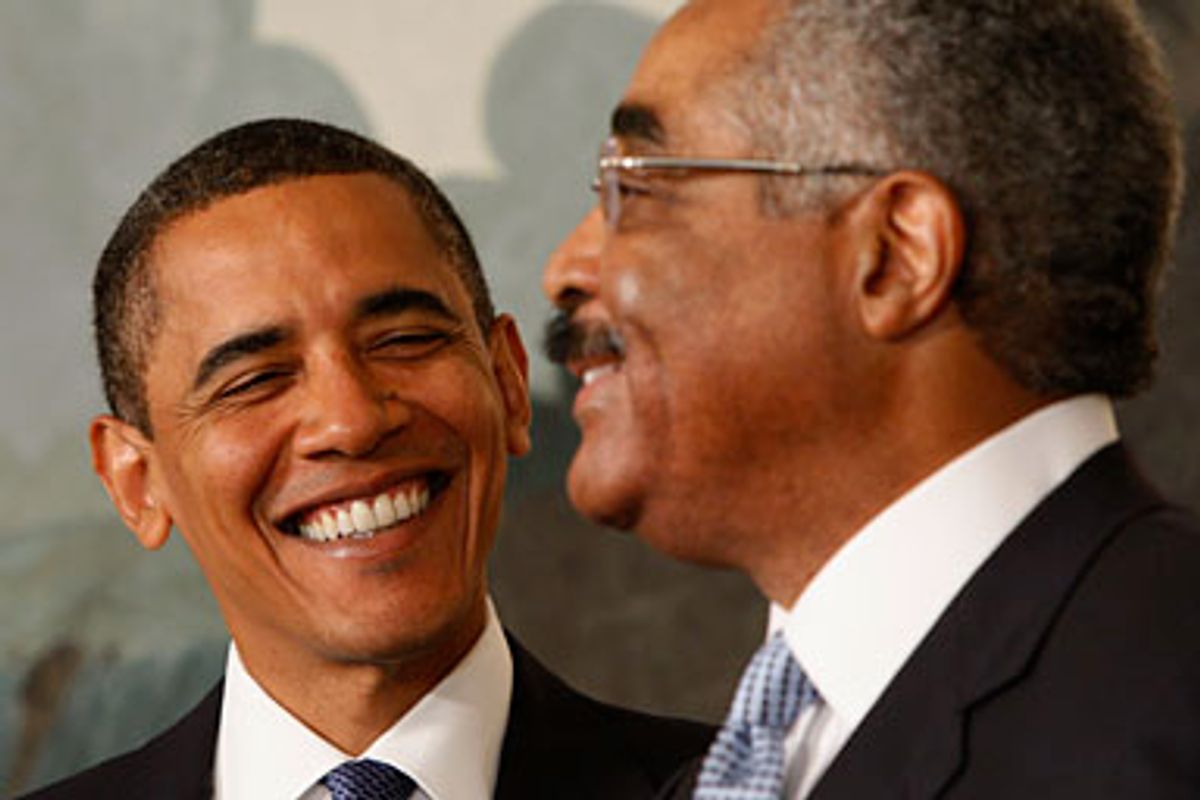
U.S. President Barack Obama (L) smiles as he is introduced to speak about the agreement to lower drug costs for seniors by Barry Rand, the CEO of AARP, in the Diplomatic Reception Room of the White House in Washington June 22, 2009. Last week didn’t bring much good news for the Obama administration’s drive to overhaul healthcare. Congressional budget wonks announced the draft legislation the Senate was working on would cost more than anyone expected; the industry players the White House had worked hard to bring into the reform process started grumbling about the whole thing. By the weekend, conventional wisdom inside the Beltway had more or less already declared reform dead.
Which made Monday’s announcement by President Obama that the lobbying arm for the nation’s drug manufacturers had agreed to cut the costs of drugs for seniors by $80 billion over the next decade something of a confusing spectacle. If the chances for getting anything done on healthcare had dwindled away, what was the president doing bringing back his campaign slogans — and, more confusingly still, smiling confidently?
“To those who, here in Washington, who’ve grown accustomed to ‘sky is falling’ prognoses and the certainties that we cannot get this done, I have to repeat — revive an old saying we had from the campaign: Yes, we can,” Obama said. “We are going to get this done.”
So the deepest significance of the deal between the government and PhRMA, the drug lobby, may well have been what it meant politically. Yes, the announcement means Medicare patients will no longer have to deal with an odd “doughnut hole” in their drug coverage; before Monday, the government pays for seniors’ prescriptions if their annual cost is under $2,700 or more than $6,100, but not if the price is in between. But more important, the news gave the administration a public relations victory — the president just saved the government, and seniors, $80 billion — to kick off a week where Obama plans to play offense, not defense, on healthcare. On Tuesday, the president will hold a midday news conference, where he’ll have a chance to pitch his plans, and on Wednesday, the White House will host ABC News all day, culminating in a live, prime-time town hall on health reform.
“There was this feeding frenzy last week,” one administration official admitted. But White House aides — who like to insist that they’re not paying attention to day-by-day news cycle battles, even as they manage events carefully to fit them — aren’t close to panicking yet. “There will be lots of developments every day about little provisions, and ultimately [very little of it] matters until you get a final bill.”
Obama certainly didn’t seem ruffled on Monday. He repeated the administration’s main theme about healthcare — you may like the coverage you have, but if the current system isn’t changed, you won’t be able to afford it for much longer. “Our goal — our imperative — is to reduce the punishing inflation in healthcare costs while improving patient care,” Obama said. “And to do that we’re going to have to work together to root out waste and inefficiencies that may pad the bottom line of the insurance industry, but add nothing to the health of our nation.”
Among healthcare policy experts, that’s become common knowledge, but the administration isn’t finding it as easy to sell to the rest of the country — or even to Congress. Obama has taken to quoting liberally from a New Yorker article about healthcare cost disparities in two neighboring Texas cities; administration officials have realized the story lays out their case pretty well. What’s tricky about pitching the reform plan is that surveys show most voters actually like the care they have. In the last two weeks, Democratic and Republican pollsters have both reported fairly broad satisfaction with existing healthcare options. Obama’s challenge is to convince people the system will soon gobble up an unsustainable share of the budget — both on the federal level and where their own paychecks are concerned — unless it’s changed.
That task won’t be easy, but advocates say it’s certainly still possible. “People need to put aside the instant gratification bug and appreciate that it’s going to take a while to get through the details,” said Jackie Schechner, a spokeswoman for Healthcare for America Now, a union-backed group pushing for reform. Even the price tag doesn’t have to scare voters off. “They say it’s expensive to fix it, and then somebody gets their next insurance bill.” Republicans, though, plan to focus their rhetoric on how much the reforms would cost — more than $1.6 trillion, according to the Congressional Budget Office, though that number is likely to change once the legislation is finished.
Meanwhile, the aspect of the reform that Congress is most upset about doesn’t seem to be particularly controversial with actual voters: including a government-funded insurance option to compete with private plans. A CBS News/New York Times poll found 72 percent of respondents liked the idea. “Free puppies and ice cream isn’t as popular as that,” the administration official joked. Even Republicans had to acknowledge that the public seems less than terrified. “Indeed, ‘government bureaucrats’ are scarcely less appealing than ‘insurance bureaucrats,” a GOP polling memo by Whit Ayres and Ed Gillespie reported on Monday. By the end of this week, the pundits may start declaring healthcare reform is as good as done. Last week’s panic was probably premature. This week’s celebration will be, too.
Mike Madden is Salon's Washington correspondent. A complete listing of his articles is here. Follow him on Twitter here. More Mike Madden.
Healthcare’s worsening crisis
Costs have risen dramatically during the Great Recession -- but one solution could make a huge difference
(Credit: lenetstan via Shutterstock) The greatest rip-off in the world is getting worse. According to a groundbreaking study released last week (PDF), the cost of employer-based health insurance – which covers a majority of the population — has risen at twice the rate of inflation during the Great Recession, even while Americans have come to use less medical services.
It is a tragic irony that even as Washington debates whom to screw over to cut the Phantom Menace of our federal deficit, it has so far failed to address the single most important factor driving those deficits over the long term (if we paid the same for healthcare per person as the 30-plus countries with longer average life expectancies, we’d be looking at budget surpluses). It’s a problem that also leads to tens of thousands of unnecessary deaths annually, creates some of the worst health outcomes in the developed world, makes American firms less competitive in the global marketplace and contributes a great deal to wage stagnation for the middle class and the working poor.
Romney pal defends Obamacare
Sen. Roy Blunt supports part of the bill his ally Mitt Romney has pledged to fully repeal
(Credit: Reuters/ Jonathan Ernst) Sen. Roy Blunt, R-Mo., gave a strong defense yesterday of a portion of the Affordable Care Act that allows children up to 26 years old to remain on their parents’ health insurance plans, breaking a bit from the GOP’s hard-line opposition to Obamacare.
Blunt endorsed Mitt Romney early on and led the campaign’s efforts to recruit Republican lawmakers during the GOP primary. But his comments in an interview on KTRS radio in St. Louis may give Boston some heartburn as it tries to convince conservative voters that Romney, who enacted the predecessor of Obamacare in Massachusetts, will actually repeal the healthcare law.
Continue Reading CloseAlex Seitz-Wald is Salon's political reporter. Email him at aseitz-wald@salon.com, and follow him on Twitter @aseitzwald. More Alex Seitz-Wald.
“Birth control doesn’t matter”
A new survey reveals just how ignorant young people are about contraception and pregnancy
(Credit: restyler via Shutterstock) When it comes to sex and reproduction, even the most mind-numbingly intuitive conclusions can be politicized or disbelieved. So they bear repeating and resubstantiation. Take this recent Guttmacher study on contraceptive knowledge. Surveying 1,800 men and women ages 18–29, the authors “found that the lower the level of contraceptive knowledge among young women, the greater the likelihood that they expected to have unprotected sex in the next three months, behavior that puts them at risk for an unplanned pregnancy.” In other words, access to factual information helps prevent risky behavior.
Continue Reading Close
Irin Carmon is a staff writer for Salon. Follow her on Twitter at @irincarmon or email her at icarmon@salon.com. More Irin Carmon.
Healthcare’s foreign invasion
Obama risked a trade war with China about manufacturing -- so why isn't he outraged about medical jobs?
(Credit: gualtiero boffi via Shutterstock/Salon) Approximately 15 percent of all healthcare workers and 25 percent of all physicians in the United States were born and educated elsewhere. This means that 1.5 million healthcare jobs are “insourced,” occupied by foreign-born, foreign-trained workers brought into the United States on special visas earmarked for healthcare jobs. This number is 50 percent greater than the total number of jobs in the U.S. auto-manufacturing industry. It’s amazing to consider that in 2008 and 2009, the auto industry, which makes up just 3.6 percent of the U.S. economy, received a $97 billion bailout. If we estimate that each of these 1.5 million insourced healthcare jobs has an average wage of $60,000, that’s $90 billion a year in wages going to people brought into the United States to work rather than training Americans to do the same jobs.
Continue Reading CloseDr. Kate Tulenko is a physician with degrees from Harvard University, Cambridge University and the Johns Hopkins School of Medicine. The former coordinator of the World Bank's Africa Health Workforce Program, she currently serves as director of clinical services for a global health nonprofit. More Kate Tulenko.
Obama destroys Constitution with mild Supreme Court criticism
Conservatives and moderates declare SCOTUS-bashing to be "intimidation"
(Credit: AP) Ruth Marcus is unsettled. Maybe even queasy. There is probably some light nausea. What has her worried for the future of the nation, today? President Obama’s shameful, horrific, vicious attacks on those nice people in the Supreme Court.
Obama said that the court overturning Congress’ healthcare reform law would be a textbook example of “judicial activism” as “conservative commentators” define it: “that an unelected group of people would somehow overturn a duly constituted and passed law.” And hey, that seems like an eminently defensible and not particularly unsettling point! Conservatives made “judicial activism” into a talking point and rallying cry and defined it vaguely enough to encompass judges striking down basically any law or statute.
Continue Reading Close
Alex Pareene writes about politics for Salon and is the author of "The Rude Guide to Mitt." Email him at apareene@salon.com and follow him on Twitter @pareene More Alex Pareene.
Page 1 of 176 in Healthcare Reform