Nonfiction

Who’s to blame for the housing crash?

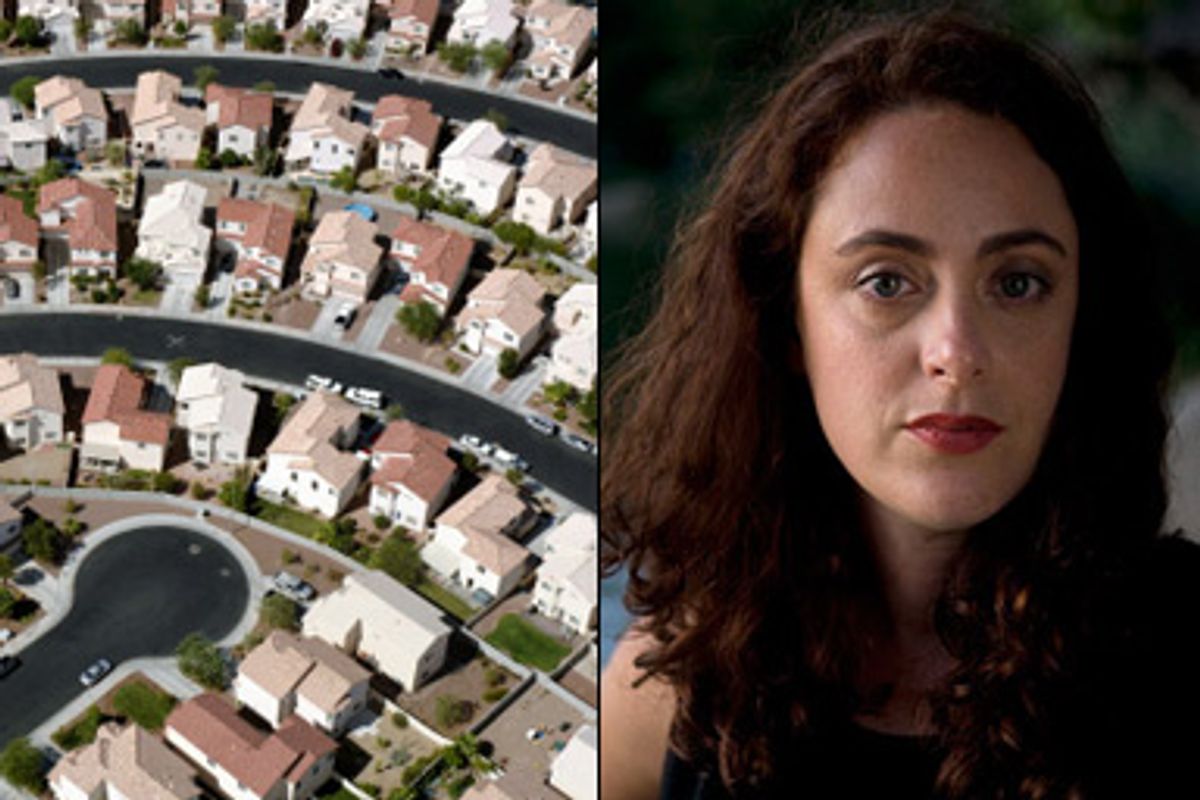
Alyssa Katz, author of "Our Lot," discusses the good intentions and mass delusion that led to the real estate boom

Alyssa Katz

To read “Our Lot: How Real Estate Came to Own Us” is to relive, in painful, anecdotal detail, the real estate bust that brought our economy low. Through Alyssa Katz, a journalism professor at New York University and the former editor of the magazine City Limits, we remeet the exploited homeowners and the naive investors, and we cringe again at the blundering politicians and opportunistic lenders.

But “Our Lot” is also a reminder that our memories are short, and that the same mix of hope, greed, good intentions and bad policy has been inflating and popping real estate bubbles since the days of LBJ. Behind it all is a conviction shared by nearly all Americans, be they Democrats or Republicans, Wall Streeters or the ARMed and desperate masses, that home ownership is a good thing — good for the neighborhood, the country and the average citizen holding the deed and the debt. “Our Lot’s” long view is perhaps most unnerving for the doubt it casts on that timeworn belief. Salon interviewed Katz by phone.

Isn’t homeownership actually good for you? I thought it was the panacea for almost all social ills, it drove the crime rate down, educational achievement up, and so on.

Yes, well, homeownership is only as good as the amount of home you actually own, and I think the big problem in the last generation or so is that Americans have turned to more and more and more debt to reach for the American dream.

There’s a lot of great examples out there — the Nehemiah homes that transformed East New York in Brooklyn from a really devastated and dangerous place to someplace that’s still really poor and has a high crime rate but has an opportunity to really grow and have a stable bunch of families really invested in building a home there. So all that’s great. Certainly there’s a lot of evidence that homeowners do tend to stay in one place for longer, their kids perform better in school. They tended to be more involved in local politics, community affairs, and block cleanups. The problem is, it’s very hard to separate out the effects of homeownership itself from the fact that people who have a certain economic or social standing are more likely statistically to be homeowners in the first place.

Does this mean that we shouldn’t actively encourage homeownership, using government money or government policy?

I think there’s nothing wrong with using government money, policy, pressure, all those tools to make homeownership more of a possibility than it would otherwise be in the marketplace, simply because the market left to its own devices discriminates aggressively. It rewards people who already have wealth, who have already had a leg up economically, and it’s great to give other people the opportunity as well.

The problem is that homeownership is the only housing policy that this country has ever shown any commitment to. Renters are treated miserably.

And that’s one big distinction you see between the U.S. and European countries that also had very loosely regulated mortgage-security markets and have had problems there. I think one reason you’re not seeing mass foreclosures on quite the scale that you had in the U.S. is that for large proportions of the population in many European countries, including the Netherlands, Germany, France, Switzerland, renting is supported through government policies that, for instance, protect tenants so that they don’t have to worry about getting kicked out at the end of the year.

Whereas in the U.S., homeownership was always the only option. And anyone who can afford to, or thought they could afford to, would choose that option. So that’s really the problem here.

Whose fault is the mess that we’re in now? And how far back do we need to go to start tracing the blame?

I think the message of my book, unfortunately, is that it’s to some degree everybody’s fault, including, I should say, liberal activists, with whom I’m extremely sympathetic, and think were right.

But what we really had was a collision of ideologies over this question of: How do we make it possible for everyone to be a homeowner? How do we eradicate this horrible legacy of discrimination, which had left the homeownership rate for whites much, much higher than that for blacks and Latinos? There was real work that needed to be done there. So I think we really have to go back to the 1970s, when we started to see pretty aggressive policy measures on the part of the federal government to try to level the playing field.

You talk about another real estate bubble in the early ’70s, when everybody who wanted one could get a mortgage. The wreckage that was left behind looks totally familiar.

Yes. Rather infamously, the federal housing administration, which is the government agency that insures mortgages — it’s what built Levittown and all those 1950s suburbs after the war — discriminated very aggressively, on the basis of what was thought to be sound statistical evidence, that the insurance fund would only be safe if it were to insure suburban and overwhelmingly white areas.

So what happened in ’67 and ’68 was that federal housing officials reversed that entirely. They proclaimed, initially just in the riot areas and then more broadly across cities, that FHA, the Federal Housing Administration, would now be open everywhere! And in fact, as I note in the book, the only circumstances under which HUD did not insure mortgages is if the house is literally falling down.

Real estate agents and loan brokers descended on inner cities, trying to find borrowers who would be unlikely to pay their mortgages back, because the real-estate speculator would get paid in full by the federal government, and paid more quickly and more generously, because of forgone interest that they would get compensated for. The sooner that borrower went into foreclosure the more generously that entrepreneur would get paid.

When was that mess cleaned up?

About ’73, ’74. There were tens if not hundreds of thousands of abandoned houses all over the country as a result of the FHA debacle, and it got a lot of attention at the time and was almost forgotten to history after that.

And then we have the Reagan presidency and — correct me if I’m wrong — but that’s when the securities market for mortgages really blossoms, right?

Absolutely. Mortgage-backed securities had existed since about 1970. They existed in the ’20s too, and that was part of why the Depression happened — they had been made illegal after that. But they came back as a government product in 1970. As I recount in the book, Lewis Ranieri of Salomon Brothers, which was trading in government-backed securities, thought, “Couldn’t we just do this ourselves? Why do we need to have Freddie Mac or Fannie Mae in the middle, why don’t we create these securities?”

In order to do that, they needed to rewrite all those laws that had been passed following the crash in 1929 and thereafter, which was as much a housing and real estate bubble crash as it was a stock market crash. 

What did that do to the housing market?

It took a while for all the pieces to come into place. But once the tax laws changed in 1986 to allow the Wall Street mortgage-backed securities market to just explode, what you saw was the invention of subprime lending. Suddenly Wall Street banks were able to do their own thing, but they had to find their own niches. Fannie Mae and Freddie Mac already had what were known as plain vanilla loans: You want a 30-year fixed-rate mortgage, you’ve got great credit, you live in the suburbs.

So the Wall Street banks started looking for niches at the bottom and at the top of the food chain: at the top, what were known as jumbo loans, loans that Fannie Mae and Freddie Mac were not allowed to buy, and then they created subprime. They created a loan product with high interest rates, high fees, adjustable interest rates, all these new features that would enable them to make money lending to people who never before would have qualified for a mortgage.

And then when Bill Clinton became president he did not shut that down?

That’s right. To the Clinton administration’s credit, his Federal Trade Commission, among other agencies, and the other banking regulators, did pretty aggressively go after some of the worst offenders, who would not just be putting out subprime loans but really engaging in predatory lending, setting up borrowers with loans they knew they could not pay.

But you had two, or three, or — one could keep counting — things that the Clinton administration did that really enabled the bubble. And I think it was with the best of intentions at the time, but a lot of sort of willful naiveté about what the consequences would be.

Number one, what it did was really just encourage homeownership very aggressively. This became a central theme of Clinton’s campaign for reelection in 1996, how almost every American can and should own their home. This was something that Clinton promoted out of a sense of his own political survival. You had Newt Gingrich and his Congress trying to eliminate HUD entirely. Homeownership was this apple pie issue that could help justify the agency’s existence.

Homeownership also became a way that Clinton pushed for a hotter economy. And what would happen as well, of course, is that he had Alan Greenspan as head of the Federal Reserve, willfully ignoring pleas that came as early as the early ’90s from consumer advocates who started to see the damage being wrought by predatory lending. They were hearing from Congress in ’93 legislation that passed that was supposed to stop predatory lending but couldn’t because of the way the industry was growing and metastasizing too fast.

That law, the Homeowner or Equity Protection Act (or HOEPA), asked the Federal Reserve to set guidelines. Congress said to the Federal Reserve, “We want you to regulate the subprime industry, you’re the only entity that can do this.” And the Federal Reserve never acted on it. Once consumer advocates tried to go to court to fight predatory lenders through lawsuits, judges — often Republican-appointed judges — would say, “You know, I’d love to rule in favor of you, but the Federal Reserve was supposed to help define this question of law that’s central to your case, and they never did, so we really can’t rule that this was a violation of HOEPA.”

So that was really the problem in the ’90s: that Alan Greenspan and his absolutist free-market approach to the mortgage markets, and the financial markets more broadly, completely defined everything that went on.

You also had community organizers and activists pushing Bill Clinton or pushing the Democratic Party to make housing more available, right?

The calamity that came to happen was enabled by this explosive growth that sucked all the customers from the government-sponsored market into the private one where they just became sitting ducks for every toxic product imaginable. Remember that the loans that went bad were people who had bought their homes, often with the help of the government programs, then refinancing with a subprime loan or with an adjustable rate loan.

There are clearly two competing narratives. You have the right-wing critique that blames the homeowners and you have the other side largely placing the blame on Wall Street. What responsibility do homeowners actually bear for the state we’re in now?

I think homeowners bear a lot of responsibility for their own wishful thinking. What you have is essentially a mass social mania. And it was infectious — you have a homeowner seeing their neighbor moving up to a bigger, better house because their broker is offering them a loan. Yes, the interest rate will adjust, but they can refinance in two years when it does. People wanted to believe. I traveled across the country for this book and interviewed many many, many homeowners and people who sold them mortgages and homes. And Americans’ capacity in general for delusional thinking, wishful thinking, fantastic thinking really just flourished.

This isn’t to say every homeowner was in this position. There was no shortage of horrifically exploitative practices, lenders who preyed and continued to prey on people’s financial desperation. This is all happening at a time when real wages are stagnant or declining, where people’s other expenses are going up. Trying to maintain a good standard of living and finding what seems like an easy way to do it. So it just became the new normal.

The book has a great number of anecdotal illustrations about the development of the market and the damage wrought. Let’s talk about a specific case: a homeowner named Charity Stewart.

Charity Stewart had bought a house for about $100,000 in 2004 because it was cheaper than renting. She was a single mom, single grandmother, and was 33 years old when she bought the home. She said she was driving around a neighborhood, saw a sign, said there was no money down — actually I think it was $500 down. She was able to get into that home for less, she told me, than it would be to put down a rent deposit.

When you rent a place, often a landlord will want to check out your finances, make sure they can get paid every month. Well, her lender, which was Argent Mortgage, now defunct, a spinoff from Ameriquest Mortgage, they asked for financial documentation — and she was allowed to count income that really shouldn’t have been counted. You know, her mom was on SSI and didn’t live with her but they added her mom’s income to her household income. So she ended up qualifying for a mortgage at a high interest rate that was much higher than she could pay for.

But it wasn’t only that that really struck me about Charity’s story because that has, I think, become very ordinary in the past couple of years. It was also that Charity had really no idea of what was involved in homeownership and no one had bothered to tell her. And so when the house, as often happens with these older city homes that were getting sold to first-time home-buyers, had some problems — it had a leak. And she didn’t know what to do. She had always lived as a tenant and could call the super or the landlord. And she actually tried to call Ameriquest when the leak started to get it fixed — she didn’t know what else to do and nobody told her. So by the time I came, which was about a year later, this leak had turned into this waterfall down the side of her living room and she stopped making mortgage payments, sort of in protest of her house falling apart. And she went into foreclosure that week that I visited her. 

What about the story of Lehigh Acres?

Lehigh Acres is an area near Fort Myers in Florida, and Fort Myers/Cape Coral is one of the hottest foreclosure hot spots in the country. The area became a Mecca for speculators. Lehigh Acres and Cape Coral were created by infomercial kingpins of the 1950s, these product pitchmen who had spent time during the winter in Florida and saw an opportunity to sell real estate the way they had sold rat killer and cosmetics on their TV shows. They decided to start selling land on the installment plan. So what you had in these areas in Florida, and still have, are just tens of thousands of these little housing lots in the middle of swamp that were created to sell on TV.

There were these organized investor schemes, these seminars that would go on road shows all over the country, encouraging middle-class Americans to make it in real estate — to be like Donald Trump. Buyers would have to put almost no money down, because they were getting set up with these construction loans. The idea was that they would get tenants in the homes and the tenants would eventually qualify for a subprime loan and owners could sell to them — but of course this isn’t how it worked out. These homes never ended up getting sold for the most part.

What I found was entire towns — I visited a town in Pennsylvania just outside Philly — where you’d have nine or 10 families from this one town and another six from down the road, and more from the next town over, all of them had gone to a seminar at a hotel in King of Prussia and seen how they could make this 14 percent return on Florida real estate. And these families just lost everything. They were really hoping only to send their children to college and to just get that leg up and this was how they hoped to get it. And so we talk about real estate investors and speculators and there’s often this stereotype of someone in that show “Flip This House” who sits in his SUV and is on his cellphone all day. But a lot of these investors were in fact ordinary middle-class Americans who had never invested in real estate before.

Is there anybody in this whole saga who stands out as both well intentioned and well informed, who was prescient about what was going to happen and said, “Stop”?

Oh gosh, quite a few along the way. So many consumer advocates, community organizers, folks in Washington, they’ve been working on this stuff for years and never drank the Kool-Aid. They were fighting discrimination but also really knew when the policies and the industry were going too far and called them on it, too. The kind of conscience and hero in my book is a now-deceased activist named Gail Cincotta, who is really central to all these progressive policy changes to help fight discrimination in mortgage lending, get the Community Reinvestment Act passed, urge more lending to credit-worthy and qualified low- and moderate-income people. She would go and testify in Congress year after year about how these programs were going and she would just call them out on it constantly and say, What are you doing? These loans are not helping people, they’re proving really harmful and you have a responsibility to do something. But by that point, this monster had already taken on a life of its own.

Is there anybody in Congress whom we should listen to, who has the right prescription or has been consistently right in the past?

For better and for worse –I think almost entirely for the better — we have Barney Frank. He is a favorite whipping boy on the right; for the believers it’s all the Community Reinvestment Act’s fault, it’s all Freddie Mac and Fannie Mae’s fault, and he is their prime evidence of that. He had an ex-boyfriend who worked for Fannie Mae and that’s part of the conspiracy theory behind this. That’s all baloney as far as what drives his policy decisions, what he’s trying to do. Frank, I think, is somebody who cares deeply about housing and about having a sane and functional mortgage market and he’s trying to do the best he can within what’s really possible in Congress right now.

I think part of the problem is that the Obama administration has been trying to play a very evenhanded role in setting the agenda going forward. So, for instance, Frank has been trying to push legislation that would outright bar a lot of predatory lending practices, but it was just a non-starter, certainly in the Senate. It passed the House thanks to the efforts of Frank and others, but in the Senate, Chris Dodd particularly, and others there are just really refusing to confront these issues head-on. So we’re sort of left now with the Obama administration’s new plan to overhaul the financial industry and its proposal for a new consumer financial products safety commission to carry that load going forward.

Has what the Obama administration has done to date about housing and lending helped or hurt?

Neither, which I guess is to its credit. I mean, it is trying to — not that successfully — keep the banking industry afloat while also keeping homeowners afloat. And the problem is you’ve got a zero-sum game.

So have we hit bottom yet?

Ask Jim Cramer [laughs], he says we’ve hit bottom. I’m not Jim Cramer.

Should I invest in real estate now?

Actually, that’s a really great question. There’s a lot of really great buys around the country right now because a lot of players who, in the past, did have money to throw around in real estate, are staying on the sidelines. So what you have in fact are sort of private equity funds  coming in, I guess you could call them vulture funds, they’re just coming in and buying up whatever they can. And prices for foreclosures — you can pick up places, especially in cities, for very very little money right now. And what you see is actually some kind of half-crazy or half-enterprising young people investors, entrepreneurs, some with good intentions and some that just want to make a buck, coming and buying up stuff cheap and fixing it up. There’s both good and bad coming out of that right now.

Sounds like the beginning of the next bubble, right?

[laughs] Well, the bubble’s only going to inflate if we choose to put air into it again. And if you look at what the Obama administration is putting out there, as far as what they want to see happening going forward, it puts a lot of very almost excessively thoughtful constraints on how that market will work. They’ve called for all these Ph.D.s to roam around and study exactly who will run into trouble if they have a pre-payment penalty or an adjustable rate and then regulate the product accordingly. It’s very, very, very wonky. That’s no guarantee that it’ll work. So I remain kind of admiring of the effort to craft this plan, but very skeptical that it will actually work as advertised.

Mark Schone is Salon's executive news editor.

“Why won’t you answer me?”

Kids' questions may be annoying -- but they're more crucial to learning than we've ever thought. An expert explains

(Credit: Bonita R. Cheshier via Shutterstock)

Children can ask a lot of very annoying questions. Starting at about 2 years of age, they begin barraging their parents with endless queries, from “Are we there yet?” to “Why is the moon round?” — questions that often seem more like desperate ploys for parental attention than anything else. And, to make things worse, cooperative parents are often treated to a relentless barrage of follow-up questions, many of which involve one word: “Why?” Is this process infuriating? Yes. But is it crucial to their development? Far more than most of us think. And furthermore, the frequency and form of those questions can tell us a lot, not only about how children learn but also about cultural and class differences in America.

In his new book, “Trusting What You’re Told,” Paul L. Harris, a Victor S. Thomas Professor of Education at Harvard, argues that much of what we’ve assumed about our kids’ early learning may be misguided. Although many parents and teachers think of children as primarily independent “scientific” learners who best absorb knowledge by physically interacting with the world — an idea that informs everything from Montessori education to museum planning —  Harris believes it woefully underestimates the importance of dialogue in young kids’ lives. Conversation — and question asking — allows young children to grasp highly abstract concepts, from religion to history, at an earlier age. However, as Harris points out, the way young children learn can vary surprisingly between working-class and middle-class children, and people from different ethnic backgrounds.

Salon spoke to Harris over the phone about Montessori’s mistakes, Asian-American kids’ deference levels, and why working-class kids ask fewer questions.

Why is it so important to determine where young children actually get their information? 

A lot of research on cognitive development has argued that children do best when they’re exploring the world for themselves in a scientific fashion. That idea has a long pedigree. If you read someone like Rousseau, that’s what he’s basically advocating — along with more recent researchers or educators like Paget or Montessori. Even in the last decade or so there have been a lot of titles within the popular science mode that have focused on the “scientist in the crib” or the “child as a scientist.” But I think it dramatically underestimates children.

Where is this, as you argue, misguided approach to early education reflected?

If you go into a Montessori classroom, which is the archetype of this, the child is given materials to play with — be they rods or cones or things to assemble — and the assumption is that the child learns best about numbers and space from interacting with those concrete materials. I’m not quarreling with this as an educational device; I just don’t think it’s the whole story. You also see this philosophy in progressive science museums for children that pride themselves on being hands-on experiences: The child is not necessarily told very much, and he or she is encouraged to try things out for themselves.

You argue that, rather than allowing children simply to figure things out for themselves, it’s incredibly important that children learn things by interacting with adults from a young age. When does that form of learning start?

Probably before the child learns how to talk. There was a nice set of experiments where toddlers who were barely able to walk were given a slope to go down. The slope was made a little bit too steep for them to be confident on, and they’d often turn toward a parent of caregiver looking for advice. The evidence showed that if the parent looked anxious and apprehensive, the toddler would probably hesitate to tackle the slope, and if the caregiver looked encouraging and optimistic, the toddler would go ahead and try to negotiate it.

But this process of learning from others really comes into its own when the child is starting to talk, from 18 to 24 months upward. If, for example, the child puts a toy in a box in a room, and the child comes back into the room, and you tell the child that you’ve moved the toy to a different box, by around two and a half, children are very good at listening to you and will go search in the new place. This is a very early illustration of the way human children realize that the world may not be as they saw it, or as they see it, and that their best bet is to listen and trust other people for guidance.

At a certain point in their childhood, kids start asking lots and lots of inane question where they don’t even seem to be interested in the answer. It can be insanely annoying, and a lot of parents dismiss this as a way to get attention, but you argue that it’s actually incredibly important.

It’s true that children ask a lot of questions, but if you look more closely at the kinds of questions they ask, about 70 percent of them are seeking information as opposed to things like, for example, asking permission. And then when you look at those questions, 20 to 25 percent of them go beyond asking for bare facts like “Where are my socks?” Children ask for explanations, like “Why is my brother crying?” If a child spends one hour a day between the ages of 2 and 5 with a caregiver who is talking to them and interacting with them, they will ask 40,000 questions in which they are asking for some kind of explanation. That’s an enormous number of questions.

And it’s not just attention seeking. When children ask questions and you answer them, that is actually a setting for a sustained dialogue, and they’re trying to get clear in their minds about a particular issue that’s confusing to them or bothering them.

One disturbing finding you highlight in the book is that children in less wealthy families are far less likely to ask these kinds of inquisitive questions.

The most critical variable is the education of the mother. The more educated the mother, the greater the richness of the vocabulary and sentences they use with their children, and to some extent the greater the amount of time they talk to their children. One study was done in the U.K. with a group of working-class 4-year-olds and middle-class 4-year-olds, and the middle-class 4-year-olds were more likely to ask questions than the working-class 4-year-olds. This was also true not just of the single one-off questions but more persistent series of questions. That study also showed that children asked many more questions at home than at preschool, so when we send kids to preschool we’re giving them opportunities to play with other children and pretend play or whatever, but in terms of one-to-one dialogue where these kinds of sustained explorations can take place, we may be limiting the opportunities.

Children also seem to trust answers that come from parents more than other people they don’t know as well.

We’ve done a variety of experiments, and children seem to have a variety of biases that steer them more toward some informants than others. One of the most basic is that they’ll often turn to familiar people rather than strangers. Though by the time the child is 5, if a familiar person starts saying things that from the child’s point of view are incorrect or implausible, the child will become less receptive to that person.

There’s a surprising finding in the book that Asian-American children are more deferential in their early learning than others. What does that mean?

There is data comparing American children who are European-American and children from Asian-American families, and to cut a long story short, it looks as if the first-generation Asian-Americans children are more likely to scan the social horizon, more likely to listen to other people. I don’t think we should automatically jump to the conclusion that’s an intellectually inferior strategy; it’s actually an intellectually sophisticated strategy. We don’t know exactly what brings this cultural difference about, but our best guess is that it goes back to the dialogue between caregiver and children — that mothers differ in the extent to which they encourage children to voice their own opinions or record a child’s opinion as worthy of attention.

But the willingness to provide and act on what you’re told is not something that’s peculiar to any particular culture. Deference has been an important tool for the transmission of culture. Human technology becomes more elaborate, more complicated, from one generation to the next, and deference allows information to be picked up and acted upon. Chimpanzees, for example, deprive themselves of the ability to learn culturally inherited wisdom passed on from generation to generation. If we look at chimpanzee tool use, it tends to be unsophisticated; it doesn’t accumulate over generations.

You draw parallels and contrasts between childhood beliefs in  religion, in the sense of the existence of God, and in more scientific things, like germs. What are the conclusions you can draw from that?

This is another illustration of how the traditional portrait of the child as a little scientist doesn’t work. A 4- or 5-year-old child isn’t in a position to observe germs, but talk to one, and they are pretty convinced they exist. It’s perfectly routine for children to believe in things that they can’t observe, and they do that presumably by listening to what other people say and looking at the presuppositions in what people say. This is as much true of germs and oxygen as it is of special beings such as God or Santa Claus or the tooth fairy. From the perspective of the child the primary evidence they have is what other people tell them about these entities.

The making of that distinction between scientifically established and more religious or supernatural entities is far from straightforward. There’s a sense that children are a little bit like psephologists: They look at what people say around them, and they do a head count, and they see that there’s nobody who’s a skeptic about germs. But on the other hand there are very subtle signs that God has a different status. Then of course when it  comes to Santa Claus and the tooth fairy — and eventually in the schoolyard — they’re going to meet a skeptic if not several, so their belief in those entities is going to suffer a heavy blow at some point.

What do findings tell us about how children first learn about death and understand it?

They start by understanding that the body has a life cycle, and that people have these internal organs that have to be working for them to live — and that at a certain point in time the life cycle comes to an end. These internal organs cease to function. The biological account of death implies that once you’re dead, that’s it. Life has ceased. By contrast the religious conception of death typically carries with it the implication of some sort of afterlife. But it takes them a longer time to start accepting the claims that a particular community will make about the afterlife. The other interesting finding is that it’s not as if those two accounts are in competition with one another. So when children subscribe in the end to a Christian notion of the afterlife, it doesn’t lead them to abandon the biological conception. Both coexist in the child’s mind — and get recruited in different contexts.

Given your findings, how should we be changing the way we educate and parent our children?

One thing that it calls attention to is how much children can learn just by talking to people and engaging in dialogue with someone they’re familiar with. Even at a fairly young age, children can be guided to think about episodes, places, periods in history which are fairly remote from their own immediate experience. Part of the human experience is the capacity to leave behind the here and now and to think about very different times and times and places. I suppose the other aspect of the book that I didn’t dwell on, though it’s increasingly on our mind, is the fact that thanks to technology, children’s access to information is now amplified. At an early age children have these spontaneous filters. They’re trusting some people more than others; navigating the Internet, which is tricky; and many of them are left to their own devices in figuring out how to do that. It’s not as if we have educational programs which encourage children to think more carefully about where they gather information from. What we tend to do is try to guarantee that children’s access to certain misleading sources or difficult sources is blocked rather than giving them the tools to make assessments for themselves. In the future we’ll have to address that question more systematically than we do and at an earlier age.

Continue Reading Close
Thomas Rogers

Thomas Rogers is Salon's Arts Editor.

“Farther Away”: Franzen on Wallace

In a new essay collection, "Freedom's" author reflects on his best friend's suicide with betrayal, anger and sorrow

This article appears courtesy of The Barnes & Noble Review.

Jonathan Franzen wants you to like him. In “Mr. Difficult,” a 2002 New Yorker essay, Franzen identifies two types of authorship: the Status model, devoted to the pursuit of difficult art at the expense of commercial gain, and the Contract model, which privileges the enjoyment and connectedness of the reader. Franzen is, in his own estimation, “a Contract kind of person.” His novels don’t ask more of the reader than she is willing to give in turn. “[T]o build the reader an uncomfortable house you wouldn’t want to live in: this violates what seems to me the categorical imperative for any fiction writer.”

Barnes & Noble Review
But if Franzen the fiction writer diligently abides by this Kantian fiat, Franzen the essayist is not in the business of building comfortable houses. In his nonfiction, Franzen violates the writerly contract he so vaunts, not by high-art subversion but simply by being a grouch. “How to Be Alone,” which appeared in 2003 two years after the breakout success of “The Corrections,” collected his essays of the previous decade into an angry bundle. Anchored by his famous Harper’s essay on the plight of the modern novelist, the book lambasted our national preference for cultural pablum and lamented the demise of a virtuous solitude. “Farther Away,” coming nearly two years on the heels of “Freedom,” follows much the same pattern. Like its predecessor, this assemblage of essays finds Franzen in a curmudgeonly mood — ranting against the encroachments of social media and other people’s cellphone “I love yous” — and like its predecessor, it contains one long essay that has already proved a lightning rod.

“Farther Away,” the essay that lends the book its title, arrived with the force of a gathering storm, an electric anticipation (literally: the New Yorker used it to bait new fans on Facebook, never mind Franzen’s public denunciation of the Like button) giving way to a blustery fracas. Here was a major novelist, possibly even the novelist of his generation, prepared to issue a public verdict on the life and work of another literary titan, his late friend and friendly rival, David Foster Wallace. And what a mournful, vengeful, bitter, sad, ambivalent verdict it was.

“Farther Away” has a deliberately inorganic quality: Franzen, having deferred the emotional work of making sense of his friend’s suicide to deal with the professional work of finishing and promoting “Freedom,” decides to isolate himself on the same remote Chilean island where Defoe set “Robinson Crusoe,” in order to contemplate the origins of the novel and work through his feelings about Wallace’s death. In Franzen’s mind, these subjects are not unrelated. The modern novel, whose genealogy begins with “Robinson Crusoe,” was born of a need to fill the leisure hours of a newly emergent bourgeoisie in 18th-century England; Wallace “in one interpretation of his suicide … had died of boredom and in despair about his future novels.” The novel was meant to be a solution to boredom, and Wallace, in taking boredom as his subject in the work eventually published as “The Pale King,” had plunged into a fatal nihilism.

While Franzen never admits subscribing to this interpretation, he has elsewhere described his and Wallace’s shared understanding of fiction as “a particularly effective way for strangers to connect across time and distance” — a conclusion that Wallace, by his suicide, would seem to have abandoned. And yet what makes Franzen angriest, and where his sense of injury over Wallace’s death begins to show through most fully, isn’t Wallace’s implicit rejection of the redemptive possibilities of fiction. It’s the way in which Wallace’s suicide has itself transmogrified into an unlikely act of connection:

But if you happened to know that his actual character was more complex and dubious than he was getting credit for, and if you also know that he was more lovable — funnier, sillier, needier, more poignantly at war with his demons, more lost, more childishly transparent in his lies and inconsistencies — than the benignant and morally clairvoyant artist/saint that had been made of him, it was still hard not to feel wounded by the part of him that had chosen the adulation of strangers over the love of the people closest to him.

The story of their friendship is the story of two great writers caught in a dialectic of mutual admiration and resentment, each finding in the other a counterpart against whom to define his own relationship both to his art and to his public. As Franzen said in his interview for the Paris Review’s “Art of Fiction” series, “I perceived, rightly or wrongly, that our friendship was haunted by a competition between the writer who was pursuing art for art’s sake and the writer who was trying to be out in the world. The art-for-art’s-sake writer gets a certain kind of cult credibility, gets books written about him or his work, whereas the writer out in the world gets public attention and money.” Some of Franzen’s bitterness in “Farther Away” seems to be directed at the ways in which Wallace’s inexplicable act thwarts the narrative he had constructed around their respective relationships to the Contract and the Status models:

[W]e who loved him were left feeling betrayed. Betrayed not merely by the failure of our investment of love but by the way in which his suicide took him away from us and made him a very public legend. People who had never read his fiction, or had never even heard of him, read his Kenyon College commencement address in The Wall Street Journal and mourned the loss of a great and gentle soul. A literary establishment that had never so much as short-listed one of his books for a national prize now united to declare him a lost national treasure.

Wallace dies not only with his cult credibility intact; he also gets public attention and money.

The fact that “Farther Away” (the collection, not the essay) opens with Franzen’s own commencement address at Kenyon makes for an instructive irony: Was Franzen ever really the populist of the two? Certainly, when we enter the terrain of nonfiction, the dichotomy begins to break down. Franzen’s essays hold his reader at arm’s length, whereas Wallace’s are more readily welcoming than his fiction. Both Kenyon speeches — Wallace’s from 2005, Franzen’s from last spring — warn against the lure of narcissism. Wallace asks the graduating class to do the hard work of consciousness, of keeping their brains from flying on autopilot; Franzen rails against the techno-consumerist threats of Facebook and the iPhone. For a talk so concerned with the importance of connecting with other people, Franzen comes across as willfully obtuse: “Very probably you’re sick to death of hearing social media dissed by cranky 51-year-olds. My aim here is mainly to set up a contrast between the narcissistic tendencies of technology and the problem of actual love.”

There are, it is worth noting, other essays in this collection: “Farther Away” is one of 22 pieces assembled from Franzen’s extra-fictional writing career since 1998. There are his environmental writings from the New Yorker, born of a midlife love affair with birdwatching; assorted literary criticism; and a handful of essays in which he uses his pedestal to plead the case of deserving, overlooked authors: Christina Stead, Donald Antrim, Alice Munro. In this last category, Franzen is at his best, shedding his perennial irritation to treat them with a nuance he fails to bring to his readings of the 21st-century cultural landscape. But it’s “Farther Away” — a document of one great writer tangling with the ghost of another — that we’re going to be reading 30 years from now. It’s the only essay Franzen has written that directs the current of anger that runs through all of his nonfiction at a subject actually worthy of it: the suicide of his best friend. His willingness to say the unsayable, to let all his ugly feelings show through, may not make him likable, but in finally writing for himself instead of for his reader, he’s given us a fitting tribute to Wallace — a confrontation with the problem of actual love.

Continue Reading Close

“When women were birds”: Reading blank journals

A writer makes sense of the rows of empty cloth-bound diaries her mother left her

This article appears courtesy of The Barnes & Noble Review.

If you are a reader who cares about nature, wilderness, our place in nature, writing and nature, how to choose a course of action when something you care about is threatened, the lifelong search for voice, and what it means to be a woman in this world, you will have crossed paths with the work of Terry Tempest Williams. Perhaps you grew up reading Aldo Leopold, John Muir, Edward Abbey, Gary Snyder and Bill McKibben and, loving their work, still felt something missing — that your relationship with these issues was not fully rendered. Then you discovered Williams, and, not unlike Alfred Stieglitz’s famous response when he first saw Georgia O’Keeffe’s paintings, you might have breathed: “At last! A woman on paper!”

A woman on paper.

Barnes & Noble ReviewWhen Williams was 22 her beloved mother, then 54, died of cancer. She left her only daughter all of her journals, rows of cloth-covered books. When Williams opened them, the pages were blank. Disappointed, she used some of them for her own; others were put away and forgotten. Quite simply, she was too young to know what to make of them. Decades later, at fifty-four, Williams seeks an explanation for these white, white pages. The result is “When Women Were Birds: Fifty-four Variations on Voice.” “My mother was a great reader,” she writes. “She left me her journals, and all her journals were blank. I believe she wanted them read. How do I read them now?”

If you’re like many readers, your first introduction to Williams’s work was her fourth book, “Refuge: An Unnatural History of Family and Place,” published in 1991, when the author, who hails from a large Mormon clan in northern Utah, was 36. This was a memoir in which Williams tried to understand how 10 women in her family, living downwind from the atomic bomb testing grounds in Utah, had died from or been diagnosed with breast cancer. She struggled at the same time to capture a world in which the rising of the Great Salt Lake was flooding the Bear River Migratory Bird Refuge, a much-beloved ecosystem. She knew that somehow, in the deep aquifer that contains the American, the western, the feminine, and the human subconscious, these events were connected.

Williams went on to create 13 more books: essays, poetry, edited volumes. She protested nuclear testing in the Nevada Desert in the late eighties and early nineties, testified in Congress on women’s health and environmental links to cancer, opposed the war in Iraq and joined the Wilderness Society in support of the Redrock Wilderness Act, which would limit the ravaging of 5.7 million acres in that state. She has served on the Governing Council of the Wilderness Society and was a member of the western team for the President’s Council for Sustainable Development. She is currently on the advisory board of the National Parks and Conservation Association, the Nature Conservancy, and the Southern Utah Wilderness Alliance.

You might say she found her voice.

With each new book, the reader feels she knows a little more about the writer; each book is autobiographical but finds a different angle of repose. Threads run through the books like rivers — a love of birds, revelations inspired by paintings, silence and sound, a lifelong conversation with the Mormon Church in which Williams challenges, confronts, encourages, illuminates the dark corners and keeps her fingers crossed that she will not be excommunicated. Women in the Mormon Church are expected to keep a journal and to bear children (“The only things I’ve done religiously are keep a journal and use birth control.”) Williams has thought a great deal about motherhood. In “When Women Were Birds,” she writes that the first voice she heard was her mother’s. She writes about the many ways that mothers withhold their voices to allow their children to develop their own. “She spoke through gestures,” she writes of her mother, Diane Dixon Tempest, “largely quiet and graceful. A letter. A meal. A walk together. Her touch.”

Williams traces the evolution of her own voice. She remembers long hours as a child listening to Prokofiev’s “Peter and the Wolf” and memorizing the music and the voices of the animals and birds. She remembers a kind teacher who helped her to overcome a speech impediment, and some of her fear of speaking out loud, by reciting poems about birds. Her new husband, Brooke, also a lover of wilderness and wildness, understood “when I threw back my head and howled.”

And then there were the silencers: a terrifying man in Idaho’s Sawtooth wilderness who tried to kill her with an axe when she was doing fieldwork in college — the story was too terrifying to tell anyone except Brooke. Or the headmistress at the ultra-conservative school where Williams taught biology, who told her environmentalism was the work of the Devil. Or Congressman Jim Hansen, who looked over his glasses at Williams when she testified to preserve Utah’s wilderness against extractive and other industries and said: “I’m sorry Ms. Williams, there is something about your voice I cannot hear.”

And then in 2010, Williams receives a diagnosis with the power to silence: a cavernous hemangioma, “located in what doctors call the ‘eloquent’ part of my brain, or Wernicke’s brain, the home of language comprehension, where metaphor and the patterned mind live.” She is given two possible treatments: brain surgery or waiting. “How well do you live with uncertainty?” the neurosurgeon asks. “What else is there?” Williams responds. This is not my story, she thinks. This is not my story.

“When Women Were Birds” is in many ways a thank-you letter to a mother who gave her daughter the gift of words, the gift of locating herself in the world with words and the gift of recognizing, describing, and protecting beauty in the world, using words. But there is more. Diane Dixon Tempest’s blank journals gave her daughter the great gift of peace with a terrible fact: words are often inadequate. “I will never be able to say what is in my heart,” Williams realizes, “because words fail us, because it is in our nature to protect, because there are times when what is public and what is private must be discerned.” Looking at a photograph of her mother, she remembers this poem by Wallace Stevens, called “The Bird Listener”:

I do not know which to prefer,
The beauty of inflections
Or the beauty of innuendos,
The blackbird whistling
Or just after.

My mother’s journals,” Williams writes, are ‘just after.’ ”

Continue Reading Close

“Drop Dead Healthy”: A failed addition to “shtick lit”

In a book about one man's "quest for bodily perfection," the author doesn't even bother to try

This article appears courtesy of The Barnes & Noble Review.

In “Memoir: A History,” Ben Yagoda defines “shtick lit” as “[b]ooks perpetrated by people who undertook an unusual project with the express purpose of writing about it.” He identifies “Walden” as the earliest example of the genre, which would seem to establish a respectable pedigree, but the word perpetrated leaves little doubt as to Yagoda’s opinion of more recent efforts. He can’t be alone in casting a skeptical eye on shtick-lit superstar A. J. Jacobs, the Esquire writer responsible for “The Know-It-All” (shtick: reading the “Encyclopaedia Britannica” in its entirety), “The Year of Living Biblically” (shtick: following every biblical injunction to the letter for 12 lushly bearded, annoying months), and now “Drop Dead Healthy,” evidently a reboot of Remar Sutton’s out-of-print “Body Worry.”

Barnes & Noble ReviewFull disclosure: I undertook the project of reading an A. J. Jacobs’ book with the express purpose of writing about it. My plan was to acknowledge, with a touch of self-deprecating humor, the unlikeliness of my enterprise: I know this seems like a crazy waste of time, guys, but just hear me out…. I’d suffer a few well-timed setbacks, and — this is de rigueur — get chastised by my wife for neglecting her, the kids or my household chores. (I’m not married, but if memoir can massage the truth, why can’t reviews of memoir?) I thought about failing to finish the book. In the end, I may not have made it to my goal of 375 pages, but I did learn a whole lot about the value of shtick lit. Would I do it all again? Probably not, but I’m still glad I made the effort

Well, I did finish the book, and I did learn a lot about the value of shtick lit. The truth is, despite the warnings of Yagoda and others whose opinions I trust, I was never reluctant to read Jacobs. I find autodidacticism and self-improvement fascinating, and greatly to be encouraged. When I took up Jacobs, my hope was to defend him and his beleaguered genre from the cynics, the ones who can’t believe that anyone acts in a spirit of genuine curiosity or enthusiasm. I’d point out, too, that nobody is forcing them to buy shtick lit; if they have a philosophical objection to bogus projects undertaken expressly to be written about, they should make themselves useful and campaign to abolish the college essay.

The cover photo of Jacobs mock-struggling to do a pull-up is a clue to the fatal flaw of this book. It is not going to be, as advertised, a “quest for bodily perfection.” It is going to be a litany of shortcomings, a chronicle of thwartings and chastenings. It will consist of Jacobs dipping his toes in a thousand different dietary and fitness fads and will read like a novelization of every health-scare story and dubious medical study that ever beckoned from a website sidebar or nagged you from your Facebook feed. And because Jacobs will flit from topic to topic, body part to body part, anxiety to anxiety, the reader will almost but not quite fail to notice that Jacobs isn’t accomplishing very much at all.

It’s not that I wasn’t expecting this. I’m familiar with the conventions of the genre. It just took seeing them at their most conventional to realize that they’re dragging the genre down. Paradoxically, Jacobs expended an astonishing amount of hard work to produce a book this lazy. In just two years, he learned to eat better, to lift weights, to reduce his exposure to environmental toxins, to run correctly, and so on. He shed 16 pounds, or eight pounds per year — a little more impressive than it sounds when you consider that he must have gained muscle weight in the process. He cut his fat in half. He wrote his entire book on a treadmill, walking over a thousand miles in the process.

His labors culminate in conclusions any fool could have seen coming: “I’ll incorporate much of what I learned” and “I’ll follow fitness expert Oscar Wilde’s advice: Be moderate in all things, including moderation.” It’s not even really fair to call these conclusions, since they probably appeared verbatim in his book proposal. You aren’t supposed to criticize an author for not having written a different book, but what if the book he’s written doesn’t need to exist? What if everyone already knows that health fads are zany and that moderation is good? A book trading on such modest insights had better be mind-bendingly funny. A quick test: Jacobs is sold on skin care when he sees two guys — “leather jackets, Harley tattoos” — at Penn Station, talking moisturizers. Do you find this a) funny, b) funny but implausible, or c) so Shoebox Greetings unfunny that it doesn’t matter if it happened or not?

Most of Jacobs’ humor is of the self-deprecating or auto-emasculating variety. “[A]s an experiment,” Jacobs writes, “I’ve been wearing my blue bike helmet as I run my errands.” Have you been, man? Is anyone laughing at this? Hack comedy is one thing, but what irks me is that someone gave Jacobs a great deal of money — he mentions his advance repeatedly — to challenge himself, and instead of doing that he’s screwing around with stuff like wearing a bike helmet in public. “Bodily perfection” implies that your 44-year-old carcass is going to scale Half Dome or complete Marine Corps boot camp. I don’t care that you ate a bushel of vegetables, tried on a CPAP, or submitted to the indignity of wearing Vibram FiveFingers sneakers. I’d like to see some results. As it stands, we don’t even get an “after” photo.

Jacobs’ crowning achievement is a modest triathlon: 11 minutes of swimming, 33 minutes of bicycling, and an unspecified amount of jogging, probably 3.1 miles. Here lies the problem with shtick lit: the pedestrian nature of its goals. When men get old and retire — when they become the target market for books making light of their Jacobs-like ineptitude — they tend to read a lot of biography. Why? Perhaps it’s because age, regret and self-criticism conspire to produce a craving for real achievement, or at least for stories about real achievement. Most of us have been half-assing it since the day we were born. Self-deprecation has become a reflex, a preemptive excuse — which is why books like Jacobs’ will climb the bestseller lists and, let’s be fair, actually entertain the average reader. Yet if shtick lit is ever to live up to its promise, it’ll have to abandon its jokesy “points for trying” mentality and start attempting the impossible in earnest.

Continue Reading Close

“A Slave in the White House”: James Madison and his slaves

A new biography focuses on an overlooked part of the president's life: His perplexing relationship with slavery

This article appears courtesy of The Barnes & Noble Review.

When James Madison died, he still owned about 100 slaves. He freed none of them, not even Paul Jennings, his valet. Jennings could read and write, and in fact published the first White House memoir, declaring that Madison was “one of the best men who ever lived.” Modern biographers of Madison, such as Richard Brookhiser and Jeff Broadwater, have frankly acknowledged the shocking truth that such a politically astute and sensitive founding father utterly failed to address the problem of slavery seriously. But most, including not only Mr. Brookhiser and Mr. Broadwater, but also Kevin R. C. Gutzman, Andrew Burstein, and Nancy Isenberg, treat the issue of slavery as a thing apart, in separate chapters, instead dealing with the place of the “peculiar institution” in Madison’s life in the years after he left the presidency.

Barnes & Noble ReviewAnd yet there never was a time when James Madison (1751 – 1836), a third-generation slave owner, did not believe slavery was evil — or a time when he did not recognize the capabilities of African-Americans. In 1791, Madison wrote admiringly about the “industry & good management” of a free African-American landowner who could read, keep accounts and supervise six white hired men on a 2,500-acre farm. In April 1800, Madison dined with Christopher McPherson, a confident and free African-American, who came as a guest to Madison’s plantation home, Montpelier, to deliver books and letters that Madison and Jefferson sent to each other. During Madison’s terms as president, he often heard out his private secretary, Edward Coles, who objected to slavery as a violation of the natural rights doctrine that Jefferson and Madison espoused. In 1816, Jesse Torrey, a zealous abolitionist, visited Montpelier and treated Madison to a tirade against slavery, afterward sending a letter of apology — only to receive, in reply, a letter from Madison saying no apology was necessary. In 1824, Madison endured with good grace the disapproval of Lafayette, then on a triumphal tour of the United States, who visited Montpelier and told off the retired president, expressing disgust that both Jefferson and Madison, such champions of liberty, should still own slaves and support such a vile institution. In 1835, Harriet Martineau, an outspoken abolitionist and an old friend of Madison’s, visited him for the last time, afterward reporting that her host “talked more on the subject of slavery than on any other, acknowledging, without limitations or hesitation, all the evils with which it has ever been charged.”

Like Madison himself, his biographers treat slavery as a kind of dirge, faintly heard offstage and nearly drowned out by the stirring music of the freedom fighters making an American Revolution and the framers of the Constitution going about the glorious work of creating a democratic republic. Elizabeth Dowling Taylor, however, wants us to listen to that more troubled theme, and the result is a revelation. In “A Slave in the White House: Paul Jennings and the Madisons,” we’re asked to consider Madison as a “garden-variety slaveholder”: “He followed the basic patterns and norms for slaves’ living conditions and treatment that had long been established on Virginia plantations and like most owners respected the customary “rights” — such as Sundays off — that enslaved people had come to consider their due.” If it is not oxymoronic to say so, Madison was a humane slaveholder. He was also not very enterprising, in that his human holdings constituted — as they did for Jefferson — a losing economic proposition. As soon as her husband died, Dolley Madison, whose Quaker father had freed his slaves, sold off batches of her slaves in order to pay off debts.

Ms. Dowling crafts a narrative in which African-Americans are virtually never out of sight. And that makes a great deal of sense: It is unlikely that Madison ever spent a day without relying on the services of a slave. He took at least one of them with him when he traveled. And Paul Jennings was the last one out the door, clutching some of Dolley Madison’s treasures, as the British advanced during the War of 1812 and set fire to the White House.

Harriet Martineau observed with some surprise how Madison could discourse on the evils of slavery, even as slaves served him at table. It is that Madison we see in Ms. Dowling’s narrative. Here is a sample sentence: “The Virginia Resolutions [1799] was yet another appeal against tyranny that Madison drafted at the place where he lived with scores of slaves.” When Lafayette comes to Montpelier, Jennings is there beside Madison, listening, although we do not know what the slave thought. And this silence forces Ms. Dowling, all too often, to resort to what “must have been” going through Jennings’ mind. It is no wonder, then, that most historians and biographers are much more comfortable dealing with Madison’s well-documented mind. Thus Kevin R. C. Gutzman writes a stirring narrative, showing his subject’s dexterity as politician and statesman, while Andrew Burstein and Nancy Isenberg portray how well the tag-team of Madison and Jefferson served their country.

The concluding pages of Richard Brookhiser’s concise biography seem to come closest to revealing why the mild-mannered Madison both deplored slavery and supported it; started the War of 1812, even as he was trying to negotiate peace with the British; and fought stoutly for maintaining the Union, even as he remained very much a son of the South. Mr. Brookhiser sees Madison as the epitome of the legislative mind. Madison was the man of principles who made deals, making sure the words “slave” and “slavery” did not appear in the Constitution, but also paying off his Southern vote-counting brethren with the three-fifths compromise. Slaves were partial “persons” for purposes of exerting political power. This political accommodation jibed with Madison’s statement that slaves were part of his family, but only a “degraded” part.

The legislative mind, Mr. Brookhiser suggests, has trouble with the idea of exerting executive power. Since Madison believed that he could secure no agreement among slaveholders to abolish slavery — let alone arrange some kind of compact with the North — then nothing could be done short of shipping African-Americans off to Liberia. But that strategy would work only if African-Americans themselves consented, Madison argued, and most did not. And the cost of reimbursing slaveholders proved a problem too large for Madison’s limited capacity as an economist.

But there is an even more important factor to consider in exploring why Madison, a mover and shaker of public opinion when it came to engineering such triumphs as the “Federalist Papers” to support the Constitution, never mounted a credible campaign to abolish or even attenuate the institution of slavery. From 1780 to 1784, William Gardner, Madison’s slave, resided in Philadelphia with his master, who attended meetings there of the Continental Congress. Upon Madison’s return to Virginia, Madison left Gardner behind, writing that his factotum’s mind had been “tainted” with ideas — the “contagion of liberty,” as Elizabeth Dowling Taylor puts it. This episode is reminiscent of that scene in Frederick Douglass’s autobiography when his white mistress is advised not to teach him to read, because doing so will only give him “notions” that do not befit a slave.

Madison’s idea of the American polity had no place for educated black men and women, let alone the masses of freed slaves that he believed had trouble governing themselves. No matter which biography you read, all of them eventually disclose this fundamental fact: Madison did not believe that white and black Americans could live side by side on terms of equality and amity. His failure to imagine a world more capacious and tolerant than his own helps explain a good deal of subsequent history, and America’s resistance to the very practice of equality that Madison otherwise did so much to foster.

Continue Reading Close

Page 1 of 81 in Nonfiction