Most adults now living were born during the Cold War, a 45-year standoff between competing political and economic systems that threatened civilization with nuclear annihilation and asked virtually every human being on earth to pick a side. One of those systems was called Communism, and it cast such a long, dark shadow across the 20th century that it’s amazing to reflect how thoroughly it has vanished from the scene and how poorly its history is understood.
Genuine support for Communism — meaning the Marxist-Leninist governing ideology of the Soviet Union and its allies, as distinct from various flavors of socialism or social democracy — was minimal in the Western world, despite the United States government’s best efforts to uncover it. But you didn’t have to endorse Communism to be fascinated by it. Simply the existence of that alternate model, with its claim of scientific inevitability and its alleged utopian aims, had a bizarre, distorting effect on political discourse clear across the ideological spectrum.
Significant sectors of the left were paralyzed by Communism, unwilling or unable to criticize regimes (no matter how nightmarish and autocratic) that nominated themselves as the enemies of capitalism and imperialism and the champions of third-world revolution. Right-wingers became hysterically obsessed by it, finding a creeping Red stain in Hollywood movies, pop music and abstract art (and never realizing how much they were mirroring the paranoia of the Soviet commissars). Eager to prove they weren’t closet pinkos, the mainstream liberals of the Kennedy and Johnson administrations launched a disastrous series of overt and covert anti-Communist proxy wars, whose echoes continue to reverberate today. (Osama bin Laden, after all, was a nasty little piece of Cold War blowback.)
Academics pumped out scholarly treatises on the theory and practice of Marxism-Leninism by the yard, and debated the Soviet system’s merits and flaws feverishly. Now all those copies of “The Lenin Anthology” and Leszek Kolakowski’s “Main Currents in Marxism” are moldering in the garages of former grad students, and our collective memory of the great 20th-century struggle between capitalism and Communism is a series of clichés and blurry newsreel images: Stalin and FDR guffawing as they carve up the postwar world, Kennedy and Khrushchev daring each other to push the button, Soviet tanks rumbling through the streets of Prague, Reagan instructing Gorbachev to “Tear down this wall!”
Archie Brown’s whopping study, “The Rise and Fall of Communism,” which is modest in tone but comprehensive in scholarship, marks an important effort to dig past those iconic stereotypes and painful memories and figure out what the hell was going on in that 75-year-long failed experiment called Communism. This is still an exceptionally difficult subject for Americans to confront with any clarity, I think. Our political life remains haunted in peculiar ways by the specter of Communism, which has become (to mix metaphors) an all-purpose ideological cudgel to use against one’s enemies.
In some quarters, President Obama is denounced as a Leninist for suggesting tepid social-democratic reforms to the healthcare system (which come nowhere near the government-administered programs of Canada or Western Europe). To other critics, Obama is merely a spineless replica of a Cold War liberal, unable or unwilling to stand tall against Mahmoud Ahmadinejad and Ayatollah Khamenei the way Reagan did against the Soviet Union. Or, that is, the way he did in their mythical version of the story.
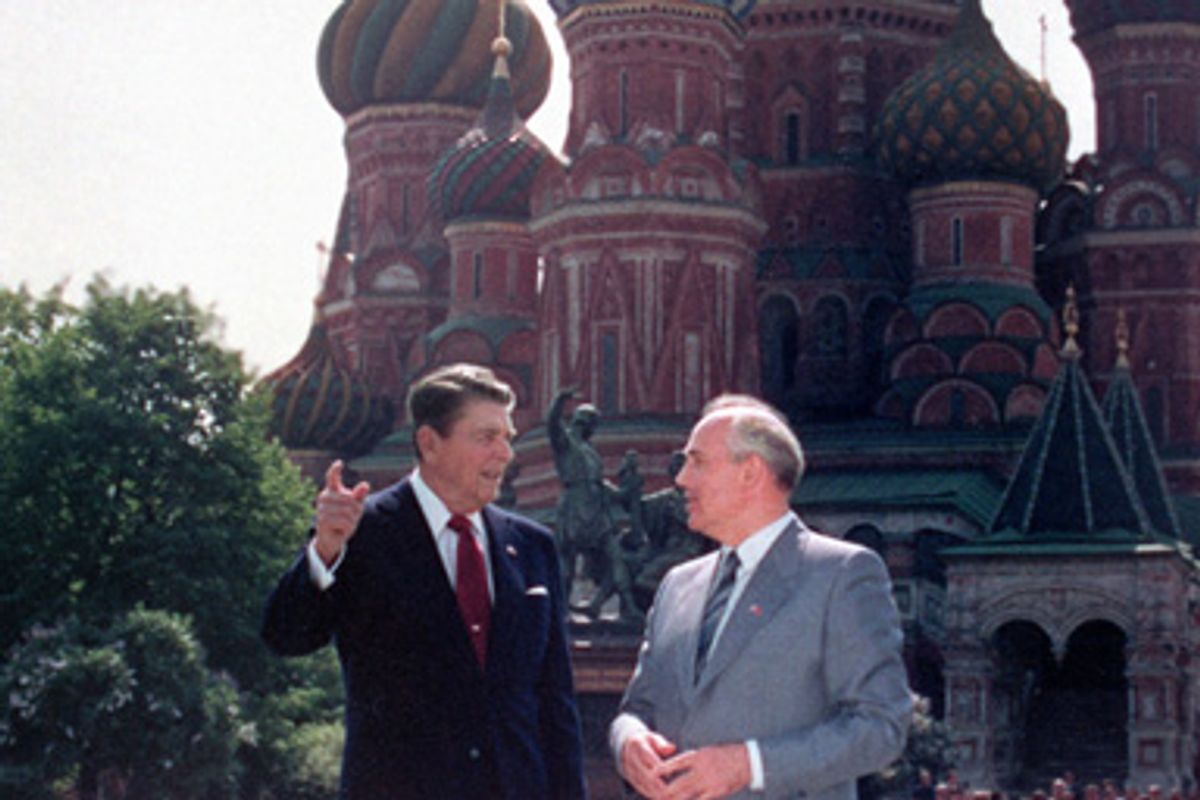
As Brown sees it, Reagan definitely played a role in the dissolution of Communism, but not the role most Americans think. Brown describes Reagan’s confrontational first-term cowboy act, and his “evil empire” rhetoric, as almost entirely destructive, heightening tensions and strengthening the resolve of Kremlin hard-liners. It was in Reagan’s second term, under the guidance of his pragmatic secretary of state, George Shultz, that he strolled amicably through Red Square with Mikhail Gorbachev, and negotiated a series of arms-control agreements that ended the threat of nuclear war in Europe.
One might summarize the central argument of Brown’s sweeping tome this way: Communism meant different things to different people in different contexts, but the very things that made it successful, at least for a while, also paved the way for its destruction. A professor emeritus at Oxford and perhaps Britain’s most prestigious Sovietologist, Brown has crafted a readable and judicious account of Communist history, from its theoretical beginnings in 19th-century Europe to its practical collapse at the end of the 1980s, that is both controversial and commonsensical.
Having served as an informal advisor to Prime Minister Margaret Thatcher during a crucial period in the early 1980s, Brown has anti-Communist bona fides, and does not pretend to be a neutral observer. But given the immense sweep of time, ideology and geography he strives to cover in 600-odd pages — as Brown observes, almost every one of his chapters could be a book on its own — “The Rise and Fall of Communism” is a work of considerable delicacy and nuance.
Brown draws an important distinction between upper-case “Communism,” to describe states governed by Marxist-Leninist political parties, and lower-case “communism,” to describe the classless future utopia imagined by Marx, which no such state ever claimed to have reached. Furthermore, although those countries typically called themselves “socialist,” Brown avoids the term. For one thing, Lenin and his followers were trying to steal the word away from the Western social-democratic tradition, which has produced elected leaders in Britain, Canada, France, Germany, Australia and elsewhere. There is an evolutionary relationship between Western socialism and Soviet Communism, to be sure, but their bitter split predates the Russian Revolution, and many of Communism’s sharpest critics have been socialists. It is no more meaningful to say that Stalin and George Orwell were both socialists than to observe that Martin Luther King Jr. and George Wallace were both Christians.
There is none of the jingoistic cheerleading in Brown’s book that you’d get from an American neocon. He firmly believes that constructive engagement with the Communist world was morally and strategically superior to tough talk and saber-rattling. In fact, between the lines you can read an account of his influence: In 1983 Brown delivered a paper at Chequers, the prime minister’s private retreat, that convinced Thatcher to talk directly to the Soviet leadership. In turn, she convinced her good friend Reagan to follow suit. Brown does not see all Communist regimes as identical or uniformly totalitarian — the notorious police state of East Germany was vastly different from the relative tolerance and openness of Communist Hungary — and believes they contained the possibility for genuine reform. Indeed, he points out that Gorbachev did reform Communism from within, before deciding to abandon it entirely.
As many anecdotes Brown lifts from recently opened Communist archives reveal, leading officials in the Soviet bloc were keenly concerned with events and perceptions in the outside world. To most ordinary people in the West — and to many of our politicians, who ought to have known better — the Soviet bloc looked like an implacable monolith in which a mysterious elite ruled over the terrorized and/or brainwashed masses. Men inside the Kremlin and other centers of Communist power, on the other hand, knew that their own populations were increasingly restive and saw the wealth and might of the “bourgeois democracies” arrayed against them. They understood that their hold on the reins of power was tenuous and contingent.
Brown focuses tightly on a series of factual historical questions as he hopscotches from the Soviet Union and its satellite states through Mao Zedong’s China, Fidel Castro’s Cuba, Pol Pot’s Cambodia and other epiphenomena of international Communism. He pays some attention to significant non-ruling Communist parties — especially the big ones in Italy, Spain and South Africa — but his principal concern is the 16 nations that at one time or another were ruled by a Marxist-Leninist party recognized as such by the Soviet Union.
His central questions are these: How and why did Communists come to power in so many different places? How did their authoritarian and manifestly unpopular regimes hold onto power for so long? And why did most of them collapse so abruptly? He also addresses, at the end of the book, what might be called the question of Communist hangover: How have self-described Communist regimes endured in Cuba, North Korea and (at least nominally) China, long after the collapse of the international movement that once sustained them?
For Brown, a Communist system had three pairs of identifying characteristics, all of which have their origins in Lenin’s ideology and philosophy. In the political realm, a monopoly of power was held by one party, with most of the power concentrated at the top, and that party operated through the process Lenin called “democratic centralism.” That was supposed to mean that open discussion could precede decision-making, which was then administered with unanimity and iron discipline. It usually meant, of course, that decisions were handed down from a dictator or a small circle of oligarchs, and were neither discussed nor questioned. In the economic realm, the state controlled the means of production, and a command economy, rather than a market economy, predominated. In the ideological realm, the declared aim of building communism — for Marx, the classless, stateless final stage of human development — was the state’s “ultimate, legitimizing goal,” and the state belonged to an international Communist movement aimed at moving the whole world toward that future society.
Communism remained a politically effective force as long as these three pillars worked to support each other. While the command economy was notoriously bad at delivering consumer goods and the one-party state offered little room for civil rights or liberties, they did deliver improved healthcare and education and widespread social mobility, along with rapid industrial progress. As long as at least some people in a society truly believed that they were part of a historic and inevitable shift away from capitalism toward something better, the hardships seemed to be worth it. Brown suggests that many people in Communist societies, including their leaders, did believe that until at least the 1960s.
Yet as people in such societies became healthier and better educated, they began to wonder about the massive social costs that “socialist progress” required in the best of times, not to mention the famine, starvation and murder it occasioned at others. They wondered about the police state the ruling party always seemed to require to maintain order, about the fantastical future that seemed to be getting no closer and about the non-Communist world, where higher living standards and greater political and personal freedom seemed to go hand in hand.
According to Brown, Nikita Khrushchev — probably the last Soviet leader who believed in the future promise of small-C communism — used to tell a joke in which a party apparatchik delivers a talk at a collective farm deep in the Russian countryside. “Comrades, some of you may doubt that we will ever live under communism,” he intones, “but I tell you it lies just beyond the horizon!” An aged peasant sticks up his hand and says, “Comrade Lecturer, what is the horizon?” The lecturer says, “I am glad you asked that, Venerable Comrade. The horizon is the imaginary line where the land meets the sky, which has the unique property of always moving further away as you approach it.” The aged peasant replies, “Thank you, Comrade Lecturer. Now I understand completely.”
Brown has read virtually every available scholarly work published about the Communist era in either English or Russian, and has studied the now-declassified Soviet archives extensively. Arguably he offers nothing startling or new on such well-rehearsed topics as the October Revolution, the brilliant and ruthless figures of Lenin and Trotsky, and the Stalinist reign of terror that followed. But his arguments are balanced and clear. One doesn’t have to excuse the brutality and bloodshed of Lenin’s revolutionary regime, for instance, to grasp that he would have been horrified by Stalin’s paranoid and murderous expansion of it.
When Brown turns to the long endgame of the Communist era, from Khrushchev’s 1956 revelations about Stalin to the long, slow percolation of dissent under Brezhnev and the sudden explosion of perestroika, his account is frequently mesmerizing and leavened with colorful anecdotes. He offers considerable new insight into what leading figures within the Communist bloc were saying and thinking at such critical junctures as the Cuban missile crisis, the Prague Spring of 1968 and the Solidarity uprising in Poland during the early ’80s. In all three of those cases, the Soviet leadership tried to walk a fine line invisible to outsiders. They could feel their empire slipping away and sought to preserve it, while also trying to stave off an intra-Kremlin coup by Stalinist hard-liners.
Brown does not believe that Soviet Communism was fated to die because of its economic failures or its autocratic character, nor does he think it was brought down by the arms race or Reagan’s muscular rhetoric. If anything, he is a charmingly old-fashioned historian who sees the slow process of social change embodied in individual personalities. He suggests that if either Yuri Andropov or Konstantin Chernenko — Gorbachev’s short-lived predecessors — had survived a few more years, or if the ruling Politburo had elected any other member as general secretary after Chernenko’s death in March 1985, recent history might look very different. Furthermore, if the Politburo members had understood Gorbachev’s thinking a little better, they would certainly not have chosen him.
Gorbachev’s life experience and philosophy, Brown argues, gave him a mental flexibility and imagination that were unique among leading Communists. He began as leader with the genuine aim of reforming the one-party state, largely by relaxing censorship and encouraging open dialogue. Some of his fellow Communists were ready for this, but few were prepared for Gorbachev’s rapid evolution into a social democrat. By 1989 he had decided that it was too late to save Communist rule, and abruptly announced that the party would abandon its “leading role” in society and hold free elections.
This launched a process Gorbachev could no longer control, which included an explosion of nationalist feeling in Russia and the other Soviet republics and the unexpected emergence of a one-time Moscow Communist boss named Boris Yeltsin. In this exciting, pell-mell experiment in democracy — Brown says 100 million Soviet citizens watched the early legislative sessions on TV — Gorbachev hoped to preserve the Soviet state, or most of it, while fundamentally changing its character. After the failed putsch by hard-line Communists late in 1991, that was no longer possible. But Brown is always cautious about hindsight, and says only that the question of whether the Soviet breakup could have been avoided is “unanswered and unanswerable.”
Brown is a big believer in the idea that history is not carved in stone. If Czechoslovakia had been allowed to become a social-democratic state in 1968, as both its citizens and its Communist leaders wanted, the Cold War might have ended 20 years earlier than it did. On the other hand, if Gorbachev had been ousted by the Politburo in early 1989 and Soviet tanks sent into Poland (as urged by Romanian dictator Nicolae Ceausescu) then the Communist states might not have toppled one after another. As Brown explains it, the now-legendary opening of the Berlin Wall on Nov. 9, 1989, was an accident rather than a policy decision, the result of a careless remark made to Tom Brokaw by a spokesman for the East German Politburo.
One thing was not a historical fluke or accident, though: the fact that a political system based on some half-baked utopian musing by Marx and Engels, and their bogus claims of scientific certainty, was not going to work out well for anybody. There’s room for argument about whether it had to turn out quite as badly as it did, and plenty of room for discussing the continuing validity of Marx’s insights into capitalism. But there’s no denying that the works of a philosopher who championed human creativity became the basis for a social system devoted to crushing it. It’s the platonic ideal of historical irony, to which other historical ironies can only aspire, and suggests some very dark possibilities about human nature.
In much of the world, the term “socialism” has been poisoned by its association with Soviet-style Communism; in the United States, it is virtually a term of hate speech. But as Brown (who is certainly no socialist) makes clear, it was socialists who saw the dangers of Communism first and most clearly. In 1918, at the dawn of the Soviet era, Karl Kautsky, who had personally known Marx and Engels in his youth, wrote a diatribe against Lenin’s use of the vague Marxist term “dictatorship of the proletariat.”
Kautsky insisted it had been meant metaphorically, and that genuine class struggle presupposed genuine democracy. The so-called dictatorship of the proletariat “always leads to the dictatorship of a single man, or of a small knot of leaders” and to a situation where ordinary people “only become instruments for carrying out orders.”
Although Lenin was trying to defend the Soviet Union against very real enemies within and without, he took time out to bang out an angry broadside against “the despicable renegade Kautsky,” which suggests how much the criticism stung. (With characteristic directness, he described his newborn state as “a machine for the suppression of the bourgeoisie.”) Lenin was too intelligent not to understand that there were real dangers in conflating the dictatorship of the proletariat with the dictatorship of those who claimed to know what was best for the proletariat, but he had long since convinced himself that the imaginary ends justified the brutal means. Seventy years later, the last leader of Lenin’s party and Lenin’s state would decide that Kautsky had been right all along.
Excerpted from the book
"ME THE PEOPLE" by Kevin Bleyer. Copyright © 2012 by Kevin Bleyer. Reprinted by arrangement with Random House, an imprint of The Random House Publishing Group, a division of Random House, Inc. All rights reserved.
I once drove through Nebraska, via I-80, days after my girlfriend broke up with me, on a self-imposed road trip from Los Angeles to Cedar Rapids to find my brother’s shoulder and cry on it. It is a long, straight, hypnotically boring drive that not only gave me ample time to think about the loss, but also put my recent heartbreak in much-needed perspective.
It could be worse, I realized. I could live here.
Cold comfort, perhaps, but comfort nonetheless. And so, for providing the enforced monotony that only a dull road trip can provide, and the bleak void to which to compare my own relatively full life, I am grateful to the state of Nebraska. Nebraska has a special place in my heart.
It has no place, however, on a map of the United States.
Let me explain: California is a state. New York is a state. Texas, for the time being at least, is a state. And they deserve to be. They’re big, they’re boisterous — but most crucially, they’re populated. Thirty-seven million people live in California, four million in Los Angeles alone. New York is home to almost 20 million people. If California were a country, it would have the eighth largest economy in the world. If New York City were its own state, it would be the 12th largest — and in my humble New Yorker opinion, the best.
Whereas Nebraska?
There are more Americans in prison than in Nebraska. And not for nothing, but as I drove past endless rows of cornstalks, I couldn’t help but think: What’s the difference? Nebraska, whose official state motto is “Equality Before the Law,” nonetheless feels like a punishment for a crime. And like a criminal, I whiled away the hours (or was it days?) thinking up mottoes that better apply: “Nebraska — a great place to serve some time.” “Nebraska — if you lived here, you’d be bored by now.” “Nebraska — Canada’s Mexico!”
Sure, the argument could be made that Nebraska is in fact an idyllic land full of picturesque cities with enviable small towns steeped in small-town values personified by some of the loveliest Americans to grace the planet — and, I confess, in my wildest dreams I often fantasize about living among them in such a glorious place — but let’s be honest: It’s also a lifeblood-sucking leech on our body politic. Yes, my fellow citizens, despite what the original Constitution of the United States says about the qualifications for statehood and the guarantee of representation in Congress, by every measure that truly matters in America (bigness, crowdedness, awesomeness, Texasness), Nebraska doesn’t deserve its star on the American flag.
Which is to say nothing about Montana (4th largest, 44th most populous).
Or Wyoming (10th largest, 50th most populous).
Or the largest but 47th most populous state we call Alaska.
Add it up, and more than half of all Americans live in eight states. The big ones. The important ones. How many live in the eight least populated states? Less than 3 percent. Three percent — also known as the margin of error. (Which raises a terrifying scenario: It’s possible these states are completely empty.)
Yet what concerned me during my soul-deadening voyage toward Omaha was not whether these states deserve their claim on so much territory (they don’t), or whether, as guaranteed by Article I, they should be represented by two senators as powerful as the senators in states where people actually live (they shouldn’t). Rather, as my car sped past miles and miles of unharvested high-fructose corn syrup, my muscles atrophying and my eyes fluttering in and out of semi-consciousness, my mind was focused on Article IV. Because it is Article IV, the first in the Constitution to turn its full attention to the states rather than the branches of national government, that wants me to believe that Nebraska, this expanse of emptiness which so begs for my disdain, actually deserves my respect.
It reads, in part:
Section 1: Full Faith and Credit shall be given in each State to the public Acts, Records, and Judicial Proceedings of every other State.
Section 2: The Citizens of each State shall be entitled to all Privileges and Immunities of Citizens in the several States.*
Put plainly, Article IV makes a revolutionary claim: All states are created equal. Laws made in Alaska, which is known for its lawlessness, are as valid as laws made in Pennsylvania, which invented laws. Article IV insists that, as a nation, we should care as much about the Carolinas as we do about California. Montana matters as much as Massachusetts. And New York is no better than any of its 49 neighbors — not even Nebraska. Which is, put even more plainly, ridiculous.
I should know. I’ve driven through Nebraska. I live in New York.
- – - – - – - – - – - – -
Was I thinking about the merits of giving “Full Faith and Credit” to each state as I drove through Nebraska? Not at all. At the time, I was merely thinking: I am soooooooo not a Nebraskan.
I was, at the time, a Californian. I had lived in the Golden State for four years, and as such, all of the rights and benefits of California residency were mine, all mine! I could serve on California juries, vote in California state elections, and draw California unemployment checks. Had I a major case of glaucoma or a minor case of cancer, in a few years I would even be eligible for my very own California-state-sanctioned, medically warranted marijuana — if I were, you know, into that type of thing. Citizenship has its privileges.
And Article IV is cool with that. It is designed to help me be a Californian even outside California. As written, it would guarantee that if I am granted certain “Privileges and Immunities” in my home state, all other states must also grant me those rights. I can thank Article IV for the fact that when I crossed the border from Colorado into Nebraska, I wasn’t immediately pulled over for not having a valid driver’s license. It is why when I stopped in North Platte to fill up my gas tank, the attendant couldn’t legally charge me $10 a gallon just because I wasn’t “from ’round these parts.” Although the Supreme Court has occasionally retreated to a more “limited interpretation” of Article IV — merely that states may not discriminate against citizens of other states in favor of its own citizens — it has always returned to the basic theme of Article IV: States must play nice with others, and do unto residents from other states as they would do unto their own.
Oklahoma must say to Oregon: Legal physician-assisted suicide? Not the way I would have done it, but I respect your choice. It looks good on you.
Oregonians must say to South Dakotans: Seriously? You’ll only provide abortions to a woman who has been raped if her life is at stake? Seems a bit heartless, but I guess that’s just another reason why we don’t live there.
This makes sense — I, for one, enjoy those regional quirks, and wouldn’t want to live in a country where I couldn’t tell Montana from Maine.
Yet Article IV isn’t all-powerful. As a referee between the states, it has its limits. The most famous check on Article IV, in fact, involved the states of New Jersey and Delaware, a boatload of purloined oysters, and George Washington’s nephew Bushrod. In 1832, Bushrod, then a federal circuit court judge, ruled on a landmark case, Corfield v. Coryell. The question at hand was whether the state of New Jersey should be allowed to prohibit the plaintiff, Mr. Corfield (and all other non-Jerseyans), from gathering oysters found in the pristine waters off New Jersey (keep in mind, this was back in 1832, when New Jersey waters stood the chance of being pristine) only to return back to their home states to sell them for profit. Bushrod ruled that although the “Privileges and Immunities” protected by Article IV do include “the right of a citizen of one state to pass through any other state … for the purposes of professional pursuits,” stealing oysters isn’t one of them. “We cannot accede to the proposition,” he wrote, “that the citizens of several States are permitted to participate in all the rights which belong exclusively to the citizens of any particular State, merely upon the ground that they are enjoyed by those citizens.”
In other words, go ahead and cruise down our New Jersey turnpike and breathe our fresh New Jersey air, but if you’re not from New Jersey, hands off our New Jersey shellfish.
Article IV doesn’t merely snub oystermen from Delaware. It fails to protect Mormons who might want to marry a dozen sister-wives in Utah and expect Vermont to approve of their polygamous bliss, or gun-toting Kentuckians who want to bring their semiautomatics to church while visiting gun-skittish Maryland. These, too, go too far.
But what if I’m not a Delaware oysterman or a Utahan missionary or an armed Kentuckian? What if I am, say, a gay Iowan? And instead of illegally gathering winkles in Weehawken or wives in Salt Lake City, I have gotten legally married in Iowa — which sanctioned gay marriage way back in 2009. And what if I wanted to celebrate the nuptials with a road trip through Nebraska? (I’m not sure why I’d do that, but just roll with me.) Would Article IV compel Nebraskans to recognize my marriage?
Congress has tried to say no. In 1996, it passed the Defense of Marriage Act, citing the broad power Article IV gives Congress — brace yourself for some gobbledygook — to “prescribe the Manner in which such Acts … shall be proved, and the Effect thereof.” Which, if you ask me, makes about as much sense as in which such Sentences … shall be understood, and the Nonsense thereabouts.
Now, such gibberish would baffle a normal human; to Congress, however, it made perfect sense. It determined, conveniently, that if could limit “the Effect” that gay marriage would have as it traveled the nation, it could also prescribe that it must have no effect at all — which is to say, it could give states the power to ignore gay marriages entirely. The Harvard constitutional scholar Laurence Tribe has called this linguistic tap dance “a play on words, not a legal argument,” which forms in us the bad habit of creating “categorical exceptions” to Article IV, when Congress has no such power.
Neither side is happy with the arrangement. Gay couples, skeptical that the federal government will ever give them that wedding day owed to them, want to see more states legalize gay marriage; opponents of gay marriage, fearful that gays might spontaneously band together and attack their northern border brandishing Le Creuset spatulas and Rufus Wainwright CDs, want to see nothing less than a constitutional amendment defining marriage as between a man and a woman. It’s all very confusing. What’s a gay couple to do — other than plan their honeymoon in San Francisco?
It is this competition, between what one state might want for its citizens and what another state might demand for its own, that Article IV is supposed to referee. Yet it hasn’t. It doesn’t. And what’s more — with all due respect to our nation’s homosexual polygamist mollusk aficionados — its failure to do so has meant repercussions far greater than a marriage license, or a second wife, or cheap, tasty New Jersey seafood: Namely, Article IV, with its schoolyard devotion to fair play and radical equality, has done something far more treacherous.
It started the Civil War.
From the book “Me the People,” by Kevin Bleyer. Copyright © 2012 by Kevin Bleyer. Reprinted by arrangement with Random House, an imprint of The Random House Publishing Group, a division of Random House Inc. All rights reserved.
Continue Reading
Close
“Inside Job,” Charles Ferguson’s Oscar-winning documentary film on how government, Wall Street and academia colluded to deliver us the worst financial crisis since the Great Depression, made a powerful case that something was very very rotten at the heart of the American political/economic nexus. His follow-up book, “Predator Nation: Corporate Criminals, Political Corruption, and the Hijacking of America,” can be considered the legal brief that dots every “i” and crosses every “t” in his argument. A tightly argued, profusely footnoted and deeply enraged castigation of everyone involved, “Predator Nation” isn’t just a factually unchallengeable account of how Wall Street blew up the global economy. It’s a denunciation, a call for justice and a warning: After getting away with the crime of the century, Wall Street still isn’t satisfied.
“If you have already got 96 percent of what you want,” Ferguson told Salon, “why not take the remaining 4? That’s where the culture of American finance is right now, and I think it’s really dangerous for the country.”
For at least 30 years the United States has been headed on the wrong track, handing over more power and wealth to a tiny percent of the American population at the expense of everyone else. But Ferguson’s story isn’t just focused on the greed and recklessness of the elite. It’s also about their criminality. The bankers who wrecked the financial system broke the law. And yet, amazingly, not only have the vast majority of responsible parties not been convicted of any crime — they haven’t even been charged. There have been a few settlements of fraud allegations with the Securities and Exchange Commission and other regulatory bodies and a smattering of slap-on-the-wrist fines, but nothing that comes close to a proper reckoning for the massive hardship and economic destruction that they caused.
Ferguson’s glowering rage spares neither political party. Clinton gets the blame for completing the process of financial sector deregulation, and George W. Bush is lacerated for his general incompetence. But Barack Obama is showered with a particularly aggrieved contempt. Obama, writes Ferguson, came into office with more hope invested in him than in any recent leader, and then proceeded to “betray” and “screw” his supporters by declining to bring Wall Street to account for its misdeeds.
“Predator Nation” hits bookstores on Monday, just in time to cash in on the headlines generated by the latest banking atrocity — JPMorgan Chase’s massively failed derivatives bet.
“Predator Nation” is an angry book. Were you this angry before you started making the film “Inside Job”?
No, I absolutely was not. I remember the first time I got any kind of inkling of what was to come was in August or September 2007, when Charley Morris sent me a copy of a galley proof of his book, “The Trillion Dollar Meltdown.” It was scary and powerful, but I couldn’t bring myself to believe it. I remember calling Charley and saying, “You lay out a very convincing case but really, these people aren’t that crazy, they aren’t that stupid. They are regulated. Can it really be this bad?”
And he said: “You just wait.” And boy, he was right.
It’s not that I thought that investment bankers were like Mother Teresa. I knew that they weren’t. But the degree of nakedness and extremity of the dishonesty and its pervasiveness was a huge shock to me. It turned out that many banks, on a very large scale, and without any disclosure, had created and sold securities with the intent of betting on their failure. And this was done with the knowledge and approval of senior management of all these banks, including the oldest and most traditional.
How do you explain this behavior? How did we get to a point where it was routine for Wall Street bankers to behave in ways that most Americans would consider frankly immoral?
I think this has its roots all the way back in the 1970s and the beginning of the era of deregulation. But there was a kind of inflection point during the five-year period between 1997 and 2003 — the late Clinton and/or early Bush administration — when all the rules just went away. You went from a period, a regime, where people did have at least some concern about going to jail, to a point where everything is legal, and derivatives couldn’t be regulated at all and nobody went to jail for anything. And looking back I would say that this period definitely started under Clinton. You absolutely cannot blame this on George W. Bush.
You say that everything is now legal, but in your book you dismiss Obama’s argument that he could not prosecute Wall Street bankers for criminal behavior because what they did was technically not illegal as “complete horseshit.”
I should be more precise. I should have said, “where everything was perceived as being legal.” There was no perception that, even when you were in fact violating the law, that there would be any legal jeopardy or legal consequence to what you were doing. And that was part of my surprise when I was making “Inside Job.” I really was surprised that people would so overtly and explicitly do things that 20 years previously probably would have gotten them landed in prison.
One can certainly argue that the penalties and prosecutions following the S&L [Savings and Loan] and insider scandals of the 1980s were vastly insufficient. No doubt about that. But there still were consequences. I don’t know whether [junk bond king] Michael Milken would have still done everything he did, if he knew that he was going to spend two years in prison and have about half of his wealth confiscated. Maybe he still would have made that bet, but still, clearly he had a few unpleasant days. And now, nothing, just nothing.
In your book, you have a laundry list of things you believe the bankers could be prosecuted for, everything from securities fraud to perjury to RICO Act violations. And then you point out, more than once, that during the Obama administration there have been no arrests or indictments of any firms or senior executives “related to causing the bubble or the crisis.” What’s your explanation for this? Is it as simple as the Obama administration being captured by the financial sector?
I’m not President Obama’s psychoanalyst, so I can’t speak to what goes on inside his head. But that is what I would say of the Obama administration generally. In the book I go through the list of his personnel appointments and it’s pretty clear.
But how do we square that with the negative Wall Street reaction to bank reform? You devote only one sentence in your entire book to Dodd-Frank, calling it “weak and ridiculously complicated.” But even so, House Republicans have introduced nine bills trying to repeal parts or all of it, Romney is campaigning on repealing the whole thing, and Wall Street hates it and has tried to kill every last part of it. There is clearly antipathy against Obama from the financial sector now, from Jamie Dimon on down, that wasn’t there when he got elected. If he was truly captured, why the antipathy?
Well, there is some antipathy. But he just held a very successful fundraiser at the home of the president of private equity group Blackstone. So the antipathy is not universal.
But you know, when I was in academia and also when I was running a software company I had a fair amount of contact with portions of the financial sector, investment banking industry, and the venture capital sector. And certainly they were already pretty rapacious and pretty politically conservative. But they would never then have said and done the things that they say and do now. I recently was at a dinner in New York City and one of the people there was a very, very successful man who is on the borderline between venture capital and private equity. And this guy went into an extended rant about how he was at a disadvantage because he had to pay 15 percent capital gains taxes. When I was first dealing with venture capitalists in a significant way, the capital gains tax rate was 28 percent, and nobody was complaining. Then they got them reduced to 20 under Clinton, and then later 15 under Bush. Plus, they got a rollover provision so if they took the proceeds of a venture capital investment and rolled it over into a new venture capital investment it was tax-free. At that point, we’ve reached nirvana, what more could there be?
But now we’re in this environment where this guy was loudly and aggressively complaining that he has to pay 15 percent to the government. And if that’s where you’re at, then of course you are going to complain about Dodd-Frank. You are going to complain about everything. If you have already got 96 percent of what you want, why not take the remaining 4? That’s where the culture of American finance is right now, and I think it’s really dangerous for the country.
Do you find it alarming that even after this huge crisis and even with a lot of populist anger on both the right and the left focused on Wall Street, Mitt Romney is running for president while promising to further deregulate Wall Street and repeal Dodd-Frank, and the polls show him neck and neck with Obama?
That is true, but I don’t think that Romney is going to get votes primarily or even secondarily for that. Most of the votes he is going to get will be because he’s religious, he’s against gay marriage, et cetera, all of these allegedly “values” issues — things like that and wanting to reduce taxes. That’s why he is going to get a substantial fraction of the popular vote. The reason he says he wants to roll back Dodd-Frank is not to get votes, it is to get money.
Ninety-nine percent of your book tells a story of how we’ve gotten ourselves into a bigger and bigger mess, and then you’ve got about a page and a half discussing what could be done to fix it. But your solutions — a legitimate third-party alternative, controlling the influence of money in politics, real tax reform, fixing education — it’s just really hard to see how we get from our current problems to those bullet points.
Yes. And we’re not. Not right now. I think it’s going to take things getting worse, either slowly or fast. Either we continue to melt away for another 25 years and then finally people wake up, or there might be another crisis. And maybe that will be sufficient. We’ll see. I don’t know. I’d be interested in your own view of this. I’ve had debates with several of my friends on this question. If Obama had really had the balls to try to do the various kind of things that he’d promised to do, or kinda sorta almost promised to do during his campaign, if he really made an effort, how far do you think he could have gotten in 2009?
At this point, I’m in the camp that believes that American government is completely broken. And we didn’t really find out how broken it was until Obama came in. In your book, you talk about Obama coming in withoverwhelming majorities, but he really only had 60 votes in the Senate from July 2009, when Al Franken was finally sworn in, to January 2010, when Scott Brown took over Ted Kennedy’s seat. And even the things that Obama did get through had to pass muster with a handful of very conservative Democrats. Nebraska’s Ben Nelson had control over the entire government. It’s a completely dysfunctional system. I think Obama severely underestimated what he was facing when he came in, and picked the wrong strategy of trying to go bipartisan, but it’s not as if he had the freedom to do what he wanted that Roosevelt enjoyed when he became president in 1932.
But there are an awful lot of things that the president can do even without the Congress. He didn’t have to choose the people he chose. He didn’t have to choose the attorney general he chose or the head of the criminal division of the Justice Department that he chose. I think that if he had said, I’m going to allocate $500 million to a special prosecutor’s office, and we’re going to find out what the fuck happened here, he could have done that.
There’s some talk now that JPMorgan’s disastrous bet on credit default swaps might lead to tighter regulation. I have to say, it was bizarre to be speed-reading your book while the Morgan news was causing post-traumatic stress flashbacks to the worst days of the financial crisis. Does what happened there fit into the narrative of “Predator Nation”?
I rather think so, yes. Mr. Dimon has long been largely correctly regarded as the best, most judicious, most careful steward of a major global bank. That he and his bank could make a mistake like this does not bode well. One thing that has actually not been widely discussed, somewhat to my surprise, in the commentary about all of this, is that this mistake — which it appears will cost them between $2 billion and $5 billion — this occurred in a very forgiving economic environment. If they made a mistake like this in September 2008, then things could look really quite different.
Does it qualify as criminal behavior?
There is some suggestion of criminality in the lack of honesty on disclosure of the positions and their potential implications. I can’t say; we don’t know enough yet. It certainly is the case that JPMorgan, although more prudent than many other banks over the last decade, has frequently been just as dishonest. It has done a number of extremely unethical things, some of which I mention in the book. So it wouldn’t be a surprise if they had not been forthcoming about this.
Do you think it will make any difference in how banks are regulated?
I fear not. Honestly. I’m sure that Mr. Dimon is momentarily chastised, and that JPMorgan will not be making any similar bets in the next couple of years. But is it going to change the overall posture of bankers and banking and is it going to change the regulatory environment in any significant way? I tend to doubt that. Unfortunately.
So where does this leave us? Your book is filled with a strong sense of personal outrage. How do you personally feel about the prospect that the only thing that could get us out of the mess we’re in is yet another crisis, perhaps even worse than the one we just lived through?
Personally, I am very fortunate. I have a very blessed life. I made some money earlier, I’m basically pretty financially secure. I can’t have private jets and private islands but I don’t have to worry about having a roof over my head or being able to eat well, unlike many people in this country going forward. And I do work that I love. I love making movies, I love writing books. Personally I’m fine.
But the country is not. But this happens to countries. This is not the first country it’s happened to. It’s not even the first time it happened to the United States. We’ll see whether we come out of it. Last time it happened we came out of it, eventually. It took a long time and it was very painful but eventually we came out of it. Will that happen again or not, I don’t know, I honestly don’t.
Continue Reading
Close
“Even the President of the United States sometimes must have to stand naked.” When Bob Dylan wrote that line in 1964, the naked emperor was Lyndon Johnson, which makes that image perhaps the most disturbing in all of Dylan’s apocalyptic work.
By stripping down Lyndon Baines Johnson to his essence, Robert Caro has himself become an American legend. Since the publication of “The Path to Power” in 1982, Caro has transformed LBJ’s life into a cautionary tale of Shakespearean dimensions. In some wonky circles, the release of a new volume is heralded like the Summer of Love release of “Sgt. Pepper’s.” Can Caro possibly top his “Revolver”?”
I am proud to be one of those wonks. Anticipating the release of “The Passage of Power,” I went full-metal LBJ, and reread every word of the previous 1,040 page “prequel” – “Master of the Senate.” Much like catching up on the last season of “Mad Men” before the new one begins, I time-traveled like the hero from the new Stephen King JFK-themed novel back to 1958, as the Master Senator (and Master Biographer) prepared for their rendezvous with world history.
The release of this new book has seen Robert Caro morph from legend to Literary Saint, a transformation aided and abetted by the Northern Liberal Media that Johnson so ridiculed. Charles McGrath of the New York Times recently wrote a piece where Caro’s monastic work habits, nurturing relationship with his longtime editor and publisher, and total immersion into the life of his subject is detailed in every, and I mean every, detail.
And after this lengthy profile and slide show, the Times then unleashed crack literary critic Bill Clinton for a hagiographic “review” – which, no surprise, revealed more about Clinton than Caro or, yes, LBJ. The final premiere event was the by now traditional preview of coming attractions in the New Yorker. This time, the sneak peek excerpt was Caro and historical writing at its very best. Things you thought you knew, things you think you have seen, are transformed. The background of the iconic photograph of Johnson being sworn in as president next to a bloodstained and haunted Jackie Kennedy on Air Force One take on entirely new meaning through Caro’s literary filter. Here are the last words of the article. “The oath was over. His hand came down. ‘Now let’s get airborne,’ Lyndon Johnson said.”
Few works of fiction, let alone history, are written that vividly, and after reading those words and that article, well, that’s when I decided to go back into the 1950s Senate and the wonderful world of cloture, cloakrooms and clout. A symbolic 1,776 pages later – 1,040 of “Master of the Senate” and 736 pages of “The Passage to Power,” here I now sit.
Remember that naked Emperor I mentioned earlier? I feel I’ve just read the same book twice. “The Passage to Power” breaks down to four books, one worth reading. Twenty-five percent is fresh, brilliant reporting (that New Yorker extract is by far the best part). Twenty-five percent is explicit and oft-cited retellings of stories from the previous three books. Twenty-five percent is editorial observations about LBJ repurposed from those previous three books. And 25 percent reads like a book proposal for what (hopefully) is to come in the next book.
Sadly, this is no “Sgt. Pepper’s.” It’s a greatest hits collection. Lyndon Johnson contained multitudes? Check. Adoptive father of civil rights movement? Check. Power that does not corrupt, but reveals? Check.
Caro also wanders off on tangents. These are not the fascinating tributaries of the history of the Senate that illuminated “Master of the Senate” or the luminous description of the Texas hill country in “The Path to Power.” Here there are chapters, long chapters, devoted to John Kennedy’s biography, even down to yet another recounting of the PT 109 saga. The chapter called “The Drums” seems entirely researched from watching readily available footage of the Kennedy funeral, with Caro’s insights on those days and that footage more appropriate for a DVD’s director’s commentary.
There are, of course, priceless nuggets of research gold scattered in this meandering stream. In the second to last chapter (and first part of the tease to the next book), Caro recounts LBJ’s eager questioning of an aide when he hears Robert Kennedy had been shot. “Is he dead? Is he dead yet?” This wishful thinking even shocked Johnson’s staff, and by 1968, they were not easily shocked. And then, there were the odds. According to Caro, before accepting the purgatory of the vice presidency, Johnson had his staff look up the odds for a president dying in office. Those odds worked out to a little less than 1-in-4 for a modern president. And as Johnson said to Clare Booth Luce on the night of Kennedy’s inauguration, “I’m a gambling man, darlin’, and this is the only chance I got.” And we wonder why he gets cast as the fall guy in many episodes of “Conspiracy Theatre“? But apparently, Caro doesn’t want to go there — any possible Johnson role gets dismissed in about a page.
My disappointment, as LBJ would say, comes “with a heavy heart.” The first book in the Caro series, “The Path to Power” and the third, “Master of the Senate,” are masterworks, deserving of any praise, hagiographic or otherwise. But the second, “Means of Ascent,” seemed a padded-out novella – it could have been edited down to a single, long New Yorker piece. Same thing here. These 736 pages could have been culled to 250 and still hit their target very hard.
Caro assumes the reader has not read any of the others in the series, so endlessly recounts what he wrote in them. At the same time, he wants to make sure that the reader is panting for the next installment to arrive, hence a lengthy tease to the next work-in-long-progress. It’s as if the 76-year-old author has made a deal for immortality, as long as he can just tease the reader into waiting another 10 years for him to get on with it.
Of course, each book should be able to stand by itself, and not require an act of devoted rereading before picking up the new one. Yes, but these books are also being written and produced as a definitive series, one long book now broken into five. They should stand with the big boys: Edward Gibbon‘s “Decline and Fall of the Roman Empire,” Carl Sandburg’s life of Lincoln, and Shelby Foote’s three-volume narrative of the Civil War.
In Caro’s defense, although he treads water in “The Passage of Power,” what water. His incisive look at the fear and loathing Johnson had for Robert Kennedy (and vice versa) is a highlight. There are flashes of descriptive writing that achieve a kind of Stephen King-esque kind of time travel. In the case of his account of the food at a Texas state dinner for German Chancellor Erhard, Caro’s literary powers summon a longing for a bib, a handiwipe and some of that thar barbecue. But these passages are few and far between, surrounded by lengthy flashbacks to previous books, long quotes taken from those same books, and even, quotes recycled yet again from the book you are still holding in your hand. The book cries out for the Ghost of William Shawn and a red pencil. How can a book take 10 years of obsessive work and still seem sloppy? It is no service to either Caro or history that he has achieved what every great writer thinks he wants, but should not necessarily have: an editor with Stockholm syndrome.
There is another non-editor-related problem that haunts this book. An omission that will definitely haunt the new work in progress no matter how exhaustively teased: the absence of the erudite voice of Bill Moyers.
Moyers was Johnson’s press secretary when the Credibility Gap was being invented and perfected. But he still has not spoken in any insightful detail of those days, to anyone. Thanks to the New Yorker excerpt, I did learn that Moyers was standing in the back of the crowd during that traumatic swearing in on Air Force One. He’s the guy with glasses, standing upper right. But although a recent profile mentions that Moyers shares an office building with Caro, he remains AWOL in “The Passage to Power.” Moyers has stated he is writing a book about Johnson where he will grapple with their shared past. But will he? One wonders if the long arm of LBJ will throttle him into silence. For a man of Moyers’ eloquence and moral insight to remain silent, when even Robert McNamara finally and very publicly grappled with his demons, is a loss to Caro’s lifework, to history, and worse, to the America that Moyers has served so well.
McGrath and Clinton’s full admiration for Caro — and their grudging respect for LBJ — does make one wish that Caro had learned just a few things from The Master. Perhaps, in an upcoming elevator ride as he and Moyers head to their respective offices, Caro might grab Moyers by the lapel, pull him close, and give him a bit of persuadin’ to attend a Texas-style chinwag. Hope so. Time is not on either man’s side.
If the 10-year gap between Caro’s book and the 45-year gap since Moyers resigned during the “Sgt. Pepper” summer is any indication, time is not on our side, either.
Continue Reading
Close