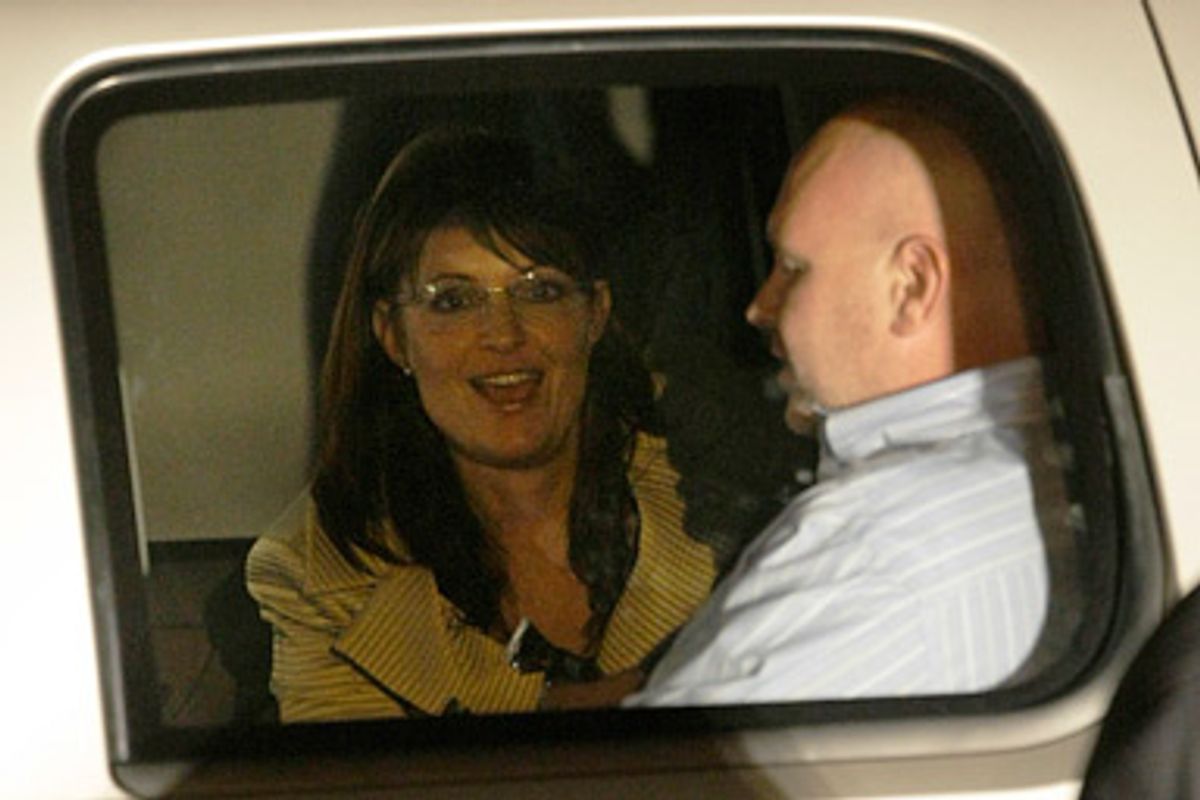
She may not be humble or politically savvy. But the governor is a rare political species: A strong maternal woman
Republican vice presidential candidate Alaska Governor Sarah Palin hugs her son Trig onstage after her address to the 2008 Republican National Convention in St. Paul, Minnesota September 3, 2008.

Reuters/Shannon Stapleton
Alaska Gov. Sarah Palin hugs her son Trig at the Republican National Convention in St. Paul, Minn., Sept. 3, 2008.
While delivering her bizarre, meandering, apparently self-penned resignation speech this weekend, Sarah Palin stood, as she nearly always had during her ten months in the spotlight, with her family at her side. Even as she articulated — Palin-style — her manifestly odd desire to avoid the jet-set antics of most lame-duck governors, there seemed another reason, another five reasons, in evidence: her children.
“This decision comes after much consideration, and finally polling the most important people in my life — my children, where the count was unanimous … well, in response to asking: ‘Want me to make a positive difference and fight for ALL our children’s future from OUTSIDE the governor’s office?’ It was four ‘yes’es and one ‘hell yeah!,’ ” she said in her strange, not-quite-clear idiom. But entirely clear to anyone watching the ongoing Sarah Palin circus is that her family has been almost unremittingly under siege, the butt of countless jokes since she first declared her candidacy. On Saturday, with her brood gathered once again around her, it seemed implicit that she was leaving, at least in part, to protect them.
One might argue that, like celebrities who court fame and then complain about paparazzi, Palin brought the attention on herself. From the beginning, she made motherhood, and her identity as a mother, central to her candidacy: She was, she told us during her debut at the convention, “just your average hockey mom.” (Now she is casting herself as the universal mom, working for “ALL our children’s future.”) Never mind that being a mom didn’t actually qualify you to be president; the tough mother persona was one we hadn’t seen before in a female candidate running at the national level –”the first indisputably fertile female to dare to dance with the big dogs,” as Todd Purdum put it, rather less charitably, in his recent Vanity Fair piece — and for many Americans, it was appealing. By all counts, someone with her diction and general lack of political knowledge and overweening tendency to get in her own way should have been laughed off the national stage a while ago, but Palin has clung on tenaciously, perhaps because she has tapped into some deep vein of psychodramatic symbolism.
Male candidates, of course, have long emphasized their domestic lives as fathers. (See numerous staged photos featuring pinafores and neat side-combed parts.) If they weren’t pointing to fatherhood as a legitimate qualification for the presidency — contrary to popular opinion, Palin’s appeal to motherhood wasn’t this literal-minded, either — they were funneling the image of themselves as a parent into a larger, quasi-metaphorical notion of national father figure. Founding fathers, anyone? Our leaders have always been family men. For women, however, the model has usually been the competent female executive, her femininity obscured by pantsuits and a newscaster ‘do.
But Palin arrived brandishing a new psycho-political authority; hers was a fierce maternal trope. And it hit a nerve. Perhaps this was because, since the mid-’60s, the divorce rate has risen dramatically (increasing, according to some statistics, by almost 40 percent in the last 40 years), and so many of us of voting age in this country were raised by single mothers, de facto presidents of their own households. Maybe it’s that for most people, one’s mother is the ur-model of capability, the only person you can imagine running a country while folding the laundry and preparing dinner and disciplining multiple kids. Maybe Palin’s emphasis on motherhood made her relatable. Whatever the reason, the “tough mother” unexpectedly turned out to be a potent political archetype for our era. Like a scientist in a laboratory who accidentally spills a substance to create a viable chemical compound, Palin seemed to stumble upon her viable political persona. It was as though she invoked the term “hockey mom,” and then realized, “Hey, you betcha, this works.”
In the past few months, we have seen her — to use her own unfortunate term –”milk it” for all it was worth. When David Letterman made a crude joke about her daughter, she didn’t just reprimand him but effectively called him a pedophile. (I criticized Letterman before Palin went on her media rampage.) A short time later, when a Democratic blogger superimposed an image of a conservative Alaskan radio host over Baby Trig’s face (in an apparent effort to show how cozy the host was with Palin), Palin issued a statement that blasted the “malicious desecration” of the photo of Palin holding Trig at the convention, an image that, in the words of her spokesperson, “has become an iconic representation of a mother’s love for a special needs child” (as though it is our contemporary Pieta). Neither of the incidents was in good taste, but Palin’s response to them seemed to lack all sense of proportion. “She couldn’t ignore the hits on the kids,” John P. Coale, a Washington lawyer who has advised Palin, told the Washington Post, by way of explanation. “She said, ‘It brought out the mama grizzly in me.’ ” While this may be true, it’s also true that in light of her frequent and self-conscious emphasis on motherhood, her actions sometimes reeked of opportunism. During Saturday’s press conference, her kids appeared not only as little victims in need of protection, but also as political tokens and a human media shield.
When it came down to it, Sarah Palin wasn’t up to the job of selling Sarah Palin. She was too quirky, too green, maybe even too daft. And the family she constantly invoked may have just been way too large and too unruly, what with the teenage pregnancy and breakup, the baby-daddy’s mom in trouble for Oxycontin and the baby with special needs. But whether or not this is the end of Sarah Palin (an unlikely scenario), it certainly isn’t the end of the Palinesque character on the political stage. She showed us the appeal of the strong, confident, maternal woman. Maybe she couldn’t handle it herself, but it will surely survive as a meme.
Mr. 1 Percent is clueless about inequality
As the country sees more conflict between rich and poor, Romney thinks we should talk about it in "quiet rooms"
(Credit: The Ed Schultz Show)
The GOP primary keeps getting funnier. Just as Newt Gingrich was telling a South Carolina Romney supporter “I agree with you” that attacking Mitt Romney’s Bain Capital career could help Democrats on Wednesday, his friendly Super PAC “Winning the Future” released the long version of its hit piece “When Mitt Romney Came to Town.” I thought MoveOn did a bang-up job last week with an ad profiling a pair of older Kansas City steelworkers left jobless thanks to Bain; this ad is so slashing MoveOn might have thought twice about releasing it. If you haven’t seen it, it’s here. Clearly, Gingrich is trying to have it both ways: Mollifying wealthy GOP donors horrified by his attacks on capitalism while continuing to bloody Romney. We’ll see how well it works.
Romney continues to insist Democrats, as well as some of his GOP rivals, are practicing “the politics of envy,” and on NBC Wednesday made what might be his dumbest remark yet. Asked whether there was ever a fair way to discuss income inequality, the GOP front-runner replied:
I think it’s fine to talk about those things in quiet rooms and discussions about tax policy and the like. But the president has made it part of his campaign rally. Everywhere he goes we hear him talking about millionaires and billionaires and executives and Wall Street. It’s a very envy-oriented, attack-oriented approach and I think it will fail.
Maybe Mitt wants to confine talk of inequality to “quiet rooms” because he’s seen the Pew Research Center data showing that Americans think conflict is growing between rich and poor. Two-thirds of Americans see that conflict, up 50 percent since 2009. While African-Americans are still more likely than whites to see that conflict, the percentage of whites who agree tripled. Credit Occupy Wall Street for hiking consciousness about the gap between rich and poor, but credit the GOP for creating the conditions that allowed income inequality to soar, and the top 1 percent to gobble up 40 percent of the nation’s wealth.
A sly Sarah Palin called for Romney to release his tax returns on Sean Hannity’s show last night, to Hannity’s seeming distress. Palin defended Rick Perry’s “vulture capitalism” attack even as Hannity kept trying to get her to declare it unfair. She’s gone rogue again! We can only dream that Romney releases his tax returns. I think he’s less scared about showing his staggering wealth than revealing the scandalously low tax rate he pays, given how much of his income comes from investment and is thus subject to lower capital gain taxes. (I’m sure we’d also learn a lot from the tricks Romney’s accountants use to keep his effective tax rate even lower.)
Palin also demanded that Romney substantiate his claims to have created 100,000 jobs while at Bain, calling it a “come to Jesus” moment. What is she up to? Her snow-machine-driving husband Todd endorsed Newt Gingrich last week, to great derision, but it did raise questions about what the nominally neutral ex-V.P. nominee is thinking. She’s not thinking good thoughts about Mitt Romney, that’s for sure.
Meanwhile, the man who foisted Palin on the world, John McCain, today accused Romney’s anti-Bain attackers as supporting “communism.” But BuzzFeed recalls that in 2008, McCain himself attacked Romney’s Bain days. “He presided over the acquisition of companies that laid off thousands of workers,” McCain complained back then, and campaign manager Rick Davis told the National Journal:
“He learned politics and economics from being a venture capitalist, where you go and buy companies, you strip away the jobs, and you resell them. And if that’s what his experience has been to be able to lead our economy, I’d really raise questions.”
I’ll be talking about Romney’s Bain troubles, and the GOP circular firing squad, on MSNBC’s “Politics Nation” with the Rev. Al Sharpton at 6 ET.
“Game Change”: The legend of Sarah Palin
New trailer shows off Julianne Moore's amazing impression of the former Alaskan governor
VIDEO
(Credit: HBO)
The 2008 presidential election was the stuff of modern myth-making: an epic Democratic primary contest, the legacy of two wars, a catastrophic financial collapse — and the election of our country’s first black president. True, it was the arc of Sarah Palin’s vice presidential candidacy that helped define the campaign’s homestretch, and also provided maybe the general election’s most dramatically potent subplot. That in mind, it’s possible we can still jive with the upcoming adaptation of John Heilemann and Mark Halperin’s campaign yarn, “Game Change,” despite its narrow focus on only six of the book’s 23 chapters (i.e. the ones that deal with Palin). Just judging by the newly released trailer, the film should be plenty entertaining, if nothing else, and Julianne Moore does a mean Palin impression.
Palin embraces OWS?
The former Alaska governor becomes the latest Republican to adopt the rhetoric of the movement
Sarah Palin (Credit: AP)
On Wednesday, I wrote a piece for Salon showing how a few top Republicans were starting to appreciate — at least rhetorically — the power of the Occupy Wall Street message. Admittedly, I wrote the piece with a bit of wishful thinking. I didn’t expect Rush Limbaugh, for example, to really believe what he was saying, but I did suggest that his use of such harsh 99-percent-versus-1-percent language validates the genuine agency of the message. If Rush sees that message and feels compelled to pretend to get it, then it is indeed powerful.
Now, just 48 hours later, it seems the trend is intensifying — in a more concrete way that may mean something more than mere linguistic illusion. On the editorial page of the Wall Street Journal — aka the biggest altar of corporate worship in the entire capitalist cathedral — none other than Sarah Palin has published a scathing manifesto that could be Xeroxed and handed out at any Occupy demonstration across the country.
Though Palin, ahem, glosses over her own troubling personal record on issues of elite power abuse and corruption, the substance of her editorial will likely warm the heart of any protestor out on the streets. Here’s an excerpt:
The corruption isn’t confined to one political party or just a few bad apples. It’s an endemic problem encompassing leadership on both sides of the aisle. It’s an entire system of public servants feathering their own nests…
What are the solutions? We need reform that provides real transparency. Congress should be subject to the Freedom of Information Act like everyone else. We need more detailed financial disclosure reports, and members should submit reports much more often than once a year. All stock transactions above $5,000 should be disclosed within five days.
We need equality under the law. From now on, laws that apply to the private sector must apply to Congress, including whistleblower, conflict-of-interest and insider-trading laws. Trading on nonpublic government information should be illegal both for those who pass on the information and those who trade on it…
No more sweetheart land deals with campaign contributors. No gifts of IPO shares. No trading of stocks related to committee assignments. No earmarks where the congressman receives a direct benefit. No accepting campaign contributions while Congress is in session. No lobbyists as family members, and no transitioning into a lobbying career after leaving office. No more revolving door, ever.
This call for real reform must transcend political parties. The grass-roots movements of the right and the left should embrace this…
Palin, of course, is as big of an opportunist as our political culture produces. But then, every politician on the national stage is an opportunist. As a rule, you don’t get to be a U.S. congressman, Senator or president without being a narcissistic, self-focused, would-fleece-your-own-mother-to-get-elected opportunist. In a sense, politics at that level is rarely ever about ideals and “good guys” and “bad guys” — it’s about a bunch of opportunists getting together and seeing whose self-interest wins.
So the fact that Palin (or Limbaugh or Coburn or any other conservative) is an opportunist is actually the most important and encouraging point of all — she shows how one of the conservative movement’s leading icons now sees a major political opportunity in these kinds of progressive/populist proposals. That is, she exemplifies how the perception of political self-interest and opportunity is now shifting so fast toward the Occupy Wall Street sentiment, that even some icons of the right are seeing a bigger opportunity in championing that sentiment than in remaining rhetorically loyal to the corporate establishment. And the fact that Palin has now gone a step further than Limbaugh and matched the rhetoric with a series of substantive policy proposals — and then branded those proposals as transpartisan — is a good sign that this shift is bringing us closer to true legislative change.
Palin takes the easy way out
The White House campaign ruse ends. If only the myth would too
Sarah Palin (Credit: AP/Charlie Neibergall)
There are, believe it or not, a few people who seem genuinely surprised by Sarah Palin’s announcement last night that she won’t run for president in 2012.
Reading through the comments section at the online hub for grass-roots Palin activity calls to mind the sorts of exchanges that presumably occurred between Harold Camping’s devotees and their skeptical friends and family members when May 21 came and went. “I can not believe she make all this hype ABOUT NOTHING!!!! She’s in it for the money and I got played!!!” one commenter wrote, while another declared: “Ok People! LISTEN UP!!!!!!!!!! I have been saying for months and months that Palin never even considered running for president.”
The latter take, of course is probably about right. Maybe in the immediate wake of the 2008 election, from which Palin emerged with a (slightly) net favorable score in national polls, she seriously entertained notions of a triumphant campaign for the top job in ’12. But from that point on, virtually everything she said and did turned swing voters against her and alienated her own party.
In the year 2010 alone, the number of Republican voters who said they’d be willing to support Palin for president dropped by 20 points; no other prospective candidate took a hit like that. And after last fall’s midterm elections, when several Palin-like candidates lost winnable races for the GOP, influential conservative voices began undermining her in public — and when Palin’s tone-deaf response to the Gabrielle Giffords shooting offered them a chance to do some real damage, they piled on. Today, her favorable rating with Republican voters stands at 44 percent, and with all voters it’s just 22 percent.
This is why it was so hard to take her periodic threats to wage a ’12 campaign seriously. Even Republicans who didn’t necessarily have anything against her seemed to realize that Palin had become electoral poison. And because she’d isolated herself from them, members of the conservative establishment weren’t there to vouch for her and prop her back up. Sure, there was always the theoretical possibility that she’d throw caution to the wind and run anyway, but even that was hard to envision, given how much she stood to lose from waging a futile campaign.
And that’s exactly the problem here. I wrote a while back that anyone sick of all the press attention Palin continued to receive should hope she decided to run. Why? Because if she put her name on the ballot and finished as an asterisk, it would prove once and for all that the empress had no clothes, and that there was no point in continuing to treat her as an unusually important and influential political leader. The example I had in mind was Gary Hart, who had been a political sensation in the mid-1980s, only to flame out in a sex scandal as the 1988 presidential campaign was beginning. When Hart decided to reenter that race at the last minute, polls initially found him running near the top of the field, but it was soft support and the Democratic establishment greeted him with hostility. His numbers withered and he finished with almost no support in Iowa and just 4 percent in New Hampshire. When it over, he vanished from the spotlight for years.
The point has been made that Palin enjoys a larger, more committed core of supporters than Hart ever had, and that’s probably true. But look at it this way: In the last poll released before her announcement, Palin was running at 10 percent in the GOP race, good for fourth place. That poll also found that 66 percent of Republicans said they didn’t want her to run, and that 49 percent said they like her less the more they learn about her — the biggest number of any GOP candidate. Add in the chilly reception the conservative establishment would have given her (not to mention all the damage she probably would have ended up inflicting on herself as a candidate) and 10 percent starts to feel like it would have been her peak. Here’s betting she would have ended up in single digits in the early contests — enough to sentence her to a Hart-like exile.
But by opting not to run, Palin can keep the illusion alive. Within minutes of issuing her written statement last night, she called in to Mark Levin’s radio show, telling the conservative host that concern for her family played a major role in her decision and vowing to take an active role in the 2012 election at the presidential, congressional and gubernatorial levels. Which, of course, means that instead of ending with her announcement, speculation about Palin will now simply evolve. Look for a parade of stories in the run-up to the Iowa caucuses about which candidate she might support. And look for Palin, just as she did with her White House charade, to milk the interest for all it’s worth, setting herself up as a would-be kingmaker (or queenmaker). Nor will the speculation stop when the primaries are over. Then there will be a new question: What role will she play at the convention — and can [nominee's name here] risk offending Palin’s army by snubbing her? And it will continue like this through the fall, when we’ll hear all about the potentially crucial role Palin could play in firing up the conservative base — or is the GOP nominee afraid that deploying her will alienate swing voters?
And really, that’s just the beginning. November 2012 will come and go, but she’ll still be around. As Ed Kilgore noted last night, she’s still only 47 years old — which means that there will be six more presidential elections after 2012 before she’s as old as John McCain was in 2008. If she’d decided to run now, Palin might have been out of our lives within a few months. Instead, she’ll be with us for years and years to come.
The Christie/Palin tease
The New Jersey governor risks looking like the narcissist from Wasilla as he drags out the "Will he run?" drama
Sarah Palin and Chris Christie (Credit: AP)
Poor Mitt Romney. Every time he’s ready to assume the mantle of frontrunner in a settled if uninspiring 2012 GOP field, he’s got to fight one more alluring phantom rival. Last time it was Texas Gov. Rick Perry, who galloped into the race last month and quickly fell off his horse. Romney smiled calmly through Perry’s three abysmal debate performances. You could see him thinking, “I’ve got this.”
Now Romney’s being taunted by New Jersey Gov. Chris Christie, who left the door open to entering the 2012 race at his Reagan Presidential Library address on Tuesday night. But Sarah Palin took to Fox the very same night to insist she still might run too. The comparison should wake Christie up to the fact that his public drama is getting close to seeming self-indulgent, not statesmanlike – even a little Palin-like, as the former Alaska governor milks questions about her intent to run for dollars and glory. Christie has to make a decision and stop flirting.
Steve Kornacki lays out the basics of Christie’s Simi Valley star turn. He made a fairly boring speech explaining why the country needs a national dose of what he’s done in New Jersey, and took a few swipes at President Obama. But he really came alive when a woman essentially begged Christie to enter the race. “I say this from the bottom of my heart, for my daughter who’s here and my grandchildren at home: I know New Jersey needs you, but I implore you…We can’t wait another four years (applause). I really implore you as a citizen of this country to reconsider.”
It was a great opening, for a man enjoying the devotion but determined not to run, to thank her and tell her he was sticking to his decision. But Christie didn’t.
He gave a long rambling answer, thanking her for her “heartfelt message” and making sure his audience knows he’s hearing a lot of similar messages from Republicans. But he concluded with: “My answer to you is just this – I thank you for what you’re saying. I take it in. I’m listening, and I feel it too.”
Feel what? That the country urgently needs him, so he’s reconsidering? Or that the country urgently needs him, but he’s still not going to do it? The door remains open. Christie is loving this.
Meanwhile, over on Fox, Sarah Palin told Greta von Susteren she’s still thinking about her options too. “I’m going to keep repeating though, Greta, through my process of decision-making with my family and with my close friends as to whether I should throw my name in the hat for the GOP nomination or not for 2012: Is a title worth it? Does a title shackle a person? Are they — someone like me, maverick, you know, I do go rogue, and I call it like I see it, and I don’t mind stirring it up… Is a title and is a campaign too shackling? Does that prohibit me from being out there, out of the box, not allowing handlers to shape me?”
Clearly Palin isn’t running. First of all, the “title” of president may well be shackling, as in you have to think before you open your mouth; it’s also the most powerful position in the world. If she wanted it, she wouldn’t make it sound like a big inconvenience. Plus, whether she wants it or not, the tease has gone too far. Even Fox has written her off; poor Roger Ailes is hot for Christie. It’s pretty clear she’s enjoying being mavericky and making millions of dollars; she doesn’t have the discipline to run, let alone lead.
Does Christie? Like Perry before him, he would learn that the glow of the cameras gets hot when you’re a national candidate. Plus, the GOP has tied itself to the Tea Party, which is now hugely unpopular with most American voters; even Christie could find he’s not pure enough for them. He wouldn’t prosecute illegal immigration as a U.S. attorney. As governor, he appointed a Muslim judge. He came out strongly against the demagoging of the Ground Zero mosque. He opposed the knuckleheaded GOP plan to hold disaster aid hostage to budget cuts.
People seem to like Christie’s regular guy shtick, which is a sharp contrast to Romney’s friendly CEO shtick. Christie’s got the common touch. Unfortunately, he bolsters his working class credibility by bashing teachers and public employee unions, as though they’re the “big government” enemy that destroyed our economy. A lot of white workers who voted Republican, in New Jersey, Ohio and Wisconsin, are waking up to their regular-guy governors’ anti-labor agenda; Christie’s Jersey-guy populism may not hide his anti-populist politics in a national race.
Besides: This regular guy is beloved by plutocrats. David Koch wants him to run; Home Depot CEO Ken Langone is introducing him to wealthy GOP donors; he’s getting attention from hedge fund managers like Daniel Loeb and other former Wall Street Obama supporters, who got their feelings hurt when the president talked about “fat cats” while still letting them loot the economy.
But I’m not Christie’s target demographic. He could well have more appeal than any of his rivals. If he wants to give it a shot, he should do it now, or shut the door. He’s starting to look like he’s putting his own good time before the interests of his party or his country.
I talked about Christie and Palin on MSNBC’s Hardball today:
Visit msnbc.com for breaking news, world news, and news about the economy
Page 1 of 132 in Sarah Palin
Whitney Houston dies at 48
Porn’s taboo transsexual stars
The Internet makes magic disappear
The case for a global currency
Bridging the Irish-Italian divide
Paul Gauguin’s Polynesian “paradise”
Taking sex out of the city
“Walking Dead” creator: Get ready for breakneck pace
Female soldiers fight the brass ceiling 

