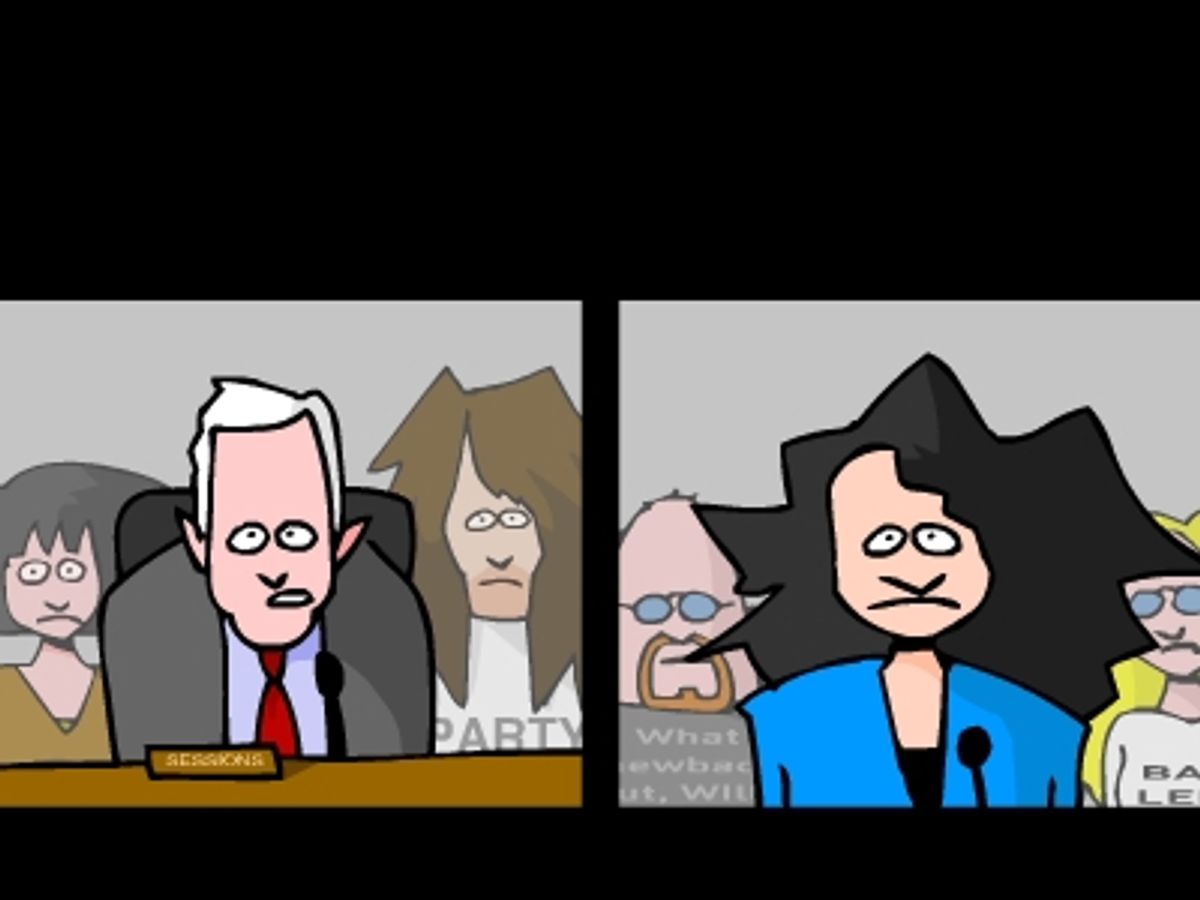
Is the senator speaking from personal experience when he mentions prejudices?
Scott Bateman responds to Sen. Jeff Sessions at the confirmation hearings for Judge Sotomayor.
Foster Friess (Credit: talkingpointsmemo.com)
You may have heard that Foster Friess, Rick Santorum surrogate and bankroller, offered women a solution for saving money on contraception in lieu of President Obama’s plan to cover it fully. “You know, back in my day, they used Bayer aspirin for contraceptives. The gals put it between their knees and it wasn’t that costly,” he told Andrea Mitchell today. If you weren’t familiar with the old-timer expression, he didn’t mean applying the aspirin vaginally — he meant that the sluts should just keep their legs shut.
But it’s worth looking at what he said right before that: “I get such a chuckle when these things come out. Here we have millions of our fellow Americans unemployed, we have jihadist camps being set up in Latin America, which Rick has been warning about, and people seem to be so preoccupied with sex that I think it says something about our culture. We maybe need a massive therapy session so we can concentrate on what the real issues are.”
This is deeply ironic, and not just because Friess has chosen to back a candidate whose singular obsession with state regulation of sexual behavior has helped bring the more extreme stances of the anti-choice movement to the forefront. It bears repeating that Santorum said as recently as October, “Many of the Christian faith have said, well, that’s OK, contraception is OK. It’s not OK. It’s a license to do things in a sexual realm that is counter to how things are supposed to be.”
It’s also because Friess said all this on a day when Rep. Darrell Issa convened a House Oversight Committee to ponder the following question (rendered verbatim), “Lines Crossed: Separation of Church and State. Has the Obama Administration Trampled on Freedom of Religion and Freedom of Conscience?” The topic, of course, was the Affordable Care Act’s mandated coverage of contraceptives as preventive care, and how unsatisfied Republicans remain with the compromise that has satisfied everyone who actually provides healthcare. And it’s not just the Republican House, which has long been interested in convening show hearings about regulating uteruses without any realistic path to getting something done: Marco Rubio and Roy Blunt are trying to tack on a “right of conscience” amendment to the highway bill that would allow all employers to opt out of any coverage they claim violates their religious beliefs.
Those hearings got a lot more attention than your average subcommittee does, when two female congresswomen, Eleanor Holmes Norton and Carolyn Maloney, walked out in protest of the all-male lineup in the first panel. “What I want to know is, where are the women?” asked Maloney. “I look at this panel, and I don’t see one single individual representing the tens of millions of women across the country who want and need insurance coverage for basic preventive healthcare services, including family planning.” Two women were on the second panel, but Republicans barred the female Georgetown law student who had been put forward to testify about how lack of access to contraception had led her friend to lose an ovary. Issa, according to Politico, said “she was ‘not found to be appropriate or qualified’ to testify about religious liberty. He said liberty, not contraception, was the topic of the hearing.”
Contraceptive coverage and women’s health are “real issues,” contrary to Friess’ formulation, but they’re public health issues that should be addressed by expanding access to options that women are already choosing for themselves, when they can. Still, the administration moved on from this almost a week ago, defusing it for anyone persuadable when they announced their compromise. The only people keeping this issue in the news right now are Republicans vainly posturing on behalf of legislation that has no chance in the current climate. The only real question is, why? Can’t they read polls? Aren’t they aware of how much they’re playing into Obama’s hands by associating themselves with a position that Americans manifestly find extreme — with video, no less? We already know they’re completely unaware of how prohibitively expensive birth control access can be for the average American.
Most of all, Republicans seem intent on proving that pro-choicers are correct when they accuse them of being more obsessed with policing women’s sex lives than any actual policymaking. By the way, here’s how Mitchell responded to Friess: “Excuse me, I’m just trying to catch my breath from that.” It is, in fact, breathtaking how incredibly divorced from reality this conversation has been.
(Credit: © Jason Reed / Reuters)
The president did something agile and wise the other day. And something quite important to the health of our politics. He reached up and snuffed out what some folks wanted to make into a cosmic battle between good and evil. No, said the president, we’re not going to turn the argument over contraception into Armageddon, this is an honest difference between Americans, and I’ll not see it escalated into a holy war. So instead of the government requiring Catholic hospitals and other faith-based institutions to provide employees with health coverage involving contraceptives, the insurance companies will offer that coverage, and offer it free.
The Catholic bishops had cast the president’s intended policy as an infringement on their religious freedom; they hold birth control to be a mortal sin, and were incensed that the government might coerce them to treat it otherwise. The president in effect said: No quarrel there; no one’s going to force you to violate your doctrine. But Catholics are also Americans, and if an individual Catholic worker wants coverage, she should have access to it — just like any other American citizen. Under the new plan, she will. She can go directly to the insurer, and the religious institution is off the hook.
When the president announced his new plan, the bishops were caught flat-footed. It was so … so reasonable. In fact, leaders of several large, Catholic organizations have now said yes to the idea. But the bishops have since regrouped, and are now opposing any mandate to provide contraceptives even if their institutions are not required to pay for them. And for their own reasons, Republican leaders in Congress have weighed in on the bishops’ side. They’re demanding, and will get, a vote in the Senate.
Sen. Mitch McConnell, R-Ky., says:
The fact that the White House thinks this is about contraception is the whole problem. This is about freedom of religion. It’s right there in the First Amendment. You can’t miss it, right there in the very First Amendment to our Constitution. And the government doesn’t get to decide for religious people what their religious beliefs are. They get to decide that.
But here’s what Republicans don’t get, or won’t tell you. And what Obama manifestly does get. First, the war’s already lost: 98 percent of Catholic women of child-bearing age have used contraceptives. Second, on many major issues, the bishops are on Obama’s side — not least on extending unemployment benefits, which they call “a moral obligation.” Truth to tell, on economic issues, the bishops are often to the left of some leading Democrats, even if both sides are loathe to admit it. Furthermore — and shhh, don’t repeat this, even if the president already has — the Catholic Church funded Obama’s first community organizing, back in Chicago.
Ah, politics.
So the battle over contraception no longer seems apocalyptic. No heavenly hosts pitted against the forces of Satan. It’s a political brawl, not a crusade of believers or infidels. The president skillfully negotiated the line between respect for the religious sphere and protection of the spiritual dignity and freedom of individuals. If you had listened carefully to the speech Barack Obama made in 2009 at the University of Notre Dame, you could have seen it coming:
The soldier and the lawyer may both love this country with equal passion, and yet reach very different conclusions on the specific steps needed to protect us from harm. The gay activist and the evangelical pastor may both deplore the ravages of HIV/AIDS, but find themselves unable to bridge the cultural divide that might unite their efforts. Those who speak out against stem-cell research may be rooted in an admirable conviction about the sacredness of life, but so are the parents of a child with juvenile diabetes who are convinced that their son’s or daughter’s hardships might be relieved. The question then is, “How do we work through these conflicts?”
We Americans have wrestled with that question from the beginning. Some of our forebearers feared the church would corrupt the state. Others feared the state would corrupt the church. It’s been a real tug-of-war, sometimes quite ugly. Churches and religious zealots did get punitive laws passed against what they said were moral and religious evils: blasphemy, breaking the Sabbath, alcohol, gambling, books, movies, plays … and yes, contraception. But churches also fought to end slavery, help workers organize and pass progressive laws. Of course, government had its favorites at times; for much of our history, it privileged the Protestant majority. And in my lifetime alone, it’s gone back and forth on how to apply the First Amendment to ever-changing circumstances among people so different from each other. The Supreme Court, for example, first denied, then affirmed, the right of the children of Jehovah’s Witnesses to refuse, on religious grounds, to salute the flag.
So here we are once again, arguing over how to honor religious liberty without it becoming the liberty to impose on others moral beliefs they don’t share. Our practical solution is the one Barack Obama embraced the other day: protect freedom of religion — and freedom from religion. Can’t get more American than that.
My thanks to Julie Leininger Pycior, professor of history at Manhattan College, for her insights and counsel on this essay
Prognostication about the future of the book is everywhere; making predictions about what books will be like tomorrow seems much more profitable (not to mention easier) than creating actual books today. Yet all these prophecies collide with a basic problem: The book, as it currently exists, is hard to improve upon. Cheap, highly portable and free of maddening formatting problems, the printed book has met most readers’ needs pretty well. Sure, in recent years, technology has transformed the distribution of texts — you can order any book online or tote around dozens of e-books in a lightweight reader — but the vast majority of these books remain essentially the same: linear strings of words, with the occasional image.
Still, the dream of interactive books lives on, despite a series of digital disappointments ranging from hypertext fiction to CD-ROMs to experimental Web novels to current ventures in social reading. Previously, I wrote about the inherent tensions between interactivity and narrative in enhanced fiction e-books. Indeed, there’s little evidence that images, videos, sound effects or clickable doohickeys add anything of value in the eyes of most readers of prose fiction. As the Wall Street Journal recently reported, the enhanced e-book of Stephen King’s novel “11/22/63″ contained a 13-minute film by King himself, yet only 45,000 readers were willing to shell out the extra $2 to get it, compared to 300,000 who bought the unadorned e-book ($14.99) or the 1 million purchasers of the print edition ($35). King’s publisher expressed doubts that enhanced e-books were worth the extra trouble and expense.
Nonfiction, however, is another matter. While some developers labor in vain to improve upon the immersive storytelling of novelists like King, others are taking factual material that might have once been published between hard covers and turning it into strange and wondrous new creations. The most successfully enhanced e-book is the one you may not even recognize as a book.
The first among these were introductory science apps like “The Elements” (used to showcase the iPad’s potential when the device was first released) and astronomy apps like “Solar System for iPad” and “Solar Walk.” A recent release, “Back in Time,” lets the user turn the hands of a cosmic clock and scroll through a series of images to explore a timeline of the history of the universe. All of these books — for that’s the category they’re given in Apple’s App Store — use touch-responsive 3-D animation and other model-like features to help the reader visualize concepts well outside their everyday experience: vast distances in time or space, the motion of the planets and the relationship between molecular structure and palpable objects. Technically, I know that the earth’s tilted axis as it orbits the sun determines the changing seasons, but “Solar Walk” allows me to see it happen.
The popularity of science apps like “The Elements” no doubt encouraged Apple to move aggressively into digital textbook publishing with its recent upgrade to iBooks. The iBookstore, with its too-broad categories and abysmal metadata, has failed to emerge as a contender among retailers of trade e-books. Apple now seems to be concentrating its energies on the education market. IBooks titles can incorporate an array of visual, audio and video features, which make it possible for publishers to create books like “The Elements” for older students. Sometimes the results add little more than eye candy, sometimes not. The sample book released with the upgrade, “Life on Earth” by E.O. Wilson, sports a lot of beautiful photographs and videos, few of which are particularly informative, but the animations of cell activity do help make the weird-looking structures of the microscopic world comprehensible.
Whole categories of routine instructional books are in the process of being digitally revolutionized. Cookbooks can include demonstration videos for beginners and advanced forms of recipe organization for more practiced cooks. You can better learn to lift hand weights or fix a car or do card tricks from a combination of text and video. There’s not much glamour or art in enhancing such practical titles, but there’s a lot of common sense. The linearity of stories may be fundamental to the pleasure they offer, but in books like these, linearity was always merely arbitrary, imposed by the print book form. Hardly anyone reads them one page at a time, in order, from cover to cover.
Even a work of substantive narrative nonfiction, however, can be genuinely enriched with some basic multimedia add-ons. The enhanced edition of Katherine Boo’s “Behind the Beautiful Forevers” comes with several short videos featuring the Mumbai slum dwellers who serve as the main characters in that remarkable book. These films form a moving version of the photographic inserts traditionally tipped into the center of biographies and histories. You can’t read the book without wanting to know what these people look like. However, since most readers deciding which version to buy haven’t read the book yet, it will be interesting to see how many are willing to spring the extra buck for the edition with the videos.
Boo shot the footage on a Flip camera as part of her research. Once upon a time (say, two years ago), these videos might have been offered for free on the author’s or publisher’s website. But not every nonfiction author just happens to have a lot of documentary images and video on hand, waiting to be repurposed for publication. The great problem with any e-book enhancement is cost. Original artwork, video and animation must be commissioned or the right to use preexisting works obtained. That gets expensive — really expensive. Voice-overs and readings call for the skills of professional actors. The whole kit and caboodle then has to be inserted into the text, which depending on how well-integrated it is, may require the expertise of programmers.
Most authors and book publishers aren’t in the business of producing this sort of thing. Add to that a prevailing attitude among consumers that e-books ought to be cheaper than their print counterparts — no matter what extras they include — and there’s not much incentive for book publishers or authors to take the trouble. As understandable as this reluctance may be from a business perspective, it’s still disappointing. Imagine how much more enlightening, say, a book on popular physics or the military campaigns of Alexander the Great or the current fiscal crisis might be with a few well-considered moving or interactive images.
An example, and one of the few enhanced e-books considered a genuine success, is Rick Perlstein’s “Nixonland,” an examination of the popular right-wing response to the counterculture of the 1960s. The enhanced e-book edition includes 27 clips, taken from CBS News archives, illustrating key events in a highly televised period of American history. Each clip is embedded in the page that refers to it. But bear in mind that the book’s publisher, Simon & Schuster, is a division of CBS, which surely made it much easier to obtain the rights to use those clips.
“Nixonland” started with a (celebrated) text, then added video. NBC News recently announced the formation of a digital book publishing division that works in reverse. It will produce titles on current events and personalities with the clips as the springboard, and then incorporate text from published books, NBC staff writers and freelancers. Companies who already know how to make videos, animated graphics and complex websites have the edge when it comes to publishing multimedia e-books. All they have to do is hire some professional writers. Traditional book publishers, on the other hand, have to figure out how to commission several types of visual media despite having little experience in working with anything but text. Besides, writing is cheap, right?
Not so fast. Complaints from app consumers about the weak writing in some otherwise spectacular digital books suggest that corner-cutting in this department is rife. Programmer- or designer-driven works often borrow text from Wikipedia and other public-domain sources, and this does not go unnoticed. One happy exception is the recently published “Skulls by Simon Winchester,” an app by Touch Press, the company responsible for “The Elements” and last year’s groundbreaking T.S. Eliot e-book, “The Waste Land.” The ever-debonair Winchester, bestselling author of “The Professor and the Madman,” not only wrote the text that accompanies the app’s 300 rotatable images of human and animal skulls (as well as artifacts representing the human head) — he also reads it. The result is informative and thoughtful as well as gorgeous and diverting. More, please.
Further reading
Republican presidential candidate, former Massachusetts Gov. Mitt Romney (Credit: AP)
(Updated)
Word is now breaking that Mitt Romney has decided not to participate in a long-scheduled debate on March 1, just days before the critical Super Tuesday primaries. Romney’s campaign has yet to confirm the news, but a spokesman for the Georgia Republican Party — which along with CNN is sponsoring the debate — is saying that “word was passed along to CNN this morning” by the campaign, while CBS News and National Journal report that Romney is blaming a scheduling conflict.
Assuming the reports are true, that’s a transparently lame excuse. Even if Romney has other events planned for the same night, he has two weeks to shuffle his schedule around. Besides, the GOP debates have been must-see events that have attracted massive audiences; the entire political world essentially shuts down when they take place. What could Romney possibly have scheduled that would keep him from attending?
Clearly, this is about Romney not wanting to take part — which, in and of itself, is hardly surprising. Debates can be tense and unpredictable and Romney comes to all of them with a target on his back. And in Rick Santorum, he now faces a main rival who is actually pretty good at them. Santorum knows exactly where Romney’s weaknesses are and exactly how to attack him. This is a threat that Romney didn’t have to worry much about with Rick Perry (who struggled to formulate complete thoughts on his feet), Herman Cain (who literally had nothing to say besides “9-9-9″) and Newt Gingrich, who melted down when Romney turned up the heat in two Florida debates last month. So from Romney’s standpoint, it would be ideal not to have to worry about any debate slip-ups and to focus on using his huge financial advantage to destroy Santorum with negative ads.
The problem is that skipping debates is something that confident, inevitable front-runners do — not front-runners who are so wounded that they might not even be front-runners anymore. With his poll numbers crashing and Santorum surging, Romney’s debate boycott looks awful, a reeling candidate who’s afraid to face his opponents. And it plays right into Santorum’s efforts to paint Romney as a candidate who has nothing to offer besides a deep bankroll and negative ads. This gives Santorum a valuable talking point for the days ahead — one that will become even more potent if he’s able to knock off Romney in Michigan on Feb. 28.
The funny thing is that Romney is actually pretty good at debates. Yes, he’s had a few slip-ups and he’s benefited from feeble opposition, but chances are he’d do just fine on March 1 — just as he’ll probably survive next week’s debate in Arizona, assuming he doesn’t back out of that too. In other words, he may get more grief now for skipping a debate than he’d get from his opponents if he actually showed up at it.
Update: Romney’s campaign has now confirmed that he won’t be at the March 1 debate:
“Gov. Romney will be spending a lot of time campaigning in Georgia and Ohio ahead of Super Tuesday,” spokeswoman Andrea Saul said in a statement. “With eight other states voting on March 6, we will be campaigning in other parts of the country and unable to schedule the CNN Georgia debate. We have participated in 20 debates, including eight from CNN.”
(Credit: Peter Zurek via Shutterstock/Salon)
It’s too late: You can beg, borrow and steal all you want, but you’ll never see the Leonardo da Vinci exhibition whose recent run in London inspired a genuine mania. Only an estimated couple of hundred thousand people — many of whom waited on line for hours or paid through the nose to get in — were fortunate enough to personally witness the Renaissance master’s three-month occupation of the British capital’s imposing National Gallery.
All might not be lost, however. At least, that’s how the producers and distributors of “Leonardo Live,” a documentary that airs tonight in nearly 1,000 theaters around the world, are hoping you’ll feel. The movie takes viewers through the exhibition at the time of its opening, enhancing the gallery experience with additional behind-the-scenes interviews and features.
So far, reception of “Leonardo Live” has been mixed. (The New York Times calls it “strangely hectic, occasionally informative and sometimes even insightful,” comparing sections to “a high-art version of ‘New Year’s Rockin’ Eve.’”) But Julie Borchard-Young, president of distributing company BY Experience (which works on many other arts-related live cinemacasts, such as “the Met: Live in HD”), says she believes in the project because it will make an international phenomenon accessible to interested viewers who would otherwise be shut out.
“Most people have bought a movie ticket in their lives, but maybe not many people have had the opportunity to actually travel to London and go to a gallery or an exhibition,” she says. “This is just a more normal experience … I think that’s the biggest benefit.”
While the Leonardo exhibition is particularly well-suited to this format and presentation for a number of reasons (the artist’s fame and the show’s staggering popularity among the most obvious), Borchard-Young says the “experiment” has generated interest from a number of other galleries and institutions keen to explore the options for future projects. “This is the first” such broadcast, she says, but it “certainly won’t be the last.”
The appraiser, consultant and fine art scholar Robert Simon, who worked to authenticate the painting “Salvator Mundi” (one of seven Leonardo paintings on display in the exhibition) and appears in the film, spoke to me about the pros and cons of viewing art exhibitions on-screen.
When you first heard that there was going to be a film of the exhibition, what did you think? Were you at all reluctant to participate?
I thought it was curious. Curious, and I didn’t quite understand it — I didn’t understand exactly why they were making it, and whether anyone would ever want to watch it.
Now that you’ve seen both — the real-life exhibition and the film — what do you think?
I’ve seen the exhibition a few times, and I saw the film once. And I understand now! I’m speaking just from the point of view of a viewer, not as a participant. The experience of seeing the exhibition the way it was recorded on film was really quite innovative and interesting. And for those who have not seen the exhibition and won’t be able to — which is 99.9 percent of the world — it’s an amazing record of it, a very different kind of experience of an exhibition. And, obviously, a permanent one.
Some people were willing to pay astronomical sums just to see these works in person — and they might not be as excited about seeing the same art on a movie screen. But at the same time, the movie version gives you the chance to get closer to some of the paintings — and you don’t have to jostle with a crowd. What are the pros and cons of this format?
The cons are basically few. If you’re not going to see the exhibition, then there’s basically no con to it.
In terms of experiencing a work of art directly, there’s truly nothing like that in the world. That’s one of the great things about art: You’re there, and there’s no mediation. There’s no technology screen … But it’s not always possible. And when you [compare this to] looking at the catalog or guidebook for an exhibition — or even something that one would see today online [an online tour or exhibition excerpt] — this is at a completely different level, because the quality is so high in the filming. There’s nothing like the big screen; it’s amazing, and I think it [says a lot] about the quality of the art that these pictures and drawings — which may be 2 feet high at the most (there are a couple that are larger) — are put up on a very large screen, and they tolerate it well, and you can see details that you’d never see otherwise. And yes, there are no people there.
The other thing that I think is very interesting and positive about the film is that … it gives you a little of the excitement of what it’s like to be at a major opening of an exhibition, in terms of the people who are there and the physical layout of the galleries: how the pictures are hung, what the exhibition’s curators are trying to convey. These things are organized and thought out so carefully over a period of years, in terms of the themes of particular rooms, the chronology, the subjects, [and] how it’s put together for the viewer, who will experience it in the exhibition. Of course, you never get that in the [catalog]. It’s just not something that can be conveyed that way. Whereas there’s part of this film — I think it’s early on — in which the presenter basically walks through the exhibition. There’s a camera following him; it’s maybe a little dizzying in HD — I found it that way — but it gave you an overview of what was going on.
[This] doesn’t take the place of the exhibition, I’m happy to say, but it’s a lot better than not seeing the exhibition, and for those who have seen the exhibition, it also adds another dimension. It’s a little bit like what people do with the opera: Opera is a wonderful thing to experience in person, and yet the film versions of it are something else, and they’re really quite effective in conveying what goes on to those who are unable to attend. They’re also able to see things that they cannot see when they do attend.
Page 1 of 15139 in All Salon
What are Republicans thinking?
Freedom of religion is freedom from religion
Reality, exploded
Now Mitt’s refusing to debate
Hollywood’s real-life night at the museum
Mitt’s ticking Maine time bomb?
The 196 people who will choose our next president
The right is attacking Media Matters because it matters
Rooting for your own kind
Is the Iran threat an illusion?