The legendary CBS News anchorman was 92

AP Photo/File
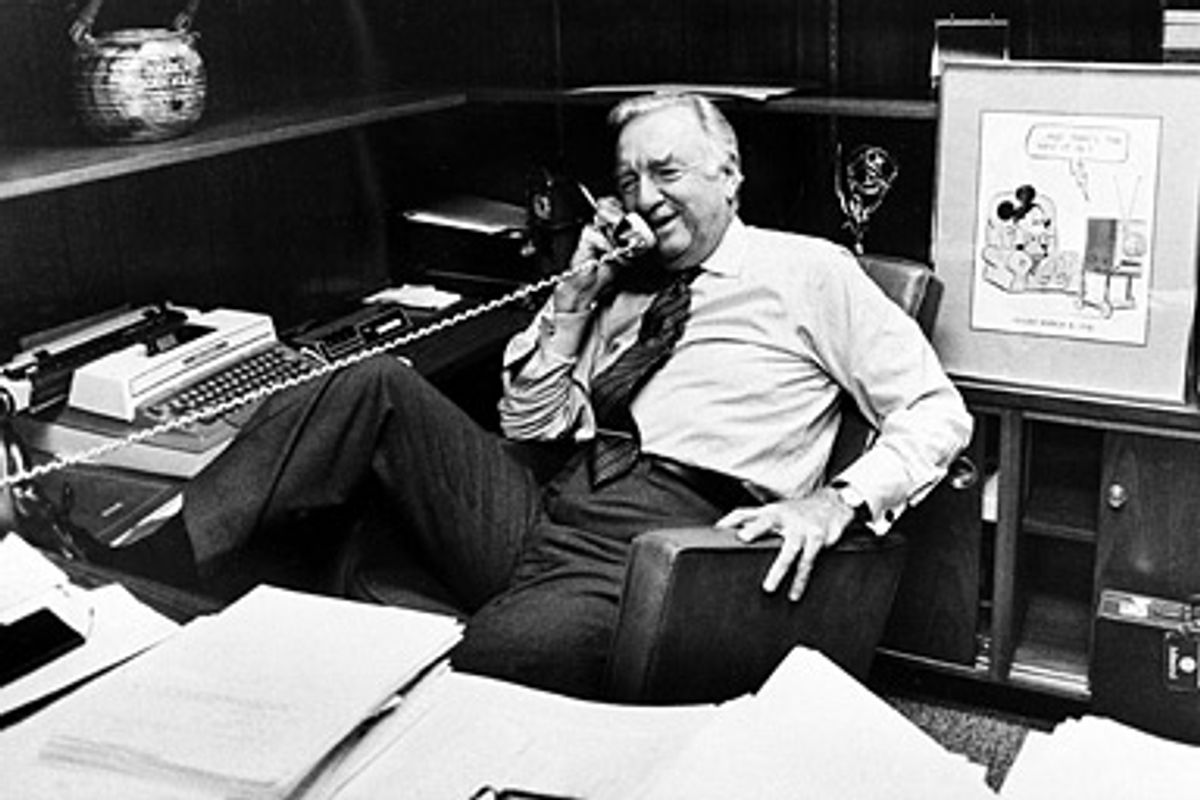
In this March 6, 1981 file photo, Walter Cronkite talks on the phone at his office, prior to his final newscast as CBS anchorman in New York City. Famed CBS News anchor Walter Cronkite, known as the ‘most trusted man in America’ has died, Friday, July 17, 2009. He was 92.
WASHINGTON — Walter Cronkite, the iconic CBS News anchorman, died tonight in New York. He was 92.
Cronkite anchored the CBS evening news from 1962 to 1981, leading the network’s coverage of the civil rights movement, John F. Kennedy’s assassination, the Vietnam War and Watergate. He had been ill with cardiovascular disease for some time, and was being cared for at Bellevue Hospital in New York since last month. CBS said his family was with him when he died.
“It is impossible to imagine CBS News, journalism or indeed America without Walter Cronkite,” Sean McManus, the president of CBS News, said in a statement the New York Times posted. “More than just the best and most trusted anchor in history, he guided America through our crises, tragedies and also our victories and greatest moments.”
Cronkite started in journalism with a part-time job at the Houston Post, and he dropped out of college to work there full-time. He wound up moving to United Press International, and covered World War II for the wire service. He joined CBS in 1950, in the early days of national television.
Not long after he took over as anchor for the network’s primetime newscast, CBS expanded the show from 15 minutes to 30, and his audience grew steadily. By 1968, when Cronkite returned from a reporting trip to Vietnam, his verdict on the situation there helped convince President Lyndon Johnson that he’d lost a crucial swath of public — and establishment — support. “It seems now more certain than ever that the bloody experience of Vietnam is a stalemate,” Cronkite said, on the air. “If I’ve lost Cronkite, I’ve lost America,” Johnson reportedly said, and decided not long afterwards not to seek reelection.
Cronkite retired in 1981, at 65, to let Dan Rather take over. But in 2006, when Katie Couric became the anchor of the evening newscast, the network began using a recorded announcement by Cronkite to open the show.
UPDATE: The White House issued a short statement from President Obama a little while after the news of Cronkite’s death broke:
For decades, Walter Cronkite was the most trusted voice in America. His rich baritone reached millions of living rooms every night, and in an industry of icons, Walter set the standard by which all others have been judged.
He was there through wars and riots, marches and milestones, calmly telling us what we needed to know. And through it all, he never lost the integrity he gained growing up in the heartland.
But Walter was always more than just an anchor. He was someone we could trust to guide us through the most important issues of the day; a voice of certainty in an uncertain world. He was family. He invited us to believe in him, and he never let us down. This country has lost an icon and a dear friend, and he will be truly missed.
And that’s the way it is.
Don’t worry, they still can’t stand Obama
Why the startlingly low turnout in Republican primaries so far is probably a red herring
(Credit: Reuters/Jessica Rinaldi)
If the contests that have taken place so far are any guide, then Republican turnout in Minnesota, Colorado and Missouri today won’t be anything to write home about. It’s been one of the most discordant aspects of the 2012 campaign: The first three years of Barack Obama’s presidency were marked by an angry awakening of the GOP base, but those same Republican voters seem oddly unexcited about the opportunity to finally select an opponent for the president. Here, courtesy of NBC’s First Read, are the turnout figures for the five states that have voted so far:
IOWA
2008: 118,411
2012: 121,503
+2.6%NH
2008: 233,464
2012: 248,485
+6.4%SC
2008: 443,203
2012: 601,215
+36%
FL
2008: 1,925,911
2012: 1,669,647
-13%NV
2008: 44,325
2012: 32,930
-26%
There are other signs that Republicans aren’t as engaged as they were four years ago. An ABC News/Washington Post poll this week found that just 55 percent of GOP voters say that are “certain” to vote when their state’s nominating contest is held; at this same point in ’08, that number was 68 percent.
On the surface, these sorts of numbers run counter to everything we’ve been seeing and hearing since January 2009, when conservative activists and voters mobilized a fierce, loud and relentless resistance to Obama’s presidency. Surely, the thinking went, they’d throw themselves into the ’12 primary race, instead of sleeping through it like they seemed to in ’08. Plus, this time around there’d be no Democratic contest to attract eligible non-Republican voters in open primary states; with all of the action on the GOP side, turnout would have to swell, wouldn’t it?
Needless to say, there’s now plenty of talk about the potential general election implications of this seemingly unmotivated Republican base, and the possibility that the enthusiasm gap that was supposed to harm Democrats could actually work in their favor — or at least not be much of a factor. And while it’s very possible there’s something to this talk, I’d offer a different theory: The low turnout figures are actually consistent with what we know about the Obama-era GOP and probably don’t portend anything for the fall.
After all, the GOP base’s 2009 awakening was primarily a response to the election of a Democratic president. While the term that the right embraced for its resistance (the Tea Party) was new, the phenomenon wasn’t; just ask Bill Clinton. But there was a twist this time, with the right deciding that Obama’s election was enabled by Bush-era Republican leaders, whose routine sellouts of conservative principles had given the movement a bad name and helped produce the depressing domestic conditions that made victory so easy for Obama. So they launched a two-front war, one against Obama and one against the “establishment”-types who had led the GOP off course. The indispensable ingredient, though, was Obama’s election.
In this sense, the low turnout figures could be a reflection of the intraparty war. That Romney is regarded with suspicion by many conservatives is well-established at this point; his Massachusetts record and his strained efforts to present himself as a born-again Reaganite make him seem like the very sort of Republican official the base rebelled against in some high-profile 2010 primaries. Romney has tried hard — very, very hard — not to give the right any new ammunition, and he’s largely succeeded. But that doesn’t mean he’s generated any real enthusiasm; his strategy has always been to be the “good enough” candidate — the one conservatives will eventually accept when they realize he’s inevitable and that they have no other options.
And that’s the other story of the GOP campaign so far: Conservatives really haven’t found any other options. They’ve flirted with various possibilities, but all of the would-be alternatives have shown themselves to be seriously flawed in one way or another, and none has shown much staying power in the polls.So what’s there for the average Tea Party-era Republican to be excited about in the GOP race? As right-wing blogger Erick Erickson put it recently: “Today, after a lot of reflection on this race, I can honestly say my position has not changed and I would honestly prefer Ace of Spades’ sweet meteor of death than any of the candidates left in the race.”
But when the primary season finally ends and the Republican Party has a nominee, Republicans like Erickson will be left with a choice: the GOP candidate or four more years of Obama — the guy whose election made them so furious in the first place and whose presidency they’ve spent the past few years desperately trying to undermine. And rest assured, the GOP base is as sour on Obama as it’s ever been; Gallup’s latest weekly tracking poll gives the president a 10 percent approval rating among Republicans and a 6 percent score among conservative Republicans. Even Clinton, a man who inspired so much animosity from Republicans that they impeached him, enjoyed more cross-party support at this point in his presidency. And so did every other president since Ronald Reagan.
There’s still nothing quite like the right’s Obama-phobia. So while a surprising number of Republicans may be sitting on their hands now, here’s guessing they won’t be in November.
Rick Santorum’s odd “badge of honor”
Don’t look now, but he could have a very big night tonight – and the Romney campaign is spooked
Rick Santorum (Credit: AP/Ed Andrieski)
February is supposed to be Mitt Romney’s month, but there’s a real chance that tonight will belong to Rick Santorum. Three states are holding nominating contests, and Santorum is well-positioned to win two of them — with an outside chance of posting a clean sweep.
Polling from PPP released late last night gives the former Pennsylvania senator a 45 to 32 percent lead over Romney in Missouri, which is conducting a non-binding primary. Newt Gingrich failed to qualify for the ballot in the state, and Ron Paul is running a distant third with 19 percent. Santorum is also ahead in the caucus state of Minnesota, where PPP shows him 9 points up on Romney, 33 to 24 percent, and just 10 points (37 -27 percent) behind the former Massachusetts governor in Colorado. Gingrich is running in third in both of those states.
Perhaps the most significant finding is that Santorum, who has mostly stayed in the background as Romney and Gingrich have traded vicious insults, enjoys favorable ratings of over 70 percent among Republicans in all three states — significantly higher than the scores for Romney and Gingrich. And Minnesota and Colorado are both particularly conducive to his emphasis on social and cultural issues, with activist-oriented caucus electorates in which the sorts of Christian conservatives who propelled him to his Iowa victory holding disproportionate sway.
It’s true that no convention delegates will be directly awarded through today’s contests, but there’s a clear opportunity for Santorum here. Look at it this way: In late December and early January, Gingrich’s numbers crashed and Santorum surged to his unlikely Iowa win*, setting up what briefly seemed like a two-man race between Romney and Santorum. But Santorum lost his momentum in New Hampshire, allowing Gingrich to get back in the game in South Carolina, where he was boosted by some serious super PAC assistance and the lack of attacks from Romney and the GOP establishment. But just about nothing has gone right since then for Gingrich, who seems decreasingly relevant by the day.
So the timing of today’s contests is fortuitous for Santorum. If he can post a series of breakthrough showings, it could help him supplant Gingrich as Romney’s chief rival. There’s still a theoretical opening for a conservative alternative to Romney to do some real damage in early March. With some wins today, it could be Santorum — and not Gingrich — who gets to play that role.
The Romney campaign clearly recognizes this potential. As soon as the South Carolina primary was over, they launched a relentless assault on Gingrich, determined to bury him once and for all, while leaving Santorum alone. But yesterday, they started attacking Santorum too, leading one of Santorum’s strategists to declare, “It’s a badge of honor that Romney has decided to try to destroy us.” He’s right, of course. It’s a sign of progress for Santorum that he’s again relevant enough to force the front-runner to issue nasty press releases. But if Santorum wins big tonight, the abuse will get a lot worse. Which means he should probably enjoy those 70 percent favorable ratings while they last.
Steve Kornacki on “Countdown with Keith Olbermann”
President Obama gets some of the best polling news of his term, but will it last?
VIDEO
Keith Olbermann was back in his usual seat on “Countdown” Monday night. First up: a segment on on Barack Obama’s improving poll numbers and reelection outlook with Salon’s Steve Kornacki:
The GOP primary season’s real winner
President Obama’s reelection prospects are a lot brighter now than they were a few months ago
(Credit: Reuters/Larry Downing)
In an interview with Matt Lauer that aired before the Super Bowl, Barack Obama argued that “I deserve a second term.” And if the election were held right now, he’d probably get one.
A new ABC News/Washington Post poll that shows the president opening a 6-point lead over Mitt Romney (and moving over the magic 50 percent mark) among registered voters has been generating plenty of attention today. It confirms the degree to which Obama’s reelection prospects have improved recently. Just a month ago, the same poll gave Romney a 2-point edge (48 to 46 percent), and not since last July had Obama run ahead of Romney among registered voters. This is also the first time either man has cleared the 50 percent mark in the ABC/WaPo poll. Among all adults, Obama notches a 50 percent job approval rating — his highest mark since last March.
To put the numbers in some context, here’s a look at how recent incumbent presidents have stood in the ABC/WaPo survey at roughly this same point in their reelection years.:
1984:
Poll conducted: Feb. 13-15
Ronald Reagan approval rating: 59 percent
Head-to-head: Reagan 51, Walter Mondale 45; Reagan 54, John Glenn 43; Reagan 62, Gary Hart 27
Comment: From mid-1983 on, the unemployment rate (which had peaked near 11 percent just after the 1982 midterms) fell steadily, while Reagan’s approval rating (which had fallen well under 40 percent after the ’82 midterms) steadily recovered. When this poll was conducted, the jobless rate had dropped for five straight months and stood at 8 percent. Hart’s poor showing was a result of his obscurity; within days, he posted a surprise (if very distant) second place Iowa finish, then parlayed it into the shocking New Hampshire primary victory that made him a national political star and nearly carried him to the nomination.
1992:
Poll conducted: March 7-9
George H.W. Bush approval rating: 39 percent
Head-to-head: Bill Clinton 46, Bush 44; Paul Tsongas 47, Bush 42
Comment: The poll was conducted three weeks after Clinton’s “comeback kid” second-place finish in New Hampshire and just days before he won a series of lopsided victories on Super Tuesday. Scandals (Gennifer Flowers/Vietnam draft) that erupted in late January and early February help explain why Clinton wasn’t performing quite as strongly as Tsongas, who suspended his candidacy just over a week after this poll was released.
1996:
Poll conducted: March 8-10
Bill Clinton approval rating: 55 percent
Head-to-head: Clinton 56, Bob Dole 39
Comment: With voters finally believing that the early-’90s recession was over and feeling more optimistic about the direction of the country, it was increasingly clear in early ’96 that Dole would face an uphill fight as the GOP nominee. But his standing was worsened in this poll by his bumpy path to the GOP nomination — which included a loss to Pat Buchanan (and near-third place finish) in the Feb. 20 New Hampshire primary — and the poisonous effect of Newt Gingrich and his fellow House Republican revolutionaries on the GOP’s national image. Another ABC/WaPo poll conducted a week later — just after Dole posted a resounding Super Tuesday landslide that basically sealed the nomination — showed a slightly closer race, with Clinton’s lead at 9 points.
2004
Poll conducted: Feb. 9-11
George W. Bush approval rating: 50 percent
Head-to-head: John Kerry 52, Bush 43
Comment: Kerry had not yet locked up the nomination (wins in Wisconsin on Feb. 17 and Super Tuesday on March 2 would cement his status), but he seemed well on his way. The Democratic primary season probably damaged Bush more than it did Kerry, because the candidates focused their messages on attacking the incumbent, and not each other. It was an unusually clean process that lacked much of the public acrimony that typically attends nomination battles. Bush began engaging the Democrats more directly in subsequent weeks; a month later, the ABC/WaPo poll showed Kerry’s lead down to 4 points.
In Obama’s recent improvement, there are shades of both the Reagan and Clinton examples.
Like Reagan, Obama is likely benefiting from good economic news. The current recovery is less dramatic and more tenuous than the one that was underway at this point in ’84, but the fact remains that unemployment has fallen for five straight months and now sits at the lowest level since the first full month of Obama’s term; voters have been hearing a lot more encouraging news about the country’s direction these past few months. As Greg Sargent points out, the new poll contains evidence that Obama is winning back blue-collar white voters, with whom he now enjoys a 43 percent approval rating:
While those numbers don’t appear too good at first glance, things are trending Obama’s way. This is his best level among non-college whites since early last year (excluding the post-Bin Laden bump), and they are far better than they were at their lowest point in 2010, when Democrats suffered massive desertions among this constituency.
Plus, the poll was conducted last Wednesday through Saturday, meaning that it doesn’t really reflect the impact of what was to date the best economic news of Obama’s entire presidency, the jobs report released on Friday.
And like Clinton, Obama is also getting some help from the other team. Romney seems on course to win the nomination, but the process has been messy for him, just as it was for Dole in ’96. Thanks in part to unexpected attacks from Gingrich and Rick Perry, significant attention has been paid in the past month to Romney history in private equity and his own tax status, subjects that the Obama campaign figured it would have to introduce later in the campaign. The scrutiny from his rivals and the press has taken a toll on Romney’s standing with some key general election constituencies. Also like Dole, Romney is probably being hurt by his association with a tainted Republican Party brand.
The strides Obama has made toward reelection are all reversible. But if nothing else, his recent progress affirms that good economic news and infighting among the opposition party make a pretty solid formula for an incumbent president.
Newt’s very bad night
The ugly Nevada result is bad enough, but the former House speaker may be losing his sugar daddy too
Republican presidential candidate, former House Speaker Newt Gingrich speaks during a campaign stop at the International Church of Las Vegas on Friday, Feb. 3, 2012 in Las Vegas, Nev. (AP Photo/Evan Vucci) (Credit: AP)
There was never any real suspense over which candidate would win the Nevada Republican caucuses. Mitt Romney racked up a landslide win in the state four years ago, and he wasn’t even the GOP front-runner back then. The state is demographically suited to him — about a quarter of the GOP caucus electorate is Mormon, and Mormons have been supporting Romney’s campaign at roughly a 90 percent clip — and he’s put far more effort into it than any other candidate, except Ron Paul.
So for Newt Gingrich, there’s no shame per se in the fact that he was beaten by Romney on Saturday night. But that he was in danger of finishing behind Ron Paul is a problem for the former House speaker, whose main task for February — a month littered with Mitt-friendly contests — is to fare credibly enough to reassure voters in the Super Tuesday primaries of early March that the GOP contest is still a real two-man race between him and Romney.
The tallying of returns by the Nevada Republican Party was painfully slow (fewer than half of all precincts had been counted by midnight EST), but if Gingrich does lose out to Paul it will amplify a second Nevada story: Not only did Romney post a big, if entirely expected, victory, but Gingrich failed to meet even the modest expectations that were set for him — a result that will validate recent media stories that suggested the Gingrich campaign is in disarray and that will surely encourage more like them. And even if he does hold on for second, it was still Romney’s night.
Gingrich seems aware of how bad this all looks, and attempted to gain some control over the narrative with an unorthodox late-night press conference after the Nevada results were in. He repeated his vow to stay in the race, chalked up Romney’s win to Nevada’s status as a “heavily Mormon state,” talked about racking up delegates strategically, and emphasized the long game.
“I am a candidate for president of the United States,” he said. I will be a candidate of the president of the United States. I will go to Tampa.”
The idea, it seemed, was to lower the bar for the rest of February in an effort to avoid any more nights like this. Realistically, Gingrich’s won’t have a chance to start winning again until early and mid-March, when a number of Southern states will vote.
But two other Saturday night developments raise some very practical questions about Gingrich’s durability. The first is news that his campaign is $600,000 in debt, even after several months of strong fundraising. Far more ominous is a New York Times report that Sheldon Adelson, the 78-year-old casino magnate who has directed $10 million to a pro-Gingrich Super PAC since the Iowa caucuses, now recognizes that Romney is likely to win the nomination and has signaled his willingness to ultimately back him. According to the Times:
Several people who have spoken with Mr. Adelson over the past two weeks said he would most likely continue to help the [Super PAC] as long as Mr. Gingrich remained in the race. But, they said, he is concerned that additional deep-pocketed donors have not joined him. And, they said, his affection for and loyalty to Mr. Gingrich, who met with him here on Friday, have not blinded him to the reality that the nominating contest is tilting in Mr. Romney’s favor.
The Times story indicated that Romney and his team have been intently courting Adelson behind the scenes, hoping to convince him that Romney is just as reliable as Gingrich on Adelson’s top issue, Israel. (Here it may be worth recalling Romney’s stern reply to a Palestinian-American questioner at a recent Republican debate, in which he channeled the pro-Likud hawkishness that animates Adelson’s Middle East politics.) Ultimately, this may be the biggest story to come out of Saturday night. It’s hard enough to see Gingrich bouncing back now, and if his chief patron turns off the spigot…
Page 1 of 2637 in War Room

Jeremy Lin’s social media fast break
Blog proves the Onion is trusted news source
Preet Bharara’s toothless bite of Wall Street
The Grave Threat of “Homegrown Terrorism”
The making of gay marriage’s top foe
Mitt Romney’s night from hell
The “lighter side” of the Vietnam War
Oscar 2012: Chicken soup for the Hollywood soul
Is work worth it?
Will Obama compromise on birth control? 

