
Republican Party

Sex and power inside “the C Street House”

Sanford, Ensign, and other regulars receive guidance from the invisible fundamentalist group known as the Family

  • more
    • All Share Services

Topics: ,

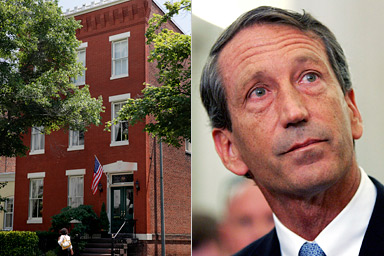
Sex and power inside 133 C Street S.E., a red-brick structure registered as a church and affiliated with a secretive Christian group known by many names, one of them the Fellowship Foundation, is seen Wednesday, July 1, 2009, in Washington. Tucked on the edge of the Capitol complex, the house has functioned as a shield for the lawmakers who live and pray there. South Carolina Gov. Mark Sanford blew away the privacy of the place over the past week, revealing that he had confided in his "C Street" "Christian friends" the cross-continental affair that he had hidden from his wife.

I can’t say I was impressed when I met Sen. John Ensign at the C Street House, the secretive religious enclave on Capitol Hill thrust into the news by its links to three political sex scandals, those of Gov. Mark Sanford; former Rep. Chip Pickering, R-Miss., who allegedly rendezvoused at the C Street House with his mistress, an executive in the industry for which he then became a lobbyist; and Sen. John Ensign, R-Nev. Although Sanford declared today that his scandal will actually turn out to be good for the people of South Carolina because he’s now more firmly in God’s control, the once-favored GOP presidential prospect will finish out his term and fade away. And Ensign’s residence at the C Street House during his own extramarital affair now threatens to end a career that he and other Republicans hoped would lead him to the White House.

When I met Ensign, he was just back from a run, sweaty and bouncing in place, boasting about the time he’d clocked and teasing a young woman from his office. She seemed annoyed that the senator wouldn’t get himself into a shower and back on the job. When I wrote about Sen. Ensign in my book about the evangelical political organization that runs the C Street House, “The Family: The Secret Fundamentalism at the Heart of American Power,” I described him as a “conservative casino heir elected to the Senate from Nevada, a brightly tanned, hapless figure who uses his Family connections to graft holiness to his gambling-fortune name.”

Now, of course, I know I was wrong: John Ensign is a brightly tanned, hapless figure who used his Family connections to cover up the fruits of his flirtations, to make moral decisions for him, and to do his dirty work when his secret romance sputtered. Doug Hampton, the friend and former aide whom Ensign cuckolded, tells us that it was Family leader David Coe, along with Coe’s brother Tim and Family “brother” Sen. Tom Coburn, who delivered the pink slip when it was time to put Cynthia Hampton out of Ensign’s reach.

If sexual license was all the Family offered the C Street men, however, that would merely be seedy and self-serving. But Family men are more than hypocritical. They’re followers of a political religion that embraces elitism, disdains democracy, and pursues power for its members the better to “advance the Kingdom.” They say they’re working for Jesus, but their Christ is a power-hungry, inside-the-Beltway savior not many churchgoers would recognize. Sexual peccadilloes aside, the Family acts today like the most powerful lobby in America that isn’t registered as a lobby — and is thus immune from the scrutiny attending the other powerful organizations like Big Pharma and Big Insurance that exert pressure on public policy.

The Family likes to call itself a “Christian Mafia,” but it began 74 years ago as an anti-New Deal coalition of businessmen convinced that organized labor was under the sway of Satan. The Great Depression, they believed, was a punishment from God for what they viewed as FDR’s socialism. The Family’s goal was the “consecration” of America to God, first through the repeal of New Deal reforms, then through the aggressive expansion of American power during the Cold War. They called this a “Worldwide Spiritual Offensive,” but in Washington, it amounted to the nation’s first fundamentalist lobby. Early participants included Southern Sens. Strom Thurmond, Herman Talmadge and Absalom Willis Robertson — Pat Robertson’s father. Membership lists stored in the Family’s archive at the Billy Graham Center at evangelical Wheaton College in Illinois show active participation at any given time over the years by dozens of congressmen.

Today’s roll call is just as impressive: Men under the Family’s religio-political counsel include, in addition to Ensign, Coburn and Pickering, Sens. Chuck Grassley, R-Iowa, and Jim DeMint and Lindsey Graham, both R-S.C.; James Inhofe, R-Okla., John Thune, R-S.D., and recent senators and high officials such as John Ashcroft, Ed Meese, Pete Domenici and Don Nickles. Over in the House there’s Joe Pitts, R-Penn., Frank Wolf, R-Va., Zach Wamp, R-Tenn., Robert Aderholt, R-Ala., Ander Crenshaw, R-Fla., Todd Tiahrt, R-Kan., Marsha Blackburn, R-Tenn., Jo Ann Emerson, R-Mo., and John R. Carter, R-Texas. Historically, the Family has been strongly Republican, but it includes Democrats, too. There’s Mike McIntyre of North Carolina, for instance, a vocal defender of putting the Ten Commandments in public places, and Sen. Mark Pryor, the pro-war Arkansas Democrat responsible for scuttling Obama’s labor agenda. Sen. Pryor explained to me the meaning of bipartisanship he’d learned through the Family: “Jesus didn’t come to take sides. He came to take over.” And by Jesus, the Family means the Family.

Family leaders consider their political network to be Christ’s avant garde, an elite that transcends not just conventional morality but also earthly laws regulating lobbying. In the Family’s early days, they debated registering as “a lobby for God’s Kingdom.” Instead, founder Abraham Vereide decided that the group could be more effective by working personally with politicians. “The more invisible you can make your organization,” Vereide’s successor, current leader Doug Coe preaches, “the more influence you can have.” That’s true — which is why we have laws requiring lobbyists to identify themselves as such.

But David Coe, Doug Coe’s son and heir apparent, calls himself simply a friend to men such as John Ensign, whom he guided through the coverup of his affair. I met the younger Coe when I lived for several weeks as a member of the Family. He’s a surprising source of counsel, spiritual or otherwise. Attempting to explain what it means to be chosen for leadership like King David was — or Mark Sanford, according to his own estimate — he asked a young man who’d put himself, body and soul, under the Family’s authority, “Let’s say I hear you raped three little girls. What would I think of you?” The man guessed that Coe would probably think that he was a monster. “No,” answered Coe, “I wouldn’t.” Why? Because, as a member of the Family, he’s among what Family leaders refer to as the “new chosen.” If you’re chosen, the normal rules don’t apply. 

So it is for Ensign. Sen. Jim DeMint, one of Ensign’s C Street roommates, insists that the prayer groups that meet there — “invisible believing groups,” in the Family’s words, designed to facilitate private prayer between partners of equally high status — are all about accountability. That is, the kind that takes place behind closed doors. We now know that the Family was aware of Sen. Ensign’s affair long before Doug Hampton’s wounded pride forced it into the public. What’s more, if Hampton is to be believed, their concern with the payoffs made by Ensign and his parents to his mistress’s family was that they were too small; operating in a medical and spiritual capacity, Sen. Coburn counseled $1.2 million, according to Hampton. Coburn is no hypocrite — he’s a true believer in the faith of the Family, the idea that the chosen need to look out for one another. Christian right leader — and Watergate felon — Chuck Colson, converted through the efforts of the Family, has boasted of it as a “veritable underground of Christ’s men all through government.”

What do they do? Rep. Zach Wamp, one of Ensign’s fellow C Streeters who’s been in the news for defending the Family’s secrecy, has teamed up with Family-linked Reps. Ander Crenshaw, R-Fla., and John R. Carter, R-Texas, on an obscure appropriations committee to help greenlight tens of millions in federal funds for new megachurch-style chapels on military bases around the country. Former Rep. Chip Pickering was not only sleeping on the sly with a representative of the telecom industry, he was living with one — former Oklahoma Republican Rep. Steve Largent, a C Streeter who in his post-Congress capacity as the head of a telecom association paid for travel by Pickering and John Ensign. Some might call that “crony capitalism”; Family members call it “biblical capitalism.”

A review of Ensign’s and Sen. Coburn’s travel records, undertaken with researcher Chris Rodda of the Military Religious Freedom Foundation, reveals an even more disturbing overlap of the pious and the political. On at least three occasions in recent years, Sen. Ensign traveled to Asia and the Middle East on what he described as official policy trips, paid for entirely by the International Foundation, one of the network of little-known nonprofits that make up the Family. Sen. Coburn, meanwhile, traveled to Beirut in 2005 on the Family’s dime, with the explicit mission of setting up Lebanese political prayer groups, just like the one that covered for Ensign. The following year, Coburn humbled himself in prayer at a special Family event in the British Virgin Islands, a Christian mission of earthly rewards also undertaken, at Family expense, by fellow C Streeter Rep. Mike Doyle, D-Penn., who also sacrificed himself for God with a Family-paid trip to Aruba.

To be fair, most of the trips sponsored by the Family aren’t pleasure junkets. They’re missionary work. Only the Family missionaries aren’t representing the United States. They’re representing “Jesus plus nothing,” as Doug Coe puts it, the “totalitarianism of God,” in the words of an early Family leader, a vision that encompasses not just social issues but also the kind of free-market fundamentalism that is the real object of devotion for Ensign, Coburn, Pickering, Wamp and Sanford, along with Family insiders such as Sens. DeMint, Sam Brownback and Chuck Grassley. At the heart of the Family’s spiritual advice for its proxies in Congress is the conviction that the market’s invisible hand represents the guidance of God, and that God wants his “new chosen” to look out for one another.

When they arrive in other countries, on trips paid for by the Family, at the behest of the Family, they are still traveling under official government auspices, on official business, with the pomp and circumstance — and access — of their taxpayer-funded, elected positions. Here’s how a former National Security Council official who traveled with Family leader Doug Coe on a tour of Pacific nations described the Family effect in small nations where a visitor like John Ensign is a major event: “It reminded me of the story in World War II, where the British sent an OSS type into Borneo … And this guy parachuted out of the sky and they had never seen anything like this so they looked on him as — he had blonde hair and white skin and he was a white god who had come out of the sky to mobilize them. Obviously his side was going to win so they had no trouble aligning themselves.”

One needn’t be a Marxist to find fault with the Family’s mash-up of New Testament and unfettered capitalism — Adam Smith himself would have recognized that theology as a disingenuous form of self-interest by proxy. Such interests have led the Family into some strange alliances over the years. Seduced by the Indonesian dictator Suharto’s militant anti-communism, they described the murder of hundreds of thousands that brought him to power as a “spiritual revolution,” and sent delegations of congressmen and oil executives to pray to Jesus with the Muslim leader. In Africa, they anointed the Somali killer Siad Barre as God’s man and sent Sen. Grassley and a defense contractor as emissaries. Barre described himself as a “Koranic Marxist,” but he agreed to pray to Grassley’s American Christ in return for American military aid, which he then used to wreak a biblical terror on his nation. It has not yet recovered. More recently, the Family has paid for congressional Christian junkets to bastions of democracy such as Serbia, Sudan, Belarus, Albania, Macedonia and Musharraf’s Pakistan.

If the Family men who stood over John Ensign as he wrote a baldly insincere breakup letter to his mistress were naive about hearts that want what they want, they don’t claim ignorance about the strongmen with whom they build bonds of prayer and foreign aid. They admire them. Counseling Rep. Tiahrt, Doug Coe offered Pol Pot and Osama bin Laden as men whose commitment to their causes is to be emulated. Preaching on the meaning of Christ’s words, he says, “You know Jesus said ‘You got to put Him before mother-father-brother sister? Hitler, Lenin, Mao, that’s what they taught the kids. Mao even had the kids killing their own mother and father. But it wasn’t murder. It was for building the new nation. The new kingdom.”

Sen. Ensign, facing calls for an investigation of what may have been felony abuses of campaign funds in his attempt to cover up his affair, might not get there. Then again, the Family’s preview of a “new kingdom” — a private club of men protecting one another’s secrets — doesn’t sound so different from the old kingdom. That’s the awful secret behind the closed doors of the C Street House, the Family’s authoritarian rhetoric, and even the Family’s real mission: business as usual, fortified by faith in more power for the powerful and privilege itself a form of piety.

Continue Reading Close

Jeff Sharlet is a journalist living in Washington.

Trump’s other GOP pals

Mitt Romney isn't his only friend in the Grand Old Party. Meet the other Republicans whom Trump backs

  • more
    • All Share Services

Topics: , ,

Trump's other GOP pals

While Mitt Romney is catching plenty of flak for standing by Donald Trump as he tells anyone who will listen that Barack Obama was born in Kenya, the presumed GOP nominee is hardly the only candidate who has benefited from Trump’s starpower and deep pockets.

In fact, even though virtually every Republican presidential candidate kissed Trump’s ring, it’s further down the ballot where he has had the biggest financial impact. He gave $5,000 to Connecticut GOP Senate nominee Linda McMahon last year and $30,800 to the National Republican Senatorial Committee (NRSC), the campaign arm of Senate Republicans, which did not return a request for comment.

On the House side, he gave $2,500 to Rep. Ed Royce’s, R-Cal., reelection effort; another $1,000 to Tea Party favorite Rep. Allen West, R-Fla.; and $2,000 to Rep. Peter King, R-NY. And while he’s given to Democrats in the past, including Senate Majority Leader Harry Reid, all of Trump’s donations in this year’s election cycle were to Republicans, including Romney ($2,500) and disgraced former New York Rep. Chris Lee, who resigned after being caught looking for sex on Craigslist. (Trump gave $500, which appears to have been returned.)

Trump has been especially involved with West, whose campaign did not return a request for comment. The “Apprentice” star appeared with the congressman at a Tea Party rally in Florida last April, and West even said he was open to being Trump’s vice presidential pick if the real estate mogul somehow won the GOP nomination. West told Newsmax at the time that he hoped Trump was “very serious” about his presidential bid. West also accepted $2,500 from Joseph Farah, the birther editor of World Net Daily, in 2008. (It’s Farah’s only political donation the past three cycles.)

But perhaps no candidate has closer or deeper ties to Trump than McMahon, who also did not immediately respond to a request for comment. McMahon made her money through the WWE professional wrestling league, which her husband founded.

Trump has been involved in the sport for years, which suits his flamboyant and phony image. Wrestlemania IV and V were both held at Trump Plaza, and a video that made the rounds on Twitter yesterday shows Trump tackling Vince McMahon at Wrestlemania 23. Trump and two beefy wrestlers hold down and restrain McMahon before shaving his head to wild cheers from the packed arena.

Trump’s ties to Linda McMahon became a campaign issue earlier this year when Democrat Chris Murphy slammed his opponent for taking Trump’s money. “That’s right, the man who led the charge to see President Obama’s birth certificate, report cards and test scores has set his sights on Connecticut’s Senate seat,” Murphy campaign manager Kenny Curran said in a fundraising email to supporters in February. The Connecticut Democratic Party even cut a web ad attacking McMahon that featured Trump.

Continue Reading Close

Alex Seitz-Wald is Salon's political reporter. Email him at aseitz-wald@salon.com, and follow him on Twitter @aseitzwald.

The new face of “Democrats are the real racists!”

The National Review's lame attempt at revisionist political history

  • more
    • All Share Services

Topics: , , , ,

The new face of (Credit: Library of Congress)

Apparently it is a great big lie — an “utter fabrication with malice and forethought” — to say that the Democrats lost their longtime hold over the old Confederacy because their support for civil rights legislation drove white Southerners away. That’s according to the National Review’s Kevin Williamson, who wrote a big National Review piece about how mad this lie makes him, when the secret truth is that Republicans have always been, and will always be, the single most pro-civil rights party ever.

The piece is largely an attempt to add a patina of respectability to the ancient, brainless comment thread talking point about how Robert Byrd was in the Klan, but lots of Republicans voted for the Civil Rights Act, so therefore Democrats are the real racists. (In this respect, the piece is an homage to Jonah Goldberg’s “Liberal Fascism,” which attempted to expand “Nazi stands for National Socialist” to book length, without pictures.) The only problem is that the “lie” he’s arguing against is 100 percent true, except when he states it in such a way that it no longer resembles what anyone has ever actually claimed.

So: It’s true, and no one denies this, that Republicans used to be very good on civil rights and Democrats used to be super racist. It’s true that Woodrow Wilson was a bigot and (Northern, liberal) Republican senators were better than (Southern, conservative) Democratic senators on civil rights in the 1940s, 1950s and 1960s. Williamson’s argument seems to be that Republicans couldn’t have taken advantage of a Democratic split over civil rights by appealing to racist white Southern voters because Republicans were too uniformly pro-civil rights, themselves. (This great big lie he’s debunking is one that Nixon and Lee Atwater and Ronald Reagan happily signed on to — they were thrilled when the Democrats fractured the New Deal coalition by eventually embracing civil rights!)

Williamson would, I guess, call it revisionist history, but he has revised all of the history out of it.

Even if the Republicans’ rise in the South had happened suddenly in the 1960s (it didn’t) and even if there were no competing explanation (there is), racism — or, more precisely, white southern resentment over the political successes of the civil-rights movement — would be an implausible explanation for the dissolution of the Democratic bloc in the old Confederacy and the emergence of a Republican stronghold there. That is because those southerners who defected from the Democratic party in the 1960s and thereafter did so to join a Republican party that was far more enlightened on racial issues than were the Democrats of the era, and had been for a century.

Oh, did they? It’s dubious to argue that the party that nominated Barry Goldwater for president was “far more enlightened” than the one that nominated Kennedy, but Johnson was a big ol’ Texas racist, so sure, fine, pretend Nelson Rockefeller cancels out Barry. But the segregationists didn’t all wake up and decide to vote for Republicans starting in 1965 — they revolted. George Wallace started a third party. They continued fighting for racism within the party, and they eventually lost. But it wasn’t until the conservative movement had finished fully taking over the Republican Party that the great shift finished.

After devoting a lot of words to LBJ’s very real history of being a loud-mouthed racist, Williamson explains that Johnson’s dumb, loud-mouthed racism was just a reflection of the whole of Democratic Party philosophy and belief since time immemorial.

Johnson did not spring up from the Democratic soil ex nihilo. Not one Democrat in Congress voted for the Fourteenth Amendment. Not one Democrat in Congress voted for the Fifteenth Amendment. Not one voted for the Civil Rights Act of 1875. Eisenhower, as a general, began the process of desegregating the military, and Truman, as president, formalized it, but the main reason either had to act was that President Wilson, the personification of Democratic progressivism, had resegregated previously integrated federal facilities. (“If the colored people made a mistake in voting for me, they ought to correct it,” he declared.) Klansmen from Senator Robert Byrd to Justice Hugo Black held prominent positions in the Democratic Party — and President Wilson chose the Klan epic Birth of a Nation to be the first film ever shown at the White House.

Johnson himself denounced an earlier attempt at civil-rights reform as the “nigger bill.” So what happened in 1964 to change Democrats’ minds? In fact, nothing.

What is the funniest part of this: How it basically makes one brief stop in between 1875 and the mid-20th century in its exhaustive history of Democratic racism? Or how Williamson is clearly annoyed at having to even slightly, obliquely credit Harry Truman (Democrat!) for desegregating the armed forces, a thing (Democrat) Harry Truman did? Like, maybe what happened in 1964 was the eventual result of an intraparty battle that was happening in 1948 when Democrat Harry Truman desegregated the armed forces (and Strom Thurmond, future Republican, threw a big fit about it)?

The 1964 Civil Rights Act, and Lyndon Johnson’s role in ensuring its passage, was one major victory in a years-long effort by the party’s liberals to make the Democratic Party the civil rights party, and it worked so well that the racists were effectively no longer welcome. They responded by changing their positions or changing sides. It wasn’t an overnight change, because politics is slow, but it happened: Robert Byrd and even George Wallace changed their positions on black civil rights and apologized. Those who couldn’t adapt, or those for whom bigotry was more genuine belief than political opportunism, left the party. Strom Thurmond became a Republican. Lester Maddox launched a third-party presidential bid against Jimmy Carter and eventually endorsed Republican Pat Buchanan in 1992. Maddox was also a charter member of the Council of Conservative Citizens, the white supremacist paleoconservative group that once counted Trent Lott, Thurmond and Jesse Helms as members. These guys are the heirs to the conservative white Southern Democrat tradition. I’m not really sure they themselves would consider it a pernicious lie to say as much.

What would have been much, much more entertaining would have been if, instead of writing this piece about “Democrats” and “Republicans,” Williamson had written it about liberals and conservatives. Barry Goldwater and George Wallace both used conservative rhetoric to justify their segregationist beliefs — and so did William F. Buckley. Both parties at the time had liberal and conservative wings, and in each of those parties it was the liberal wing that was right on civil rights.

There was really only one American political party with a solid record on civil rights in the first half of the 20th century, and it was the American Communist Party. But “in praise of the liberal Northeastern Republicans who stood with the communists on civil rights and who were eventually driven from the party by conservatives like the ones who founded this magazine” would not go over well in the National Review, I imagine.

Williamson goes on to argue that the white South didn’t go Republican because of civil rights, it went Republican because of … the New Deal. So while the change happened too slowly and gradually to be ascribed to racism, it can happily be pinned on a series of popular economic programs that had been enacted 30 years prior to 1964. (Programs so popular that Southern racists and blacks joined together in a political coalition that lasted until liberals began … winning civil rights victories.)

But let’s not also forget to blame hippies and welfare:

The Republican ascendancy in Dixie is associated with the rise of the southern middle class, the increasingly trenchant conservative critique of Communism and the welfare state, the Vietnam controversy and the rise of the counterculture, law-and-order concerns rooted in the urban chaos that ran rampant from the late 1960s to the late 1980s, and the incorporation of the radical Left into the Democratic Party. Individual events, especially the freak show that was the 1968 Democratic convention, helped solidify conservatives’ affiliation with the Republican Party.

In other words, it was literally everything that was going on in the 1960s besides civil rights issues that made white Southerners eventually fully embrace the Republican Party. (And blacks continue to support the Democrats because Democrats lied about what happened in the 1960s and because Johnson promised them free government money forever, apparently.)

I mean it’s obviously true that the shift didn’t happen purely because of the Civil Rights Act of 1964, but it’s just as obviously true that it’s a hilarious and deeply stupid misreading of history to pretend that the Republican Party has always and will always be the champion of civil rights.

[Thanks to, and please also read: Adam Serwer, Jonathan Chait, Mark Schmitt, Clay Risen, and Jonathan Bernstein.]

Continue Reading Close
Alex Pareene

Alex Pareene writes about politics for Salon and is the author of "The Rude Guide to Mitt." Email him at apareene@salon.com and follow him on Twitter @pareene

How to cure the crazy

The return of Donald Trump forces the question: Is there anything the GOP can do to recover from insanity?

  • more
    • All Share Services

Topics: , ,

How to cure the crazyDonald Trump (Credit: Reuters/David Moir)

One thing when writing about the Republican Party and the crazy – you can always be certain that it’ll generate new examples. So just when the news that a member of the House accused dozens of Democrats in Congress of being Communists seemed to be going stale, along comes Donald Trump – who is scheduled to appear at a fundraiser with Mitt Romney next week – to spout birther nonsense.

For those of us who believe that there’s something seriously wrong with the Republican Party (and see Tom Mann and Norm Ornstein’s new book; see also my argument that the problem is not about how “conservative” they are, but about their radical style), the big question is whether anything can be done about it. American democracy needs two strong, solid political parties, but currently one of the parties is just a mess – incapable of making coherent policy when it’s in office, and dangerously obstructionist when it’s out of office.

So how can a party recover? I think there are three ways, but two are unfortunately quite unlikely, and the third is at best uncertain.

Some talk about the possibility that the electorate will punish Republicans for their radicalism. Unfortunately, I think that’s unlikely. Note that consecutive blowouts in 2006 and 2008 certainly didn’t make things better. Part of the problem here, too, is that elections generally don’t work that way. It’s true that the impression of ideological extremism can be costly, as Barry Goldwater and George McGovern learned the hard way, but we’re talking here about 2 or 3 percentage points in a presidential election. Direct action by the voters just isn’t enough to do it. After all, as voters, they can only choose between the nominees that they’ve been offered, and if anything voters are more partisan than ever; they’re not likely to defect just because a candidate embraces the crazy, even if they don’t like it, because they would still have a strong preference for that candidate otherwise.

A second possibility is that they’ll wind up with a successful president who sets a strong example of sane conservativism and who is strong enough within the party that he or she can push a lot of the crazies to the fringes and beyond. That could work. Presidents have limited influence in general, but one thing that a popular president can do is to define normality for his or her own party. They can reward some and punish — or at least avoid rewarding — others, creating real and meaningful incentives that can be very different from what came before. The obvious analogy is Dwight Eisenhower’s maneuverings against Joe McCarthy. The problem is that for this strategy to work it takes a skilled and popular president who decides to try it, but Republicans might have to wait a long time before they get another Ike.

So the first method probably can’t work, and the second one is unlikely to happen. That leaves one other possibility: that the Republican coalition itself might demand change. Specifically, that Republican-aligned interest groups – perhaps business, national security or others – might become upset enough with the crazy, or worried enough that the crazy will impede their ability to get things done, that they’ll push to end it. After all, part of the problem with the crazy is that it truly is random; you really never know what nonsense Limbaugh or the Breitbart sites are going to be up to next, and there’s every possibility that it could interfere with groups within the party pursuing their interests. Even worse: Politicians who believe they were elected because their most valuable allies convinced the electorate that the president was a radicalized foreigner are going to be responsive to those supporters, and not to organized party groups. Those groups have enough troubles as it is, since in the current free-for-all campaign finance environment they have to compete with random billionaires who might have all sorts of unorthodox policy preferences.

We’ve seen a little bit of this already. During the healthcare debate, many normally Republican-leaning groups chose to work with the Obama administration and cut their best deal, rather than sticking with the rejectionist GOP. Several companies quit the conservative state lobbying organization ALEC when it became controversial by lobbying for ideological and partisan goals. On the national security side, a break has emerged between the Department of Defense and movement conservatives; both conservatives who care about national security and (on some issues) businesses might choose to stick with the Pentagon. And it’s not quite the same thing, but there’s been a small but steady stream of defectors from the movement.

Nevertheless, something like this would likely play out in nomination politics, with party-aligned groups insisting on candidates who are willing to fight for their interests while rejecting the crazy, and there certainly isn’t any sign of that yet. Will it in 2014 and 2016 if Romney falls short this fall and the crazy gets even worse? I have no idea – but that’s the only path out of this that I can imagine.

Continue Reading Close

Jonathan Bernstein writes at a Plain Blog About Politics. Follow him at @jbplainblog

GOP to modernity: Stop

For House Republicans, the less we know about our country and our planet, the better

  • more
    • All Share Services

Topics:

GOP to modernity: Stop House of Representatives Republican leadership (Credit: AP)

Watching the antics of the House GOP, you get the very strong sense that if the class of Republicans elected in 2010 were offered a chance to repeal the Enlightenment, they would leap at the opportunity. The great flowering of science and philosophy that reached critical mass in the 17th century employed human reason to batter away at the dogmas of blind faith. But as far as the Tea Party seems to be concerned, that was just one big wrong turn.

The most recent evidence that the current incarnation of the Republican Party just can’t handle the truth arrived this month when House Republicans voted to get rid of the American Community Survey. The ACS is an annual information-gathering effort that’s part of the U.S. Census. Every year, a randomized sample of 3 million Americans is surveyed for data on “demographic, housing, social and economic characteristics.” In one form or another, the U.S. government has been carrying out similar surveys since 1850 — the current version is the fourth major iteration.

Most sensible people consider the ACS to be extremely useful, the kind of thing that government is really well equipped to carry out. That is not, or at least did not used to be, a partisan statement. Both private and public sector policymakers use ACS data to make important decisions. The federal government allocates $450 billion annually according, in part, to information derived from the ACS. Businesses also consider the ACS vital, which explains why the U.S. Chamber of Commerce, rarely a fan of government spending, is opposed to the House action.

Even conservative economists are leery: The clearest evidence that the House GOP has gone completely beyond the pale can be seen in a Businessweek article reporting that representatives of the American Enterprise Institute, Heritage Foundation and Cato Institute all declared their support for government data gathering. If you don’t understand what’s going on in the U.S. economy on a granular level, you’re flying blind. This should not be a controversial statement.

Even the Wall Street Journal is appalled — although the lead sentence of its editorial criticizing the funding cuts required some remarkable calisthenics before reaching the point of disapproval.

With the contempt of the Washington establishment raining down on House Republicans for voting on principle, every now and then the GOP does something that feeds the otherwise false narrative of political extremism.

Marvelous! In one sentence, the Journal’s editorial writer manages to deny, not once, but twice, the self-evident fact that the current crop of House Republicans occupies the nethermost regions of right-wing extremism, while at the same time admitting that, yeah, well, in this one case they are indeed bonkers.

There’s been no end of media chatter focusing on the importance of the data gathered by the ACS. We’ve also heard how the Constitution specifically enjoins Congress to gather demographic information “in such a manner as they shall by law direct.” And, in fact, the current form of the ACS follows the mandate set forth by a Republican Congress in 2005.

The sponsor of the House measure, the freshman Florida Republican Daniel Webster, claims that ACS questions are too “intrusive” and “the very picture of what’s wrong in D.C.” He seems to be projecting. The very picture of what’s wrong with D.C. is exquisitely captured by daily demonstration that one of our leading political parties is dedicated to the proposition that the less we know about what is going on in our economy or on our planet, the better. If science tells us that one of the consequences of human activity is an overheated planet, then the answer is to defund climate research. If data gathered by the ACS gives us a better understanding of where poverty may be growing as a result of economic policies put into place over the past few decades, best to just to close our eyes and ignore it.

Which brings us back to the 17th century. It’s no stretch to argue that both representative democracy and the Industrial Revolution flourished in large part through the application of Enlightenment principles. The founders of the United States were very much a product of Enlightenment ideals. Looking for an Enlightenment avatar? Think Ben Franklin. Progress is built on the accumulation of knowledge, and ideological rigidity shouldn’t be able to compete against the truth that derives from a better understanding of our universe. And yet that’s where we are today — watching as one of the two major political parties in our country becomes not just more and more distrustful of science, but also opposed to the very notion of information-gathering — and governs accordingly.

Continue Reading Close
Andrew Leonard

Andrew Leonard is a staff writer at Salon. On Twitter, @koxinga21.

Mitt’s favorite new dodge

Romney and the GOP insist the economy is more important than social issues. Why can't we address both?

  • more
    • All Share Services

Topics: ,

Mitt's favorite new dodgeMitt Romney (Credit: AP/Carlos Osorio)

One of the most overused metaphors in a writer’s arsenal is the one about “walking and chewing gum at the same time.” As a hiker and Big League Chew enthusiast, I particularly hate this cliché. Nonetheless, I feel it is fitting right now because it so perfectly summarizes the argument being made by Republicans. They now insist that America cannot simultaneously walk the walk on equal rights and also chew economic gum.

In the last week, Colorado was the testing ground for this talking point. At the presidential level, Republican nominee Mitt Romney criticized a Denver television reporter for daring to ask about his position on, among other issues, same-sex marriage. Before restating his opposition, he scoffed at the question, asking: “Aren’t there issues of significance that you’d like to talk about [like] the economy? The growth of jobs? The need to put people back to work?”

At the same time, Colorado’s Republican House Speaker Frank McNulty twice blocked a vote on a bill to legalize civil unions. His rationale? “We should not be spending time on divisive social issues when unemployment remains far too high and [when] far too many Coloradans remain out of work,” he said. Echoing that sentiment, the shadowy Republican front group Compass Colorado financed an automated telephone call telling thousands of voters that the push for civil unions was unacceptable because it is “promoting [a] divisive social agenda over Colorado job creation.”

Obviously, it’s perplexing to see the Republican Party allege that social issues are insignificant and “divisive.” This is, after all, the party whose most recent presidential nominating contest was dominated by attacks on contraception — the same GOP whose politicians have made an art out of riding a “guns, god and gays”-focused agenda to electoral victory.

But while such naked hypocrisy is enraging, the substance of the Republican rhetoric about gay rights is downright offensive. Essentially, conservatives are asserting that we cannot extend equal rights to all Americans and fix the economy. In the process, they are deliberately insinuating that the twin goals are somehow contradictory.

Well, you might ask, do they have a point? History says no. Our country’s story is the story of multitasking — a tale of extending the franchise to women while passing progressive legislation to deal with crushing economic inequality, a tale of both passing civil rights legislation and creating Medicare.

In light of such achievements, would anyone retroactively argue that America should have opposed the campaign to let women vote because the economy was so bad in the early 20th century? Would anyone insist that lawmakers should have halted civil rights legislation in the 1960s because there was a simultaneous need for a War on Poverty? Probably not, because most of us recognize such arguments for what they are: diversionary non sequiturs whose real goal is to preserve institutional bigotry and prejudice.

That’s the same objective of today’s GOP when it comes to rights for same-sex couples. For proof, just consider the abruptness of the shift: the Republican Party that spent the last decade insisting that we should simultaneously cut taxes, prosecute foreign wars and fight to limit a woman’s right to choose an abortion now suddenly says we can’t even discuss equal rights because of a recession.

The language changed not because the new “can’t walk and chew gum” mantra makes sense (seriously — would any sane person really claim that a bad economy justifies continued persecution of lesbians, gay, bisexual and transgender people?). It changed because the cause of equal rights is involved. And, clearly, that cause is what today’s Republicans are now most committed to stopping — no matter how much their flawed logic indicts their credibility.

Continue Reading Close
David Sirota

David Sirota is a best-selling author of the new book "Back to Our Future: How the 1980s Explain the World We Live In Now." He hosts the morning show on AM760 in Colorado. E-mail him at ds@davidsirota.com, follow him on Twitter @davidsirota or visit his website at www.davidsirota.com.

Page 1 of 285 in Republican Party