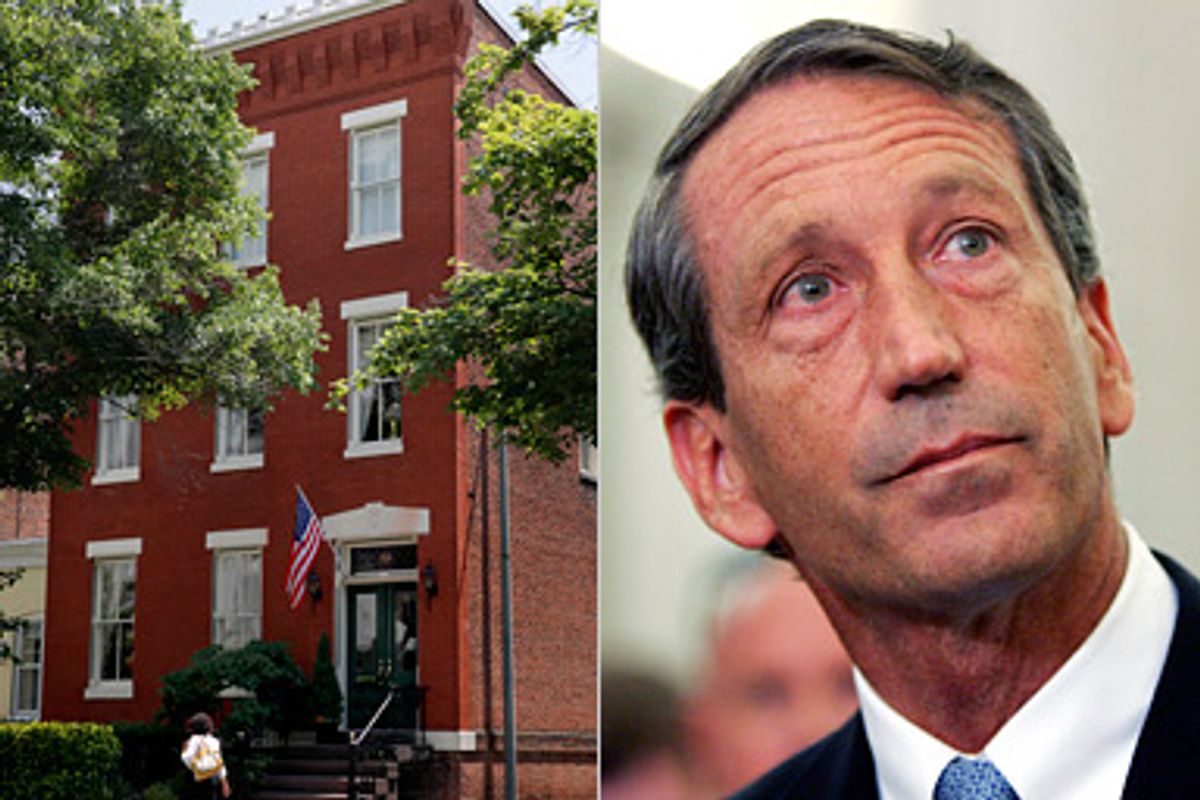
It's good to see Obama, Gates and Crowley meet, but they can't fix years of racism with a few beers
U.S. President Barack Obama (R) sits down for a beer with Harvard scholar Henry Louis Gates (L), Cambridge, Massachusetts, police Sergeant James Crowley (2nd R) and Vice President Joe Biden to try to start a dialogue on better race relations in the Rose Garden at the White House in Washington, July 30, 2009. Crowley arrested Gates for disorderly conduct in his own home July 16 while investigating a report of a burglary in process. Obama inflamed tensions by saying police had "acted stupidly," prompting him to back down from the remark.

Reuters/Jim Young
President Obama (right) sits down for a beer with Henry Louis Gates Jr. (left), police Sgt. James Crowley (2nd right) and Vice President Joe Biden in the Rose Garden at the White House Thursday.
Never before have so many cared about three guys having a beer. When the three are President Obama, his friend Henry Louis Gates Jr. and Cambridge Sgt. James Crowley, who jumped into the headlines when he arrested Gates at his home two weeks ago, well, the hype was unavoidable; in fact, the attention was the point. We were all invited to watch these guys try to drink 400 years of conflict away with a Bud Light, a Sam Adams Light and a Blue Moon (Joe Biden, a late addition to the guest list, had a Buckler, a non-alcoholic beer).
Did the “beer summit” provide us with one of those coveted “teachable moments”? Probably not, because many people seemed to be watching from behind their own racial barricades. Crowley defenders were angry their guy agreed to have a beer with two black men who accused him of at best acting stupidly, and at worst, being a racist. Gates defenders couldn’t believe Crowley’s being rewarded for what they considered racial profiling: When was the last time you screwed up on the job and got invited to have a beer at the White House?
Me, I didn’t change the way I thought about the Gates-Crowley-Obama mess, because I always thought it was incredibly complicated, and a happy-face beer summit couldn’t make the situation any less so. But I’m glad they did it. As I said last week, I wish Obama had refrained from directly commenting on the case, especially before he knew all the facts. I understood why Gates was angry, and assuming I now know the facts — still a big if — I don’t understand why he’d be arrested in his own home, even if he did give Crowley a hard time. Yet I wasn’t sure Crowley was being treated fairly, either; cops are on the front lines of all of our intractable race and class conflicts, and without knowing everything, I couldn’t say for sure he wrongly arrested Gates. (I also thought, and think, class played an under-examined role in the story of the working-class cop vs. the Harvard professor.)
So I was proud of Obama for admitting his words made a bad situation worse, not better, and happy the three found time to gather for a beer. Would that many other situations fraught with misunderstanding and the potential for real tragedy — guns, cops and black men have rarely led to a happy beer garden party — could end this way.
Now today I found myself labeled “the Magic Honky” by Rush Limbaugh, of all people, for what he imagines are my thoughts on the Gates case. (He didn’t read my blog post, of course.) Here’s what he said:
Joan Walsh, editor-in-chief, Salon.com, also known as The Magic Honky. The real racist is Ms. Joan Walsh, with her race-based materialistic — or maternalistic attitude toward black people, who have, in her small, little mind, no responsibility for their own actions. This flap over Gates and the cop, Sergeant Walsh [sic], happened as a direct result of actions and words, both Gates’ actions and Obama’s words. But that doesn’t matter a hill of beans to The Magic Honky, Joan Walsh, who sees blacks as perpetual victims in need of her white protections. She sees black people as needing to constantly be reassured by her that she understands that they understand that she is trying real hard not to be a racist.
Wait, am I “Sergeant Walsh,” or the Magic Honky? Is Rush confusing me with James Crowley because we’re both Irish? Silly of me to try to parse Limbaugh’s words as if they have meaning. In his addled mind, I am a liberal; therefore I’m a race traitor, and the complexity of my actual views on race and class don’t matter. I’m tempted to suggest that the president invite me and Rush over for some beer-garden diplomacy, but I like Obama, I wouldn’t wish that on him or me.
The fact is, nothing Obama says or does, about the Gates controversy or healthcare reform or the economy, will mute the racist haters. Limbaugh and Glenn Beck are using race to try to scare people — NPR featured a white man complaining that he heard Obama wanted to take his healthcare away and give it to minorities; I’ve even heard Obama’s reform plans described as reparations for slavery (an impractical idea now, but would that we’d done something meaningful 140 years ago). Clearly the beer summit won’t reassure racists, but I hope it showed some doubters Obama’s basic good nature when it comes to race. (It does sort of kill me that only six months in, Obama’s already having to remind people, “Wait! Remember, I’m the black guy you’d like to have a beer with! And Joe’s here too, so Skip and I won’t outnumber the white guys!”) But racial progress in this country is two beers forward, one beer back, so to speak. Obama’s racial views represent the future; Limbaugh’s are the past. I’m sure Jim Crowley would rather have a beer with Obama than with the radio blowhard.
What everyone gets wrong about Jeremy Lin
The NBA star does not transcend race. Instead of upending stereotypes, he owns them -- unapologetically
Jeremy Lin (Credit: Reuters/Adam Hunger)
Last week, I wrote a Salon essay about my experiences with racial bullying growing up in northern Minnesota; particularly, a pair of girls who decided to sing “ching-ching-a-ling” and pull their eyes into slits when they saw me in seventh-grade gym class. It was painful to write, and — from the responses I received — pretty painful to read, especially by anyone who had experienced bullying. Thus, it felt almost as if counteracting forces in the universe were acting to promote Jeremy Lin’s farm-team-to-bench-to-global-superstar ascent in the basketball world. Finally! Being Asian American was cool, not something to be bullied over.
I happened to be in New York at the apogee of Lin hysteria, and I stopped into a sports store near Times Square in hopes of scoring his jersey as a Valentine’s Day present for my husband. After swimming through a chaotic but amiable crowd, despite it being near midnight, I was dismayed to find only unwanted XXXXXXXL sizes. A clerk confirmed there were no more; in fact they’d just gotten their first shipment — and it had been decimated by feral shoppers.
Lin’s appeal has been decoded for two weeks now, and much of what has been said is true: As an Asian American, my ethnic pride has me following his career when I don’t even like basketball. He went to Harvard. A handshake with a teammate involves books, glasses and pocket protectors. One signature of his game is that he passes to teammates and makes everyone better; he isn’t a lonewolf showboater. Lin not only upends the nerdy Asian stereotypes, he owns them.
Yet I also hear white males unabashedly talk about weeping while watching him play. Other friends who, like me, don’t usually follow basketball know that he had a game on such-and-such night and scored more points that Kobe Bryant. The sports-store crowd in which I was displaying my Tae Kwon Do shopper skills was decidedly multiracial, multi-generational, multi-aged. We all want our Lin.
No athlete of late — particularly an Asian American athlete — has caught our American imaginations like this. To be Lin-spired is to watch Jeremy Lin on the court and want a little bit of that for yourself — you don’t want to be him, necessarily, you want to be a little more yourself. That’s why, as opposed to the recent editorials crowing the tired, ready-made (and implicitly condescending) narrative that he “transcends” race, the reality is quite the opposite. He’s not an Asian American Tim Tebow. His appeal comes from his unapologetic owning of who he is, whether that encompasses being Taiwanese American, a baller, a Harvard grad, economics major, a Christian, a nerd. He projects his specific Lin-ness with such grace and aplomb, it’s impossible not to be a little awed by that, to want a little Lin-spiration for yourself.
As a person who shares little of the above (just the nerdiness and the economics major) with Lin, when I watch him play, something deep inside me resonates, almost as if I am the one leaping like a gazelle and whisking in a three-pointer in the nail-biting last seconds of a tied game. This is I, graceful, unpressured, even as a person who cannot tie my shoes properly if someone is watching me.
What ties me to Lin is seeing that he is doing what he is good at and exactly what he wants to be doing. Which is what we all strive to do. Watching the ferocious joy — and the peace — that suffuses his face as he plays, this is the same feeling I have when I, a professional writer, am writing a great sentence. Flannery O’Connor, when asked why she writes, explains, “because I’m good at it.” What is life if not to find our purpose, our skill, pursue it, and to go for broke, as Jeremy Lin has done?
This week, the bloom is slightly off the rose. Not for Lin — he’s still on fire, still passing to his teammates. But deeply entrenched anti-Asian sentiments that lurk beneath the tectonic plates of society have to burp to the surface at some point (can we take a moment to remember that in the wide swath of American history, Japanese Americans were the only group ever to be interned on the basis of race/ethnicity?). There was ESPN’s sad and sadly predictable straight-from-the-bullies’-playbook “Chink in the Armor” headline about Lin done twice, both on its web site and spoken by an anchor. There was FoxSports.com’s Jason Whitlock’s “Some lucky lady’s gonna feel a few inches of pain” tweet, MSG’s airing the image of Lin’s head coming out of a fortune cookie, sportswriter Buzz Bissinger’s ingenious idea that Lin and Michael Vick should start a dog-meat (“Vietnamese-style”) restaurant, and the seemingly positive but still racially based “AMASIAN!” New York Post’s headline (just try substituting any other racial/ethnic group in there and see how that feels).
But ironically, these events have only strengthened the Jeremy Lin magic. He gracefully forgave the ESPN commentators, accepting their explanation of an “honest” mistake (while to me, it sounds just like my bully claiming she had amnesia during junior high and thus could not remember bullying me). Perhaps even more importantly, ESPN took it seriously, fired the headline writer and suspended the commentator. This is a seismic change for Asian America. It was in 1982 when Vincent Chin, a young Chinese American out for his bachelor party in Detroit ended up dead, pelted by racial epithets, his head bludgeoned by a baseball bat by some out-of-work autoworkers who were mad at Japan (“It’s because of you … that we’re out of work!”). The two murderers served no time, and were fined $3,000. It is easy for white males like Buzz Bissinger to say racial epithets are no big deal, that Lin continues to play well despite them — but racial epithets are only a verbal expression of the poison that exists inside.
I don’t necessarily feel ESPN hustled to punish the “Chink in the Armor” perpetrators out of a sense of racial justice, but even if not, Jeremy Lin, with his talent, popularity and his humanity has forced the people who cheer him on to acknowledge that he’s a person, as opposed to the way Asian Americans are so frequently seen as Wesley Yang wrote in New York magazine last year: “a mass of stifled, repressed, abused, conformist quasi-robots who simply do not matter, socially or culturally.”
I endured months of racial bullying, two girls to my one. It wasn’t until some “tough” girls took it upon themselves to stop the bullying, that I realized how pernicious my internalizing of the “ching-a-ling” trope. I thought I was ignoring the bullies, but what I was doing was not defending myself. By their action, the tough girls showed me I was worth defending. Just yesterday, as I have been continuing to muse publicly on the sad spectacle of racism following in the wake of Jeremy Lin’s rise, I received an angry note from a white man saying “Be like Jeremy Lin and GET OVER IT!” Now, I can tell him, yes, I try, but somehow I just can’t get over racism. Or having white men telling me how I should feel.
But perhaps Lin-spiration can help us see we are all special selves, worthy of nurturing, cheering on, and defending. Indeed, it might take you from thinking, “…I wish I were a baller… I wish I were taller…” to a place where you might find a little more joy in being yourself, just a little bit better.
The real problem with honoring Whitney
The uproar over Christie's order to fly the flags at half-staff was about race and gender, not drug addiction
(Credit: AP)
If any single political figure in America is a flesh-and-blood personification of a Rorschach test, it is Republican New Jersey Gov. Chris Christie. In almost every way, he raises vexing questions which ultimately say more about us than they do about him.
Is he, for instance, refreshingly authentic or just downright offensive? Is he regular-guy fat or too obese to be president? Is he a rare moderate Republican who is at least willing to discuss legalizing gay marriage or is he a standard GOP bigot who is deftly maneuvering to prevent such legalization?
How you answer all of these questions is a matter of political identity — your answers all but determine where you fall on the larger political map, and in the process, highlight your assumptions about a whole host of issues.
Now, in the wake of Whitney Houston’s tragic death, Christie’s done it again. By ordering his state government’s flags to half-staff to mourn the singer’s tragic death, he has ignited a heated national debate about who should — and who should not — be posthumously honored by the public. In the process, his move has provided a lesson in how dog-whistle politics works — and how the ugliest forms of bigotry still dictate so many Americans’ unconscious reflexes.
To summarize the details of this latest manufactured controversy, read the arch-conservative Washington Times’ writeup (emphasis added):
Twitter was abuzz Wednesday with reaction to the decision by Christie… In online postings, there were two main arguments against the honor for the Grammy Award winner who died over the weekend in California at age 48: One was that it should be reserved for members of the military, first responders and elected officials. The other was that it’s wrong to honor a drug addict.
Heather Clause, a Richmond, Va.-based blogger who writes about teen moms and was tweeting critical comments, said in a telephone interview that she was appalled by the planned flag-lowering.
“It’s just such a bad example for people,” said 23-year-old Clause. She said the decision was like saying if someone sings well, drug use doesn’t matter and “you can still be an idol.”
In upstate New York, Rebecca Eppelmann, a newspaper copy editor, also tweeted her disgust at the Houston honor, then discussed her views.
“It should be for major events,” she said. “It’s horrible that she passed away. It’s not something that should warrant this.”
Thankfully, Christie did the right thing and proudly stood by his decision, saying “I am disturbed by people who believe that… because of her history of substance abuse that somehow she’s forfeited the good things that she did in her life — I just reject that on a human level.” But that hasn’t stopped the backlash. In response to Christie’s alleged crime of honoring the dead, conservatives’ Fake Outrage MachineTM has rip-corded to life, generating the usual howls of heartland outrage — including a man who burnt a New Jersey flag in protest of Christie’s order.
Of course, when singer Frank Sinatra died and New Jersey’s flags were flown at half-staff, this kind of outrage was nowhere to be found — despite the fact that Sinatra himself was a drug abuser (the drug in question being alcohol). Likewise, the outrage was nowhere to be found when Elvis Presley died of a drug overdose in 1977 and flags all over America were flown at half-staff. Indeed, as the Rockford Register Star’s Chuck Sweeney notes, that event prompted an order for “all city flags in Memphis (to be) lowered to half staff”; compelled former President Richard Nixon to “ask Americans to fly their flags at half staff in honor of Elvis”; and got then-President Jimmy Carter to issue a statement saying, “With Elvis, a part of our country has died.”
What, then, explains the difference? Why would there be a hostile reaction to the way New Jersey memorialized the drug-abusing Houston, when there was no such hostile reaction to the way the drug-abusing Sinatra and Presley were memorialized?
The answer, of course, is rooted, in part, in racist and sexist double standards.
When famous white men engage in illicit activities, American culture allows them to nonetheless retain their street cred, their wholesome image and their public honor. In some instances, in fact, the illicit behavior contributes to their mystique and their legacy — it is seen as a cool part of who they are. This is exactly why one of the iconic images of Sinatra is him in a tux with a highball in his hand — because a white, male-dominated culture accepts — and even at times celebrates — the blemishes of fellow white men.
By contrast, when famous women — and particularly famous women of color — engage in the same behavior, the same swath of America that celebrates the Presleys and Sinatras often reacts with indignant disgust. Hence, the backlash to Christie daring to minimally honor Houston — a reaction that shows a white, male-dominated culture which accepts the imperfections of white males simultaneously refuses to accept the imperfections of “the other.”
Importantly, such a double-standard isn’t just amplified by men. In this case, some of those criticizing Christie’s decision are women. But that merely shows how pervasive the double standard really is — it’s so widespread and so accepted that it’s operating at a subconscious level across demographic divides.
To be sure, it’s fair to raise questions about whether any entertainer deserves the same form of state-sponsored memorial as soldiers, elected officials, first responders and other public servants. Such principled and necessary queries make us contemplate a culture that overly deifies famous people, regardless of why they are famous — and challenging that celebrity-worshiping theology is important.
However, if we are going to accept entertainers being recognized and memorialized by our civic institutions, then we ought to apply one standard. Either icons should be recognized regardless of their lifestyle choices, or they should not be recognized because of their lifestyle choices. Applying two standards to two sets of icons — and applying those standards selectively against women and minorities — converts solemn memorials of the dead into more ugly expressions of racism, sexism and other pathologies that still plague America.
“Key & Peele’s” edge-less, post-racial lie
A Comedy Central smash is too busy soothing white, liberal consciences to actually be funny
VIDEO
Jordan Peele and Keegan-Michael Key in "Key & Peele"
Comedy Central’s new sketch show “Key & Peele” (Tuesday, 10:30 p.m. Eastern) is neither funny nor daring. And since these are the show’s two goals, it has failed miserably.
“Key & Peele’s” deep flaws have gone unnoticed by the majority of reviewers, and I suspect this is due to the attractiveness of the package: Comics Keegan Michael Key and Jordan Peele are black folk who, like most white critics, want to move past race. In our sincere but hasty desire to actualize this mythical post-racist world, Key and Peele are the jackpot. Two light-skinned black men, middle-class in mannerism, who, like our black president, have white mothers. (It’s also been popular with viewers; the show was Comedy Central’s most-watched premiere since 2009, and was just picked up for a second season.)
On one hand, this is a genuinely good thing. The black experience is hugely varied, existing outside of the limited narratives typically shown in film, television and music. These narrow definitions play a destructive role in how the world sees black people and how black people see themselves. Key and Peele address this tension and frustration by juxtaposing black identities, their own and their characters’, with black caricatures in popular culture.
As the daughter of an African-American father and an Asian mother, I’m tempted to support their efforts. In theory it’s interesting for America to hear about the mixed experience. But “Key & Peele” is less about the complexities of navigating the often tricky multi-racial road, and more about the cheap humor of “White people talk like this,” and “Black people talk like this” — with black characters deciding whether they’ll talk white or black in a given situation. This premise is the basis of nearly every single sketch.
White talk / black talk is an old and lazy shtick. This “Simpsons” moment from 18 years ago mocks both the comedy and how eager white audiences are to embrace racial comedy that doesn’t address real racism:
Homer watches a black comic’s stand-up routine:
Comedian: Yo, check this out: black guys drive a car like this.
[Leans back, as though his elbow were on the windowsill]
Do, do, ch. Do-be-do, do-be-do-be-do.
Yeah, but white guys, see, they drive a car like this.
[Hunches forward, talks nasally]
Dee-da-dee, a-dee-da-dee-da-dee-da-dee.
[Audience howls with laughter]
Homer: Ah ha ha, it’s true, it’s true! We’re so lame!
Key and Peele do have a few funny moments that show genuine potential for great comedy. The “Lunch With Greatness” sketch in which black actors playing Malcolm X and Martin Luther King Jr. fight for the audience’s approval is one of their funniest. But the show’s largest flaw is its preoccupation with translating a particular black experience for liberal white sensibilities. Its eagerness to avoid offense hangs over every tepid sketch about race, sketches already laboring under excessive gentleness and lack of imagination. In each sketch black people are impeded by their own blackness, or more specifically black men cling to an idea of black masculinity, one that Key and Peele suggest is a needless performance.
Look at the following sketches from the first three episodes. Each either attempts to make a certain black masculinity look ridiculous or show the “true” blackness hidden by blacks operating in a white world.
Vain slaves at an auction:
Black traffic reporter:
Black man in doctor’s office:
Key and Peele never show the reasons behind the performance of whiteness or blackness, and this is why the show is politically problematic and far less funny that it could be. On “Key & Peele,” racism isn’t a real or serious threat. All white people mean well, and the burden is now on black folk to figure out how to behave and adapt. The only sketches that are explicitly about racism are historical and the only racists in the first few episodes are Nazis and slave owners. This makes the black characters seem like fools and the result is a show that makes fun of blacks in a way white liberals will allow themselves to enjoy, under the guise of “talking about race”.
This is the defining difference between “Chappelle’s Show” and “Key & Peele” (which in its staging and presentation is straining to position itself as Chappelle’s successor). But Dave Chappelle didn’t care about offending whites or avoiding truly painful moments or topics, and that’s why he was funnier.
In a recent interview, Jordan Peele said:
“Keegan and I, we’re pretty good, I think our personal taste and our personal sense of adventure doesn’t go too much across this line, we don’t like to make fun of victims. We like to make fun of hypocrites, of bullies.”
But who exactly are the bullies in “Key & Peele”? Judging from the majority of their sketches, the main oppressive force the duo faces is a certain notion of blackness, particularly black masculinity. The pressure to conform to race appropriate behavior does exist. Many people of color are familiar with accusations of “acting white,” but this pressure is a symptom of the larger problem — that they are living in a racist world full of racist ideas and are negotiating their own identification with or against that society. The most powerful comedy is based on pain and discomfort. Patrice O’Neal’s comedy on race for example, is incredible. But Key and Peele fail to ever address the violence of racism, literal or figurative, and this timidity leaves their material lifeless.
Unless you are Bill Cosby (who avoids race almost completely), comedy without bitterness, venom or pain, is no comedy at all. Key and Peele have the grit of a cotton ball. What does it mean that in order for two black comedians to get rave reviews, they must be stripped of the very weapons that are the essence of comedy? One even looks like Elvin from “The Cosby Show” — that’s the level of non-threatening that this show is operating on.
If they’d only take off their kid gloves, they might actually make comedy about race that feels real.
Rooting for your own kind
Jeremy Lin shows that we like to cheer for people who look like us -- and there's nothing wrong with that
Why so excited? (Credit: Reuters/Mike Cassese)
Lin-sanity has broken out all over the world. The kid nobody in the NBA wanted, from an ethnic group about as associated with the NBA as bullfighters are with People for the Ethical Treatment of Animals, had just broken Shaquille O’Neal’s league record for the most points in his first five games as a starter. Adoring fans are holding up signs saying “To Lin-finity and beyond.” The Lin-ternet has broken under the strain of millions of tweets, many of them featuring even worse puns than “Lin-ternet.” Sports Illustrated put him on its cover.
And, of course, Asian-Americans are going wild.
I’m one of them. As a half-Japanese, half-white ex-jock, I’ve always followed and rooted for that tiny number of Asian-Americans who make it in any of my three favorite sports, the all-American Big Three of football, basketball and baseball. (There are lots of Asian baseball players, but not many Asian-Americans.) Half-Japanese players get even more points. The triumphs of Olympic speed skater Apolo Ohno had me feeling my half-breed oats. And when former Giants’ hurler Atlee Hammaker, a hapa like me, melted down in the 1987 playoffs, my inner mulatto got a lot more tragic.
There’s no great mystery why I root for Asian-American jocks. It’s the same reason any member of a minority group pulls for one of their own: racial pride and solidarity. There are so damn few of “us” in the big leagues (I’m an “us” with an asterisk) that when one makes it, it’s cause for celebration.
The first thing to note about Lin-mania is that America is basically just fine with it. The mainstream media features photos of Asian fans wearing Lin T-shirts and runs stories in which they are quoted as expressing racial pride. It is all deemed benign and heartwarming, a multicultural Cinderella story in which everyone wins. The Asian kid overcomes impossible odds and racial stereotypes – if white men can’t jump, Asian men are not even supposed to be able to hop – to make it in the NBA. Horatio Alger meets the Statue of Liberty in the land of the melting pot.
But race is such a minefield in American society, and honest conversation about it is so constrained by politically correct politeness, that even the Lin story makes people tongue-tied, as if they thought that admitting that yes, people root for players because of their race would cause the Ku Klux Klan to rise again.
Case in point: an ESPN panel’s reaction to boxer Floyd Mayweather’s now-notorious tweet in which he said, “Jeremy Lin is a good player but all the hype is because he’s Asian. Black players do what he does every night and don’t get the same praise.” The latter part of Mayweather’s comment, implying that black players are not praised the way Lin has been because of racism, is a total crock, another one of Mayweather’s heavy-handed attempts to provoke a race controversy. But his comment that the hype over Lin is because he’s Asian is clearly true. Not all the hype, but most of it – and the most interesting part of it – is precisely because Lin is Asian. Does anyone think SI would put Lin on the cover if he were black or white?
This is so obvious that it strains credulity to think that anyone would even try to dispute it. And yet when four panelists on ESPN’s First Take were asked to comment on Mayweather’s comments, only one of the four, Bomani Jones, was able to forthrightly acknowledge it. Absurdly, sports reporter Beto Duran actually denied that Lin’s race had anything to do with the hype, saying it was simply because “he’s balling.” Eventually, they all admitted that race played a role in the hype, but their reluctance to go there spoke volumes about how radioactive all discussions of race in sports continue to be.
And the Lin story is the most non-threatening possible race-in-sports story, one involving a societal minority group that is also so underrepresented in the NBA as to be positively exotic. If America has trouble admitting that it’s OK for Asians – or members of any other race, for that matter – to root for Jeremy Lin because he’s Asian, just imagine how it deals with the issue of white people rooting for athletes because they’re white. Even to suggest such a thing is considered way out of bounds.
But there’s nothing wrong with it. I’ve been doing it for years. And it’s completely racially innocent.
Just as the Asian part of me celebrates the unlikely success of Jeremy Lin, the white part of me celebrates the almost equally unlikely success of New England Patriot running back Danny Woodhead. Rooting for white players who break out of racial stereotypes is harmless. It does not mean rooting against black players or those of any other race. It’s fun. And I suspect a lot of other people do it, too.
I’m not talking about Rush Limbaugh and his followers, most of whom I suspect are bigots who are rooting against black players as much as they are rooting for white ones. (In a brilliant, half-crazy 2003 essay in the New York Review of Books, “The White Man Unburdened,” Norman Mailer argued that one of the reasons Americans supported Bush’s Iraq war was that so many reactionary white men needed to regain a masculinity threatened when their white sports stars were replaced by blacks.) I’m talking about people who are able to acknowledge the reality that white running backs and cornerbacks are almost as rare as Asian point guards, and are sufficiently free from racial uptightness or self-consciousness to root for them for precisely that reason.
I’ve never agreed with the quasi-official view, expressed in endless “diversity” seminars held by big corporations and piously promulgated in schools and universities, that everyone is to some degree a racist and needs to engage in constant Maoist “constructive self-criticism” to become more racially enlightened. That ortho-liberal view has always struck me as a sterile guilt-trip, a recipe for racial constipation that only breeds more racial animosity and misunderstanding. However, it does contain a grain of truth. Everyone is not a racist, but everyone is aware of race. Unfortunately, much of the time this awareness is lugubrious and heavy, both because of America’s long and painful history of racism and because we haven’t come up with any lighter ways of dealing with race. Sports offers one of those ways.
When I root for white NFL players like Danny Woodhead or retired New York Giants’ cornerback Jason Sehorn, or white 2004 Olympic 400-meter gold medalist Jeremy Wariner, I’m not rooting against black athletes. In fact, the very fact white running backs or cornerbacks or 400 runners are so rare is a testament to the sheer dominance of African-American athletes at those ultimate bad-ass positions. It just makes my white-boy self happy to have a few Caucasians in that Olympian company. It’s exactly the same attitude expressed by Charles Barkley when he says, “Steve Nash is one bad white boy.” Is acknowledging this really going to make Lester Maddox rise from the grave, baseball bat in hand?
I suspect that many of those white fans who do root for unlikely white stars are uneasy about acknowledging it for the same reason that they (rightfully) believe that only blacks can use the n-word. It’s the liberal racial double standard, which is predicated on the fact that racism, in particular bigotry against black people, is still very much alive. (Have you checked out the GOP primaries lately?) Charles Barkley is allowed to say “Steve Nash is one bad white boy,” but white people are not, because when they do, it could be construed as racism. White talk about race in America is governed by a priori semiotic censorship: Any statement that could be interpreted as racially suspect is ruled out.
This prior restraint on white speech makes sense in some areas. If someone goes around complaining that white people are all discriminated against and black people get all the breaks, and celebrates some white businessman for that reason, he’s either a fool, a racist or a demagogue. (See above comment about the GOP primaries.) But cheering for white running backs or cornerbacks is different. They aren’t discriminated against. It’s just that 99 percent of the time, they aren’t good enough to play the position. That’s a fact. And when they do make it, it’s fun to identify with them.
It would be stupid to make too big a deal out of this. It’s strictly lighthearted. It’s a holiday from racial politeness, a bit of benign tribalism. I don’t usually hold with tribalism, but we all have a little of it in us, and as long as it’s innocent, we might as well enjoy it from time to time. Besides, as someone who has covered three Olympics, I can attest that national tribalism trumps racial or ethnic tribalism. Every red-blooded American, of whatever race, watching the finals of the 4×100-meter relays at Sydney or Athens was for that moment an honorary black person.
And anyway, it’s all changing. When I saw Chinese hurdler Liu Xiang win the 110 meter hurdles in Athens, I knew that the world of sports would never be the same again. Races and ethnicities are mixing more and more, old athletic stereotypes are dying, and great athletes are popping up in the most unexpected places. Right now, the Jeremy Lin show has captured the world. Tomorrow, a black hockey player will challenge Wayne Gretzky as the Great One, or a heavyweight champion will come from Iceland. The infinite diversity of the human race is displayed in all its glory in sports, and there’s nothing wrong with appreciating every last part of it. Even if it means rooting for a bad white boy.
My debate with Charles Murray
His genetic fatalism made it hard to find solutions to the dangerous American class divide we both lament
Charles Murray
I debated Charles Murray today on WBUR’s “On Point” with Tom Ashbrook. You can listen to it here.
I shouldn’t admit this, but I almost didn’t review Murray’s “Coming Apart: The State of White America, 1960 to 2010.” I told my editors it was just a mashup of his two most infamous books, “Losing Ground” and “The Bell Curve:” Welfare programs make poverty worse, not better, and social support can’t help the poor and struggling rise up, anyway, because they’re low-IQ losers. Only in this book, Murray confined his analysis to poor and struggling white people, to defuse charges of racism that greeted his two earlier bestsellers. I decided to write about the book anyway, but I thought it would be of little interest except to wonky people like me.
What do I know? “Coming Apart” is No. 9 on the New York Times nonfiction bestseller list, and it’s been reviewed, with varying degrees of respect, almost everywhere that matters. The good news is, even on the right, some critics reject Murray’s fatalism. I practically never agree with the New York Times’ Ross Douthat, but in his review of “Coming Apart,” he acknowledges that finding “ways to make it easier for parents to manage work-life balance when their kids are young” might help working-class families stay together, and maybe even more important, that “high incarceration rates” are to blame for the shortage of men in low-income communities. Douthat and I found some common ground there, thanks to Charles Murray.
David Frum, a conservative with whom I agree more frequently, wrote a magisterial five-part takedown of Murray’s book here. Frum writes about something I’ve been harping on lately: the way government worked to create the American middle class after the twin shocks of the Great Depression and World War II. He notes that the so-called greatest generation was also “the statist generation,” and ties the troubles of the white working class to the decline of industries as well as policies that once provided it with security and economic mobility. Contrary to Murray’s depiction of a golden, harmonious age of unfettered capitalism, Frum shows that it wasn’t unfettered capitalism that created the mythical middle class; it was quite fettered capitalism.
I winced at one line in Frum’s review, though, and that’s when he noted that he still admires “Losing Ground.” I’m not sure how Frum can be so right about “Coming Apart” and so wrong about “Losing Ground.” Murray’s 1984 work held that poverty programs were to blame for worsening poverty, since they supposedly rewarded indolence and punished two-parent families, and he paid special attention to rising rates of welfare recipiency and single parenthood in low-income black communities. Since then, we sponsored a massive social experiment based on Murray’s claims: We ended welfare as we knew it, requiring that recipients either work or engage in serious job training and capping eligibility at two years consecutively and five years lifetime. While it may have (briefly) looked as though welfare reform encouraged industry in the underclass, more poor people got jobs in the 1990s largely because there were more jobs for the getting: 22 million were created in the eight years of the Clinton administration. Those trends have since reversed, and all the while rates of single motherhood continued to climb. Murray was as wrong about black families in 1984 as he is about white families today.
“On Point” host Tom Ashbrook did a great job parrying Murray’s claims, but we didn’t spend much time discussing Murray’s genetic fatalism. This book continues where “The Bell Curve” left off: It warns that the nation is splitting into a highly educated, highly privileged elite (the residents of his composite “Belmont”) and an increasingly large lower class (the denizens of fictional “Fishtown”). At bottom, though, Murray believes that the widening gulf is due to modern society finding better ways to identify and reward the highly intelligent among us. And since IQ is “intractable” – Murray no longer uses the words “genetic” or “innate” – the various ways we decide to structure society and create opportunity won’t make much of a difference. As I come from a people – Irish Catholics – whose median IQ has climbed along with the opportunities provided to us, I know that Murray is wrong. IQ is not destiny.
I’ve written at length about my problems with the book, and with Murray’s attributing the success of America’s uber-class to their industriousness and religiosity along with their superior intelligence. I don’t need to rehash it. But in preparing for the debate I found an interesting exchange in an online chat hosted by the Wall Street Journal that displays Murray’s thinking on these issues even more clearly than his carefully phrased and (slightly) nuanced book does. One reader asked whether predatory banking conditions in low-income communities might play a role in their unraveling, and Murray quite simply said no.
We’re talking about IQ more than culture. It helps to be living in a neighborhood where smart actions about money are common, but the main breakdown is IQ. Lots of smart people in Fishtown do the right thing, but (politically incorrect warning) there are more smart people in Belmont than in Fishtown.
If you’re looking for a quick synopsis of “Coming Apart,” you’ve got it right there.
Murray closed our debate by telling Ashbrook that he’s pessimistic about reversing these trends. I said I’m optimistic. I joked on Twitter today that my (almost finished) book is a rejoinder to Murray’s pessimism. Maybe I’ll call it “Coming Together: How the White Working Class Woke Up and Realized the Right Now Thinks They’re Dumb and Lazy, Too.” Given the role of race and racism in dividing the Democratic Party, I believe the naked class bias of the GOP might help white working-class voters see that by voting Republican, they’re dismantling the opportunity society that once made success more widely possible.
Page 1 of 73 in Race
Is a Greek debt default still inevitable?
Birth control: The right’s still winning
How Viola Davis took Meryl Streep’s Oscar
Bathrooms: the new transgender battleground
Our nation of moaners
A very pornographic Rick Santorum
The death of chick lit
The futile search for meaning in “Linsanity”
Gidra takes on the American war machine
What can primates feel? 

