Director Park Chan-wook talks about his delirious, dark-comic "Thirst" -- this year's other, better vampire romance
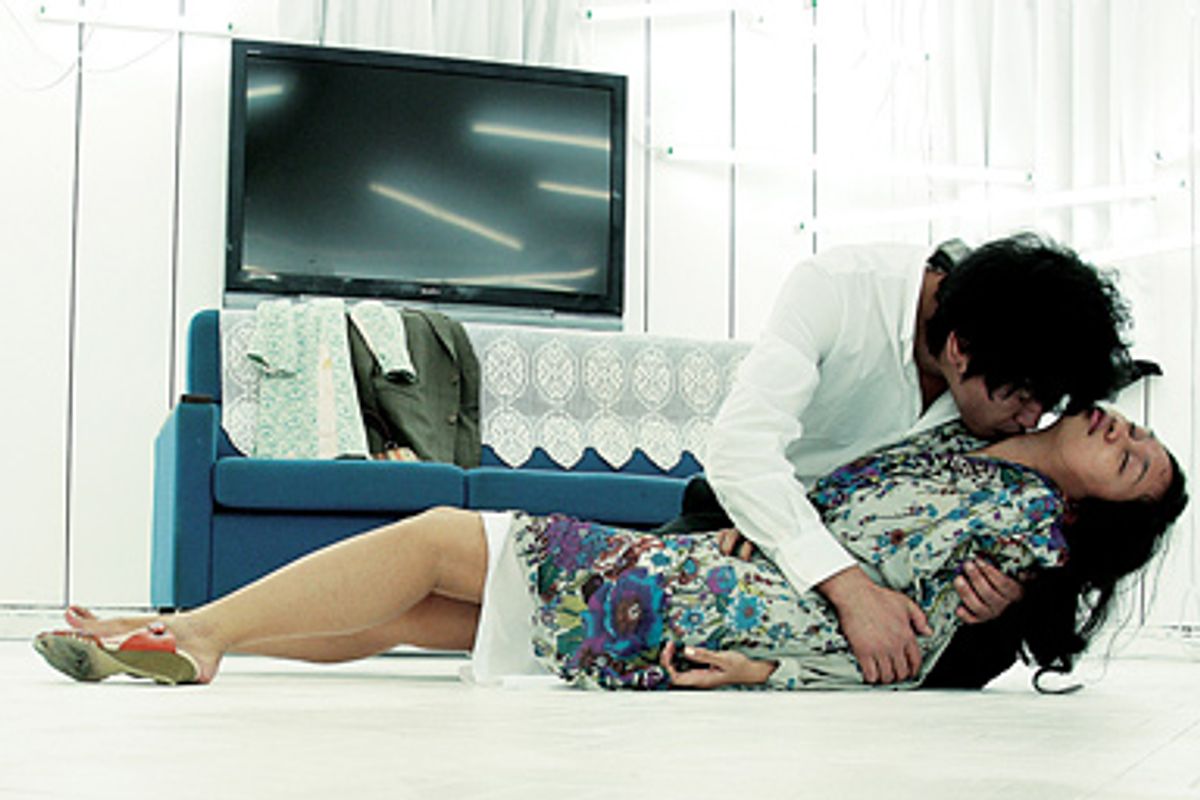
Song Kang-ho (left) and Mercedes Cabral in "Thirst."

Focus Features
Song Kang-ho (left) and Mercedes Cabral in “Thirst.”
Hey, I know — you can’t wait for that new vampire love story, right? The one with the handsome, tormented stranger who sees the inner beauty of that mousy Cinderella chick. He loves her intensely, so much so that even though he must drink human blood to live, he constantly fights against the impulse to pull her into his undead world of darkness and suffering. Well, here it is.
OK, this one is in Korean, which maybe you weren’t expecting. And its vampire hero is a Roman Catholic priest, which admittedly might not go down big with the family-values crowd. It comes with a heavy dose of religious guilt, some bizarre sexual slapstick involving a leering, drowned ghost, unpredictable explosions of violence and a black-comic satire of middle-class family life. It’s called “Thirst,” and it’s partly based on Emile Zola’s 19th-century novel “Thérèse Raquin,” of all things. Its cinematic daring, narrative wildness and, yes, full-throated romance make it the best vampire love story of the year. (If you’re over the age of 14, that is.)
Winner of the Jury Prize at Cannes earlier this year, “Thirst” is the newest (and in some sense oldest) film from Korean director Park Chan-wook, who almost single-handedly seems to embody this decade’s prodigious East Asian cinematic renaissance. Best known for the “Vengeance” trilogy, a series of interconnected, ultraviolent, moral fables that included the international cult hit “Oldboy” — which a few media hysterics briefly, and irresponsibly, linked to the 2007 Virginia Tech massacre — Park has already become a singular figure in film history. It’s difficult to think of another director who’s been so widely embraced by the global art-cinema scene and by horror-thriller genre buffs. Hitchcock? Kurosawa? Roman Polanski? Quentin Tarantino? Maybe if you Cuisinart those guys together and ferment the mixture in the cultural hothouse of contemporary South Korea, you get Park Chan-wook.
Even in jest, such a formula seems like diminishing an artist, and Park is very much his own creation. Both in person and in his films, Park comes off as completely committed and sincere. He hasn’t made a movie about a selfless priest who dies of a horrible skin disorder after a failed medical experiment, only to be reanimated as a vampire who seems to have supernatural healing powers, and who then embarks on a doomed love affair with a bitter and lonely middle-class wife — all while trying to square his bloody and sinful existence with his abiding faith in God — out of some jaded, meta-B-movie impulse. If “Thirst” can be described as a wild, nearly crackpot assemblage of different kinds of stories, they’re all addressing a set of basic human questions about love, sex, violence, guilt and redemption that have preoccupied Park throughout his career.
I think “Thirst” is a brilliant and gruesome work of cinematic invention as well as a passionate and painful human love story. Park is so often celebrated as a stylist — some of the credit should go to his cinematographer, Chung Chung-hoon — that people don’t notice how wonderfully he works with actors. The central couple in “Thirst,” leading Korean star Song Kang-ho (who plays the priest) and one-time beauty queen Kim Ok-vin, are marvelously matched as they veer from living to undead, from love to hate and back again. I’d qualify that glowing endorsement by saying that Park’s risk-taking doesn’t always pay off. “Thirst” goes on too long, drags in places, and can’t always manage its unstable balance of horror, romance and comedy. When the result is a daring crazy-quilt of a movie that’s not quite like anything you’ve ever seen before, I’ll take it.
I met Park Chan-wook at his midtown Manhattan hotel during his recent American visit. Sober and soft-spoken, dressed in a turtleneck and suit jacket, the 45-year-old director could pass for your average visiting Asian businessman. Although he appeared to understand my questions in English, he responded through an interpreter. This might sound implausible if you haven’t seen his films, but Park is a major classical music buff. He told me his principal regret about his brief New York stopover was that he had no time to catch a concert at Carnegie Hall. “I walked by there yesterday, and there were so many posters on the walls for artists I admire,” he said. (Indeed, a Bach cantata forms the basis for the score in “Thirst.”)
Mr. Park, your reputation in the United States is mostly as a director of violent thrillers or horror films. Is that how you think of yourself?
Well, it would be hard for me to say that I’m a horror film director. But it would be equally hard to say that there’s no violence in my films. Of course I would like to emphasize that there are many other elements in my films, and I would also like you to think about how I use violence in my films. It’s not about a release. If you watch these films just for the sake of violent release, it isn’t there. There is no big, beautiful, violent gunplay. I don’t try to make violence look beautiful. Just because there are scenes of violence in my films, you can’t lump my films together with every other film with violent scenes. In a sense that is a violence of categorization.
Now, “Thirst” is being called a vampire film, which I guess it is. But isn’t that an inadequate way of describing a movie that covers so much narrative territory and so many different styles and moods?
That’s true, but also, when you think about all the genre names, they never manage to represent everything that’s in a film. It would be grossly inadequate to call “Brokeback Mountain” a western. Even if you add another word and say it’s a gay western, it still wouldn’t adequately describe the film.
I understand you’ve been planning “Thirst” for many years, since before the “Vengeance” films and even before you made “Joint Security Area” [the film that first brought Park international attention in 2000].
Yes, I started thinking about this film 10 years ago, but not every story element was there. And it’s not as if I was thinking about it constantly for 10 years. The first things that came to me one night were the first sequence, how the priest becomes a vampire, and the climactic sequence, in which the woman who is his lover becomes a vampire. The rest of the story was blank to me.
Then one day I came across a book called “Thérèse Raquin,” and the details of that story started to fill in the gaps left in my vampire story. That’s when I started to write the script properly. It hasn’t actually been that long since then.
Maybe the influence of that Zola novel explains this, but “Thirst” strikes me as a romance more than anything else. Yes, it’s a violent and bloody vampire story, it’s a story about religious faith and it’s an erotic story. But first and foremost it’s a romance, it follows the arc of a love affair between a man and a woman.
Yes, that’s actually one of the most important elements. It’s as important as the religious aspect, or the vampire aspect. So much so that I contemplated calling it a “vampire romance” when we were trying to categorize the film. If we had called it that, it might be too reminiscent of something like “Twilight.” [Laughter.]
That might not be a bad thing.
Then I wondered whether I should call it a”vampire romantic comedy.” No, I couldn’t really do that.
You mentioned the religious element of the story. Why was that important to you? Is this the story of a priest who loses his faith?
Well, you could view it that way, that the main character loses faith, but in another light he really doesn’t. This character very much tries to make an effort to bridge his faith and his identity as a vampire, to try to bridge these two opposing ideas. It’s important to see that he makes that effort. It’s almost impossible to mix these two concepts in the human brain, in any logical way. In order for him to preserve his faith and at the same time suck the blood of other people — or to commit suicide — all of it goes against his beliefs. At the same time, he tries to reconcile these aspects of himself. This desperate attempt, this struggle to make sense of these two opposing ideas, is the backbone of this film. It provides the energy for it to move forward, and the comedy is born out of such efforts.
Your two leading actors, Song Kang-ho and Kim Ok-vin, have wonderful chemistry together. Sexual chemistry but also a very complicated emotional chemistry, which is more important. I understand they collaborated with you a great deal in creating the film.
Yes, but I don’t want to talk about only those two actors. I’d also like to talk about Shin Ha-kyun, who plays the husband of Kim Ok-vin’s character. I’ve worked with both Shin Ha-kyun and Song Kang-ho since “Sympathy for Mr. Vengeance” [the first film in the "Vengeance" trilogy, although released second in the U.S.] and the three of us are best friends. Kim Ok-vin is a relative newcomer to the mix, but the four of us spent a lot of time together, reading the script. We made excursions to rural areas and camped out. We met up often to go drinking. We did that countless times! [Laughter.] Throughout this process we developed a bond, like brothers and sisters, like family members. In those sessions we had lots of discussions, lots of debate about the characters. That was the foundation on which those characters were built.
“Thirst” is now playing in New York, Los Angeles and San Francisco. It opens Aug. 14 in Chicago, Honolulu, Seattle, Washington and Austin, Texas; Aug. 21 in Boston, Portland, Ore., and San Diego; Aug. 28 in Denver, Detroit and Philadelphia; and Sept. 4 in Atlanta, Baltimore, Minneapolis and St. Louis, with more cities to follow.
Why is Hollywood still terrified of abortion?
Forty years after Roe, abortion's so traumatic in films that it leads to suicide -- and teens deliver half-vampires
Kristen Stewart in "The Twilight Saga: Breaking Dawn - Part 1"
Of course Bella would keep Edward’s baby. Dammit, she loves her sparkly vampire husband. She doesn’t care about the concerns of her family and friends, their pleas that she consider the risks of carrying a hellspawn to term. Like Julia Roberts’ saintly, ill-fated Shelby in “Steel Magnolias,” who pursues a pregnancy because she “would rather have 30 minutes of wonderful than a lifetime of nothing special” (and subsequently dies for it), Bella knows it’s her body, her choice. And a “Twilight” franchise dreamed up by a nice Mormon lady isn’t going to include a scene of newlywed, saved-herself-for-the-wedding night Bella trotting down to Planned Parenthood for a quickie D&C. No, her devotion to life is so great that it extends to life that isn’t even quite human.
Authentic to its characters as it may be, the gruesomely traditional blockbuster “Breaking Dawn” illustrates an unavoidable reality of contemporary cinema — that whether you’re in the mysterious realm of vampires or the corridors of power, normal, untraumatic abortion barely exists. Consider the movie offerings of just the past few years. In “The Last King of Scotland,” a clandestine attempt at abortion leads to a harrowing murder. In “Waitress,” Keri Russell hates her life and her abusive husband, but plunges on with an unwanted pregnancy. More recently, in George Clooney’s “The Ides of March,” a pregnancy and hush-hush abortion lead to a tragic suicide. And in “Crazy Stupid Love,” middle-aged Steve Carell’s Cal admits he and his estranged wife got married in the first place when she became pregnant – because apparently the option of not being pregnant never occurred to anybody. As Stephen Farber noted last year in the Daily Beast, movies like Ben Stiller’s “Greenberg,” which depict abortion as a matter-of-fact reality of many women’s lives, are few and far between.
When abortion does turn up in the movies, it’s likelier to be in the context of a riskier, more dramatic time and place, a gambit known to cinephiles as the “Dirty Dancing” plot device. Mike Leigh’s “Vera Drake” gave us a reassuring, pre-feminist abortionist in postwar Britain. Lasse Hallstrom’s “Cider House Rules” was a similarly nostalgic take on that whole bygone, “girl in trouble” era. And “4 Months, 3 Weeks, and 2 Days” offered abortion as, in the words of Salon’s Andrew O’Hehir, a “carefully plotted thriller” in ’80s-era Eastern Europe.
The surplus of movie and television pregnancies can’t all be attributed to some great Mormon conspiracy, though. An abortion is an action. A baby is a whole story line. “Juno” wouldn’t have had a whole lot going for it if the Ellen Page character had ignored her classmate’s warning that her fetus already had fingers. And had “Knocked Up” gone in the direction of what one character describes as “rhymes with smashmortion,” it would have been 15 minutes long.
Yet it’s hard not to note a not-so-faint whiff of judgment in all the tiptoeing around a procedure that 40 percent of American women undergo in their lifetimes. Sure, two-thirds of unwanted pregnancies in real life end up in abortion, but cinematic women who do it tend to wind up dying. Those who carry to term, meanwhile, are plucky heroines. And it’s not just the movies. Consider the entire premise of “American Horror Story” – a show that hinges on the rampant evil unleashed because an L.A. doctor did abortions in his basement back in the day. In present time, meanwhile, our brave heroine Vivian is continuing her pregnancy despite the fact that at least one of her babies apparently has hooves. Come on, even fans of “Personhood” amendments would give that one a pass.
Without her plot-enhancing, eminently true to the character pregnancy, Bella Swan would not be the Bella her fans have come to know and love. But until our entertainment broadens out and reflects our reality, abortion will be viewed as an aberration instead of the commonplace reality it is. Not every pregnancy winds up with a baby — even a half-vampire or Antichrist baby — in a woman’s arms, nor every abortion with a bloody corpse in a back alley. Safe, legal smashmortion happens. And nearly 40 years after Roe v. Wade, it’s absurd that supposedly progressive Hollywood remains so backward about acknowledging it.
“Breaking Dawn Part 1″: Bella Swan, demon mama or Christ figure?
In a gory, porny penultimate chapter, all the sexual perversity of "Twilight" comes bubbling through the cracks
Robert Pattinson and Kristen Stewart in "Breaking Dawn"
“How badly are you hurt?” murmurs studly but ethereal vampire Edward Cullen (Robert Pattinson) to his human bride, née Bella Swan (Kristen Stewart), on the morning after their wedding night. No no no no — it’s not what you’re thinking. Edward’s superhuman and indeed inhuman strength has left Bella’s arms and torso covered with bruises (and, infamously, has shattered the headboard above their bed). Devotee of the union of Eros and Thanatos that she is, Bella digs it, and wants more. Being a man, albeit an undead one, Edward has second thoughts about the whole thing now that he’s gotten what he came for, and spends the rest of their honeymoon on a Brazilian tropical island shying away from Bella, or playing chess with her. Which is a metaphor for, you know, sex or war or something. Or maybe not a metaphor at all but just chess, played by two people who self-evidently don’t know how to play, with a strangely large and silly set of chessmen.
Mind you, “it’s not what you’re thinking” is kind of the situation in general with “The Twilight Saga: Breaking Dawn Part 1,” a movie that masks its genuine perversity under layers of artifice and saccharine melodrama. I truly do not mean that as a criticism. To my taste, savvy Hollywood veteran Bill Condon (“Dreamgirls” and “Gods and Monsters”) debuts as director of the two-part “Twilight” conclusion in satisfying fashion, delivering a voluptuous if often inert spectacle that splits the difference between high camp and decadent romance. (This opinion may not be widely shared.) We will in fact see Bella bleeding copiously later in the movie — there’s a startling amount of gore, as well as an overripe, nearly pornographic sensuality, to this PG-13 film — as the direct, if delayed result of her deflowering by Edward. See, he has impregnated her with some kind of succubus-like demon child, which is impervious to the science of humans and vampires alike and poses an intriguing challenge to the pro-life, family-values fantasy universe of “Twilight” author Stephenie Meyer. Does life begin at conception even if it isn’t entirely human?
I have other logistical and/or theological questions that “Breaking Dawn Part 1″ cannot quite answer. I suppose it makes sense that vampires possess the power to block or distort caller ID, since in one scene Bella calls her pining dad — the young, single and handsome one played by Billy Burke, whose relationship with Stewart’s Bella has always had a Freudian undertow — from across town, pretending she’s in Brazil or Switzerland or something. But Bella and Edward are apparently married by some kind of priest or minister, and I can’t get my head around that one at all. Holy matrimony plus undead monstrosity — does not compute! Either they’re not telling the dude any version of the truth (and in that case are also lying to God), or the officiant’s got nothing to do with any Christian denomination I’ve ever heard of, and in either case the whole wedding, rendered in such sugary detail you can almost taste the cake icing, is a hypocritical sham. I could insert a Mormon gag here — but I’m no bigot! Not gonna go there!
I recognize that as a member of the educated upper middle class, and a man to boot, I’m supposed to feel outraged and horrified by “Twilight” on various levels. I’ve never seen the point of that. I haven’t read Meyer’s books and don’t intend to, but the Twi-movies so far range from mediocre teen horror to outrageous pulp melodrama, a combo I’m perfectly happy to absorb. This beginning-of-the-end chapter is without doubt the most momentous episode in the saga, and not just because Edward and Bella consummate their relationship (a risky narrative maneuver in any love story). In rapid succession, Bella gives up literally everything: her girlhood, her virginity, her childlessness, her life itself and even her humanity. Rarely have the metaphorical transformations of horror fiction been carried to such rococo extremes. Is this a story about a young woman coming of age or a deviant, heretical Christ legend with a female hero? If you’re going to wring your hands and insist plaintively that Meyer intended no such thing and that director Condon and screenwriter Melissa Rosenberg (who has handled an impossible task gracefully) have remained faithful to her vision, I shall nod sagely and say, of course, of course, but no artist or author can ever fully control meaning and interpretation. And that’s really going to piss you off.
“Breaking Dawn Part 1″ definitely involves less action than the last couple of “Twilight” chapters, and a lot more shots of Bella lying on the couch looking like crap. Taylor Lautner’s American Indian-slash-wolf-slash-shape-shifter character, Jacob, spends most of the movie brooding in the shadows, now that he’s definitively lost Bella and been thrust in the role of chaste, vulpine protector. (There is a major Jacob-related plot twist late in this movie, as many fans will already know.) But a lot of it is absolutely ravishing to watch, in the manner of eating hot buttered corn with marshmallows and Champagne; a woman sitting next to me at the New York media screening was literally moaning out loud during the wedding sequence. There are some bizarre, Goth-flavored fantasy sequences that are better than anything in the first three films, notably Bella’s nightmare version of the wedding, in which everyone she loves is killed. Of course it’s Bella herself who will learn not to fear the Reaper, and prepare for her new undead life in “Breaking Dawn Part 2.” But not until after Edward sits her down, at long last, and tells her about all the guys he’s been with. Some of you think I’m kidding, don’t you?
“Abduction”: Taylor Lautner's chest gets a movie
Team Jacob obsessives may love it, but this fourth-rate "Bourne"-style thriller does the Twi-hunk no favors
Taylor Lautner in "Abduction"
Writing a review of “Abduction,” the new thriller designed as a star vehicle for “Twilight” hunk Taylor Lautner, is pretty much a free-fire zone. Lautner’s fan base — which I would presume to be young and female and interested in viewing his hairless and monumental chest — isn’t super-likely to read reviews before rushing out to see the movie. On the other hand, if you’re here reading this, the likelihood that you’re actually going to pay to watch “Abduction” is exceptionally low. So I can pretty much make up any damn thing without fear of contradiction: The sequence where aliens destroy the earth was pretty cool, but the B&D sex scene between Lautner and Sigourney Weaver was somewhat disturbing. Unless it was the other way around.
Yes, I’m desperate here. I’d really like to come up with some mildly contrarian take on “Abduction” — to report, perhaps, that Lautner is a self-effacing charmer who can dance, or that director John Singleton (long, long ago the auteur behind “Boyz n the Hood”) has reversed his long slide into hackdom and made an enjoyable “Bourne Identity” knockoff. Sadly, it’s impossible to fake the faintest enthusiasm for this picture, which is a fourth-rate Hollywood thriller that bungles a lot of thievery from better movies, is entirely bereft of suspense or excitement and features a leading man who absolutely, positively cannot act. I saw the film with an old friend who compared Lautner’s performance to that of Vanilla Ice in the legendary 1991 “Cool as Ice.” I can’t say, personally, but given that Lautner has considerable camera experience for a 19-year-old, his block-like impassivity and utter incapacity to register humor or emotion are remarkable. He spends the whole film looking smug or baffled, possibly smaffled.
Here’s what I can say for “Abduction”: It heightened my respect for the “Twilight Saga” movies, where Lautner is employed quite effectively as Jacob Black, the American Indian werewolf who relentlessly woos but will never win Kristen Stewart’s emo-tinged, virginal heart. Jacob is of course a doubly “other” character, capitalizing on the fact that Lautner looks both racially ambiguous and borderline inhuman, and I suppose Singleton and screenwriter Shawn Christensen had some vague idea of emulating that. In “Abduction,” Lautner plays a hard-partying Pittsburgh teen named Nathan, who discovers — while surfing the Internet, literally — that his parents aren’t his real parents and that both the CIA and some quasi-Slavic hoods (their background and nationality and motives are never clear) are looking for him. So Nathan hits the road with the girl next door (Lily Collins, rumored to be Lautner’s real-life squeeze) for a series of remarkably uninvolving chase scenes and supposed romantic interludes.
“Abduction” may win the 2011 prize for wasting good actors in absolute balderdash; we’ve got the aforementioned Sigourney Weaver as a psychiatrist and/or secret agent with a bouquet of balloons, Alfred Molina as a paunchy, lumbering CIA bigwig, and Swedish actor Michael Nyqvist (co-star of the “Girl Who …” movies) as the sinister but non-specific international bad guy. Nyqvist and Lautner have a nice scene sitting in the stands together at a Pittsburgh Pirates game, and I would have paid good money to turn the movie into some kind of sentimental father-son drama at that moment. Furthermore, Pittsburgh is a picturesque city, underutilized in American film, and here and there Singleton seems to wake up from his extended power nap and pay attention to that fact. There! I finally said something nice, and kind of meant it.
The emasculation of the modern vampire?
Would Don Draper really be a better vampire than the men of "True Blood" and "Twilight"? Madness
For bloodsuckers, does manliness matter?
Screenwriter Brian McGreevy did a guest stint on Vulture today with a diatribe on the emasculation of vampires in modern media, specifically in “True Blood” and “Twilight.” “True Blood,” at least, began with McGreevy’s ideal sexy/dangerous vampire — if not in Bill Compton, than in Eric Northman. Of course, now that Eric has lost his memory and Bill is playing at being a prissy little king, it’s totally reasonable for McGreevy to assert that these characters “have taken the Romantic vampire and cut off his balls, leaving a pallid emo pansy with the gaseous pretentiousness of a perfume commercial. We are now left with the Castrati vampire.”
Unfortunately, this argument smacks of chauvinism. McGreevy (currently adapting Bram Stoker’s “Dracula” for the big screen) blames this on a new, dangerous “female gaze” — as opposed to the misogynistic “male gaze” as defined by feminist film theorist Laura Mulvey in her essay “Visual Pleasure and Narrative Cinema.” The female gaze, he suggests, makes these non-threatening vampires “pornography for tweens.” When he asserts that “Mad Men’s” Don Draper is actually more of a vampire than any of the “True Blood” or “Twilight” characters, what he’s saying is that Draper is more of a man.
“It is a killer’s heart that is the motive force of masculinity and predation its spirit. This is not to suggest nature is immutable, or that one ought to act in blind obeisance to it, but that ‘ought’ is not in the vocabulary of want, and choosing is meant to have consequences.”
But one could argue that original vamps like Stoker’s “Dracula” and Max Schreck’s Nosferatu are way more emo than Draper: They both are obsessed and stalkerish with women they like, stay secluded from the rest of society instead of engaging in it, and are ultimately tragic figures because they are so sexy, yet so sad. And if we want to get technical about the timeline, Joseph Sheridan Le Fanu’s “Carmilla” actually predates “Dracula” by 25 years, and revolves around lesbian vampires. So maybe that “female gaze” will come in handy after all.
McGreevy is arguing for vampires who are manipulative, coldhearted Patrick Bateman types — charming sociopaths like the “American Psycho” character who understand the human morality structure and can play the game, but whose nature compels them to kill in order to live.
In that way, maybe there is one television character that would be less of a “Castrati” vamp than Edward Cullen or Bill Compten: Cersai Lannister from “Game of Thrones.” That soul-sucking pit of evil puts on a pretty face in public while using her sexuality to stay in power. Her only desire is to protect her progeny; behind closed doors, she engages in incestuous taboos. She knows what’s expected of her in public, but could care less once the curtains have drawn. “You win, or you die,” says Cersai about the game in question, implying that holding onto power is its own version of immortal life — and the mark of a true vampire.
Today’s must-see viral videos
Jay Leno loses his crowd, "Glee" knights itself into memehood, and we learn the true meaning of Independence Day
1. “Independence Day” on Independence Day
While most of us spent July 4th blowing up fireworks to celebrate our emancipation from the Brits, comedian Sean Kleier made us remember the true meaning of Independence Day by reciting Bill Pullman’s speech from the movie all over New York City.
2. “Glee” goes viral
The stars of the Fox musical stopped by Internet star Keenan Cahill’s to cover Katy Perry’s “Last Friday Night.“
3. Field of “NFL” Dreams
Taylor Lautner in a FunnyorDie video spoof of the Kevin Costner flick. Well, it’s nice to see those “Twilight” kids getting work these days.
4. Jay Leno bombs while talking about the Casey Anthony verdict
5. Harry Potter houses
You know, I always wondered what those Hufflepuffs were good for, anyway.
Page 1 of 7 in Twilight
Whose Wisconsin recall is it?
Can Greece thwart a complete meltdown?
Ruth Bader Ginsburg’s alternative abortion history
Inside Syria’s whirlwind of war
Syria’s looming threat of civil war
Santorum’s well-compensated love of fracking
The Tea Party’s war on mass transit
At the CPAC-Occupy beer summit
Whitney Houston’s lessons in love
Our non-withdrawal from Afghanistan 

