Food

The jiggle is back

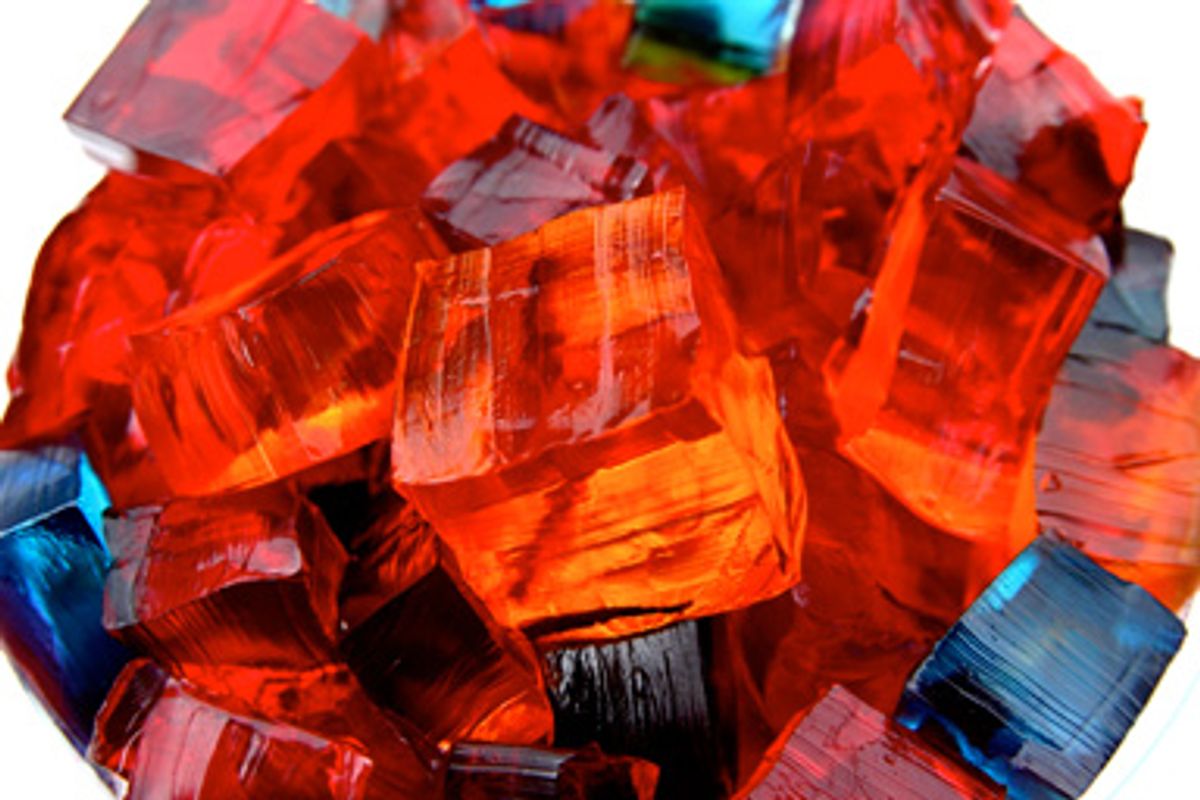
Jell-O is cheap, versatile and ridiculously fun. Could there be a more perfect food for a battered economy?

  • more
    • All Share Services

The jiggle is backThe jiggle is back

I am neither Lutheran, a lunch lady, nor a native of Utah – but I admit: I love Jell-O. Give me a wedge of quivering pink pie studded with sliced strawberries and ringed with a corona of whipped cream, or a pile of chilled coffee cubes to pop like caffeinated gumdrops. Watch: I’ll lick my spoon. I’ll giggle when they wiggle.

I come forward with this confession as a serious cook and without irony – because, well, it’s about time someone did. After decades of pretzel and marshmallow-strewn degradation, Jell-O (and its plain old unbranded sibling, gelatin) has served out its term as a culinary punch line. Let’s give the Rodney Dangerfield of desserts some respect.

Now seems like as good a time as any to start: Another August is well upon us, and thermometers around the country are finally nudging their way above 90 degrees. No one wants to soak through a T-shirt standing over a hot stove. Freezers are full of ice cream and Popsicles already, and the long days of late summer are prime time for a little cool-cooking experimentation. Not to mention, recession-minded penny pinchers: compared with single-origin chocolates or pistachio-saffron cakes, gelatin is both pretty and pretty easy on the wallet (At my local Met Food, a box of Jell-O retails for $1.09; Knox unflavored gelatin is $1.59. Pistachios are $7 for 10 ounces.)

I know: The specter of dozens and dozens of odiferous cafeteria lunches, countless cheerless hospital trays, and towering potluck salads of ectoplasmic lime Jell-O and mayonnaise is a hard one to shake. In the modern American cook’s imagination, Jell-O is inextricably linked to the Technicolor convenience foods and culinary disasters of atomic-era housewifery (allow me to present the Gallery of Regrettable Food). But Jell-O, and certainly gelatin, have been a part of the cook’s arsenal for much, much longer than 50 years, and rearview mirrors are notoriously distorting. Examples of sophisticated gelatin dishes can be found in some of our earliest cookbooks, and they were served with honor at the courts of Napoleon and the Medicis. Even more recently, one of my favorite kitchen references, the Women’s Day Encyclopedia of Cookery, a 12-volume guide published in 1966 that featured such esteemed contributors as James Beard and Nika Hazelton, devoted almost a dozen reverent pages to the subject, right between gâteaux and génoise. Its recipes include both the sweet and the savory – from a seafood cocktail salad (glazed with fresh tomato gelatin) to a lemon, fruit and white-wine jelly. Jell-O can be cool and seductive, a playful spectacle, and the ultimate culinary blank slate. Where’s the horror in that?

Indeed the story of Jell-O, like so many other classic American sagas, is a fable of inspiration, invention and fall from grace. For most of their history, gelatins (or jellies, as dishes made with gelatin are known) were strictly aristocratic fare. Their esteem was a reflection, in part at least, of the intense labor required to produce them. Just how hard was it? It helps to begin with some science: Gelatin is simply a hydrocolloid protein that can be extracted from animal collagen in tissue and bones. (Ever wonder what gives great homemade stocks their velvety feel? Yep, it’s gelatin.) High-quality gelatin is both odorless and flavorless; the proteins swell in contact with liquid, dissolve in warm water, and form a firm jelly when cooled. (Cooks today can create vegetarian jellies by substituting agar, a gelatin made from red seaweed, for one derived from animal bones.) But before the development and widespread availability of powdered gelatin, cooks had to collect bones and remove the gelatin themselves. Carolyn Wyman, the author of “JELL-O: A Biography,” describes the whole gory process, thusly:

First, you had to get two calves feet – scald them, take off the hair, slit them in two, and extract the fat from between the claws. Then you had to boil them, remove the scum, and boil them again for as long as six or seven hours – before straining, letting the product cool, skimming the fat, boiling once more, adding the shells and whites of five eggs [to pick up impurities], skimming again, and straining twice through a jelly bag that you would have had to make yourself [there being no Kmart].

Not exactly appetizing. Should it be any surprise that jellies were most beloved by those who could afford to foist the task of preparation on an army of hired help?

Nearly any liquid can be jellied, from fresh juices to meaty broths to spirits and wines – though a handful of raw fruits, including pineapple, papaya, figs, ginger and kiwis, contain an enzyme known as bromelain, which inhibits gelatin from properly setting. (That enzyme is destroyed during cooking and preserving, though, which is why you still see many Jell-O fruit salads studded with Dole pineapple chunks.) As early as the 17th century, chefs were creating dramatic, layered or “ribboned” jellies as dining table centerpieces – but during the Victorian era, with the invention of elaborate, architectural jelly molds, the art of gelatin cookery reached its rococo peak. Many dishes were as practical as they were beautiful. Gelatin was a popular method of preservation before refrigeration became routine, as a jelly encasement could cut off oxygen to food, inhibiting the proliferation of bacteria. In French fine cooking, jellied foodstuffs never fell out of fashion; to this day gelées and savory aspics are celebrated on their own and as a part of iconic dishes, such as pâté en croûte (in which a layer of gelatin and fat insulates the forcemeat terrine from its pastry shell). In Southeast Asia, almond milk Jell-O topped with sliced melon or lychee remains a warm-weather staple; and in Mexico and South America, no market or stall is complete without a refrigerator case chock-full of fruity, creamy or coconutty jellies.

Ultimately, though, like so many other tales, the story of gelatin cookery underwent a drastic reimagining on American shores. The first U.S. patent for a powdered gelatin dessert was taken out in 1845 by none other than Peter Cooper, inventor of the steam locomotive. But Jell-O as we know it today – in all its artificial glory – wasn’t introduced until 1897, when Pearle Wait, a carpenter and part-time patent-medicine tinkerer from LeRoy, N.Y., developed a powdered gelatin with coloring and flavorings already added and marketed it as the world’s first packaged dessert mix. His wife christened it Jell-O. The ads declared: “Just Add Water!” and “Works Like Magic!” The 20th century, and the future of food, had arrived.

Inexpensive and brash, over the next hundred years Jell-O democratized dessert in America – and was transformed from a novelty treat available in only four flavors (strawberry, raspberry, lemon and orange) into a kaleidoscopic, multinational corporate culinary and cultural behemoth. “It might be more American than apple pie,” says Lynne Belluscio, the director of the Jell-O Museum in LeRoy, N.Y. Because it was simple enough for a harried housewife to throw together after picking up Junior from school, yet versatile enough to spiff up when there was company to impress, Jell-O soon became a symbol of postwar suburbia at its most sweet and stifling. But – like a maraschino cherry suspended in a scoop of lime gelatin – that reputation has hardly budged since.

Sure, there have been sporadic revivals and reinventions. Show me a high school graduate who hasn’t slurped down a brain-melting shot of grain alcohol and blue Jell-O from a Dixie cup, and I’ll show you a Mormon. More than a decade ago, the world-class chef Jean-Georges Vongerichten surprised diners at his flagship four-star New York City restaurant, Jean-Georges, by serving a chocolate and raspberry Napoleon with strawberry Jell-O and vanilla ice cream. Then the aughts ushered in the era of the kitchen laboratory, and chefs on the vanguard of the global “molecular gastronomy” movement, including Spain’s Ferran Adrià, Chicago’s Grant Achatz, and New York’s Wylie Dufresne, began playing with gelatin and agar to create whimsical dishes like fried mayonnaise nuggets and beef short ribs swaddled in thin, translucent blankets of jellied Guinness.

Britain has Bompass & Parr, two self-proclaimed “jelly mongers,” whose work includes “bespoke” jelly molds in the shape of Madrid’s Barajas airport, glow-in-the-dark Jell-O, and even Jell-O wedding and funeral towers in the same silhouettes as traditional cakes. And just last month, the Gowanus Studio Space in downtown Brooklyn, N.Y., hosted a Jell-O mold design competition that resulted in feats of artistry and engineering such as jelly jewels and an all-Jell-O hamburger and fries. What’s been missing, though, are creative Jell-O dishes that go beyond nostalgia and kitsch and celebrate the quotidian versatility of the ingredient itself; modern food for every day, created for and by home cooks. Think about it: Cupcakes used to be strictly the stuff of fourth-grade classrooms – now they’re a billion-dollar boutique business. A Jell-O revolution could be unleashed with only a smidgen of that star treatment.

Given its processed, dyed and powdered past, perhaps the most revolutionary approach a cook can take with Jell-O is to start simple and fresh. Invest in a box of unflavored gelatin and a few cups of fruit, and snip a few sprigs from your garden. I came home from an afternoon of berry picking yesterday with a dozen pounds of blueberries, and my window box is spilling over with lemon verbena. Add a simple sugar syrup, a squeeze of lemon, an envelope of Knox – heat, stir, chill, and there’s the evening’s sweet ending. And once you let gelatin’s irreverent nature be your muse, it only gets easier. For instance, maybe you’re sick of tomato and mozzarella salads? Me too. So I’m already eyeing my tomato plants and planning an eye-popping savory terrine of homemade basil-infused Jell-O and meaty slices of late summer beefsteaks.

“When it comes right down to it, gelatin is just fun to play with,” says H. Alexander Talbott, one of the chefs and mad geniuses behind the blog Ideas in Food. “Food doesn’t always have life and texture – but when you slurp gelatin through your teeth, you can feel it moving. It has a force.” That’s right. So, Jell-O warriors, go forth and cook. It is in your power to vanquish the empire of mayonnaise and the mini-marshmallow. And may that force be with you.

- – - – - – - – - – - -

RECIPES

Summer Blueberry Cream Pie

Serves 6-8

A tart and voluptuous summer dessert – without a marshmallow in sight.

1½ cup fresh blueberries
3 eggs
¼ teaspoon salt
½ cup sugar
Seeds of 1 vanilla pod, or, 1½ teaspoon real vanilla extract
1 envelope unflavored gelatin
½ cup cold water
1 cup heavy cream, whipped
1 deep-dish 9-inch pie crust, prebaked

  1. Place berries in a medium bowl; crush slightly with the back of a spoon to bruise them and release some of their juices; set aside.
  2. In a separate bowl, beat eggs with salt until thick, then gradually beat in sugar and vanilla.
  3. Soften gelatin in a small bowl of cold water, then add a bit of hot water and stir until the crystals are fully dissolved. Allow it to cool, then stir into egg mixture. Fold in cream and chill until mix begins to firm up. Then, fold in berries. Spoon the finished berry-cream into the pie crust, and chill until set. Decorate with additional whipped cream and a scattering of blueberries.

Adapted from the Woman’s Day Encyclopedia of Cookery (Fawcett Publications, 1966)


Iced Coffee “Gumdrops”

Makes two dozen 1-inch cubes

American food anthropologists Jane and Michael Stern attribute the origins of this dish to Durgin Park, a dining landmark in downtown Boston – and, indeed, its straightforward simplicity does smack of Yankee thrift. (Think of it as iced coffee, only solid!) But, in fact, versions of coffee jelly are popular around the globe, most notably in Southeast Asia and Japan. If you like your coffee black, go ahead and eat these unadorned – but beware, they’re strong. Otherwise, try them topped with a dollop of fresh whipped cream, or – my favorite – a drizzle of coconut milk.

4 cups coffee
1/2 to 3/4 cup sugar (depending on your desired level of sweetness)
2 envelopes unflavored gelatin

In a small saucepan, bring the coffee to a boil. Once it is simmering, whisk in the sugar and gelatin. Stir until they are completely dissolved. Turn off heat and let sit for 5 minutes. Pour the coffee mixture in a shallow pan. Refrigerate for 3 hours or until firm.

 - – - – - – - – - – - -

Share your great Jell-O recipes on Open Salon. Be sure to tag your post “jell-o recipe”.

Sarah Karnasiewicz is a freelance writer and photographer based in Brooklyn, N.Y. Until recently, she was senior editor at Saveur magazine; prior to that she was deputy Life editor at Salon. She has contributed to the New York Times, the New York Observer and Rolling Stone, among other publications. For more of her work, visit thefastertimes.com/streetfood and Signs and Wonders.

The making of the term ‘pink slime’

A simple nickname that forever changed an entire industry

  • more
    • All Share Services

The making of the term 'pink slime'FILE - In this March 29, 2012 file photo, the beef product known as lean finely textured beef, or "pink slime," is displayed during a plant tour of Beef Products Inc. in South Sioux City, Neb., where the product is made. Gerald Zirnstein, the microbiologist who coined the term "pink slime," says it came to him in the spur of the moment as he was composing an email to a coworker at the U.S. Department of Agriculture a decade ago. Although it's been used as a filler for decades, the product became the center of controversy only after Zirnstein's vivid moniker for it was quoted in a 2009 New York Times article on the safety of meat processing methods. (AP Photo/Nati Harnik, File)(Credit: AP)

NEW YORK (AP) — “Pink slime” was almost “pink paste” or “pink goo.”

The microbiologist who coined the term for lean finely textured beef ran through a few iterations in his head before pressing send on an email to a co-worker at the U.S. Department of Agriculture a decade ago. Then, the name hit him like heartburn after a juicy burger.

“It’s pink. It’s pasty. And it’s slimy looking. So I called it pink slime,” said Gerald Zirnstein, the former meat inspector at the USDA. “It resonates, doesn’t it?”

The pithy description fueled an uproar that resulted in the main company behind the filler, Beef Products Inc., closing three meat plants this month. The controversy over the filler, which is made of fatty bits of beef that are heated and treated with ammonium to kill bacteria, shows how a simple nickname can forever change an entire industry.

In fact, beef filler had been used for decades before the nickname came about. But most Americans didn’t know — or care — about it before Zirnstein’s vivid moniker was quoted in a 2009 article by The New York Times on the safety of meat processing methods.

Soon afterward, celebrity chef Jamie Oliver began railing against it. McDonald’s and other fast food companies later discontinued their use of it. And major supermarket chains including Kroger and Stop & Shop vowed to stop selling beef with the low-cost filler.

Bettina Siegel, a food blogger who posted an online petition asking the USDA to stop using the filler in school lunches, said the controversy isn’t based on the term alone. She said consumers are just upset that the filler is not what they think they’re getting when they buy “100 percent ground beef.”

But Siegel acknowledges that the name doesn’t hurt her cause, either. She said the term “filled a vacuum” in the public arena about the filler; her petition, “Tell the USDA to STOP Using Pink Slime in School Food” had more than 200,000 signatures within a week.

Beef Products, which makes the filler, blames its plant closings on what it calls unfounded attacks. About 650 jobs will be lost when plants in Amarillo, Texas, Garden City, Kansas, and Waterloo, Iowa close on Friday. Another plant in South Sioux City, Neb., will remain open but run at reduced capacity.

Still, the company, based in South Dakota, said it’s not considering changing the filler’s name. Instead, Beef Products set up a website, beefisbeef.com, to combat what it calls “media-perpetuated myths” about the filler.

Meanwhile, the author of the term “pink slime” makes no apologies about his creation. Zirnstein, who has since left the USDA, said he thinks “pink slime” is a better descriptor than “lean finely textured beef.”

“It says it’s lean. Great. But it doesn’t describe what kind of lean it is,” said Zirnstein, who doesn’t think the product should be mixed into beef. “Textured. What does that mean?”


Continue Reading Close

Did slaves catch your seafood?

Thailand, a major source of fish imported to the US, depends on forced labor for its product

  • more
    • All Share Services

Did slaves catch your seafood? (Credit: Alena Brozova via Shutterstock)
This article originally appeared on GlobalPost.

PREY VENG, Cambodia, and SAMUT SAKHON, Thailand — In the sun-baked flatlands of Cambodia, where dust stings the eyes and chokes the pores, there is a tiny clapboard house on cement stilts. It is home to three generations of runaway slaves.

Global PostThe man of the house, Sokha, recently returned after nearly two years in captivity. His home is just as he left it: barren with a few dirty pillows passing for furniture. Slivers of daylight glow through cracks in the walls. The family’s most valuable possession, a sow, waddles and snorts beneath the elevated floorboards.

Before his December escape, Sokha (a pseudonym) was the property of a deep-sea trawler captain. The 39-year-old Cambodian, his teenage son and two young nephews were purchased for roughly $650, he said, each through brokers promising under-the-table jobs in a fish cannery.

There was no cannery. They were instead smuggled to a pier in neighboring Thailand, where they were shoved aboard a wooden vessel that motored into a lawless sea. His uncle had fallen for the same scam five years prior and escaped to warn the others. But Sokha told his son, then just 16, that this venture would turn out differently. He was wrong.

“We worked constantly, for no pay, through seasickness and vomiting, sometimes for two or three days straight,” he said. “We obeyed the captain’s every word.”

Near-daily death threats reinforced the captain’s supremacy. So did his Vietnam War-era K-54 pistol, and the night he carved up another slave’s face in view of the crew. “For 20 hours a day, we were forced to catch and sort sea creatures: mackerel, crabs, squid.” It’s back-breaking work, under the searing tropical sun. “But the fish wasn’t for us,” he added.

So who was it all for?

The answer should unsettle anyone who closely examines Thailand’s multi-billion dollar wild-caught seafood industry and the darkest links in its supply chain.

“It’s an export-oriented market. And we know the countries where these products are exported to,” said Lisa Rende Taylor, chief technical specialist with the United Nations Inter-Agency Project on Human Trafficking or UNIAP. “Do the math.”

For Americans, the calculation is worrisome. Thailand is the United States’ second-largest supplier of foreign seafood. Of America’s total seafood imports, one out of every six pounds comes from the Southeast Asian nation.

In 2011 alone, Thailand exported 827 million pounds of seafood worth more than $2.5 billion to the US, according to National Marine Fisheries Service figures. The only nation that consumes more Thai seafood exports is Japan.

Murder is an occupational hazard. But a monotonous job assembling iPads is heaven compared to slavery on a Thai trawler, where conditions are as grueling and violent as any 19th-century American plantation. The lucky escape within a year or so. Less fortunate are those traded several times over for years on end.

Denying that the fruits of forced labor reach the biggest importers of Thai seafood — Japan, America, China and the European Union — has become increasingly implausible.

The accounts of ex-slaves, Thai fishing syndicates, officials, exporters and anti-trafficking case workers, gathered by GlobalPost in a three-month investigation, illuminate an opaque offshore supply chain enmeshed in slavery.

A long trail of offshore operators — slave boats, motherships and independent fishmongers — can obfuscate the origins of slave-caught seafood before it ever reaches the shore. While the industry’s biggest earners rely on clannish and violence-prone fishing crews for raw material, they’re distanced from the worst abuses by hundreds of nautical miles and several degrees of middlemen.

The result is that many Thai factory bosses have no idea who caught the seafood they process for foreign consumers.

There are caveats. The majority of Thailand’s two largest seafood exports to the US — tuna and shrimp — are sourced differently. Most “Thai” tuna is actually imported from overseas and processed for re-export. The shrimp industry, though routinely accused of abusing poor migrants, is at least vulnerable to spot checks on seaside farms.

The same cannot be said for deep-sea trawlers, the favored vessel of slave-driving captains.

The species caught by Thai trawlers legal and illicit alike include sardines, mackerel, cuttlefish, squid, anchovies and “trash fish,” tiny or foul-tasting catch ground into animal food or preserved to create fish sauce. Americans consume these breeds en masse. One in five pounds of America’s imported mackerel or sardines comes from Thailand, according to US government records. For processed fish balls, puddings or cakes — made from trawlers’ trash fish — the figure is one in three pounds. Thai fish sauce supplies nearly 80 percent of the American market.

All that trawler catch ends up in familiar American fare: anchovy pizzas, squid linguine, smoked mackerel salads and fish fillets on ice. Even pets are entangled: trash fish is a common dog- and cat-food ingredient. But industry representatives in Thailand admit there’s often no way to tell whether a particular package of deep-sea fish was caught using forced labor.

Using bar codes, American shoppers can track packaged Thai-exported seafood to its onshore processing facility, said Arthon Piboonthanapatana, secretary general of the Thai Frozen Foods Association. “You can trace it back to the factories.”

But exporters, he said, are not in the business of policing the fishing syndicates that supply their factories. “We only have the power to enforce our members,” Arthon said. “We have no power to enforce other stakeholders such as boats or fishermen.”

American seafood importers consider themselves similarly powerless in overseeing far-flung Thai boats. “Western regulatory agencies have little or no reach, or authority, over various parts of the value chain,” said Gavin Gibbons, spokesman for the National Fisheries Institute, America’s chief seafood trade organization and lobbying group based outside Washington, DC. The institute will promptly respond to allegations against specific factories, he said. But so far, it has not found an effective way to monitor conditions on deep-sea boats catching US-bound fish.

“We have started discussions with our members about just how far an audit could realistically go and whether, perhaps, there are dockside audits that could be developed,” Gibbons said.

The “nature of boats being at sea,” he said, presents a major challenge to industry’s self-policing efforts.

International pressure to rid Thailand’s seafood trade of slavery is mounting. Thailand teeters just above the US State Department’s worst human-trafficking ranking and could be downgraded this summer. Last year, during a visit that vexed Bangkok officials, a UN rapporteur declared that forced labor is “notoriously common” in Thailand’s fishing sector and even alleged police complicity.

“It’s not like monitoring brothels, plantations or factories … all this labor is at sea,” Rende Taylor said. “So it’s essentially a universe where captains are king. Some are out to make as much money as possible by working these guys around the clock and being as cruel as they want to be.”

Continue Reading Close

Horrors we hide

From slaughterhouses to sweatshops, modern society is constructed to let us ignore atrocities

  • more
    • All Share Services

Horrors we hideWorkers at a Seagate Wuxi factory in China (Credit: Robert Scoble / CC BY 2.0)

Would Americans eat less meat, and would animals be treated more humanely, if slaughterhouses were made with glass walls and we all could see the monstrous killing apparatus at work? This is the query at the heart of Timothy Pachirat’s new book, “Every Twelve Seconds” — the title a reference to the typical slaughterhouse’s cattle-killing rate.

Before you think this is a column merely about food, recognize that Pachirat’s question isn’t (only) about the immorality of the cheeseburger you had for lunch. It’s about the larger phenomenon whereby modern society has reconstructed itself to hide so many horrific consequences from view.

Calling this the “politics of sight,” Pachirat’s blood-soaked experience inside a slaughterhouse spotlights only the most illustrative example of how we’ve divorced ourselves from the means of producing violence — and how, in doing so, we have made it psychologically easier to support such brutality. Sadly, billions of factory-farmed animals dying barbaric deaths are just one subset of casualties in that larger process.

Today, for example, free trade policies that promote offshoring allow Americans to enjoy consumer goods at ultra-low prices without having to see that those low prices represent companies taking advantage of the developing world’s poverty wages, environmental destruction and human rights abuses. A veritable slave may have assembled the iPad you are reading these words on, but thanks to the supply chain’s geography and Apple’s lack of transparency, you can easily avoid dealing with the ethical implications of that reality.

Another example: Many Americans drive gas-guzzling SUVs, proudly slapping patriotic declarations on their bumpers. This seems perfectly reasonable, but only because many either don’t live near polluted oil-drilling sites or don’t have to personally experience the ramifications of our petroleum-focused military policies. Ultimately, by separating the consequences of gas consumption from the driver, we’ve created the psychological conditions for fossil fuel consumption to seem like an honorable statement of strength rather than an endorsement of environmental degradation and war.

Speaking of war, the politics of sight sculpt our martial policies. We ended conscription, separating most of our fellow citizens from the consequences of military action; we conduct combat via unmanned aerial vehicles that remove the pilot-shooters from the populations being bombed; and both the military establishment and the media themselves suppress photographs of coffins or battlefield viscera that might show us what war really looks like.

Some of this, of course, is an inadvertent byproduct of larger trends like globalization that stretch supply chains across the planet. Some of it comes from a culture narcissism that teaches us to consider only on our immediate surroundings and nothing else. Much of it, though, is a deliberate effort to hide the truth. From the Pentagon’s photo policy to agribusiness now championing so-called ag gag laws to punish activists who expose factory farm atrocities, vested interests are exploiting the fact that “out of sight, out of mind” is a default setting in the human mind.

For his part, Pachirat ends his brave journey unconvinced that, unto itself, removing the veil will be enough to make us a more thoughtful — if not moral — society. He’s almost certainly correct. The atrocities that power modern life are now integral to what we define as the norm. And whether that norm is eating meat, driving massive cars or flippantly waging war, changing the status quo warrants more than just knowledge — it requires the will to change once knowledge is available.

Fortunately, history proves Americans can summon that will. However, without knowledge — without an end to the moment’s deceptive politics of sight — the most important changes can never happen.

Continue Reading Close
David Sirota

David Sirota is a best-selling author of the new book "Back to Our Future: How the 1980s Explain the World We Live In Now." He hosts the morning show on AM760 in Colorado. E-mail him at ds@davidsirota.com, follow him on Twitter @davidsirota or visit his website at www.davidsirota.com.

Lessons of a reluctant hunter

A transplant to Oregon teaches me about growing up in rural Mexico, killing iguanas and grilling chicken

  • more
    • All Share Services

Lessons of a reluctant hunterJazmin Rudin with her mother, Esperanza

Jazmin is 27 years old and beautiful. She has the fierce, dark beauty of a Mexican Indian, but she’s tall, and when you see her move, you think Masai warrior or maybe ninja. And it’s true: She does have ninja skills. When I first met Jazmin, she’d just killed a pheasant. She was sitting on the deck talking with a friend when she spotted the bird at the edge of the yard, 20 feet away. She casually picked up a two-by-four and hurled it. The missile hit the pheasant in the head, a neat kill. Jazmin walked over and picked it up. “Dinner,” she said.

She says she doesn’t particularly like killing animals, but she does kill from time to time, if she has good reason. A deer invaded her garden and she killed it with a machete, and she sometimes nets fish in the surf near her home on the coast of Guerrero, Mexico. It’s a skill born from practice and necessity: She grew up rural and poor. Her father abandoned her family when she was 8, and her mother, Esperanza, had to find a way to support seven children. “We ate a lot of natural things,” she says. “Things from the forest.  My brother used to kill iguanas. I’ve got a good iguana recipe if you want it. It’s the best meat as far as I’m concerned. There are two types of iguana: green and black. The black is good to eat. The green is too beautiful to kill. Last winter I found a big black one in my house! Can you believe it? The way you kill them is you step lightly on their heads and then pull on the tail.”

Humans worship athleticism, talent and perfection. We have a fascination with the tiny fraction of people who stand on the other side of the line that separates life from art: the grand master, the prima ballerina. We are drawn to people who embody something of the divine; the ones who, through their grace and inspiration, remind us that to be alive is majestic. Often these heroes in our spotlight are athletes. Sometimes they are leaders — warriors, politicians or rebels. Sometimes they are great chefs or composers or guitarists. But outside the spotlight and the enchantment of our collective worship, there are other artists, who turn mundane actions into magic, who approach humble tasks with perfect artistry. The masters of skills born of necessity and perfected to fulfill a pride that is autonomous from credit or accolades, a pride based on the perfection of the action itself, the economy of movement, the swiftness of results.

Jazmin Rudin is one such person. She possesses the grace and determination to execute any task at hand with astonishing efficiency. For example, she hunts shrimp in the river with a homemade metal spear. ”You take a long sharp piece of metal, filed at the end. It has to be really sharp. You attach that to a piece of surgical tubing so it snaps back to you when you throw it,” she says. She mimes aiming a spear, and remarks that on a good day she can spear two kilos of shrimp this way. I express disbelief. She shrugs.

“It’s a cultural thing. If you learn when you’re really little it’s easy enough. You have to learn because the shrimp are not going to come to your house and knock on your door.” She explains her technique: “The shrimp are under the rocks. You go underwater, and lift each rock. Don’t lift it all the way. You need to lift gently so they don’t see you.” She’s a demonstrative teacher. She talks slowly, and pauses to make eye contact. She’s checking to make sure I understand her. To help me get it, she uses hand motions. “They also like to hide in the roots of the trees that grow into the river; they hang out in there, caved up. Before you go for it, you have to check out all the potential exits they might have.” She mimes looking around and adds, “Sometimes you have to grab them with your hand, which can be prickly. But I say no! You’re for me. I don’t care if you bite me, you’re not escaping me!” She laughs. “But really, it’s all about taking aim. Just like hunting with a gun. When everything is correct you’ve got your shrimp.”

But hunting isn’t Jazmin’s only talent. The lectures on killing iguanas and spearing shrimp are just digressions: I’m here in her Oregon kitchen for a lesson in grilling chicken, estilo Mexicana. She learned this recipe for pollo asado from her mother, who raises chickens. Her mother learned it from her grandmother. Both women have lived their entire lives in the same small Guerrero village. Jazmin describes her grandmother as “muy antiquada,” or very antiquated. “She has Indian ways, folk ways,” Jazmin says. “There’s something a little witchy about her.”

Jazmin starts by butterflying a chicken thigh with a deft stroke of her knife. When I admire her technique she says, “My mother always says: ‘I know how to cook chicken, but you are the chicken maestro.’” There’s too much delight and humor in Jazmin’s countenance for this revelation to sound boastful. Besides, as I watch her demonstration, I realize she’s just stating a truth. “Take the leg,” she says. “Find the thickest part and slice it open, like so. Don’t cut it all the way through. Leave a layer of flesh so that you can fold the meat back. When you fold it open, the bones and meat are on one side, and there’s pure meat on the other side. You want to cut it so both sides are of equal thickness.” She slams the chicken leg flat on her cutting board. “Chickens prepared this way absorb more sauce,” she says and gives me a challenging look. I’m not about to argue with someone who can kill living shrimp with a handmade spear.

After salting the butterflied chicken legs and breasts, she sets the meat aside in a bowl and works on the sauce. “You’ll want to put seven dried chiles guajillos to soak in a bowl of water,” she says, helpfully adding, “It’s important to soak the chiles first, because it helps the chile to retain the red color.” She assembles her spices: powdered oregano, cumin seed, ground cloves and whole peppercorns, which she’ll grind in a stone mortar and pestle, or molcajete. The basalt bowl stands on its own three legs; the grinding stone is the size and texture of an avocado. “In Mexico everyone has the rock,” she says, laughing. “But if you don’t have a molcajete, use the blender. It’s not quite the same, but it works.” To make the sauce, she places two cloves of garlic and strips of wet chile in the molcajete, and then deftly adds spices and water a little at a time. The finished result is a uniform liquid, which she ladles over the chicken.

While the chicken marinates and the grill heats, we talk. Jazmin’s pueblo on the coast of Guerrero sounds a lot like the village in coastal Jalisco where I spent part of my childhood. It’s a rural culture, rooted in farming and fishing and family. Jazmin has always felt different from the other girls in town; she’s never cared for makeup or clothes. “I’m old-fashioned like my grandmother,” she admits. But although her values may be old-fashioned, she’s not exactly a textbook campesina: Her great joy in life is surfing, she raves about Hank Williams III, and she’s taught her dog, Rambo, to ride on the front of her four-wheeler. She married Mark, an older guy from Oregon, when she was 19, so that could help explain her cultural idiosyncrasies. But as I watch Jazmin laugh uproariously at a silly joke, it strikes me that even without the foreign influence, she would have been an oddball. She’s one of those rare individuals who always cleaves true to some inner compass.

“The secret to barbecuing chicken is to make sure the flame isn’t too hot,” she says, holding her hand over the gas grill, which she views with some contempt. We’re standing on a back porch in Bend, Ore., and Jazmin has been waxing poetic about the superiority of Mexican chickens. “In Mexico, we get a chicken that’s been killed that day. And it’s double good when you grill it over real coals; these gas grills have nothing on real charcoal.” She slaps a chicken thigh on the grill. “Keep turning the chicken over and over again,” she instructs. “It’s a totally different style. Not as juicy maybe, but more flavorful.” She’s right; when we pull the chicken off the grill a scant 20 minutes later, the meat has a satisfying, chewy texture and the flavor sings, savory and complex. Jazmin gives me a look, as though to say, “I told you so.”

“What do you call this recipe?” I ask.

“It’s called pollo asado,” she says, grinning. Grilled chicken. The answer is pure Jazmin: no nonsense and uttered with the easy confidence of a maestro. Like any great artist, she knows to let her work speak for itself.

Ingredients

  • 1 chicken, cut into pieces
  • Salt
  • Soy sauce (optional)
  • 7 dried red chiles guajillos
  • 1 teaspoon of ground cloves
  • 1-2 cloves of garlic
  • 1 teaspoon of cumin seed
  • 1 teaspoon of whole peppercorns
  • 1 teaspoon of powdered oregano

Directions

  1. Butterfly chicken.
  2. Splash chicken with soy sauce and sprinkle with salt.
  3. Rinse chiles and put them in a bowl. Fill the bowl with water until the chiles are covered. Let soak for 10 minutes. Reserve water.
  4. When the chiles are the consistency of wet satin, grind or blend them with the garlic and spices.
  5. Add the water left over from soaking the chiles to the spice/chile mixture.
  6. Pour liquid over raw chicken and leave to marinate for an hour.
  7. Heat your grill.
  8. When chicken is marinated and grill is hot, throw your chicken on the grill.
  9. Turn the chicken every minute or two until it’s done.
Continue Reading Close

Felisa Rogers studied history and nonfiction writing at the Evergreen State College and went on to teach writing to kids for five years. She lives in Oregon’s coast range, where she works as a freelance writer and editor.

Pink slime monster runs amok

The beef product processing industry is in a world of pain. Another scalp for social media?

  • more
    • All Share Services

Pink slime monster runs amokThe beef ingredient dubbed “pink slime.” (Credit: AP/Beef Products, Inc.)

The battle over “pink slime” is getting messier. Blaming an “unfounded public outcry over the use of boneless lean beef trimmings” in the nation’s commercially sold ground beef supply, meat processor AFA Foods Inc. filed for Chapter 11 bankruptcy protection on Monday. Beef Products Inc. — the South Dakota-based meat titan that invented the pink slime manufacturing process — is also reeling, idling plants in multiple states. In response, Iowa Gov. Terry Branstad, a politician who hails from a state where there is a whole lot of boneless beef extrusion going on, called for a congressional investigation into the causes of the public uproar.

“We have a smear campaign going on against a product that is healthy and safe,” Branstad said. “If they get by with this, what other food products are they going to attack next?”

Score another scalp for social media. Because when Terry Branstad inveighs against “they,” that’s exactly who he’s talking about: the easily outraged masses of Twitter and Facebook. We’ve known about “pink slime” for years. Food Inc. took us into a Beef Products Inc. factory and showed us the repulsive stuff back in 2008. The New York Times referenced the name (coined by a USDA researcher as far back as 2002) and devastatingly punctured the safety claims in a breakthrough piece of reporting in 2009. Celebrity chef Jamie Oliver blasted it on his reality TV show a full year ago.

But only in the last few weeks has pink slime captured the national consumer consciousness, and in doing so provided us with just the latest example of how quickly social media grass fires can become conflagrations with real dollar-and-cents consequences. On March 5, the Daily reported that the USDA was holding firm to its plans to buy 7 million pounds of pink slime for its national school lunch program. The very next day Bettina Siegel, a blogger who writes extensively about food and kids, created a petition on Change.org titled “Tell USDA to Stop Using Pink Slime in School Food.” Within a week the petition had over 200,000 signatories and an Internet frenzy had been born.

Fox News columnist Dan Gainor would have us believe that the real villain here is ABC News, which jumped on the anti-pink slime bandwagon with particular passion, but make no mistake, “pink slime” is a semantic framing that was born for the Twitter era. When you have only 140 characters to spread the news, “pink slime” packs all the wallop you need. The process itself, in which fatty trimmings left over at the slaughterhouse are heated, disintegrated via centrifuge, and then dosed with ammonia, is easy to express in a simple Facebook illustration. We saw it with Susan G. Komen for the Cure and we saw it with SOPA — when the social media masses get a bee in their bonnet, they can’t be stopped.

Certainly, the beef industry knows whom it is blaming.

From the Kansas City Star:

The outrage over pink slime registered the sort of quick and virulent response that seems to characterize a new media age. Janet Riley, spokeswoman for the industry group the American Meat Institute, said she’d never seen anything like it — not with E.coli outbreaks, passing worries about so-called mad cow disease or sundry health studies.

“It’s been a social phenomenon,” she said. “Twitter just made it crazy.”

The beef processing industry is trying to fight back, with websites – Beef Is Beef, Pink Slime Is a Myth – and even a catchy slogan, “Dude, it’s beef.” Pink slime contrarians are also eager to point out that if we want low prices for our burgers and “efficient” use of our beef resources, we should learn to embrace pink slime. But I suspect that the defenders of “lean, finely textured beef” are unlikely to see a social media wave of support break in their favor.

I may be the wrong person to make this argument, as I am a Berkeley, Calif., resident who feeds his children hamburgers made from grass-fed cows raised in Marin. But the questions of whether “pink slime” is safe or efficient or guarantees us low-cost patties are all beside the point. It is impossible to look at the beef trimmings being transformed into pink goo in “Food Inc.” without being revolted. And when American consumers are revolted, they don’t reach for their wallets. Gov. Rick Perry can warn all he wants about how “social media rumors” and “hysteria” threaten to destroy any industry. Maybe that’s even true. But it’s not social media’s fault that pink slime is getting a bad rap. It’s the inherent disgustingness of the process that deserves the blame. When you see it, or think hard about the process that creates it, you just don’t want to eat it.

What’s amazing about the current social media revolution is that it is bringing to pass something that food activists have been dreaming about for decades: If only consumers were more informed about the nature of the industrial food system, they would change their behavior. Well, guess what, with a little help from grass-roots viral marketing, the activists turn out to have been right.

Continue Reading Close
Andrew Leonard

Andrew Leonard is a staff writer at Salon. On Twitter, @koxinga21.

Page 1 of 238 in Food