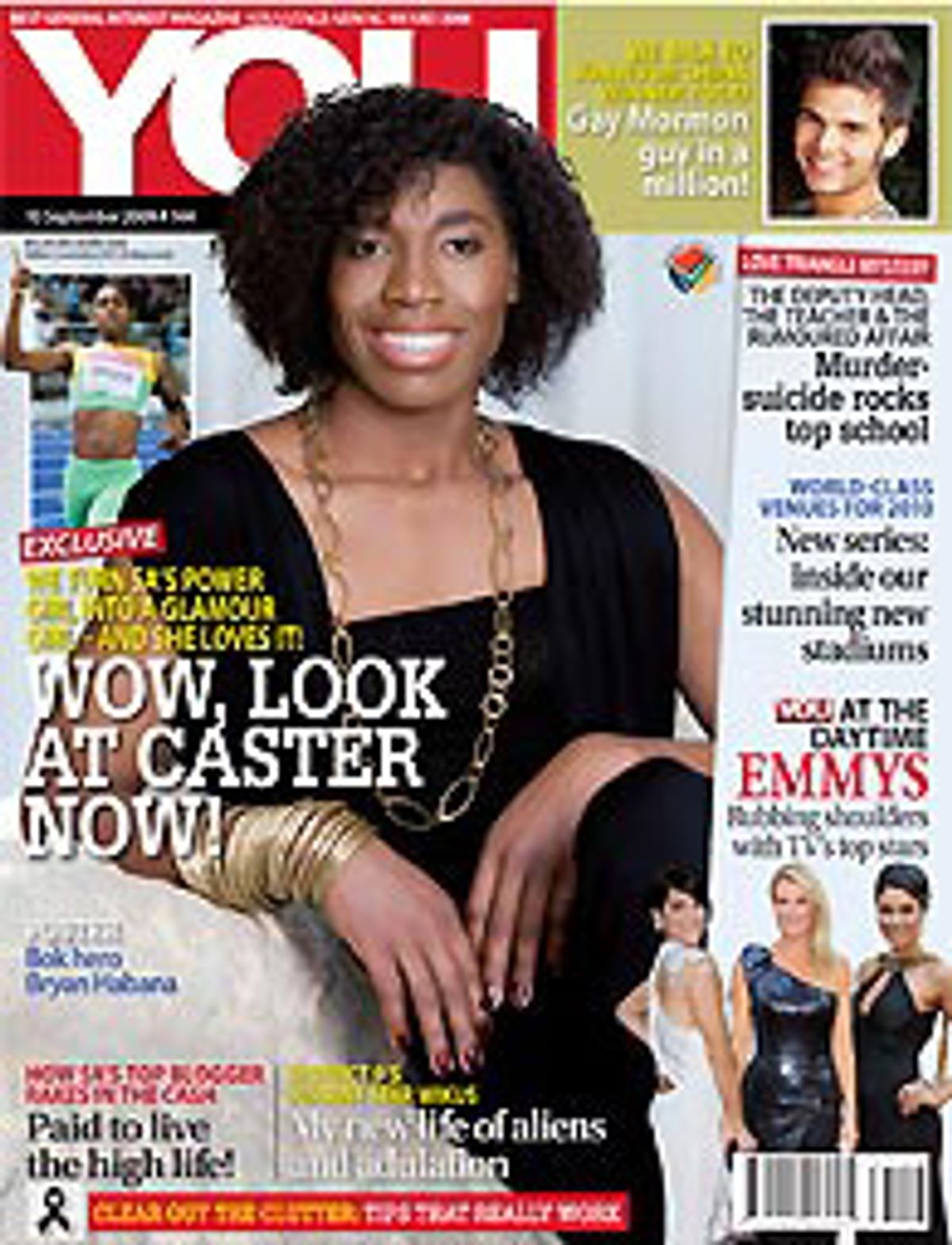
The results of Caster Semenya's sex-determination exam are still out -- but, in the meantime, she's gone femme

Caster Semenya after her magazine makeover
What’s an exceptional female athlete to do when her masculine appearance threatens her livelihood and tabloid headlines the world over begin questioning her biological sex? Get a super-femme makeover!
Such is the P.R. move made by Caster Semenya, the South African runner who was forced by the International Association of Athletics Federations to undergo sex-determination testing. The 18-year-old appears on the cover of You magazine with her cheeks rouged, lips glossed and nails painted. Instead of her yellow-and-green tracksuit, she dons a sleek black dress that covers up her washboard abs; gold jewelry, not sweat, drips from her neck; and her cornrows are combed out into a bouncy coiffure. The South African glossy declares in a headline: “Wow, Look at Caster Now!” Also: “Athletics star Caster Semenya as you’ve never seen her before – transformed by YOU from powergirl to glamour girl.”
Inside the magazine, a four-page spread shows Semenya in various feminine fashions: a sequined top and skin-tight black leggings and, according to the BBC, “a grey knee-length dress worn with a grey cropped jacket and a black-and-white cocktail dress worn with stilettos.” The magazine quotes her as saying, ”I’d like to dress up more often and wear dresses but I never get the chance.” After the shoot, Semenya reportedly told her manager to buy all of the outfits she had modeled. Of course she did. Playing the “appropriate” feminine part must come as a relief after enduring childhood teasing about looking like a boy in her poor rural village and then later having her identity called into question by an international crowd of critics.
The media storm over her sex has succeeded where those childhood tormentors failed: Getting her to conform. The results to Semenya’s sex-determination test (which we learned today she was tricked into taking) are still out — but her public makeover is the result of a another most unfortunate gender test.
Porn’s taboo transsexual stars
"T-girls" are fighting for respect in the adult biz. What does it mean for the general acceptance of trans women?
Brittany St. Jordan, a 28-year-old leggy redhead in a plunging gold number, was all dressed up with somewhere to go: the Adult Video News Awards, the so-called “Oscars for the porn industry.” But she ended up standing in line for three hours waiting to walk the red carpet, as other female performers were sent ahead. When she finally got her turn, event organizers directed her away from interviews with the press.
St. Jordan had an idea of why: Unlike the ladies who were sent right in, she’s a transsexual woman.
After the night was over, having lost in the Best Transsexual Performer category, St. Jordan took to the Web to protest her treatment. Her story inspired Kelly Pierce, a female trans performer who didn’t attend the ceremony, to write a lengthy blog post titled “AVN’s Inequality & Segregation Needs to Stop!” Soon, industry blogs and message boards picked up on the controversy.
It was an explosion of long-building resentment over their treatment within the industry. Beyond the red carpet delay this year, which AVN says was not limited to transsexual performers, the company has never allowed the Transsexual Performer of the Year award to be presented on stage. Instead, it has been announced on a JumboTron as the audience starts to filter out of the auditorium. As one star told me, “We’re the black sheep.”
That is despite the genre’s tremendous popularity: “T-girl sites are the fourth most popular category of adult Web site,” according to “A Billion Wicked Thoughts,” a book that crunches the numbers behind Internet porn. (Although female-to-male transsexual stars are on the rise in queer porn, what we’re talking about here are trans women — more specifically, people assigned as male at birth who have transitioned to being female but still have a penis.) There are more frequent Web searches for this genre — often through terms like “shemale” and “chicks with dicks” — than for basic X-rated categories like “butts” or “blowjobs.” Authors Sai Gaddam and Ogi Ogas found that the genre’s average viewer is a straight-identified male (and, based on their analysis, passing curiosity doesn’t explain its popularity).
After St. Jordan’s outcry gathered virtual steam, AVN called a meeting last week with a handful of concerned trans women. On Tuesday, the company published a press release announcing that the transsexual winner would be announced on stage in the future. AVN also promised to allow more trans performers to walk the red carpet and talk to the press, and to present awards during the ceremony.
St. Jordan, who says she put her career on the line by speaking out, is thrilled. “Whether or not I ever get nominated again or get invited to anything with AVN again, the fact that the Transsexual Performer of the Year will be on stage and seen by everybody? That’s huge.” Tomcat, director of Kink.com’s TS Seduction site, agrees: “Not sharing the stage with Ts performers has allowed the majority of non-trans performers to dismiss them as outsiders and perpetuated discrimination against a group who should be equally praised for the work they do and the revenue they generate for the industry.”
While AVN’s decision marks serious progress, St. Jordan says that recent commentary on industry message boards reveals just how far there is to go. “Some of the hate and ignorance that came spewing from people was unbelievable, and this was people in, or associated with, the industry. You saw where a lot of people stood.”
Not that it wasn’t already apparent. There’s a huge stigma against mainstream straight stars working with transsexual female performers — they’re stereotyped as gay and therefore at higher risk for transmitting HIV. Tomcat, a trans man, told me in an email, “I still encounter many non-trans performers who will not work with [female] Ts performers because they consider [them] to be more of a STI risk to do a scene with — this is bullshit. In a industry where everyone is tested and everyone makes choices, the same risks are present regardless of gender identity.”
It perhaps goes without saying that the marketing of transsexual porn is often problematic. “People still search for Ts porn using ‘shemale,’” Tomcat says. “To me, this is like searching online for a cab company by typing in ‘stagecoach.’ It’s an antiquated term that is ignorant, incorrect and no longer OK to use.”
Some performers, like Wendy Williams, aren’t so concerned about the lingo. “I don’t live in a utopia, it’s what it is,” she says with her Southern lilt (she’s from Eastern Kentucky). “I’m not trying to be a transsexual activist.” Plus, “It’s a porn term that describes a genre. That way, some country, straight-ass guy in the corner is going to understand,” says Williams. “You say ‘transsexual’ and they’re confused, you say ‘shemale’ and they know what that is.”
A major struggle for the transsexual female niche is to get recognition within the straight side of the business as opposed to the gay side. “This is one of my biggest pet peeves, when I go into a store to do research to see if they’re carrying my DVDs or product lines and you have the transsexual stuff mixed in with the gay stuff,” says Williams. “Putting it next to ‘Harry Men Volume 1,’ it’s just not a good idea,” she says, since the vast majority of their fans identify as hetero. “My gay friends squeal at the idea of having sex with anything but a masculine male — the breasts and all that is just a huge turnoff.”
For most fans of transsexual porn, the genre is just one of many categories that they’re interested in. “A Billion Wicked Thoughts” argues that T-girl porn has such a significant straight male following because it combines the key sexual cue of female anatomy with that other fixture of heterosexual porn: a big, hard cock. Madison Montag, a nominee for Transsexual Performer of the Year, says, “They get tired of just the same old thing. Transsexuals are more feminine, they’re like hyper-feminine. To me, it’s kind of get the best of both worlds.”
The mis-categorization of Ts female porn has been painfully evident at the AVN awards in the past, Williams says: Buck Angel, the first recognized FTM trans performer, won the Best Transsexual Performer award in 2007. “It was a huge scandal in our community,” she says. “How do you judge his porn against our porn? His fan base is totally different. That’s just one example of how ignorant the porn community is.” (In an aside, she mentions the scene she filmed with him in 2005: “Actually, Buck was the very first, quote, vagina I had ever been in.”)
Many female transsexuals feel like they’re rejected from both the straight and gay world. “Even if you go into the [gay] clubs, transsexuals and drag queens are primarily there for entertainment,” says Williams. “It’s not really inclusive. We’re kind of in limbo, we’re in between both worlds.” In the straight world, men are often timid about revealing their interest in the genre. Most sales happen online, says Williams, who has a line of signature toys, including a $240 cyberskin mold of her ass. She says, “We’re the taboo, and where does taboo usually happen? Behind closed doors.”
Then again, Pierce, a blond with pixy features, says that when she signed autographs in a booth at the AVN Expo in 2008, she was allowed in the “female section” and had a line longer than some non-trans girls. “They were kind of upset with me,” she laughs.
In terms of fans’ willingness to announce their interest in public, it all has to do with a performer’s “passability,” according to Pierce: “Some men feel like they’re more straight if they’re attracted to more feminine looking transsexuals who bottom” — because topping is seen as masculine. Passability is also a factor in how girls are treated within the industry, she says: “If you look like a woman, they’re more accepting of you. And if you don’t look like a woman, they’re less accepting.”
Montag, a 19-year-old, doe-eyed brunette who calls me “sweetie,” says she got stellar treatment at this year’s AVN awards — she rubbed elbows with Ron Jeremy on the red carpet and scored a seat in the second row — and attributes it in part to her passability. “I’m very young. I’m only 5’1″ and 81 pounds. I’m very petite.” She adds, “I started hormone therapy earlier than other girls.”
St. Jordan agrees: “When it comes down to it,” she says matter-of-factly, “this is business, and it’s a beauty contest every day.”
Williams, who is 6-feet-tall with red, va-va-voom hair, says the pressure to pass as a porn star is even greater than in everyday life. Normally, she says, “I pull my hair up into ponytail and throw on some lip gloss and people just think I’m a tall girl with big boobs.” On camera, everything is different: “You need to seem extremely feminine, but if you want to seem feminine, then you need to be on hormones — but if you’re on hormones, you can’t stay hard and come, and if you can’t stay hard and come, you’re a bad performer.” On top of that, she says, the same viewers who expect this expensive nipped and tucked aesthetic “want to pirate my videos and not sign up for my website and have it for free.”
The irony is that many female trans performers get into the sex industry to pay for their transitions. Well, that and because it can be difficult to get a job anywhere else: “I interviewed for a job that I should have got,” says Williams about her pre-porn days, “and the guy told me, ‘I just don’t know how the cohesion in the office would be if people knew that you were a transsexual woman.’” Things have improved in the decade since then, but the same issues persist: “I couldn’t get a job, not even at Burger King,” says Montag, who lives in a small town in Texas where “people get beat up just for being punk and emo.”
She may be sexually outgoing on the Internet, but it’s not so in real life. Montag says she gets far more action on-screen and doesn’t pursue men in real life, for fear of them having a bad reaction to the discovery that she’s trans. Instead, she sticks to the Web: “[You get] a better reaction and it’s safer, too,” she explains. “It’s not like they’re gonna beat you and leave you in a cornfield to die.”
Courtney Trouble, a queer porn star and director who has worked with many trans performers, hopes that porn might actually help reduce transphobia in society at large. “Porn, while seemingly a private, frivolous luxury, has the immense power to gently create an awareness for trans issues in the audience,” she says. “If porn can create a change in the minds of people outside the industry, that’s where the real rewards are.”
Tobi Hill-Meyer, director of “Doing It Ourselves: The Trans Women Porn Project,” left the mainstream business “to create an alternative that allowed trans women to be represented the way each performer wanted to see herself represented,” she says. “I had to leave the mainstream industry in order to accomplish that, but I’ve seen a similar thing happening within it. More and more performers are speaking out about changes they’d like to see and setting up their own websites or productions.” Trouble believes that independently produced porn will do away with terms like “shemale,” “tranny” and “chick with a dick.”
Others predict transsexual porn will explode within mainstream straight porn. That’s in part because “so many transsexual stars are transitioning younger and getting more beautiful,” says Pierce. But she adds, “Sexuality in general is becoming more open-minded and the new generation is really pushing the limits on sexuality, and I think it’s going to push the transsexual market.”
St. Jordan agrees: “I think there’s gonna be some great crossover stuff real soon, within the next year or so,” she says. That means transsexuals performing not only with non-trans girls but also with straight male performers. This is partly because of growing acceptance and interest on the part of porn viewers, and partly because the up and coming generation of young performers have increasingly liberal attitudes. She says, “As new minds and ideas are coming into the industry, there are more people willing and open to work with us.”
“House” gets asexuality wrong
In a TV first, the Fox drama introduces asexual characters -- only to blame their identity on a medical condition
(Credit: Fox)
Last week’s episode of “House” marked the first time a major TV network featured self-identified asexual characters. But the asexuality community isn’t exactly celebrating this breakthrough; in fact, many are petitioning Fox executives in outrage.
That’s because the episode ends — spoiler alert! — with the revelation that the characters aren’t asexual after all.
When the show’s cantankerous lead, Dr. Gregory House, learns that his colleague has a female patient who identifies as asexual, and is married to an “asexual” man, he bets him $100 that he can find “a medical reason why she doesn’t want to have sex.” Through his signature unethical approach, House manages to run some tests on the husband under the guise of administering a flu shot. He finds that the man has a pituitary tumor that’s killing his sex drive. Then comes the ultimate reveal: The wife — or “giant pool of algae,” as House calls her — is just pretending to be asexual to make her husband happy.
David Jay, founder of the Asexual Visibility and Education Network (AVEN), tells me the show’s treatment was “disturbing but not unexpected.” Not only does the episode assert “that asexuality is problematic and pathological,” he says, but it also tells people who actually accept asexuality as a valid sexual orientation — an acceptance Jay has long fought for — that “they’re wrong.”
OK, so it’s a popular network TV show, and a medical-mystery drama at that: The bar for nuance and sensitivity is set pretty low. It’s also medically possible for a pituitary tumor to cause a lack of sexual desire — but it certainly isn’t the norm among the 1 percent of the population estimated to be asexual. (Although, asexuality as a whole is underresearched and poorly understood.)
The petition, which urges Fox execs to reconsider future portrayals of asexuals, argues, “The episode encourages viewers to meet asexuality with skepticism rather than acceptance, to probe asexual people for causes of our ‘condition’ rather than to accept us as a part of the natural spectrum of human sexual diversity.”
Asexuals hardly need to be investigated by “sexuals,” says Jay. “If someone identifies as asexual, chances are they’ve already done a lot of deep self-reflection and analysis to come to that,” and that can include the possibility of a pituitary tumor, a hormonal imbalance or past sexual trauma. “There’s such a strong message that there’s something wrong with you if you don’t like sex, it’s very hard for people to accept this about themselves,” he says. “It’s hard to be on that journey in an honest way and to be avoiding something. [Asexuality’s] not an easy out.” It’s not like “you identify as asexual and then you’re done trying to understand yourself,” Jay explains.
As for the wife on “House” who faked her asexuality to please her husband? Jay’s not buying that either. He has several asexual friends who have been in relationships with sexual people for years; and each couple finds a way to make it work, whether it’s non-monogamy or negotiating sexual interaction within the relationship — kinda like in relationships between sexuals! Believe it or not, he says, such arrangements are not uncommon in the asexual community, and he says they work “because of really good, honest communication,” not because one partner is lying to the other. But that does make for better TV.
I’m fixated on my wife’s past
After 25 years of marriage, a man finds himself suddenly obsessing about his partner's sexual history
(Credit: brushingup via Shutterstock)
Help! I’ve been married for nearly 25 years, and I can’t stop obsessing over my wife’s past sexual history.
When we first started seeing each other, she was married, I was married and we were both having affairs with other people. She told me in very exquisite detail about many — if not all — of her sexual adventures (many of them extramarital with married men). She went into great detail about how affairs started, when, where, the type of sex performed (oral/anal) with each man. Her sexual experience was far greater than mine.
I have asked her in recent months to recount what she told me 25 years ago about her sexual experiences. Not only will she not discuss it and gets angry about it, she now claims that she never did any of those things. Well, of course, I have some proof that she did many.
My question is why can’t I stop obsessing over her past sexual conquests (and that’s what they were — she seduced primarily married men), and why is she now denying and refusing to discuss her past?
I feel for your wife, man. You’re interrogating her about her sexual past after a quarter-century of marriage. There should be a statute of limitations on such things.
There must be a reason why this suddenly matters to you now. M. Gary Neuman, a therapist and author of “Connect to Love,” senses “some guilt or fear of the ‘what goes around comes around’ karma.” He says, “Maybe you now feel doomed to struggle since this relationship began through inappropriate behavior,” and adds: “It’s never too late to apologize to those you may have hurt in the past. Do what you need to in order to feel freer moving forward and allowing yourself to enjoy your marriage to the max.”
Listen to the man. He’s been on “Oprah,” yo.
Therapist Charles Foster, co-author of “I Love You but I Don’t Trust You,” says there are a couple of possible interpretations of what’s going on here. It could be that “after 25 years, their sex lives — so clearly in need of spicing up from the beginning — are developing rigor mortis, and his re-opening this can of worms is the best way he knows how to wake things up in bed.” Or maybe “for some reason, trust issues have reared their ugly head.”
Is your wife giving you new reason to mistrust her — based on her current behavior, as opposed to things she did when she was a young seductress? If not, this might be less about your wife’s actual trustworthiness than obsessive thinking.
Foster has little patience for this: “Come on, what is it you really want? Better sex? More closeness? More trust? Any of these could make you happy,” he says. “But satisfying your obsession will only stimulate the very itch that’s making you miserable.” Instead, he suggests that you “focus on your real needs, and work with your partner to get them met, and keep telling yourself that your obsession is just a sinkhole of misery.”
On a similar note, Diana Kirschner, author of “Sealing the Deal: The Love Mentor’s Guide to Lasting Love,” suggests that you start by simply listening to each other: Sit down and give each other 10 minutes to talk uninterrupted about whatever is on your mind. Instead of talking about past exploits, try talking about “sexual longings or fantasies you have right now and especially how you would like to act them out with each other.” She says, “Build a whole new relationship now that is so satisfying, the past just doesn’t matter.”
The invention of the heterosexual
The history of straightness is much shorter than you'd think. An expert explains its origins
A detail from the cover of "Straight"
If you met Hanne Blank and her partner on the street, you might have a lot of trouble classifying them. While Blank looks like a feminine woman, her partner is extremely androgynous, with little to no facial hair and a fine smooth complexion. Hanne’s partner is neither fully male, nor fully female; he was born with an unconventional set of chromosomes, XXY, that provide him with both male genitalia and feminine characteristics. As a result, Blank’s partner has been mistaken for a gay woman, a straight man, a transman — and their relationship has been classified as gay, straight and everything in between.
Blank mentions her personal story at the beginning of her provocative new history of heterosexuality, “Straight,” as a way of illustrating just how artificial our notions of “straightness” really are. In her book, Blank, a writer and historian who has written extensively about sexuality and culture, looks at the ways in which social trends and the rise of psychiatry conspired to create this new category in the late 19th and early 20th century. Along the way, she examines the changing definition of marriage, which evolved from a businesslike agreement into a romantic union centered around love, and how social Darwinist ideas shaped the divisions between gay and straight. With her eye-opening book, Blank tactfully deconstructs a facet of modern sexuality that most of us take for granted.
Salon spoke to Blank over the phone about the origins of heterosexuality, the evolution of marriage and why the rise of the “bromance” is a very good thing.
Men and woman have been having sex for as long as there have been humans. So how can we talk about there being a “history” of heterosexuality?
We can talk about there being a history of heterosexuality in the same way that we can talk about there being a history of religions. People have been praying to God for a really long time too, and yet the ways people relate to the divine have specific histories. They come from particular places, they take particular trajectories, there are particular texts, and individuals that are important in them. There are events, names, places, dates. It’s really very similar.
So where does the term “heterosexual” come from?
“Heterosexual” was actually coined in a letter at the same time as the word “homosexual,” [in the mid-19thcentury], by an Austro-Hungarian journalist named Károly Mária Kertbeny. He created these words as part of his response to a piece of Prussian legislation that made same-sex erotic behavior illegal, even in cases where the identical act performed by a man and a woman would be considered legal. And he was one of a couple of people who did a lot of writing and campaigning and pamphleteering to try to change legal opinion on that matter. He coined the words “heterosexual” and “homosexual” in a really very clever bid to try to equalize same-sex and different-sex. His intent was to suggest that there are these two categories in which human beings could be sexual, that they were not part of a hierarchy, that they were just two different flavors of the same thing.
But the term took quite a while to catch on. How did it spread?
Thanks to psychiatrists in the 1880s and 1890s — a part of the medical profession that was deeply unscientific at that time. It meant that somebody with a medical degree and all of the authority it brings could stand up and start making value judgments using specialized medical vocabulary and pass it off as authoritative, and basically unquestionable.
Psychiatry is responsible for creating the heterosexual in largely the same way that it is responsible for creating the various categories of sexual deviance that we are familiar with and recognize and define ourselves in opposition to. The period lasting from the late Victorian era to the first 20 or 30 years of the 20th century was a time of tremendous socioeconomic change, and people desperately wanted to give themselves a valid identity in this new world order. One of the ways people did that was establish themselves as sexually normative. And it wasn’t the people who were running around thinking, “Oh, I’m a man and I like to sleep with other men, that makes me different,” who were creating this groundswell of change; it was the other people, the men who were running around going, “I’m not a degenerate, I don’t want to sleep with other men, I am this thing over here that is normative and acceptable and good and not pathological and right, that’s what I am. That’s what I need people to understand about me, because I need people to understand that I am a valid person and I need to be taken seriously.”
This also has to do with the popularity of social Darwinism at the time.
Social Darwinism comes into play in a big way. It became important to prove that you were part of the solution and not part of the problem in this pell-mell, hurly-burly, crazy new social order [of the late 1800s and early 20th century].
So how did this change in terminology play itself out in the real world?
I actually talked to my grandmother about this. My grandmother is 88 and she came to consciousness in a world that didn’t have heterosexuals in it, where nobody knew that word, and certainly nobody used it to refer to themselves. And she associates this change with Freud, whom she’s never read but whom she’s heard a lot about. So there was this sort of culture-wide game of telephone, if you will, in which these authoritative medicalized ideas coming from very rarefied circles trickled down into the larger culture. I think that for people of my grandmother’s generation particularly, heterosexual simply became a synecdoche for normal. And that’s certainly the way Freud talks about it, that you know, you attain heterosexuality. There’s this process of attaining normality. When you manage to develop yourself, or to become developed, in the proper way, in an appropriate way, in the way that Freud says you’re supposed to, what you end up with is a heterosexual.
In his book “Gay New York,” George Chauncey writes about the flip side of this, how previous to the invention of “homosexuality,” men’s sexualities were much more fluid. Do you think that’s the case?
Oh, absolutely. When you start operating on the principle that you indeed can divide people into sheep and goats, then there’s also the idea that you must divide people into sheep and goats and there are certain boundaries that cannot be crossed without reclassifying.
As you point out in the book, for much of human history, marriage had absolutely nothing to do with sexuality or sex.
It’s more that marriage didn’t have a lot to do with desire. Marriage has always had to do with sex, and the ability to have marital sex and preferably procreate has always been central to marriage. But what was not so important was whether or not you necessarily wanted to have sex with that person. It was your duty, it was paying the marriage debt, and you were gonna do it, by golly, but this was a co-worker, this a partner in business enterprise — not a person you chose to satisfy your own personal whims and desires with. If you happen to also like them and think that they were swell or pretty or handsome then that’s great. But that’s not what you were in it for.
And now everything has changed, because we now prioritize attraction, desire, love, romance, over the strictly economic and community-building aspects of marriage. We live in a culture now where we find it very odd when women don’t support themselves, if somebody chooses to be a stay-at-home mother. That is a huge change, and that’s a huge change just in my lifetime. I’m in my early 40s and I know that when I was a very small child those discussions were not happening in the same way. The economic and legal enfranchisement of women has gone hand-in-hand with both women’s and men’s ability to choose marriage partners based on their own desire, desires for sex, love, companionship, all of those things, and to put that first.
How do the successes of the women’s movement impact our concept of heterosexuality?
I think that referring to it as the success of the women’s movement is a little bit of a misnomer because there’ve been multiple women’s movements, and also because it’s not entirely to be credited to or blamed on organized feminism. There’s been a lot of other enfranchisement of women that’s gone on as well that has actually been not identifiably feminist, but definitely comes out of a very 18thcentury spirit of egalitarianism. But in general I think that equal rights egalitarianism has had an enormous amount to do with changing heterosexuality. Simply because once you give women and men equal or nearly equal rights to their own economic autonomy, political autonomy, social autonomy, you change the playing field, you change the dependency relationship.
Over the last decade, there’s been a lot of science arguing that there are physical differences between gay people and straight people, in their brains and even the direction of their hair whirls. You’re skeptical of this research. Why?
I question their validity primarily because nobody has established or in fact attempted to establish that there is a canonical straight body. And if you don’t have characterized control, you can bet your bottom dollar I am not going to believe your hypothesis. It’s really that simple.
All of this research that is purporting to look for physiological material differences between gay bodies and straight bodies: What are they comparing it to? Their assumption that they know magically what a heterosexual body is? When no one has actually established what that is. That’s bad science.
OK. Then do you think it’s possible to establish what a heterosexual body looks like?
Well, you know, if you’re going to stipulate that it’s possible to establish what a non-heterosexual body is, it better damn well be possible to find out what a heterosexual body is. And if one of those things is not possible, then, chances are, the other is not either.
I’m quite attached to my identity as a gay man — and, to be honest, I would feel a little troubled having my category taken away from me.
See, that’s the thing, no one is going to take that away from you. No one can take that away from you. The only thing they can take away from you is the illusion that this is not something that is constructed. And that’s very, very different. Just because something is constructed as a social category, doesn’t mean that it’s not enormously meaningful. It doesn’t mean that we haven’t built a whole damn civilization on it. Doesn’t mean that we don’t live our daily lives on it, doesn’t mean that we don’t use it all the time every time we’re walking down the street. This is real. It’s stuff that has physical manifestations in the real world. But that does not mean that it is organic.
Or innate.
Or inevitable.
But these categories have also been very practical. Gay rights wouldn’t be imaginable without them.
Well, you know, minority politics has been a lot easier to sell than to just say, “Being human ought to get you human dignity,” full stop. If you can pin down the difference, if you can make the difference the salient issue, it somehow makes it easier for people to stomach the fact that they can’t go out and just beat people over the head. I don’t know why that is. I find it intensely frustrating.
Do you think the success of the gay rights movement is helping broaden our ideas of sexuality?
I think that it is having an interesting effect of making the boundaries of the categories more permeable. Simply because we now have this doxa [omnipresent acknowledgement] of gayness in our culture where we believe that gayness is a thing, we believe that it exists, we believe that we know what it looks like, we believe that we know what it acts like, and therefore, when we see it, we’re actually very likely to say, “Hey, that over there, that looks really gay,” regardless of whether or not that person may be, in fact, gay.
Those boundaries are becoming more porous. The term “bromance” cracks me up, but it is also promising. For the past hundred years or so, a lot of men have found it very difficult to express affection and love for other men without having it assumed that that love is necessarily sexual. And now we’re actually coming around to a place where at least some people, some of the time, are able to avail themselves of a category in which they can say, “Oh, OK, here’s a way that men can be affectionate toward each other and one another and love one another and we don’t have to assume that we know more about it than that.” I think that that adds something to the conversation.
Women, in particular, seem to be eschewing the traditional between binaries of gay and straight these days, at least in pop culture. The same thing doesn’t seem to be true of men.
There’s a reason for that. Every queer woman I know — and I’m a queer woman — understands intuitively that a lot of people don’t consider what two women do together sexually as sex. It’s a whole lot easier to fly under the radar when what you’re doing is not something that a lot of people are even going to consider as sex.
But men, for various other cultural reasons also seem to be more attached to categories. It functions partly as a sort of safety mechanism.
I think there is a lot of safety in categories. And there’s a hell of a lot of safety in a binary. When you can just say, you know, anything that is not this is automatically that. You know, it frees up a lot of spare time.
I have a number of friends who are negotiating the reverse of this, in that they for a long time identified as lesbians and have now started dating transmen and now have to negotiate the awkwardness of being in what ostensibly looks like a heterosexual relationship. I’ve been around several friends who, when they mention their boyfriend in a queer setting, reflexively say, “Oh, but he’s trans.”
And I think that really points as well to the fact that these are constructed categories. This is about your subjectivity, it’s about your allegiance, it’s about where your social networks are, it’s about the kinds of cultural priorities that you embrace and that you endorse. This is not just what gets you hard or what gets you wet. This is not just about what kinds of sex you have, or the congenital configurations of the people you have sex with. It’s very much about what cultures you participate in. What cultures you ally yourself with, you know, whose flag you fly.
It’s interesting that transgender men and women could marry their partners long before gay people could get married, even though they are probably far more despised by conservatives in this country, simply because they fit into this heterosexual idea of marriage.
Although, that’s not uniformly true and there have been cases, like Littleton v. Prange in Texas — which still to this day breaks my heart — where jurisdictions refused to uphold the legality of marriage or partnerships involving a trans person, because they basically take the stance that you can’t change genetics and this is person was never a whatever. And therefore the marriage is not valid. So it does cut both ways. I do think that the issue of gay marriage is a very interesting one to look at in the context of the history of sexuality, because what I think it testifies to is not so much the tendency that non-heterosexuality has to destabilize heterosexual culture, but the incredible depth of the investment that our culture and our government have in regulating the kinds of relationships that people have in their lives.
Our successful open marriage
My husband and I may seem strange for wanting multiple partners. To my kids, this is what normal looks like
(Credit: Dmitri Mikitenko via Shutterstock)
I spent a recent weekend up in Maine with my girlfriend and our three kids. We went on long canoe trips, made mountains of buttery waffles, and read Rainbow Fairy books aloud till the words blurred together on the page. When the kids had gone to bed and the house was quiet, we crawled into bed and had sex so hot I thought the sheets might catch fire.
When I got home, I told my husband all about it.
My marriage is open. It’s also happy and stable. After I shared our mountain adventures, he filled me in on the highlights of his weekend: a small triumph at work, some quality time with his girlfriend, a successful home repair. We curled up at the end of the night, watched some old “Dr. Who” episodes and went to sleep in each other’s arms.
I never thought I’d have anything in common with Newt Gingrich. But if the claims that he once asked his ex-wife, Marianne, for an open marriage are true, then we might be more alike than I thought. Unlike that alleged scenario, however (which began with an affair), my husband’s and my open marriage has been based on openness and honesty from day one.
In fact, I’ve never been in a monogamous relationship. This openness in my romantic life stems in part from feminism and in part from idealism. I’m passionate about owning my own sexuality. I can’t stomach the thought of handing the reins of my sexual life to someone else, even someone I love and trust as much as my husband.
I’m also passionate about sharing. Being open in my marriage comes from the same ideals that make me shop at the food co-op and vote for socialist political candidates. If I were 30 years older, I’d be a veteran of the ’60s free love movement, staging bed-ins with my antiwar buddies. I embraced nonmonogamy, or polyamory as the cool kids like to call it, because I’m good at it. I’m prone to falling for people; my girlfriend likes to say I fall in love with lampposts. I’m good at communication and mediation. I’m bad at rules. Clearly, polyamory was for me.
When I got married and started a family, I just kept doing what I’d always done.
While some people leave polyamory behind with their wild youth, there are large numbers of families that quietly continue to embrace this life while raising kids and growing old together. Some of them form households with several adult “spice” (a humorous plural of spouse). More commonly, they do what I do: live with one spouse, whom they raise kids with, and step out for date nights with other lovers.
We’re largely invisible. When I pick my girlfriend’s daughter up at school, I don’t tell the teachers I’m dating her mom. I just sign the pick-up form and head home.
Nothing in my life is a secret, it’s simply my private business. When it does come up, people tend to be very accepting, but also curious. Don’t you get jealous? What about the kids? How does that even work?
My life sounds complicated, but in many ways it’s routine. The children are the main focus of our attention. My husband and I have three kids. We spend a lot of our time doing the things any parent does: picking the kids up from school, shuttling them to and from activities and birthday parties, cooking them dinner and reading them bedtime stories.
Since we’ve always been poly, I often wonder how monogamous couples do it. I get so much support from my lovers. No one else, not my friends, not my parents, no one, is as willing to deal with the messes and mishaps of parenting as my sweeties. There’s something about romantic intimacy that builds a family-type closeness. These are the people I call when I’m puking my guts out and can’t take care of my kids, the people who call me when their car gets towed and they need a rescue.
Polyamory enthusiasts like to point out that the word means “multiple loves.” They really want to stress the loving commitments people make, the way these networks of relationships support each other. It’s not about the sex, you hear over and over again.
This always makes my girlfriend and me giggle. Here’s a tip: It’s about the sex. If it weren’t, we’d be close friends and I wouldn’t be writing this article. The sex isn’t a bad thing: In fact, sex outside a marriage can be good for you. There’s a pile of scientific evidence showing that a new sex partner is the most surefire cure for sexual dysfunction and low libido, especially for women.
It’s much easier to keep the sparks flying with someone whose laundry you don’t have to fold. Having an outside partner means getting to date endlessly: an endless string of exploring new restaurants, trying new positions, long wandering conversations that don’t involve fights about the cost of day care or nagging reminders to take the trash out.
That’s hot. I get all the excitement of an outside love affair – the wild sex, the sympathetic ear, the chance to fall in love all over again – without the bitterness of betrayal.
This is a blessing and a curse. At its best, it makes everyone’s life better. At its worst, this kind of arrangement can sap energy from a struggling marriage. It’s easier to have fun with a lover than it is with a spouse that you can slip into the habit of playing only outside your marriage. One friend said, after watching his wife tart up to go out with her new boyfriend, “I used to be the lingerie guy. When did I become the pajamas and cornflakes guy?”
It can also be a challenge for the outside relationship. Remember that idyllic weekend my girlfriend and I had? We’ve been dating for three years. Eventually, many people who like each other as much as we do get married. Not us — we’ll be going out to dinner on Tuesday nights until the end of time. That’s a lot of dates. She’ll never be my pajamas and cornflakes buddy.
Now, to the jealousy question: If the thought of your lover being with someone else makes your stomach turn, polyamory probably isn’t for you. Most poly people feel jealous sometimes, but they treat those feelings as a sign of a problem in their own relationship. If I’m jealous because my husband has his girlfriend sleeping over three nights this week, I’m inclined to look at how I’m getting – or not getting – my needs met in my relationship with him. It’s not his sleepovers with her that are the problem, it’s that we haven’t had enough time together lately.
That’s not the case for everyone, though. Some people – maybe most people – really are jealous simply because their honey likes someone else. Their jealousy isn’t an arrow pointing at another problem that can be worked out. It’s a sick feeling in their gut telling them this is not the right relationship to be in. If you feel like that, do yourself a favor and hightail it back to monogamy.
That isn’t the real issue with polyamory, though. I once spoke on a polyamory panel. When an audience member asked what the biggest downside was, all the panelists shouted in unison: “Scheduling!”
That was back in the dark ages, before smartphones and Google calendar. These days, scheduling kinks get ironed out by technology. I can use IM to stay close to all my loves while I’m running through a busy day, hopping from work to school to home. Text messages let us communicate on the run, and online calendars make it much simpler to see when everyone is free.
Then there’s the issue of secrecy: What do you tell the children? What will the neighbors think?
Some of my friends are poly activists. They wear buttons, write magazine columns, march in parades. They want more visibility for our lifestyle so that, like our queer allies, we can be less closeted about who we are. Me, I’m content to keep a fairly low profile. Nothing in my life is a secret, but I don’t usually advertise the details to strangers.
To my kids, this is all normal. I’ve never had a big sit-down talk about how Mommy and Daddy’s marriage is different. They were born into this. We’re a big messy family. The kids know I go on grown-up sleepovers sometimes, and take it for granted.
Because we live in a major urban center with a large poly community, we’re able to hang out with other poly families a lot of the time. That helps provide community support for the adults, as well as making it seem more normal for the kids. I can go to a BBQ with my husband and our kids, spend half the time holding hands and chatting with my girlfriend, and no one will bat an eye.
Polyamory is not for everyone. Many people, probably even most people, prefer the simplicity of a monogamous marriage.
But a lot of people want something else. About half of married people will cheat during their lives. Another substantial minority – anywhere from 1 percent to 10 percent, depending on which expert you ask – are having intentionally open relationships. It takes a lot of emotional energy, and an ongoing commitment to complexity, to make those relationships work. But I wouldn’t do it any other way.
Page 1 of 395 in Sex
Interview With My Bully: When I confronted my bully about racism
Iran’s Greens aim to rise again
The prettiest boy in the world
Should I donate a kidney to my friend?
America’s billionaire-run democracy
The bishops go off the deep end
No, Newt, don’t quit to make room for Santorum
Whose Wisconsin recall is it?
Can Greece thwart a complete meltdown?
Ruth Bader Ginsburg’s alternative abortion history 

