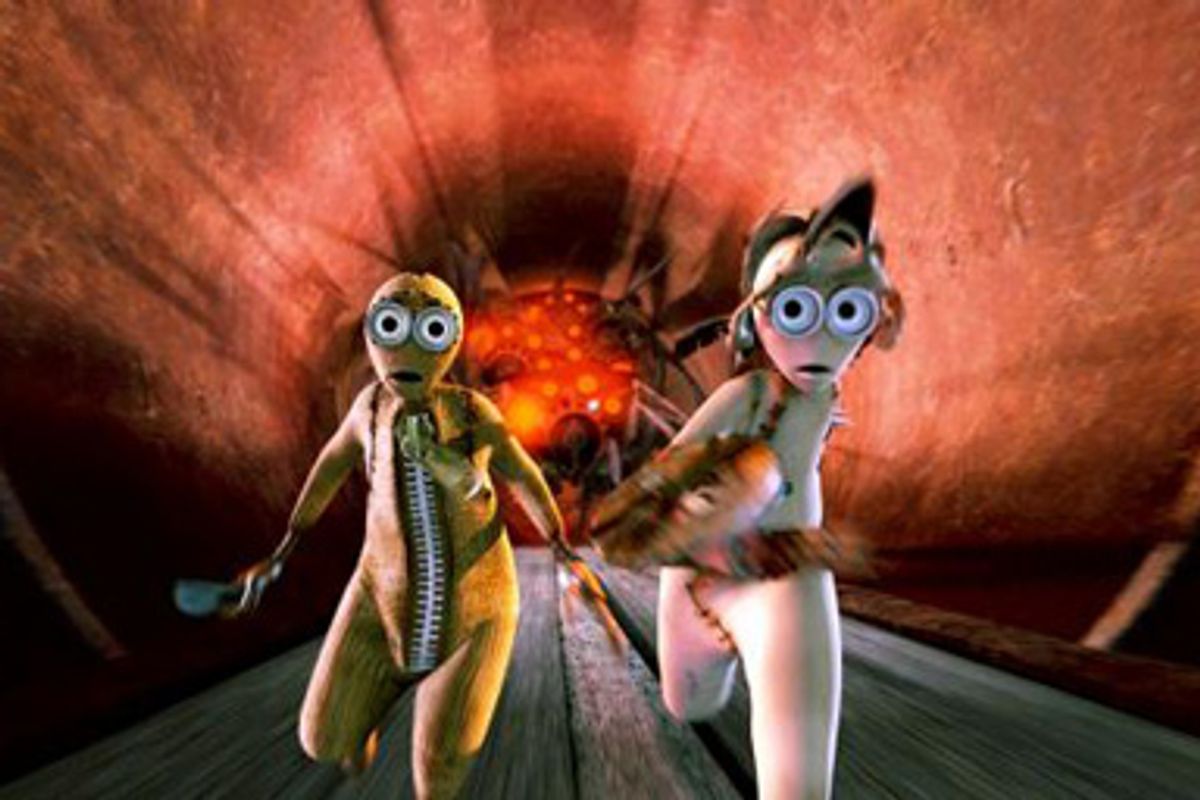
Often gorgeous, this Tim Burton-infused "stitchpunk" animation is a mixed-up quilt of hackneyed yarns

Focus Features
9 (at left, voiced by Elijah Wood) and 7 (voiced by Jennifer Connelly) flee for their lives from the Fabrication Machine.
Elijah Wood needs to set some limits. I just don’t think he should be playing plucky little heroes in quest narratives, especially ones with lovable, puppy-loyal sidekicks who must set out across hostile terrain into the lair of a forbidding enemy. Actually, the problem with wunderkind director Shane Acker’s “stitchpunk” animated fantasy “9″ isn’t so much that it bears a sped-up, dumbed-down resemblance to “The Lord of the Rings,” although it does. It’s more that Acker’s dark and whimsical creation, so clearly in the tradition of his mentor Tim Burton, is wondrous to behold but offers only an indifferent and generic mishmash of quest fantasy and post-apocalyptic science fiction when it comes to story.
Wood supplies the voice for 9, the last in a series of zippered, goggle-eyed burlap sock-puppets who’ve had the spark of life zapped into them by a scientist who may have been the last living human on the planet. 9 wakes up with his creator dead on the floor in front of him, and opens the window to find a devastated city that has apparently been destroyed at the height of an industrial civilization that was simultaneously high-tech and not quite modern, exactly the combination for which the already-overused neologism “steampunk” was invented. Acker builds a tremendous atmosphere of menace and mystery in these early scenes, as the voiceless 9 wanders through a ruined, dead landscape patrolled by a fearsome, feline robot known only as the Beast.
Indeed, when the storytelling of “9″ is purely visual, without much explanation or exposition, it’s haunting and highly effective. One of the monsters 9 and his homespun compadres must face, a sinister, cobra-like creepy-crawly that simultaneously suggests the evil snakes of Kipling’s “Rikki-Tikki-Tavi” and the undead Nazgûl of “Lord of the Rings,” might be the scariest creature I’ve seen in a movie all year. And when one of the nine living puppets is killed and must be given a solemn funeral, at a moment when the group’s mission to preserve their last fragmentary piece of planetary life amid a hateful wilderness seems doomed to pathetic failure, I felt a genuine upsurge of emotion.
But a 90-minute mass-market motion picture demands a conventional narrative, and the more of it Acker and screenwriter Pamela Pettler supply, the more conventional it becomes. Our tiny group of burlap survivors is divided into factions, one loyal to the stern and conservative 1 (Christopher Plummer), who sports a bishop’s miter and crook and urges caution, and the other to the renegade warrior 7 (Jennifer Connelly), who sports a skull mask and stages guerrilla attacks against the robot overlords. You get exactly one guess which of these characters — oh, forget it, no you don’t.
Furthermore, a bunch of the film’s relatively brief running time is devoted to unpacking a back story we can pretty much figure out from context: These little homunculi find themselves at the tail end of a genocidal war between humans and machines, launched when the superpowerful robot warriors turned against their creators. Naturally enough, there’s a magic whatsit encoded with mystical symbols (not a ring exactly, though it kind of looks like one), which 9 and his Sancho Panza-like one-eyed co-puppet, 5 (John C. Reilly), must carry into the deep, dark, brooding lair of the Beast and then — no! For God’s sake don’t stick it there! Too late.
Produced under the aegis of both Burton and Russian director Timur Bekmambetov (“Wanted” and the “Day Watch”/”Night Watch” series), “9″ presents a wildly uneven mixture of ingredients. On one hand, it’s an earnest, loving attempt to expand Acker’s 2004 Oscar-nominated short into a full-length movie; the animation looks fantastic and the range of voice talents (also including Martin Landau and Crispin Glover) is impressive. On the other hand, the story is a half-assed jumble of the hackneyed and half-familiar, and once you get past how cool the movie looks, so is Acker’s created universe.
In the end-of-summer battle between two numerologically obsessed fantasy-director protégés, Neill Blomkamp’s “District 9″ is the clear winner. Blomkamp’s giant-prawns-from-space apartheid allegory combined a bunch of sci-fi movie archetypes with a real-life setting to create a world nobody had ever seen on screen before, while Acker has created a fitful combination of beautiful, dreamlike images that never knit together forcefully enough to seem individual or convincing. I’ll remember that undead snake-critter years from now. What movie was it in? I’m already starting to forget.
How Hollywood guts children’s classics
"Gulliver's Travels" is just the latest movie to eviscerate its source material. Tim Burton, we're looking at you
A still from "Gulliver's Travels"
A staple of freshman English classes and a classic of Juvenalian satire, Jonathan Swift’s “A Modest Proposal” has been pored over for centuries — and yet, so far as I can determine, no one in all that time has suggested that Swift’s essay would be improved by the addition of robots.
But that’s exactly what Swift’s “Gulliver’s Travels” gains in its most recent movie version, which stars Jack Black as a loudmouth underachiever who works in the mail room of a New York newspaper. Black’s Gulliver — everyone calls him by his surname, owing perhaps to the fact that his first name is Lemuel — doesn’t have much in the way of ambition, but he is nursing a fierce crush on one of the paper’s editors (Amanda Peet). He finally works up the courage to ask her on a date, but chickens out at the last second, and in order to explain his presence in her office, he awkwardly puts in for a travel-writing assignment (get it?).
So far, so nothing like Jonathan Swift. Gulliver does eventually make his way to the kingdom of Lilliput, whose diminutive residents are permanently at war with nearby Blefuscu, and makes himself useful by singlehandedly dispatching the Blefuscunian navy. But that’s about all that remains of Swift’s 1729 novel. Well, that and a scene in which Gulliver extinguishes a fire raging through the Lilliputian king’s castle by voiding his bladder on the royal residence.
The movie industry has a long history of raiding literature, great or otherwise, for inspiration and then discarding whatever parts of the original don’t fit into a preestablished mold; readers of L. Frank Baum’s “The Wonderful Wizard of Oz” would be hard-pressed to recognize large chunks of the 1939 film. But in the case of “Gulliver’s Travels,” the gulf between page and screen is vast, yawning — abysmal, even.
The particulars of Swift’s satire — references to the contemporary relations between England and France, or the conflict between the Whig and Tory parties — are obscure to most modern readers. But his absurdist take on political squabbling needs no context. The ages-old strife between Lilliput and Blefuscu, Gulliver discovers, is owed to an irreconcilable debate over whether the large or small end of an egg should be broken first before eating.
In place of the novel’s acid satire of human nature, the movie gives us a sequence in which Gulliver, having vanquished the Blefuscans and become the hero of Lilliput, puts the kingdom’s grateful people to work building him a replica of Times Square, with every billboard remade to feature his likeness: “Gull Side Story,” “Gavatar” and the like. Not only is that not satire; it barely qualifies as humor.
This is hardly the first time “Gulliver’s Travels” has been faithlessly adapted; from watching most movie versions, you’d never suspect that Gulliver’s sojourn among the Lilliputians occupies only one of the novel’s four parts. But given how little resemblance the film bears to its ostensible source, the question is, why bother at all? Swift’s book is in the public domain and thus free for the uncredited plundering, and it’s doubtful the title has any resonance among the movie’s target audience. At the Vermont multiplex where I saw it the day after Christmas, a teenage boy in the lobby was trying to talk his friends into seeing the movie. “Gulliver[cq] Travels,” he said, adding hopefully, “Jack Black.”
It’s not worth getting worked up over a standard-issue dumbing-down, but this is more like an evisceration, hollowing out the source so only a shell remains. Director Rob Letterman and writers Joe Stillman and Nick Stoller fill the void with stock love plots and a tepid self-empowerment plot that ends with Black’s Gulliver doing battle with — yes — a giant robot.
Tim Burton’s “Alice in Wonderland” did much the same with Lewis Carroll’s classic, featuring a grown-up Alice returning to Wonderland — or make that Underland, since the film’s conceit is that Alice, having visited as a child, has since forgotten or misremembered many of the details. Linda Woolverton, who also co-wrote scripts for “Mulan” and “The Lion King,” converts Carroll’s morbid whimsy into a tepid Joseph Campbell myth, in which Alice must defeat the Red Queen and slay the Jabberwock. Or rather, and it pains me to write this, “the Jabberwocky,” as it’s called in the film. As anyone who’s read “Through the Looking Glass” knows, “Jabberwocky” is the poem about the Jabberwock, not the beast itself, but since more people have heard of “Jabberwocky” than read it, Woolverton eliminates any potential for confusion, or thought. The half-second it might take the viewer to process the source of that extra “-y” is time Burton could be searing their eyeballs with gaudy CGI.
“Alice in Wonderland” is a children’s book, and “Gulliver’s Travels” has become (erroneously) thought of as one, but in their original forms, they’re filled with ideas that children have to grow into, rather than predigested narratives whose main purpose is to keep them from fidgeting in their seats. They have the form of fables, but their only moral is not to try too hard. The film adaptations of C.S. Lewis’ Narnia novels at least hold onto their Christian subtext — “We have nothing if not belief,” says Reepicheep the talking mouse in “The Voyage of the Dawn Treader” — but they’re too flatly transcribed to have any emotional affect, or to transmit their ideas as anything but obscure allegory. I imagine it’s possible to sit children down after the fact and explain to them that Aslan is Jesus and so forth, but that leaves room for backlash: As a child, I devoured the novels, but I felt betrayed when told after the fact that I’d unknowingly consumed a religious text. It was like being told the delicious cake I’d just finished was laced with Brussels sprouts.
It doesn’t have to be that way. The day after watching “Gulliver’s Travels” alone, my nieces and I went to see “Tangled,” Disney’s reworking of the Rapunzel tale. As with “Gulliver’s Travels” and “Alice in Wonderland,” the Grimm’s fairy tale is treated as raw material, woven into a plot in which the imprisoned girl is a kidnapped princess whose magic hair keeps her captor perpetually young. The familiar elements of the Disney formula fall neatly into place, from the soaring Alan Menken ballads to Rapunzel’s sassy nonhuman sidekick (here, a chameleon named Pascal). But while it lacks the Grimm’s morbid detail — no eyes poked out by thorns here — “Tangled” is still a horror story, with the terrifying faux mother Gothel (voiced by Donna Murphy) at its core. Gothel has raised Rapunzel to believe she is her mother, and keeps the girl housebound by filling her with tales of the outside world’s evils. Alternately cajoling and threatening her surrogate daughter, proclaiming her love and undermining her sense of self-worth, she’s the wicked witch as mommie dearest, a master of emotional abuse who knows the scars that last are those on the inside. It’s possible parents may find her more frightening than children — my nieces were more shook up by “How to Train Your Dragon” — but her character makes the movie real in a way that the others studiously avoid. It’s the only animated movie of the three, but also the only one that feels anything like real life.
“Alice” still reigns at box office with $34.5M
After three weeks in theaters, Disney film has raised $565.8 million worldwide
Alice remains the queen of the box office.
Johnny Depp and Tim Burton’s “Alice in Wonderland” took in $34.5 million to remain the No. 1 movie for a third-straight weekend, according to studio estimates Sunday.
The Disney release raised its domestic haul to $265.8 million and its worldwide total to $565.8 million after just three weekends in theaters, a huge result for a film playing in the typically slow month of March.
“You rarely see this kind of domination by one movie at this time of year,” said Paul Dergarabedian, box-office analyst for Hollywood.com. “Normally at this time of year, films don’t make this kind of money, and they don’t hold in this long.”
“Alice in Wonderland” easily beat a rush of new movies led by 20th Century Fox’s family film “Diary of a Wimpy Kid,” which opened at No. 2 with $21.8 million. The movie is adapted from Jeff Kinney’s cartoon novel about a sixth grader maneuvering through the intricate social structure at his middle school, which includes its own “cooties” game known as the “cheese touch.”
“I think cheese touch equals magic touch at the box office,” said Chris Aronson, head of distribution at 20th Century Fox.
Debuting at No. 3 was Jennifer Aniston and Gerard Butler’s action comedy “The Bounty Hunter” with $21 million. Released by Sony, the movie follows a bounty hunter chasing his ex-wife, a reporter with an arrest warrant over her head after she misses a court date while pursuing a story.
“We had figured an estimate in the high teens, so 20-plus million is a good number for us,” said Rory Bruer, head of distribution for Sony.
Jude Law and Forest Whitaker’s action thriller “Repo Men” flopped with a No. 4 opening of $6.2 million. The Universal release features Law as a repo man on the run in a future where organs are bloodily repossessed if patients miss their payments.
In narrower release, Kristen Stewart and Dakota Fanning’s Joan Jett music drama “The Runaways” opened weakly with $803,629 in 244 theaters, averaging $3,294 a cinema.
That compared to an average of $9,229 in 3,739 theaters for “Alice in Wonderland,” $7,085 in 3,077 theaters for “Diary of a Wimpy Kid,” $6,831 in 3,074 cinemas for “The Bounty Hunter” and $2,440 in 2,521 locations for “Repo Men.”
Released by Apparition, “The Runaways” stars Stewart as Jett and Fanning as singer Cherie Currie as they opened doors for women rockers in the 1970s with an all-girl band.
Ben Stiller’s comic drama “Greenberg” premiered strongly in limited release, pulling in $120,432 in three theaters for a huge average of $40,144 a cinema.
Released by Focus Features, “Greenberg” stars Stiller as a neurotic whose mean tongue jeopardizes a budding romance with his brother’s personal assistant (Greta Gerwig).
James Cameron’s science-fiction blockbuster “Avatar” remained in the top 10 three months into its run. The 20th Century Fox release pulled in $4 million to raise its domestic total to $736.9 million. Worldwide, “Avatar” has taken in $2.67 billion.
“Alice in Wonderland” continued to lift overall Hollywood revenues, which came in at $130 million for the weekend, up 23 percent from the same weekend last year, when the thriller “Knowing” debuted at No. 1 with $24.6 million.
So far this year, domestic revenues are at $2.43 billion, up 10.3 percent over 2009′s, according to Hollywood.com. Factoring in higher ticket prices, movie attendance is 8.2 percent ahead of last year’s.
Estimated ticket sales for Friday through Sunday at U.S. and Canadian theaters, according to Hollywood.com. Final figures will be released Monday.
1. “Alice in Wonderland,” $34.5 million.
2. “Diary of a Wimpy Kid,” $21.8 million.
3. “The Bounty Hunter,” $21 million.
4. “Repo Men,” $6.2 million.
5. “She’s Out of My League,” $6 million.
6. “Green Zone,” $5.96 million.
7. “Shutter Island,” $4.8 million.
8. “Avatar,” $4 million.
9. “Our Family Wedding,” $3.8 million.
10. “Remember Me,” $3.3 million.
——
On the Net:
http://www.hollywood.com/boxoffice
——
Universal Pictures and Focus Features are owned by NBC Universal, a unit of General Electric Co.; Sony Pictures, Sony Screen Gems and Sony Pictures Classics are units of Sony Corp.; Paramount and Paramount Vantage are divisions of Viacom Inc.; Disney’s parent is The Walt Disney Co.; Miramax is a division of The Walt Disney Co.; 20th Century Fox, Fox Searchlight Pictures and Fox Atomic are owned by News Corp.; Warner Bros. and New Line are units of Time Warner Inc.; MGM is owned by a consortium of Providence Equity Partners, Texas Pacific Group, Sony Corp., Comcast Corp., DLJ Merchant Banking Partners and Quadrangle Group; Lionsgate is owned by Lions Gate Entertainment Corp.; IFC Films is owned by Rainbow Media Holdings, a subsidiary of Cablevision Systems Corp.; Rogue Pictures is owned by Relativity Media LLC; Overture Films is a subsidiary of Liberty Media Corp.
‘Alice’ extends her No. 1 stay with $62 million
In its second weekend, the Disney fantasy reaches $208.6 million domestically
Alice is still ruling the movie palace.
Johnny Depp and Tim Burton’s “Alice in Wonderland” easily remained the No. 1 weekend draw with $62 million, according to studio estimates Sunday. The Disney fantasy has climbed to a $208.6 million total domestically, becoming the first $200 million hit released this year.
In its second weekend in theaters, “Alice in Wonderland” pulled ahead of the $206.5 million domestic haul of “Charlie and the Chocolate Factory” to become the top-grossing of Depp and Burton’s seven films together, which include “Edward Scissorhands,” “Sweeney Todd” and “Corpse Bride.”
“I believe it’s literally the magical, if you would, pairing of Tim and Johnny,” said Chuck Viane, head of distribution for Disney. “When you take those two, they always seem to make something really out of the ordinary.”
“Alice in Wonderland” added $76 million overseas to bring its international total to $221 million and its worldwide gross to $430 million.
A rush of new movies had so-so openings, led by Matt Damon’s Iraq War thriller “Green Zone,” which debuted at No. 2 with $14.5 million domestically. Released by Universal, “Green Zone” stars Damon as the leader of a U.S. Army team who stumbles onto a conspiracy over the search for weapons of mass destruction in Iraq.
Paramount’s romantic comedy “She’s Out of My League” debuted at No. 3 with $9.6 million. The movie stars Jay Baruchel as a geek in an unlikely romance with a babe.
“Twilight” star Robert Pattinson’s romantic drama “Remember Me” opened at No. 4 with $8.3 million. The Summit Entertainment release stars Pattinson and “Lost” co-star Emilie de Ravin in a dark story of young lovers with tragedy in their past.
In its fourth weekend, Paramount’s “Shutter Island,” the latest collaboration between Leonardo DiCaprio and Martin Scorsese, was No. 5 with $8.1 million, raising its domestic total to $108 million.
Debuting at No. 6 with $7.6 million was Fox Searchlight’s comedy “Our Family Wedding,” starring America Ferrera as a Hispanic bride marrying a black man.
“Alice in Wonderland” took in nearly as much as the rest of the top-10 movies combined.
“It’s like this great divide between the No. 1 and 2 films, which says that without ‘Alice in Wonderland’ in the marketplace, we’d be hurting right now,” said Paul Dergarabedian, box-office analyst for Hollywood.com. “By itself, it’s really propelling huge box office.”
Hollywood’s business soared, with overall revenues at $144 million, up 43 percent from the same weekend last year, when “Race to Witch Mountain” led with a $24.4 million debut.
For the year, revenues are at $2.24 billion, up 9 percent compared to receipts last year, when Hollywood took in a record $10.6 billion.
Factoring in higher admission prices, movie attendance this year is running 6.7 percent ahead of 2009′s, according to Hollywood.com. Before “Alice in Wonderland” opened, attendance was lagging slightly behind last year’s.
“In just a couple of weeks, ‘Alice’ has turned the entire marketplace around almost single-handedly,” Dergarabedian said.
James Cameron’s science-fiction sensation remained a strong draw after nearly three months in theaters, taking in $6.6 million to raise its domestic total to $730.3 million. The 20th Century Fox release has topped $2.6 billion worldwide.
Summit Entertainment’s “The Hurt Locker,” which beat “Avatar” for best picture at the Academy Awards, got a slight box-office bump from its Oscar triumph. The Iraq War drama, which is out on DVD but came back to theaters for Oscar season, pulled in $828,000, raising its box-office total to $15.7 million.
Estimated ticket sales for Friday through Sunday at U.S. and Canadian theaters, according to Hollywood.com. Final figures will be released Monday.
1. “Alice in Wonderland,” $62 million.
2. “Green Zone,” $14.5 million.
3. “She’s Out of My League,” $9.6 million.
4. “Remember Me,” $8.3 million.
5. “Shutter Island,” $8.1 million.
6. “Our Family Wedding,” $7.6 million.
7. “Avatar,” $6.6 million.
8. “Brooklyn’s Finest,” $4.3 million.
9. “Cop Out,” $4.2 million.
10. “The Crazies,” $3.7 million.
——
On the Net:
http://www.hollywood.com/boxoffice
——
Universal Pictures and Focus Features are owned by NBC Universal, a unit of General Electric Co.; Sony Pictures, Sony Screen Gems and Sony Pictures Classics are units of Sony Corp.; Paramount and Paramount Vantage are divisions of Viacom Inc.; Disney’s parent is The Walt Disney Co.; Miramax is a division of The Walt Disney Co.; 20th Century Fox, Fox Searchlight Pictures and Fox Atomic are owned by News Corp.; Warner Bros. and New Line are units of Time Warner Inc.; MGM is owned by a consortium of Providence Equity Partners, Texas Pacific Group, Sony Corp., Comcast Corp., DLJ Merchant Banking Partners and Quadrangle Group; Lionsgate is owned by Lions Gate Entertainment Corp.; IFC Films is owned by Rainbow Media Holdings, a subsidiary of Cablevision Systems Corp.; Rogue Pictures is owned by Relativity Media LLC; Overture Films is a subsidiary of Liberty Media Corp.
Tim Burton’s Alice in Underland
The director plays his best cards: Visual splendor, darkness, Johnny Depp. But has he fallen down a rabbit hole?
Johnny Depp as the Mad Hatter (Credit: Film Frame)
It’s disappointing enough that a movie whose title contains the word “wonder” should hold so little of it. It’s even more disheartening that that movie should come from Tim Burton, a filmmaker whose imaginativeness — working in tandem with his dark heart – - has given moviegoers so much pleasure over the years that even at the relatively tender age of 51, he’s earned his own Museum of Modern Art retrospective. “Alice in Wonderland” is hardly a total disappointment: Burton has put the expected level of care into its production and character design, and the picture is a far more low-key affair than either of his last two live-action films, “Sweeney Todd, the Demon Barber of Fleet Street” and “Charlie and the Chocolate Factory.” Unlike the former, “Alice” doesn’t groan under the weight of thunderous pretentiousness, and unlike the latter, its garishness is, at least, of the muted sort.
But I found myself trying so hard to like “Alice in Wonderland” that the process of watching it exhausted me. Burton, working from a screenplay by Linda Woolverton, isn’t even attempting a faithful adaptation of Lewis Carroll, and that’s probably a wise move. Carroll’s “Alice’s Adventures in Wonderland” — coupled with its sequel, “Through the Looking-Glass” — is a marvel of dream-logic storytelling, a perfect articulation of the way our minds reinvent the rules of life during sleep: Carroll — or the Rev. Charles Lutwidge Dodgson, if you prefer — understood how a conversation with a rabbit in a waistcoat can be a matter of life and death while you’re dreaming it and seem like a silly, dismissible trifle once you’re up and awake. Carroll’s books have a beautiful structure, but a movie needs more narrative drive, and Burton and Woolverton seem to know that. They’ve framed their story as a sort-of sequel, in which Alice (played by the ethereal-looking Mia Wasikowska) is now grown-up enough to be betrothed, and she needs to make a good match owing to her family’s constrained financial situation. The problem is, she doesn’t much like the husband who’s been chosen for her. And so, when the prospective groom puts her on the spot by asking publicly for her hand in marriage, she slips away from the gawking crowd and escapes — from him and from the responsibilities of adulthood — by tumbling into a rabbit hole.
In Burton’s vision, that world isn’t “Wonderland,” but “Underland,” a mildly witty play on words that makes sense in the context of his reimagining of the story (though, apparently, when you’re making a movie for the Walt Disney Co., it would be messing too much with tradition to call it “Alice in Underland”). In that world, Alice meets the cast of characters so familiar from Carroll’s book, although they generally serve different purposes here. Johnny Depp’s Mad Hatter is a sensitive, wild-eyed, gap-toothed scatterbrain who hasn’t been the same since the benevolent yet frightening-looking White Queen (Anne Hathaway) was dethroned by her power-mad and very big-headed (literally and figuratively) sister, the Red Queen (Helena Bonham Carter). The Red Queen rules her kingdom with a tiny iron fist: Her chief henchman is Stayne, Knave of Hearts (Crispin Glover, borrowing a page from Laurence Olivier’s film version of Richard III, a spindly, black-clad figure with a charred, corrupted soul). The Red Queen takes pleasure in cutting off people’s heads, willy-nilly; she likes to rest her feet on the backs of fat, ottoman-shaped pigs. In short, she’s not a very nice person at all.
Alice, who is alternately too big or too small depending on what she’s most recently had to eat or drink, moves through this strange world — one in which giant, jewel-toned toadstools sport furry spots and, curiouser and curiouser, hookah-puffing caterpillars sound just like Alan Rickman — with a mixture of trepidation and sure-footedness. She’s been transported to Underland for a reason, and although she doesn’t yet know what that is, we of course can see it coming a mile away.
Foreseeing the ending of a story isn’t necessarily a problem; particularly in fairy tales, getting there is supposed to be most of the fun. But the problem with Burton’s “Alice in Wonderland” is that it’s all production design and no storytelling. There’s no compelling thread to follow here. Burton doesn’t build a universe in which we have any real reason to fear some characters and to feel protective of others. There’s nothing at stake in this Wonderland/Underland: When the action gets droopy, Burton cuts back to the Red Queen’s castle, where we get to watch her toddling about and spewing her highly amusing self-important twaddle. (Her silliest riffs are spun from the fact that she herself knows her head is enormous, and so what of it?) The Red Queen, as Carter plays her — her head has been enlarged and glued, via CGI, onto a twig-size body — is the most entertaining character here, and her makeup alone is both fascinating and repellent: Her lips have been painted into a tiny heart-shaped pout; her eyelids are coated with a magnificent color I can describe only as old-lady Maybelline blue.
But this tiny prima donna isn’t enough to carry a movie, and so Burton has to come up with activities to occupy the other characters. Depp, in particular, gets lost in the shuffle. The Mad Hatter, as Burton has reimagined him here, with a matted puff of red hair and perpetually dilated crazy-ass eyes, is something of a lost soul, the very type of character that Depp is generally so wonderful at playing. But it’s hard to see anything genuinely moving behind his tics and mannerisms. Even though Burton and Depp have done some wonderful work together — in movies like “Edward Scissorhands” and “Sleepy Hollow” — it’s gotten to the point where I prefer to see Depp in performances where he’s not hidden under “Look at me!” makeup. There’s a point at which perpetual collaboration between a filmmaker and an actor becomes a liability, and Depp and Burton may have reached it, at least for now.
“Alice in Wonderland” does offer its share of slender pleasures: Wasikowska plays Alice as bright and unassuming, and watching her is never a chore, even when the story devolves into a “Girls can do cool stuff, too!” empowerment tale. And the sequence in which she takes her first swig from that little bottle marked “Drink me!” — followed by her nibbling on that adorable “Eat me!” petit four — is ingeniously designed and staged, taking place in a warped-perspective room that appears to be all corners. Alice’s costuming here is particularly clever: She’s dressed in a billowy, translucent blue gown that she can both shrink out of and grow into. I also loved looking at, and listening to, the Cheshire Cat (voiced by Stephen Fry), a creature whose iridescent teal-blue stripes have been carefully coordinated with his enormous, glowing eyes.
But as lavish-looking as this “Alice in Wonderland” is, it still feels cobbled together, albeit painstakingly. It’s not at all shallow to care about the look of a film. Visual seduction is part of the reason we go to the movies. But maybe Burton is working too hard at being visually impressive: In the end, “Alice in Wonderland” comes off as manufactured instead of dreamy. Burton delivers all the wonder money can buy; what’s missing is the wonder it can’t.
Upcoming movies: Awesome or awful?
Terry Gilliam and Tim Burton's latest, Britney and Lindsay do Bergman, and leaked Anne Frank-David Mamet dialogue
Mia Wasikowska as Alice in "Alice In Wonderland"

Walt Disney Pictures
Mia Wasikowska as Alice in “Alice in Wonderland”
OK then, here’s a pop quiz for pop-culture mavens. First, identify each of the following proposed movie projects. Second, identify which one I just pulled out of thin air. Or to put it another way, identify which one was not pulled out of thin air, or some darker, moister region, by someone sitting behind an extremely nice neo-retro desk in Los Angeles. After that we’ll get to the subject of whether any of these motion pictures should exist at all.
- A bewildering adult fantasy, adapted from a literary source, that features four different actors playing the same role and also includes the final performance of a recently departed star (no, really — his final final performance), directed by a one-time rebel genius now viewed as both a loose cannon and box-office poison.
- A bewildering adult fantasy, adapted from a literary source and shot almost entirely in a green-screen, effects-driven process that makes its director (he says) “jittery and crazy.” Said director is a one-time rebel genius now viewed as an underperforming Hollywood hack.
- A remake of a breakthrough American indie crime drama of the ’80s, made in a foreign language by a director who himself made more than one breakthrough indie crime drama in the ’80s.
- A remake of a breakthrough foreign-language film of the ’60s about an intense, crypto-erotic relationship between two women, sexed up and made contemporary as a comeback vehicle for two flagging post-teen stars.
- A remake of a red-meat, Red Scare action film of the ’80s, sexed up and made contemporary as a vehicle for the offspring of a flagging mega-star.
- Approximately the umpteenth adaptation of a tear-jerking literary classic read widely by teenagers, to be scripted by a major American writer who seems uniquely unsuited for the task.
So how did we do? Too easy, right? I would agree, but I would further contend that my fake idea is no worse than the third- or fourth-worst idea on this list. And yeah, maybe I cheated by including one movie that actually exists, along with another one that’s partway along. That’s not the point, if I have one; the point is to argue that the movie-supply pipeline of the moment seems jampacked with baffling, half-baked ideas that, y’know, could surprise us and be pretty good, but have a really high potential of turning out to be incredibly awful and/or memorably bizarre, and very likely belong in the category of Someone Should Have Thought About This a Little Bit Harder.
Now, to review. In order, as above:
“The Imaginarium of Doctor Parnassus” Yes, the latest addition to Terry Gilliam’s oo-ver is an actual, completed motion picture that will apparently be released this fall. Doesn’t quite seem that way, though, does it? Gilliam’s effects-driven, unsummarizable, Munchausen-scale fantasy — which does indeed feature four actors playing one role, and stars the late Heath Ledger alongside Johnny Depp — premiered this spring at Cannes, to mixed and tepid response. That’s neither a positive nor a negative; dark, indigestible films don’t do well at film festivals (this is known as the “Synecdoche, New York” problem). This movie has a higher profile than anything Gilliam has made since God knows when — “12 Monkeys,” maybe? — but given his propensity for muddled aesthetic results and commercial failure, that’s not saying a whole lot.
My personal feeling is that Gilliam has been so badly burned by the forges of the film industry’s Saurons that he’s morphed from Sméagol to Gollum — he’s become a perennially sour old dude who has lost all sense of how to reach audiences. I know he’s got fans out there, because I hear from y’all every time I complain about him, so let me state what should be obvious: Gilliam is a rare, acerbic talent with genius-level skills in composition and design, and one of these years he might cough up a good movie. Thing is, I’m tired of waiting — and unlike almost everybody else in North America, I actually sat through “Tideland,” the hackneyed, cruel and thoroughly poisonous Alice-in-Wonderland knockoff that was his last film. Go watch that — no, I’m serious, go right now; the rest of us will wait — and then come back and tell me what a big fan you are.
Here’s the British trailer for “Imaginarium,” which New York magazine’s Vulture blog has summed up as “something you’d dream after eating some bad clams and falling asleep in a sauna”:
“Alice in Wonderland” Now we come to Tim Burton’s effects-driven spectacular in the offing, and I got stuck trying to define exactly what relationship Burton bears to Terry Gilliam. He’s the rich man’s Gilliam? He’s the saner, less evil member of a pair of evil-genius twins? I can’t quite figure it out. I know, I know, you’re very excited that Burton is finally making a Lewis Carroll adaptation, he seems perfect for it, etc. There’s a huge gap here, in that none of the screen versions of “Alice” is fully satisfactory, and I absolutely agree that Burton’s trailer looks gorgeous, exactly the kind of vaguely sinister visual candyfloss that made his reputation.
But let’s be honest here: Burton has a terrible record with adaptations (“Sleepy Hollow,” anyone? “Planet of the Apes”? Didn’t think so) and if the story’s not about a damaged Goth kid, he doesn’t know how to tell it. There’s a real risk here that this “Alice” will wind up with Johnny Depp’s Mad Hatter as the main character, who happens to meet some chick from another world. And as for making Alice a fully pulchritudinous young adult instead of a little girl, doesn’t that risk pushing Dr. Freud even closer to the surface of the film? Again, just personally, I was greatly and pleasantly surprised by Burton’s take on “Sweeney Todd,” mostly because I wasn’t expecting much, but expectations are already off the charts for this one. In case you haven’t seen the trailer, or need another look:
Zhang Yimou’s “Blood Simple” remake There were some startled blogosphere reactions to the idea that the director of “Raise the Red Lantern” and “Hero” is set to stage a Chinese-language remake of Joel and Ethan Coen’s hallowed 1984 debut film. I’m here to tell you that I think it’s a tremendous idea. Several of Zhang’s best movies have a pronounced noir element, slowed down and adapted to the rhythms of life in rural China. And here comes the moment where I blow my so-called indie cred: I don’t like “Blood Simple” that much. It’s really well made, but it’s one Coen movie that totally earns their rep as sadistic and smirky. I’ll probably like Zhang’s version better.
Britney Spears-Lindsay Lohan “Persona” remake Sadly, this does not exist. Yet. Awesome idea, though, right? I’m hereby offering to write and produce, hopefully launching myself on a Zalman King-like trajectory as softcore mogul of the 2010s. Screw the moody, black-and-white cinematography of the original, of course — but you know that scene when Bibi Andersson tells the story about how she and her hot friend get it on with some kid on the beach? What we do with that scene is gonna put the whoot-there-it-is back in avant-garde cinema, my friends. (And that moment where the film breaks and all sorts of crazy shit happens is a good spot for some product placement: BK, Red Bull, Captain Morgan.)
Connor Cruise “Red Dawn” remake This is just depressing and there are all sorts of reasons I don’t want to think about it, let alone write about it (or, still worse, actually watch it). Tom Cruise and Nicole Kidman’s 14-year-old adopted son, Connor, has joined the cast of a remake of John Milius’ Cold War action flick “Red Dawn,” to be directed by Dan Bradley, which sounds like a porn-star name but is actually the name of a dude who shot second-unit on the Bourne films. Evidently this reheated Red Scare paranoia exercise will involve the premise that Russian and Chinese troops are invading the American heartland and — I’m sorry, that’s enough.
Mind you, I might want to act all high-minded, but I’m pretty sure I paid to see the Milius film on the big screen myself, so OK. Since we’re casting celebrities’ kids in remakes of popular ’80s films that the world would have gotten along fine without in the first place, there’s also a “Karate Kid” remake in the works, with Will Smith’s son to play opposite Jackie Chan. Your suggestions please! “Back to the Future”? “Fast Times at Ridgemont High”? “Dirty Dancing”?
David Mamet “Anne Frank” project So by the time I get around to deriding the news that irascible man’s-man playwright and screenwriter Mamet has been hired to write and direct a version of “The Diary of Anne Frank,” not just one but two parody excerpts have already been scribbled by my competitors. Neither is pitch-perfect — Mamet’s voice is so distinctive that mocking it is quite difficult — but I think the Village Voice version is closer, and much funnier, than the New York magazine attempt.
It ought to be more like this:
Anne: What do they want? The people who …
Peter: People? What people? The Nazis? Is that what you mean? The fucking Nazis? [Laughs.]
Otto: Peter. The child. She’s just a child.
Peter: She’s a child? A child? You’re a fucking child. No, no, I’m sorry. I take that back. I apologize. I fully and freely apologize. I’m the child here. Let’s be honest.
Anne: The people who will come here …
Otto: When I was a child, there was a river. No, a stream, not a river. A river is …
Peter: Roaring. A river is roaring.
Anne: What will they do? What do they want?
Otto: Yes, roaring. That’s right. A stream gurgles. It gurgles.
Peter: Where was this stream? When you were a child? It was at your house? Your house, or someone else’s?
Otto: Yes. No. Perhaps it was my grandmother’s house. Perhaps it wasn’t near a house. I was a child.
Anne: I think about what they will do. But I can’t imagine it. You can’t imagine something like that.
Peter: Did you throw stones in it? In the gurgling stream? I love to throw stones. That is one thing that I love.
Otto: I did. I threw them. I think I threw them. Or I am saying it because you said those words. How can I be sure?
Anne: I am asking you a question! What will they do when they come to this house?
Peter: They will fuck us with their big uncircumcised cocks and they will suck the marrow from our bones. Is there anything else that you would like to know?
Page 1 of 3 in Tim burton
Interview With My Bully: When I confronted my bully about racism
Iran’s Greens aim to rise again
The prettiest boy in the world
Should I donate a kidney to my friend?
America’s billionaire-run democracy
The bishops go off the deep end
No, Newt, don’t quit to make room for Santorum
Whose Wisconsin recall is it?
Can Greece thwart a complete meltdown?
Ruth Bader Ginsburg’s alternative abortion history 

