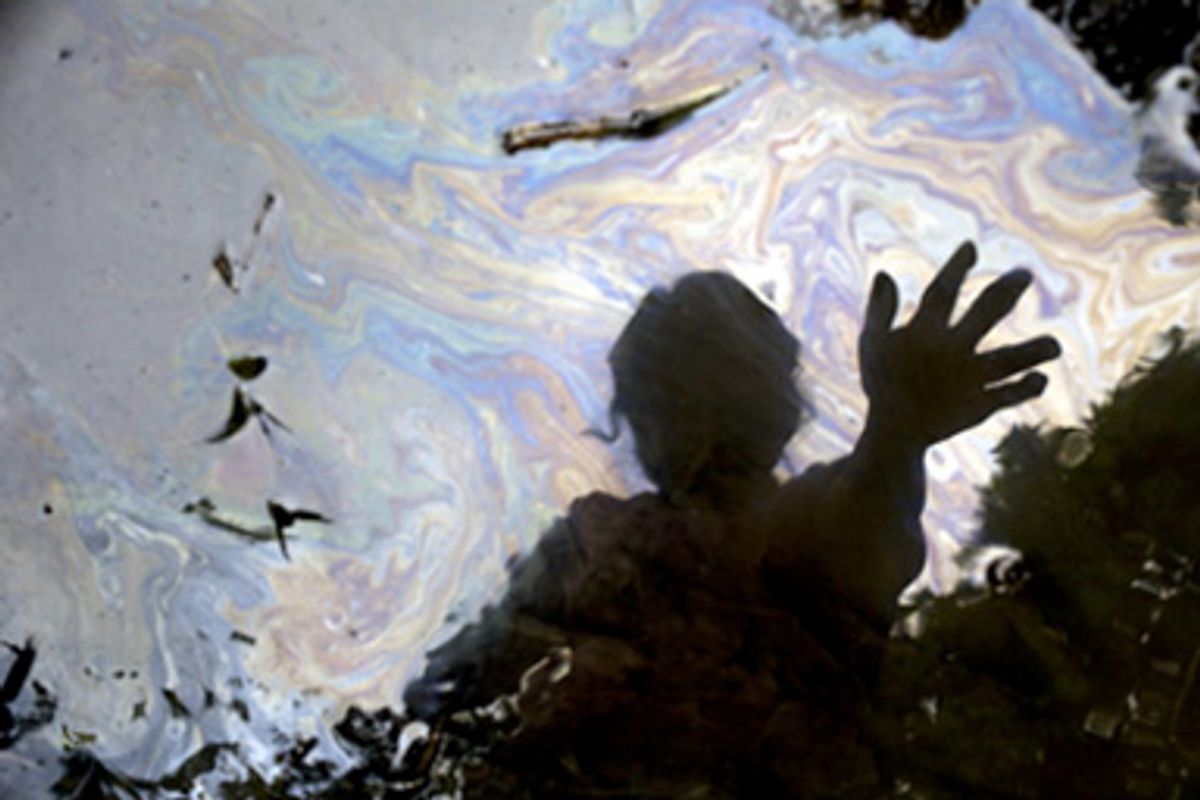

Joe Berlinger is such a tireless talker -- a spinner of anecdotes and theories, and alternately an ardent defender and harsh critic of his own work -- that I should let him explain "Crude" in his own words. Briefly, though, this new documentary from the co-director of "Paradise Lost," "Brother's Keeper" and "Metallica: Some Kind of Monster" explores the epic-scale, endlessly complicated story of one of the largest lawsuits in history. It's the suit in which the indigenous inhabitants of Ecuador's Amazonian jungle are on the verge of winning a massive judgment from Chevron -- a court-appointed expert has suggested $27 billion -- for the poisoning of their homeland, previously among the most pristine and biodiverse rain forest regions on the planet.
"Crude" sometimes seems like improbable fiction, a story co-authored by Charles Dickens and Che Guevara in which a former oilfield worker named Pablo Fajardo, who still lives in the two-room house where he grew up, is now the plaintiffs' lead attorney, threatening to bring the world's fifth-largest corporation to its knees. One of the story's many oddities is that Chevron was never involved in Ecuadoran oil exploration, or in the alleged systematic and deliberate discharge of oil sludge and contaminated water that has sometimes been called the "Amazon Chernobyl." But when Chevron acquired Texaco in 2001, it also took on that company's assets and liabilities, and now must defend itself in a case that has had many unexpected twists and turns.
After lawyers for the 30,000 or so Ecuadoran plaintiffs filed suit in the United States, Chevron fought for years to have jurisdiction returned to Ecuador, probably assuming that that country's traditional pro-business oligarchy would make the whole thing go away. Sometimes you need to be careful what you wish for: Now Ecuador has a left-leaning president, Rafael Correa, who is allied with Venezuelan President Hugo Chávez and openly sympathetic to the anti-Chevron case. As Berlinger's camera captures, the trial was largely conducted outdoors, on the site of the alleged contamination, with soil samples taken in public with the cameras rolling. Chevron's attorneys respond with various contradictory claims: That sludge in the ground isn't dangerous; it isn't ours; it wasn't taken from the right place; people shouldn't be living here anyway.
Over the course of four years in diverse and difficult conditions, Berlinger captures Fajardo and his American consultant, Steven Donziger, as they travel from Ecuador to New York to Houston and back. He meets residents and nurses in the Cofán indigenous community who discuss the cancer clusters and epidemic skin diseases found in the area around the contaminated waterways. He follows Trudie Styler, the jet-set fashion-plate spouse of Sting, as she tours the region and renders it an international cause célèbre. At the last minute, just as Berlinger was preparing the film for Sundance this year, he was granted interviews with a senior Chevron scientist and a corporate counsel, who assured him that A) everything is fine in the affected region, and B) we're off the hook, legally speaking, even if it isn't.
Berlinger is a leading practitioner of the cinéma-vérité method, which avoids voice-over narration or other devices aimed at directing the reader toward a specific conclusion. This is somewhat unusual in a film that seems so clearly a work of advocacy, but as he explained during a phone call that was scheduled for 15 minutes and stretched to 45, his job is to convince the uncommitted viewer that what Texaco did in the Amazon was an immense moral crime -- not to create agitprop on behalf of the plaintiffs in a specific lawsuit. First, here's the official trailer for "Crude":
Joe, I was thinking that the vérité method must have posed a special challenge in this case. You're not in the business of telling the audience who is right and who is wrong, and that comes with certain advantages and certain disadvantages for a storyteller.
Definitely. I don't believe in voice-over narration, but voice-over narration helps you speed the story along and gets you through difficult moments you may not have coverage on. This film was one of the hardest editing challenges I've ever faced, because there's a complicated 13-year history behind this lawsuit, which you have to dole out to the audience so they understand the context. Then you can get to the present-tense story.
I think my point of view is all over this film. This film has been criticized at film festivals by more activist-oriented folks, who think I've given Chevron too much screen time and think that I need to have a clearer point of view. But I have a certain view of how to engage an audience. I'm a pretty active television producer and executive producer, and I see a lot of environmental and human-rights films that have this style of banging a singular message over somebody's head. That's a very different theatrical experience from engaging the audience to be a judge or a juror, to weigh the pros and cons of all the issues.
I think it makes a more persuasive film, and, ironically, a more effective advocacy film, if you allow people to arrive at a point of view on their own. When you whitewash certain troubling aspects of a situation because you think, oh, it takes away from the main point of view that Chevron is evil -- that makes the film less honest and less interesting and less real. You end up just preaching to the converted, when the mission ought to be to bring people who aren't sure about what they think into your camp. A non-narrated approach, a warts-and-all portrait of all sides, is to my mind a more persuasive moviegoing experience.
Right. I mean, just in terms of the lawsuit, I didn't come out of this film absolutely sure who was going to win, or who should win. The issue of liability seems immensely complicated, and I'm not sure if anybody really understands it.
People have said to me, "You give Chevron too much airtime. You don't seem utterly convinced that they should lose the lawsuit." Well, I'm not utterly convinced that they should lose the lawsuit, because I'm coming at it from a different perspective. Specifically, I'm not smart enough or well enough equipped -- I'm not a judge or a scientist, and I haven't read the 100,000 pages in binders in that judge's office. I can't tell you whether Chevron has wrapped itself up in enough legalese to prevail in that lawsuit. But I can tell you that some things are larger than the lawsuit, and that the moral responsibility lies at their door. You don't go into somebody's backyard and treat it the way they treated it. I don't care about the legality. Manifest destiny was a legal philosophy that justified all sorts of terrible acts in this country. The Nuremberg racial laws made discrimination against Jews legal in Germany. So I can't tell you whether Chevron should win or lose in this lawsuit, but I don't think they have morality on their side.
The film to me is not about the lawsuit. After having spent almost four years on this situation, I see a certain inadequacy to the legal structures in place to deal with these human rights and environmental crises. It has taken 17 years to get to this point, and it will probably take another 10 or 15 years for the whole thing to be appealed and counter-appealed and worked out, and then God knows how long before payment is made. That's just too long. Generation after generation are suffering. While this legal proceeding goes on, people are dying and generations are being affected.
So I'm comfortable showing both sides of the lawsuit, to show how messy it is and how long it takes. Also, I think truth rises to the top. No matter how much corporate-speak legalese they wrap themselves up in, the ultimate message of the film is that for 600 years white people have treated indigenous people abysmally. It's a part of our history we really don't grapple with. I mean, at some level we know, in the back of our heads, that that Jack in the Box over there used to be a Cherokee village, and we moved these people out of sight.
Here was the big epiphany for me in making this movie -- it seemed like that was something that happened in the distant past, but the reality is that multinational corporations of the late 20th century, particularly in the extractive industries, are just the modern-day continuation of this shameful treatment of indigenous people. The Chevron lawyer in the film says, "People shouldn't be living here. This is an industrial zone." No, sorry. People have been living here for millennia. So I think this is an advocacy film. It's an advocacy film on behalf of indigenous people who were fucked over by Catholic missionaries, and then by their own governments, and then by the oil companies.
On one side you have this enormous oil company, and on the other side you have this former oilfield worker just out of law school, and they're fighting it out in the legal system of a country that, let's face it, has a long record of cronyism and corruption. It doesn't seem like a fair fight.
Chevron fought for years to get the case moved to Ecuador, and I don't think they ever imagined it would go to trial. At the time Ecuador was run by a military junta that was very pro-business, run by the Spanish-descended oligarchy. It was a very comfortable and cozy relationship: extracting minerals and fucking over the indigenous population. I don't think they counted on a couple of things that have taken place that happened that, luckily for me, were very cinematic. One of them was the emergence of this local populist hero, Pablo Fajardo. A local oilfield worker, impoverished but horrified by the humiliation of the workers and the environmental degradation, pulls himself up by the bootstraps and gets educated, gets a law degree, and his very first legal case -- which gains traction and results in at least a moral victory -- is against the fifth-largest company in the world. You simply couldn't make that up.
Chevron also didn't count on the emergence of a global environmental movement and the rise of mistrust of large corporations and their way of doing business, of pursuing profit at all costs. Then there was the change of regime in Ecuador, the election of Rafael Correa, who gets a bad rap in this country as a left-wing, anti-corporate protégé of Hugo Chávez. And a lot of that is accurate, to be fair. But he's the first president to visit the region, the first one to have some sympathy for the indigenous people and the first one to eschew cozy relationships with the extractive industries. Ecuador actually passed certain constitutional rights for flora and fauna last year, as a demonstration of their new commitment to the environment. Correa is having mixed results, but instead of extracting the oil, he wants to sell the oil rights to people who will keep it in the ground.
There are a lot of fascinating characters in the film, but I was really interested in Sara McMillan, the environmental scientist Chevron supplied to you at the last minute. She says everything is fine in Ecuador, there's no problem, if people are getting sick it's not our fault. She's very reassuring and comes off as really sincere. If she's lying, she's doing an extraordinarily good job of it.
She does come across as sincere, and I think she is. That's one of the deeper and more troubling aspects of those interviews. I think she believes every word coming out of her mouth. She's been down there, but she's drunk the Kool-Aid.
It reminds me of our earlier film, "Paradise Lost" [about the dubious conviction of the "West Memphis 3" on murder charges], when co-director Bruce Sinofsky and I were so flabbergasted at what was going down that we'd pull the judge aside, or the prosecutor, and ask them, "Are you guys kidding?" It became very clear that the judge, the prosecutor and the chief inspector had utterly convinced themselves of the righteousness of their mission and the evilness of Damien Echols [accused of masterminding the killings]. It's not that they were covering something up. It's more difficult to change that mind-set than it is to expose a coverup.
It's the same thing with this woman from Chevron. I believe she believes every word that comes out of her mouth. That to me is scary, and it's a signal of institutional denial. We're not talking about bad individuals, we're talking about an institution with no regard for indigenous people.
Another ambiguous area in "Crude" is the presence of Trudie Styler, Sting's wife. On one hand, she's clearly done a lot for the Amazonian people, and has raised the international profile of the case tremendously. On the other hand, you've got the bogus architecture of celebrity, and this beautiful, well-mannered English lady showing up in an outfit that cost more than every physical object in the Cofán village, all put together.
Absolutely. I have tremendous regard for Trudie and Sting. The only tangible benefit these people have received in 17 years of outside involvement are the water-filtration systems Trudie brought to the region. She and Sting have been talking about the rain forest and the rights of indigenous people for many years, long before celebrity drive-by cause-embracing had become favorable.
But the film is observing and commenting upon that uncomfortable intersection between celebrity culture and social activism. It is a shame that only when the wife of a rich and famous rock star comes to town, this case gets kicked up a notch. There are many places around the world that don't have a film and don't have a rock star or a celebrity to help them.
To go back to "Paradise Lost," Damien Echols is alive today -- and I don't say this arrogantly -- because the film produced a great outpouring of support from people like Eddie Vedder, Johnny Depp and Norman Lear. There were a tremendous amount of people who saw that movie and joined an international movement. The film came out at just the right time, just when the Internet was becoming a communication device in a big way. Lots of money has been raised, and if it hadn't been for that outpouring of support, Damien might not be alive today. I don't think the state of Arkansas has the balls to inject the guy, because of all the international attention and celebrity involvement.
I bring that up because that's an example of a guy being lucky, because a film was made. I can't tell you how many letters I've gotten over the years from wives or mothers or girlfriends of people on death row who claim they're innocent. Of course, not everybody is innocent, I'm not that naive. But those people don't have a film or a celebrity, and it's the same thing with these human-rights cases and pollution cases. This is just one part of the world that's been ravaged by the oil industry. They happen to have a celebrity involved and a film being made. The film is definitely a comment on that -- not just on Trudie's involvement but the film's involvement. It's a shame that that's what it takes to move the needle.
"Crude" is now playing at the IFC Center in New York. It opens Sept. 18 in Los Angeles; Sept. 25 in New Orleans, San Diego and San Francisco; Oct. 1 in Toronto; Oct. 2 in Chicago; Oct. 9 in Philadelphia, Portland, Ore., and Austin, Texas; Oct. 16 in Coral Gables, Fla., Denver and Santa Fe, N.M.; and Oct. 23 in Seattle and Washington, with more cities to follow.
Shares