Bank Bailouts
Feeling sorry for George Bush
An insider account of the White House during the height of the financial crisis achieves the impossible: Pity
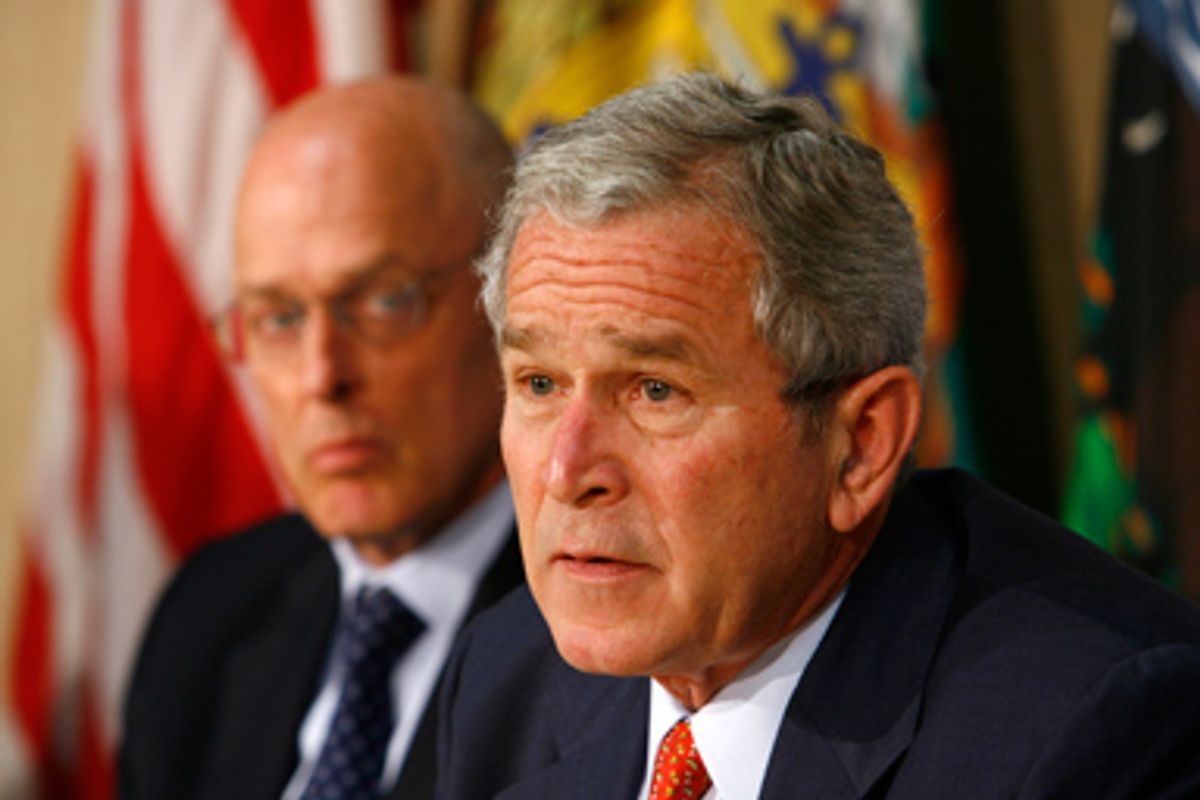
U.S. President George W. Bush speaks during a meeting with members of his economic team at the Department of Energy in Washington July 11, 2008. At left is Treasury Secretary Henry Paulson. What’s the first lesson to be learned from Matt Latimer’s amazing account in GQ of the Bush White House during the height of the financial crisis?
Never trust a speechwriter not to spill the dirt. Fish gotta swim, birds gotta fly, and writers gotta write. You’d think that a man who says that he had always “dreamed of heading to Washington to work for a conservative president and help usher in another Reagan Revolution,” would be loyal to the cause. But with the kind of material Latimer was sitting on, who can blame him for grabbing a book deal and telling all?
My colleague Alex Koppelman cherry-picked some of the more politically explosive quotes grabbed by the New York Daily News yesterday. But the GQ excerpts are even more revealing for the picture drawn of a White House that had no clue what to do about the economy, and did not even remotely understand what its own treasury secretary was proposing to do to fix the mess.
We wrote speeches nearly every time the stock market flipped. Meanwhile, the White House seemed to have ceded all of its authority on economic matters to the secretive secretary of the treasury. The president was clearly frustrated with this. I was told that at one Oval Office meeting, he got very animated and exclaimed to Paulson, “You’ve got to tell me what you’re doing!” (In the weeks that followed, Paulson changed his spending priorities two or three times. Incredibly, he’d been given the power to do with that money virtually anything he pleased. All thanks to a president who didn’t understand his proposal and a Congress that didn’t stop to think.)
OK, much as it pains me, I can forgive the president for not understanding what Paulson was doing. No one understood what Paulson was doing, including the secretary himself, as was clear from his testimony to Congress. But at least Paulson was doing something. The global economy was crashing and he felt a responsibility to act. But the White House, in general, was helpless: An imminent depression simply did not fit into the ideological parameters of an administration that had hitherto determined economic policy according to Karl Rove’s political calculations. The brutal fact is that an administration that prided itself on not being reality-based had no idea what to do when reality could not be ignored.
At one point, Bush, faced with congressional resistance to the TARP bailout plan, cries out in rage to his assembled aides, “Then why the hell did I support it if I didn’t believe it would pass?” But no one had an answer for the president, because there was no good answer.
Perhaps Matt Latimer’s most astounding achievement is to make one feel a little sorry for Bush. The poor man was so clearly in the wrong place at the wrong time — and history will never let him or us forget it.
Finally, this might be one self-serving tell-all account that is actually worth buying, if only because Latimer displays a cutting dry humor that one does not expect from your typical Republican apparatchik.
We were chatting casually when the president’s favorite speechwriter came in. Chris Michel was in his midtwenties, with sandy blond hair. He was usually chipper, though at the moment his face was so pale he must have been the whitest man in the Bush White House. And that was no small accomplishment.
Andrew Leonard is a staff writer at Salon. On Twitter, @koxinga21. More Andrew Leonard.
Top Obama campaign aide lobbied for bank bailout
Senior campaign advisor Broderick Johnson was paid over $1 million to lobby for Wall St. over the past five years
Barack Obama and Broderick Johnson(Credit: AP) The Obama campaign is keeping mum on the role senior advisor Broderick Johnson played in lobbying for the 2008 Wall Street bailout when he worked as a hired gun for the country’s largest financial services companies.
Johnson’s past work as a lobbyist was noted in the press when he was appointed a top Obama surrogate in late October, but not the details of his extensive and lucrative work for the financial services industry. Johnson’s hiring despite his recent work for Wall Street strikes a dissonant note in view of the Obama camp’s reported strategy of “channeling anti-Wall Street anger” as a way to take on the Republicans.
Continue Reading CloseJustin Elliott is a reporter for ProPublica. You can follow him on Twitter @ElliottJustin More Justin Elliott.
How the rich rig the system
From low capital gains taxes to stock buy-backs, here are the ways the elites ensure the markets benefit them
(Credit: Lynne Furrer via Shutterstock) A growing number of Americans suspect that the American economic system is rigged in favor of the rich and merely affluent. That growing number of Americans is right.
Here are three of the many ways that markets for compensation are rigged to benefit not only the top 1 percent but also the top 10 percent, a group that includes many well-paid professionals:
Financial sector compensation. By now the phrase “too big to fail” has become so familiar that it is known by its acronym: TBTF. What needs to be emphasized is that TBTF is the basis for the huge bonuses paid to elite American bankers who benefit from a government that socializes their losses while allowing them to keep their profits.
Continue Reading CloseMichael Lind’s new book, "Land of Promise: An Economic History of the United States", will be published in April and can be pre-ordered at Amazon.com. More Michael Lind.
Occupy HQ: A bailed-out bank
In an ironic twist, a plaza in a Deutsche Bank skyscraper on Wall St. has become a key meeting place for protesters
An Occupy working group meets at 60 Wall Street.
(Credit: Justin Elliott) Occupy Wall Street’s de facto headquarters is the atrium of a skyscraper that is home to a large bailed-out bank.
Various Occupy working groups, the key decision-making bodies of the movement, gather several times a day at 60 Wall Street, the North American headquarters of Deutsche Bank. Lined with palm trees and waterfalls, with direct access to shops and the subway, and — crucially — heated, the atrium is a respite from the raw, chaotic environs of Zuccotti Park.
The fact that Deutsche received bailout money — which was news to several occupiers I interviewed at 60 Wall Street — imbues the space with an ironic symbolism. A movement taking on global finance is now literally being run out of the ground floor of one of the industry’s biggest players.
Continue Reading CloseJustin Elliott is a reporter for ProPublica. You can follow him on Twitter @ElliottJustin More Justin Elliott.
A declaration of independence — from Wall Street
Washington can't -- or won't -- fix the economy. So we're going to have to do it ourselves
(Credit: iStockphoto) After three years of political nonsense, we can hold one truth to be self-evident about our government. It is broken.
A financial crisis that should have inspired a grand new set of rules for Wall Street instead delivered a hopelessly compromised reform package — and even that weak sauce is under daily withering assault from the banking industry. The devastating aftermath of a Great Recession that should have demanded unrelenting executive action instead degenerated into a fruitless squabble between two parties competing to see who could best cut and cripple government.
Continue Reading Close
Andrew Leonard is a staff writer at Salon. On Twitter, @koxinga21. More Andrew Leonard.
A proposed demand for Occupy Wall Street
Let's tackle the debt that actually matters VIDEO
(Credit: iStockphoto/kryczka/Salon) The establishment press’s primary “problem” with the Occupy Wall Street protest is that those silly kids don’t have a concrete demand. Or they have too many demands. Or their demands aren’t realistic.
This is silly. The movement’s “demand” is economic justice. Its goal is plainly to remind everyone that the bloated, obscenely profitable financial industry is sitting on vast piles of money while everyone else struggles, and to focus outrage about that situation where it belongs. Groups aligned either directly or in spirit with Occupy Wall Street have spent years issuing tons of demands (a financial transaction tax!) that the elites dismiss as unreasonable and the objective press ignores as unrealistic.
Continue Reading Close
Alex Pareene writes about politics for Salon and is the author of "The Rude Guide to Mitt." Email him at apareene@salon.com and follow him on Twitter @pareene More Alex Pareene.
Page 1 of 31 in Bank Bailouts