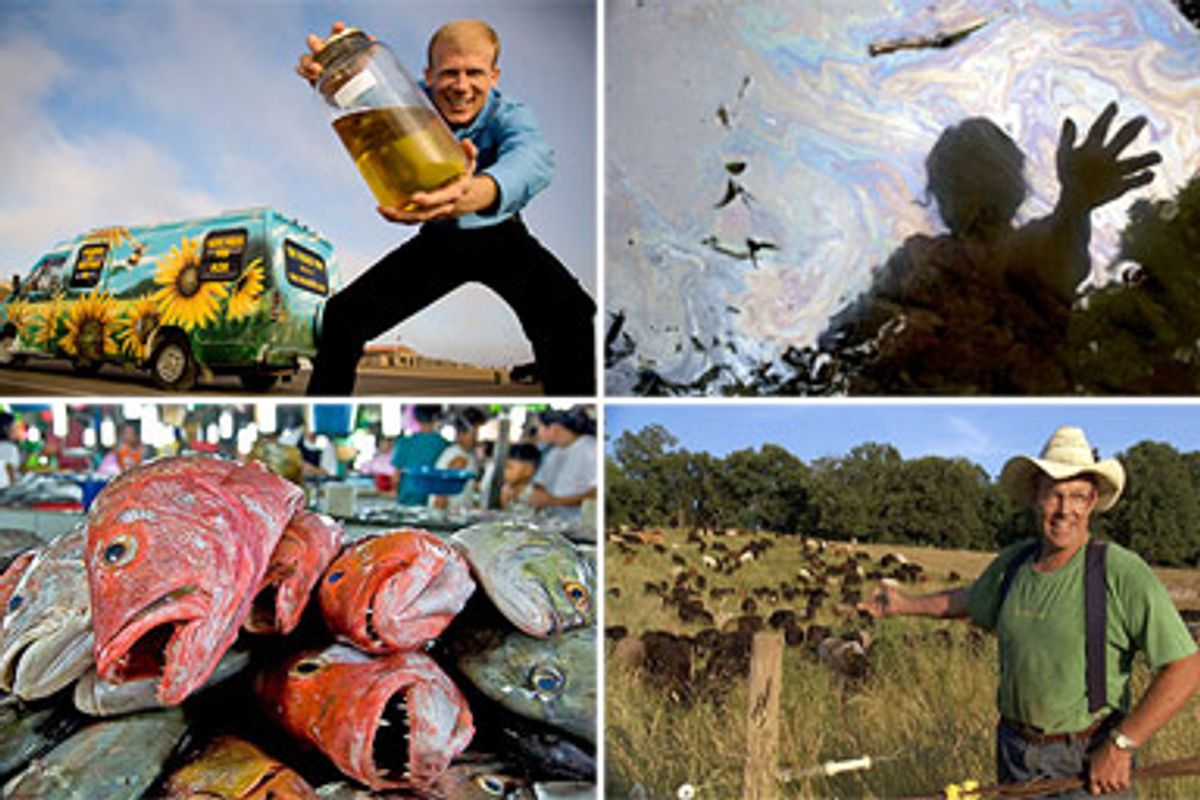
A guide to help you choose between "Earth" and "Earth Days," and "War, Inc." and "Food, Inc."
Stills from Fuel, Crude, Food Inc and The End of the Line

Clockwise from top left, images from “Fuel,” “Crude,” “Food Inc.” and “The End of the Line”
I say this from the bottom of my heart, with deep conviction: “An Inconvenient Truth” changed the world. Did the Davis Guggenheim-Al Gore PowerPoint-based Oscar winner mark a turning point in global climate change, and the beginning of a carbon-neutral future? Oh, that. I have no idea about that. But it sure changed the world of movies. As any successful film is likely to do, “Inconvenient Truth” established a template for other eco-catastrophe documentaries to follow, and inspired a legion of well-intentioned emulators, wannabes and copycats.
Across the filmland economy, funding dried up for zombie-stripper flicks and Iraq war docs alike, and this year the eco-doc floodgates opened. Filmgoers in 2009 have been barraged with feel-bad flicks, each of them assuring us that the dire plight of the endangered blue-tailed skink, e.g., is dooming our grandchildren to lives of poisoned, skink-free grimness and slavery, and that it is the Unique Responsibility of Our Generation to Do Something. (Cut to mid-level celebrity, say, Eliza Dushku, without much makeup on: “I always thought that skinks were, like, these pretty lizards who lived in my mom’s flower pots. I was like everybody else: I didn’t understand the ancient wisdom of a simpler time! When you’re on the Hollywood Freeway with a triple latte, you’re just not confronting the way skinks are bound with the future of our planet!”)
I jest, but only sort of. The post-Gore wave of eco-docs has produced some fascinating, information-rich and occasionally beautiful filmmaking, but it also threatens to cancel itself out in a cacophonous roar of competing voices. Can you tell “Earth” apart from “Earth Days”? Is “Food Inc.” a sequel to “War, Inc.”? (And when is ”Sex Inc.” coming out?) Most of these movies bring life to the phrase “labor of love,” resulting from years of dedicated work and sacrifice at starvation wages. Their directors and producers have defied the odds in getting them released at all, and most have gone on to defy conventional release patterns: They hopscotch from one film festival to the next, screen in church basements and community centers, self-distribute on DVD or online.
Some of these movies will never “succeed,” according to the film industry’s standards, and they vary enormously when it comes to coherence and cinematic quality. Some are genuine outsider projects, some are made by prestigious documentarians and some are corporate attempts to cash in on eco-chic. But they all represent the tip of an extremely large iceberg, and reflect the fact that environmentalism has become a mass-scale, grass-roots-based movement that can’t be controlled by politicians, policy wonks or talking heads. In that sense, maybe these movies will change the world — but only if you know which ones to catch and which ones to skip. Herewith, Salon’s exclusive user’s guide to the eco-docs of 2009.
“Fuel” Activist-cum-filmmaker Josh Tickell spent 11 years of his life on this film, but as he appears to have had a blast driving around the country in his goofball, biodiesel-powered van, I suppose it’s all good. Pushing two hours in length and chaotically structured, “Fuel” is a high-spirited, pseudo-encyclopedic tour of everything that’s wrong with America’s energy policy and how it all could be made right through a combination of biodiesel, wind and solar power. Maybe his arguments aren’t all as convincing as they look at first glance, but Tickell gets full marks for making an eco-doc designed to uplift and inspire — it’s the Viagra of green movies!
After taking his film (and his crunchy-power vehicles, including a new one fueled with algae) to innumerable film festivals — and getting short-listed for the ’08 documentary Oscar — Tickell finally has a theatrical distribution deal. “Fuel” opens this week in New York, San Francisco and Washington; and Sept. 25 in Los Angeles and Philadelphia, with lots more cities to follow.
- Hero: For better or worse this movie is about Tickell himself, and his quixotic, low-rent-Michael Moore quest to tell the world that we’ve already got all the darned alternative-energy technology we need, and all we lack now is the darned gumption, darn it.
- Villain: All the usual suspects. The oil companies, the auto manufacturers, the government and to some extent the lazy-ass, narcotized American consumer. Hey, I’m not arguing the point.
- Celebrity quotient: Pretty damn high. Woody Harrelson, Sheryl Crow, Willie Nelson and Larry David all appear, more or less gratuitously.
- Film most likely to be confused with: I’ve already heard it referred to as “Fuel Inc.” Any other movie with a short noun for a title.
- Takeaway: I’d heard so many film-industry people moaning about this movie that I was pleasantly surprised. “Fuel” is pure agitprop, but audiences love it, and you come out convinced that our current energy policy is unbelievably dumb (no-brainer, granted) and that we at least ought to try some of Tickell’s solutions.
- Mainstream-media snark factor (MSMSF): Pretty minor so far; reviews have been decent. But documentary mavens kind of hate it, and with a New York opening this week, Tickell’s about to have a can of gaseous, lethargic big-city ennui opened on his ass.
“Crude” Not an eco-doc in the classic sense, Joe Berlinger’s fascinating cinéma-vérité exploration of the $27 billion pollution lawsuit filed against Chevron by indigenous groups in Ecuador shares the same consciousness-raising goals and aims at the same audience. Berlinger’s fly-on-the-wall methodology ensures that there’s plenty of ambiguity here, and he goes to great lengths to include Chevron’s point of view (legalistic and inane as it may be). A meaty process film that captures the intersection of global petro-politics, law, inequality and celebrity, “Crude” is thought-provoking and profoundly unsettling. It most definitely does not leave you thinking that everything will be OK if you make your own diesel fuel out of corn husks scavenged from Dumpsters.
- Hero: Up-by-the-bootstraps Ecuadoran lawyer Pablo Fajardo, a one-time oil-field worker turned indigenous-rights crusader. Secondarily and more ambiguously, Steven Donziger, the alternately appealing and offputting New York lawyer who is Fajardo’s main advisor.
- Villain: I can appreciate that Chevron is in a no-win position here. It inherited the toxic nightmare in Ecuador when it bought Texaco in 2001, and now must battle an enormous potential judgment in a country that has swung sharply toward the anti-American left. Well, cry me a river. And don’t their corporate communications people understand that the more they attack Berlinger’s film, the more people will want to see it?
- Celebrity quotient: London socialite Trudie Styler swans through the poisoned indigenous communities in one awkward sequence. In fairness, Styler and her husband, Sting, have done a great deal to help the afflicted villages, and have put the Chevron case on the international cause-of-the-month calendar.
- Film most likely to be confused with: “Fuel”
- Takeaway: It’s a grim and engaging yarn leavened by flashes of possibility, something like the legal case from Dickens’ “Bleak House” transplanted into “Heart of Darkness.” Opening-week audiences at New York’s IFC Center have been tremendous.
- MSMSF: None. Even the members of the entertainment media, who bow to no one in their jadedness, aren’t going to side with Chevron against a well-respected documentary filmmaker and a bunch of dirt-poor Amazonian Indians living in a poisonous cancer cluster.
“No Impact Man” New York couple Colin Beavan and Michelle Conlin, both writers, decide almost on impulse to transform their lifestyle such that they have near-zero environmental impact, meaning no TV, no air conditioning, no product packaging, no food grown outside their home region, etc. (Yeah, yeah — no toilet paper either.) The result was Beavan’s fascinating blog and just-published book, along with this highly entertaining documentary by Laura Gabbert and Justin Schein, which captures both the problems attendant on worm-composting and lack of refrigeration in the Manhattan summer (more maggots than a Dario Argento movie!) and also the reality-TV-style psychodrama of the Beavan-Conlin marriage. Beavan tends to drive people nuts, while the self-effacing shopaholic Conlin is irresistible.
- Hero: Husband and wife both have their followers — Beavan has become a highly in-demand environmental speaker and fundraiser — but Conlin is the undisputed movie star. She’s the one who buys a $975 pair of boots just before the project starts, and then must walk up and down nine flights of stairs in them. She’s the one whose conversion experience is both dramatically and personally effective.
- Villain: For perhaps a third of the audience, that’s going to be Beavan, who can come off as a cloaked, judgmental persona. The intended villain, of course, is the mixture of apathy, complacency and conventional wisdom that makes most of us feel completely powerless in the face of impending global doom.
- Celebrity quotient: Well, much of the problem with “No Impact Man” comes from its resemblance to reality TV, and from the fact that Beavan and Conlin have now reinvented themselves as ambiguous public figures. I like their irascible friend Mayer, who teaches Beavan how to grow vegetables and strives to indoctrinate him with leftover ’60s anarchism at the same time.
- Film most likely to be confused with: No problem here! Comparisons to “Super Size Me” aside, this movie is instantly identifiable as itself.
- Takeaway: This couple’s naive struggle to save the planet single-handed will either suck you in or drive you batshit. There’s not a lot of middle ground here. But love ‘em or hate ‘em, it’s a damned entertaining spectacle.
- MSMSF: Over the moon. The Beavan-Conlin household has been the target of an extended takedown by the New Yorker’s Elizabeth Kolbert, and reviews have tended to dismiss the environmental message and describe the film as if it were a Henry James novel: It “unsparingly exposes the confused power dynamics of a certain kind of modern middle-class marriage,” wrote A.O. Scott of the New York Times. That’s not entirely off base, but it also speaks to how uncomfortable most lardass journalists are when confronted with anything that might require them to reflect on the world of power and privilege they inhabit and their own ideological preconceptions about it. (Allow me to clarify that I don’t mean that Tony Scott is a lardass, specifically — he looks pretty good on TV!)
“The End of the Line” Traveling from the tuna markets of Tokyo — where some wholesalers reportedly have tons of that delicious red meat frozen against future shortages — to the streets of London, the straits of Gibraltar and the coast of Senegal, British director Rupert Murray paints a dire but colorful portrait of the global overfishing crisis. A thoroughly depressing catalog of how completely we have devastated the world’s oceans, “The End of the Line” argues that many factors have combined to cause a near-catastrophe: rising populations and widespread poverty in the developing world, coupled with the rising popularity of seafood in the metropolitan West and the explosion of high-tech methods for finding and catching ever more fish. Late in the film, some hope is offered: If we can limit our appetite for seafood, especially the large and delicious ocean fish, most species can still recover.
- Hero: Charming, laconic English reporter and author Charles Clover, who delights in tormenting high-end chefs, dysfunctional Euro-bureaucrats and trawler operators who flout the rules.
- Villain: Well, the global fishing industry has operated with no rules — or broken them, where they existed — for generations. But the real culprits, I am afraid, are you and me. Sushi, anyone?
- Celebrity quotient: None, unless you take sides in the intra-professional warfare between fisheries biologists.
- Film most likely to be confused with: There are at least four other movies with this title, two of them made in this decade. Also sounds like “At the Edge of the World” and “Encounters at the End of the World.” Enough with the bland and generic phrase-titles, people!
- Takeaway: The mixture of rage and hope in this one is tough to take, frankly. Fixing the overfishing problem would be relatively easy, compared to, say, global warming. No new technology is required and the solution is well understood. But political will, changes in the global marketplace and adjustment of human appetites would all be required, and I’m not too sanguine about those.
- MSMSF: Not much, except for the fact that the film went almost unnoticed. This is an urbane, professional, impressively constructed documentary, although its subject strikes people as a little abstract and unsexy.
“Food Inc.” This eye-opening agitprop doc about the true costs of cheap, corporate food, a collaboration between director Robert Kenner and writers Eric Schlosser (“Fast Food Nation”) and Michael Pollan (“In Defense of Food”), is one of the signal cinematic moments of 2009. Although compared often to “Inconvenient Truth,” “Food Inc.” represents a much earlier phase of activism. As Pollan said when I interviewed him, the local and organic food movement is about where environmentalism was 40 years ago, just before the first Earth Day. A complex and layered attack on agribusiness and its transformation of America’s food economy, Kenner’s film both recognizes that corporate food production has had obvious benefits for consumers and argues that in the long run it’s unhealthy for everybody. Alternately horrific, humorous and inspiring, “Food Inc.” continues to play around the country as an organizing tool for locavores and organic-food mavens.
- Hero: Of course Michael Pollan is an eloquent speaker with a huge following, but it’s Joel Salatin, a western Virginia farmer and rancher who raises organic livestock, who steals the show with his Will Rogers-flavored folk philosophy.
- Villain: Nobody from Smithfield, Perdue, Tyson or Monsanto would comment on camera for the film. Suffice it to say their hard work on behalf of the American consumer is depicted harshly herein.
- Celebrity quotient: Near-zero, although in some overeducated quadrants Pollan may qualify.
- Film most likely to be confused with: Is it a sequel to “War, Inc.” or a companion piece to “Fuel”?
- Takeaway: Unabashedly partial but thoroughly nonpartisan, this is terrific muckraking journalism.
- MSMSF: Absolutely none. Reviews have been universally glowing.
“At the Edge of the World” This odd, breathtaking high-seas adventure follows the eco-pirates of the Sea Shepherd Conservation Society (originally a Greenpeace splinter group) as they pursue the Japanese whaling fleet in the ocean off Antarctica. Deliberately controversial, and likely to alienate at least as many viewers as it delights, Dan Stone’s doc makes an intriguing companion piece to Louie Psihoyos’ vastly more respectable dolphin doc, “The Cove” (see below).
- Hero: Very much depends on your perspective, but Alex Cornelissen, the laconic young Dutchman who captains one Sea Shepherd vessel, comes off as a high-integrity action-movie protagonist who steers by his own compass but is no zealot. Vin Diesel could play him in the fictional version — for that matter, so could Adrien Brody.
- Villain: You can debate the semantics, but the Japanese have found a loophole in the international whaling moratorium that permits them to flout the law’s spirit, if not its letter, and stock the sushi bars of Tokyo with whale meat.
- Celebrity quotient: Nah. Greenpeace renegade Paul Watson, who founded Sea Shepherd, is as close as we get.
- Film most likely to be confused with: Werner Herzog’s “Encounters at the End of the World.” That’s a terrible title too (although a terrific movie).
- Takeaway: Watson is a divisive figure, seen as an ineffective bombast even by many people within the environmental movement. As to the bigger picture, you’re free to debate the morality of Sea Shepherd’s tactics, call them terrorists, etc. They’re fearless, they believe in what they’re doing, they have indeed saved some whales, and it looks like they’re having a blast.
- MSMSF: Surprisingly, not that high. One prominent critic, says Rotten Tomatoes, actually called this “the summer season’s most surprising and thought-provoking documentary.” Oh, wait — that was me. Seriously, though, there’s been considerable Internet chatter directed against Watson and the Sea Shepherds, but critics have been gentle.
“The Cove” This blend of James Bond-style adventure and Jacques Cousteau-style underwater discovery is beautifully photographed, thematically explosive and often surprisingly funny. It’s a smashing filmmaking debut from longtime nature photographer Louie Psihoyos, so why has it underperformed at the box office? Could be that scene where we watch hundreds of dolphins slaughtered in a secret Japanese cove, but I’m just guessing. Still, Psihoyos and his collaborator and star, longtime dolphin activist and former “Flipper” trainer Ric O’Barry, have accomplished at least some of their goals — this year there was no dolphin massacre in Taiji, Japan, and dolphin meat is off the local school-lunch menu. Definitely a contender in this year’s docu-Oscar race.
- Hero: O’Barry has spent most of his life campaigning to free dolphins from captivity, using legal and extra-legal means. This stems from an electrifying story he tells in the film, about watching one of the “Flipper” stars, in his words, commit suicide as a result of life in captivity.
- Villain: As with the whaling issue, it’s easy to blame the Japanese. But there wouldn’t be a dolphin roundup at Taiji if there weren’t an international dolphinarium trade, eager to pay prices as high as $250,000 for the most desirable young-adult dolphins. (It’s the rejects who get turned into meat, which is often mislabeled and contains near-toxic levels of mercury and other heavy metals.)
- Celebrity quotient: Well, O’Barry might have turned himself into a celebrity in this movie. He’s great on talk shows!
- Film most likely to be confused with: Actually, none. A title that’s simple, that works and that everybody can remember — what a concept!
- Takeaway: A tough sell to audiences, apparently, but a movie you’ll never forget and also one that’s likely to create widespread enforced changes in the dolphin trade.
- MSMSF: Some of the usual comments about how a movie can’t possibly change anything. But the response has been glowing overall.
“Earth Days” A fascinating film with a concept that’s difficult to summarize, ace documentarian Robert Stone’s latest offering feels like a voyage into a Thomas Pynchon-style alternate reality: One-tenth of the American population demonstrated against pollution and environmental destruction; a 36-year-old ex-Jesuit seminarian whose platform included “exploring the universe” was elected governor of California and appointed an astronaut-turned-hippie as his science advisor; a female college student became an overnight celebrity with an anti-childbirth commencement address titled “The Future Is a Cruel Hoax”; a Republican congressman became the leading environmental exponent in Washington; and the president ordered solar panels installed on the White House roof. Of course it all actually happened, during the now-forgotten historical period before and after the first Earth Day, in 1970. In telling the stories of those people and their era, Stone simultaneously laments the road not taken and suggests we can still learn from it.
- Hero: This movie’s awash with ‘em, from Whole Earth impresario Stewart Brand to one-time Interior Secretary Stewart Udall to longtime GOP congressman Pete McCloskey to “hippie astronaut” Rusty Schweickart to Stephanie Mills, the aforementioned anti-breeding coed. (Who was actually a student of my mom’s!)
- Villain: Once again, friends, that would be all of us. We don’t really have someone else to blame for allowing the historical moment, pregnant with exciting changes, to slip away amid the Reagan revolution and the flow of cheap Saudi oil.
- Celebrity quotient: It’s loaded — if you’re a longtime Sierra Club member who’s followed the history of American environmentalism closely. Otherwise, there’s Jerry Brown and Jimmy Carter.
- Film most likely to be confused with: “Earth,” an assemblage of pretty nature footage released by Disney at almost the same time. “Earth Days” was never such a great title, but that unhappy coincidence killed any chance this picture had at the box office.
- Takeaway: Kind of a downer, and isn’t it always like that with American history? Sometimes I feel like the entire story of this country goes from periods of overweening arrogance to a series of heartbreaking missed opportunities, and then back again.
- MSMSF: Kind of a problem. Reviews were OK, but you can’t expect people who write about movies to think about historical issues, or to understand social and political questions in anything beyond the most canned, received-wisdom terms.
Do we still need Black History Month?
Three great documentaries air, including "More Than A Month," where one filmmaker explores his conflicted feelings
A still from "More Than a Month"
Black History Month is an idea that filmmaker Shukree Hassan Tilghman finds passé. In his documentary “More Than a Month,” which premieres Thursday on PBS’ “Independent Lens,” he walks around with a signboard that says END BLACK HISTORY MONTH and receives plenty of dirty looks. But he also gets more support than he suspected — after he explains that history should be part of the American story, told even during months with more than 28 or 29 days.
As he goes about his somewhat whimsical quest, some caution him that without that annual anchor, there’d be even less black history taught than before. He takes his campaign on the road; peers into the home of the month’s originator, Carter G. Woodson in Washington, D.C.; meets with the Association for the Study of African American Life and History; and goes to Virginia to see what black history means to big fans of the Confederacy.
Eventually he gets more serious about his task, realizing that while history may convey how we were, the way we tell history conveys how we are. And he’s had one direct effect: His mother, an activist, moves the date for a black history performance she had been planning out of February to help demonstrate that it is part of the fabric of U.S. history all year round.
One day, even television networks may spread their black-heritage documentaries beyond the confines of February as well. Unfortunately, two remarkable documentaries air at the same time Tuesday in many markets.
After demonstrating that he’s a sensitive observer of life in black America with “Hoop Dreams,” Steve James is back with “The Interrupters” – a more ambitious film that follows a fearless group of activists and amateur psychologists determined to end urban violence. It makes its national TV debut this evening on Frontline (check local listings).
That James and author Alex Kotlowitz (“There Are No Children Here”) decided to focus on Chicago at the precise time its youth-killing rates and lurid viral videos made it a national news story put them in the center of the cyclone. Their alarming footage, from the center of exploding violence and retribution, put the superficial approach of the national news media and government officials — who did little more than hold press conferences — to shame.
Even more remarkable are the counselors and community-minded people, many of whom learned their lessons in the streets, who put their lives on the line to defuse the mayhem out of a regard for love and doing what’s right.
Among them, Ameena Matthews deserves to be some kind of national heroine for her street sense, humor, decency, insight and bravery, which seem to change everyone she approaches. No matter how explosive the situation, she can enter, speak sensibly and have people listen.
James and Kotlowitz do treat their subjects seriously, listen to what they have to say and show how the activists are getting things done. For the inches of progress made before our eyes, it’s a hopeful film.
“The Loving Story,” on HBO, may seem like it is tied to Valentine’s Day. But it’s only providence that the couple at the center of the story is also named Loving.
But loving is the key. Richard Loving and Mildred Jeter were both members of a small community in Virginia where whites and blacks freely worked and socialized. They met and fell in love, and like anyone else might do, got married.
But there were laws in Virginia, as there were in more than a dozen other states, outlawing any such mixing of races through marriage, using a word that is as ugly as the prejudice, miscegenation.
Somebody called the cops and the happily married duo were hit with a felony charge in 1958 — and a year in jail – which would be suspended if they’d just leave the state. Any visits back to see family or friends would have to be done individually, lest they risk arrest. They decided to fight the law, not only for their own sake, but as Mrs. Loving says in the sweetest possible way, for other people as well — because “it isn’t right.”
“The Loving Story” is in some ways the exciting case of the two young American Civil Liberties Union lawyers who agreed to take the case on and brought it to the U.S. Supreme Court. But that’s only because lawyers like to talk, especially looking back at what they can now see was the biggest case of their lives. Although there is a surprising amount of footage of the Lovings in the film, they never do say very much. They just want the right thing done. And in the end, it is.
The two are not around to tell their story, though one of their daughters is. He died in a car accident in 1975; she in 2008 at 68, surrounded by family and friends. The last anti-miscegenation law wasn’t repealed until 2000 in Alabama. Theirs is a love story that hasn’t been fully told previously — and may not have had a showcase had it not been for Black History Month.
The civil rights battle ignored by the U.S. media
The documentary "Black Power Mixtape" tells a counter-history of the 1960s, through the eyes of foreign journalists
A still from "The Black Power Mixtape 1967-1975"
It was tough enough to track the social and political upheaval of the 1960s through domestic news coverage, let alone to pay attention to what the rest of the world was reporting. But journalists from abroad were fascinated by the roiling changes — and often saw it quite differently.
Though U.S. network coverage of civil rights cruelties helped rally the country against the worst offenders in the South, coverage of revolutionary groups such as the Black Panther Party more often took J. Edgar Hoover’s extremist stance that it was the most dangerous internal threat to the U.S. Rarely did it look at the accomplishments of its free breakfast programs, community organizing and determination to stand up to police harassment and brutality.
Swedish newsmen and filmmakers who didn’t follow the FBI line came to America to learn what they could, looking at life in largely segregated black America, talking frankly and seriously with black leaders and closely following their trials.
Footage of the era, said to have been sitting in a Swedish basement for three decades, became the eye-opening documentary “The Black Power Mixtape 1967-1975” making its U.S. television debut on PBS’ “Independent Lens” Thursday night as part of its Black History Month series.
The modernist title owes in part to filmmaker Göran Hugo Olsson using modern-day commentary, from musicians in many cases, to accompany the found footage. Talib Kweli, Erykah Badu and Ahmir “Questlove” Thompson of the Roots add their contemporary revolutionary musing among commentaries by professors and historians.
The wealth of Swedish footage owes in part to the Panthers’ desire to see their movement as an international one, or one that certainly relied on support from outside the U.S.
It is the Panthers’ Embassy in Algeria where Eldridge Cleaver holds court, for example, far from the threat of FBI invasions. Martin Luther King Jr.’s visits to Stockholm to meet King Gustaf VI Adolf that are well preserved, and King’s traveling partner Harry Belafonte recalls the meeting.
Some of the earliest footage in the film shows a young Stokely Carmichael speaking in Stockholm in 1967, stating in the simplest terms the recent history of black movement in the U.S., carefully stepping beyond the nonviolent action approach by King.
“In order for nonviolence to work, your opponent has to have a conscience,” he points out coolly. “The United States has none.”
In some ways, it is the footage of Carmichael, the Student Nonviolent Coordinating Committee and honorary “prime minister” for the Panthers, that is the revelation of “The Black Power Mixtape.” How suppressed has his voice been over the years, even at a time of black history mining?
It’s certainly eye-opening for modern-day commentator Kweli, who exclaims, “He has so much passion and fire inside of him,” yet remains quite cool. “He seemed like a regular dude.”
After telling reporters in Stockholm, “I’m not as patient as Dr. King,” Carmichael takes over a Swedish interview of his own mother in Chicago to get to the point: The family’s struggles and limited opportunities can be boiled down to the fact that they are black.
One gets the sense that Swedish journalists enjoyed visiting black ghettos, where they tried to get a taste of life as they paused for interviews with Huey P. Newton and Kathleen Cleaver.
The coverage was noted in the U.S. as well, when TV Guide in a cover story complained about its negativity. Swedish reporters interviewed the story’s writer, balancing it with the view of director Emile de Antonio, who dismisses TV Guide as “an absolute nothing magazine.”
Officially, Sweden had been so critical of America’s role in Vietnam that the U.S. pulled its ambassador from Stockholm in 1968 and ended diplomatic relations with the country altogether for a time in 1972, after Prime Minister Olof Palme compared the bombings of Hanoi with the worst atrocities of Nazis.
Whatever the diplomatic relations, Swedish journalists certainly took the black revolutionaries more seriously and were plainly excited to be the first TV reporters to talk to an imprisoned Angela Davis. Still, because they worked from the same script, the question soon boiled down to: Do you have to use violence to reach your goals? Davis, receiving her first media visitor, was plainly annoyed by this, in just about the only footage that’s in color rather than black-and-white.
“When somebody asks me abut violence, I just find it incredible,” she says. “What it means is that the people who ask have no idea what people have gone through, what black people have experienced in this country since the time the first black person was kidnapped from the shores of Africa.”
The revolutionary tone of the film may provide grist for those on the right who erroneously see PBS as some kind of government-funded left-wing propaganda machine. When was the last time Louis Farrakhan was given a forum to talk about white devils?
But “The Black Power Mixtape” qualifies as a social history of a revolutionary movement, one quashed by a mid-1970s drug infusion to black neighborhoods that film participants are quite sure was caused by the government.
More than that, the modern voices in the film are resolute that lessons of the past need to be learned as the struggle goes on.
Wind power: Renewable resource, or another corporate scam?
A fascinating new film about one small-town political fight takes on the pseudo-green wind industry
A still from "Windfall"
In telling the story of a small-town political fight over wind power, Laura Israel’s fascinating documentary “Windfall” at first seems like another entry in the long laundry list of post-”Inconvenient Truth” doomsayer environmental films. Indeed, “Windfall” has some of the rural, homespun feeling of Josh Fox’s Oscar-nominated “Gasland,” which helped ignite a national debate over the natural-gas extraction method known as fracking. Israel’s film also offers a direct riposte to Bill Haney’s “The Last Mountain,” in which Robert F. Kennedy Jr. is seen promoting wind power as a clean alternative to the dirty and destructive combination of mountaintop-removal coal mining and coal-generated electricity.
Viewed through a long lens, “Windfall” is about much more than the hidden costs and unexpected side effects of wind-power generation, or about a citizens’ uprising in the tiny town of Meredith, N.Y., in the Catskill region 150 or so miles northwest of Manhattan. (Mind you, both are gripping stories.) It’s about the American tendency — and very likely the human tendency — to look for magic-bullet solutions to complicated social and economic problems, where none are available. It’s a microcosmic version of the political divisions — between left and right, environmentalists and free-marketers, corporations and citizens — that have virtually paralyzed our republic. It’s a reminder that whenever a virtually unregulated industry (as in this case) offers capitalists a chance to defraud the little guy and make a bundle, they’ll do it. It’s a tantalizing case study that suggests ordinary people still have the power to steer a course between faceless bureaucracies and greedy capitalists, but only just — and only if they can find a way to overcome their differences and work together.
In the abstract, wind power sounds like a good thing to nearly everybody. It relies on an essentially infinite resource, carries little or none of the obvious environmental downside of coal or oil, and presents no Fukushima-style doomsday scenario. Wind generation has become a major focus of venture capital; Israel includes video of a hearing a few years ago at which T. Boone Pickens told a congressional committee that he could imagine, in the relatively short term, 20 to 25 percent of the country’s electricity demand being fulfilled by wind and other renewables. I have no way to evaluate that claim, but the experts Israel consults in the film think it’s hokum. Given the inherently inconstant nature of wind, they argue, it’s not a stable or permanent solution to our energy crisis, and is unlikely ever to amount to more than a drop in the bucket.
Setting aside the discussion of whether it’s worthwhile to pursue wind power in the first place — and we shouldn’t really set that aside — there might be locations in the Great Plains states, the Southwest and the high western deserts where wind farms, even on the enormous scale imagined by Pickens, would do no great harm. But as people in Meredith and numerous other communities in the wind-friendly rural Northeast and Great Lakes region have discovered, living anywhere near those gargantuan wind-harnessing engines is quite a different matter. These days, the typical industrial wind turbine is around 400 feet high — the height of a 40-story building, or twice the length of a jumbo jet. The blades alone can weigh upward of 35 tons, and the entire assembly anywhere from 150 to 400 tons (resting on a platform of concrete and rebar, which itself may be 30 feet deep and weigh several hundred tons). It’s an enormous construction site, culminating in a high-voltage electrical device, that emits a 24/7 whoppa-whoppa-whoppa noise and incessant low-frequency vibration, and is topped with a brilliant flashing light. By daylight, there’s the nightmarish strobe effect — the vast rotating shadow that falls across an entire neighborhood when the turbine is between you and the sun. (While the question of whether it’s actually unhealthful to live near a turbine is unresolved, it’s definitely unpleasant.) If your neighbor put one up in her backyard without asking permission, how would you feel?
As it happens, I have a personal interest in the events and location of “Windfall,” because I spend summers in a town just a few miles from Meredith. But nothing about the town or its surrounding area (in Delaware County, N.Y., one of the poorest and least populated counties in the Northeast) is untypical of rural America. Meredith has a mix of longtime residents and big-city emigrants, and its longtime dairy-farm economy has largely collapsed in recent years, partly replaced by an unstable mixture of tourist-oriented businesses, craft initiatives and boutique organic farming. These social tensions came to the fore, predictably, during the wind-power debate, with the major landowners and dairy farmers on one side — hoping for the rather skimpy royalties paid by the corporate investors in wind — and many “recent” New York City arrivals, convinced that the region’s economic future depends on its unspoiled landscapes, on the other. (I use the scare quotes because anyone who’s lived in Delaware County less than 30 years is often viewed as a newcomer.)
People on both sides of the issue in Meredith assumed at first that the anti-turbine forces were an elitist minority, partly because the town board had always been dominated by the same landowning families, and partly because wind-power companies had signed people up to secret agreements that forbade them from discussing anything about the relationship. What ensued was a fascinating lesson in democracy (and a version of the same lesson the Tea Party and its supporters may learn later this year). After 826 people — more than half of Meredith’s total population — signed a petition opposing the town board’s pro-development policy on wind turbines, it turned out that the people who thought of themselves as the “real” residents were in the minority, and the jig was up for the wind industry in this one tiny corner of America. Yet as one newly elected board member reflects at the end of the film, nobody came out of this fight feeling good. A formerly harmonious community is now bitterly divided, and the Mitt Romney-style venture capitalists of wind power will just move on to the next town and sell their pseudo-green poisoned chalice to somebody else.
“Windfall” opens this week at the Quad Cinema in New York and the Facets Cinémathèque in Chicago. It opens Feb. 9 at the Art House Cinema 502 in Ogden, Utah, Feb. 24 at the Clinton Street Theater in Portland, Ore., and March 2 at the Northwest Film Forum in Seattle, with other cities and festival screenings to follow. It’s also available on-demand from cable, satellite and online providers, including Amazon, iTunes and VUDU.
Sundance opens with “riches to rags” story
The festival begins with the incredible true story of the tycoon, the beauty queen and their massive dream house
A still from "The Queen of Versailles"
PARK CITY, Utah — According to the mayor of this ski-resort town, which is a famous outpost of crunchy liberalism smack in the middle of the most Republican state in the union, it took the arrival of thousands of outsiders for the Sundance Film Festival to get the place back to normal. Last year the Utah Legislature passed a resolution declaring climate change a hoax, as Mayor Dana Williams told us before a Thursday night screening. Since then, Mother Nature has retaliated: It has barely snowed in the Wasatch Range this winter, leaving the region’s fabled slopes almost bare. But a day that began with drizzling rain and temperatures in the 50s ended with a healthy dose of the white stuff, while we all sat inside in overheated auditoriums watching movies.
Sundance has ditched its former tradition of having one main opening-night film, instead screening four different pictures, two American (a narrative feature and a documentary) and two foreign (ditto). This is all to the good, and avoids invidious comparisons with more Hollywood-centric festivals — but there’s little doubt this year that photographer-turned-filmmaker Lauren Greenfield’s documentary “The Queen of Versailles” was first among equals. The unbelievable-but-true story of Florida real-estate tycoon David Siegel and his ex-beauty-queen wife Jackie, who nearly went broke while trying to build the biggest house in the country, is like a Theodore Dreiser novel for our time, infused with the vivid, vulgar spirit of reality TV. It often had the sold-out Eccles Center howling, but also has elements of profound tragedy and allegory.
After everything starts to go south for the Siegels, Jackie has to take their enormous brood of children — or some of them anyway; I believe they have eight — back to her upstate New York hometown on a commercial flight. (Previously, they had gone everywhere in their private jet, of course.) But she’s still baffled when she gets to the Hertz counter at the airport in Elmira, N.Y., and asks, “Who’s my driver?” She grew up in modest middle-class circumstances and hasn’t been nosebleed-rich for that many years, but she has totally forgotten that regular people don’t have chauffeurs.
And the thing is, I never felt that Greenfield was mocking Jackie, who comes across as a likable, commonsensical middle-aged mom (albeit one with considerable, um, cosmetic enhancements) and is in many respects the heroine of the movie. She really is an ordinary person who has led a life that goes beyond the unlikely or the bizarre to the flat-out impossible. Her previous jobs included cocktail waitress and nursing-home attendant, and here she is pumping out kids and managing a 26,000-square-foot house for a sour and distracted rich guy 30 years older than her. (That’s not the uncompleted house modeled after the Palace of Versailles; that one was supposed to be 90,000 square feet.) By the end of the film, with most of the household staff laid off, Jackie’s job includes wandering around scraping dog crap off the carpeting in room after room, and discovering how many of her children’s pets have died from neglect.
David Siegel, who made his enormous fortune by selling time-share vacation rentals in places like Florida and Las Vegas (and Park City) to working- and middle-class people who couldn’t quite afford them, is apparently suing Greenfield over his portrayal in the film. Specifically, he objects to the Sundance brochure describing “Queen of Versailles” as a “riches-to-rags” story, and while I’m no lawyer, I suspect he’d have a better case if that weren’t exactly how he puts it in the movie. What David really doesn’t like, I suspect, is seeing himself on-screen as a brooding old cuss with no life outside his work and no time for his own children. He shuts himself up in a cluttered den with a widescreen TV and stacks of papers, trying to find a way to rescue both his Orlando dream house and his Vegas condo tower, now deeply underwater. (Time-share lending was essentially a species of subprime mortgage, and when credit dried up so did Siegel’s business.)
Still and all, Greenfield does allow us to see Siegel’s human qualities, especially the fact that he’s chasing the same ersatz vision of luxury, the same unattainable simulacrum of the good life, that he’s been selling to poor people one Vegas weekend at a time. He’ll probably never finish his Versailles, but even if he does it’ll have cockroaches and the same ghastly paintings of his family in pseudo-medieval finery. Siegel and his wife are of course entirely unaware that their attempt to build a replica of Versailles in Florida, and fill it with “Louis XIV-type antique furniture,” is a cruel and altogether too appropriate historical joke. But that’s really not their fault; they live in a country that has become a parody of itself.
Pick of the week: The amazing American journey of Harry Belafonte
Pick of the week: Day-O! How the singer-activist blended Caribbean shtick and fierce political passion
Harry Belafonte (Credit: HBO)
For several generations of people too young to remember the civil rights era, Harry Belafonte may seem like a baffling figure, familiar mainly from protest marches seen on television and Caribbean-shtick pop songs heard on grandma’s car radio. Who is this elderly African-American celebrity with the Italian-sounding name and the aristocratic demeanor? Why did he become famous in the first place, and why does he sometimes come off as the self-appointed radical conscience of black America? Most famously, Belafonte ignited immense controversy both within and without the black community by repeatedly suggesting that Colin Powell and Condoleezza Rice were the “house slaves” of the George W. Bush administration.
Those inflammatory remarks are not mentioned in “Sing Your Song,” the rich and fascinating new documentary about Belafonte’s life and times, which was written and directed by Susanne Rostock but has clearly been authorized and approved by Belafonte and his family. We learn a great deal about Belafonte’s central role as a towering figure of the early-’60s civil-rights movement, when he was confidant and advisor to Martin Luther King Jr. But also unmentioned are his visits to Fidel Castro in Cuba and Hugo Chávez in Venezuela, his warm relations with the Soviet leadership before the fall of communism, or his assertion that George W. Bush was a greater terrorist than those who perpetrated the 9/11 attacks.
For the record, I believe that Belafonte’s remarks about Bush are entirely defensible, if impolitic. What he has to say about Barack Obama’s first term can only be imagined, because the current president’s name, startlingly, is never uttered. (His father’s is; Barack Obama Sr. first came to the United States from Kenya by way of a Belafonte-sponsored scholarship.) I don’t bring up Belafonte’s past associations or overseas visits in order to red-bait him (as his ideological opponents have done exhaustively over the years). My point is that “Sing Your Song” is a vital document of American history, which I recommend to everyone, and also an attempt to massage the patriotic legacy of a complex and polarizing figure.
One thing Rostock’s film makes abundantly clear is the fact that Belafonte had the opportunity to become a high-profile and sometimes strident social activist because his first incarnation as a celebrity was about as wholesome and non-polarizing as a black man could possibly be. Born in Harlem but largely raised in Jamaica by his grandmother, Belafonte ultimately brought the island’s folk songs back to America as mid-’50s pop-calypso hits like “Matilda,” “Man Smart (Woman Smarter)” and of course “Banana Boat Song,” which you’ve definitely heard even if you don’t know what it’s called. (Irrelevant footnote: Belafonte’s story speaks to me personally in all sorts of ways, but partly because it parallels that of my own father, who was born in the same month of 1927 a few dozen blocks to the north, and then was sent back to his own grandmother on a somewhat colder island.) With his trademark tight pants and unbuttoned shirt, the muscular Belafonte became a sex symbol to millions of white women and girls at a time when interracial marriage was still impossible in many states, and toured with a mixed-race folk group to cities where black audiences had to watch from the balcony.
I realize this is stretching a little, but Belafonte in the ’50s — viewed strictly as a cultural archetype — was something like an early version of Obama, an articulate and handsome light-skinned African-American who spoke standard English better than most white people did. (To this day, Belafonte’s pronunciation of the word “theater” is redolent with cultural specificity; he says it as Bette Davis or Lynn Redgrave would have.) But as Belafonte himself explains it in the film, his path to stardom was at least partly calculated. Near the beginning of his performing career as a folk singer, he remembers, his idol Paul Robeson came to see him backstage at the Village Vanguard and told him: “Get them to sing your song, and they’ll want to know who you are.”
If anything, “Sing Your Song” may convey the impression that Belafonte’s career as a pop singer and stage and film actor — a shameless ham, it must be said — was simply a means to an end, a tool to be used against Jim Crow and apartheid and other forms of racism and injustice around the world. While I suppose it’s true that Belafonte’s close working friendship with King, or his later relationships with Nelson Mandela and Jean-Bertrand Aristide, may weigh more in the scales of history than “Banana Boat Song,” he honestly may be selling himself a little short. Sure, some of Belafonte’s calypso numbers may be cheesy, but he was a generous singer with a huge spirit, who pioneered multiculturalism and “world music” long before anyone used those words. The performers he introduced to mainstream audiences included Odetta, Nana Mouskouri and, most famously, Miriam Makeba — and his 1962 album “Midnight Special” featured a then-unknown harmonica player named Bob Dylan. (In the movie, you’ll watch him perform “Hava Nagila” on network TV in 1959, which became part of his concert repertoire for years. You can think that’s silly or think it’s awesome; I vote for both.)
Belafonte’s early association with Robeson (who was without doubt a communist) will raise in some viewers’ minds the long-cherished right-wing assumption that Belafonte was or is a treacherous Red seeking to destroy the American way of life. Even bracketing the fact that the two things are not connected — most American communists were not traitors, just as most American Muslims do not support terrorism — the evidence is pretty thin. Even the right-wing investigative site Discover the Networks can go no further than claims that Belafonte was “aligned with the Communist Left” and that he “views America as an evil and profoundly racist nation.” Depending on your definition of “evil,” those vague and disputable terms could be used to describe all kinds of people, from Cornel West to Noam Chomsky to Roger Ebert (to me).
“Sing Your Song” never addresses these allegations directly, other than sourcing most of the FBI’s files on Belafonte to a shadowy figure named Jay Richard Kennedy (aka Samuel Solomonick), a one-time Communist Party insider turned showbiz executive and government informant. Kennedy was Belafonte’s manager for several years — while his wife served as Belafonte’s therapist! — and the two of them apparently fed the FBI some ludicrous “Manchurian Candidate” line about Belafonte being a double agent “controlled by Peking.” My Internet searches suggest that at least one academic is trying to write a book about Kennedy/Solomonick, and I can’t wait to read that one.
I don’t support everything Belafonte has ever said or done, but he’s a hugely important American dissident who’s been on the right side way more often than the wrong one, and who pioneered a path followed by many other activist celebrities, from Marlon Brando to Sean Penn and beyond. Even in this carefully staged self-portrait, we meet a man in his 80s who is aware of his failings as a husband and father (although his two youngest children, David and Gina, helped produce the film) and plagued by the thought that all his labors against tyranny and injustice have not nearly been enough. On one hand, he comes off as boundlessly optimistic, seeking to hand off the torch of rebellion to a new generation; on the other, since the 1980s he seems to have hardened and grown less tolerant of politics. He declined to attend Mandela’s inauguration as president of South Africa because of his rift with Bill and Hillary Clinton, and declined to attend Coretta Scott King’s funeral because Bush would be there.
With his physical health precarious, Belafonte keeps touring the globe, meeting with European hip-hop artists, L.A. gang members, prison inmates, Native American leaders and his own council of African-American “elders,” in search of some resolution or program that might reverse the global tide of neoliberal capitalism and pseudo-democratic police states. He’s a hero, all right, but not the kind who gets to ride triumphantly into the sunset at story’s end. More like the hero of a long-running tragedy, the kind of hero once summarized this way by the English socialist William Morris: “Men fight and lose the battle, and the thing that they fought for comes about in spite of their defeat, and when it comes turns out not to be what they meant.”
“Sing Your Song” opens this week at the IFC Center in New York and the Playhouse 7 in Pasadena, Calif. It opens Jan. 20 in Santa Fe, N.M.; Jan. 27 in Portland, Ore., San Francisco and Seattle; Feb. 3 in Denver; Feb. 10 in Albuquerque, N.M., and Bellingham, Wash.; Feb. 12 in Montgomery, Ala.; Feb. 17 in Hartford, Conn.; and March 16 in Minneapolis, with other screenings and venues to be announced.
Page 1 of 39 in Documentaries
A match made on Craigslist adult services
Can’t see the forest for the wood
The things I carry
When I lost the ability to type
Pop art, the beaded edition
The beautiful banality of high school
The unemployed meet MacArthur’s tanks
Demi’s last night out
One day you’re in
Pitch and catch 

