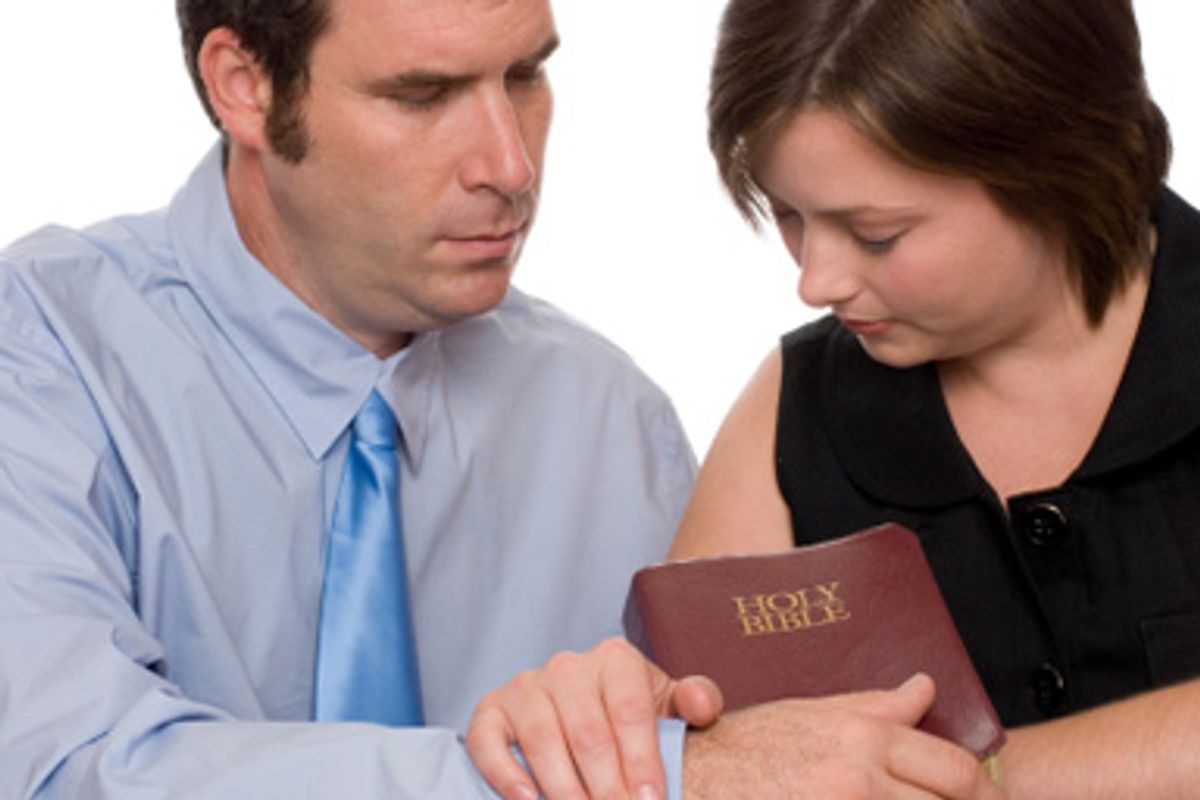
A British publishing house has created a stir with a new book. No, not the latest teen vampire saga or bestseller of intellectual derring-do; this hot commodity is the Prayer Book for Spouses. The 64-page booklet from the Catholic Truth Society (CTS) contains prayers about pregnancy, about caring for children and elderly parents. The prayer getting all the attention, however, is about sex. It is the prayer married couples are advised to say “before making love.”
It's hard not to detect a note of skepticism and confusion in media reports, as though the prayer is something akin to Scientologists using e-meters to uncover childhood secrets. "The Roman Catholic Church encourages couples to pray before sex to remind themselves that intercourse is a selfless act not driven by hedonism," reads a caption in London's Daily Mail, which illustrates the story with a cutesy photo of a couple kneeling by a white bed. Those crazy Catholics -- what will they think of next?
As for the prayer itself -- well, it's gibberish. Perhaps it's unfair to subject prayers to literary criticism, but this one is a dour series of poorly strung-together clichés about married couples being mired in “half-truths and little deceits," as CTS director Fergal Martin said on the organization's website, adding this gloomy forecast for marriage: “For many the struggle for sincerity and truth in loving will be constant.”
But more important, whoever wrote this prayer (the authors are unnamed) squeezed all the juice out of sexual pleasure. Had they bothered to study the greatest of all prayers and songs of love -- the Old Testament Song of Solomon, in which the lover and the beloved sing to each other in 117 lines of exquisite intimacy and truth-telling -- they might have written something beautiful and evocative. It could have started bydrawing on the third verse: “By night on my bed I sought him whom my soul loves.” It could have ended as the Song of Solomon ends: “Make haste my beloved and be thou like to a roe or to a young hart upon the mountain of spices.” It could have invoked fine wine, the nectar of the pomegranate, the “waters that cannot quench love,” the “floods that cannot drown it.”
Instead the couple in the prayer whines and pleads and pretty much avoids sex altogether: “Father, send your Holy Spirit into our hearts. Place within us love that truly gives, tenderness that truly unites, self-offering that tells the truth and does not deceive, forgiveness that truly receives, loving physical union that welcomes. Open our hearts to you, to each other and the goodness of your will. Cover our poverty in the richness of your mercy and forgiveness. Clothe us in our true dignity and take to yourself our shared aspirations for your glory, forever and ever. Mary, our Mother, intercede for us. Amen."
Avoiding sex is something religion -- especially Catholicism -- excels at. From the earliest days of Christianity, sex was suspect. The early Christians were sure the second coming of Jesus would happen in their lifetime and believed it was their obligation to prepare by spending as much time as possible praying and thinking about God. They understood that sex -- and especially its pleasure -- distracted them from that purpose. The only possible redeeming feature of sex was procreation. Just the idea of a prayer for making love would have been anathema to them: Christians were advised to avoid sex, and married couples living “as brother and sister” were the ideal. After all, church leaders postulated that, if Adam and Eve had not sinned and had been able to remain in paradise, sex would be devoid of all those messy emotions -- pleasure, pain, jealousy, anxiety, need. And this fear of sexual pleasure did not disappear with time. As late as the 18th century, sex was a sin outside procreation. The more pleasure you had, the more sinful it was.
Modern Catholics are embarrassed by this history. They claim everything has changed and, in some ways, it has. But even today, the Catholic Church does not accept sexuality separated from procreation. This despite the fact that most Catholic couples have sex for the purpose of having children only a few times during their married life and thousands of times as an expression of love and in pursuit of pleasure. And why not? It is incomprehensible to believe that God wishes couples to have more children than they can afford or thinks it is “good” for them to abstain from sex when they are not prepared to have children. This hostility to sexual pleasure has caused much suffering. When modern contraception became available 50 years ago, in the form of the pill, the church forbade its use and, for a time, Catholic couples listened -- often to their detriment. Kate Michelman, the former director of NARAL, was a young, faithful Catholic wife who used the rhythm method. She had three daughters in three years and a fourth child on the way when her husband left her. She had an abortion, a painful choice about which she has eloquently written. Today, 90 percent of Catholics in the U.S. use contraception and few of them see any need to beg for forgiveness. The principles and values that govern their sex lives are so far removed from the “prayer for spouses” that the prayer is more like a fairy tale.
Catholic couples -- married, unmarried, gay and straight -- feel no need for “forgiveness” for the wrongs the prayer alludes to. They do not believe their lives are impoverished. They do not feel the need to be “clothed” in dignity. Truth is found in nakedness; love itself is enriching and requires no pardon.
If anyone needs to pray for forgivenessit is Popes and bishops for the pain they caused to children by scaring them into believing they’d go to hell if they masturbated, for the divorced and remarried Catholics who have been denied the sacraments, for couples who followed the teaching against contraception and had more kids than they could care for, for gay Catholics who have been denied the right to marry, and for infertile couples who are told they can’t use modern fertility treatments.
The rest of us might pray that, as time marches on, more and more Catholics stop following what bishops and "spousal prayers" say on these matters -- and continue to follow their common sense and their conscience.
Shares