Home Schooling

Confessions of a home-schooler

Call us crackpots, but our kids spend their days at beaches and museums, not in school

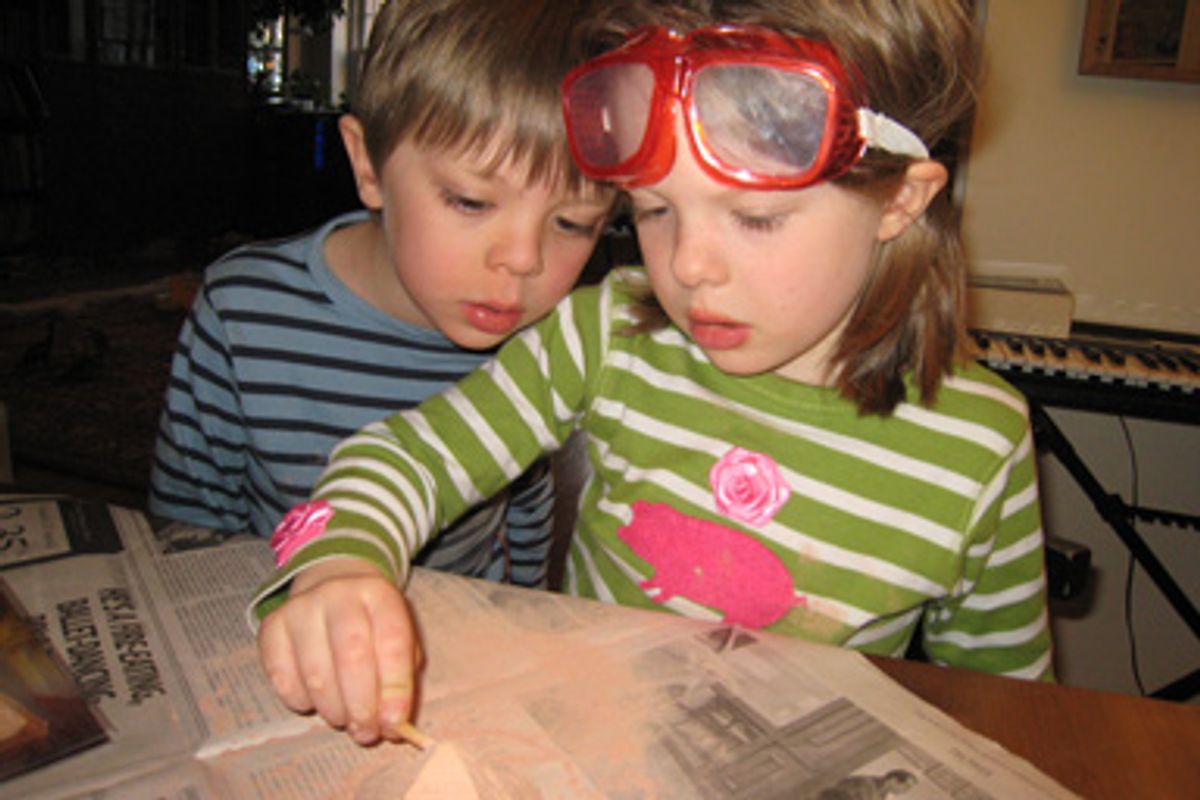
Desmond and Nini, the author's homeschooled children, during an "archaeological dig."

It’s a Sunday night at the tail end of summer, and I’ve dragged two squawky kids out of the minivan and into a half-closed rest stop on the Garden State Parkway in search of non-dreadful dinner options. Leslie, their mother, is catching some precious zone-out time in the car. After we sit down with our unadorned burger and fries, I notice the woman at the next table, the one who’s making eye contact and smiling.

“Are they twins?” she asks. “How wonderful!” Then she talks to Nini and Desmond: “Wow, you guys are 5. So big! Are you starting kindergarten soon?”

Here’s where the fun starts.

My son and daughter regard me in grave silence, faces stuffed with processed meat and fried potato product. They field this question themselves fairly often, but they’re going to let me take it this time. For an insane split second, I consider a full-on lie, just some total invention about where and when they’re going to school this fall. Instead, I take a swig of fizzy fountain Pepsi and bite the bullet: “Actually, we’re home schooling.”

After various tense conversations with friends, family members and strangers, Leslie and I have concluded that earnest, heartfelt discussion of exactly how we’re approaching our kids’ education and why we’re doing it is a bad idea. For reasons I can about halfway understand, other parents often seem to feel attacked by our eccentric choices. I guess this is what it’s like to be a vegan, or a Mennonite convert. I can certainly remember having a weirdly defensive response (“You know, I hardly ever eat red meat”), one where I reacted to someone else’s comment about themselves as if it were really all about me.

At the risk of gross generalization, there’s a hierarchy of responses when you drop the home-school bomb in conversation. Childless men don’t much care; the question is too remote from their consciousness. Childless women are often curious and even intrigued; the question is hypothetical but possesses a certain allure as a thought experiment. As for men with children, they may or may not be sympathetic, but they don’t experience the subject as a personal affront. Let’s be honest: It’s almost always mothers who react defensively when the subject comes up, as if our personal decision not to send our kids to public school contained an implicit judgment of whatever different choices they may have made.

As I say, I understand this a little bit better than I did at first. For one thing, I’m not sure any man can really grasp the competing and largely incompatible demands faced these days by American women, who are expected to be providers, power brokers, nurturers and sex symbols, either all at the same time or in rapid succession. Whether they’re working-class or middle-class, most working mothers feel fundamentally torn between home and the workplace. They get shunted into mommy-track careers if they seem insufficiently devoted to their corporate overlords while getting grief from mothers-in-law for not spending enough time with the kids. They’re doing the best they can and it’s not that much fun, and the last thing they want to hear is somebody telling them, in effect, that they must have missed the latest memo on hip 21st-century motherhood: You’re supposed to quit your job and spend your days reading your kids “Oliver Twist”! Home schooling is the new black!

Other stuff is involved as well. Some people seem genuinely disturbed by our decision, on philosophical or political grounds, as if by keeping a couple of 5-year-olds out of kindergarten we have violated the social contract. Specifically, we have rejected the mainstream consensus that since education is a good thing, more of it — more formal, more “academic,” reaching ever deeper into early childhood and filling up more of the day and more of the year — is better for society and better for all children. This is almost an article of faith in contemporary America, but it’s also one that’s debatable at best and remains largely unsupported by research data.

In a related vein, some people suspect we have a hidden ideological or religious agenda we’re not telling them about. We may look like your standard-issue Brooklyn creative-class family — two 40-something parents, two kids, two pet rabbits and a battered Chrysler minivan — but who are we really? Home schooling has become a lot more mainstream and diverse in recent years, but familiar stereotypes endure. As Alicia Bayer, a Minnesota home-schooler and blogger who’s one of Leslie’s online mentors, puts it, “People think we’re all conservative Christians who hate the government and wear denim jumpers.”

In order to avoid one or more of these discomfort zones, we try to answer all well-meaning interlocutors with bland, diplomatic and totally unspecific generalities. Not quite lies, but well short of what you’d call the truth. This is a phenomenon known to almost all home-schoolers, from Mormon separatists to off-the-grid hippie anarchists, and a frequent discussion starter in online home-school groups. So it was in my conversation with the nice Garden State Parkway lady in that fluorescent cavern between Burger King and Sbarro.

Mrs. Garden State Parkway: Well, you guys live in the city, right? I guess the public schools are out of the question.

Me: No, that’s really not true. There are some perfectly good schools in Brooklyn.

Real answer: There are, indeed, and in any other municipality you care to name. Now, it is true that the zoned public school in our multiracial, middle-class neighborhood has, let’s say, a checkered reputation and is mainly attended by children bused in from other parts of Brooklyn. It’s a uniform school run on a paramilitary model, ruthlessly devoted to driving up the test scores. Oh, and last semester the principal was arrested for assaulting a teacher. But, honestly, that stuff played only a marginal role in our decision making. There are numerous pretty good to very good schools in nearby neighborhoods that we could have applied to but never did.

Both Leslie and I went to public school and had the usual assortment of excellent, mediocre and bad teachers. We’re not zealots with some animus against public education. We’re glad it exists and relatively happy to pay taxes to sustain it. As I said earlier, though, we feel dubious about the ideology that seems dominant in public education these days, and especially about the idea that sending kids to school virtually all day for 10 months a year, beginning at age 3 or 4, is the healthiest mode of delivering it.

Home schooling sneaked up on us, or at least on me — Leslie has been mulling it over far longer. About three years ago, she started to burn out on her low-paid, high-stress job as a political organizer for a lefty nonprofit that was working to end the war in Iraq. At the time, we were in the not-so-unusual New York position of spending her entire income, and then some, on paying a nanny to spend far more waking hours with our children than we did.

Leslie decided to untangle this conundrum by quitting her job, ditching the nanny — who promptly got a job with a much richer family on Park Avenue, if you’re wondering — and handling the childcare herself, at least for a little while. She had read a lot about alternative approaches to education and was in touch with the “attachment parenting” online universe, which tends to overlap extensively with the home-school world. She started hosting a weekly playgroup in our Brooklyn backyard and writing a blog, and before our kids were even 4 years old she’d gotten hooked into the New York “home preschool” network, a bunch of smart, high-powered, Type A women who’ve taken on their kids’ education as a challenge.

This struck a chord with Leslie in several different ways. She’s a hardcore nonconformist — yeah, she’s a lifelong lefty, but one closer to anarchism than socialism — and home schooling dovetailed perfectly with a bunch of other DIY interests she’s developed in recent years. She tends a large vegetable and flower garden every summer at a family house in central New York state, where Desmond and Nini help her grow peas, beans, lettuce, carrots, pumpkins and enormous sunflowers. In the basement she has a workshop where she makes furniture out of recycled wood and fallen branches, and she hoards piles of sewing projects for the cold winter months. Her interest in unconventional education goes back to her beloved grandmother, a renegade schoolteacher in an Indiana small town who gave her a copy of A.S. Neill’s legendary “Summerhill School” more than 30 years ago. Compared with all that, public school never had much chance.

Mrs. GSP: Do you use a curriculum?

Me: Oh, sure! Absolutely.

Real answer: Give me a break! These kids are 5 years old. What curriculum was involved when you were in kindergarten? As I recall, it was mainly scissors and paste. My wife will talk as long as you want her to about the fact that there’s no real evidence to back up the recent move toward “academic,” full-day kindergarten, and plenty of evidence that young children need more unstructured playtime than most of them get. The real purpose of all this formal schooling is to get the kids out of the house and train them to stand in line and follow instructions while mommy and daddy get back to their ultra-important lives as economic production units. If you break down the impressive-sounding, bureaucratically adumbrated federal list of kindergarten standards, a whole lot of it amounts to learning to count from 1 to 20, learning the alphabet and the months of the year, and learning to tell time.

All-day kindergarten is clearly a boon — or more like a necessity — for working families who have few other options, and where the alternative is likely to mean parking the kids on the sofa all day with Nintendo and Noggin. Nini and Desmond are fortunate human beings, and we have an unusually flexible home life. I get that. I’m not stressed about when or how they learn that March comes after February.

That said, you could argue that Leslie has developed a fairly demanding curriculum. But that word comes with certain expectations that don’t fit here. It isn’t written down, it doesn’t run on a set schedule, and it isn’t based on lesson plans, piles of worksheets or a fixed rotation from subject to subject. It’s tough to make generalizations about home-schoolers, because there are so many different flavors, from the aforementioned denim-jumper Christians to back-to-the-land types who live in sod houses without electricity. But hardly any of them structure their time and space so it resembles conventional schooling. That’s exactly what they’re trying to avoid, after all.

“If you grew up in the school system, you can’t imagine how totally different this looks,” says Alicia Bayer, who home-schools her four kids in Westbrook, Minn., a small town about 160 miles southwest of Minneapolis. “I didn’t go buy desks. We don’t sit in rows. We don’t spend an hour on one subject and then move on to another.”

Bayer tells me she began her “grand adventure” by teaching her eldest daughter to read at age 4. When she first met another home-schooler online, she began to understand how different it was in practice from what she had envisioned. “She told me that one of her daughters was asleep at noon, because she’d been up all night studying the constellations,” Bayer remembers. “Another one was across the street taking soil samples from a vacant lot that she was convinced was contaminated with toxic waste, and a third one was someplace in the house curled up with a book. It sounded like what I was doing, and what I wanted to do.”

Leslie has loosely coordinated her grand adventure with her closest home schooling pal, the novelist Joanne Rendell, whose son Benny is a year older than Nini and Desmond. In practice, that means they read a lot of the same books and take a bunch of museum expeditions together. Given that one of the main reasons we’re home schooling is to give the kids more unstructured time to play and explore, they also grab every opportunity they can to get outside in nice weather. (I’ll have a lot more to say about Leslie and Jo’s shared curriculum in a future installment.)

Jo found out the hard way how eager other people can be to judge one’s parenting choices, having been virtually flogged in the public square after writing what I thought was a sparkling, funny home-school confessional for Babble last year. I suppose it was impolitic for Jo to admit, all at one gulp, that Benny sometimes accompanies her and her husband to bars and other adult social situations, that he goes to sleep much later and wakes up much later than most kids, and that she uses the freed-up morning hours as writing time.

Perhaps it was Jo’s descriptions of Benny’s dirty socks and unwashed hair. Perhaps her breezy, dry English wit was akin to sticking a fork in the haunches of the angry and puritanical razorback hog that is the American Internet-reading public. Be that as it may, her article provoked an explosion of outraged name calling and numerous suggestions that Benny’s terrible predicament be reported to Child Protective Services. One commenter’s post, in its entirety, read: “What an awful human being you are. You’re creating a freak.”

Mrs. GSP: What do you do about socialization?

Me: Oh, we’ve got a nice support network. They have a circle of friends. They do lots of classes and activities. They go to birthday parties and stuff.

Real answer: My public answer is OK, as far as it goes. But hang on a minute, lady: What do you mean by “socialization”? In a legendary Internet screed called “The Bitter Homeschooler’s Wish List,” Deborah Markus answers this question by observing, “If you’re talking to me and my kids, that means that we do in fact go outside now and then to visit the other human beings on the planet.” Ordinary schools tend to socialize children by way of enclosed, age-homogeneous pods, while home schooling tends to socialize children through a wide range of interactions with older kids, younger kids and adults, as well as peers. It’s not up to me to decide which is better, and I’m pretty sure both methods have their pros and cons. We like the sound of option B, at least for now.

Looking at the bigger picture, being a home schooling freak isn’t what it used to be. We aren’t Bible-thumping Christians or off-the-grid hippies, and we definitely don’t feel isolated. You certainly encounter both of those groups in the home-school universe, a fascinating realm in which social dissidents from the left and right margins of society struggle to communicate and coexist. But home schooling has become a broad and diverse phenomenon found at all socioeconomic levels and in all regions of the country, and it can’t be summarized with easy demographic labels.

At the time of the 1970 census, there were a reported 15,000 home-schoolers in the entire United States, nearly all of them presumed to be members of religious minorities who objected to the contents or method of public education. By 2007, the Department of Education estimated that there were 1.5 million home-schooled children in the country — almost 3 percent of the school-age population — but admitted that the real number was likely higher. Furthermore, in the same DOE survey, only 36 percent of home schooling parents picked a desire to provide “religious and moral instruction” as the No. 1 reason for their decision.

Now, I suspect that response fails to capture the full extent of faith-driven home schooling, but it does suggest that the phenomenon is more complicated than many people suppose. A rough but reasonable guess might be that one-quarter to one-third of home-schoolers — say, 450,000 school-age kids — come from more or less secular backgrounds, and that proportion is probably growing. Just as important, not every home-schooler who happens to be religious is home schooling solely or primarily for religious reasons. There’s a vibrant African-American home schooling scene, for instance, and while a lot of the folks involved are Christians, many say their top concern is the destructive culture they see in public school.

Our support network in New York is diverse in many ways, but it definitely lacks the extraordinary racial, ethnic, religious and economic heterogeneity you find in the city’s public schools. Our home-school cadre mostly consists of creative professionals with flexible work lives — writers, actors, artists, musicians, academics — both because those are people who can conceivably accommodate home schooling in their lives and because those are people who share a nonconformist attitude toward work, authority and institutions. Do we regret not exposing our kids to the intense cultural melting pot of New York’s school system? Sometimes, sure. But we’re also not exposing them to bullying, arbitrary systems of order and discipline, age-inappropriate standards of behavior, and the hegemony of corporatized kid culture. Desmond and Nini have never heard of “Transformers,” and we’re OK with that.

Mrs. GSP: God, I could never do that! Why in the world are you doing it?

Me: [Polite laugh] It works for us, for now. It’s not some lifetime commitment. We’re not sure about anything beyond this year.

Real answer: I’m not here to recruit you, and I’m not sure what the ritual pronouncement “I could never do that” — which comes up in almost all these conversations — really means. Does it mean you’re not interested? Fine. Does it mean you feel envious, but you couldn’t pull it off for financial, logistical or psychological reasons? (Leslie and Jo have had women tell them this explicitly.) Does it mean that at some level you don’t feel too certain about the way you’ve lived your life and raised your children and what the point of it all was? Yeah, me too. That part doesn’t have much to do with home schooling, I don’t think.

As for the “why” question: We’re not ready to surrender our kids, and ourselves, to a 10-month-a-year, all-day institution whose primary goal, at least at this age, seems to be teaching kids how to function within a 10-month-a-year, all-day institution. Our kids are learning plenty — not exactly the same things other kindergarteners learn, I suppose, but plenty. They’re making friends and having fun. They can go to the beach on gorgeous fall afternoons, or hit zoos and museums on crisp winter mornings, when other kids are sitting at desks doing worksheets about the letter B. Hell, I wish I could do it.

If I really felt like spilling my guts to Mrs. Rest Stop, I’d tell her that home schooling can be a difficult and draining way to live. Leslie gets overloaded and loses her temper sometimes. After a day as home-school mommy she can be so exhausted that she makes it halfway through a glass of wine and passes out at 9 o’clock. I get distracted and irritable, torn between my demanding work schedule and my desire to unplug the computer and spend time with my weird, adventurous family. I could also assure her that we wouldn’t be doing this if it didn’t come with a host of unexpected delights.

This is just the beginning of what could be an extended experiment, full of surprises and pitfalls. If I told you I knew how it was going to turn out, I’d be lying far worse than I lied to Mrs. GSP. Legally speaking, we’re not even home-schoolers yet. In New York, as in most other states, kindergarten is not compulsory; we don’t have to notify any bureaucrats or file any paperwork until next year. I think home schooling has brought Leslie and me closer together, after a difficult period in our marriage. (By definition, having twins from birth to age 4 constitutes a difficult time in one’s marriage.) The four of us are a pretty tight unit — it’s not us against the world, but us in the world, trying to experience the days as they come.

We’ve planted seeds and watched them grow into sunflowers taller than Daddy; read books about Alexander Calder and Squanto and the warm-blooded, egg-laying Maiasaura; told stories about how our beloved bunny Picaro made his final voyage into the Egyptian Land of the Dead. We say goodbye to the setting sun (when we remember to) and greet each new day with tremendous enthusiasm, often much closer to dawn than the adults would prefer. I’m not saying that other families don’t do that stuff too. I guess I’m saying what I said already: It works for us.

Rick Santorum’s home-school hokum

America's most famous home-schooler spent three years soaking Pennsylvania taxpayers for his kids' education

Republican U.S. presidential candidate Rick Santorum is applauded by members of his family during remarks to the CPAC in Washington (Credit: Jonathan Ernst / Reuters)

As the Los Angeles Times recently noted, Republican presidential candidate Rick Santorum is probably “the most prominent home-schooler in America.” Indeed, the fact that Santorum’s seven kids have largely been educated at home (two of them are now adults) is a key aspect of Santorum’s appeal to his right-wing base. Of course, home-schooling is a popular issue in its own right, especially among religious conservatives, but its symbolic importance goes much deeper than that. It also symbolizes Santorum’s self-presentation as a man of firm principles and unbending anti-government convictions, in obvious contrast to some flip-floppy, Obamacare-loving, one-time Northeastern governor one might mention.

As a home-schooling parent on the opposite end of the political spectrum from Santorum, I’ve observed his emergence — and, to a lesser extent, that of Denver Broncos quarterback Tim Tebow — with a certain queasy fascination. It’s difficult to imagine a hypothetical universe where I’d ever vote for Santorum for anything, but sometimes his rhetoric on home-schooling strikes one of those weird political nerves where the quasi-libertarian right and the quasi-anarchist left hold similar views. In a recent Ohio speech, for instance, Santorum described the predominant model of public education as an artifact of the Industrial Revolution that has become ill-suited to a post-industrial age: “People came off the farms where they did home-school or had a little neighborhood school, and into these big factories … called public schools.”

That’s a crude but historically accurate summary, and many of the home-schoolers I know in New York City and other non-heartland locations would agree that that legacy — standardized education aimed at creating a standardized workforce — is problematic. In Santorum’s 2005 book “It Takes a Family,” he offered a defense of the age-diverse, socially mixed context of home-schooling that could just as well have been written by a utopian educational reformer in Boston or Berkeley: “In a home school … children interact in a rich and complex way with adults and children of other ages all the time. In general, they are better-adjusted, more at ease with adults, more capable of conversation, more able to notice when a younger child needs help or comfort, and in general a lot better socialized than their mass-schooled peers.”

As Dana Goldstein’s recent attack on home-schooling in Slate reveals, the issue lays bare an intriguing split among progressives between the competing or complementary values of communal responsibility and individual freedom. Suffice it to say, however, that no one on the left, either hippie home-schooler or an ardent public-school advocate, is likely to agree with Santorum’s radical remedies. It’s difficult to tell exactly what he has in mind, but it seems to involve defunding both federal and state support for public education, and forcing poor or middle-class families — indeed, almost everyone who works for a living — into a Darwinian struggle over educational resources.

Many Christian and/or conservative home-schoolers are understandably eager to embrace Santorum (alongside Tebow) as the movement’s leading public face. But even on the rightward fringe, the chorus of praise is not as unanimous as you might think, and Santorum’s fans are distinctly on the defensive. If I had to guess, I would speculate that actual home-schoolers, as opposed to conservatives who find it appealing in the abstract, remain somewhat uncomfortable with Rick Santorum. That’s because his rhetoric — his promise to be a forceful advocate of home-schooling as president, and to continue home-schooling his own kids in the White House — does not square with his own family’s history, which in turn calls the whole Santorum narrative of supreme rectitude and impeccable character into question.

As various media outlets from Mother Jones to the Washington Post have reminded us in recent weeks, Santorum’s record as a home-schooler is ambiguous at the very least, and arguably hypocritical. From 2001 through at least 2004, when Santorum was serving in the Senate and living full-time in Loudoun County, Va., five of his children were enrolled in an online charter school based in Pennsylvania — a public school, albeit an unusual one — with computers, curricula and other educational services provided at taxpayer expense. According to the Penn Hills Progress, a newspaper in Santorum’s suburban Pittsburgh hometown that broke the story at the time, the local school district had spent approximately $100,000 educating the senator’s so-called home-schooled children, although they lived neither in the district nor in the state.

Santorum owned a modest three-bedroom, 2,000-square-foot house in Penn Hills (and reportedly still does), on which he paid about $2,000 a year in taxes. But owning a home is not sufficient to prove residency, and public records, neighborhood testimony and common sense all suggest that Santorum’s constantly enlarging family — his kids now range from age 3 to age 20 — never actually lived there. (At the time of the Penn Hills Progress investigation, Santorum’s wife’s niece and her husband were registered to vote at that address.) Appearing to live in Pennsylvania was distinctly advantageous for the Santorums, because state law required school districts to pay 80 percent of the online charter-school tuition for local families who chose it. (No such law pertained in Virginia.) The Penn Hills district challenged Santorum’s local residency, and the ensuing dispute only ended when the senator withdrew his kids from the Pennsylvania Cyber Charter School. Since 2006 the Santorum kids have reportedly been registered as Virginia home-schoolers.

When Penn Hills tried to bill Santorum for $72,000 that the state had withheld from the local education budget to cover the senator’s kids’ online tuition, he refused to pay. In the end, the Pennsylvania department of education was forced to refund most of that money to the local district. In other words, the Santorums presented themselves to the world as home-schoolers for at least three years, while Pennsylvania taxpayers picked up the bill for their kids’ education — and they actually lived in a different state. For a private citizen, this would have been an embarrassing ethical lapse, but somewhat short of criminal misconduct. For a politician whose reputation rests upon issues of character and integrity, it’s considerably more damning.

Speaking personally, I’m not opposed in substance to the choices Santorum made about educating his own children, and the way the former senator’s political rise has pushed home-schooling onto the national agenda may end up being useful. Like most home-schoolers, irrespective of religion or politics — and like most other parents, for that matter — I support exploring widespread possibilities for educational reform. The Pennsylvania law that allows parents to pursue a de facto version of home-schooling that is publicly funded, and therefore hews to the norms and standards of public education, is interesting in theory, although I don’t know much about it in practice. (The Pennsylvania Cyber Charter School, which Santorum’s kids attended, has been embroiled in various controversies and has delivered mixed academic results.)

But railing out loud against the public funding of education, while taking advantage of it yourself under sneaky or deceptive premises, is something else again. That’s an altogether too familiar ingredient of American know-nothing conservatism, which has long been rooted in rural areas of the country where residents are, on average, far more dependent on federal or state support than people who live in cities or suburbs. From here, Rick Santorum does not look like an independent-minded man of principle, however misguided — and still less like a model home-school parent. He looks like another angry white guy who wants to cut taxes and slash government and declare his John Wayne independence from society, but is still delighted to spend other people’s money on his own kids.

Continue Reading Close

A home-schooler goes to college

It wasn't the schoolwork or social life that threw me. It's that I never realized how dull a classroom could be

(Credit: Darrin Henry via Shutterstock)

I went to college when I was 18, like everyone else. But unlike other people, I had never been to school before. The first standardized test I ever took was the SAT. The day I took it was the first time I’d ever been in a high school classroom. It didn’t seem like a fun place.

I started college as a Music Ed major, because while I didn’t know what I wanted to study, I knew I liked music. The Intro to Music Education teacher, a woman I’ll call Mrs. Grimini, had taught kindergarten at a local school before joining the university faculty. She led us in songs like “The wheels on the bus go round and round!” She wanted us to share a memory of our own music teachers from kindergarten and first grade.

Everyone had one: The triangle. Holding hands in a circle. Those rainbow xylophones.

“Actually,” I said, “I didn’t go to school. But my dad is a jazz pianist?”

He played every day when I was a little kid. I used to sit under the piano and he’d ask if I could remember the melody, or he’d teach me how to play a few notes. Sometimes I sat with him on the couch in the darkened living room and we listened to Gustav Holst’s “The Planets” together, talking about how scary Mars was, and how big Jupiter was. We were almost never not listening to music.

But before I could say any of that, Mrs. Grimini interrupted me. “Home-schooled?” she said tightly.

“Yes,” I said, offering my politest smile.

“OK, you don’t need to participate.” And she moved on.

I was home-schooled. Unschooled, really, because my brothers and I didn’t follow a formal curriculum at all. But home schooling sounds radical enough, so I usually use that term to describe how I grew up. The latest statistics about American home-schoolers from the U.S. Department of Education were collected in 2007. They estimate around 1.5 million home-schoolers were in the country at that point, up from 1.1 million in 2003. No one seems to have any idea how many of those home-schoolers call themselves unschoolers, but it’s a pretty safe bet that there are more of us now than ever.

I look really normal, I promise. No one would think I’m a freak. Which is important, because if I didn’t appear normal, it would look bad for everyone in my group. We’re a very small group, and the world hasn’t had much time to get to know us. Like most minorities, we get stereotyped a lot. People think the wrong things about us and keep on thinking those things. Like that all home-schoolers are evangelical Christians who don’t believe in evolution, or that home-schooled kids can’t socialize, that we’re huge nerds who win spelling bees but can’t grasp simple pop cultural references. We’re all radical hippies or strange child prodigies. Whatever people think about home schooling, they’re pretty sure it’s emotionally damaging.  We make people uncomfortable, even angry, maybe because they just don’t know us well.

“How arrogant does someone have to be,” they say, “to think they know better than everyone else in the world?”

That part is about my parents, because they made the decision initially. Sometimes all of the anger is directed at my parents (mostly my mother), and I am force-fed bitter, watery spoonfuls of pity.

“You poor thing! You didn’t get to be like the other children …”

That’s definitely true.

“How arrogant,” people like to say of my parents, “to think you could educate your child better than qualified teachers!”

“I could never do that,” women often say, of my mother. “I don’t have the energy.”

“But how will they learn science without a lab?” everyone says in unison.

These people have no idea how unschooling works.

And it’s hard for me to explain it to them. Because unschooling, for me, worked a lot like living. It wasn’t a dramatic political statement about our broken society. My parents decided not to send me to school because they liked hanging out with me. It sounds too simple. Were they radical anarchists or free-love types? Nope. They were just two brave people who believed that kids are naturally smart, and will naturally learn the things people need to learn to get by. As a result I am very polite and pretty bad at math. My parents were entrepreneurs. They were running their own business when I was born. They thought they could probably make it work. They didn’t think they were smarter than other people; they just trusted themselves to figure it out.

For me, home schooling meant getting to read all day and then read all the next day. It meant being able to apprentice myself to the adults whose work I admired, spend a lot of time playing in the nearby brook, write the books I couldn’t find but wanted to read, try directing Shakespeare plays and competing in classical piano and learning some Greek, all without having to worry about what might happen if I failed. Home schooling was about making mistakes that didn’t have bigger consequences than momentary embarrassment. Because I didn’t have grades. I worked hard to get better, because I cared about being better, because, I think, maybe people just care about that.

And then there was the occasional math textbook and online biology course, which Mom researched and purchased when she got nervous. Sometimes she became overwhelmed with concern. What if I fell behind the school kids? What if I didn’t go to college? It was important that I could still be good at the things people were supposed to be good at.

I wasn’t worried. I was happy.

I thought college would be interesting, but it didn’t sound particularly necessary, and I only applied to one school, the state university, which I chose for its proximity to my job and its relatively low cost. Home-schoolers often already have jobs, and I’d gotten mine at 15. I led services and tutored bar and bat mitzvah students at my synagogue. I was the one who sang the prayers in Hebrew on the bima, at the podium across from the rabbi’s. Adults sometimes asked for my advice. I was a community leader. I was making more money than all of my friends (a lot of them went to school and didn’t have time to work as much as me). College was going to be a piece of cake compared to this. But I had no idea what that particular piece of cake would be like.

College, it turned out, was an ugly place with mismatching architecture, surrounded by a sagging, distracted-looking little city. I got a big scholarship, for my SAT score and my “class rank.” My SAT score was good, but then, it’s kind of a dumb test. I’d made up the class rank. I didn’t have a class, so I said first. Technically, I was last as well.

“We shouldn’t lie,” my mom said.

“Why not?” my dad said. “Look how stupid this is.”

I was naive. It’s embarrassing, but I was. I thought college would be full of students leaning forward in class, eager to learn. Mom thought that, too. Her family couldn’t afford it, so she hadn’t gone, but she always imagined it would be world-expanding and fantastic. Dad hadn’t gone because his family couldn’t afford it either, and he thought it sounded boring.

Since I was so naive, I didn’t think a music major sounded different from another major. Or a state university sounded different from a private one. College was college. As a home-schooler, I hadn’t learned to separate everything into its own categories and rank it according to some perceived value. I got better at doing that in college, but it made life less interesting.

That was one of the most jarring lessons I learned in college. Life is just less interesting in a classroom. In college, you don’t really have to contribute. Unless it’s one of those classes where participation is 15 percent of your final grade. I liked those classes best.

I also learned what it felt like to be truly bored. I learned it was much more important to memorize than to understand. I learned that it was cool to get drunk and not cool to admit, as my friend down the hall once did, that you were in AA because of all the getting drunk. I learned it was fine not to care about any of your classes and funny to lock someone out of a building they were trying to get into and important to band together in the hall of the dorm to scream, “Get out! Get out, bitch!” at a girl from another school who had come to see her boyfriend, and who, freshly broken up with, was crying hysterically, huddled against his locked door.

And I learned that I wasn’t allowed to talk in Mrs. Grimini’s class. The next time I raised my hand, she said to the other students, “Kate was home-schooled, she can’t participate in this discussion.” And she never called on me again.

“Can she really take points off this one?” I asked, holding out my recently graded test to a friend. “I think that’s the answer. What did you write?”

He showed me. He’d written the same thing. And she had not taken off any points.

I sighed. “Should I go to a dean or something?”

“I guess.”

I didn’t want to. I wanted to pretend that Mrs. Grimini didn’t actually narrow her eyes when she looked at me. I wanted pretend that in college, people were smarter than they’d been outside of college. They were supposed to understand more about the way the world worked.

I needed some advice. I picked the scariest, most renowned, most bearded professor I could find, and I asked if I could meet with him.

“This is hard,” I told him. “All this is very new for me. I was home-schooled.”

“Oh!” he said, squinting at me like a puzzle he might have a chance at solving. “Home-schooled. And then here. A trial by fire.” He shook his head and chuckled in a way that only very bearded, very revered professors are able.

“So,” he said, as though we were about to begin a long talk. “Is it mostly the socialization?”

“Well, not exactly,” I said. I didn’t sigh aloud; I sighed to myself. I liked him.

It was mostly that I had thought that college would be the beginning of an exciting new phase of life, and instead it felt like the end of one. Before, learning could happen at any moment, rather than waiting for a professor to get up in front of a blackboard and start talking. You could end up friends with anyone, not just people exactly the same age as you. There were lots of problems with being home-schooled, and they were all becoming apparent. Home schooling had made me expect too much. It had given me plenty of time to figure out who I was, so that I didn’t have to do it now. College, so formulaic to me, didn’t feel like the real world.

Which is sort of funny, because for my whole life, people have been telling me that I must not know what the real world is. People always think that home-schoolers live these small lives in a constricted little world. I don’t know how to explain my life to them. I don’t know how to clarify the open-ended world of my childhood, in which the rules made sense and I worked hard because it was fun to be productive. What world is that? It isn’t normal. There are no grades.

“So how is it?” Mom would ask. She was eager, much like any other mother, probably.

I didn’t want to disappoint her. I wanted her to feel that home schooling had been a success. The right kind of success that had prepared me for the next step. So I didn’t tell her that my little brothers were wittier than the students I was meeting. I didn’t tell her that they knew more about the Enlightenment than the upperclassmen in my history class. I didn’t tell her about Mrs. Grimini. But I didn’t lie to her, either.

“I’m getting really good grades,” I said.

Kate Fridkis, blogger at Eat The Damn Cake and Skipping School, has written for Jezebel, The Forward, the Huffington Post, and more. She lives in Brooklyn, and is writing a book about her experiences as a homeschooler.


Continue Reading Close

Why my kids are pop-culture illiterate

As parents who home-school, my wife and I shield our twins from mainstream kids' fare: No Dora, no Barney

My children have never heard of Dora the Explorer or Barney the dinosaur or “Star Wars.” I’m pretty sure they still think Walt Disney’s trademark mouse is named Mick, although they have stopped referring to the Marvel Comics web-slinger as “Spider-Guy.” They love Thomas the Tank Engine as a toy, but they don’t know he has a television show. In fact, although they’ve seen a handful of TV shows — “Sesame Street” and “Mister Rogers’ Neighborhood” and “Between the Lions” — they really don’t know about the existence, or the 24/7 availability, of children’s television as a medium. They have never played a video game, unless you count the crappy little bowling game on kiddie author Jon Scieszka’s Trucktown site.

Nini and Desmond are only 6 years old, so none of this strikes me as all that unusual or amazing. Parents of all descriptions are negotiating the endlessly vexing question of how much electronic media and what kinds, and unplugging — or at least ramping down — has itself become a lifestyle trend. Furthermore, it’s not like our kids’ pop-culture illiteracy was the result of some totally thought-out parenting strategy. Dora may be a stranger to them, but Chip ‘n’ Dale, the cartoon chipmunks from the ’40s who make Donald Duck’s life a living hell, are their beloved pals. They have never watched Nickelodeon, but they’ve seen the Disney/Pixar film “Cars” two dozen times. Who would make those decisions on purpose?

This isolation from the mainstream of kid-oriented pop culture is at least somewhat related to the fact that my wife, Leslie, is home-schooling our kids (at least for now). Desmond and Nini haven’t been in preschool or kindergarten classrooms where Barney and Dora are likely to be superstars. Our decision to constrict the flow of electronic media predates our home-school decision by several years, but both stem from the same impulse. We want to give our kids as much time as possible to be kids, to experience a slowed-down childhood of books and play and imagination before their inevitable engagement with the industrialized childhood of media conglomerates and educational bureaucracies. While I suspect many home-schoolers have made similar decisions, there’s no necessary connection.

We started from two simple principles, neither of them radical or unique. We decided to follow the universal, if widely ignored, pediatric recommendation that kids under age 2 watch no TV at all, and to introduce electronic media slowly and gradually after that. The only remarkable thing about that is how much pressure you have to fend off well-meaning friends and family, who seem convinced that 2-year-olds unfamiliar with Bugs Bunny are missing out on the central joys of childhood.

Secondly, we wanted to affirm the idea that media is something you can choose and control, not a collective demonic unconscious that fills up your imagination and swallows all your spare time. Specifically, we wanted to resist the stepped-up invasion and colonization of early childhood by corporate media, both in its most obvious Happy Meal and merchandising tie-in form and also in its friendlier, allegedly educational “Dora”/”Blue’s Clues” guise. It’s not like we think toddlers who watch TV will all become mindless consumer zombies, but the correlations between childhood media consumption, the obesity epidemic, literacy problems and the disappearance of outdoor play are too strong to ignore.

We got rid of cable, which has saved us a lot of money. (When necessary, Leslie and I treat ourselves to catch-up crash courses on DVD, as we recently did with “Mad Men.”) As far as Desmond and Nini know, the television set is only for playing videos, although it occasionally and mysteriously shows live news or ballgames. When we started showing them videos at age 3 — the first one I remember was a holiday screening of “How the Grinch Stole Christmas!” (the original animated special, of course), which was a blast — we mixed in stuff their friends liked, stuff we wanted them to watch and random stuff that just seemed like a kick in the pants.

“Cars,” Chip ‘n’ Dale cartoons and Hayao Miyazaki movies like “My Neighbor Totoro” and “Kiki’s Delivery Service” are all longtime favorites. They’ve gone through phases with the Disney “Winnie the Pooh” movie, the BBC’s early-’90s Beatrix Potter animations, a series of films about the Hindu gods made for English-speaking kids in the Indian diaspora, and an entire genre of instructional video you can always find at thrift stores and garage sales: “Where the Garbage Goes,” “Farm Country Ahead,” “At the Minivan Assembly Plant.”

Yes, I make my living mostly by writing about movies, and I guess you might expect me to be a bit more programmatic about this whole question. But I’m not delivering lectures about camera angles, framing devices and mise-en-scène, or insisting that they watch every episode of “Astro Boy,” in the correct order, before moving on to Miyazaki. Some of my colleagues have kids who are incredibly media-savvy; one critic I know recently showed his 6-year-old son “Jaws,” and then sat around dissecting how it was made. That movie would reduce my daughter to a state of cataleptic terror for at least three months.

My friend’s kid son will be fine, of course, mostly because he’s got a really smart dad who loves him and is paying attention. Like so many other parenting decisions — talking about sex, buying them their own computer and cellphone, deciding when they can ride the bus or train on their own — the question of what to show your kids and when is fueled by private and personal considerations, and doesn’t translate into social philosophy. Mainly, I just don’t think what they watch at this age is all that important, as long as they enjoy it and it’s within the context of a full, active life. Maybe that’s heresy for somebody with my job description, but there it is.

Sure, I look forward to watching them leap up and down with joy at Chaplin and Harold Lloyd, and convincing them that black-and-white movies don’t depict a different species and that you can hear people speak in one language and read the words on the screen in another and that after a few minutes you’ll barely notice. It’ll be thrilling to introduce them to “Gone With the Wind” and “Casablanca” and Frank Capra and Hitchcock, and the first time I show them Bergman’s “Magic Flute” I’m pretty sure I will cry.

But it’s not necessary to their survival to know about any of that at age 6, and frankly those experiences will be more powerful if they’re the kinds of kids who’ve done a lot of other stuff along the way — if they’ve read a bunch of books and gone hiking in the mountains and grown vegetables for the county fair and swum illegally in ponds in closed-down state parks (all of which has happened this summer). At their age, I was an owlish only child who had lived in three countries, but never with a TV set in the house — and that remains an important aspect of who I am today. They need to figure out on their own terms that “Farm Country Ahead,” in which a dude named Rusty with a thick Down East accent explains where the ingredients for a peanut butter sandwich come from, is a remarkably amateurish and boring production, and then decide for themselves whether to view it as a treasured, flawed private possession or cast it away forever.

Let’s stipulate a couple of things here: We are not naive enough to believe that we can insulate them from mass kiddie-culture much longer, if at all. They’re now perfectly capable of reading newspaper ads and billboards; they knew about “Toy Story 3″ and “Despicable Me” long before I suggested that we go to see them. They’re avid readers of DC Comics and occasionally sneak time on the Internet. There’s almost certainly stuff that I don’t know they know about, and some of my assertions in the opening paragraph may be wrong, or about to become wrong. Needless to say, all that is a normal aspect of childhood; if Leslie and I strike some people as control freaks, we are not completely insane and unrealistic control freaks.

Furthermore, there is no question that a lot of this is about our own particular and peculiar tastes. How could it be otherwise? There is no rational or pedagogical basis for banning Dora and Barney but permitting the George Reeves “Superman” serial, which was already antique when I watched it on UHF television in the early ’70s. The latter seems like a charming artifact of American cultural history — educational in an ass-backward way — while the former examples strikes us as insipid, insidious, brightly disingenuous. (I’m beating up on Dora a lot, but only as a synecdoche I know she strikes some people as a sign of progress; for me, it isn’t enough.)

Why say yes to the Pixar films and the Disney classics, but no to “The Little Mermaid” and “Shrek” and “Kung Fu Panda”? Because we think those movies suck, and because one of the short-lived privileges of parenting young children is arbitrary aesthetic totalitarianism. (The list of offbeat family-oriented DVDs I put together with Salon’s readers two summers ago — and have extensively road-tested since — remains one of the most popular things I’ve ever written. An updated version is on the way, I promise.)

I have no doubt that in the years ahead Nini and Desmond will become media-literate big time, involving technologies that haven’t been invented yet. They will absorb things I think are great and things I think are garbage, with less and less regard for my opinion. It was ever thus: My dad and I spent many hours together watching “Doctor Who” and “Monty Python,” but he just couldn’t get Elvis Costello, even though I really, really thought he should. My high-low appetite for horror movies and long, meandering art films comes entirely from my mother, although she can’t grasp what I see in Douglas Sirk or Wong Kar-wai.

Our household policy — introducing media slowly and rather late, and making it neither forbidden nor obligatory and “educational” — definitely made managing our kids as toddlers more challenging, and most of that fell on Leslie. But it didn’t kill us or anything, and it has pretty well accomplished what we hoped it would. Our kids would almost always rather read comics or go on an outing or play a game than watch TV, and they never beg for it. Maybe they watch an hour or two a week, on average, but that’s deceptive. More typically, we’ll have a week when I’m away at a film festival or Leslie’s really busy or the weather’s crappy and they’ll watch six or seven hours of videos, and then several more weeks go by when they see almost nothing.

As I realized when we watched two or three innings of somebody clobbering the Mets earlier this year, Nini and Desmond had never previously seen a TV commercial, and did not understand why the game was periodically interrupted with pictures of somebody driving a Toyota along the California coast. My daughter has had virtually no contact with the pinky, gauzy, Disney-fueled princess culture that is ubiquitous among girls her age, and doesn’t seem much interested.

We do not think we are exemplary parents; we both lose our tempers too easily and you should see the state of our apartment and when, exactly, did they last have a bath? We also have no idea whether Desmond and Nini will turn out better or worse because they spend relatively little time in front of the box. (Journalists rely way too much on statistics without context, but the average American child purportedly spends more than five hours a day consuming media.) But in the long war of trying to raise interesting individuals in a culture of perpetual slap-happy consumer distraction, it feels like a small victory. Someone will tell Nini that it’s actually Mickey Mouse. And we’ll show them “Star Wars” (the original 1977 version, thank you). Just not today. 

Continue Reading Close

Why our kids don’t go to kindergarten

Like many home-schooling families, we saw an educational system plagued by tests, drills, busywork and flawed ideas

About a year ago, a friend of my wife’s was touring the kindergarten classroom at her local school, in a middle-class, racially mixed New York neighborhood. She noticed the lack of blocks, craft supplies, sand or water tables, a puppet theater — things she remembered from her own year in kindergarten, long ago. The teacher shook his head firmly. “They played with that stuff in pre-K,” he said. “In kindergarten, they’re here to work.”

I have no doubt that the teacher thought that was the right answer, and for some parents it might have been. Our friend ended up deciding to home-school her son, which is how Leslie, my wife, met her in the first place. But that isn’t the moral of the story. One isolated anecdote has no larger social relevance, and, believe it or not, I don’t mean to use it as an evangelical tool.

As I began to document last fall, Leslie is currently home-schooling our twins — Nini and Desmond, who are now almost 6 — through kindergarten, and probably into first grade. Beyond that, it’s anybody’s guess. (You can follow their progress on Leslie’s blog.) It seems clear from a variety of statistical and anecdotal evidence that home schooling has grown rapidly in recent years, and that includes what is often called secular home schooling, meaning home schooling not primarily motivated by religious or moral concerns.

But anyone who claims that home schooling is anything more than a tiny part of the solution to America’s educational woes is kidding themselves. Home-schoolers are a self-selected, constitutionally nonconformist group that encompasses, at a generous estimate, 2 to 3 percent of the school-age population. (They are extremely diverse, I hasten to add, in terms of geography, economics, class and race.) But the forces that have propelled an increasing number of parents and children out of the public school system are ubiquitous, and affect virtually every family in America, no matter where their kids do or do not go to school.

I should make clear that for our family and most other home-schoolers we know — Leslie’s online support network includes parents all over the country, rich and poor, devout and atheistic — the decision was profoundly personal and primarily positive in nature, not some wholesale ideological rejection of public education. Leslie’s friend Alicia Bayer, a blogger and mother of four in Westbrook, Minn., says that her family has found home schooling “a joyful way of life,” and that’s more typical than not.

All that said, do the real and perceived failures of America’s public schools play a role? Of course they do. Just as they do in the decisions made by millions of other American families about how and where they will live, families for whom home schooling never appears on the radar screen as a realistic or desirable possibility.

All over the country, children and parents are applying for schools outside their designated zones or districts, entering charter-school lotteries, cramming for target-school exams, applying for private-school vouchers. Parents are making multiple and ever more painful financial sacrifices: Downscaling their houses to move to upscale neighborhoods or suburban towns they can barely afford; taking on extra jobs, or second and third mortgages, to pay for private or parochial school. If you’re reading this and you’ve got school-age children, the odds are close to 100 percent that you’ve done one or more of these things yourself, in search of an education for your kids that was somehow better than the most obvious free and local opportunity.

And in fact, as parents of elementary-school students know all too well, that story about my wife’s friend and the kindergarten teacher is not some isolated or apocryphal aberration. As Susan Engel, a psychologist who heads the teaching program at Williams College, puts it, “There are great public schools, but there are way too few of them. They shouldn’t be in the minority, and they are.”

Speaking broadly, American public education, especially in the early grades, has become dominated by a bizarre orthodoxy that is almost completely unsupported by rigorous research, or for that matter by teachers, education professionals and child psychologists. It’s the orthodoxy of political buzzwords like “standards” and “accountability,” the orthodoxy of business-school methods like standardized testing (and the hours of test preparation that accompanies it), drill-based and scripted instruction and repetitious busywork. It’s the orthodoxy that has created homework for 5-year-olds, along with the expectation that they should be able to sit at a desk for hours at a time (or risk losing their 20 minutes of “choice time,” which you and I once knew as recess).

“Crisis in the Kindergarten,” an academic study of 268 kindergarten classrooms in New York and Los Angeles, which was conducted by researchers from Long Island University, Sarah Lawrence College and UCLA, and published last year by the nonprofit advocacy group Alliance for Childhood, put it this way:

Children now spend far more time being taught and tested on literacy and math skills than they do learning through play and exploration, exercising their bodies, and using their imaginations. Many kindergartens use highly prescriptive curricula geared to new state standards and linked to standardized tests. In an increasing number of kindergartens, teachers must follow scripts from which they may not deviate. These practices, which are not well grounded in research, violate long-established principles of child development and good teaching. It is increasingly clear that they are compromising both children’s health and their long-term prospects for success in school.

At first glance, and to many people, that might not exactly sound like a crime against humanity. Kids are studying literacy and math in kindergarten — how horrible! I mean, it’s too bad about playtime and all, but times are tough, and the United States (as we are often told) may be losing its “competitive edge” against China, Japan and Europe. Maybe it’s high time for the little ones to close down the puppet theater and hit the books.

That might be a valid argument if there were any solid evidence that the increasingly “academic,” test-oriented environment of early-grade elementary school actually produced abler or smarter or better-prepared adolescents and adults. In fact, most research points in the opposite direction. While middle-school, high-school and university education in Asia is famously competitive and demanding, most Chinese and Japanese schools (according to the Alliance for Childhood report) remain play-based until about second grade. Germany ditched its “early-learning” kindergarten curriculum after a study suggested that kids who had attended play-school kindergartens outperformed those who had not. Finnish children often don’t even start school until age 7, and consistently score among the highest in the world on an international exam given to 15-year-olds.

There isn’t much controversy about this among academic psychologists and education scholars, which makes it all the more remarkable that this new orthodoxy — grounded, in equal measures, in politics, private-sector ideology and parental anxiety — has become so firmly established. “What’s dumbfounding to me, because I’m a developmental psychologist,” says Susan Engel, “is how little our insights have influenced the way the country thinks about education.

“We know that play is essential to good cognitive development. It’s not just nice, or a relief, or child-friendly, or ‘They need a break,’ or anything like that. When we study what goes on when kids play, we see that that’s the situation and the activity in which they learn things that we consider to be essential to higher-order thinking. When kindergarten becomes too skill-oriented, kids are actually prevented from doing the things that we as psychologists know they need to do to develop sophisticated ways of thinking, including asking questions and trying to find answers to those questions.”

Engel’s recent research on childhood curiosity led her to study five kindergarten and five fifth-grade classrooms in Berkshire County, Mass., a rural area that’s demographically and physically very different from the big-city schools studied in the Alliance for Childhood report. “The schools in Berkshire County are really nice,” she says. “They’re safe, with friendly teachers, a gym, a nice cafeteria, fun read-aloud time. But they’re still not doing a great job of educating children.”

Engel found the teaching and learning process in these rural school districts just as dominated by “unbelievably strangulating standardized test scores” as any urban school. She was hoping to document what she calls an ethnography of curiosity: “Where were kids exploring? At the table, or more in the open areas? In which parts of the day were they asking questions? Was it some kids who were doing this, or was it some classrooms? It turned out that I couldn’t answer those questions, because there was so little curiosity being expressed, at either level. That was stunning to me, and anybody who tells you that’s because kids naturally get less curious hasn’t looked at the research.”

Given that many educators and psychologists believe that the regime of standardized testing and drill-based instruction is counterproductive, if not actively destructive, how on earth did it become so widely accepted? It’s always tempting to blame the excesses of the Bush administration — and the No Child Left Behind law certainly enshrined these standards and practices as federal policy — but the problem really goes much deeper than that, and seems to have bloomed out of a toxic stew of right-wing political philosophy, reform-minded good intentions and the arguably misguided needs and desires of a new generation of parents.

Politicians of all stripes have profited in recent decades from bashing the public schools. Republicans accused them of lacking three-R’s-style rigor and classroom discipline, and Democrats bemoaned the way they failed inner-city children. In practice, the two critiques have melted into each other and seemed to demand similarly sweeping solutions.

“To understand the origins of these changes, you need to talk to the business community,” says Edward Miller, research director at the Alliance for Childhood and a co-author of “Crisis in the Kindergarten.” “If you look at the arguments and comments that come up when the Wall Street Journal covers these issues, you see certain common themes: Teachers are lazy, the schools are a giant failure because the teachers’ unions are too powerful. There is a lack of standards and a lack of rigor, and the whole touchy-feely experiment of progressive education has been a disaster.”

The solutions such observers favor, Miller says, are drawn from the “command and control” models familiar to the military and the business world, which of course appeals to the private-sector bias that has (at least until very recently) run strong in American public life. That also dovetails with the “long-standing American trait of competitiveness,” Miller says. “People want their kids to come in first, which translates into doing things earlier and earlier, pushing down the curriculum into the early grades. There’s this widespread assumption that kids will do better if they learn algebra when they’re little. There’s no science to that. It’s just superstition.”

In Patti Hartigan’s excellent feature article on the kindergarten wars, published last August in the Boston Globe Magazine, Nancy Carlsson-Paige, a professor of education at Lesley University in Cambridge, Mass., remarks that parents of the early-2000s “Baby Einstein” generation were seduced by cutting-edge neurobiological research into believing in a whole set of technological shortcuts to education. Such parents, she says, have been “misled by a marketing culture and a school culture that tells them achievement in early childhood is children sitting at tables doing work sheets.”

It’s entirely true that Leslie and I wanted our kids to spend more of their day playing than they would have in a typical New York all-day kindergarten, and we certainly didn’t want them sitting at tables for hours doing worksheets on the letter G. But we also wanted them to learn more — and be more excited about learning — than we thought they would in that environment.

In early February, Engel wrote a much-blogged-about and much-forwarded Op-Ed article for the New York Times on the changes she’d like to see the Obama administration make to educational policy. (While Obama campaigned on a promise to dismantle No Child Left Behind, he now seems more likely to tinker with it around the edges and leave the basic ideological parameters in place. Why does that sound familiar?) She imagined a hypothetical school day in which children would spend two hours reading and listening to books, an hour or so writing stories or letters or comics, a brief but focused session on computational arithmetic, numerous extended conversations with teachers and plenty of time for play.

In place of “a curriculum that is currently strangling children and teachers alike,” Engel imagines a modest set of simultaneously broad and specific goals for elementary education. By age 12, she writes, children “should be able to read a chapter book, write a story and a compelling essay; know how to add, subtract, divide and multiply numbers; detect patterns in complex phenomena; use evidence to support an opinion; be part of a group of people who are not their family; and engage in an exchange of ideas in conversation. If all elementary school students mastered these abilities, they would be prepared to learn almost anything in high school and college.”

For a great many home-schoolers — and plenty of other people too, I am sure — this was a Eureka moment. Both Engel’s proposed goals and methods come pretty close to describing what Leslie and other home-schoolers I know are actually doing, and what they hope to accomplish. “I heard from a lot of people who said, ‘We’re already doing this,’” Engel says, “whether they were home-schoolers, Montessori people, Rudolf Steiner people or whatever. Of course, my thing is that I want to see this in public school.”

I can’t speak for the majority of home-schoolers, who are a highly heterogeneous group, but the ones I know personally would enthusiastically agree. It’s unlikely, for many reasons, that Leslie and I will home-school Nini and Desmond all the way through 12th grade, and we’d be delighted if there were public options that resembled Engel’s model and incorporated some of the alternative educational philosophies that have inspired home-schooling. Far more important, those options would benefit all children, including the overwhelming majority for whom home schooling isn’t remotely an option.

While the fiery debates sparked by my first two articles in this series were irresistible, in a sort of car-accident way, there was a lot more heat than light in those discussions. Obviously we believe home schooling is a viable and valuable part of the educational puzzle, or we wouldn’t be doing it. As a product of public schools myself, I can understand why some people see home schooling as a violation of the social contract, or as a reactionary, overprotective rejection of the public sphere. Ultimately, though, home schooling may be more important as a venue for some unconventional ideas about education than as a widespread social phenomenon or a panacea.

“You do have a lot of advantages as a home-schooler,” Engel told me. “We all know it’s easier when you’re teaching kids you love and care about, and when they love you and care about you. You’re working with a small group of kids, which leads to the third advantage: There’s a lot more opportunity for informal learning, which is the most powerful kind of learning. It’s very hard to duplicate informal learning in a room with 30 kids and a bell going off all the time. Some of that we could change, if we were willing to. The answer is not to see only what’s different, but also to look at what we could borrow from home-schoolers.

“Sometimes people want to set it up like: Are you for home schooling? Are you against it? I’m neither. For people like you, I totally understand it. In the end, do I wish people like you were in the public schools? Yes. I wish you were. I wish your kids were. I want more of that good stuff in public schools. It might be one more reason why the schools might get better.”

Miller, of the Alliance for Childhood, says that in some ways he finds the rise of home schooling regrettable. “On a policy-making level, on a societal level, it’s just terrible that people have to choose that. But when it comes to your own kids, all bets are off. I would never blame anybody for refusing to send their kid to a school that was going to kill their joy in learning. It’s child abuse.”

Continue Reading Close

Home schooling: How we do it

What's the curriculum for our twin 5-year-olds? Greek myths, costumed trips to the Met and Lightning McQueen

At the Met: Nini dressed as the goddess Demeter, and Benny, dressed as Zeus.

One morning last week, before my kids Desmond and Nini had begun their home-school kindergarten day, they were playing on the floor with a random assemblage of building blocks, figurines and toy vehicles, like a zillion other 5-year-olds around the world. Since I was theoretically in charge while their mother got ready for the day, I surfaced from my cup of coffee and the New York Times sports section to listen in for a few seconds. It turned out they were building a temple for Ganesh, the elephant-headed god who removes obstacles from the lives of observant Hindus. Their construction materials were the columns and blocks from a Greco-Roman architecture play set.

I made some wry dad comment: Hindu gods at a Greek temple, ha ha ha. Literally jumping up and down with excitement, Desmond set me straight: “We’re playing ancient times, Daddy, when there was trade between Greece and India! They traded stuff, and they traded ideas!”

Now, I’m not vouching for the soundness of Desmond’s scholarship. Ancient contact between Greek and Indian civilization is plausible, according to historians, but entirely hypothetical. Furthermore, if it did happen it almost certainly did not involve motor vehicles. See, the way elephant-headed Ganesh and blue-skinned Vishnu are incarnated in Nini and Desmond’s game, they look an awful lot like little die-cast metal cars. Specifically, they look like Snot Rod and Doc Hudson, two supporting characters from the Disney-Pixar “Cars” universe.

In a perverse way, that’s highly appropriate. Our kids know about Ganesh and Vishnu — along with Isis and Osiris, Orpheus and Eurydice, and a few dozen other mythological figures — thanks to a pre-K and kindergarten home-school curriculum designed on the fly by my wife, Leslie Kauffman. (She calls it “Meet the Ancient World.”)

Leslie is definitely drawing on some of the alternative educational theories that inform the home-school movement. These include the ideas of “unschooling” guru John Holt, the literature-based approach identified with 19th-century English educator Charlotte Mason, and the “classical education” model popularized in bestselling books by Susan Wise Bauer and Jessie Wise. But it didn’t start with them, or from some highfalutin desire to read our kids “The Odyssey.” It all started with the hero of “Cars,” Lightning McQueen.

As I wrote in the first installment of this series last month, home schooling sneaked up on us, or at least on me. It’s true that Leslie knew about the rapidly expanding world of urban, mostly secular home schooling through online parents’ groups, and was already drawn to alternative educational approaches. But right up until the moment she quit her lefty-nonprofit job early in 2007, when our twins were 2½, we were a pretty typical big-city, middle-class family, with two kids, two incomes and a full-time nanny.

One of the numerous screwy things about raising children these days, especially in a hotbed of social-Darwinist parenting like New York, is that by taking time off to hang out with a couple of toddlers, Leslie became a home-schooler by default. Neither of us completely understood this until it happened. But in an economy that essentially requires all able-bodied adults to work outside the home, and an environment where preschools for 3-year-olds have an intensely competitive application process (and can cost $15,000 a year), you can’t opt out without making a statement, whether you intend one or not.

When Leslie started hosting a playgroup for preschool-age kids in our Brooklyn, N.Y., backyard, there was no major-league ideology attached. She was thinking she’d attract a group of like-minded moms and dads who were skipping official preschool for a wide range of personal reasons. As it turned out, those personal reasons dovetailed to a remarkable degree. Everybody who showed up to let their kids smash melons and chase bunnies in our yard was already opting out of the mainstream system, at least temporarily, which involved some sacrifice: time or money or both.

Almost all of them had either decided to home-school already (at least for a while) or were right on the cusp of that decision. Although the methods they chose as they moved forward with home schooling are all over the map, their reasons for doing it are roughly similar. They didn’t feel comfortable about sending their kids to “school” at the age of 2 or 3, and wanted them to have much more open-ended, free-form play than most preschools and pre-K programs allow.

So at least for a while, the bunny chasing and melon smashing, and the trips to the Bronx Zoo and the New York Hall of Science, were free of any explicit educational intentions, beyond the universal goals of all exhausted parents of small children: to get through the day without unacceptable acts of violence, while demonstrating that the world is full of cool and exciting stuff. But as the months rolled on and the 3-year-olds in Leslie’s group turned 4 — the age when most public-school kids head off to pre-K — their parents began to face the inevitable question: What do we do now?

We had always read tons of books to Desmond and Nini, and they were picking up letters and numbers more or less on schedule. But we weren’t unschoolers, who resist all attempts at formal education and allow children to decide for themselves, within certain broad parameters, what to do and when to do it. We also weren’t the kind of home-schoolers who were going to take someone’s prepackaged curriculum — there are a great many available, in every cultural and ideological flavor you can imagine — and implement it on a regular and rigorous schedule.

Leslie experimented with some pre-K workbooks from a teachers’ supply store, and they weren’t exactly a smash hit. Desmond liked them pretty well — he’s a task-oriented kid who loves structured activities — and Nini largely ignored them or responded to them by hopping up and down and telling stories about the silly animals in the pictures. (This is her standard modus operandi at all times.) As Leslie read and thought more about home schooling, she began to ask herself a basic question: What are our kids most excited and most passionate about? As she wrote in her blog recently, an answer quickly emerged:

One day last winter, when my twins were 4½, they were fighting back exasperation as they explained to their obviously dense mother the differences between Radiator Springs McQueen and Cruising McQueen, two [nearly identical] die-cast metal toy figures from the movie “Cars” … Like many kids their age, Desmond and Nini had developed a fascination with the world of the Piston Cup and Radiator Springs. They had an encyclopedic knowledge of the movie’s characters and personal histories and had developed the discernment to pick out small differences between the many versions of each. The characters loomed large in their imagination and play life.

Well, I thought, if they can have this complex connection to Lightning McQueen, Doc Hudson, and Tow Mater, why not to Isis, Osiris, and Anubis? Or Zeus, Athena, and Aphrodite? At a time when they were so clearly eager to learn about the world around them, might it be possible to introduce them to its history in an age-appropriate and systematic way?

For weeks after that, Leslie did research online late at night, or at the public library, in search of books, resources and materials for teaching an introductory approach to ancient history (including paleontology and archaeology) to young children. What followed, as she led Nini and Desmond through a pre-K year that encompassed dinosaurs, the rudiments of evolution, early humans and the Ice Age, ancient Egypt, the Old Testament and ancient Greece, came as an extraordinary revelation to me. Don’t get me wrong: I’ve read the kids dozens of books and dished out hundreds of PB&J sandwiches, serving as a combination of substitute teacher, teacher’s aide, librarian and cafeteria lady. But the conceptual heavy lifting has been Leslie’s.

As a basis for an early-education curriculum, the ancient world is especially ingenious. There are any number of stories to read, which tend to converge in a fascinating way, and to form patterns and archetypes we can see all around us in modern life. At age 5, our kids have already grasped, without much prompting, that stories about floods and quest-adventure narratives show up all over the world. After we read Beverly Cleary’s “Ribsy,” a book about a dog who gets lost at a suburban shopping center and has to find his way home past many dangers, I asked them if Ribsy’s long adventure reminded them of anyone else. They thought about it for a minute and seized on the answer with big, beaming smiles: “Odysseus!”

But it isn’t simply that Nini and Desmond are enjoying themselves, have learned a bunch of names and stories I didn’t know until I was much older, and may, just possibly, have received a basic foundation in cultural literacy that I’m not quite sure I possess now. They love it. They’ve devoured it all voraciously and begged for more. They demand stories from “D’Aulaires’ Book of Greek Myths” over and over again — Hades and Persephone, Jason and Medea — and howl when it’s time to close the book and go to bed. They recount their own versions: I remember one gruesome bathtub tale about Osiris’ Hall of Judgment, where the hearts of recently deceased Egyptians are weighed against the Feather of Truth. (Nini takes particular glee in the crocodile monster, who stands ready to eat your heart if you’ve led a wicked life.)

They’ve built Mesopotamian ziggurats out of mud in our neighborhood park and repurposed Fisher-Price Little People to serve as the Olympian gods and goddesses. (You can easily acquire plastic figurines of the Egyptian gods, maybe because they’re such striking human-animal hybrids, but Greek gods are in short supply.) As we’ve moved on to India and Hinduism in their kindergarten year, they used one of those plastic Barrels of Monkeys to build the monkey-bridge by which the hero of “The Ramayana” reaches the demon-island of Lanka. They know a lot more about Hindu theology and mythology than I do: “Daddy, Hanuman the Monkey King is really an incarnation of Shiva,” Nini informed me the other night, as if it were only common sense.

She also told us recently that the Metropolitan Museum is one of her favorite places in the world — along with the playground across the street from our house and Storybook Land, a 1950s-era amusement park on the New Jersey shore. Nini and Desmond and their friend Benny were regular visitors in the Met’s Greek and Roman wing last spring, and even elicited some smiles from the notoriously grumpy guards. There just can’t be that many people who show up there in costume. (Nini goes as Demeter, goddess of the harvest, in a crimson holiday dress and golden sash. Desmond is Hermes, messenger of the gods, in a pair of winged hightop sneakers. Benny gets to be Zeus, complete with painted cardboard thunderbolts.)

Now, look: Our kids aren’t geniuses or prodigies, and their understanding of the ancient world based on a year-plus of reading storybooks and going to museums is a miscellaneous highlight reel, extremely vague as to chronology and context: Sue the famous T. rex, woolly mammoths frozen alive, Moses among the bulrushes, a few dozen mythological deities and their stories. As Leslie puts it, “Small children have no preconceptions about ancient history, no notion that it might be dry or remote or inaccessible. They also, however, have no real conception of time — certainly not of millennia or centuries or even decades … Teaching ancient history to small children, in my experience, involves not trying to explain historical causation or even spending much time discussing historical change: It’s a matter, instead, of making introductions to the marvelous, beautiful and fascinating civilizations of long ago.”

I should add that Leslie’s also been doing an hour or two every day of more conventional kindergarten stuff. Our kids are fast-improving readers, and they practice handwriting, do art projects, sing the occasional cacophonous round of “Puff the Magic Dragon,” and so on. If we do absolutely nothing more than we’ve done already — if Leslie packs up the whole project next week, next month or next year and ships Nini and Des off to whatever school will take them (and believe me, we have those days) — she’ll have done something amazing. She’ll have implanted in them a ferocious appetite for learning, and the idea that it’s full of wondrous discoveries. They have absolutely no idea that some children experience schoolwork as thankless drudgery, or human history as a tedious assortment of facts, dates and dusty objects in vitrines.

After my earlier article, a bunch of people wrote me with variations on the question: Well, OK, tough guy, but how in the hell are you going to teach them calculus? I can promise you that neither Leslie nor I will be teaching them any such thing, and about the only thing to say is that we’re well aware that eventually they’ll need or want things we cannot provide. There certainly are home-schoolers with an ideological opposition to formal schooling, but that doesn’t describe us or most of our peers. On balance it seems unlikely that we’ll home-school Nini and Desmond all the way through high school. (Anyway, that decision will end up being as much theirs as ours.)

My perception, at the moment, is that whatever they do and wherever they go down the line, Nini and Desmond will be better off with the tremendous start Leslie has given them. We may be stuck with them for a while — I suspect they’d be monumentally bored by first grade if we closed down our home-school program next year — but there are worse problems to have. Right now, I have to go watch the story of how Ganesh got his elephant head (after losing his human one in an unfortunate misunderstanding), acted out by a couple of little kids with toy cars.

Continue Reading Close

Page 1 of 2 in Home Schooling

www.salon.com/topic/home_schooling/