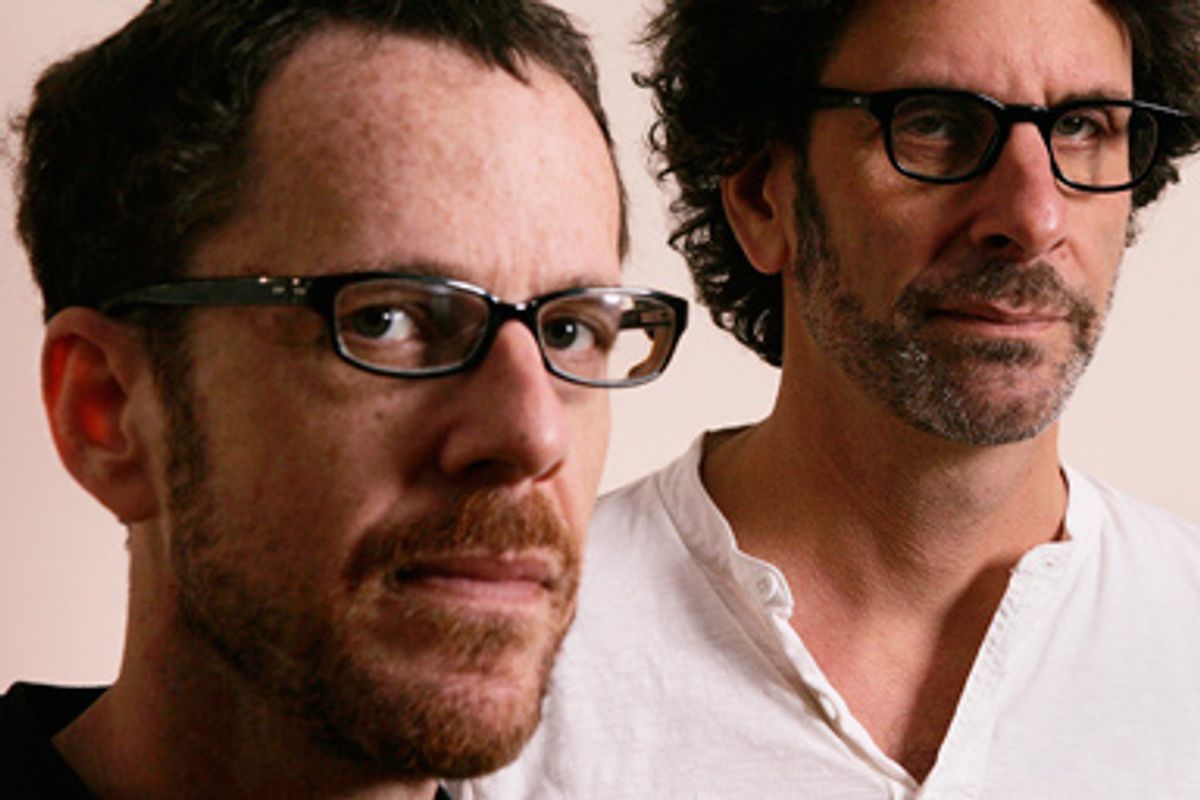
Joel and Ethan Coen on mixing Yiddish fable and suburban farce in their slippery, dark and brilliant new movie
Directors Ethan Coen, left, and Joel Coen pose for a portrait at the 34th Toronto International Film Festival in Toronto, Sunday, Sept. 13, 2009.

AP photo
Directors Ethan Coen, left, and Joel Coen at the 34th Toronto International Film Festival in Toronto, Sunday, Sept. 13, 2009.
So you want to hear a story? I’ve got one for you. It’s about a beleaguered suburban dad who’s got problems in his marriage and goes to see the rabbi — actually, a whole sequence of rabbis — with unsatisfactory results. It’s got an envelope full of money and a glorious 1964 Coupe de Ville in it, both of which lead to startling and unforeseen consequences. It’s got a secret message, possibly or probably from Hashem (aka God), inscribed on the teeth of an oblivious goy. This whole story might indeed be a fable about the way Hashem works in the lives of ordinary people — or it might be about a dybbuk, a demonic spirit from ancient Jewish folklore. Then again, the fable might just be about the disordered, random operations of fate, and the futile human struggle to understand them.
One thing is for sure: This story, which comes to us in the form of a movie called “A Serious Man,” is one of the subtlest, darkest and most deceptive ever spun by Joel and Ethan Coen, its writers, directors and producers. This is by far the most personal and revealing film the Coens have ever made, which might not seem like saying much: They’re known for creating mannered, sardonic fictional worlds shaped as much (or more) by film history as by real life. But in recapturing the vanished realm where they grew up — a self-enclosed world of Midwestern Jewish suburbia — the Coens have crafted perhaps their most original work, one that presents itself, early on, as middleweight middle-American domestic comedy before revealing a strange and secret power that’s closer to magic or myth.
In fact, it isn’t true that “A Serious Man” appears to be suburban comedy at first, since it opens with an ambiguous yarn straight out of 1920s Yiddish theater. On a snowy night, in a shtetl somewhere in Eastern Europe, a man and his wife are visited by — well, who, exactly? Is it a man who recently recovered from a serious illness and was mistakenly reported to be dead? Or has the man really died, and been possessed by a malicious, wandering spirit — a dybbuk? (Whether dybbuk or human, the visitor is played by legendary Jewish theater actor Fyvush Finkel.)
Only after that are we plunged into suburban Minneapolis in 1967, straight into the ear canal of bored teenager Danny Gopnik (Aaron Wolff), who is listening to Jefferson Airplane on his transistor radio instead of paying attention in Hebrew school. That transgression will be discovered and punished — Hashem sees everything we do, after all — and so will the other sins committed by the movie’s characters, which range from adultery to accepting bribes to smoking some killer weed in the middle of a weekday afternoon with the hot, semi-abandoned wife next door.
What’s the connection between the dybbuk story, set in a vanished world of poor and superstitious villagers, and the far more familiar story of Danny’s dad, Larry (the wonderful Michael Stuhlbarg, another New York theater actor), a perennially perplexed college professor who’s trying to keep his respectable suburban existence from slipping between his fingers like so much Minnesota lake mud? There are a lot of possible answers: The Coens could be saying, for instance, that modern American Jews still inhabit the same mythological universe their European forebears did; or perhaps that the people in the 1960s story are still paying off the debt incurred by that couple in the Yiddish tale.
But the real answer is that I don’t know, and that like “A Serious Man” in general, the Yiddish prologue either clicks with you or it doesn’t. Although critics generally love this movie so far, there also seems to be an emerging consensus that it’s “too Jewish” and too light on star power to have any chance with a general audience. Maybe that’s all true — there’s definitely no Clooney or Pitt in this cast — but speaking as someone who’s about as goyish as you can get while still living in New York City, I found this beautifully crafted movie to be frequently hilarious, consistently surprising and rigged with spring-loaded narrative bombs, from its opening scene to its devastating final shot.
Is Larry Gopnik even the “serious man” of the title? He yearns to be, but his wife, Judith (a pitch-perfect Sari Lennick), reserves that adjective for Sy Ableman (Fred Melamed), the pompous, erudite pseudo-bon-vivant for whom she’s leaving Larry. Melamed — one of those guys you’ve seen in, say, Woody Allen movies but couldn’t put a name to — gives an absolutely priceless performance, but it’s tough to pick a favorite in a supporting cast like this. Richard Kind plays Larry’s depressive brother Arthur, who haunts the Gopnik family in dybbuk-like fashion, monopolizing the bathroom (to drain his sebaceous cyst) or arriving home at dawn and in handcuffs. Adam Arkin is a pathologically pessimistic divorce lawyer, George Wyner plays the rabbi who tells us the story of the goy’s Hashem-inscribed teeth, and Amy Landecker gets one wonderful scene as the blasé-but-smoldering stoner babe next door.
You certainly couldn’t say that “A Serious Man” is suffused with Proustian longing for the Jewish suburbia of years gone by — these are the Coens, after all, and there are plenty of other sources for that kind of thing. But it isn’t a ruthless satire, either. I think it’s a meticulously pitched black comedy, which is both too slippery to hold in your hands and fundamentally sincere in expressing the Coens’ view of their roots and the universe.
Although Joel Coen (the taller one, with longer hair, generally seen in sunglasses) and Ethan Coen have a reputation as being difficult interview subjects, in my few encounters with them I’ve found them congenial, amusing and completely willing to discuss their films, their methods and their motivations. I think they don’t do well with vague or general questions — when asked at a recent press conference, “What’s the best thing about being Jewish?” they declined to answer — and don’t especially relish playing the role of celebrities. Ask them to talk about movies, though, or about the vicissitudes of 1960s television reception, and you’re golden. I met them recently in New York, just before the premiere of “A Serious Man.”
I was thinking about your last three movies: “No Country for Old Men,” “Burn After Reading” and now this one. They’re really pitched in different keys, so to speak. Is that deliberate, or did it just come out that way?
Joel Coen: You do pursue that to an extent. The funny thing about those three movies is that the scripts were all done around the same time, and they got made in the particular order that happened for boring production reasons. But when you move on to something else, you’re often thinking, “What can we do that’s not like what we just did?” Just because that makes it more fun for us.
I’m someone who also lived through the period of American history you capture in this film, and it’s incredibly vivid. It seems like one thing you guys really like about making movies is the opportunity to create a world, a place and time that’s specific to each film.
Ethan Coen: It is important to us, where and when the story is set. To get a grip on the story, we kind of have to get a grip on its context. Especially in this case, because the context of this one is where and when we grew up. It’s interesting you refer to it as American history — I guess that means we’re getting on. But yeah, the whole enterprise of doing a story in the ’60s, in suburbia, in this Jewish community — Midwestern suburbia — was interesting to us. And part and parcel of thinking about this story was thinking about where it was set.
J.C.: Part of the pleasure of making a movie, of actually putting the movie together, is creating a world that’s specific to the movie. When you’re doing period movies, that has its own challenges and pleasures, which was pretty much the case here.
You have some shtick in this movie about sending Dad up onto the roof to adjust the TV antenna, in a futile effort to get rid of all that snow on the screen during your favorite show. I can remember that, but I suppose there are now several generations of Americans now who will never have that experience.
J.C.: That’s true. Those times are gone — TV aerials. We actually had to put the aerials up on all those houses. Another interesting problem was that we were looking for a neighborhood — and you can find them where we were shooting — where the houses are of that vintage and are still in great shape. The problem is that they’re surrounded by old trees that weren’t there 30 or 40 years ago. So most or all of the trees were removed digitally, by computer. But in doing that, because they used the roof lines of the houses as matte lines, then they had to put all those aerials back in.
E.C. I want to say we had rabbit ears on our TV, which we didn’t use in the movie. I remember dicking around with the rabbit ears, spinning them and moving them around on top of the set.
With aluminum foil on top of the rabbit ears?
We didn’t do that. Some people did, but we didn’t do that.
You were not low-class enough for aluminum foil on top of the TV set. That’s a goy thing. [Laughter.]
You know, we always had a black-and-white TV, even past when our friends got color TV. But I remember that the early color TVs had controls for “Hue,” and there was something else, some other quaint, dated term.
I remember that. I can’t remember what it was called. You could make it go really green in one direction, and then really, like, this hideous orange-red color in the other. Was that what it was?
Yeah, I guess. You saw some really gruesome color.
Now, the most specific and startling thing about this film’s setting, which is definitely not universal, is that it’s a Jewish community that looks very generic at first glance, but totally isn’t. Most representations of Jewish culture in American movies comes down to two things: immigrant culture, on one hand, or the fully assimilated culture of a Barry Levinson movie, where the people are into Cadillacs and football. This is totally different: middle-class, fully American but not assimilated.
J.C.: That’s correct. That’s a really good characterization of it, and of how it’s different from what you’re familiar with: things like a Barry Levinson movie or, like, Bernard Malamud or Saul Bellow novels. Those are also more urban.
E.C.: They’re all more urban and except for Saul Bellow, more East Coast.
J.C.: Yeah, he was a Chicagoan, but Chicago is very different from where we grew up. You’re right, it’s very American but not assimilated. It was a community that existed within the wider culture but was protective and somewhat insular. You felt like your experience — even though we were aware that most of the people around us were not Jewish, in the city that we lived — we felt like our experience was in certain ways really bounded by the community.
E.C.: It wasn’t just us. It was universal among the Jews in our community. We went to Hebrew school every day after school, Monday through Thursday. We went to shul on Saturday, and Hebrew school again on Sunday morning. It was, you know –
J.C.: We had some form of religious instruction six days a week.
That’s impressive. I notice that you don’t ever show the kids in the movie in public school, where presumably they are interacting with non-Jews every day. Except for the scary neighbors, and of course the goy with the teeth, there pretty much aren’t any non-Jews in the movie.
J.C.: Right. What seemed interesting, as a place to set a story, was that world on the bus coming home from school, and the experience in Hebrew school and the synagogue. To a certain extent, when you’re thinking about these things, you’re also aware of the things you’ve seen many, many times and the things you haven’t seen at all. The things you haven’t seen at all seem like more interesting challenges, more interesting stories.
Some viewers may be taken aback by the way you depict the community’s attitude toward non-Jews. There’s a lot of dismissive talk about “goys,” and the community seems totally self-contained: Jewish doctors, Jewish lawyers, Jewish dentists. I guess it’s all summed up at the end of the anecdote the rabbi tells about the “goy’s teeth.” Which is awesome, by the way. At the end of it, Larry asks the rabbi, “What happened to the goy?” and the rabbi is, like, “The goy? Who cares?”
J.C.: [Laughter.] That always brings the house down.
E.C.: It’s a classic line.
J.C.: That’s the way, you know, non-Jews were talked about. It wasn’t in a dismissive way. It was that, in certain contexts anyway, they were the Other.
E.C.: Right. It wasn’t even about slighting them. It was: They have nothing to do with us.
Well, I’m definitely out of my depth with respect to Jewish culture, but the whole story — the whole movie — feels to me like a Talmudic parable, a moral fable about what happens to somebody who makes certain choices in his life. Then you’ve got these other stories nested into it, including a prologue that’s in Yiddish and has the feeling of the old Yiddish theater. It uses the old tradition of the dybbuk, a kind of demonic spirit from Jewish folk tradition. I’m sure you don’t want to give too much away, but what can you say about the relationship between that story and the main story?
E.C.: Well, it’s interesting that you ask about it in connection with your other comment, that the main body of the movie feels like a folk tale or fable. That, I guess, is the ambition — well, not even the ambition of putting on that beginning story, because there was no clear-cut agenda. It just felt right to us. But I think it felt right for that reason. It felt like a folk tale, so it served implicitly as an introduction, to say, “Here’s another folk tale, here’s another Jewish story.” I guess this is imposing an explanation after the fact, because we don’t really think about it in these terms while we’re doing it, but, yeah, it’s part of the whole Yiddishkeit, part of the whole Jew storytelling thing. Jews are big on stories, you know?
J.C.: Yeah, exactly. At a certain point we were thinking, maybe not explicitly, “What is Jewish storytelling?” This is Jewish storytelling, and this is Jewish storytelling. Are they an echo or a reflection of each other? Can they be? Would that be interesting? “What is a Jewish community?” This is a Jewish community in the shtetl, this is a community in another place. Are they reflections or echoes of each other in some way that’s vaguely interesting and feels right, or at least not wrong? Will it be an interesting ambassador for the rest of the movie?
As Ethan was saying, sometimes you impose these things after the fact. But I think there was a little bit of thinking that by doing this we were saying immediately, “This is a story very specifically about Jews.” Not a story about the Midwest, which you might have felt for a while if we hadn’t done this. We were plunging into the deep end, and saying, “Here you are in a world of Jews, and that’s what this movie is going to be about.” It’s a cliché, but when you see them in the long black coats and the sidelocks, that’s putting your face in it. And we thought that was a good thing.
Yeah, I guess that’s roughly how I responded to it. I assumed that there was a relationship between that first story and the later story, but not a linear, one-to-one connection, like those people in the shtetl are the grandparents of those later people or something. It does pose a question right away: What’s the relationship between this village in Poland or wherever the hell it is, and this suburban neighborhood in Minneapolis?
E.C.: Another thing that appealed to us about it was that first you see Jews where you’re used to seeing them, in the shtetl — and then you see Jews on the plains. That’s odd!
Let’s talk about the story of the goy’s teeth. So some non-Jew goes to see a Jewish dentist, who discovers that he’s got a coded message from God written on the inside of his lower front teeth in biblical Hebrew. Did you make this up from whole cloth, or does it have some basis in folklore or something?
E.C.: It’s got a basis in fact. It’s something that happened to me a few years ago. I don’t really like to talk about it. [Laughter.] No, we just made it up. The whole Jewish storytelling thing: You go to the rabbi with a problem, and he tells you a story. So what’s the story going to be?
J.C.: The only thing we had trouble with was coming up with a Hebrew expression or word that was exactly seven characters that meant “Help me.” For that we went to a rabbi named Daniel Sklar, who suggested something.
E.C. It was good. He said, “It’s kind of ‘help me,’ kind of ‘save me,’ kind of ‘redeem me.’ And we thought, OK, that’s perfect. Those are all good tones.
This is your most overtly Jewish movie, by a long shot. But I was able to come up with a brief list of other Jewish characters in your films. John Goodman’s immortal Jewish convert in “The Big Lebowski,” of course, who announces that he doesn’t fucking roll on Shabbos. And I think we can assume that Barton Fink is Jewish.
E.C. We assumed that too.
J.C.: Well, he’s Jewish and the Michael Lerner character in that movie is Jewish. The studio head. Some people kind of objected to that at the time, absurdly.
E.C.: We made a studio head Jewish! Imagine that!
“A Serious Man” opens Oct. 2 in New York, Los Angeles and Minneapolis, with wider national release to follow.
Pop Torn: This week in cultural ambivalence
We're on the fence about: Fake teeth tattoos, Paula Abdul's inner warrior, "Friday Night Lights'" secret endgame
Your weekly dose of popsam and jetsam.
Fish gotta swim, birds gotta fly, and I have to make sure that I have no idea what is going on with those Republican debates. Is Michele Bachmann winning? Is that why her scary face was on Newsweek? Oh man, what a world, what a world. Oh, and London burned down too! Come on, Earth, get it together!
If you’ve had enough of the depressing news for the week, feast those things in your ocular cavities on these 10 pop culture stories that we’ve culled from the Internet and beyond! (But mostly the Internet.) They aren’t here to make you feel OK again, but maybe they’ll take your mind off the fact that the world is going to hell in a hand basket.
1. Clear eyes, full hearts, secret speech?: Entertainment Weekly has the mother of all Easter Eggs in the form of a special finale pep talk from Coach Taylor on “Friday Night Lights” that was supposed to play over the end sequence. Well, here it is, in all its gruff-but-lovable glory. (Though it is kind of awkward, the way he talks about never forgetting the feeling of “that hot breeze slapping my face.”)
2. All about the Bitcoins: If you haven’t heard about the Internet’s new form of currency that takes hundreds of dollars in computer equipment to “mine” and is vulnerable to hackers stealing all your fortune in fake (but kind of real?) money, count yourself lucky. Or just read this story.
3. Arnold Schwarzenegger is a fashion icon and a really great guy:
I wonder if he had this shirt custom-made, or if he found it in a Salvation Army or something. Maybe Marie is the name of a new ride at Six Flags?
4. Paula Abdul wants to be the new Khaleesi: It’s common knowledge that Paula is a little cuckoo for cocoa puffs, so why anyone would take on a job as her assistant is beyond me. Maybe it’s so they can come back and report how the “X-Factor” judge needs to have her entourage constantly remind her that she’s a “warrior, survivor and gift.” Dragons!
5. Dissecting the Coens: David Haglund over at Slate watched every single Coen brothers movie. (Who hasn’t?) At first he thought they were self-indulgent. Then he thought they didn’t make any sense. Finally he came to the conclusion that we aren’t supposed to like these characters-bordering-on-caricatures, and it was all a broad, meandering metaphor for real life. Kind of like this article is for a Coen brothers film. Wait … brilliant!
6. Fergie, Duchess of York, can’t make it through a whole interview: I guess we’ll have to wait until Australia’s “60 Minutes” on Sunday to find out what made Fergie “go off the rails.” (Though we kind of already know it’s the infamous 2010 tape where she begs for money to see Prince Andrew.)
We can only hope the reporter didn’t try something akin to that Dalai Lama joke. You know how those Australian newscasters are. Where is Barbara Walters when you need her?
7. Mark Zuckerberg dares to call “Chill” Facebook app “lame”: Guys, not to freak you out, but the fallout from this could be devastating. Especially because the Zuck wasn’t talking about FarmVille.
8. Bizarro Twitterverse even scarier than the real thing: Check out “fake Twitter” site Heello. It’s by the same guy who founded Twitpic, but it’s a hell of a lot weirder. Though honestly Twitter is such a mess sometimes that reading a CNN tweet all in caps about Justin Bieber doesn’t seem that out of the ordinary.
9. Temporary teeth tattoos for everyone! (But mostly the Japanese):
At least they are a step up from those real teeth tattoos? Or maybe they are like a gateway drug for permanent images that look like red rot on your chompers. Moms, don’t let your kids start putting decals on their baby teeth, or else they will grow up to be this guy.
10. That “Russian Dolls” show actually happened and you missed it: You probably skipped the premiere to watch “Jersey Shore,” right? Shame on you! There is a whole world out there of trashy cultures you have yet to experience! Well, here’s the first episode in its entirety. Try to keep up, it moves fast. Brighton Beach forever!
Readers respond: Cinema’s best unexpected villains
Slide show: Last week, we gave you our favorite "good guy" actors at their most devious. Now, we let you choose
How can anyone that looks this good be so bad?
Who knew that evildoers could be so polarizing? Last week, I put together a list of nine actors whose turns as sinister villains caught audiences off-guard, like Heath Ledger’s turn as the Joker in “The Dark Knight” and Henry Fonda in “Once Upon a Time in the West.” Far from being a definitive collection, I asked for readers to leave their favorite crooked performance from a Hollywood hero in the comments section. And boy did you.
So here are your choices for the best bad boy (and girl) roles, along with your reasoning for what made the portrayal so disturbing and/or awesome. If your vote didn’t make it on the list, I apologize. Feel free to aggressively champion them again in the comments. I also apologize for adding Keanu Reeves’ appearance in “Much Ado About Nothing” to the original list, which many of you pointed out was not a terribly great one: my point there was that sometimes this good cop/bad cop casting misfires horribly, and there was no better example of that than Neo from “The Matrix” trying to do Shakespeare.
Be aware, this list does contain some spoilers for older films.
The Oscars’ black hole of boredom
By trying to be "young and hip," last night's Academy Awards turned into a great big middle-of-the-road splat
Natalie Portman poses backstage with the Oscar for best performance by an actress in a leading role for "Black Swan" at the 83rd Academy Awards on Sunday, Feb. 27, 2011, in the Hollywood section of Los Angeles. (AP Photo/Matt Sayles) (Credit: Associated Press)
Oscar has fallen, and he can’t get up. Now, if you get that reference, you’re probably: A) too old to belong to the demographic that was supposedly being hunted by the producers of Sunday night’s dreary and confused telecast, and B) too young to have written most of the shtick. Presented with one of the most varied and interesting lists of nominated films in recent memory — many of which had actually been seen by large numbers of paying humans — the academy managed to screw up its messaging totally and create a soul-sucking black hole of boredom.
One way of explaining what happened last night is that the Oscar producers tried to tack young and hip, just as academy voters tried to tack mass and mainstream, correcting for several years of more audacious indie-style winners like “The Hurt Locker,” “Slumdog Millionaire” and “No Country for Old Men.” The result was a great big middle-of-the-road splat, presided over by a monumentally uncomfortable pair of stars, the miffed-looking James Franco and the perky-like-a-little-coffeepot Anne Hathaway.
While the show galumphingly tried to incorporate bits of the Twitterverse snark that surrounds it (and has all but superseded it), the biggest prize of the evening went to a dignified, achingly sincere Masterpiece Theatre-style film about the suffering of the Queen of England’s late papa. I have no particular problem with “The King’s Speech”; in fact, I enjoyed it. But my colleague Matt Zoller Seitz was correct to note, last week, that it might be the fifth- or sixth-best of this year’s nominated films (after “Black Swan,” “True Grit,” “The Social Network,” “The Fighter” and “Winter’s Bone,” at the very least). Awarding “King’s Speech” the best-picture prize was at least predictable; giving Tom Hooper the directing award, in a category that included Darren Aronofsky, the Coen brothers, David Fincher and David O. Russell, feels more like criminal pandering. (If I had a video clip of Sen. Paul Tsongas and his “Pander Bear” from the 1992 presidential campaign I would stick it in right now. Anybody? No? Well, let’s just move on then.)
It wasn’t simply that Franco was baked or bored, or that his idiosyncratic blend of sincerity and authenticity are precisely out of sync with the combo demanded by the Bob Hope-Billy Crystal-Whoopi Goldberg Chair of American Toastmastership, although those are all plausible hypotheses. Franco was pissed. On a night when he could have been building a multimedia installation or running lines for “General Hospital” or getting busy with an NYU sophomore or working on a paper about Sir John Suckling, Franco had to hang out on a cold night in L.A. with all these dorks, presiding over a pseudo-event so miscellaneous it couldn’t be rescued through meta-ness or reframing or any other kind of mental gamesmanship.Was this “performance art” like your GH gig, Jimmy? No, it wasn’t, was it? It was just lame.
Oscar’s leaden attempt to rebrand its trademark telecast as young and hip and social media-savvy (just consider all those terms surrounded with scare quotes, in celebration of your/my/our/James Franco’s sense of detachment and superiority) was as awkward as such things generally are. Justin Timberlake pretending to use an iPhone app to change the bewildering background projections — ho ho ho! Nobody in the entire world thought that was funny. Not you, not me, not the people watching in India or equatorial Africa. Not Kirk Douglas and Melissa Leo. (Why the negativity, people? At least they seemed like human beings.) Not my mother-in-law who doesn’t know what an app is or my 6-year-old son (who does). Not the person who wrote it, and definitely not James Franco. That was more and different pandering, of the sort that makes everybody unhappy, like the time your grandfather gave you a quarter but all you can remember about it is the terrifying tuft of hair sticking out of his nose. (More Paul Tsongas video, please. I just want to keep typing that name: Paul Tsongas!)
Speaking of the 1990s, let’s talk about that set, shall we? A few puff pieces last week dutifully described the use of digital projections as a “radical departure” from Oscar tradition and even invoked the term “virtual reality,” a sure sign that whatever you’re talking about will resemble a sales conference hosted by a mid-level Fortune 500 corporation. I spent much of the evening trying to figure out what those illuminated hoops looked and felt like. A briefly hot Las Vegas resort hotel, now teetering on the edge of bankruptcy? The inside of a vintage Wurlitzer jukebox? A rejected design template for “TRON: Legacy”? Then, when we saw a black-and-white clip of Bob Hope cracking wise on the first Oscar telecast — and when Bob Hope is much, much funnier than your current hosts, your show is in trouble — I grasped that the set was sort of, halfway supposed to evoke the classic interior of the Pantages Theater, not far away on Hollywood Boulevard, where the ceremony was held in the ’50s. But evoke it for whom, and why? To make Kirk Douglas feel less confused? (I’m kidding; he did fine.) To give younger viewers and participants some vague, disembodied sense of being connected to history? Wait, yes, that’s it exactly.
Awards? Yes, they gave awards and I haven’t mentioned them, because except for Melissa Leo’s unhinged F-bomb outburst and the outrageous, even shameful selection of Hooper as best director, it all went according to plan. Natalie Portman and Colin Firth had been practicing their lines, and delivered them nicely. (Yes, Annette Bening deserved to win, but Portman became the ass-backward representative of “Black Swan,” which deserved to win all kinds of other awards but didn’t.) Christian Bale looked more like The Dude than Jeff Bridges did, and gave every impression of being intensely weird. Lots of people we’d never heard of before mentioned their parents and grandparents and children, which is always irresistible. That Carrot Top-Yahoo Serious looking guy who won the live-action short prize was hilarious (although his movie isn’t that great). Accepting an inevitable and thoroughly deserved screenwriting prize for “The Social Network,” Aaron Sorkin went on and on and on — shocker! — and ended with the words “guinea pig.”
We were all the guinea pigs last night, Aaron, and the experiment didn’t go well. After that prepackaged opening riff when Franco and Hathaway inserted themselves into the nominated films — which was silly but fun and actually involved their talents as, y’know, actors, instead of their limited ability for shtick — the whole evening felt more and more like a bad idea gone wrong. (Sen. Tsongas, please!) I’d compare it to, like, taking your aunt to the prom, except that James Franco would handle that situation with awesome suavity. Anyway, if he’s got an aunt I bet she’s hot. And I bet she’d rather see “Black Swan” than “The King’s Speech.”
“A Somewhat Gentle Man”: Hilarious darkness from the frozen north
Pick of the Week: Norway's "A Somewhat Gentle Man" includes some of the funniest sex scenes in movie history
When Ulrik, a ponytailed, weatherbeaten Norwegian convict played by Stellan Skarsgård, is about to be released from the prison that’s been his home for the last 12 years, a guard rushes up to him at the last minute with a bottle of something good and a few words of wisdom. “When you leave this place, keep going forward,” the guard tells him. “Don’t look back.” Then the gate slides open, and Ulrik looks out at freedom: the flat, white, unrelieved winter landscape of Norway. We don’t know anything about his life in prison, but was it really as bad as all that?
That’s just the first of numerous sight gags in Hans Petter Moland’s film “A Somewhat Gentle Man,” which I truly and honestly believe is one of the funniest movies I’ve seen in years. If you suspect that says more about me than about the film, you might be right. I’m exactly the sort of evil bastard who finds disproportionate delight in a Scandinavian black comedy that suggests both the Coen brothers’ “Fargo” and the grim fables of Finnish minimalist Aki Kaurismäki. Still, maybe you’re the kind of person who grooves to the dark humor of the northlands yourself, and I’m more than happy to defend “A Somewhat Gentle Man” as a pitch-perfect blend of darkness and sweetness, built around a masterful performance by a great actor.
If you don’t recognize Skarsgård’s name, you’ll definitely recognize his face; he’s one of those European actors who’s a superstar in his home country (which is actually Sweden, not Norway) but has made a terrific living playing villainous and/or comic roles in Hollywood. Maybe you’ve seen him on “Entourage,” or in “Mamma Mia!” or as Bootstrap Bill in the “Pirates of the Caribbean” franchise. He’s been a regular in Lars von Trier’s films, played Matt Damon’s professor in “Good Will Hunting” and played both anti-Nazi hero Raoul Wallenberg and Nazi sympathizer Wilhelm Furtwängler (not in the same film). I won’t pretend to have seen even half his film roles, which encompass at least five languages and six countries, but if the brooding, baffled Ulrik isn’t his best performance it’s definitely up there.
Moland is more like a director of commercial films than art-house obscurities, at least by Norwegian standards, and while “A Somewhat Gentle Man” has the look and feel of downscale, kitchen-sink realism, it’s a lot warmer and nuttier than it seems at first. (Moland has directed Skarsgård twice before, in the thrillers “Zero Kelvin” and “Aberdeen.”) We know almost nothing about Ulrik or his life as he takes his first steps into freedom, except that he has an ex-wife and an adult son who both claim they want nothing to do with him (although their actions suggest otherwise). He owes some kind of debt — financial or moral or tribal — to a paunchy mob boss named Jensen (Bjørn Floberg), who presides over a dismal suburban diner and bosses around a moronic flunky named Rolf (Gard B. Eidsvold), but whose imperial power seems seriously diminished.
Ulrik apparently exudes some serious prison-house pheromones, because womenfolk can’t keep their mitts off him. Not his seriously scary landlady (Jorunn Kjellsby, in what may be the greatest of several scene-stealing deadpan performances) — who makes a delicious fish pudding and expects payment for it, if you know what I mean and I think you do — not his bitter ex-wife (Kjersti Holman) and not Merete (Jannike Kruse), the blond German girlfriend of his boss who serves as this movie’s low-budget femme fatale. “A Somewhat Gentle Man” contains several of the most hilarious sex scenes ever committed to film, and through it all Ulrik is simultaneously wide-eyed and stone-faced. (He seems to enjoy eating while in flagrante delicto.) Somehow Skarsgård manages to convey the fact that this man, raised in a culture that devalues emotion and then hardened by crime, is going through an internal transformation he can neither understand nor express.
Ulrik’s droll odyssey through downwardly mobile suburban Oslo also involves a foulmouthed Lappish arms dealer (with a smartass dwarf underling), a Norwegian salsa cover band and our eventual realization that his past misdeeds — and present-day debt to Jensen — are much worse than we thought. Still, this is the kind of movie where things are always darkest before the dawn, and a chance meeting with his son’s hostile but very pregnant girlfriend (Julia Bache-Wiig) offers Ulrik a totally unexpected chance for redemption.
Everything about “A Somewhat Gentle Man” is so subdued and precise, from Philip Øgaard’s cinematography to the brilliant score by Danish composer Halfdan E (constructed around half-buried bits of rock, pop and country hits) to the performance by Skarsgård that tells us nothing but shows us everything to the easily misremembered title (this isn’t “A Serious Man” or “A Single Man” or “A Man for All Seasons”), that I don’t really expect American audiences to cotton onto how rich and funny it is. Still, Moland and screenwriter Kim Fupz Aakeson’s ruthless treatment of their country’s frozen landscape and repressed people can only be rooted in love, and by the end of the film that prison guard’s advice (along with his bottle of aquavit) definitely comes in handy.
“A Somewhat Gentle Man” opens Jan. 14 at the IFC Center in New York and Jan. 28 at the Nuart Theatre in Los Angeles, with other cities to follow.
A “Biutiful” chat with Javier Bardem
Javier Bardem on how his buzzy new role differs from his Oscar-winning turn in "No Country," and more
Javier Bardem in "Biutiful."
Javier Bardem gestures meaningfully out the window at the frozen New York streets and says, “I saw the wolf.” Whether this is an unfamiliar Spanish idiom or simply a metaphor that appeals to him I am not sure, but I think it translates as “I have a cold.”
My meeting with Bardem, in a hotel cafe overlooking Rockefeller Center, begins at noon, but the 41-year-old star of “Eat, Pray, Love,” “No Country for Old Men” and “Before Night Falls” arrives looking rumpled and unshaven (not that that’s unusual in itself) and doesn’t even try to pretend it’s not breakfast time. While publicists, assistants and waiters orbit around him, bringing cappuccinos and a basket of rolls — and trying to discover whether the hotel will permit him to sneak a cigarette — he apologizes for running late and chats with me a little about childbirth and fatherhood. He and partner Penélope Cruz are expecting their first child in February, and have avoided learning its sex so far. “We’re old-fashioned in that sense,” he says. “We want to be surprised.” When I mention that my twins were born by Caesarean section, he asks whether I stayed to watch. (I tell him that I did, but wouldn’t necessarily recommend it.)
Bardem is in town to talk about his magnificent starring performance in Alejandro González Iñárritu’s new film “Biutiful,” an Oscar contender that has already won Bardem the best-actor award (shared with Italian actor Elio Germano) at the 2010 Cannes Film Festival. As I wrote at the time:
“Biutiful” is another of Iñárritu’s grandiose meditations on life and death, parents and children, the supernatural, the interconnectedness of the universe and everything else under the sun (or over it). But at least it’s mainly about one guy and one city. While it might run 20 minutes or so too long, and could stand to be thematically deflated as well, “Biutiful” is a major return to form for Iñárritu, closer to his riveting debut “Amores Perros” than to the ponderously noble “21 Grams” or the Hollywood-loves-the-world messaging of “Babel.”
Bardem plays Uxbal, a shaggy, soft-hearted Barcelona lowlife and single parent who makes his living by managing and renting gangs of illegal African and Chinese workers, and who’s been putting off going to the doctor because he expects some really bad news. As one friend of mine noted in Cannes, if you lay out Uxbal’s story, it sounds like way too much: He’s sick with cancer, he’s got two small children, his estranged wife (Maricel Álvarez) is a junkie nutjob and he’s got to deal with corrupt cops, organized crime lords and cheapskate employers. Oh, and he has a side business communicating with recently dead souls, whom he visualizes as human-shaped helium balloons huddled against the ceiling.
“Biutiful” is in danger throughout of collapsing into a sentimental omelet of pseudo-spiritual mush, and it’s Bardem (along with the spectacular photography of Rodrigo Prieto) who keeps it tethered to recognizable human experience. Despite his reputation as an international sex symbol and bon vivant, Bardem in person comes across as a serious student of acting and cinema, discussing the invisible similarities between his role in “Biutiful” and his Oscar-winning performance as cold-blooded, Ringo-haired Anton Chigurh in “No Country for Old Men.” He also told me as much as he could about his just-completed role in an untitled Terrence Malick film (the one that will come out after “The Tree of Life”), and explained why he considers himself “retarded,” at least in comparison to John Malkovich.
So you’ve got a baby on the way, and some people are saying that you could get another Oscar nomination for “Biutiful.” This must be an exciting time.
Very, very exciting. If it were not for this cold, it would be even better.
You may not feel much like getting out right now, but do you like coming to New York? Do you have fun here?
I think New York is pretty amazing, in every sense. It has the best and the worst of any town in the world. The impulse that it has, the sensation, is unlike anyplace else. Everything on the street is a show. You have to pay attention, no? It’s very exciting, but also exhausting.
Talking about cities, you’ve made two movies in a row in Barcelona — “Vicky Cristina Barcelona” followed by “Biutiful” — and they could hardly be more different. It’s not like the same place!
I said the other day to the people in the city hall in Barcelona, “I brought a lot of tourism to you guys with ‘Vicky Cristina Barcelona.’ And now I’m taking it back.” So we’re even!
Yeah. In “Biutiful,” we see the side of Barcelona that Vicky and Cristina never visit.
No, they don’t. But I’ve been to the Vicky Cristina Barcelona, and it’s real too. Have you been there? It’s a beautiful town. Both of them are real, both of them have to live with each other. As in any major town like this one, I mean, there’s a backstage. A lot of people are trying to survive in that backstage, sometimes with the waste that we leave for them. That’s basically the Barcelona that Iñárritu shows there.
We were there shooting for five months, and that’s a very, very long shoot. For an emotional work like this, that was pretty tough. Prior to that, I prepared for three months, and the last month of my preparation was to be in Barcelona going to those places with those people, the immigration community. I knew about it, I read about it, I saw it on the news, but then I was in it.
So you saw things you hadn’t known about before.
Well, you go and see all these illegal factories. It’s very impressive to see that they are right in the middle of town. Like, right here, right there, that window. You wouldn’t ever expect that. So it’s not only the backstage. It’s also in the middle of town that things are going unnoticed. Big, big things that are affecting a lot of people are going on there.
Uxbal must be a tough character to spend five months with. I mean, he’s a decent man, but he’s a total mess. He’s sick with cancer, burdened with guilt, haunted by ghosts …
Yeah, he is. This is not a movie about delivering the lines and then going back home. This is a life experience, and a journey. I knew that. I knew since I read the script, and based on Alejandro’s previous work, that what he was proposing to me was to jump into the abyss. That’s why it took me a little bit of time to say yes, because I knew he wasn’t offering a job. He was proposing that we grab hands and go to the end of the world. We know where we have to go — we’ll see if we can come back. Five months, plus three months of preparation, working six days per week. Most of the time we worked Saturdays, and he likes to work 12 to 14 hours per day. Holding that emotional state for so long is not easy.
When you are in a movie you have to always be in focus. It’s not like doing a play. When you do a play, of course you warm up a few hours before, you live the play, and then you go back home and have a drink, whatever. You stay with him, but you don’t have to be in focus. The play is done in two or three hours, and then goodbye. On a movie set, you have to be totally in focus, because you never know when they’re going to say, “OK, now we got it. Let’s go!” When you’re doing a character like this, you can’t take a break from him. Otherwise it’s going to disappear.
I wonder whether being exhausted like that helped you play a guy who is terminally ill. Because I think it’s hard to play someone who’s dying — who knows he is dying — without lapsing into cliché.
Yes. This is the most powerful character I’ve played so far, and I’m not sure if I will ever play somebody like this again. There are so many layers to convey and so many circumstances to construct. Relationships of many different kinds — people that you use, people that you are used by, affectionate relationships, hate relationships. And then there’s the sickness. I felt there was no way I could do this without putting myself at risk. Because Alejandro’s work, the way I see it, is about being as honest as you can. The work of the actor has to be about taking off all these faces, social characters that you put on yourself in order to survive out there, and getting as naked as you can, in order not to interfere with the character.
This character needs to be as transparent as crystal, because there are so many things that have to be seen through his behavior, his voice. Those things have to be attached to the actor emotionally, otherwise you cannot portray them and it will be a fake performance. [Clutching chest and moaning.]“Oh, I’m sick!” No. All of that has to be within, so that when he’s not speaking, when he’s walking on the street, you will see that. That was the challenge, and that was the exhausting part. Bringing all that and putting it in there and saying, “I have to hold this for five months.”
I suppose preparing for “No Country for Old Men” must have been very different. That character is also intense, but almost in an opposite direction.
Yeah, it was very different. I didn’t know what I was doing there, man! [Laughter.] But it’s funny you mention that, because they are similar in a way. They are characters I had to work on with my acting coach, who I’ve worked with for 20 years. I go to my acting school every year, whether I’m working or not, I have to be there at least three months. My coach is named Juan Carlos Corazza, and I think he’s a genius. I think he reads material, characters and human beings in a way I haven’t seen before. In both cases, those roles have to do with how much you have to take out of yourself — it’s not about doing anything, it’s about, OK, let’s take things out of yourself so you can go to the character in a way that is more pure and simple.
Especially in “No Country for Old Men,” he is a very simple man, with simple ideas. But those ideas were pretty tough! Uxbal is the same, I think. I’ve done some other characters, like Reinaldo Arenas [in "Before Night Falls"], where you have to add things, add behavior, and then work around them until the moment those things are yours. These two guys are different — it’s like take out, take out, take out, until you are naked. And then you put that drama in, or you put that philosophy in, like in “No Country for Old Men.” They are simple statements, but very strong.
Of course language is only one part of a performance, and a lot of actors say it’s the last part. But it must be different for you, acting in Spanish, as in “Biutiful,” after all the recent films you’ve done in English.
Yeah, it makes a difference because it’s the mother tongue. You live your life in Spanish and you’ve suffered and enjoyed and had pleasures and pains in Spanish. Words have an emotional resonance in you, huge emotional echoes, when you’re speaking in your own language. You don’t think about what you’re saying; the words come out of a need to express yourself. When you’re speaking in a foreign language, there’s like an office in your brain, where people are throwing the words at you. “Give me that word — I need a verb! I need an adjective!” There’s a lot of people working in there, and you have to live with that.
Well, one of the funny things about Anton Chigurh, in “No Country,” is that he doesn’t seem to speak or understand Spanish. And he doesn’t seem to be a native speaker of English either. He’s, like, Hungarian. Or maybe from nowhere.
He’s something else. He doesn’t belong to anywhere. We don’t want to know. [Laughter.]
I’m sure you can’t really tell me anything about your role in Terrence Malick’s next film, but I still have to ask. You wrapped that recently, didn’t you?
We wrapped a month ago. I am not allowed to talk about it, as you know. Well, there are two things: I’m not allowed and I don’t have any idea. [Laughter.] So how’s that? It’s set in Oklahoma, and here’s the great thing about Terry: To my surprise — because I didn’t know him — he is as funny as hell. He has a great, great sense of humor. He made me laugh a lot. He is a great man, a philosopher. I’ve always been very grateful for his work, so when he gave me a call I said, yes, of course. It’s like with Woody Allen: He calls you and you go, “Where? When?” And of course they don’t pay you shit! They take advantage of that! But it’s OK, you go there and you want to be part of the experience. Will I end up in the movie? Maybe not! Or maybe I am the star of the movie. Who knows? But that is the less important thing. The most important thing is to be there, to go through the experience of shooting with him.
OK, so what’s that like? You can tell me what Terry is like as a director without really talking about the movie, I suppose.
Well, it’s unique. He sends you some notes, and that’s it. Then you show up and he takes the camera and you never know what’s going to happen, ever. What time, where, when, with who. So you have to be so alive, especially when you’re playing a character like mine. I cannot really tell you what my character is, but it’s definitely a character. It’s not just me being natural. Hopefully! Maybe you’ll see it and it’s the most horrible thing I’ve ever done. But when you’re playing a character with certain behavior, with a very clear point of view, you have to be 24 hours with him. The way Terry combines reality and fiction is pretty amazing, very poetic. Things were coming out of the scenes unexpectedly, and some of them were amazing things, amazing reactions. Afterwards he would let me know, “That’s why I don’t write, because I would never have expected you or him to do and say that.” He’s like a hunter, and sometimes when you go hunting you don’t get shit. Sometimes you get a big buffalo, man, and I saw Terry hunting a lot of buffaloes. When it works it’s pretty fantastic.
Before I go, I wanted to ask about a movie of yours that’s one of my favorites, that people probably don’t ask you about that much: “The Dancer Upstairs,” which you made with John Malkovich directing. Hardly anyone saw it, but I love that movie.
Me too!
I think that was one of your first movies in English. What do you remember about making that film?
Oh — stress, nervousness, responsibility! Before that I had done “Before Night Falls,” because my dear friend Julian Schnabel had given me his trust, partly to see if I could more or less act in a foreign language, preparing for what would come later. And then working with John Malkovich was like a master class. He’s a very sweet man, a very, deeply, extremely clever and smart and intelligent guy who I will never have anything to talk about with. It doesn’t matter what I say, I will always look, like, retarded next to him. He knows a lot about a lot of things, but he never makes you feel stupid about it. I think that film is very powerful, I loved the story. I have nothing but good memories of that one.
“Biutiful” opens Dec. 29 in New York and Los Angeles, with wider release to follow.
Page 1 of 5 in Coen Brothers
Ricky Gervais: My conscience never takes a day off
Lessons of a very sexy pirate costume
America’s failed promise of equal opportunity
Is gay literature over?
A voice that touched us all
Whitney Houston dies at 48
Didn’t she almost have it all?
Porn’s taboo transsexual stars
The Internet makes magic disappear
The case for a global currency 

