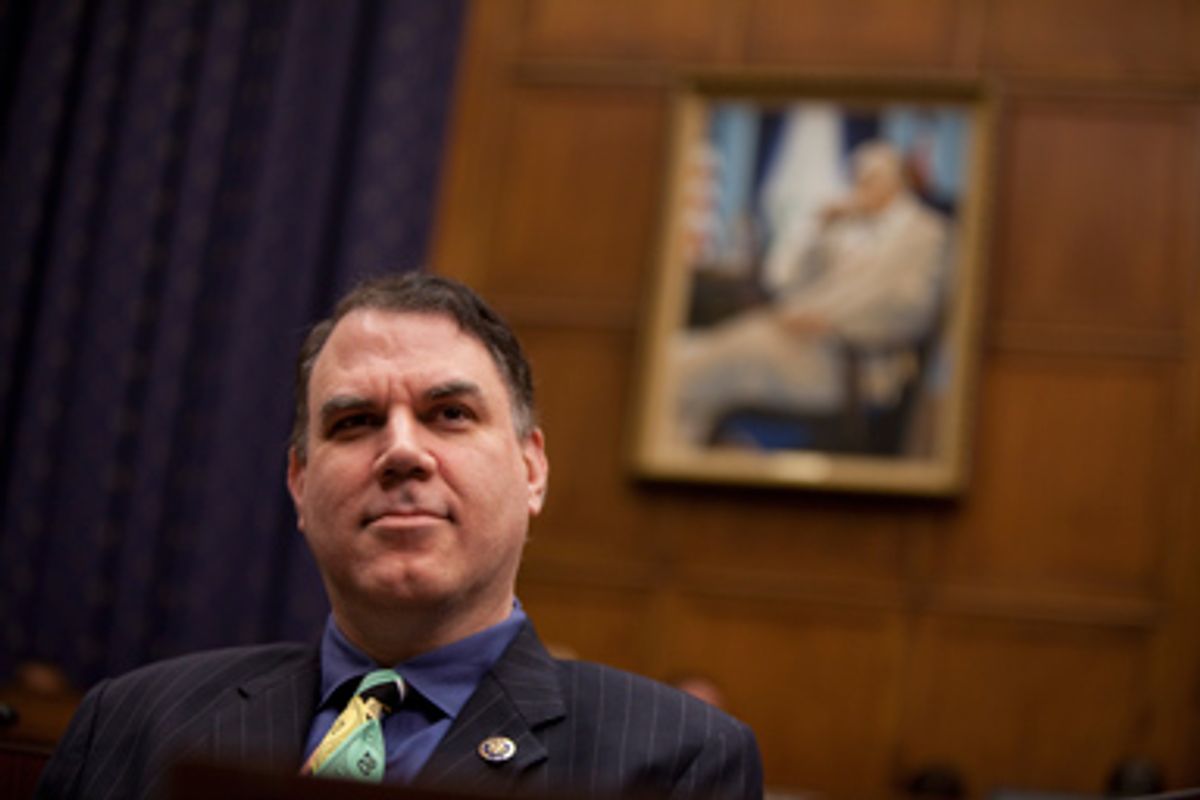
His claim that the GOP's healthcare plan is "die quickly" is just the latest part of the congressman's rapid rise
House Financial Services Committee member Rep. Alan Grayson, D-Fla., listens to Federal Reserve Chairman Ben Bernanke testify before the committee on Capitol Hill in Washington, Thursday, Oct. 1, 2009.

AP Photo/Evan Vucci
House Financial Services Committee member Rep. Alan Grayson, D-Fla., listens to Federal Reserve Chairman Ben Bernanke testify before the committee on Oct. 1.
In a little less than a month, Rep Joe Wilson, R-S.C., went from virtual unknown to a man with real star power in the Republican Party. He’s raised almost $2 million for his reelection campaign, been tapped for a fundraising appeal for the National Republican Congressional Committee and is now even heading out to stump for other candidates. And all it took for him to make that transition was a single moment, when he decided to interrupt President Obama’s address to a joint session of Congress by shouting out “You lie!”
What Rep. Alan Grayson, D-Fla., did on the House floor Tuesday night may not be directly comparable to what Wilson did — he said that the Republican healthcare plan is “don’t get sick,” but if you do, “die quickly,” but he didn’t interrupt the president in front of Congress and a prime-time national audience. Still, the reactions the two men have gotten from their respective party’s bases have been strikingly similar. Grayson, who’s serving his first term, probably won’t get the kind of campaign invitations from high-profile colleagues that Wilson has — but he has taken in more than $115,000 from just one fundraising Web site, ActBlue.com.
“We’ve had thousands of new contributors to our campaign, we’ve received 6,000 e-mails in less than 24 hours,” Grayson told Salon. “People are urging us to make sure that we go ahead and take care of America’s business, and they’re applauding the fact that a congressman had the guts to say the truth and speak the truth to power.”
It comes down to this: Whether they want to believe it or not, the passionate people on both sides of the political divide are more alike than they realize. Both sides believe the party that represents them isn’t forceful enough, that it rolls over for its opposition, no matter how malicious that opposition might be. And when they find someone who’s willing to say what they think needs saying — even if that thing isn’t really true, even if it involves yelling at the president or accusing opponents of wanting people to die quickly — they can be energized pretty quickly. If that person is, like Wilson and Grayson, unwilling to give in when the other side starts howling, well, that only adds to their new aura.
Grayson certainly seems to realize this. In the face of demands for an apology from the House GOP, he went back to the floor on Wednesday and offered an apology — not to the GOP, but “to the dead,” people who’ve died for a lack of health insurance. “I apologize that we haven’t voted sooner to end this holocaust in America,” he said. On CNN, he called Republicans “foot-dragging, knuckle-dragging Neanderthals.”
The congressman wasn’t feeling any more conciliatory when he spoke to Salon Thursday afternoon, saying, “If anybody needs to apologize, the Republicans need to apologize, because since they started these obstructive tactics so many more thousands of Americans have died for lack of health insurance.” And he stood by his original assertion, “Republicans want you to die quickly if you get sick.”
When Salon pressed him, “Is what you said really true? Are they that evil?” Grayson responded, “Uh, yes. Yes. The answer is yes. They have done nothing to grapple with the real problems in people’s lives … Nothing that they have proposed would eliminate the daily tragedy, in fact the hourly tragedy, of people dying in America from not having health coverage. So the answer is yes, what I said is a proper characterization of what they have proposed or in their case not proposed.”
Grayson’s reelection staff is taking full advantage of the opportunity they’ve received as a result of their boss’s outspokenness, too. On Friday, the campaign sent out a fundraising appeal that mocks House Republicans for their criticism of the congressman.
“Congressman Grayson’s re-election campaign wishes to thank all of the Republican hypocrites who attacked Grayson,” the e-mail says. “As soon as the Republican hissy fits began, contributions began to pour in to Grayson’s campaign … Rep. Tom Price (R-GA) demanded an apology. The Grayson re-election campaign would like to usher in a new era of bipartisanship by inviting Rep. Price to serve as the campaign’s Finance Director. The campaign would also like to invite the chairman of the National Republican Congressional Committee, Pete Sessions (R-TX), to serve as Chairman of the Campaign’s Fundraising Committee.”
So far, the left has been loving all of this. It’s no surprise, really. As Marin Cogan wrote for the New Republic just last week, during his short tenure in Congress, Grayson has become “something of a cult hero — a darling of the liberal blogosphere.” He’s the kind of politician that group has been waiting for, and he proved it early on by hiring one well-known blogger, Matt Stoller. In fact, since even before Grayson was sworn in, he gave plenty of indication of what was to come.
A graduate of Harvard Law, Grayson spent the last few years before being elected working on lawsuits against contractors in Iraq and testifying before Congress about some of the waste and corruption he’d helped to unearth. (Coincidentally, back in 2005 I interviewed him about one suit he was working on.) Though he’s worth at least $30 million, he drove an old Cadillac that sported bumper stickers like “Bush Lied, People Died.” Then, not long after he took office, he got some attention for telling a writer for the Huffington Post, “Rush Limbaugh is a has-been hypocrite loser, who craves attention. His right-wing lunacy sounds like Mikhail Gorbachev, extolling the virtues of communism. Limbaugh actually was more lucid when he was a drug addict. If America ever did 1% of what he wanted us to do, then we’d all need pain killers.”
But Grayson might end up paying a price for his willingness to be so outspoken, so freewheeling. Things like giving an interview to notorious conspiracy theorist and radio host Alex Jones, who’s a 9/11 Truther, are likely to keep him out of the mainstream for a while. And he may not even last that long — the Republicans are gunning for him.
Even if Grayson didn’t have a tendency to cause controversy with his public statements, he’d be the kind of candidate any aspiring member of Congress hopes to run against. He’s still a freshman, meaning he hasn’t really accrued the usual advantages of incumbency and he’ll be running in a year when history alone says Democrats should lose seats. Plus, his district leans Republican. It has been trending blue, and it did go for Obama last year, but in the 2010 midterms, Grayson won’t get the boost Obama gave his fellow Democrats. Add in the fact that the congressman will now inspire Republicans from all over the country to donate to his opponent, and there should be some people out there salivating at the chance to take him on.
Problem is, though, that the GOP hasn’t yet found the challenger it wants. Some people within the party say that’s due to an embarrassment of riches — too many good candidates to choose from, rather than a lack of them. That may be true, but by the time Republicans do settle on an opponent for Grayson, their choice will have lost out on all the money and attention he or she could have gotten from this controversy.
For now, though, Grayson’s not worried; actually, he told Salon that he thinks he’s helped the cause of healthcare reform.
“We’re back on track,” Grayson said. “The Republicans realize now that their stall tactics aren’t going to work forever, because now we’ve changed the debate. For weeks, they’ve been saying, ‘What’s the rush?’ Now it turns out people understand what the rush is: Another 122 dead Americans every single day. That’s the rush. So I think this is going to push healthcare reform along, and God knows, I want it to happen soon.”
Update: Grayson has now issued an apology for something he said on the House floor. Once again, though, it wasn’t the Republicans he was apologizing to. This time he wrote to the Anti-Defamation League about a comment he made on Wednesday, “I apologize that we haven’t voted sooner to end this holocaust in America.”
Grayson, who is Jewish, said of those remarks, “In no way did I mean to minimize the Holocaust … I regret the choice of words, and I will not repeat it.”
Don’t wish for a Newt nomination
Yes, Obama would very likely beat him, but it's still not worth even the smallest risk of a President Gingrich
(Credit: AP Photo/Matt Rourke)
Republicans are worried sick about Newt Gingrich’s ascendance, while Democrats are tickled pink.
Yet no responsible Democrat should be pleased at the prospect that Gingrich could get the GOP nomination. The future of America is too important to accept even a small risk of a Gingrich presidency.
The Republican worry is understandable. “The possibility of Newt Gingrich being our nominee against Barack Obama I think is essentially handling the election over to Obama,” says former Minnesota Governor Tom Pawlenty, a leading GOP conservative. “I think that’s shared by a lot of folks in the Republican party.”
Pawlenty’s views are indeed widely shared in Republican circles. “He’s not a conservative – he’s an opportunist,” says pundit Joe Scarborough, a member of the Republican Class of 1994 who came to Washington under Gingrich’s banner. Gingrich doesn’t “have the temperament, intellectual discipline or ego control to be either a successful nominee or president,” says New York Republican Rep. Peter King, who hasn’t endorsed any candidate. “Basically, Newt can’t control himself.”
Gingrich is “an embarrassment to the party,” says New Jersey Republican Governor Chris Christie, and “was run out of the speakership” on ethics violations. Republican strategist Mike Murphy says “Newt Gingrich could not carry a swing state in the general election if it was made of feathers.”
“Weird” is the word I hear most from Republicans who have worked with him. Scott Klug, a former Republican House member from Wisconsin, who hasn’t endorsed anyone yet, says “Newt has ten ideas a day – two of them are good, six are weird and two are very weird.”
Newt’s latest idea, for example – to colonize the moon – is typically whacky.
The Republican establishment also points to polls showing Gingrich’s supporters to be enthusiastic but his detractors even more fired up. In the latest ABC News/ Washington Post poll, 29 percent view Gingrich favorably while 51 percent have an unfavorable view of him. (Obama, by contrast, draws a 53 percent favorable and 43 percent unfavorable.)
Independents, who will be key to the general election, are especially alarmed by Gingrich.
As they should be. It’s not just Newt’s weirdness. It’s also the stunning hypocrisy. His personal life makes a mockery of his moralistic bromides. He condemns Washington insiders but had a 40-year Washington career that ended with ethic violations. He fulminates against finance yet drew fat checks from Freddie Mac. He poses as a populist but has had a $500,000 revolving charge at Tiffany’s.
And it’s the flagrant irresponsibility of many of his propositions – for example, that presidents are not bound by Supreme Court rulings, that the liberal Ninth Circuit court of appeals should be abolished, that capital gains should not be taxed, that the First Amendment guarantees freedom “of” religion but not “from” religion.
It’s also Gingrich’s eagerness to channel the public’s frustrations into resentments against immigrants, blacks, the poor, Muslims, “liberal elites,” the mainstream media and any other group that’s an easy target of white middle-class and working-class anger.
These are all the hallmarks of a demagogue.
Yet Democratic pundits, political advisers, officials and former officials are salivating over the possibility of a Gingrich candidacy. They agree with key Republicans that Newt would dramatically increase the odds of Obama’s reelection and would also improve the chances of Democrats taking control over the House and retaining control over the Senate.
I warn you. It’s not worth the risk.
Even if the odds that Gingrich as GOP presidential candidate would win the general election are 10 percent, that’s too much of a risk to the nation. No responsible American should accept a 10 percent risk of a President Gingrich.
I’d take a 49 percent odds of a Mitt Romney win – who in my view would make a terrible president – over a 10 percent possibility that Newt Gingrich would become the next president – who would be an unmitigated disaster for America and the world.
Democrats got over $1 million from Bain
Even as they attack Romney for his record at Bain, Democrats have received generous contributions from the company
Democratic National Committee Chairwoman Rep. Debbie Wasserman Schultz (Credit: AP/Alex Brandon)
The record of Bain Capital is already a primary line of attack against Mitt Romney by Democrats, especially because of Romney’s claim that he created 100,000 jobs during his tenure at the firm.
Democrats have released ads on Bain, and Democratic National Committee Chairwoman Debbie Wasserman Schultz said this month of Romney, “He was a corporate-buyout specialist at Bain Capital. He dismantled companies. He cut jobs. He forced companies into bankruptcy and he outsourced jobs and sent jobs overseas.”
Obama campaign strategists are also promising that the current flare-up over Bain is just a taste of what’s to come in the general election, if Romney is the nominee.
As an investigation by the Hill found, though, Democratic campaigns have actually received more money from Bain executives than Republicans in recent years. The Washington newspaper reports:
During the last three election cycles, Bain employees have given Democratic candidates and party committees more than $1.2 million. The vast majority of that sum came from senior executives.
Republican candidates and party committees raised over $480,000 from senior Bain executives during that time period.
This is an important point, but it’s not the whole story. If one adds super PACs into the equation, the GOP takes the advantage in Bain contributions. That’s because three people employed by Bain have given $1.25 million to the pro-Romney group Restore Our Future this cycle.
Still, though, it’s worth keeping in mind that lots of prominent Democrats have taken significant amounts of money from the company that they are now attacking so vociferously. This isn’t hypocrisy, exactly — I haven’t heard Democrats attacking Republicans for taking money from Bain. But it does cast into relief the contradictions of the Democratic Party, with its very cozy connections to Wall Street and big finance, attacking the GOP over the same.
A win for progressives on Israel
Hardline activists sought to unseat Rep. Donna Edwards over her Mideast views, but failed to raise enough money
Rep. Donna Edwards and Glenn Ivey (Credit: Edward Kimmel / Center for American Progress / CC BY 3.0)
Rep. Donna Edwards, a Maryland Democrat who is associated with J Street, which argues for a more progressive U.S. policy on the Israel-Palestine conflict, has staved off a challenge from a fellow Democrat who sought to raise money by running to her right on Mideast issues.
This week, Glenn Ivey, the former Prince George’s County state’s attorney, announced he was abandoning plans to challenge Edwards, citing his inability to raise money.
“[I]t would take a very substantial amount of money to get my message out to voters in two very expensive media markets,” Ivey said in a statement. “A tough economy and a compressed election time-frame have made it tough for my campaign to raise enough funds to move forward.”
Ivey had raised about $150,000 while Edwards had taken in about $230,000, according to the latest available numbers reported by the Baltimore Sun. Part of the fundraising fight centered on the contentious issue of American policy toward Israel.
Edwards has long been associated with J Street, and she has, for example, been much more critical of Jewish settlements in the West Bank than most members of Congress. In 2010, she raised money from a group, New Policy PAC, that is open to the idea of a “democratic secular state” in historic Palestine – in other words, a one-state solution. Edwards describes herself a strong supporter of a two-state solution to the conflict.
In the past few months, J Street raised more than $40,000 for Edwards, the group tells me. Federal election filings show that virtually all of the money J Street raised for Edwards came from outside of her district, from places like New York and California.
American activists who are more aligned with the hardline positions of the American Israel Public Affairs Council than with J Street have long opposed Edwards and sought to unseat her. Ivey first explored a primary challenge to Edwards in 2009 with the backing of right-wing activists on the issue, who were angered by Edwards’ “present” vote on a resolution supporting Israel’s invasion of Gaza.
This time around, Ivey was “rumored to have the backing of several wealthy members of the local Jewish community who live outside of Edwards’ district,” Washington Jewish Week reported in November.
A December invitation to an Ivey fundraiser, which I’ve posted in full below, focused almost exclusively on U.S. policy toward Israel.
“Glenn [Ivey] has made it clear that he is unwavering in his support for the State of Israel while his opponent’s voting record, public positions and comments on Israel related issues have been of major concern to the Jewish community,” writes Barbara Goldberg Goldman of Rockville in the invitation, adding in a follow-up:
“His opponent, Donna Edwards, has demonstrated by her absolute actions on multiple occasions that her ideas about Israel’s safety, security and right to defend herself, is vastly different from how we believe as a people and as a community. We now have an opportunity to make an important change and difference. It doesn’t matter whether or not you reside in Glenn’s district. Let’s do it!”
Checks for Ivey were to be sent to Michael Gelman, the chairman emeritus of the hardline Israel Project and chair of the Executive Committee of the Board of The Jewish Federations of North America.
The invitation also contained a lengthy and detailed Ivey position paper on Israel and Iran, in which Ivey pledges to support increased U.S. military aid for Israel, despite the deficit-cutting fever In Washington, and tightened sanctions on Iran.
In the end, though, the effort to raise money for Ivey apparently fell short. JStreetPAC President Jeremy Ben-Ami argues that Ivey’s decision not to pursue a challenge against Edwards says something significant about the current moment.
“For too long, the conventional political wisdom has been that the most hawkish within the Jewish community had the fundraising ability to defeat candidates whose views on what it means to be pro-Israel did not comport with their own,” he says. “The assumption was that because these voices were the loudest that they spoke for the majority. Donna Edward’s ability to raise nearly $50,000 from pro-Israel, pro-peace Americans tells a very different story.”
It’s also possible that AIPAC-oriented donors decided Ivey was a bad investment. An internal Edwards poll from November showed her with a wide lead over Ivey. In any case, Edwards is now expected to win easy reelection in the solidly Democratic district. And given the failure of hardline activists to unseat her for two cycles in a row, it seems unlikely that Edwards will retreat from her progressive position on the Mideast.
Here’s that full invitation, with some personal contact information deleted:
From: barbara goldberg goldman
Date: December 20, 2011 12:49:30 PM EST
To:
Subject: POSITION ON ISRAEL: GLENN IVEYFriends,
We thought you might be interested in reading Glenn’s recent position paper outlining his stance on Israel. As we said in our earlier email/invitation to you, we strongly believe that Glenn will make a wonderful Member of Congress not just for the residents in his Maryland congressional district, but also for the entire Jewish community. We need to send him to the Hill.
We do hope you will agree with and join us along with Michael Gelman, David Butler, Danny Abramowitz, Louis Mayberg, Paul Berger, Benham Dayanim, Ron Glancz Eric Kassoff, Danny and Jocelyn Krifcher, Andy Stern and John Verstandig, and many others in our efforts to get Glenn elected to Congress. His opponent, Donna Edwards, has demonstrated by her absolute actions on multiple occasions that her ideas about Israel’s safety, security and right to defend herself, is vastly different from how we believe as a people and as a community. We now have an opportunity to make an important change and difference. It doesn’t matter whether or not you reside in Glenn’s district. Let’s do it!
So, please attend our event on January 3, 2012. But, if you are unable to be with us in person, we ask that you make a donation. Below Glenn’s position paper, please find the original email. And attached please find the January 3rd invitation. In the invitation you will find the details. And, feel free to forward the information to anyone who you believe would like to join us!
Checks, by the way should be sent to: Michael Gelman, Chevy Chase, Md Attn: Ivey For Congress Event. Again, we would like to receive the funds in time to meet theDecember 31st filing deadline. Think of it as a wonderful Chanukah gift to our entire community!
Thanks so much. We look forward to hearing from you and seeing you on January 3, 2012!
Have a healthy, happy, safe and fun Chanukah and New Year!
Cheers,
Barbara GG and Mike Goldman
GLENN’S POSITION ON ISRAEL
In Congress, I will continue to strongly support the vital and vibrant relationship between the United States and Israel. Because Israel is America’s strongest and most reliable ally in the turbulent Middle East, it remains the centerpiece of America’s foreign policy in that region.
When I visited Israel in 2005, I quickly realized the challenges of living with the constant threat of terrorist attacks. At the Hadassah Hospital, I saw first hand shrapnel from a bomb a former patient used to blow up the doctors and nurses who had treated him just days before. In Jerusalem, I saw restaurants with armed guards and security gates, heavily armed soldiers, and checkpoints at nearly every turn.
At the same time, I saw a nation that had decided to risk its very own security by turning over the Gaza Strip to the Palestinian Authority-even though that meant the forcible removal of more than 9,000 Israeli citizens who had lived there peacefully. I saw the meticulous restoration of sacred religious sites that had been neglected for centuries. Most importantly, I saw a people wrestling with the challenge of balancing the command of self-preservation with the ideal of an open, democratic society governed by the rule of law.
Military Support for Israel
A strong Israel bolsters American strength and security internationally, while creating new economic opportunities for American businesses and workers. Most of the U.S. funds supporting Israel are spent here in America buying military equipment that helps protect the Middle East – a joint goal of Israel and the United States. The United States should continue to work with Israel in its development of defensive weapons systems designed to protect against ballistic missile and rocket attacks from Iran, their terrorist proxies Hezbollah and Hamas as well as other potential attackers. Such weapons help both Israel and America alike. It is critical for Israel to maintain a significant military edge over enemies of Israel and the West.
As a Member of Congress, I would support the ten-year security agreement committing the United States to help Israel address growing and evolving threats to its existence. Israel is America’s strongest and steadiest strategic ally in the Middle East. Yet, Israel is also surrounded by threats including a potential for an Iran with nuclear capability, and increasing military capability by terrorist groups like Hamas and Hizballah. American military cooperation and aid bolsters Israel’s ability to defend itself in a dangerous region and sends a clear signal to these foes that our support for Israel is unwavering. Moreover, helping Israel maintain a military advantage over potential adversaries serves as a deterrent to military conflicts and has enabled Israel to take risks for peace. Therefore, it is critical that America continue its support for Israel. Congress provided the full $3 billion in security aid to Israel for 2011. While it may be necessary to trim federal spending in many areas, including on foreign and security programs, I will fight for critical funding of our assistance to Israel, at the level of $3.075 billion for 2012, in accordance with the 10 year plan. Israel typically spends most of its aid money buying U.S.-made items.
Iran’s Nuclear Threat
Iran’s nuclear program and support of terrorist groups such as Hezbollah, Hamas and Palestinian Islamic Jihad are a threat not only to Israel, but to all who care about security and peace. According to U.S. Courts and other key sources, Iran has been behind bombings that killed many Americans. Iran poses an existential threat to the security of Israel and its citizens. Led by President Mahmoud Ahmadinejad, who has openly called for Israel to be “wiped of the map”, and an unelected cleric, Supreme Leader Ali Khamenei, Iran is recklessly pursuing the acquisition of nuclear weapons and the means to deliver them. Clearly, Iran must not be allowed to develop nuclear weapons. The United States must be willing to enforce and expand a rigorous sanctions regime that deters Iran from its pursuit of nuclear weapons, and should not eliminate the possibility-however remote-of military action to eliminate the threat. My specific plan for stopping the threat of Iran is to be clear that they cannot get access to nuclear weapons and must stop their state sponsorship of terror. We must:
1. Put Serious Sanctions on the Central Bank of Iran
The Central Bank of Iran (CBI) conducts the bulk of Iran’s international transactions and is the key financial facilitator for Iran’s proliferation and terrorist activities. UNSCR 1929 notes the potential connection between Iran’s revenues derived from its energy sector and the funding of Iran’s proliferation-sensitive nuclear activities. To stop the flow of the petroleum commerce, the international community should pursue sanctions on the CBI as well as on oil companies, shipping firms, insurance providers and banks that are involved in such activity.
These sanctions will dramatically increase pressure on Iran’s leaders to change their course and end their illicit activities. Could such steps tighten the world’s supply of oil, putting pressure on the world economy? This is possible, although other suppliers could increase production to fill at least part of the shortfall. But the impact would certainly be tiny compared to the price we would all pay if Iran got nuclear weapons or if military action was ultimately used to stop them.
2. Adopt more aggressive approach towards the Iran Revolutionary Guards Corps
The Iran Revolutionary Guards Corps (IRGC) are in charge of Iran’s nuclear and ballistic missile programs, and have been involved in serious human rights abuses. In recent years the IRGC has been playing an increasingly crucial role in Iran’s economy. Washington has already listed the IRGC as a “specially designated global terrorist” and Europe has taken some important measures too, but that is not nearly enough.
What is required now is a comprehensive campaign to map and sanction the hundreds of front companies and agents that operate on behalf of the IRGC. Multinationals who engage in commerce with the IRGC should be penalized, and travel bans and asset freezes should be applied to IRGC officials and members by all responsible members of the international community.
3. Enact new sanctions legislation and eliminate loopholes
Nations around the world should take the lead from the U.S. Congress and increase pressure on Tehran by taking steps similar to those that recently were adopted unanimously by the House Foreign Affairs Committee. The Iran Threat Reduction Act closes loopholes in energy and financial sanctions, including sanctioning parent companies for the activities of a foreign subsidiary that violates current US sanctions. The bill also targets the Iran Revolutionary Guards Corps and senior Iranian regime officials.
Demonstrate commitment for human rights
Last month, the U.N. Special Rapporteur for human rights in Iran filed his first report, revealing a pattern of systemic violations of fundamental human rights.
All responsible members of the international community have a duty to show their support for universal human rights by imposing financial and travel sanctions on human rights abusers. Europe, while waving the banner of human rights, should not have anything to do with the Iranian regime, and governments must punish companies that provide goods, services, and technologies that enable the regime to oppress its people.
4. Isolate Iran diplomatically
Senior Iranian leaders have enraged the international community with their fierce and hateful rhetoric towards Israel, the U.S. and the West, as well as their defiant stand on their country’s nuclear weapons program. Iranian officials repeatedly have vowed to wipe Israel off the map and their country is considered by the U.S. State Department as “the most active state sponsor of terrorism.” Iran’s president, Mahmoud Ahmadinejad, repeatedly has questioned and denied the Holocaust.
The international community must make it clear that Iranian leaders are not welcome in their countries or in international forums, and world leaders should not visit Tehran. Clearly, the U.S. cannot enforce this step on other nations, but we can lead by example in ostracizing Iranian officials around the world. It is abundantly evident that the regime in Iran has no interest in unclenching its fist in response to the President’s offer of an open hand; the door to productive engagement has been slammed shut by Tehran.
The Peace Process
There is no doubt that over time, a two-state solution with both a homeland for the Palestinians and a homeland for the Jewish people and all Israeli citizens should become a part of the landscape of the Middle East. It is critical to have a with a secure Israel living side by side a democratic state of Palestine. However, this must not come at the expense of the security of Israel and can only occur when the Palestinian Authority represents all of the Palestinian territories and is able to negotiate towards a lasting two-state solution. The ability of the Palestinian Authority to negotiate is conditioned on its acceptance of the right of Israel to exist, an acceptance of the Jewish character of Israel, and a rejection of violence against the citizens of Israel.
As we work towards peace, leaders must incorporate a bottom-up, grass-roots approach as the “Arab street” has immense power. U.S. policy should focus on mutual respect and recognition between the Israeli and Palestinian people, and between Israel and its Arab neighbors. Confronting the conflict’s fundamental issues – mutual recognition and respect, ideology, dignity – requires working with people on both sides and presenting each side’s narratives and wishes to the other.
The culture of hate being taught in Arab textbooks, public television and other culture must stop. This work must also entail such fundamental activities as rewriting textbooks, eliminating hate-filled speech and television programs, and developing civil societies among both peoples that prepare them to accept the other’s humanity. Any group getting US foreign or military aid should work towards hope and not hate, jobs and not jihad. This includes both Egypt and the Palestinians.
ORIGINAL EMAIL LETTER:
Dear Friends,
It is very exciting when a friend who shares your values and priorities runs for Congress. Such is our case with
GLENN IVEY, former State’s Attorney for Prince George’s County. He is emminently qualified to be a real leader in Congress as the Representative in Maryland’s recently reconfigured 4th Congressional District. GLENN is challenging incumbent Donna Edwards in a Democratic primary election scheduled for April 3, 2012. And, as you can imagine, we have no time to lose. ( (http://iveyforcongress.com/
about-the-candidate/ ).While primary races are not normally the focus of excitement and concentrated fundraising activity, this race presents a special circumstance. Quite simply, there is no comparison between the two candidates. Here in Maryland as elsewhere throughout the Country, we are very concerned about the myriad of issues facing our elected officials, and their abilities to address constituent services. Of course, one important issue to all of us is Israel’s safety, security and lasting peace with her neighbors. GLENN has made it clear that he is unwavering in his support for the State of Israel while his opponent’s voting record, public positions and comments on Israel related issues have been of major concern to the Jewish community. His record as State’s Attorney demonstrates his absolute commitment to the safety, concern and responsiveness to his constituents. We now have a real, strong possibility of helping a true friend of Israel get elected to the United States Congress.
GLENN IVEY is an intelligent, personable and a very popular figure in Prince George’s County. He has a distinguished public service record dating back to the time after his college (Princeton) and law school (Harvard) graduations. He has strong connections with the political leadership of Prince George’s County, and with most state and federal officials in Maryland. He has a track record of working well with his colleagues as he builds strong coalitions. And, he has strong ties to our community — having visited Israel on a JCRC mission several years ago, and maintaining close relationships with many leaders within our community here in Maryland.
Our fundraiser for GLENN IVEY will be held at 6:00pm on Tuesday, January 3, 2012 in downtown Washington, DC. Attached is your invitation. We so hope you will be able to attend. But whether or not you are able to join us on January 3, we hope you will join us by contributing to our fundraising effort. And, because a report must be filed by December 30, 2011, we would like to show additional resources by then.
We sincerely believe that this is the most important primary race for the pro-Israel community in the greater Washington area as well as our broader Jewish community. Please join us, and please do what you can to support this effort. We look forward to hearing from you.
Seriously…if you are unable to attend, we would so appreciate your making a contribution to GLENN’s campaign. This would mean a great deal to Glenn’s campaign as well as to us.
Information on where to send your donation is in the attachment. But, if you would rather do it on line, please let me know asap. We are confident that you will agree with us that GLENN IVEY is a very formidable candidate who will make us proud as a United States Member of Congress
Thanking you in advance, and Most Sincerely,
Barbara GG and Mike Goldman
Barbara Goldberg Goldman
Should liberals be more thankful for Obama?
He won healthcare and banking reform as well as the super committee standoff. Great. We have to keep pushing
VIDEO
(Credit: AP/iStockphoto/sjlocke/Salon)
I got to debate Jonathan Chait about his much-discussed New York magazine piece, “When Did Liberals Become So Unreasonable?” on “Hardball” Tuesday night. He’s aiming at President Obama’s liberal critics, but in fact his article proves that criticism is nothing new. Apparently, we’ve always been unreasonable, because Chait’s survey of Democratic presidents going back to FDR finds that the left has always found a reason to squawk. But he seems to think we’re particularly unreasonable when it comes to Obama. With Thanksgiving ahead, I found myself wondering whether liberals should be more grateful to the president.
First, let’s take in the list of Obama’s accomplishments as Chait describes them. They’re considerable:
His single largest policy accomplishment, the Affordable Care Act, combines two sweeping goals—providing coverage to the uninsured and taming runaway medical-cost inflation—that Democrats have tried and failed to achieve for decades. Likewise, the Recovery Act contained both short-term stimulative measures and increased public investment in infrastructure, green energy, and the like. The Dodd-Frank financial reform, while failing to end the financial industry as we know it, is certainly far from toothless, as measured by the almost fanatical determination of Wall Street and Republicans in Congress to roll it back.
Beneath these headline measures is a second tier of accomplishments carrying considerable historic weight. A bailout and deep restructuring of the auto industry that is rapidly being repaid, leaving behind a reinvigorated sector in the place of a devastated Midwest. Race to the Top, which leveraged a small amount of federal seed money into a sweeping national wave of education experiments, arguably the most significant reform of public schooling in the history of the United States. A reform of college loans, saving hundreds of billions of dollars by cutting out private middlemen and redirecting some of the savings toward expanded Pell Grants. Historically large new investments in green energy and the beginning of regulation of greenhouse gases. The Lilly Ledbetter Fair Pay Act for women. Elimination of several wasteful defense programs, equality for gays in the military, and consumer-friendly regulation of food safety, tobacco, and credit cards.
We could, and I do, quibble about details in each of Chait’s examples, but his overall point is important: Even if every measure he lists has its flaws, the list itself is impressive. That President Obama took office in the middle of the worst crisis since the Great Depression, and with a nominal Democratic majority in both houses, helps explain why some people still expected more, but we should still stop more often and acknowledge what’s been accomplished in the last three years.
Having conceded that, I think Chait’s piece suffers from big definitional problems. First, how do we define liberals? Polls show self-described liberal Democrats are happy with Obama – in Gallup’s weekly tracking polls upward of 75 percent approve of the job he’s doing (and the same was true for Clinton), and that’s been true since he took office. There’s no crisis of liberal support for the president.
Also, Chait’s roster of unreasonable “liberals” includes MSNBC’s Rachel Maddow and Starbucks CEO Howard Schultz. That’s silly: Schultz, cited along with New York Times centrist Thomas Friedman, rails against politicians who refuse to cut the deficit by trimming so-called entitlements and raising taxes. But that’s exactly what Obama tried to do with his proposed debt-ceiling “grand bargain”; Republicans wouldn’t cooperate. Those guys aren’t liberals; Friedman is a formerly liberal, formerly smart writer who got rich and stopped paying attention. (You’d think he could at least pay someone to pay attention for him, so he’d stop asking Obama to do what Obama has already done.)
What about actual liberals, people to the left of Schultz and Friedman – people like Rachel Maddow and, OK, sure, me. Yes, some of us have demanded more from Obama – on the economy, on Wall Street regulation, on gay rights, on civil liberties. But you know what? That’s our job. And when Chait goes down the list of the ways liberals have been disappointed with Democratic presidents going all the way back to FDR, I found myself thinking, Good job, liberals! Because we were usually right, and the country’s a better place for our pushing.
While liberals lionize JFK today, Chait notes, during his presidency (cut short 48 years ago Tuesday) they criticized him for not moving faster on civil rights. Yes, they did. Kennedy was trying to find a way to hold his party together and postpone the departure of the Dixiecrats, and he needed pushing. Should Dr. Martin Luther King Jr. have said, “OK, Mr. President, we’ll skip the March on Washington, we know you’re doing what you can.” Liberals were right to push Kennedy. (I am not trying to say that Obama is compromising on anything equivalent to the basic human rights of African Americans, just that on the social justice issues of their day, presidents need pushing.)
Similarly, while FDR gets more historic veneration from liberals (mainly because there’s almost no one here with us who actually lived through his presidency as an adult), his New Deal only came about because of left-wing agitation (and corporate desperation) in the first place. And liberals were right to criticize some of Roosevelt’s compromises: leaving most African-Americans out of the Social Security program (again to mollify Dixiecrats) and easing up on government spending in 1937 (to mollify conservatives and business leaders), which reversed some of the progress he’d made getting us beyond the Great Depression. Japanese internment was a shame that more liberals should have criticized.
In my adulthood, Jimmy Carter and Bill Clinton got elected with liberal support but wound up disappointing the left, particularly on the economy. Sadly, both men accepted the Republican premise that the economic problems and social disorder of the late ’60s and early ’70s required that Democrats trim back on government and make nice with business. Chait himself admits that while we all love the outspoken human rights defending, “Habitat for Humanity” supporting ex-president we know today, we didn’t love Carter during his term, and for good reason:
The truth is that Carter’s domestic agenda carried only small bits of liberalism, and those small bits (a consumer-protection agency, tax reform) met with total failure in the Democratic Congress. Carter’s policy accomplishments tilted right of center—he deregulated the airline and trucking industries and cut the capital-gains tax. Most infuriatingly to liberals, Carter refused to push for comprehensive health-care reform. A Carter adviser later recalled that the president “did not see health care as every citizen’s right, nor did he think the government has an obligation to provide it.”
When it comes to Clinton, I think many liberals are frustrated with Obama not because of some supposed great contrast with his supposedly liberal predecessor, but because of similarities between the two. Both of these liberal presidents spent considerable political capital trying to compromise with Republicans, and they failed. That’s been a particular problem for Obama because he didn’t have the strong economy that made Clinton’s inability to wrest concessions from the GOP less painful.
It was precisely because Clinton failed to neutralize the critique of Democrats as the “big government” party that I objected to Obama’s effort to do the same thing in a time of economic crisis. Before it all fell apart, the president defended the idea of his deficit-cutting grand bargain to progressives. “Get this problem off the table,” he argued, “and then with some firm footing, with a solid fiscal situation, we will then be in a position to make the kind of investments that I think are going to be necessary to win the future.” But Clinton already tried that, balancing the budget and endorsing a welfare reform plan largely crafted by Republicans. He believed that getting the issue of bloated government “off the table” would set the table for a progressive agenda. Of course, it didn’t work.
Before writing his New York magazine piece, Chait got a lot of attention for a scathing retort to Drew Westen’s left-wing critique of Obama that ran in the New York Times in August. Chait made a lot of good points; some of the things the left blames on Obama either didn’t happen, or couldn’t have happened otherwise given the Blue Dog Democrats in Congress. But he made one point I wanted to answer at the time, and didn’t. He accused Westen and other lefty Obama critics of romanticizing the power of the bully pulpit and the presidential speech:
Westen’s op-ed rests upon a model of American politics in which the president in the not only the most important figure, but his most powerful weapon is rhetoric. The argument appears calculated to infuriate anybody with a passing familiarity with the basics of political science. In Westen’s telling, every known impediment to legislative progress — special interest lobbying, the filibuster, macroeconomic conditions, not to mention certain settled beliefs of public opinion — are but tiny stick huts trembling in the face of the atomic bomb of the presidential speech. The impediment to an era of total an uncompromising liberal success is Obama’s failure to properly deploy this awesome weapon.
I think that’s a caricature of liberals’ criticism. I have an actual model of what I wish the president had done, and it doesn’t come from Bill Clinton or JFK or FDR, it comes from Barack Obama. Look at the way he tried to sell the deficit-cutting grand bargain, to settle the 2011 debt-ceiling stalemate, even though in the end, the GOP didn’t bite — and probably, predictably, never was going to. That let the president tell voters he was the one who really wanted to cut the deficit, but Republicans wouldn’t let him. He railed, he ranted, he ordered both parties’ leaders to work night and day on a deal. He told the American public to call their congressional leaders and demand compromise — and sure enough, they tied up the phone lines in Congress for a while. In the process, he accepted the Republican premise that deficit-reduction was more important than job creation, a hallmark of the Clintonian “third way” politics he’d supposedly rejected, but even critics had to admit it was a bold political move, and he worked hard and risked a lot for it.
Now, imagine the new president had told a comparably bold story about the recession in early 2009: that he was the one who knew how to use government to fix the economy — but Republicans and Blue Dog Democrats wouldn’t let him do all that was needed, so he was probably going to have to compromise to do what was possible. Obama failed to give voters a vision of the kind of government role that would be required to fix the economy — his advisors were telling him it would take at least $1.2 trillion in stimulus — even if he had to compromise and settle for less. And let’s be clear: He did have to settle for less. Since the Senate barely passed the $787 billion stimulus bill, even though 40 percent of it went to tax cuts, it’s hard to imagine the president getting more than that.
But what if the president laid out bigger, bolder plans for the Recovery Act? What if he’d gone on television every few days, as he did during the debt-ceiling crisis, and demanded the American people lobby Congress? Then, when the compromise stimulus worked as well as it did — and it did work, keeping the country out of a Depression and reversing the steep trend of job losses that began under Bush — but its effects trailed off, he’d have been in a much stronger position to push Congress to do more. But Obama never made that case. That was a missed opportunity that wound up hurting the president politically, and hurting the country.
One last thing about the debt-ceiling debacle: Obama’s approval numbers fell as he pushed for compromise with the GOP, and they have climbed since he’s begun pushing for a jobs bill he knows has no chance of getting Republican support. I think Obama’s liberal critics weren’t just right morally, they were right politically. But I’ll also give the president credit for what now looks like shrewd bargaining: He got the debt ceiling raised without cutting Social Security or Medicare, reckoning he could offer whatever he felt like knowing the GOP would never agree to raise taxes.
I think Chait’s right that liberals are less inclined than conservatives to close ranks around their president, right or wrong. Conservatives tend to defer to authority, by definition; our side, not so much. I think he’s right to remind liberals how much Obama has done. I’m grateful to Obama for a lot of those things, but mostly, I’m grateful to be a member of a party that fights openly about what’s right. When the president got heckled by some Occupy Wall Street protesters Tuesday in New Hampshire, he modeled that tolerance, listening to them; he didn’t have them pepper-sprayed. I guess I’m grateful for that too — but I wish I didn’t have to be.
Here’s our “Hardball” debate. Have a great Thanksgiving.
Visit msnbc.com for breaking news, world news, and news about the economy
Karl Rove spending millions lying about everyone
Crossroad GPS launches misleading ads against Elizabeth Warren, Jon Tester and Tim Kaine
VIDEO
Sen. Jon Tester and Karl Rove (Credit: Reuters)
An ad by Karl Rove’s Crossroads GPS attacking Montana Sen. Jon Tester was pulled from the air by a cable service because it contains nothing but very blatant and indefensible lies, unlike the usual defensible lies and distortions most political ads make.
Cablevision’s Optimum cable pulled the ad, which claimed that Tester voted against banning the EPA from regulating farm dust. The supposed EPA rule was completely imaginary and the vote was about Chinese currency manipulation.
I bet Crossroads is super embarrassed about this awful mistake, right? Of course they are:
Nate Hodson of Crossroads said in defense of the pulled ad, “It was a very small cable system. The four largest broadcast stations in Montana reviewed the facts supporting the ad and will continue airing it.”
He said later, “We are communicating with the cable system and expect that the ad will be back up and running on cable soon.”
At least the ad pitting Bill Clinton against Obama while falsely claiming that Obama wants to raise everyone’s taxes right now is based on deceptively edited quotes! This is just based on fantasy.
The dishonest Crossroads ad attacking Virginia Senate candidate Tim Kaine has a similarly weird blatant lie, claiming Virginia under Kaine ran a “big deficit,” which is not the case. (Virginia slashed spending after the recession made revenues plummet, a move Republicans and deficit hawks everywhere support.)
But because Elizabeth Warren, running for Senate in Massachusetts, represents the greatest threat both to a sitting Republican senator and to the conservative economic message in general, Rove and Crossroads are sparing no expense smearing her. Warren took credit for inspiring the national conversation about economic injustice that led to the Occupy Wall Street protests. Or, in Crossroads’ words, she “sides with extreme left-wing protests” while … ignoring “jobs.” Elizabeth Warren supported protesters doing drugs, even though millions of Americans are out of work! For shame.
Warren, unfazed, launched her campaign with an ad attacking Wall Street, because Americans seriously don’t like Wall Street, but Crossroads spent $560,000 on the “radical redistribution of wealth” ad and plans to spend $150 million altogether defeating Warren.
Rove has, it seems, realized that you don’t even need to base your attack ad on something that actually happened. You don’t need to take something out of context. You can just make up whatever attack you want! Jon Tester voted for spending taxpayer dollars on Magnolia cupcakes for pedophiles. Elizabeth Warren was a member of the Organizing Committee for the Second Congress of the Russian Social Democratic Labour Party.
And the only checks on their lies are mealy-mouthed newspaper fact-checkers and, apparently, cable companies. Otherwise there are no serious downsides or risks to running anonymously funded hundred-million-dollar misinformation campaigns. There are no consequences, no fear of any sort of future professional repercussions for any of the people involved in producing and airing the ads, and really no compelling reason not to lie to destroy a couple of political opponents.
This should be something of a lesson to Democrats, too: You cannot prevent Rove and his allies from accusing you of being a wealth-redistributing tax-hiking Communist radical no matter how “centrist” or “moderate” your voting record, so you may as well vote to redistribute wealth, right?
Page 1 of 164 in Democratic Party
A match made on Craigslist adult services
Can’t see the forest for the wood
The things I carry
When I lost the ability to type
Pop art, the beaded edition
The beautiful banality of high school
The unemployed meet MacArthur’s tanks
Demi’s last night out
One day you’re in
Pitch and catch 

