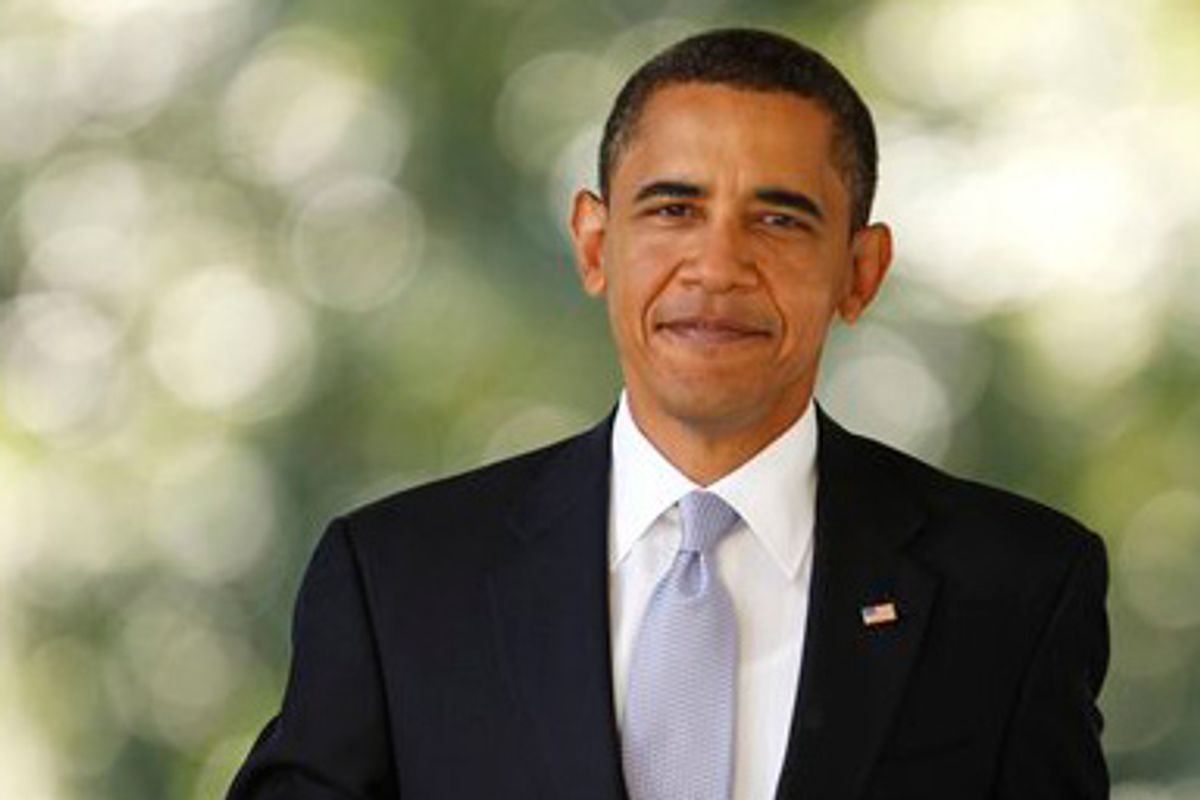
The president says he doesn't feel he deserves the Nobel, but believes that it will spur movement towards peace

AP photo
President Barack Obama
On Friday morning, more than a few people were asking how President Obama would handle having won the 2009 Nobel Peace Prize. With people on the left and the right, not to mention in between, wondering whether he really deserved the win, there was some speculation that he could hurt himself politically if he responded the wrong way.
He didn’t.
Obama’s speech, instead, struck all of the right notes, as he accepted the award but included plenty of self-deprecation — we’ll forgive him a couple lame jokes about what his daughters told him after he won — and shifted the credit to the U.S. as a whole. He also was quick to acknowledge that this award seems more about aspiration than accomplishment, and embraced that, saying it would be a call to action.
The full text of Obama’s remarks:
Good morning. Well, this is not how I expected to wake up this morning. After I received the news, Malia walked in and said, “Daddy, you won the Nobel Peace Prize, and it is Bo’s birthday!” And then Sasha added, “Plus, we have a three-day weekend coming up.” So it’s good to have kids to keep things in perspective.
I am both surprised and deeply humbled by the decision of the Nobel Committee. Let me be clear: I do not view it as a recognition of my own accomplishments, but rather as an affirmation of American leadership on behalf of aspirations held by people in all nations.
To be honest, I do not feel that I deserve to be in the company of so many of the transformative figures who’ve been honored by this prize — men and women who’ve inspired me and inspired the entire world through their courageous pursuit of peace.
But I also know that this prize reflects the kind of world that those men and women, and all Americans, want to build — a world that gives life to the promise of our founding documents. And I know that throughout history, the Nobel Peace Prize has not just been used to honor specific achievement; it’s also been used as a means to give momentum to a set of causes. And that is why I will accept this award as a call to action — a call for all nations to confront the common challenges of the 21st century.
These challenges can’t be met by any one leader or any one nation. And that’s why my administration has worked to establish a new era of engagement in which all nations must take responsibility for the world we seek. We cannot tolerate a world in which nuclear weapons spread to more nations and in which the terror of a nuclear holocaust endangers more people. And that’s why we’ve begun to take concrete steps to pursue a world without nuclear weapons, because all nations have the right to pursue peaceful nuclear power, but all nations have the responsibility to demonstrate their peaceful intentions.
We cannot accept the growing threat posed by climate change, which could forever damage the world that we pass on to our children — sowing conflict and famine; destroying coastlines and emptying cities. And that’s why all nations must now accept their share of responsibility for transforming the way that we use energy.
We can’t allow the differences between peoples to define the way that we see one another, and that’s why we must pursue a new beginning among people of different faiths and races and religions; one based upon mutual interest and mutual respect.
And we must all do our part to resolve those conflicts that have caused so much pain and hardship over so many years, and that effort must include an unwavering commitment that finally realizes that the rights of all Israelis and Palestinians to live in peace and security in nations of their own.
We can’t accept a world in which more people are denied opportunity and dignity that all people yearn for — the ability to get an education and make a decent living; the security that you won’t have to live in fear of disease or violence without hope for the future.
And even as we strive to seek a world in which conflicts are resolved peacefully and prosperity is widely shared, we have to confront the world as we know it today. I am the Commander-in-Chief of a country that’s responsible for ending a war and working in another theater to confront a ruthless adversary that directly threatens the American people and our allies. I’m also aware that we are dealing with the impact of a global economic crisis that has left millions of Americans looking for work. These are concerns that I confront every day on behalf of the American people.
Some of the work confronting us will not be completed during my presidency. Some, like the elimination of nuclear weapons, may not be completed in my lifetime. But I know these challenges can be met so long as it’s recognized that they will not be met by one person or one nation alone. This award is not simply about the efforts of my administration — it’s about the courageous efforts of people around the world.
And that’s why this award must be shared with everyone who strives for justice and dignity — for the young woman who marches silently in the streets on behalf of her right to be heard even in the face of beatings and bullets; for the leader imprisoned in her own home because she refuses to abandon her commitment to democracy; for the soldier who sacrificed through tour after tour of duty on behalf of someone half a world away; and for all those men and women across the world who sacrifice their safety and their freedom and sometime their lives for the cause of peace.
That has always been the cause of America. That’s why the world has always looked to America. And that’s why I believe America will continue to lead.
Thank you very much.
Nobel Peace Prize goes to women’s rights activists
This year's honor goes to three women who fought oppression in Africa and the Middle East
Yemeni activist Tawakkul Karman chants slogans along with anti-government protestors, during a demonstration demanding the resignation of Yemeni President Ali Abdullah Saleh, in Sanaa, Yemen, in June. (Credit: AP/Hani Mohammed)
Africa’s first democratically elected female president, a Liberian campaigner against rape and a woman who stood up to Yemen’s autocratic regime won the Nobel Peace Prize on Friday in recognition of the importance of women’s rights in the spread of global peace.
The 10 million kronor ($1.5 million) award was split three ways between Liberian President Ellen Johnson Sirleaf, women’s rights activist Leymah Gbowee from the same African country and democracy activist Tawakkul Karman of Yemen — the first Arab woman to win the prize.
The chairman of the Norwegian Nobel Committee told The Associated Press that Karman’s award should be seen as a signal that both women and Islam have important roles to play in the uprisings known as the Arab Spring, the wave of anti-authoritarian revolts that have challenged rulers across the Arab world.
“The Arab Spring cannot be successful without including the women in it,” Jagland said.
He said Karman, 32, belongs to a Muslim movement with links to the Muslim Brotherhood, the Islamist group “which in the West is perceived as a threat to democracy.” He added that “I don’t believe that. There are many signals that that kind of movement can be an important part of the solution.”
Yemen is an extremely conservative society but a feature of the revolt there has been a prominent role for women who turned out for protests in large numbers. The uprising has, however, been one of the least successful, failing to unseat President Ali Abdullah Saleh as the country descends into failed state status and armed groups take increasingly central roles. In Libya’s and Syria’s uprisings, women have been largely absent. And while there were many women protesters in Egypt’s revolution, few had key leadership positions.
Karman is a mother of three who heads the human rights group Women Journalists without Chains. She has been a leading figure in organizing the protests against Saleh that kicked off in late January.
“I am very very happy about this prize,” Karman told The Associated Press. “I give the prize to the youth of revolution in Yemen and the Yemeni people.”
Citing the Arab Spring alone could have been problematic for the committee. Libya descended into civil war that led to NATO military intervention. Egypt and Tunisia are still in turmoil. Hardliners are holding onto power in Yemen and Syria and a Saudi-led force crushed the uprising in Bahrain, leaving an uncertain record for the Arab protest movement.
Jagland told AP it was difficult to find a leader of the Arab Spring revolts, especially among the many bloggers who played a role in energizing the protests, and noted that Karman’s work started before the Arab uprisings.
“It was not easy for us to say to pick one from Egypt or pick one from Tunisia, because there were so many,” he said. “And we did not want to say that one was more important than the others.”
Karman “started her activism long before the revolution took place in Tunisia and Egypt. She has been a very courageous woman in Yemen for quite along time,” Jagland said.
No woman had won the prize since 2004, when the committee honored Wangari Maathai of Kenya, who died last month at 71. 2004 was also the last year the prize went to an African.
Liberia was ravaged by civil wars for years until 2003. The drawn-out conflict that began in 1989 left about 200,000 people dead and displaced half the country’s population of 3 million. The country — created to settle freed American slaves in 1847 — is still struggling to maintain a fragile peace with the help of U.N. peacekeepers.
Sirleaf, 72, has a master’s degree in public administration from Harvard University and has held top regional jobs at the World Bank, the United Nations and within the Liberian government.
In elections in 1997, she ran second to warlord-turned-president Charles Taylor, who many claimed was voted into power by a fearful electorate. Though she lost by a landslide, she rose to national prominence and earned the nickname, “Iron Lady.” She went on to became Africa’s first democratically elected female leader in 2005.
Sirleaf was seen as a reformer and peacemaker in Liberia when she took office. She is running for re-election this month and opponents in the presidential campaign have accused her of buying votes and using government funds to campaign. Her camp denies the charges. The election is Tuesday.
“This gives me a stronger commitment to work for reconciliation,” Sirleaf said Friday from her home in Monrovia. “Liberians should be proud.”
Buttons from her presidential campaign say it all: “Ellen — She’s Our Man.”
Jagland said the committee didn’t consider the upcoming election in Liberia when it made its decision.
“We cannot look to that domestic consideration,” he said. “We have to look at Alfred Nobel’s will, which says that the prize should go to the person that has done the most for peace in the world.”
African and international luminaries welcomed the news. Many had gathered in Cape Town, South Africa on Friday to celebrate Nobel peace laureate Archbishop Desmond Tutu’s 80th birthday.
“Who? Johnson Sirleaf? The president of Liberia? Oooh,” said Tutu, who won the peace prize in 1984 for his nonviolent campaign against white racist rule in South Africa. “She deserves it many times over. She’s brought stability to a place that was going to hell.”
U2 frontman Bono — who has figured in peace prize speculation in previous years — called Sirlaf an “extraordinary woman, a force of nature and now she has the world recognize her in this great, great, great way.”
Gbowee, who organized a group of Christian and Muslim women to challenge Liberia’s warlords, was honored for mobilizing women “across ethnic and religious dividing lines to bring an end to the long war in Liberia, and to ensure women’s participation in elections.”
Gbowee has long campaigned for the rights of women and against rape. In 2003, she led hundreds of female protesters through Monrovia to demand swift disarmament of fighters who preyed on women throughout Liberia during 14 years of near-constant civil war.
Gbowee works in Ghana’s capital as the director of Women Peace and Security Network Africa. The group’s website says she is a mother of five.
“I know Leymah to be a warrior daring to enter where others would not dare,” said Gbowee’s assistant, Bertha Amanor. “So fair and straight, and a very nice person.”
Karman is from Taiz, a city in southern Yemen that is a hotbed of resistance against Saleh’s regime, and now lives in the capital, Sanaa. She is a journalist and member of Islah, an Islamic party. Her father is a former legal affairs minister under Saleh.
Long an advocate for human rights and freedom of expression in Yemen, she has been campaigning for Saleh’s ouster since 2006 and mounted an initiative to organize Yemeni youth groups and opposition into a national council.
On Jan. 23, Karman was arrested at her home. After widespread protests against her detention — it is rare for Yemen women to be taken to jail — she was released early the next day.
Karman has been dubbed “Iron Woman, “The Mother of Revolution” and “The Spirit of the Yemeni Revolution” by fellow protesters.
During a February rally in Sanaa, she told the AP: “We will retain the dignity of the people and their rights by bringing down the regime.”
The peace prize was in line with Norway’s development aid strategy, which is often focused on women’s rights. Norwegian Prime Minister Jens Stoltenberg called the award “important and worthy.”
In his 1895 will, award creator Alfred Nobel gave only vague guidelines for the peace prize, saying it should honor “work for fraternity between nations, for the abolition or reduction of standing armies and for the holding and promotion of peace congresses.”
The peace prize is the only Nobel handed out in Oslo, Norway. The other five awards — in medicine, physics, chemistry, literature and economics — are presented in Stockholm.
Last year’s peace prize went to imprisoned Chinese dissident Liu Xiaobo.
Krista Larson in Johannesburg, Robert Reid and Sarah El-Deeb in Cairo, Jonathan Paye-Layleh in Monrovia, Liberia and Ahmed Al-Haj in Sanaa, Yemen, contributed.
Nobel committee receives record nominations for Peace Prize
Among this year's 241 nominees for the international prize are both the Internet and WikiLeaks
The Nobel Peace Prize Medal, which will be awarded to one of 241 nominees in October.
A record 241 nominations were submitted for the 2011 Nobel Peace Prize and the Norwegian jury has now begun the secretive process to select a winner, the panel’s spokesman said Tuesday.
Russian human rights activist Svetlana Gannushkina, secret-spilling organization WikiLeaks and Cuban dissidents are among the candidates who have been publicly announced by those who nominated them.
The Norwegian Nobel Committee does not reveal the names of nominees and doesn’t discuss any candidates until the winner is announced in October.
Geir Lundestad, the permanent secretary of the committee, told The Associated Press that 188 individuals and 53 organizations have been nominated for the prestigious award.
“We have a record number of nominations this year, but there has been a steady increase over time,” he said. Last year the committee received 237 nominations.
The deadline for outside nominations was Feb. 1, but the five-member committee added its own suggestions at a meeting Monday, said Lundestad, who doesn’t have voting rights.
“We have an active committee, which has added several proposals the last years,” he said.
Imprisoned Chinese dissident Liu Xiaobo won the Nobel Peace Prize last year for his nonviolent struggle for human rights in his homeland. The award infuriated China, which accused the Nobel committee of honoring a criminal.
Lundestad said the impact of the prize was exceptional.
“We have never before experienced that the prize has been discussed at the highest level in governments around the world,” he said.
The Nobel Prizes also include awards in medicine, physics, chemistry and literature. A sixth award, the Nobel Memorial Prize in Economics, was created by Swedish central bank in 1968 in memory of prize founder Alfred Nobel.
The prize amount has been fixed at 10 million Swedish kronor ($1.6 million) in recent years. Lundestad said the sum will probably be the same this year, but no final decision has been taken. The Nobel Peace Prize will likely be announced on Oct. 7, he said.
Jailed Chinese dissident is honored at Nobel ceremony
An empty chair represents Liu Xiaobo in Oslo. This is the first time in 74 years the prize has not been handed over
With a large portrait of a smiling Liu Xiaobo hanging front and center, the chairman of the Norwegian Nobel Committee crossed the dais and gently placed the peace prize diploma and medal on an empty chair. Ambassadors, royalty and other dignitaries rose in a standing ovation.
The man they honored wasn’t there Friday — he is serving an 11-year sentence at Jinzhou Prison in northeastern China for urging sweeping changes to Beijing’s one-party communist political system.
And there was no news coverage of it in China, where foreign TV news channels went black as the ceremony began and authorities denounced the award as a “political farce.”
It was the first time in 74 years the prestigious $1.4 million Nobel Peace Prize was not handed over.
Committee chairman Thorbjoern Jagland drew the first of several standing ovations from the international gathering of 1,000 guests at Oslo City Hall when he noted that neither Liu nor his closest relatives were able to attend.
“This fact alone shows that the award was necessary and appropriate,” he said.
He brought the crowd to its feet again when he declared: “He has not done anything wrong. He must be released.”
China was infuriated when the Nobel committee awarded the prize to the 54-year-old literary critic, describing it as an attack on its political and legal system. Authorities have placed Liu’s supporters, including his wife, Liu Xia, under house arrest to prevent anyone from picking up his prize.
After Jagland drew another standing ovation by placing the medal and diploma on Liu’s empty chair, Norwegian actress Liv Ullman read the dissident’s statement, “I Have No Enemies,” which he delivered in a Chinese court in 2009 before he was sentenced.
In the speech, Liu portrays the surprisingly positive and gentle nature of his correctional officer while awaiting trial, which gave him hope for the future.
That “personal experience” caused him to “firmly believe that China’s political progress will not stop,” Ullman read. “I, filled with optimism, look forward to the advent of a future free China,” she quoted Liu as saying.
Lynn Chang, a Chinese-American violinist, then performed a haunting Chinese melody, “Colorful Clouds Chasing the Moon” and “Jasmine Flowers.”
But ordinary viewers in China saw none of it. Both CNN and BBC TV channels went black at 8 p.m. local time for nearly an hour, exactly when the Oslo ceremony began. Security outside Liu’s Beijing apartment was heavy and several dozen journalists were herded by police to a cordoned-off area.
Foreign Ministry spokeswoman Jiang Yu said the awarding of the peace prize to Liu reflected a Cold War mentality, infringed upon China’s judicial sovereignty and “does not represent the wish of the majority of the people in the world, particularly that of the developing countries.”
“This political farce will in no way shake the resolve and confidence of the Chinese people to follow the path of socialism with Chinese characteristics, and the scheme by some people will get nowhere,” Jiang said in a statement issued after the Nobel ceremony started.
In Washington, President Barack Obama said he regretted that Liu and his wife were not allowed to go to the ceremony as he and first lady Michelle Obama did when he won the peace prize last year.
“Liu Xiaobo is far more deserving of this award than I was,” he said.
China had pressured foreign diplomats to stay away from the ceremony, with 16 other countries joining their boycott, including Russia, Pakistan, Iran, Venezuela and Cuba. At least 46 of the 65 countries with embassies in Oslo accepted invitations.
U.S. House Speaker Nancy Pelosi, who attended with U.S. Ambassador Barry White, told The Associated Press that “Liu Xiaobo has been a hero to all of us.”
About 100 Chinese dissidents in exile and some activists from Hong Kong also attended. Chinese dissident Wan Yanhai, the only one on a list of 140 activists in China invited by Liu’s wife to attend the ceremony, said the jubilation felt by many at Liu’s honor will be tinged with sadness.
“He did not do any harm to the country and the people in the world. He just fulfilled his responsibility,” Wan told AP. “But he suffered a lot of pain for his speeches, journals and advocacy of rights.”
After the ceremony, a torchlight parade meandered through Oslo’s dark, snowy streets and ended at the Grand Hotel where the laureate normally spends the night. Hundreds of torch-bearing demonstrators gathered near the hotel and chanted: “Democracy Now” and “Free Liu Xiaobo.”
Outside Parliament, the Norwegian-Chinese Association held a pro-China rally with a handful of people proclaiming that awarding the prize to Liu was a mistake.
Chang, the violinist, told AP Television News that his performance came at a cost.
“I will be not permitted to go visit China (professionally) or to play or to teach,” he said. “That would be, I think, a big loss — the absence of students that come from China to visit and study in the United States and to work with me also would be a big loss.”
Also Friday, a group of Nobel laureates, including former South African President F.W. de Klerk and Nazi death camp survivor and author Elie Wiesel, offered to mediate with China for Liu’s early release.
The last time a Nobel Peace Prize was not handed out was in 1936, when Adolf Hitler prevented German pacifist Carl von Ossietzky from accepting his award.
The German media — which by then was under Nazi control — initially stayed silent on the award, but then German newspapers reported on it in overwhelmingly negative terms on Nov. 25, said Johannes Tuchel, a professor with the German Resistance Memorial in Berlin. The papers described the award as a scandal and Ossietzky as a traitor.
China’s fury at Liu’s award has reached proportions last seen during the Soviet and Nazi regimes. But even Cold War dissidents Andrei Sakharov of the Soviet Union and Lech Walesa of Poland had their wives collect the prizes for them. Myanmar democracy activist Aung San Suu Kyi’s award was accepted by her 18-year-old son in 1991.
The Kremlin forced writer Boris Pasternak of the Soviet Union to decline his 1958 literature prize. French writer Jean-Paul Sartre declined the 1964 literature prize because he had consistently declined all official honors.
In 1973, North Vietnamese negotiator Le Duc Tho was awarded the peace prize jointly with U.S. Secretary of State Henry Kissinger but said he could not accept it, citing continued fighting in Vietnam as his reason.
Laureates who are unable to attend the ceremony can have their relatives pick up the award and prize money, even at a later date. If an award is not presented, as in the case of winners declining the prize, the money is returned to the Nobel Foundation.
In the Swedish capital of Stockholm, the other Nobel laureates were honored in a separate ceremony Friday. Winners in literature, physics, chemistry and economics received their awards from Sweden’s King Carl XVI Gustaf.
Nobel Peace Prize may not be presented
If no one from the imprisoned Liu Xiaobo's family can attend the ceremony, the award will not be given out
The Nobel Peace Prize may not be handed out this year because no one from imprisoned award-winner Liu Xiaobo’s family is likely to attend the ceremony, the award committee’s spokesman said Thursday.
The prestigious 10 million kronor ($1.4 million) award can only be collected by the laureate or close family members.
Liu, a Chinese dissident, is serving an 11-year sentence for subversion after co-authoring an appeal calling for reforms to China’s one-party political system. His wife, Liu Xia, has been under house arrest and subject to police escort since the award was announced last month.
Norwegian Nobel Committee secretary Geir Lundestad told The Associated Press that no other relatives have announced plans to come to Oslo for the Dec. 10 ceremony.
“The way it looks now, it is not likely that someone from his close family will attend,” Lundestad said. “Then we will not give out the medal and the diploma during the ceremony.”
If that happens it will be the first time since 1936, when there was no one present to accept the medal and diploma for German journalist Carl von Ossietzky, who was seriously ill and refused permission to leave Nazi Germany. However, a representative of Ossietzky received the prize money, Lundestad said.
The Nobel committee has skipped selecting a winner altogether in some years, including during World War II.
Lundestad said the committee has not yet ruled out that someone from Liu’s family can attend the ceremony.
“If someone shows up at the last minute, it will not be a problem to change plans,” he said.
Liu Xiaobo has three brothers, the most publicly known being Liu Xiaoxuan, who is the youngest. A Hong Kong-based human rights group has reported that two of the brothers, as well as Liu Xiaobo’s brother-in-law Liu Tong, have been unable to visit Liu in prison despite repeated requests.
Friends of the couple say all of Liu’s closest family members are under tight police surveillance aimed at preventing them from attending the ceremony. Liu Xiaoxuan has also been told by his employer not to go, the Hong Kong-based Information Center for Human Rights and Democracy said. When reached by phone Thursday, Liu Xiaoxuan said he was not allowed to accept interviews.
China has called Liu a criminal and has pressured countries not to send representatives to the ceremony at Oslo’s City Hall.
Lundestad said ambassadors from Russia, Cuba, Kazakhstan, Morocco and Iraq have declined invitations, but didn’t specify the reasons.
Russian Embassy spokesman Vladimir Isupov said the Russian ambassador would not be in Norway at the time of the award ceremony.
“It is not politically motivated and we do not feel we are pressured by China,” he said.
Lundestad said 36 ambassadors have accepted the invitation to the ceremony and 16 ambassadors have not yet replied. Some of them have asked for more time to decide, he said.
Besides the award ceremony, the peace prize program includes a banquet on Dec. 10 and a concert held in the laureate’s honor the next day.
Organizers said Thursday that the concert will be co-hosted by actors Anne Hathaway and Denzel Washington and feature performances by Barry Manilow, Jamiroquai, A.R. Rahman and Elvis Costello among others.
——
Associated Press writer Gillian Wong in Beijing contributed to this report.
Vigil held in Myanmar for pro-democracy leader
Nobel laureate Aung San Suu Kyi's house arrest is set to expire Saturday
Supporters of pro-democracy leader Aung San Suu Kyi held a vigil on the eve of Saturday’s expiration of her house arrest order, hoping to see the Nobel Peace Prize laureate taste freedom for the first time in seven years.
While scores of people who gathered near her home were disappointed that she was not given an early release Friday night, colleagues said an order to set her free had already been signed by Myanmar’s ruling generals. Some 200 people has come earlier when rumors of her impending release were at their height.
Adding to the expectant atmosphere was a sharply stepped-up security presence in Yangon: truckloads of riot police, cruising and parked — a familiar sight to city residents during times of political tension.
The country’s first in 20 years was held Nov. 7, and critics allege it was manipulated to give a pro-military party a sweeping victory. Results have been released piecemeal and already have given the junta-backed Union Solidarity and Development Party a majority in both houses of Parliament.
The 1990 election was won in a landslide by Suu Kyi’s National League for Democracy party, but the military refused to hand over power and instead clamped down on opponents.
Jailed or under house arrest for more than 15 of the last 21 years, Suu Kyi has become a symbol for a struggle to rid the Southeast Asian country of decades of military rule.
She was convicted last year of violating the terms of her previous detention by briefly sheltering an American man who swam uninvited to her lakeside home, extending a period of continuous detention that began in 2003, after her motorcade was ambushed in northern Myanmar by a government-backed mob.
“My sources tell me that the release order has been signed,” said Tin Oo, vice chairman of Suu Kyi’s party. “I hope she will be released.”
He did not say when she would be freed or when the order had been signed.
About 300 people gathered excitedly at NLD headquarters earlier in the day, some wearing T-shirts reading, “We stand with you.”
“There is no law to hold (Suu Kyi) for another day. Her detention period expires on Saturday and she will be released,” her lawyer, Nyan Win, told reporters.
Suu Kyi, 65, has shown her mettle time and again since taking up the democracy struggle in 1988.
Having spent much of her life abroad, she returned home to take care of her ailing mother just as mass demonstrations were breaking out against 25 years of military rule. She was quickly thrust into a leadership role, mainly because she is the daughter of martyred independence leader Gen. Aung San.
She rode out the military’s bloody suppression of street demonstrations to help found the NLD. Her principled defiance gained her fame and honor, most notably the 1991 Nobel Peace Prize.
Charismatic, tireless and outspoken, her popularity threatened the country’s new military rulers. In 1989, she was detained on trumped-up national security charges and put under house arrest. She was not released until 1995 and has spent various periods in detention since then.
Suu Kyi’s freedom has been a key demand of Western nations and groups critical of the military regime’s poor human rights record. The military government, seeking to burnish its international image, has responded previously by offering to talk with her, only to later shy away from serious negotiations.
Suu Kyi plans to help probe allegations of election fraud, according to Nyan Win, who is also a spokesman for her party, which was officially disbanded for refusing to reregister for this year’s polls.
Such action, which could embarrass the junta, poses the sort of challenge the military has met in the past by detaining Suu Kyi.
Awaiting her release in Bangkok in neighboring Thailand is the younger of her two sons, Kim Aris, who is seeking the chance to see his mother for the first time in 10 years. Aris lives in Britain and has been repeatedly denied visas.
Her late husband, British scholar Michael Aris, raised their sons in England. Their eldest son, Alexander Aris, accepted the Nobel Peace Prize on his mother’s behalf in 1991 and reportedly lives in the United States.
Michael Aris died of prostate cancer in 1999 at 53 after having been denied visas to see his wife for the three years before his death. Suu Kyi could have left Myanmar to see her family but decided not to, fearing the junta would not allow her back in.
The NLD’s dilapidated headquarters in Yangon has been bustling with party members cleaning her old office.
Nyan Win said Suu Kyi would meet with the NLD’s central committee, members of the media and the public after her release. He noted that after earlier detentions, she always visited the Shwedagon pagoda, one of the most sacred sites in Myanmar, formerly called Burma.
More than 25 young members of Suu Kyi’s party planned to donate blood at hospitals as a gesture of welcome.
The junta called this month’s vote a major step toward democracy. Suu Kyi was barred from participating and critics said it was aimed at cementing the military’s power. Top members of the ruling junta were among those who won seats, including Prime Minister Thein Sein, who also heads the USDP.
Page 1 of 7 in Nobel Peace Prize
The things I carry
When I lost the ability to type
Pop art, the beaded edition
The beautiful banality of high school
The unemployed meet MacArthur’s tanks
Demi’s last night out
One day you’re in
Pitch and catch
Whip-it 

