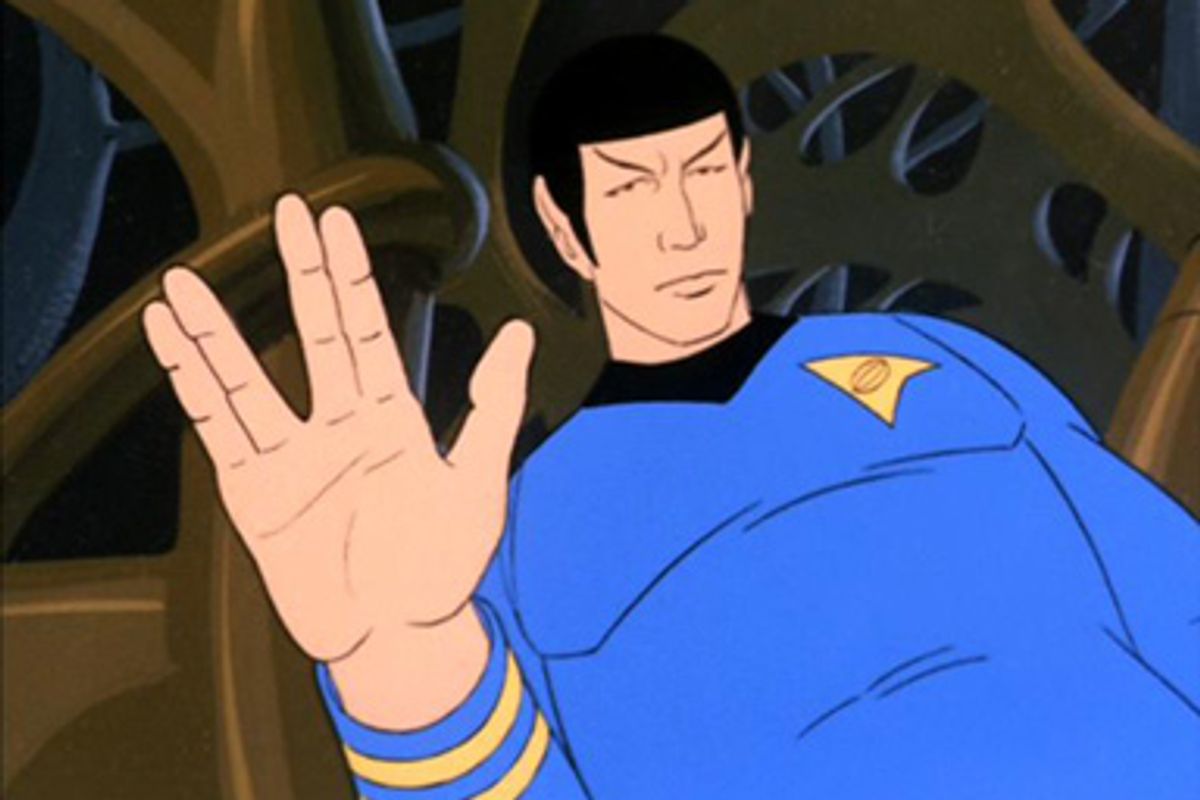
Is the interactive kiddie spinoff "Star Trek Live" the final, gruesome nail in Gene Roddenberry's space-coffin?
A still from "Star Trek: The Animated Series"

A still from “Star Trek: The Animated Series”
Gene Roddenberry must be spinning in his grave. Or he would be if he had one; his ashes were shot into space in 1997. (Wait, I’m confused. Does that mean he’s always spinning in his grave?) With Roddenberry and his wife, Majel Barrett Roddenberry (Nurse Chapel in the original “Star Trek”), now both dead, control over the “Star Trek” franchise has devolved onto a slithery nest of interlocking corporate interests. Which accounts for a troubling press release I received on Friday, announcing the creation of something called “Star Trek Live.”
Although the “Trek” franchise presumably has renewed Hollywood viability after this summer’s lively and successful J.J. Abrams prequel — the 11th “Star Trek” movie overall — it long ago entered a decadent phase of creative and marketing metastasis: Spinoffs producing spinoffs, actors becoming directors becoming authors. (I’m still waiting for a film version of “Star Trek: The Animated Series,” or a Web-only series based on William Shatner’s co-authored “Trek” novels. Somebody’s probably working on them.)
That provides some context for the genesis of “Star Trek Live.” But what the hell is it, exactly? My first guess, while cagily inspecting a press release that’s crammed with merchandising buzzwords and light on specifics, was that somebody who hadn’t been reading the paper lately was following through on some three-year-old scheme to launch a “Star Trek” Broadway musical. Now, that sounds like a pop-culture disaster of heroic and delicious proportions, so I’m sorry to report it isn’t happening. With discretionary spending in free fall and the recent closure of “Shrek: The Musical,” Hollywood studios are backing away from the Great White Way as an ancillary revenue stream.
No, “Star Trek Live” is something else, “an interactive stage show” that’s “targeted for a run in theme parks and performing arts centers across the country.” The show “combines cutting-edge special effects, unmatched audience interaction and an exploration of real space-age technology,” taking “audiences of all ages on an exhilarating journey with Captain James T. Kirk and Vulcan science officer Spock.”
Yeah, I know what you’re thinking. You’re thinking: ZOMG! This is what Roddenberry’s atheist-Apollonian vision of the future has come to! Unemployed dinner-theater actors in Kirk and Spock drag and plastic tricorders, doing a laser show for the kiddies! At Waldameer WaterWorld in Erie, Pa.! It will bear the same relationship to any actual “Star Trek” incarnation as that teeny-tiny Stonehenge in “Spinal Tap” bears to seeing Led Zeppelin play live in 1973! And you’re absolutely right.
OK, OK, let me pay some lip service to journalistic fairness by reporting that “Star Trek Live,” while a property of CBS Consumer Products, will actually be created by the Mad Science Group, a “science enrichment provider” that creates shows for schools, camps and other youth venues. It’ll be some kind of hybridized edutainment product, in which Kirk and Spock train a fresh group of “Starfleet cadets” on their first day at the Academy. Learn, learn, learn; science, science, science. But wait, enough of that, shorty — the Earth is under attack from unknown aliens! Put down those curly fries and shoot those bastards!
I’m not backing off my initial, bigoted assumption that this latest bastardized effort to grub a few more dollars off a canceled 1960s TV series is an idiotic debasement of the already-flaccid “Star Trek” legacy. But, hell, that’s nothing new. And let’s face it, fellow parents: If these people can bottle even 0.5 percent of the Trekker spirit, in a package that appeals to the science-nerd kids who are too chicken for the vomitous coaster rides, we’ll all be grateful. If they can end it with a group line-dance number — hopefully led by “Kirk” and “Spock” doing the Robot — I take back everything I just said.
Robert Harris’ sci-fi thriller, ripped from the business headlines
A hedge fund's efforts to generate huge profits backfires in Robert Harris' "The Fear Index." Wait, this is fiction
(Credit: Dr. Jost Hindersmann)
Most thrillers do not send me hustling off to Wikipedia for a refresher course in the Stoic philosophy of the first century A.D. Greek sage Epictetus. But that’s where I found myself before commencing this review of “The Fear Index,” by Robert Harris. I wanted to be sure I was properly grounded before straying into treacherous territory: the nature of being in our phantasmagorical high-finance, high-tech era.
I certainly had no time to brush up while actually reading the novel. “The Fear Index” is a perfect exemplar of the species “taut thriller.” It’s a book whose pages cannot be turned fast enough; a mystery with just a dash of science fiction and plot twists ripped from the business news headlines of the past year. Beware taking this book to bed with you, because you will stay up too late. (And your dreams will be queasy.)
But in the haste to turn those pages lies a danger: the chance that you might miss how surprisingly profound “The Fear Index” is, in its contemplation of modern financial markets and the “digitalization” of modern life. With his previous novelistic excursions to ancient Rome (“Pompeii,” “Imperium”), and reimaginings of history (“Fatherland” — set in a Germany where Hitler won World War II), Robert Harris long ago proved himself capable of mixing high intelligence with action and a swiftly moving movie-script-ready plot. “The Fear Index” takes his game to the next level: It is a riveting meditation on the reality of now, complete with a trail of bodies and streaks of madness — both algorithmic and human.
Which brings us back to Epictetus. The heart of “The Fear Index” is the story of how a hedge fund’s attempts to generate unprecedentedly huge financial returns from stock market bets executed by a super-smart computer program go horribly wrong. (Sound familiar? Didn’t we just live through that?) The program is the brainchild of physicist Alexander Hoffmann, and the key to its successful operation is its ability to sniff out traces of fear in the markets. Where there’s fear, there’s volatility, and where’s there volatility, there is the opportunity to cash in.
About a third of the way through the novel, Hoffmann explains to a group of prospective investors (the 1 percent of the global 1 percent!) that the times are ripe for a trading strategy based on fear, because contemporary society has never been so fearful, a fact for which we can blame our online, networked lives.
“Our conclusion is that digitalization itself is creating an epidemic of fear, and that Epictetus had it right: we live in a world not of real things but of opinion and fantasy. The rise in market volatility, in our opinion, is a function of digitalization, which is exaggerating human mood swings by the unprecedented dissemination of information via the Internet.”
Epictetus nailed it. The mood-swingingness of our universe is a truth apparent to anyone who follows the zigs and zags of modern financial markets (or the Republican primary race, for that matter). Computer-driven trading strategies are not reacting to fundamental economic realities; they’re bouncing out buy and sell orders every nanosecond based on price shifts that are themselves generated by emotional reactions to news headlines. A German foreign minister says something nasty about Greece, and markets plunge as London, New York and Shanghai all freak out. Moments later, a soothing press from a central banker sends prices skyrocketing again.
It’s a crazy way to run an economy. And it’s not fiction. Harris underlines this point by interpolating into the plot actual testimony before Congress by current Securities Exchange Commission Chairwoman Mary Schapiro explaining the notorious “Flash Crash” of May 2010. On May 6, the Dow Jones industrial average fell 1,000 points in a matter of minutes before suddenly rebounding. Computers were largely to blame. More such shenanigans are on the way! It’s a sign of how murky our digitally mediated markets are now, how inscrutable to human understanding, that science fiction offers just about as good an explanation of what is going on at the New York Stock Exchange as do the most highly paid market analysts.
Epictetus had it easy. We are no longer capable of understanding what we have wrought. That’s a job only the algorithm can do.
More from Hoffmann:
“When Hugo and I started this fund, the data we used was entirely digitalized financial statistics: there was almost nothing else. But over the past couple of years a whole new galaxy of information has come within our reach. Pretty soon all the information in the world — every tiny scrap of knowledge that humans possess, every little thought we’ve ever had that’s been considered worth preserving over thousands of years — all of it will be available digitally. Every road on earth has been mapped. Every building photographed. Everywhere we humans go, whatever we buy, whatever websites we look at, we leave a digital trail as clear as slug slime. And this data can be read, searched, and analyzed by computers and value extracted from it in ways we cannot even begin to conceive.”
The most terrifying part of “The Fear Index” is the sinking sensation, as you turn the last page, that we haven’t seen anything yet. We are incapable of comprehending the totality of the data we produce. We’ll design ever more complex computer programs to do that for us. And they’re going to make a big mess.
William Gibson: I really can’t predict the future
The science fiction legend tells Salon that if he had a crystal ball, he'd have put Facebook in an early novel
William Gibson (Credit: Michael O'Shea)
On the Toronto stop of his book tour this month, William Gibson was asked by an earnest 20-something reader for advice: “Give my generation whatever you think is helpful for it to survive.” Where an author with an inflated sense of self-worth might have dispensed a few pearls of wisdom, Gibson replied that one should distrust people on stages offering programs for how to build the future.
As much as people look to Gibson as a prophet, the science-fiction writer who invented the term “cyberspace” (in the 1982 short story “Burning Chrome”) helped conceptualize the ways we interact with the Web (in 1984’s “Neuromancer” and later works) and foretold the explosion of reality TV (in 1993’s “Virtual Light”) is notoriously reluctant to predict the future. The title of his new collection of journalism and essays, “Distrust That Particular Flavor,” is taken from a piece on H.G. Wells where Gibson explains his suspicion of “the perpetually impatient and somehow perpetually unworldly futurist, seeing his model going terminally wrong in the hands of the less clever.” Though he’s often able to extrapolate from the present with great prescience, Gibson prefers to probe, not prescribe.
“Distrust” is the Vancouver-based Gibson’s first book of nonfiction; mostly it deals with aspects of technology, and his prose, as in his novels, is always vivid and keen-edged. And yet the newly written afterwords he appends to each piece can be unflinchingly self-critical. Some articles are very much of their time and place; others cram startling insights into a mere few pages. Still others read like provocative responses to Frequently Asked Questions – one is even titled, “Will We Have Computer Chips in Our Heads?” (The answer? “Maybe. But only once or twice, and probably not for very long.”)
Over a bagel and cream cheese at Gibson’s hotel, the morning after his Toronto talk, the lanky writer, with his friendly drawl, furrowed brow and perpetual mien of engaged curiosity explained how his fiction and nonfiction overlap, and how he plans to dream up more imaginary futures out of the weirdness of the present.
How do you feel when a young reader asks you – or orders you – to “Give my generation whatever is helpful for it to survive?”
Oh, it’s complex. I feel old, and unwilling to be the golden geezer. At the same time I feel sort of avuncular. When I was that young man’s age, I wouldn’t have asked that of anyone. I wouldn’t have thought that anyone over 30 was capable of saying anything much that I should be believing anyway.
Does it hearten you in a way that he asked this, as maybe now there’s less of a perceived gap between generations?
I suppose so. I didn’t really have a problem with that question; I just had a problem thinking of any piece of advice. I should have said, “Never pass up a chance to use the toilet,” and “It’s a good idea to eat three reasonably sized meals a day. Take care of your gums.” [laughs] This is the kind of advice you can actually give younger people.
In your piece about Steely Dan’s album “Two Against Nature,” you write, “I’m starting to feel like a reviewer, which makes me intensely uncomfortable.” Your nonfiction, in general, resembles your fiction in that it’s presented as one person’s direct experience. Are you more comfortable with this method of writing than with a kind of omniscient critique?
Yeah. With the nonfiction, I have an instinctive need to present the material as simply as, “This is what I think it is.” Whenever I sense myself moving into pundit mode, I like to stop and check my motivation. Am I just doing it for some extra attention? Do I actually believe what I’m saying? It makes me a very poor television guest, because I’m incapable of saying anything without qualifying it. It’s very hard for me to produce the sort of demonstrative sound bite that that medium runs on: “X is x, don’t you know?” And mine is like, “Well, I sometimes feel that x is x, but then again, it can seem like y.” The medium doesn’t know what to do with that – at least the kind of trad television that we’ve got.
That said, your nonfiction pieces do tend to start out with strong, declarative sentences, even though there are nuances later on.
Well, that’s probably an attempt to do the culturally accepted thing … When I move into a different form, somebody’s paying me for it, and I have to produce on a relatively short deadline, I become a cultural chameleon and start to emulate, say, the look and feel of a Wired article. There are artifacts of that attempt at camouflage in all of those pieces, and it always made me feel a bit reluctant to bring out a collection like ["Distrust"]: some of it seems forced in a way that I would be uncomfortable with in my fiction. [In nonfiction], the reader wants to be immediately assured that this is somebody who knows what he’s talking about. So I jump into the middle of the stage, make a declarative statement, and possibly by the end of the piece I’ve completely reversed my opinion! [laughs]
You write that you’ve been “mining” one of the pieces in this book “for over a decade now,” for both talks and fiction. Does this mean you have an ongoing relationship with your texts in general?
Someone who’s very familiar with my work can read this new book and see where the nonfiction later bled into the fiction. The flip side is that unless there’s a very pressing professional reason to do so, I very scarcely reread my own fiction. I could not, if it were required of me right now, give you précis of the plots of my earlier novels. I remember scenes and characters somewhat, but I haven’t read them for 20 years, and I know “Neuromancer” very well because I’ve had endless, largely pointless, talks with filmmakers about turning it into a movie. Something someone gave me at the signing last night reminded me that in “Virtual Light” [from 1993] there’s a country song called “Me and Jesus Are Gonna Whup Your Heathen Ass.” I thought, “That is kind of predictive, pre-9/11.” It isn’t really predictive; it’s just that the tendency was there in the culture to think that way, which is why I wound up putting it in the book.
In an afterword, you mention that writing the piece “Dead Man Sings” “was entirely a matter of taking dictation from some part of my unconscious that rarely checks in this directly.” Certain passages in the book are quite poetic in an unexpected way, and I wonder if they might have come from a place other than the organizing journalistic brain. Do you ever write something and then figure out what it means later?
I very seldom compose anything in my head which later finds its way into text, except character names sometimes – I’m often very much inspired by things that I misunderstand. Have you ever seen Brian Eno’s deck of Oblique Strategies? One of them is “Honor thy error as a hidden intention.” That’s my favorite. [At a] hotel in New York a couple of days ago, the young woman who checked me in said what sounded to me like, “Thank you, sir; my name is Tyranny. If there’s anything you need …” I’m not enough of an extrovert to go, “Your name’s what?” … For the rest of the day, I was thinking of young, benevolent female characters with the first name “Tyranny.” Possibly an Asian character, where it’s kind of an ESL issue. Those things inspire me, but what you’re talking about is a result of the process of composition having spun itself up to a certain wonderfully flaky level, where it says something that I transcribe without quite being able to understand it. I’ve learned to trust that, and it seldom lets me down. Occasionally if I look back at something I’ve written I’ll find one of those that I don’t understand, but that’s a bad thing – the unconscious has dealt me a bad hand.
Last night [fellow science fiction author] Rob Sawyer pointed out how opposite his idea of creativity was to what I describe in the introduction to this book. He said that he had to be able to decide beforehand what [a book] was about, how he was going to do it, and then as he went along, he would compare what he was composing to this directive that he had arrived at prior to the work. To me, that’s absolutely incomprehensible; the part of me that sits here having this conversation with you is incapable of doing any very original literary work. The part of me that creates stuff is right now largely offline and unavailable, and I couldn’t summon it if my life depended on it. I have to make myself available and hope it turns up. To me, that’s where the good stuff comes from. It’s like, William Gibson doesn’t get ideas for novels while I’m walking around in the world … [He stops and grimaces.] That scared the shit out of me, because a friend of mine that’s a publicist in New York once told me that the worst sign in the interview is if the author ever starts to speak of themselves in the third person … so I did that for effect.
If you’re traveling somewhere, are you simply aware that what you see around you might seep into something you write, or do you actively seek to have experiences that may be useful?
As William Burroughs liked to say, “A writer always gets his pound of flesh.” No matter what I’m going through, I can always step back and go, “This is material.” [He pulls out his iPad, encased in a black sleeve, and calls up a picture he took of a house in Key West with strange curved shutters that open out into awning-like structures.] I could get a whole novel out of that house. That’s got some mojo going on! Not just the window, but the front door has got at least one layer of inch-thick plywood, no hinges.
I’m a fairly visual writer; I can get an awful lot out of really closely examining a photograph like that. It’s a very interesting exercise that I would recommend to anyone. Take any photograph – preferably a photograph that contains relatively little information (no humans or animals in it) – and catalog everything visible. It usually can’t be done in less than a thousand words, and it can’t be done well in less than about two [thousand]. It always leaves me thinking that pictures really are worth a thousand words, at least, that the visual matrix is so incredibly rich with stuff and meaning, that there’s actually no place to stop. People who have tried it find they stop because they just get exhausted.
Your first three books were set relatively far in the future from when they were written –
For my own purposes I assumed that “Neuromancer” was set in 2035, but I was very careful to keep out of the book anything that would allow anyone to date it by internal evidence, which I think was a smart move, considering the longevity that it has strangely enjoyed.
The next three were set in the near future, and your latest three have been set in an “imaginary present.” Are you working your way around to the past?
I once thought I was, but I think I’ve actually worked my way around to the future again. The first three were full-on “This is the future” genre sci-fi books; the next three were like the ‘90s in high cyberpunk cosplay mode. Those [characters], for me, hadn’t been altered by history at all. They were like ‘90s people, but inhabiting this satirical set. I never saw a critic or a reader even remark on that. They accepted them as folk from the very near future, and noticing the lack of response to that was one of the things that emboldened me to write “Pattern Recognition” [2001] and then the next two books ["Spook Country" (2006) and "Zero History" (2010)], which are speculative novels of the very recent past, in that they are each set in the year prior to the year in which the book is actually published, with huge amounts of internal evidence of when it is. A lot of people said to me, “Why are you doing that? It’s going to date it.” I said, “I want to date it. It’s in some way a description of life, and I want to know which month these imaginary events supposedly happened in.”
The other thing that sent me on that program was a worrying sense I had, by the end of my sixth novel, that my yardstick of absolute quotidian weirdness was actually an ‘80s yardstick. In order to accurately judge the degree of cognitive dissonance I’m inducing in the reader with my fiction, I need a yardstick of how weird the world is right now, and by the time I got to “All Tomorrow’s Parties” (1999), the world outside the window was fully as weird as the world of [the book]. Then we abruptly found ourselves in the post-9/11 era, when the 21stcentury seriously began, and my yardstick was just too short. I couldn’t navigate. Where those last few novels have fit for me in the process was getting myself a really contemporary early-21st-century yardstick of weirdness. And now, if I want to write something set in a future rigorously imagined from this incomprehensibly strange and complex world we now live in, I’ve taken the measurement of that, to some extent, by writing the fiction, just by opening myself further to the weirdness of it.
So now I’m feeling my way towards what that could be. As always at the beginning of the process, I’m completely overwhelmed. It seems to be either impossible or hideously difficult to describe the future of social media from the point of view of characters who would be participating in it, perhaps even while they’re sleeping, and not be paying its workings any mind. A huge part of the work in writing “Neuromancer” was a kind of stage-managing on behalf of the reader. I want the reader to be experiencing something akin to culture shock constantly and be slightly off-balance in an enjoyable way, but never fully lost. It’s a very complex and tedious business to keep the reader supplied with reliable information about the strange place that the reader’s entering, and yet keep it out of sight so that the reader doesn’t have the text issuing what science fiction writers of my day were taught to regard as the “expository lump.” It becomes strategic – the more novel the environment you’re describing, the more complex the act of providing the reader with the oxygen of meaning. A totally disoriented reader generally won’t stick around.
If somehow in 1985 you had the idea for Facebook as the idea for a science fiction story, and you sat down to write it, you’d have all those problems, because the artifact that the character is encountering and interacting with is incredibly complicated and would require a huge amount of exposition or totally adroit set-handling.
How I found my father in the “Twilight Zone”
I was devastated after my dad, Rod Serling, died. But then I found relief in another dimension
The author with her father, Rod Serling, "Twilight Zone" creator.
The last time I saw my father, he was lying in a hospital bed in a room with bright green and yellow walls, inappropriate colors intended to console the sick, the dying. As he slept, curled beneath a sheet, I watched him breathe, willing him to, his face still tan against that pillow so white. And as I sat looking at him, I thought of how, when I was small, I would wake in my room beside my flowered wallpaper and listen for his footsteps down the hall, comfortable in their familiarity, secure in the insular world of my childhood, knowing without question or doubt that when I followed those sounds, I would always find him.
When he first got sick, I wiped his forehead dry until he became too ill and I could do nothing, and on the eighth floor of Strong Memorial Hospital in Rochester, N.Y., my father died. He was just 50 years old, I barely 20.
- – - – - – - – - -
In 1975, open heart surgery was new, but we believed the operation was the answer. My father told me that himself. “Pops,” he’d said, calling me by my nickname, “I think this surgery will fix things.” For a moment, we were quiet, the brown of his eyes reflecting my own. I never admitted hearing him tell the doctor, “My survival chances were better in the war.” Deep down, in a place I didn’t want to glimpse, was a fear as immeasurable as his.
A few nights before, he jokingly told us that he had listened to the radio to see what his condition really was, what the doctors, my mother, sister and I might not be telling him. My father was well-known as the creator of “The Twilight Zone” and so the impending surgery had reached the media. I thought of him, lying in that hospital bed beneath the thin blue blanket, listening for his status update, the heart monitors attached to his chest, that, when I was there, he pretended were microphones. He swore into them and then launched into a litany of dirty limericks: “There once was a laddie from Boston …” These always made me laugh.
On the night before his surgery, the moon was full, a white-yellow glow pouring through the hospital window, illuminating him. We kissed him goodnight and said we’d see him tomorrow.
As the next day moved forward, people — faceless forms in the hospital waiting room — drifted in and out. Seats were filled and then emptied, like a child’s game of musical chairs. Doctors and nurses hurried down halls, white coats flowing behind them, their soft-soled shoes silent against the tiled floor. Elevator doors opened and closed, telephones rang, announcements echoed paging doctors, and we paced, keeping step with strangers’ ankles, waiting for news.
I was in the hospital hall leaning over the drinking fountain when I saw them coming forward like a firestorm.
Something was different in their step, something ominous, and there were too many of them walking toward me. I backed into the waiting room and told my mother and my sister, “The doctors are coming.”
And suddenly, there they were, looking at us. White forms leaning against a pastel wall. The air conditioner, the only sound for moments, strained against the late June sun pouring through the expansive glass. Magazines fluttered on the window ledge. One doctor sat down. Another stood beside him, near a nurse. They were watching us — the waiting people — the patient’s wife and daughters.
The sitting doctor cleared his throat.
He crossed his leg and looked at us.
He explained what happened, making certain not to leave a space where some errant hope might erroneously crash through and challenge what he had to say. He had to speak quickly, all in one breath. He told us that after the surgery my father had another heart attack. And then: “We are so sorry. He’s gone.”
Gone? Gone where?
That’s the thing about euphemisms. They never speak the truth. They leave all sorts of questions and dangling expectations. “Gone” would imply my father might return, or he’d just momentarily slipped away. Around the corner. Off to the nearest store. Gone might mean there would be footsteps to follow, tracks in the snow, a place to set at the table for later.
Gone would not necessarily mean “never coming back.”
They asked us. They must have. “Did we want to see him?” None of us could.
We went in reverse; we walked to the nurses’ station where a nurse with a sad, trembling smile, handed us my father’s black shaving kit and a small paper sack no larger than a lunch bag. In it, his wedding ring, watch and his paratrooper bracelet. A life reduced to ounces. We moved on, past the painted walls, past doctors and nurses — a whirl of faces and colors, voices and sounds.
Silently, mechanically, we stepped into an elevator, descended, then walked across the echoing lobby floor. When the exit doors blew open, we walked out into a backdrop of summer, a day so brilliant that my father’s death seemed even more implausible. Our loss, even in its immediacy, was so blinding that, like the day, we could not look at it.
News of my father’s death had already reached the press. We heard a bulletin driving home. A sentence, a string of words so inconceivable, no more comprehensible than if spoken in a foreign language. “Rod Serling died today at 2:20 p.m.” And then, a flash of a hand as someone — my mother? — clicked it off.
- – - – - – - – - -
For years I mourned the loss of my father, at first replaying those last days of the hospital — the waiting, the doctors in their silent shoes, the unimaginable words — in excruciating, explosive detail as if in the revisiting, the outcome could be changed in some way.
Initially I found that what was left behind defied the reality of his death and perpetuated false hope. His shoes by the door, his comb by the sink still holding strands of his hair, mail just that day addressed to him — all concrete signs of his presence, possibilities of his return, challenged only by the sudden, insidious silence of the house, the low murmur of voices in the living room, the sea of dark, crushed faces.
I walked aimlessly outside stunned by the normalcy of those obscenely bright summer skies. I knew it was useless, but I would whisper, “Dad, if you can hear me, make the leaf move. Or the bird, make that bird fly now,” and I would wait. I needed something tangible, some acknowledgment that he could hear me. Some sign that I was not losing my mind.
Sitting at his desk, I listened to his Sinatra tapes, looking at notes, letters, photographs. I found cigarettes he’d hidden after he’d “quit.” An interview where he’d said, “All I want on my grave stone is, ‘He left friends.’”
I tried to watch a “Twilight Zone.” I listened to his opening narration, but it was terse and somber and his image in black-and-white was not the man I knew.
I panicked when I thought it might be possible I could very soon forget the way he smiled, or the sound of his laugh and the way his voice trailed up the stairs calling me Pops or Miss Grumple or Nanny. I was so afraid that I would lose him, lose him incrementally, lose him for good.
Grieving is not tidy, not organized or easy, but after it slams you, it has nowhere else to go. Understanding this can take years, can take its toll, can excise you off the planet, and it did for me. I finally started seeing a therapist after the insistent prodding of friends. It took more than a year but there I sat with Dr. Feinstein, week after week, in a room with shelves of books and no sunlight. He told me, “You need to visit your father’s grave.” He said it quietly but emphatically. My mother, my friends were all telling me the same thing: “You need closure.” I felt ambushed. Although I had just graduated from college, I was depressed. I had panic attacks and the start of agoraphobia. I was overwhelmed by an acute and all-consuming sadness that sometimes left me gasping for air. A year passed, then another. Seasons vanished. Suddenly summer filled the air in a barrage of color and I finally did what I needed to do. I went to the cemetery.
I walked quickly, looking at gravestone after gravestone. Name after name. None of them my father’s, none of them his.
And then.
His name, his birth date, the date of his death, WWII paratrooper; a small American flag.
In that instant came the finality and inconsolability I’d feared, but I stayed awhile, surrounded by silence, looking again at his name and the flag and then I saw it: a piece of masking tape attached to the stick of the flag and those three words from his interview: “He left friends.”
- – - – - – - – - -
Later that summer, a little more resilient, I began to watch my father’s “Twilight Zones,” doing this more to see him than the actual show. I randomly selected one called “In Praise of Pip.” The episode was filmed at the Pacific Ocean Park, the same amusement park on the Santa Monica Pier that my dad took my sister and me to.
What was so striking, so personal and so moving about this particular story was some of the dialogue. In this episode, Jack Klugman says to his son, “Who’s your best buddy, Pip?”
“You are, Pop.”
Just like the routine my dad and I did.
I watched this episode on a rented projector in a darkened room of our cottage on the lake one hot July afternoon and remained there a long while after the film ended. Through the screen door I could hear the boats on the lake below. An occasional shout rose as a water skier fell and in response, a motor quickly shut down. I heard the gull’s cries in the ensuing silence and then someone shouting, “OK, ready,” and a boat speeding away, transforming the water, reviving the waves slapping thunderously at the shoreline.
I was cognizant of all of the summer sounds in those moments and of this life that moved forward absent my father. I was still haunted by the void, by the reality of this empty space, and yet, those past 30 minutes spent watching his show brought a reconnection with him in a most unexpected way.
In the episode’s closing narration, I watched my dad saying, “The ties of flesh are deep and strong, the capacity to love is a vital, rich and all-consuming function of the human animal, and you can find nobility and sacrifice and love wherever you might seek it out — down the block, in the heart, or in ‘The Twilight Zone.’”
I found it in a darkened room on a summer afternoon. Something invisible, inaudible and, until then, quite mistakenly presumed gone.
“After the Apocalypse”: The end of the world, without heroes
In nine visionary stories, a tough-minded writer imagines what the fall of civilization would really feel like
(Credit: iStockphoto/Abenaa)
The post-apocalyptic adventure story, in the American imagination, at least, is a wish disguised as a fear. Feigning horror at the notion of civilization razed to its foundations, we can indulge in the fantasy of remaking it from the ground up. Finally, we’ll get it right because we Americans — despite not knowing about stuff like, say, Libya — abound in native common sense and gumption. And that’s all we really need, right?
“After the Apocalypse,” a new short story collection by Maureen McHugh, amounts to a merciless dismantling of this delusion. The first story, “The Naturalist,” is a zombie yarn (the only one in the book), set in the ruins of Cleveland, a fenced-off no-man’s land where convicts are impounded in the unspoken hope that the zombies will finish them off — or vice versa. Whittaker, the inevitable self-appointed leader of the cons, likes to make speeches about “how they were all more free here in the preserve than they’d ever been in a society that had no place for them, about how there used to be spaces for men with big appetites like the Wild West and Alaska — and how all that was gone now.”
Cahill, the protagonist of the story, doesn’t have much use for such notions; he will discover another, and far more appalling, interest in his new surroundings. But Whittaker speaks to the kernel of yearning in all the varied popular depictions of the post-apocalypse: that it will give us back our frontier, that domain of lawlessness and possibility that the historian Frederick Turner famously idealized as the keystone of our national identity: “American social development has been continually beginning over again on the frontier. This perennial rebirth, this fluidity of American life, this expansion westward with its new opportunities, its continuous touch with the simplicity of primitive society, furnish the forces dominating American character.”
Having run out of space, and constructed an overwhelmingly complex, sophisticated and often decadent society, we can only make our way back to the frontier (where men were men, etc.) by wiping the slate clean in the place where we already live and starting over. Zombies serve as non-human humanoids who can be slaughtered, without a twinge of conscience, as a demonstration of our mettle — a role formerly filled, in less enlightened times, by Native Americans. (Not all post-apocalyptic crypto-westerns feature zombies, of course. Some have cannibals, like Cormac McCarthy’s “The Road.”)
McHugh’s stories, however, are more interested in what the fall of civilization might actually feel like. The cataclysms in “After the Apocalypse” range from flu epidemics to dirty bombs to the exhaustion of fossil fuel reserves to water shortages to good old-fashioned economic depression. In “The Effect of Centrifugal Forces,” an illness similar to mad cow disease has contaminated the food supply, so that everyone who ate chicken nuggets during some undetermined time period could be harboring a ticking bomb in their brains. Of course, not everyone eats chicken nuggets, and one of the persistent themes in this book is that when the world as we know it collapses, certain groups are far more likely to end up crushed in the rubble.
In the title story, which reads like a deliberate inversion of “The Road,” a mother and daughter travel rough through a landscape of pillaged houses and ransacked convenience stores, seeking a vaguely rumored refuge in the north. When they take on a male companion (the mother feeling obliged to provide him with sex in exchange for protection), he recalls meeting a couple of guys, the kind “who, you know, manage a copy store or a fast-food joint or something, thinking that now that civilization is falling apart they can be like the hero in one of their video games.” That doesn’t happen here, for anyone, which makes this story more tough-minded than even McCarthy’s notoriously bleak novel.
Hardship does sometimes bring out the best in people, but if you really look, really pay attention to how we live right now, you’ll see that more often it does the opposite. Although McHugh’s fiction is often set in the future, and features speculative motifs, her approach to her characters is rigorously and exquisitely realistic, refusing to indulge video-game fantasies of heroism and transcendence. An artist struggling to get by in water-starved New Mexico feels the possibility of simple generosity and trust rubbed away, little by little. A runaway bride risks her life in a medical trial to get the money for the honeymoon she never had, only to realize how little it means in the larger, lousy scheme of her life.
This acute psychological realism applied to the apparatus of wish-fulfilling adventure stories makes for a heady combination. The stories in “After the Apocalypse” will catch many readers off-guard; they’re suspenseful, but they never quite go where you expect them to. The end of the world as we know it will never be the same again.
The overlooked sci-fi of 2011
These novels explore a virus-plagued West, a reality-altered utopia and a collapsed American empire
When compiling best-of lists at the end of the year, it’s easy to overlook certain classes of deserving books. In a year filled with massive, highly publicized releases — a new Neal Stephenson, a Vernor Vinge sequel awaited for twenty years — wonderful books with less flash can go unnoticed in the shadows. A debut novel, perhaps. Or the second book in a quiet series. Or a novel published right at the busy holiday end of the calendar year.
I have selected one of each of these oft-neglected types to bring to your attention. But besides highlighting these superior books, this essay hopes to remind you to cast your own literary nets widely when selecting your personal candidates for the year’s finest.
When the World Is Running Down
The old career path for genre writers — polish your chops with short stories, garner some notice, then get a book deal — has undergone lots of evolution. Many young writers leap straight to novel-length tales nowadays — not always nimbly or successfully enough to ensure a long run. But for some, the old ways still work. Will McIntosh is one such. After graduating from the fabled Clarion SF Workshop in 2003, he began publishing accomplished short stories, finally picking up a Hugo Award for “Bridesicle.” This year sees his first book, “Soft Apocalypse,” and it bears the razor-sharp edge earned by the honing of that apprentice work.
McIntosh’s bracingly bleak novel, a triumph of believable doomsaying with a black-humored heart, stands firmly in the “Mundane SF” camp first staked out by Geoff Ryman and later best exemplified by Paolo Bacigalupi’s “The Windup Girl,” a book that’s kissing cousin to McIntosh’s. Eschewing the more outré tropes and conceits of SF — telepathy, interstellar empires, sentient robots — Mundane SF focuses on the realistic near-term prospects of our planet. And as you might suspect, if you’ve even been scanning the headlines lately, those horizons can look awfully grim. McIntosh’s genius what-if premise shows a bedrock simplicity: what would the world look and feel like if the conditions in Somalia circa 2011 — amped up speculatively, of course — prevailed everywhere? Specifically, in Savannah, Georgia, home to Jasper, our semi-likable, semi-detestable antihero.
A Millennial Baby, Jasper was born in 1995, and we pick up his tale in the year 2023, when he’s a homeless gypsy roaming the parched, designer virus-plagued, hate-filled American West with his fellow impoverished tribe members. He soon relocates back to his home city and finds life improving a tiny bit, as he grabs the lowest rung on the ladder of some kind of minimal stability and security, finding work in a convenience store. But all is relative. Jumpy-Jump terrorists roam the streets openly. Civil Defense forces are a venal extortion racket. Mutant bamboo sown by the Science Alliance erupts through the pavement unpredictably. And it’s generally a dog-eat-dog (or person-eat-dog) existence.
McIntosh tells his tale in fluid first-person reportage, with chapters that function almost as stand-alone stories, but with recurrent characters and threads and symbols, following an arc of entropy and maturation. Each chapter leaps ahead significantly in time, giving the narrative a disorienting jump-cut momentum. We ride the shoulders of Jasper as, with his posse of idiosyncratic pals, he alternates between selfishness and altruism, despair and hope, lust and apathy.
McIntosh’s unrelenting and unflinching car crash documentary of a novel surprises by just how tonic it is. There’s a liberation to be had in envisioning the worst that can happen, and somehow living through it. Harking back to such landmarks as Fritz Leiber’s “Coming Attraction,” John Barnes’ Century Next Door series, and Thomas Disch’s 334, the book actually might be best likened to a season of “Friends” or “Seinfeld,” mated with John Brunner’s “The Sheep Look Up,” pushing chrome-plated irony through bloody horror and emerging annealed.
War Is Over if You Want It
Although Kathleen Ann Goonan’s 2007 novel “In War Times” won the John Campbell Award, it’s been relatively neglected ever since, uninvited into the upper ranks of the fannish canon of 21st-century SF. My evidence for this, besides intuition and hearsay? Here’s one measure. The novel’s title plus Goonan’s last name, used as search terms, translate into some 80,000 Google hits. The same test on the similarly scaled, more populist book of a peer, John Scalzi’s “Old Man’s War,” delivers half a million references. Scalzi’s novel had two years’ head start, but still …
The outsider nature of “In War Times” derives from the old controversies of mainstream versus genre, of subtlety versus flash, of humanism versus technophilia. Although it should be said right from the outset that this is a problem of perception, not reality, since Goonan’s superb book actually unites and transcends all these antinomies with skill and zest. Yet to a superficial reader, it seems to lean away from pure science fiction while still containing a core of speculative imagination. Its territory is awkwardly situated between two literary camps.
Goonan’s novel covers the years 1940 to 1980. It’s the saga at first of loner Sam Dance and, eventually, his family too, after he marries vivacious OSS agent Bette Elegante. Sam is a young man when WWII breaks out, tasked with secret radar work for the Army. But he also has a mission that’s even more hidden. He’s been covertly entrusted with half-formed plans and clues about a weird gadget, developed by the mysterious scientist Eliani Hadntz. The Hadntz Device could literally remake the world, using quantum linkages between the brain and matter to alter history and shift the entire planet into new, more welcoming timelines.
Mining her own father’s actual WWII experiences, Goonan achieves a deep and rich verisimilitude for all the wartime passages. She crafts a beautiful correspondence between jazz music and quantum physics (shades of Richard Feynman’s bongo playing!). Her unique interpretation of the many-worlds theory is genuinely speculative. She builds living characters beautifully from the ground up, making us feel intensely for Sam and company. Her utopian themes are inspiring. And her sly depiction of warping realities is worthy of Philip K. Dick. In short, this novel reads like Thomas Pynchon’s “Gravity’s Rainbow,” seeded with Christopher Priest’s “The Separation” and watered with some of Michael Moorcock’s multiversal inventions. It should really be on every fan’s shortlist of best books of the past decade.
Now comes the sequel, which has been reviewed only lightly since its midyear release. “This Shared Dream,” while fully as expert and enjoyable as its predecessor, feels necessarily different. “In War Times” was all about the exciting quest, with victory uncertain; “This Shared Dream”is all about protecting and extending what was won, inglorious maintenance duty. The challenges and price of defending an achievement are different than those of winning the prize in the first place.
The year is 1991, and Sam and Bette have been separated from their loved ones by the reality-shifting their work has brought about. On the timeline they are now sundered from, their three children — Jill, Brian and Megan — are all adults with families of their own. But only Jill remembers, in nebulous jigsaw fashion, that the world was ever different. The dissonance is driving her crazy and ruining her personal life. But otherwise, the world is ticking along nicely (no AIDS, no war, universal education through smartbooks). The Hadntz Device is now distributed in consumer products that conduce toward peace, stability, equality and empathy. HD-50, an upgrade that enforces instant empathy, looms on the horizon. (Goonan has some sharp things to say about thrusting goodness onto people against their will.) But the speed bump in the path to paradise is an elderly unreformed Nazi who wants to use the power of reality alteration for his own nefarious purposes. He’ll be as much a threat to Jill and family as the disbelief the rest of the world has in her revelations.
The narrative is split mainly among the viewpoints of Bette and her three children, making for a more diffuse story than previously. But Goonan employs the multivalent perspective to get across a good portrait of her proto-utopia: a bold undertaking often shirked by SF writers. Additionally, there’s a kind of mythic, familial John Crowley ambiance, as the doings at the ancestral Dance homestead, Halcyon House, resonate with the magical affairs at the Drinkwater manse in “Little, Big.”
Goonan also gets a good Henry Kuttner vibe going — recall that writer’s classic “Mimsy Were the Borogoves,” in which toys displaced from the future cause children to evolve strangely. Goonan’s take: “The essential agents in Hadntz’s Device, which fostered altruism, were also in the cereal toys she had just sold to General Mills. These agents were transmittable through touch, and through the very air. They formed networks, which would grow. Their molecular design came from another timeline, one in which engineering had accomplished molecular replication. Should one be cut in two, each would regenerate a complete figure. This practically guaranteed worldwide distribution in a short period of time.”
The story, much of which unpacks lost memories in a solidly constructed Washington, D.C., venue, nonetheless manages to convey a sense of urgency about humanity’s evolutionary path. Goonan uses the word “fragile” often, hinting at the house-of-cards nature of civilization. The urgent necessity for our species to master its worst impulses and take charge of its own destiny — a core tenet of the SF genre — has seldom been conveyed with such emotional and intellectual force.
The Future Is a Voyage Without End!
Lately, if we do not find ourselves living through the collapse of civilization in our science fiction novels, we are often just on the far side of such a sea change, inhabiting an “Ozymandias” landscape with the melancholy feeling of Gray’s “Elegy Written in a Country Church-Yard.” This mode has noble roots in SF: George Stewart’s “Earth Abides;” Edgar Pangborn’s “Davy;” John Crowley’s “Engine Summer;” Robert Charles Wilson’s “Julian Comstock”. Tales of humble folks in reduced circumstances, oftentimes exhibiting strange adaptive customs, living in the ruins of our techno-Acropolises. Jump ahead far enough in time, and you end up in Jack Vance’s “The Dying Earth,” where our failed era is mere myth.
John Wright’s heady, slam-bang new series kickoff, “Count to a Trillion” (somewhat haplessly released in a season when the attention of readers is elsewhere and many best-of selections have already been solidified), starts out in such a milieu, before moving to far stranger places.
In the 2200s, the remnants of the fallen USA are ruled by the dominant powers of the Hispanosphere and the Indosphere. (The whole globe is a place of diminished expectations, still emerging from various plagues, wars, and Dark Ages.) Our hero, Menelaus Montrose, is a young Texas lad prone to dreaming about past and future glories. (He is particularly enamored with an ancient “Star Trek”-style show called “Asymptote,” whose catchphrase is “The Future Is a Voyage Without End!”) He grows up to be a lawyer specializing in out-of-court settlements: dueling to the death. But he’s rescued from this harsh career by a patron who recognizes his innate intelligence.
After training, Menelaus finds himself on mankind’s first new expedition to the stars. But something goes horribly wrong: he’s put into suspended animation and is awakened after 164 years, when his condition can finally be cured. But this farther-off future is still not up to Menelaus’s lofty dreams, and he sets out to do something about his disappointments, employing his mutant brain, Tex-Mex aggressiveness (cue the ring-tailed roarer antics of R. A. Lafferty), and his love for the beautiful Princess Rania, ruler of the galaxy — or at least mankind’s sorry portion thereof.
With his previous book having been the authorized sequel to an A. E. van Vogt series — “Null-A Continuum” — Wright is still flying high in the recomplicated space-opera fashion. This story is full of million-year-old indecipherable Monuments, ruthless hordes of cruel machines, and deadly intrigue among the merciless technocrats. But overall, Wright has toned down the surreal jargon and bizarre conceits this time around for a less-complex approach. He’s plainly bent on emulating such straight-ahead past masters as Edmond Hamilton and Jack Williamson, whose Golden Age sagas of Earthmen transported to the far future enchanted many a reader. Some Leigh Brackett-style planetary romance can be discerned here too. And Wright resonates beautifully with this tradition, modifying it skillfully for sophisticated twenty-first-century tastes.
But the book features one last layer: the meta-, or self-referential one. Menelaus Montrose is not a naive hero but rather what passes for an SF fan of his era. His first observations upon being revived are complaints about the lack of progress, including the semi-serious, “So no voluptuous green-skinned spacewomen in silvery space-bikinis?” He stands in for all those diehard fans who continue to believe in SF’s bright futures and limitless horizons, despite any short-term roadblocks, however high and seemingly insurmountable. This theme aligns Wright with some recent thoughtful work by William Barton.
“Count to a Trillion” is both a love letter and a call to arms. If you really believe the future is a voyage without end, consider this book the start to the countdown.
Page 1 of 29 in Science Fiction and Fantasy
Our nation of moaners
A very pornographic Rick Santorum
The death of chick lit
The futile search for meaning in “Linsanity”
Gidra takes on the American war machine
What can primates feel?
Did crafty Dems make contraception a campaign issue?
The man behind Romney’s “self-deportation” plan
Don’t ignore Facebook’s silly-sounding policies
A pro-choice win in Virginia, assisted by “Saturday Night Live” 

