Going Rogue

“Going Rogue” — the shorter version

What you really need to know about Sarah Palin's new opus -- the slurs, the zingers, the big-time bloopers

  • more
    • All Share Services

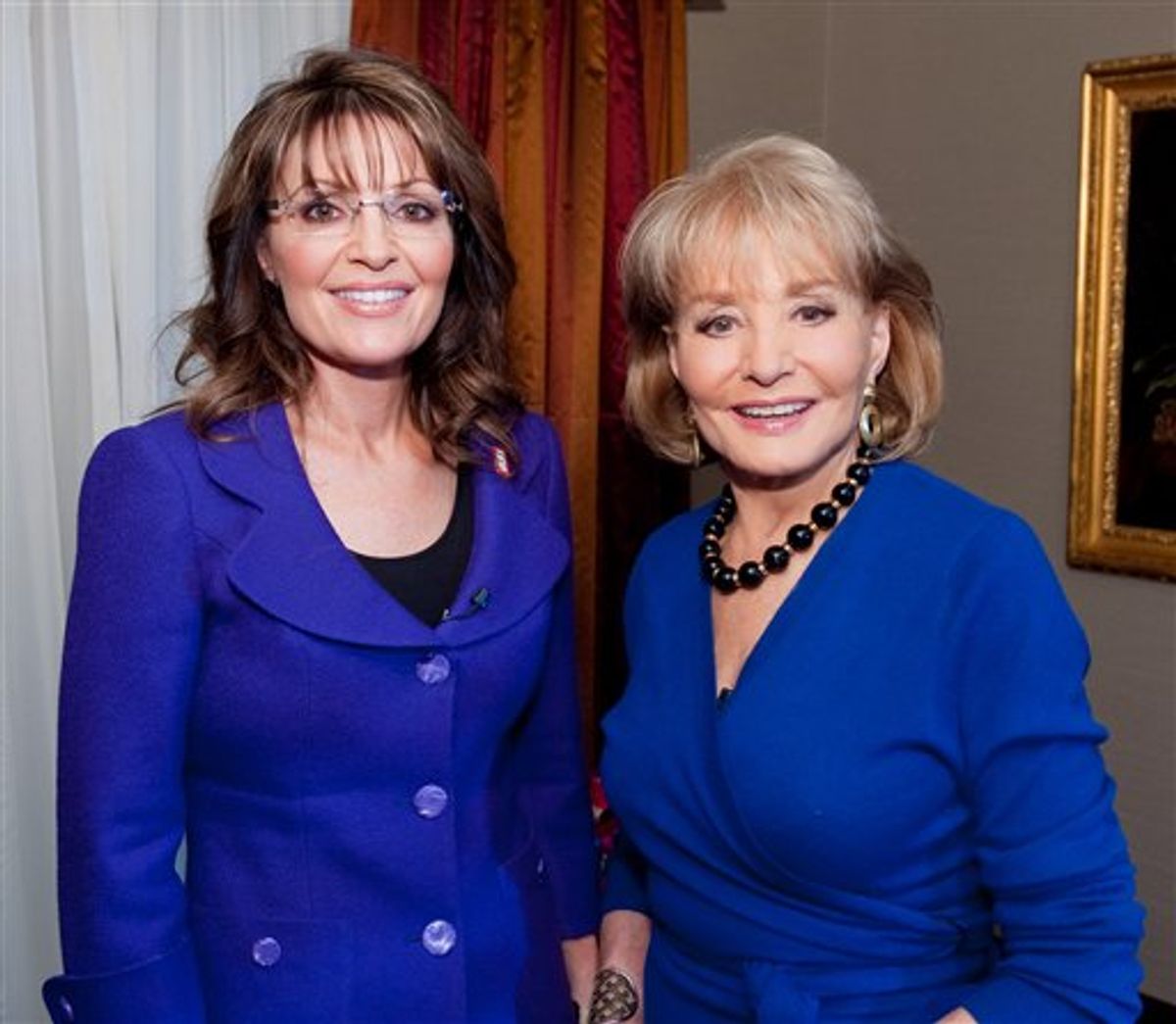
In this photo released by ABC, former Alaska Governor and Republican Vice-Presidential candidate Sarah Palin, left, is photographed with ABC's Barbara Walters, at a New York City hotel, Friday, Nov. 13, 2009. Walters' interview with Palin will air in segments starting with "Good Morning America," on Monday, Nov. 17. (AP Photo/ABC, Steve Fenn) ** MAGS OUT; NO SALES **(Credit: AP)

Sarah Palin’s memoir, “Going Rogue,” finally goes on sale today, after already producing an avalanche of criticism worthy of Proust. (Rush Limbaugh proclaims it “one of the most substantive policy books I’ve read.”)

Do you want to read it? Of course not. So we’ve compiled the key elements to the book so you can know what everyone’s talking about without enduring 413 pages of Palin-isms — or shelling out $30 for a book.

So … what, exactly, is the book about? 

Agenda No. 1, apparently: Settle old scores

The New York Times’ Michiko Kakutani wrote that Palin spends much of the book lashing out at the McCain campaign — for being too slow in addressing the economic collapse, too easy on its rival, and too disorganized — and laying principal blame for its failures on Steve Schmidt, McCain’s chief campaign strategist and one of the people responsible for choosing Palin as a running mate. She largely blames the McCain staff for all the miscues of 2008, but rather than granular details of policy disagreements or communication problems, she’s not above the cheap shot.

At one point, Palin recounts (via Politico), Schmidt told her to get a nutritionist. “As he lectured, I looked at his rotund physique and noted that he used nicotine to keep his own cognitive connections humming along.”

On the loyalty of Nicolle Wallace, McCain spokesperson and former Bush official: “I had to trust her experience, as she had dealt with national politics more than I had. But something always struck me as peculiar about the way she recalled her days in the White House, when she was speaking on behalf of President George W. Bush. She didn’t have much to say that was positive about her former boss or the job in general.”

Wallace also is painted as a hoity-toity Beltway mean girl. According to Politico, she writes about Wallace snobbishly going through her wardrobe in Palin’s Alaskan bedroom. “No … no … no [Wallace] said as she slid each garment aside on its hangar.” The clothes, Wallace claimed, were not appropriate for a vice-presidential nominee — and it was Wallace, according to the book, who made the decision to purchase those costly, controversial designer clothes for the Palins.

Then, cleverly, Palin uses Wallace to smear CBS’s Katie Couric (whose devastating interview with Palin created a damaging media narrative). According to Palin: “‘[Couric] just has such low self-esteem,’ Nicolle said. She added that Katie was going through a tough time. ‘She just feels she can’t trust anybody.’”

Agenda 2: Bolster her folksy image

Palin also uses the book to paint herself as a woman of the people, whose ignorance about world affairs is no impediment to her ambitions (because “there’s no better training ground for politics than motherhood”). She later argues that her family-budgeting skills and belief in creationism made her into a “much needed fresh breeze blowing into Washington D.C.”

According to the Washington Post, Palin goes to considerable length to assert her religious faith. On the campaign trail, she writes, she even took a call from controversial Pastor Rick Warren while in the shower: “I would never turn down prayer even with limited hours in a campaign day, standing in a few inches of water with a shower curtain for a wardrobe. You do what you’ve got to do.”

Also,  the Los Angeles Times notes that, unlike many other celebrity memoirists, Palin doesn’t acknowledge her “collaborator” until late in her acknowledgments (after five HarperCollins editors and before “everyone who values good customer service”).

Agenda 3: Lay the groundwork for . . .

The NYT’s Kakutani believes the the book is a “calculated attempt to position — for 2012.” Other politicos and talking heads seem to agree. Will it work? Only time will tell.

But if she does enter political life again, the book has a litany of blurbs and bloopers she’ll have to live down. Many media outlets have combed through the book to extract some of its most noteworthy or bizarre passages. Among the best that have popped up:

  • On the phone call from McCain, when he offered her a place on his ticket: “For some reason, when the call came at the State Fair, it didn’t come as a huge shock … I certainly didn’t think, Well, of course this would happen. But neither did I think, What an astonishing idea.” (via MSNBC)
  • On the irresistible sex appeal of Todd Palin: “That day in sunny Texas when the divorce rumors were rampant in the tabloids, I watched Todd, tanned and shirtless, take the baby from my arms and walk him back to the ranch house so Trig could nap while I made calls. Seeing Todd’s blue eyes smiling, I chuckled. Dang, I thought. Divorce Todd? Have you seen Todd?” (via First Post)
  • On doing an “SNL” sketch with Alec Baldwin: “The bigwigs haggled back and forth over my appearance with Alec, the writers sending down some lines where Alec was basically supposed to perform a comic dissection on me. Then I was supposed to passively take his arm and stroll offstage. From a political messaging standpoint, the campaign could see that wasn’t going to work. We put our heads together and sent the producers a counteroffer: Alec would still get his barbs in, then I would say, ‘Hey, Baldwin, weren’t you supposed to leave the country after the last election?’ Uh … no, producers said.” (Via First Post)

But perhaps the book’s bigger buzz has been its inaccuracies. The Associated Press published a thorough summary of them (a project that Palin dismissed on her Facebook page as “opposition research,” claiming that reporters would be better off fact-checking “Pelosi’s health care takeover costs”). Among the AP’s finds:

  • Palin claims to have asked to stay “only” in reasonably priced rooms while on Alaska state business (AP: She once took a $3,000 trip to New York, and billed Alaska $20,000 for children’s travel).
  • She claims to have financed her campaign for governor on small donations (AP: About half of her campaign money came from people and political action committees giving over $500).
  • She describes Alaska as a state that doesn’t want “help” from government (AP: Alaska is one of the states most dependent on federal subsidies).

Elsewhere: 

  • Media Matters disproved Palin’s claim (among others) that she did not support aerial hunting. (In fact, in 2007, she introduced a bill to “simplify and clarify” the state’s “‘same day airborne hunting’ law.”)
  • At the Huffington Post, Sam Stein disproved Palin’s claim that she was always excited about the prospect of going on “Saturday Night Live” (leaked McCain campaign e-mails show that she initially had some strong reservations).

And, as the book enters wider circulation, we’re sure there will be more. Let us know in the Comments section if you come across a great blooper we’ve missed.

Thomas Rogers

Thomas Rogers is Salon's Arts Editor.

How Palin’s PAC spends its money

One big priority? Buying copies of "Going Rogue"

  • more
    • All Share Services

How Palin's PAC spends its moneySarah Palin Boook(Credit: George Frey)

Some Republicans — if not the elected ones, then certainly plenty of the voters — see former Alaska Gov. Sarah Palin as the savior of their party. So far, though, she doesn’t seem to be doing much on that score.

In the last half of 2009, Palin’s political action committee, SarahPAC, gave only $43,000 to Republican candidates for federal office. That money was spread over more than a dozen people.

By contrast, National Journal’s Reid Wilson notes, SarahPAC spent almost $48,000 buying copies of Palin’s memoir “Going Rogue.” The books, purchased from the publisher, were used as thank-you gifts for donors.

Update: A little more detail from ABC News’ Blotter, including more money spent — their report has $63,000 spent on the books, along with $8,000 on bookmarks and $20,000 to Palin’s publisher, apparently to cover the cost of sending a photographer and another aide on her book tour.

Alex Koppelman is a staff writer for Salon.

The Palin scoop that wasn’t

A big new political book promises a juicy detail that isn't really all that juicy

  • more
    • All Share Services

The Palin scoop that wasn't

“Game Change: Obama and the Clintons, McCain and Palin, and the Race of a Lifetime” comes out next week. Written by Time’s Mark Halperin and New York’s John Heilemann, it’s supposed to be perhaps the big literary summary of the 2008 presidential election. And it’s already getting some press, including a feature on “60 Minutes” this weekend. But some of the press it’s gotten so far seems, well, less than deserved.

The big detail from the book that’s gotten attention this week is a story about Sarah Palin and her preparation for the vice-presidential debate, against Joe Biden. The press release for the “60 Minutes” story — published on Drudge, who got the book and this story covered elsewhere as a result — tells the story this way:

Palin had a reflexive tendency to refer to Biden as “O’Biden,” says [Steve Schmidt, former chief campaign strategist for John McCain], something that had to be fixed before the debate. He says others in the campaign came up with a solution. “It was multiple people — and I wasn’t one of them– who all said at the same time, ‘Just say, Can I call you Joe,’ which she did.” Schmidt says he took over the prepping, simplified it, and says she “more than held her own” in the debate. But not without one “O’Biden” slip on national television.

In Politico, Mike Allen turned this anecdote and the release into a full story. And it got pickup elsewhere as well.

But it wasn’t exactly a scoop, or even as embarrassing to Palin as one might have thought.  In fact, as you can see in the image included below, Palin herself told the tale in her own book, “Going Rogue.”

Everyone wants to sell their book, and that’s understandable; but this particular tactic seems a little dishonest, and the people who’ve run with it as a big story since seem just a little lazy.

Continue Reading Close

Alex Koppelman is a staff writer for Salon.

Palin’s book sales top one million

"Going Rogue" makes it very, very big

  • more
    • All Share Services

Palin's book sales top one millionFormer Alaska Gov. Sarah Palin signs a copy her her autobiography, "Going Rogue", at the North Post Exchange at Fort Bragg, N.C., Monday, Nov. 23, 2009. (AP Photo/Jim R. Bounds)(Credit: Associated Press)

From the moment it was announced, it was clear that Sarah Palin’s memoir “Going Rogue” would be a bestseller. But the size of the book’s success is still pretty amazing: According to Greg Sargent, more than one million copies have now been sold. That’s after a first week in which 700,000 were bought.

These are, to put it mildly, huge numbers in today’s publishing industry. That said, though, there’s no reason to believe Palin’s success at the cash register can transfer into success at the ballot box — to expand on one observation Sargent made, what the sales figures really show is that she’s become a media star.

Alex Koppelman is a staff writer for Salon.

The Annie Oakley of American politics

She's scrappy, she's folksy, and she won't take any of your bullcrap. Like it or not, Sarah Palin is here to stay

  • more
    • All Share Services

The Annie Oakley of American politics

Sarah Palin’s ascent, not unlike Barack Obama’s, is an American story. The hockey mom becomes the mayor who becomes the governor who becomes the national candidate. She’s a folkloric character: Annie Oakley, Horatio Alger and Gatsby in one. Even her florid self-mythologizing is an accepted cultural tradition. She is the girl from the sticks who made it big. She is a pragmatic, can-do feminist who’s convinced, as she told Oprah, that an American woman can have it all but that “some things might have to be put on the back burner.” Say what you want about Palin or her positions (and, in the past, I have), it takes scrappiness and guts to strike back at the old-boys’ network that anointed you by publishing a book, so soon after the campaign, detailing your frustrations and disillusionments. We might want to take a long breath before discounting her. As Gwen Ifill recently said on “This Week”: “You can not underestimate the degree that women will be drawn to her story.” We don’t hear many real-life fairy-tales of American female success, which makes the few that exist intrinsically compelling.

But Sarah Palin’s story is also peculiarly modern and culturally apt in another, more unsettling way. As the vice-presidential candidate, she showed, despite her postgame spin, little real knowledge of matters non-Alaskan, and at least for the span of the campaign, she didn’t seem bent on acquiring much more. Her current desire for visibility, the motives for which remain unclear, suits our age of reality television, this moment in American life when fame for fame’s sake is the ultimate goal. One might argue that Palin’s ambition, which some have branded simple narcissism, allowed her to forget her own unreadiness for the presidency and accept the nomination in the first place.

Yet in her interviews the past two days with Oprah and Barbara Walters, Palin seemed wiser and more seasoned than she was just one year ago. It wasn’t only that she looked older, the creases around her mouth having deepened, it was also that, no longer under the shadow of McCain and his handlers, she came off as natural, confident, good-humored and even, at times, articulate. Though her tendency to ramble persisted, she wasn’t as awkward and garbled as in the past. She was also disarmingly honest. “It was easy to understand why a woman would feel that it’s easier to just do away with some less-than-ideal circumstances, to do away with the problem,” she told Oprah, about the soul-searching she underwent on learning that Trig would be born with Down syndrome. And about that fateful interview with Katie Couric, she noted, “Of course, I’m thinking, ‘If you thought that was a good interview, I don’t know what a bad interview was.’” Watching her — though I may be nearly alone here — it was almost possible to buy the narrative that McCain’s advisors, in their contempt for her, genuinely threw her off her game and then, by silencing her, conveyed the sense she shouldn’t have tried to play at all. Or at least it was possible to understand why many Palin supporters believe this. It even seemed plausible that her risible cocktail of big words and folk sayings was an attempt to ape political rhetoric that she wasn’t trained in and found intimidating. Maybe, in an earnest, rushed attempt to jam together a highfalutin idiom, to sound like the politicians on TV rather than the one she happened to be, she scrambled her own persona.

After all, as the populist governor of a state whose voters respond to plainspoken directness, she suddenly found herself a national figure addressing big-media sophisticates. She was given about seven seconds to learn her role and then, after eight seconds, patronized and mocked. The reasons she performed so poorly are the very reasons her fan base loves her. If, over the next three years, her performance improves as much as it appears to have in just the last year, the conventional rap about her rustic idiocy may come off as mean-spirited and archaic. Her foes might be wise to contemplate the notion that someone of Palin’s background and sensibilities has a right, regardless of her views, to participate in the national debate merely because she speaks (though often unclearly) for many like her. If this possibility can’t be countenanced, then government for the people by the people is an abstract idea we’ve grown too cynical to practice. Sarah Palin endures not because she’s brilliant, smooth or philosophically correct, but because hope in democracy endures, too.

Continue Reading Close

Democrat goes rogue, declares Palin’s book “great”!

The surprising charms of the week's most talked-about political memoir

  • more
    • All Share Services

Democrat goes rogue, declares Palin's book Sarah Palin waves to fans before an autograph session during the first stop of her book tour in Grand Rapids, Mich on Wednesday, November 18, 2009. (AP Photo/Adam Bird)(Credit: Adam Bird)

Now hold your horses, you snarky, lefty, NPR-listening, New York Times-subscribing readers of Salon. I haven’t jumped ship to declare Sarah Palin herself “great.” I’m from California, after all; I am not a creationist, I am not pro-life, I have never shot a moose. Nor is my culinary specialty an Alaskan dish called “moose chili.” Here on the Left Coast, along with our hummus, we prefer “turkey chili,” which is perhaps less gamey and lower in fat but in the end, I ask you, is it really more humane? (Who killed the turkey? Was it a person or a corporation? This Trader Joe’s we speak of — is he union? Is his name actually “Joe”? And what is his relation to Big Oil’s manipulation of the rising price of Bristol Bay canned fishery salmon to 27 cents a pound?) These are the complexities one ponders at night while falling asleep under the gristly if at times oddly tasty caribou stew that is Sarah Palin’s new 400-plus-page memoir.

If I am giving Palin’s book a thumbs up, it is qualified by the fact that, let’s face it, the genre of the female political autobiography is itself in its infancy. It’s like some 53rd state, housing at this moment in time only a handful of crude, wooden, lean-to outposts. These are times when former Secretary of State Madeleine Albright can do a book tour based on her pins and brooches, about which “Morning Edition’s” Susan Stamberg will huskily midwife a most empathic and unironic discussion. These are times when Nancy Pelosi comes out with a memoir slender as a Hallmark card, a memoir no living person but me has apparently read, vaguely titled “Know Your Power: A Message to America’s Daughters,” which her publishers carefully deemed (“How shall we describe this?”) a “keepsake.” Then again, one understands why female political books tend toward focus group-approved mottos and tasteful brooches — women have not been in politics for very long and, even more than the men in this rabid age, if they dare utter an opinion or take a stand, they and, weirdly, also their children get media-raped and shredded. (One curious triangulation in Palin’s book is irritation with Obama’s and Biden’s relatively easy media rides coupled with unexpected sympathy for media-slogfested Hillary Clinton. Our bodies, ourselves! “Clinton-Palin in 2012!” Can you imagine? Neither can I.)

So what’s refreshing is that Palin seems unafraid to express herself, warts and all — informal campaign motto: “Heels on! Gloves off!” — and the book just goes where it goes. Much has already been made of her freewheeling critiques, not just of Democrats but also of Republican Party insiders and McCain 2008 campaign managers, particularly in the gloomy waning days of the run. (“Schmidt leveled his eyes at me. ‘We don’t have the money Obama does and the numbers don’t look good. We’ve got to change things up.’ I AGREE. I was eager to hear a new strategy. ‘So,’ he continued, ‘headquarters is flying in a nutritionist.’” Ba-dump-bump!) She is forthcoming enough about her personal failings. Belying her shellacked outer shell, more reminiscent to me of Anita Bryant than Tina Fey, Palin confesses a not-ready-for-prime-time horror at Trig’s Down syndrome diagnosis and relates at least one fairly satisfying campaign trail fight with husband Todd. As opposed to Bush’s post-Yale reinvention of himself as a Texas cowboy, Palin doesn’t seem to be making this folksy stuff up. And really, who would want to? While courting Palin as a teen, Todd gave her “gold nugget earrings”; with only one phone line in the house, she and Todd yapped at night on their back porches on fishing boat radios, until they realized every commercial trucker trundling through town could hear them; the wedding rings were each $35, the post-nuptial dinner was at Wendy’s. All this in the town of Wasilla, which, due to stratospheric sales of this particular product, Wal-Mart has deemed “the Duct Tape capital of the world.”

In Palin’s “Little House on the Tundra” (her own coinage), the very state of Alaska seems to have its own sound, its own language, its own quaint patois. There are so many more colorful sayings than that “pit bull with lipstick” quip! Things grow “faster than fireweed in July”; bench warming during sports games is known as “riding the pine.” Alaskan history itself seems to be rich, so very rich in … the letter K. “The year before Jack London arrived, Skookum Jim Mason and Dawson Charlie met up in the Yukon Territory east of the Alaska border with a gold miner who had been panning near the Klondike River,” reads one particularly chunky sentence. Decades later, that same territory might be crossed by a winning Iditarod dog team, whose members had endearing names like Hobo, Lippy and Fudge! There is the truly startling tale of their neighbor Doc. A private bush pilot, he was electrocuted and fell off a ladder while hand-draping fluorescent flagging over power lines so he could more safely land his Citabria at home. Never one to give up, after the accident Doc “retrained himself to be a left-handed, one-armed dentist”! Writes Palin of her huntin’ dad (who is known for palming balmy, just-removed moose eyeballs and warming fish eggs in his mouth), “So a lot of what Alaskans ate, we raised or hunted: moose, caribou, ptarmigan, and ducks. Dad and his friends became their own small-game taxidermists. Even today, my parents’ living room looks like a natural history museum. And when an earthquake hits, Dad can tell the magnitude by how fast the tail wags on the stuffed cougar.” As Frontier literature, I believe “Going Rogue” compares favorably to the Natty Bumpo stories of James Fenimore Cooper. And who wants to argue with me?

Indeed, by the end of this book, I thought, Never mind the hundreds of thousands of reasons the fiery Republican femme fatale is hated in, for instance, my oh-so-blue state of California. Honestly, a fair amount of what makes Sarah Palin weird is the very same stuff that makes Alaska weird. Covering one-fifth of continental North America (as Palin points out), Alaska is baffling. Alaska is ungraspable. Recall Jon Krakauer’s descriptions of Alaska in “Into the Wild.” On the one hand, a Palin quip about her favorite natural “organic protein” seems calculated to inflame PETA: “I love meat. I eat pork chops, thick bacon burgers, and the seared fatty edges of a medium-well-done steak. But I especially love moose and caribou. I always remind people from outside our state that there’s plenty of room for all Alaska’s animals — right next to the mashed potatoes.”

On the other hand, in Alaska it appears people really do eat what they hunt. They hunt in Alaska, they do: Wind chill drops to minus 60, there’s no main thruway to Juneau, wolves are predators, they kill moose and caribou, so hunters shoot them, half are Native Americans, people get their heads lopped off in snowmobile accidents, oil spills destroy fisheries, thousands of jobs depend on natural pipelines, stuffed cougar tails shake in giant earthquakes, there are halibut tacos, God knows.

So when Palin writes: “The spirit of Alaska is unique, combining awe for the untamed majesty of nature, a rugged individualism, and strong traditions of mutual aid,” what can you do but shrug and grudgingly concur? Sarah Palin is Alaska. She is Alaskan. (I almost bouncily want to write “AlasCan!”) As for the next chapter, look for new brooches, at least in 2012. 

Continue Reading Close

Sandra Tsing-Loh is a writer and performer based in Los Angeles. Her most recent book is "Mother on Fire."

Page 1 of 3 in Going Rogue