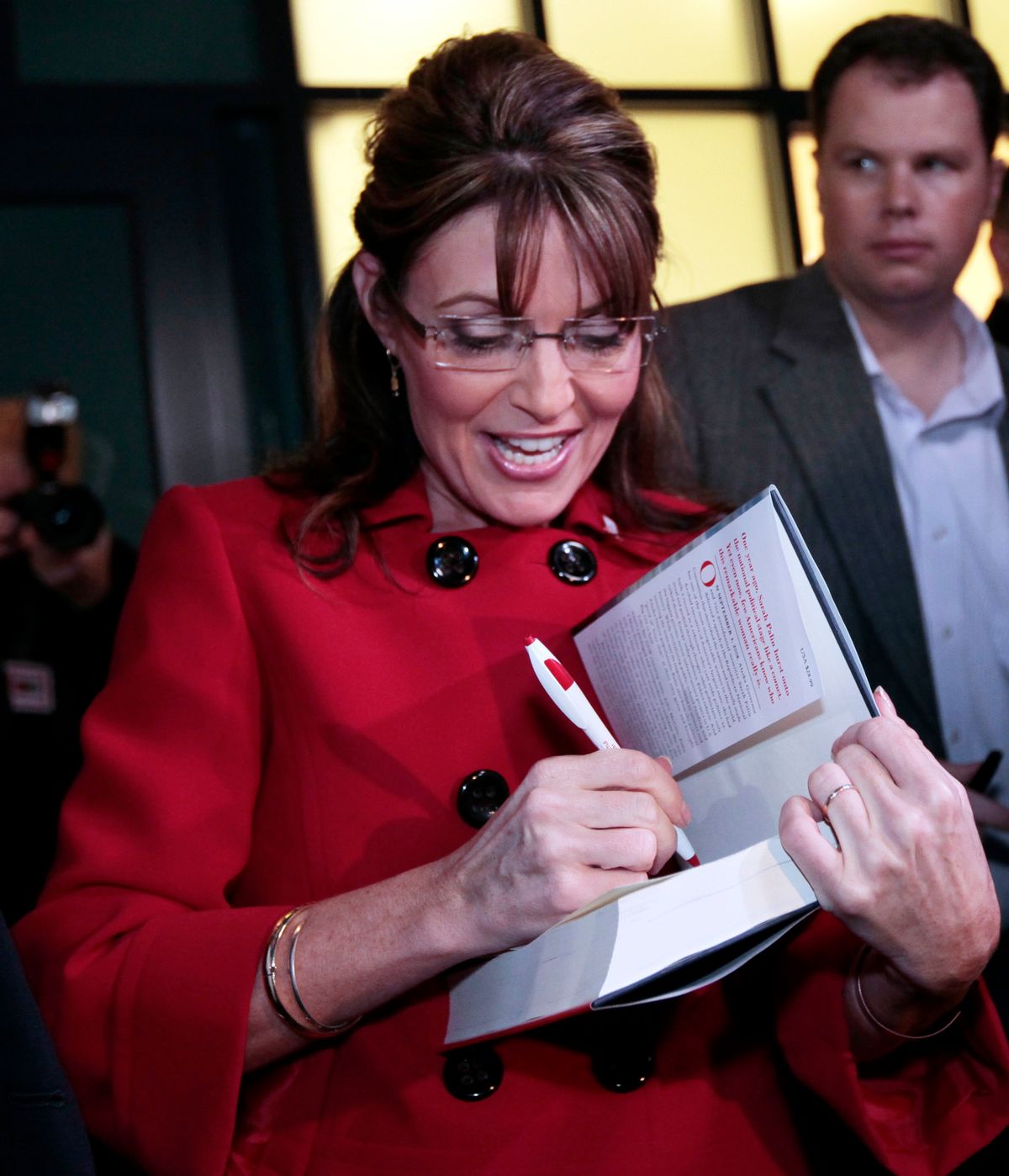
Sarah Palin fans began gathering late Monday night for a book signing that wouldn’t begin until 6 o’clock Tuesday evening. The signing fell during Michigan’s two most sacred weeks — firearm deer season. So Ken Bellhorn left his hunting camp at 1 a.m., and showed up at the Barnes & Noble in Woodland Mall still dressed in an orange camo jacket, a John Deere T-shirt, and hunting boots. He got there early enough to claim one of the 940 wristbands that guaranteed him an autographed copy.
“I already shot a small buck, but this’ll be a bigger trophy,” said Bellhorn, who was laid off last year from his job at a plastics firm that supplies the auto industry, and has spent some of his free time attending tea party rallies. “I think when Reagan was in office, he saved us from ourselves, and I think she’s got the character and the morals to do the same thing.”
Sarah Palin seemed to have an affinity with Greater Grand Rapids that she may not find anywhere else on her 31-city tour. West Michigan fits both sides of the Palin persona — the antiabortion creationist and the moose-skinning hockey mom. It’s a northern exclave of the Bible Belt, with one of the highest churchgoing rates in the nation. But unlike the rest of the Bible Belt, it’s a place of deep snowfalls, ice rinks and bars with more Ski-Doos than pickups parked outside on a January night.
(In “Going Rogue,” Palin thanks a Grand Rapids family for hosting her son Track during a hockey tournament.)
“There’s a bond of northern women,” said Jacquelyn Krug, a mother of five from Battle Creek. “She knows how to hack a winter.”
Krug was waiting outside the store when the Going Rogue Express — an enormous blue bus with a photo of Palin standing in front of a mountain landscape — began circling the parking lot, to chants of “Sarah! Sarah!”
Palin stepped out, holding her infant son, Trig. She stepped onto a stage surrounded by red velvet ropes, then handed the baby off to an aide.
“Thank you so much for showin’ up!” she crooned. “First stop on the tour. There’s just somethin’ about Michigan. I couldn’t wait to get back to Michigan. Alaska and Michigan have so much in common, with the huntin’ and the fishin’ and the hockey moms and just the hardworking patriotic Americans who are here. This is the heart of industry in our country, and I would like to see for this heart of industry for you all to just see a revitalization of your economy, and to be able to see really some remarkable things happen in this part of our land, and I anticipate that good things are going to happen here.”
“Palin power! 2012!” someone shouted.
“Tell the truth, Andrea Mitchell!” someone else cried — a challenge to the NBC reporter who was broadcasting from the store.
After Palin went inside, people took turns posing for photos next to the bus, as though it were Mount Rushmore on wheels. Tomas Ojeda, a former Marine from Grand Rapids, held an American flag and a copy of “Going Rogue.” He opened the cover of his book to show off a pencil sketch of a pit bull, drawn by his daughter.
“I yelled, ‘Get your pit bull on’ when I saw her,” he explained.
In her short speech, Palin had promised that buyers of “Going Rogue” could “read my own words — unfiltered.” If there were two common sentiments in the thousand-person line inside the mall, they were: resentment of the news media for its unfair treatment of Palin, and eagerness to use the news media to air that resentment.
Doug Till of Kalamazoo was wearing a T-shirt that identified him as a member of the Southwest Michigan Tea Party Patriots. I told him I was from Salon.
“The enemy!” he said jovially. Then he talked to me for 10 minutes, breaking off only to run to the other side of the rope line and engage a reporter for an Alaska newspaper.
“We’re here because we want to show support for Sarah Palin, because we want to show her words,” Till said. “She’s Middle America. She’s our values. When they’re attacking her, they’re attacking us. If they would have interrogated Barack Obama and Joe Biden as much as they did Palin, the election would have been a lot closer.”
Till was glad to see Palin in Michigan, a state that had been “abandoned” by the Republican establishment. And he was glad the national cable channels had followed her here.
“I wonder if MSNBC and CNN will listen to us now,” he said.
Palin sat in front of a blue screen on the second floor, scrawling “Sarah” in book after book, while country music blasted from a speaker. (The “Going Rogue” soundtrack: “Independence Day,” by Martina McBride; “These Are My People,” by Rodney Atkins; “How Do You Like Me Now?” by Toby Keith; and, natch, “Shuttin’ Detroit Down,” by John Rich.)
Jacquelyn Krug’s daughter, Annalisa, got into line without a wristband, because she was wearing her Air Force ROTC uniform.
“I can’t wait for you to commission me in the Air Force when you’re president,” Annalisa Krug told Palin. “You inspired me to join the Air Force.”
“It’s such an honor to hear you say that, and that you’ve committed to serving our country,” Palin replied, sounding both pleased and taken aback.
Randy Cotton of Kentwood walked down the escalator carrying two copies of “Going Rogue.” The night before, he had attended a Mike Huckabee book signing at a store just down 28th Street. It was nothing like the Palinageddon that hit Barnes & Noble on Tuesday.
“This crowd was definitely by far bigger in size,” Cotton said. “I spoke to people yesterday who didn’t know Huckabee was going to be there until they came in to buy the book.”
The last time Grand Rapids saw a line this long, it was for another Republican, though not one Palin has to worry about facing in 2012. When Gerald Ford’s casket was brought home, Grand Rapidians waited five hours in the cold to pay their respects. (Ford is buried at his museum, a pretty colorful memorial to a pretty colorless guy, with a Pet Rock, a glitter ball, and other mementos from the disco era that defined his presidency.) Ford belonged to a different Republican epoch: He was pro-choice, pro-ERA, and named Nelson Rockefeller his vice-president. He was the last representative of the moderate, Midwestern Republicanism that was upended by Ronald Reagan, in whose footsteps Palin is trying to follow.
Grand Rapids proper still enjoys the middle of the road. The city narrowly voted for Obama last year. But the surrounding region may be Palin country. West Michigan is, by far, the most conservative part of the state. It was settled by Dutch Calvinists, members of one of the country’s most Republican ethnic groups. (Amsterdam may be so libertine because all the religious folks moved to Michigan.) A Republican has to do well in West Michigan to carry the state. But a Republican too closely identified with the area usually loses. Detroiters think West Michigan is sanctimonious. As a result, it has never produced a governor.
That, in a nutshell, is the problem Palin faces with America. On the back of the Going Rogue Express is a list of her book tour stops. Like Grand Rapids, most are medium-size cities in what Palin considers the “real America.” She’ll be signing books in Sioux Falls, S.D., Roanoke, Va., and Birmingham, Ala. She won’t be signing books in New York, Chicago — or Detroit. Those are capitals of the fake America. But the fake America elected Obama. The fake America has more votes than the real America, and it’s turned off by candidates who cloak themselves in small-town values, while insisting those values are superior to big-city ways.
Palin puts on a terrific political show. Her book signings are worth the $28.99. Only Barack Obama inspires as much fervor among his followers. Except for a few nuts like a Yankee Bubba in the “Jesus Beat the Devil With an Ugly Stick” T-shirt, Palin’s disciples are earnest and patriotic. But she’ll likely stay a genre superstar, like the country musicians she plays at her rallies. She can sell libraries full of books that way, and she can even start a political movement, but she probably can’t cross over to the White House.
Palin fan Doug Till hopes media doubters are wrong about that. He had two objectives for his encounter with Palin: He wanted to ask her to attend a fundraiser for his tea party organization. And he wanted to show her a framed photo of his 8-year-old granddaughter sitting astride a bear she had shot in the Upper Peninsula.
Spotting Till’s tea party shirt, Palin said, “You’re doing a great job. Keep it up.” And though he wasn’t allowed to bring the photo to the signing table, Palin had been told the story of Kailey’s bear hunt.
“Oh, you’re my hero,” Palin said, shaking the girl’s hand.
“You rock,” Kailey responded. “I want to be just like you.”
It’s hard to work up much outrage about the Secret Service prostitution scandal, in which 11 members of the president’s elite protective service and various military personnel were found to have picked up escorts in Colombia, where they were doing advance work for the president’s visit. I guess it is probably not a good idea for the people in charge of protecting the president to leave themselves vulnerable to sexual blackmail, but on the other hand we do not live in a John Le Carré novel or “24″ episode, and I don’t think the threat of a honey-trap assassination conspiracy plot is very credible. If members of the Secret Service want to get drunk and hire escorts after work, that is their business. (As Melissa Gira Grant says, the only actual scandal here — and the reason this became an international incident — is that all these guys tried to bilk one of the women out of the money she was owed.)
But the predictable Washington mixture of prurient interest and moral posturing has turned this incident into grist for the scandals-and-investigations mill. And now we have the attempts at somehow making this a winning partisan issue for Republicans. Chuck Grassley, the senator from Iowa who triumphed over adversity and became the ranking Republican on the Senate Judiciary Committee despite being functionally illiterate, would like to know whether any White House staff also slept with escorts that evening. No one has made the claim, but Grassley’s asking just in case. (For a live peek at a future paranoid right-wing myth in its embryonic stage, read the comments on that Washington Times story: “I can just hear those paper shredders going a mile a minute in the white house, and the document forgers are being called in, you know the same ones that did the birth certificate.”) Grassley was on Fox last night to make sure viewers repeatedly heard baseless speculation as to the involvement of White House staff.
Rep. Pete King, Long Island Republican and stalwart publicity monger, has sent Secret Service Director Mark Sullivan a list of 50 questions about the scandal in order to make it appear that he is very seriously investigating this very serious incident.
For those outside Congress, for whom insinuating escort patronage by unnamed White House staff seems a bit of a reach, the game is to attempt to use the scandal to prove some point the fecklessness of Obama as a leader and his shameful failure to make everyone in Washington stop being so awful and wasteful all the time.
NRO’s Mark Steyn, after praising the fiscal discipline of the agent who attempted to bilk his escort (ugh), suggests that the moral of the story is that we pay too much for presidential security, and that all those agents and fancy bullet-proof Suburbans are wastes of taxpayer funds and evidence of broke post-Imperial America’s profligacy. Sarah Palin, who had every right to be personally aggrieved for once, after it was reported that the agent at the center of the scandal wrote gross sexist things about her on Facebook, was among the first to declare that the problem was with the “culture” Obama has created at the White House. (Karl Rove, smarter than most of these people, suggested that politicizing a Secret Service scandal was dumb and counterproductive. Secret Service Director Mark Sullivan, coincidentally, was elevated to his position under George W. Bush.)
The makeup of the Secret Service, obviously, has very little connection to the political party of the person occupying the White House. Like most American law enforcement agencies, it’s primarily white and overwhelmingly male, and, historically, the culture of the agency has had more than a whiff of machismo. These are not exactly the sort of public sector employees right-wingers get off on demonizing.
In fact, the right has had for years a sort of Clint Eastwood-inspired fantasy of the Secret Service agent as folk hero. Decent, hard-working men putting their lives on the line to protect a bunch of elitist ingrates. That ingratiating phony Bill Clinton and his frigid, hectoring monster of a wife weren’t deserving of such stolid, unflinching loyalty and service.
The fullest expression of this fantasy is in this classic chain email that made its way to every inbox in the nation during the second president Bush’s first term. According to this email, attributed to the unnamed author’s former neighbor, the president’s security detail was constantly disrespected by those awful Clintons and their terrible staff. Hillary Clinton was “arrogant and orally abusive.” “She forbade her daughter, Chelsea, from exchanging pleasantries with” agents. “Al Gore resented Bill Clinton and thought he was to centrist. He despised all republicans.” Agents prayed for Bush to win the election, and their reward was the joy they all felt in the presence of President Bush and his amazing, wonderful wife.
This nonsense has its roots in fake anti-Hillary attacks, attributed to imaginary Secret Service members, that Republican operatives spread to sympathetic media voices starting more or less the day Bill took office. Former Secret Service agents do plenty of gossiping and bitching, most frequently to Ronald Kessler, but their complaints don’t tend to track quite so directly to right-wing fantasy narratives.
But a popular trope is of the upstanding agents blanching at being asked to look the other way as libidinous Democratic presidents — Kennedy, Johnson, and Clinton — womanized. (Clinton was said to have threatened to fire agents who stymied his attempts to have trysts with Monica Lewinsky, though the agent who made the claim admitted to having invented it.) The pat moralism of the conservative Secret Service fantasy makes the agency’s lurid misadventure a bit funnier. It also explains why various people have to somehow convince themselves that the Obama administration somehow degraded the agency, through a lack of “management skills” or the widespread embrace of sexual deviance that is the logical end result of repealing the military’s ban on out gays and lesbians.
Continue Reading
Close
HBO’s “Game Change,” airing this Saturday, is not actually an adaption of the book “Game Change,” by Mark Halperin and John Heilemann. It is “Sarah Palin Goes Rogue,” the movie, with a couple of anecdotes borrowed from the notoriously gossipy account of the 2008 election as a whole. (Or, arguably, it’s an adaptation of Scott Conroy and Shushannah Walshe’s “Sarah From Alaska.”)
That is sort of a shame. The Palin thing is the most heavily over-covered story line of the entire 2008 campaign, so focusing on it might be totally logical from a marketing perspective, but it’s unfortunate from an artistic one. The film re-creates various moments of YouTube campaign ephemera very well — remember when that old white lady called Obama an Arab and McCain looked uncomfortable? When it takes us behind closed doors, it’s to witness scenes any moderately close observer of the election and its aftermath could’ve dreamed up him- or herself. It might have been fun to see a TV movie about the Democratic primary fight; the personality clashes of the disastrous Clinton campaign would have made for entertaining television, and Mark Penn is surely a creature crying out for a grotesque Emmy-winning portrayal by, say, Paul Giamatti.
Instead, McCain has won the nomination three-and-a-half minutes into the film. Soon we’re watching Julianne Moore watch Tina Fey on TV. You remember the “SNL” sketches making fun of Palin, right? In case you don’t, “Game Change” airs lengthy chunks from most of them. It also has tons of actual footage from CNN and MSNBC and Fox News, and it re-creates debates and speeches and the Couric interview and the Charlie Gibson interview and a bunch of other things you saw either live or on YouTube when they happened.
Moore’s performance is not just fair but maybe even flattering. (For one thing, she doesn’t hit those flat upper Midwest vowels as gratingly as the real Palin.) Woody Harrelson plays strategist Steve Schmidt — the film’s protagonist — as a grizzled, “too old for this shit” campaign veteran called back to the trail against his better judgment. Jamey Sheridan is given barely anything to do as Mark Salter, McCain’s “conscience.” Salter, the primary author of his “Maverick” mythos, is limited, after the Palin selection, to making a hilariously over-telegraphed face of concern as everyone else in the war room applauds her first speech.
But the film is about Schmidt and Nicolle Wallace because they were pretty clearly Halperin and Heilemann’s primary sources, and we watch them become horrified by the depths of Sarah Palin’s ignorance at exactly the same time as everyone else in America became horrified by her ignorance.
Because it’s Hollywood, there’s very little politics in the film’s depiction of politics. Policies are simply things for Sarah Palin to write on note cards and not memorize. Operatives confidently declare, in faux Sorkin-ese patter, that if this or that meaningless decision is made, it means “we’ll lose by five.”
There is a sheen of faux cynicism (McCain swears like a sailor!) but it masks complete naiveté: Everyone is basically honorable and decent. Nicolle Wallace — a member of the Bush administration communications team — is sincerely alarmed at the prospect of someone as dangerously ignorant as Sarah Palin in the White House. On election night, she breaks down in tears as she admits to Schmidt that … she didn’t vote. They embrace.
The film subscribes to the simplest theory of Sarah Palin: That she is childlike, vain and incredibly ignorant but also an essentially decent person and wonderful mother. The moments that come closest to “unfair” — Sarah Palin doesn’t know that the head of Great Britain’s government is the prime minister, not the queen — are basically plausible. This isn’t Andrew Sullivan’s conniving, dangerous pathological liar. It’s an overwhelmed working mother whose most unhinged moments are explained by a crash diet. Her convention speech is largely stripped of its snarling attack lines, imagining a world in which it appealed to “the base” because of Palin’s heartfelt commitment to special-needs children and not because she was very good at saying mean things about Obama. (The film actually repeats the bullshit story that her teleprompter broke midway through, and she kept going.) Even when the film has her take a major heel turn — “if I am single-handedly carrying this campaign, I am gonna do what I want!” — after “winning” her debate with Joe Biden (played by video footage of Joe Biden), she is still basically an innocent seduced by the adoration of riled-up crowds and national attention. (Todd Palin barely does anything.)
The constant use of actual news footage adds a bit of verisimilitude but also constantly raises the question of why this lightly fictionalized version of the election actually needs to exist. “Game Change” is not really for serious political junkies, who remember all the stuff that did happen and will scoff at the stuff that didn’t. (At one point, John McCain answers his ringing iPhone in the middle of the night. He used a BlackBerry, HBO.) But if casually politically involved people want to see their assumptions about Sarah Palin reinforced, well, there are still those “SNL” sketches.
In the end, the Republican operatives who foisted Sarah Palin on an unprepared nation are rightly horrified that they created a monster, but at no point does anyone act concerned that their actual candidate was himself an angry, warmongering old crank with extremely fungible principles. Sure, Sarah Palin didn’t know what the Fed did. Do we have any proof John McCain knew what it should’ve done? Maybe everyone actually was totally unfair to poor Sarah Palin.
Continue Reading
Close
In recent years, Danny Strong has become the go-to guy for political drama for HBO. He’s gotten an Emmy nomination and Writers Guild of America award for his screenplay for the 2008 “Recount,” about the 2000 presidential vote in Florida. And now he’s gone back to work with that film’s director, Jay Roach, on the anticipated adaptation of the controversial bestseller “Game Change,” which premieres on HBO Saturday. “Game Change” chronicles Sarah Palin’s rise during the 2008 presidential race and features a superlative performance by Julianne Moore as Sarah Palin, along with Ed Harris as John McCain and Woody Harrelson as McCain’s senior strategist Steve Schmidt. It is already getting pushback from Republicans, who are calling it a political-year propaganda film.
Oddly enough, Strong began his entertainment career playing key roles in cult series – Jonathan Levinson on “Buffy the Vampire Slayer”; Paris’ boyfriend on “Gilmore Girls”; the hopeful copywriter hired after Don Draper stole his idea on “Mad Men.” We caught up with him in Atlanta last week.
Sarah Palin is introduced on about page 350 of John Heilemann and Mark Halperin’s “Game Change,” a book that covered the 2008 Obama, Clinton, McCain and Edwards races as well. Was it always going to be just about her?
It was the director Jay Roach’s concept to just do the Palin story, and I agreed that I thought that was the best approach, for various reasons. One, I thought it was the most exciting story in the book, but not only that, I thought it was one of the most exciting stories in recent American politics. I just thought it would make an amazing movie. I also thought that doing a story about Barack Obama at this time, it would be impossible for the film not to come across as an informercial for his reelection and it would be difficult for an audience to get lost in a movie about him while he was still president. I think there’s a great movie there, too. But I think that movie needs to be made after he’s out of office.
When did you start to work on this? And, as in “Recount,” I understand it began with a lot of your own reporting.
I think we started in late summer, 2010. I did 25 interviews with people in the campaign and then read a ton of other books, too, on the subject, particularly Sarah Palin’s book “Going Rogue,” which was a beat-by-beat account of what happened in the campaign from her point of view.
What percentage of the movie was based on the book and what was your own reporting?
I would say 90 percent of the movie is the book, 5 percent is my original reporting, 5 percent is other sources. But so much of my own reporting was just trying to confirm the veracity of the book, which I found to be extremely accurate, based on the interviews.
I don’t want to misrepresent I was some big scoop-getter in this process. The movie really is built on the back of reporting of the book. There’s nothing I found out that I wouldn’t have been able to find out if it hadn’t been the work John and Mark had done. But there’s one thing [I found out] that’s already been put on record that I’ll just mention – that Palin thought that the queen of England was the ruler of England. That’s something I got from my own reporting.
There were also some surprising quotes in the book that I don’t remember seeing in the movie, such as when she said during a low point of preparing for her single debate “If I’d known everything I know now, I wouldn’t have done this.”
Yeah, you know that was in the movie. It was in the script and was shot. It just ended up on the cutting room floor. But you’re absolutely right. It’s an amazing line, isn’t it? When you’re editing a film, you’re just trying to get it to breathe; you’re trying to make it work. Things kind of just get cut here and there. And that was just one of those moments. I believe that line was the casualty of a scene that was made significantly shorter.
How was this process different from your last film, which was also a political potboiler based on recent events?
In the case of “Recount,” I had never done anything like that before. I had no background in journalism. I always tell people the biggest advantage is that I had no idea what I was doing. It was really exhilarating and kind of scary. By the time I did this, I’d done several projects now where I’ve interviewed people. I’ve just done it a lot more. I’m used to it; I’m used to dealing with sources.
Also, one of the big differences between the two films is that “Recount” has Democrats and Republicans, but this one is just Republicans. By the way, I prefer dealing with just one party in a movie rather than dealing with two, because you have all these balance issues that have nothing to do with story. You know, for every scene of one party, you have to have a scene of the other, kind of thing. In this we just get to tell our story.
Did you see any similarities in Katherine Harris, who is one of the central characters in “Recount”?
I don’t really see many similarities between Katherine Harris and Sarah Palin as far as their portrayal in film. In “Recount,” Katherine Harris is secretary of state of Florida overseeing the recount process. The film shows how she, beat by beat, does everything she can to help one candidate. That’s violating her oath of office, and I think the film is very critical of that.
In “Game Change,” the film doesn’t show Sarah Palin doing anything unethically. It shows how Palin goes on to become this beloved, charismatic figure within the party, whereas Katherine Harris is not. This is just the story of someone who has been thrust on the national spotlight literally overnight, as Katherine Harris was, and is doing her best to try and make things work. I think Katherine Harris was doing her best to try to help one candidate get elected, when she should have been overseeing a fair and impartial process.
You do get to show the charismatic side of Palin, particularly on the rope lines or when she’s meeting other parents of Down syndrome children.
Yeah, the scenes were really moving. When campaign staffers would tell me those moments on the rope line, whether they loved Sarah Palin or didn’t love Sarah Palin, they all told me it would make them cry. You need to show what made her so beloved and dynamic. That’s an amazing part of the story.
Political dramas in general seem rife for criticism even before the film is released.
Absolutely. And that happened on “Recount” too. It happened on the Democrats’ side. Warren Christopher came out and attacked the film before he had seen it. In this case, we have Sarah Palin staffers basically attacking the film before they’ve seen it. To be honest with you, I don’t think it serves either one of them. I think both portrayals are much more complex, dynamic and layered than they realized because they hadn’t seen the film. It gives the films a lot of publicity.
We’ve had screenings across the country by now, and one of the main things that people talk to me about afterward in the Q & As is how sympathetic she comes across at times; how they never imagined they were going to see her in the light that they see her in – particularly liberal Democrats that don’t care for her are surprised about how much sympathy they have for her with the pressure she was under.
I’ve heard that one of the Palin staffers who complained had offered to be a consultant earlier.
Yeah. The offer was in an email to me, where he asked to be our confidential consultant with formal agreement. And I’m just very surprised. In the same email he basically validated the book by saying that the portrayal of Sarah Palin was complex and unique, not false and inaccurate. So I was pretty stunned that a week ago, a year after that email, he came out and attacked the film as being based on a book that’s grossly inaccurate. And if it was so grossly inaccurate, I don’t know why he would have offered to have been our confidential consultant a year ago.
We did hire a consultant. The person we hired [Chris Edwards] was someone who we thought had a very balanced, fair viewpoint of the entire campaign. He was her deputy chief of staff on the campaign, so he was there for everything.
And the reason to have a consultant is to get all the details right?
Yes. To have someone on set who sat next to Palin for those 60 days is an enormous asset. And he was primarily utilized for helping us with the technical details of what it’s really like on the campaign plane, who sits where; helping out with making the green rooms look how they actually looked. The goal was to make it look and feel as authentic as possible, and he was a great asset for that.
One of the other charges against “Game Change” is that HBO deliberately scheduled this for right after Super Tuesday to ruin any Palin election plans.
Me and Jay Roach never believed she was going to run back when we started working on this in earnest in summer 2010. It was kind of the accepted discussion in political circles and in the press that she was not going to run, so that was really never a concern for us. And we were right; she never ran. We never thought this film was going to affect the election. I don’t think anyone who sees this movie is going to vote differently because of it. I don’t think it makes Republicans look negative. I don’t think it makes Obama look positive. I don’t think it’s going to affect the election at all.
But don’t you hope this film has an effect in the broader sense?
I hope has the effect of making people question what they want in a leader. The themes of the film aren’t partisan themes. The themes of the film are about the process, about how we elect our president and what we value in a leader, and how that value system and that process has been shifted by the internet, YouTube and the 24-hour news cycle.
I got the feeling it was a “Frankenstein” story – that these consultants had created a monster they regretted unleashing on the nation.
It was a “Pygmalion” story – I conceived it and Jay Roach completely agreed that this was a Pygmalion story of them finding an individual and then trying to turn her into something that perhaps she’s not. And there are consequences to that. And they lived the consequences.
Don’t you think it will affect any of Sarah Palin’s political plans going forward?
I don’t think anything is going to affect Sarah Palin except for Sarah Palin. No matter what she does, or what happens, she just has a base of support and they love her, and nothing’s ever going to change that. And people who are not fans of Sarah Palin — I don’t think anything’s going to change that. Because I think everyone has their opinions of her, and those opinions are essentially set in stone.
The goal of the film wasn’t to try and change anyone’s mind about anything. The goal of the film was to talk about the process of how we elect our president, and here’s a pretty crazy story in which a candidate was not vetted to be vice president of the United States. She was not properly vetted, and we came very close to having a vice president that perhaps wasn’t prepared for that job.
“Game Change” premieres Saturday at 9 p.m. on HBO.
Continue Reading
Close
The GOP primary keeps getting funnier. Just as Newt Gingrich was telling a South Carolina Romney supporter “I agree with you” that attacking Mitt Romney’s Bain Capital career could help Democrats on Wednesday, his friendly Super PAC “Winning the Future” released the long version of its hit piece “When Mitt Romney Came to Town.” I thought MoveOn did a bang-up job last week with an ad profiling a pair of older Kansas City steelworkers left jobless thanks to Bain; this ad is so slashing MoveOn might have thought twice about releasing it. If you haven’t seen it, it’s here. Clearly, Gingrich is trying to have it both ways: Mollifying wealthy GOP donors horrified by his attacks on capitalism while continuing to bloody Romney. We’ll see how well it works.
Romney continues to insist Democrats, as well as some of his GOP rivals, are practicing “the politics of envy,” and on NBC Wednesday made what might be his dumbest remark yet. Asked whether there was ever a fair way to discuss income inequality, the GOP front-runner replied:
I think it’s fine to talk about those things in quiet rooms and discussions about tax policy and the like. But the president has made it part of his campaign rally. Everywhere he goes we hear him talking about millionaires and billionaires and executives and Wall Street. It’s a very envy-oriented, attack-oriented approach and I think it will fail.
Maybe Mitt wants to confine talk of inequality to “quiet rooms” because he’s seen the Pew Research Center data showing that Americans think conflict is growing between rich and poor. Two-thirds of Americans see that conflict, up 50 percent since 2009. While African-Americans are still more likely than whites to see that conflict, the percentage of whites who agree tripled. Credit Occupy Wall Street for hiking consciousness about the gap between rich and poor, but credit the GOP for creating the conditions that allowed income inequality to soar, and the top 1 percent to gobble up 40 percent of the nation’s wealth.
A sly Sarah Palin called for Romney to release his tax returns on Sean Hannity’s show last night, to Hannity’s seeming distress. Palin defended Rick Perry’s “vulture capitalism” attack even as Hannity kept trying to get her to declare it unfair. She’s gone rogue again! We can only dream that Romney releases his tax returns. I think he’s less scared about showing his staggering wealth than revealing the scandalously low tax rate he pays, given how much of his income comes from investment and is thus subject to lower capital gain taxes. (I’m sure we’d also learn a lot from the tricks Romney’s accountants use to keep his effective tax rate even lower.)
Palin also demanded that Romney substantiate his claims to have created 100,000 jobs while at Bain, calling it a “come to Jesus” moment. What is she up to? Her snow-machine-driving husband Todd endorsed Newt Gingrich last week, to great derision, but it did raise questions about what the nominally neutral ex-V.P. nominee is thinking. She’s not thinking good thoughts about Mitt Romney, that’s for sure.
Meanwhile, the man who foisted Palin on the world, John McCain, today accused Romney’s anti-Bain attackers as supporting “communism.” But BuzzFeed recalls that in 2008, McCain himself attacked Romney’s Bain days. “He presided over the acquisition of companies that laid off thousands of workers,” McCain complained back then, and campaign manager Rick Davis told the National Journal:
“He learned politics and economics from being a venture capitalist, where you go and buy companies, you strip away the jobs, and you resell them. And if that’s what his experience has been to be able to lead our economy, I’d really raise questions.”
I’ll be talking about Romney’s Bain troubles, and the GOP circular firing squad, on MSNBC’s “Politics Nation” with the Rev. Al Sharpton at 6 ET.
Continue Reading
Close