
Afghanistan
No one at the wheel in Afghanistan
A fraudulently elected president is presiding over an empty cabinet, while the parliament plays hooky
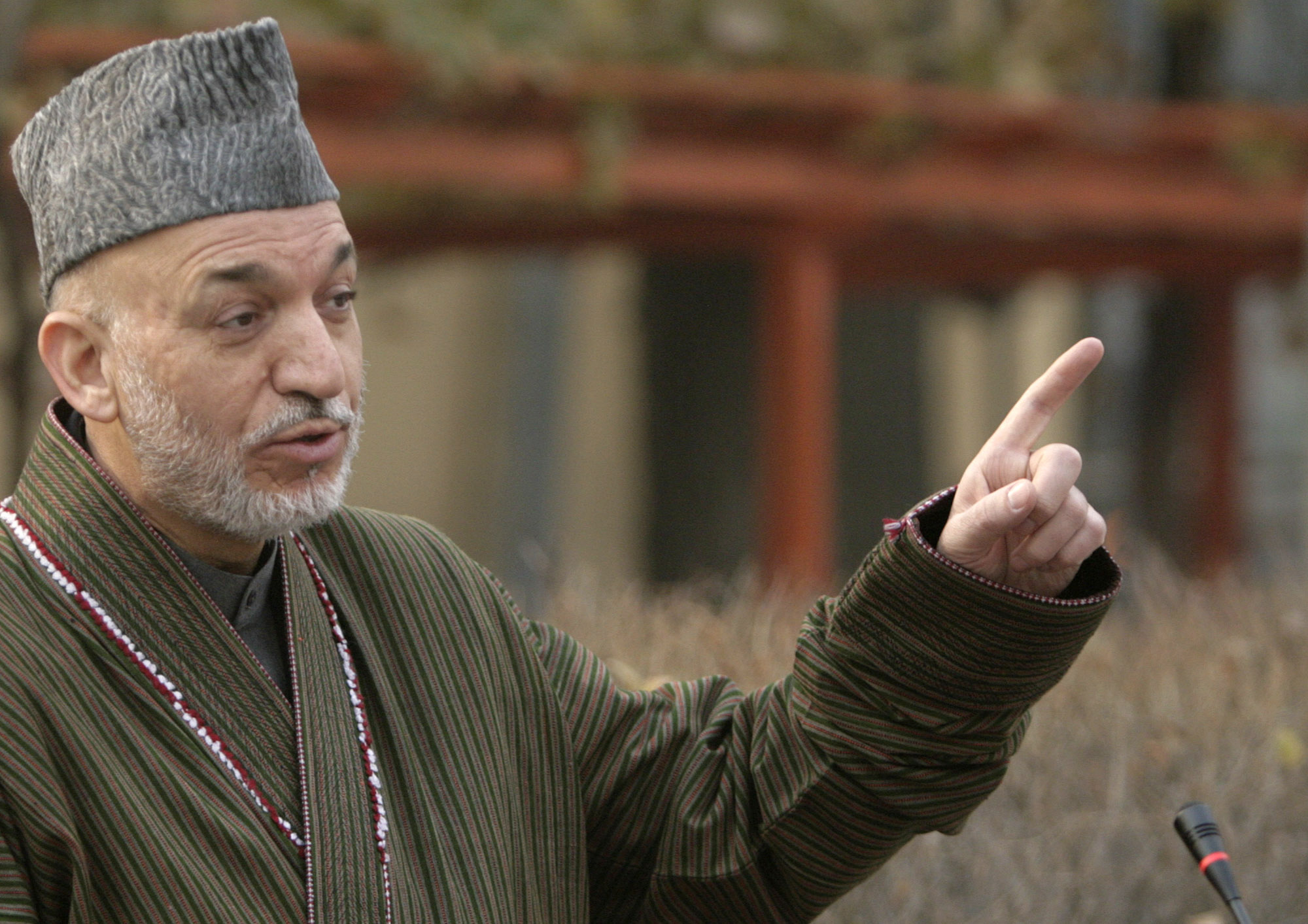
Afghanistan President, Hamid Karzai, addresses the media on the occasion of Eid al-Adha, at the Presidential Palace mosque in Kabul, Afghanistan, Friday, Nov. 27, 2009. In his message to mark the major Muslim holiday of Eid, Karzai said that "all our ... brothers who stand armed against their country," including the militant Islamic faction Hezb-e-Islami led by warlord Gulbuddin Hekmatyar, should help ensure stability and development in Afghanistan. (AP Photo/Mustafa Quraishi)(Credit: Mustafa Quraishi) President Barack Obama’s commitment to “finish the job” in Afghanistan by sending 55,000 U.S. troops to that country (counting the 21,000 he dispatched last winter shortly after being inaugurated) depends heavily on a hope of building up an Afghan government and army the U.S. can eventually turn control over to. But one of the questions we seldom hear any detail about concerns the country’s governmental capacity. Does the government function? Can it deliver services?
As might be expected, governmental capacity is low, but here are some specifics. Months after the controversial presidential election that many Afghans consider stolen, there is no cabinet, and parliament is threatening to go on recess before confirming a new one because the president is unconstitutionally late in presenting the names. There are grave suspicions that some past and present cabinet members have engaged in the embezzlement of substantial sums of money. There is little parliamentary oversight. Almost no one bothers to attend the parliamentary sessions. The cabinet ministries are unable to spend the money allocated to them on things like education and rural development, and actually spent less in absolute terms last year than they did in the previous two years. Only half of the development projects for which money was allotted were even begun last year, and none was completed.
In other words, we can say of the Afghanistan government what Gertrude Stein said of her inability in later life to find her childhood home in Oakland, Calif.: “There is no there there.”
President Hamid Karzai pleaded with the lower house of parliament on Monday to delay its winter recess by one week so that he can present his final cabinet nominees for confirmation, according to Pajhwok. Speaker of the House Yunus Qanuni sniffed that the parliament was responsible for setting its own recess, implying that he would not be strong-armed by the president. (Qanuni is a Tajik, formerly a leader of the Northern Alliance, and has long been a rival of Karzai, running against him in 2004; he was a counselor to Abdullah Abdullah, Karzai’s main rival in the Aug. 20 presidential election).
But Qanuni seems to have been one of the few members of parliament who cared one way or another. Nader Khan Katawazai, an MP from Paktika, complained that only 30 of the 238 MPs attended Monday’s session. This is the government we are being asked to prop up with blood and treasure? Only 30 legislators bothered to come in to work?
By law, Karzai was supposed to have presented his cabinet to parliament within two weeks of being sworn in (which was two weeks ago). Since he has been insisting he was the winner since early September, he should have had time to put together a cabinet. But he presumably had to make some substitutions once he admitted that three of his current cabinet members were under investigation for corruption. (Twelve other former cabinet members, having fled the country, were also being looked at for criminal prosecution.)
That is the government that the U.S. has been propping up for the last eight years. Fifteen cabinet members that Interpol is looking into?
Even the non-corrupt ministers may not be confirmed by the parliament because of substantial dissatisfaction with the inability of many of them to spend the development money their ministries had in the kitty.
Seven ministries spent only 40 percent of their allocated budget in the past year, according to Pajhwok News. And the sums expended on development projects declined 10 percent last year from the two previous years!
Let’s repeat that. The Afghanistan government presides over the fifth-poorest country in the world. It has millions of dollars in aid to spend for the betterment of its constituents. But it actually managed to spend less on these tasks this year than in previous years, despite having more money.
- The Ministry of Rural Rehabilitation and Development expended 10 billion Afghanis from its allocation of 22 billion Afghanis;
- The Public Works Ministry spent 6 billion of 18 billion Afghanis;
- The Water and Energy Ministry 9 billion of 17.6 billion Afghanis;
- The Education Ministry 3 billion of 8 billion Afghanis;
- The Public Health Ministry: 2.3 billion out of 5.5 billion Afghanis;
- The Finance Ministry spent 3.5 billion out of 5.5 billion Afghanis;
- The Agriculture Ministry spent 1.5 billion out of 3 billion Afghanis.
The chairman of the National Economy Commission, Siddiq Ahmad Usmani, said that 500 development projects were supposed to have been pursued last year with the 111 billion Afghani budget allotment, but in fact, “work on only 263 of 500 was carried out which are yet to be completed.”
The low governmental capacity of the Afghan state bodes ill indeed for Obama’s success in Afghanistan. He will be constantly looking for a reliable partner. He will find shifting quicksand.
Meanwhile, the Taliban, whom no one is accusing of apathy or inefficiency, have begun deploying donkey suicide bombs against foreign troops.
Salon contributor Juan Cole is a professor of modern Middle Eastern and South Asian history at the University of Michigan and the author of "Engaging the Muslim World." More Juan Cole.
Memorial Day’s lessons in amnesia
If nothing else, the holiday allows us to reflect on our commitment to forgetting bloody conflicts
(Credit: Carly Rose Hennigan via Shutterstock) It’s the saddest reading around: the little announcements that dribble out of the Pentagon every day or two — those terse, relatively uninformative death notices: rank; name; age; small town, suburb, or second-level city of origin; means of death (“small arms fire,” “improvised explosive device,” “the result of gunshot wounds inflicted by an individual wearing an Afghan National Army uniform,” or sometimes something vaguer like “while conducting combat operations,” “supporting Operation Enduring Freedom,” or simply no explanation at all); and the unit the dead soldier belonged to. They are seldom 100 words, even with the usual opening line: “The Department of Defense announced today the death of a soldier who was supporting Operation Enduring Freedom.” Sometimes they include more than one death.
Continue Reading CloseTom Engelhardt, co-founder of the American Empire Project, runs the Nation Institute's TomDispatch.com. His latest book, "The United States of Fear" (Haymarket Books), has just been published. More Tom Engelhardt.
Where the wounded are
Wars don't just cause casualties among soldiers, they drain medical staff. I traveled to see the costs firsthand
A soldier is prepared for an operation at Landstuhl Regional Medical Center. (Credit: Reuters/Kai Pfaffenbach) The weather’s getting warmer in Afghanistan and the war there is heating up again. That means – as it has meant every year for more than a decade — that the pace will quicken at the Landstuhl Regional Medical Center in Germany. More casualties will be brought to this largest American military hospital outside the United States. The Critical Care Air Transport teams and their C-17 Globemasters will fly in from “downrange,” as they call the Afghan battleground, and the injured will be brought by ambulance bus from nearby Ramstein Air Force Base to the hospital front door.
Continue Reading CloseMichael Winship is senior writing fellow at Demos and a senior writer of the new series, Moyers & Company, airing on public television. More Michael Winship.
NATO invites Pakistan to summit
A sign that Islamabad is ready to reopen its western border to NATO troops on their way to Afghanistan
Oil tankers, which were used to transport NATO fuel supplies to Afghanistan, are parked at a compound in Karachi, Pakistan, Tuesday, May 15, 2012. NATO on Tuesday invited Pakistani President Asif Ali Zardari to the alliance's summit in Chicago, after signs that the country could be moving to reopen its Afghan border to NATO military supplies. (AP Photo/Shakil Adil)(Credit: AP) ISLAMABAD (AP) — NATO on Tuesday invited Pakistan’s president to the upcoming Chicago summit on Afghanistan, the strongest sign yet that Islamabad is ready to reopen its western border to U.S. and NATO military supplies heading to the war in the neighboring country.
Pakistan blocked the routes in November after American airstrikes killed 24 of its troops on the Afghan border. The attack sent ties between Washington and Islamabad to new lows, threatening regional cooperation needed for negotiating an end to the Afghan war.
Continue Reading CloseAfghanistan, I can’t quit you
My mom pushed me to join the Marines. Now that she's gone, I'm still drawn to war zones
A child flies a kite in Kabul on Tuesday Mar. 27, 2012. (Credit: Geoffrey Ingersoll) The heat. That’s what I remember most. Shimmery and bright. Blinding. Stifling. Heeee-eeaat.
The kind that’s not just on you, wrapped around you, but balled up and pulsing inside you — a desert blanket with teeth. It’s a type of heat that makes your skin cry and your eyeballs sweat, even in the shade; heat like a predator you can’t run away from.
I notice it right as I get off the plane — not just the degrees but also the dust. Dust you can smell, kicked up by a thousand years of struggle. In a region this old, I’m sure each breath carries a dose of unintended history: Inhale, Alexander the Great; exhale, the Ottoman Empire; inhale, the USSR; exhale, the Taliban.
Continue Reading CloseGeoffrey Ingersoll is a freelance journalist, documentarian, writer, photographer, and veteran of Operation Iraqi Freedom. He is the recipient of the Sam Stavisky Award for Combat Reporting. More Geoffrey Ingersoll.
What Obama didn’t mention in Kabul
Just outside the Afghan capital, the Taliban is in control and preparing for a wider war
President Barack Obama addresses troops at Bagram Air Field, Afghanistan, Wednesday, May 2, 2012. (AP Photo/Charles Dharapak)(Credit: AP) MAHMUD RAQI, Afghanistan — The office of Kapisa’s governor sits high on a hilltop overlooking the provincial capital, Mahmud Raqi. It has a beautiful view of the river below and the mountains, trees and fields that stretch into the distance.
Beneath the tranquil surface, however, lies a grim truth. Just outside town roadside bombs are planted to target NATO convoys.
Page 1 of 122 in Afghanistan