Eatymology
Take a bite of virgin’s breasts
They're sweet, but their story isn't
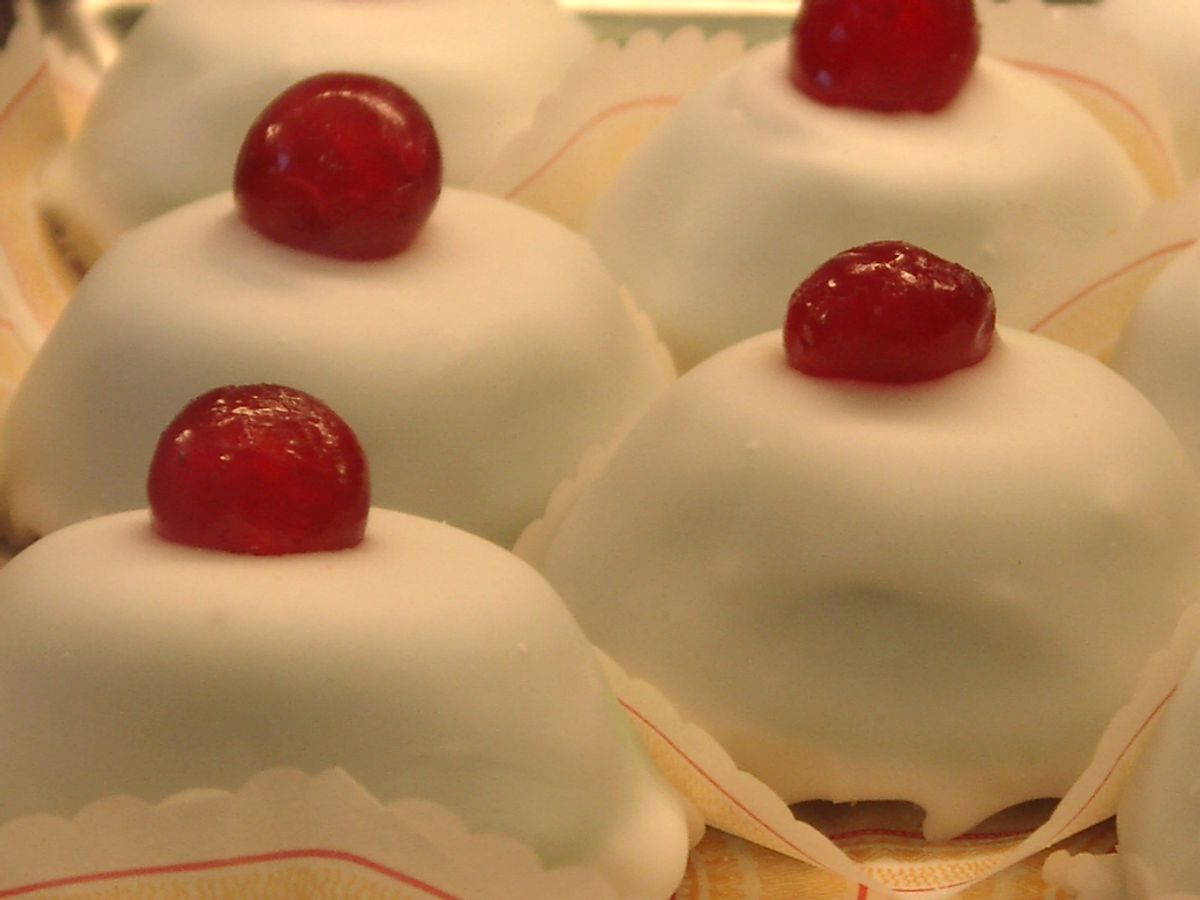
I looked at the cakes, and then turned my head to look at them again. Alabaster mounds — not more than a handful — set in pairs, each topped with a pert cherry. “Those are certainly … suggestive,” I said.
“They’re called virgin’s breasts,” my friend translated. I admire that. Why go for the double entendre when the single will do?
But they’re not sexy pastries, even if they are rounds of sponge cake piled with sweetened ricotta and covered in marzipan. They’re devotional, an homage to Saint Agatha, patron saint of the Sicilian city of Catania. A beautiful if uncomfortably young virgin, Agatha caught the attention of Quintianus, the local Roman prefect. And, as early Christian stories go, it’s rarely a good thing when you catch the attention of the local Roman prefect. (This means things are going to get gnarly, so be warned.)
So Quintianus tried to kick it with Agatha, but his game was wack. Agatha’s heart belonged to Jesus, and that doesn’t make for a very competitive love triangle. And whatever charm he did have, he didn’t show it by banishing Agatha to a brothel, run by the incredibly named Aphrodisia.
When being forced to live in a brothel failed to make her love him, Quintianus tried putting her in prison instead, where she was visited upon daily by foul men with bad intentions. Agatha was still unmoved. Finally frustrated, Quintianus had his thugs cut off her breasts, naturally inspiring future bakers to make cakes in the shape of her sacrifice.
But! Magically, she was healed overnight. This enraged Quintianus, who then decided to grill her to death in the coliseum, despite, you know, the magic. Sure enough, he got her over the coals and the earth quaked, killing his closest advisors. The people of Catania, living in the shadow of Europe’s biggest volcano, had enough anxiety about natural disaster that they really didn’t want to deal with ones caused by jealous blasphemers. A furious mob descended upon the coliseum. Quintianus escaped, repairing with the scorching-hot Agatha back to the prison. They made some awkward conversation, she died, the earthquake stopped, and Catanians started to believe that, you know, maybe there was something special about that girl. That her relics were later believed to have saved the city from a direct hit from Mt. Etna’s lava helped, and a-canonizing they went.
Minni di virgini, the cakes that honor Saint Agatha, were probably first made in convents, which were instrumental in the development of pastry in Sicily. Nuns, having time on their hands and long institutional memories, developed and preserved these old recipes, which were often labor intensive and highly decorative; the opposite of functional food. They sold their work to fund their convents, and the sweets often referred to religious icons, heedless of (or maybe because of?) the irony. In “The Leopard,” Giuseppe Tomasi di Lampedusa’s novel of the fall of the Sicilian aristocracy, the prince looks at his plate at a ball and exclaims, “Saint Agatha’s sliced-off teats sold by convents, devoured at dances!”
So where can I try some?
Forgive me, but: get thee to a nunnery. Or, at this point, to most any Sicilian-style pastry shop. If you live in an American city with an old Italian neighborhood, this probably isn’t too hard to find, as many early Italian Americans were from Sicily. If they don’t make them, and if the shop does nice work, have a piece of the cassata instead. (See below.)
And what does it taste like?
Ed Behr, in a fascinating exploration of Sicilian cuisine in “The Art of Eating” (Number 65, 2003), claims that the nuns’ version of the pastry probably contained jasmine and winter squash. But according to Mary Taylor Simeti’s authoritative “Pomp and Sustenence,” the name minni di virgini “so delights the Sicilians that they will apply it indiscriminately to almost any cake, provided it is small and rounded.”
The versions I’ve had have all been essentially the same as the ubiquitous cassata: a little bit of cake as a foundation, a thick layer of aggressively sweetened ricotta, wrapped in an even sweeter marzipan shell. (Adding even more irony, Sicilian pastry is often extremely sweet, reflecting the influence of the Arabs, who loved their sugar.)
Have any fun stories of where a dish comes from, or have any food origins you’d like us to look into? Send them to: food@salon.com
Francis Lam is Features Editor at Gilt Taste, provides color commentary for the Cooking Channel show Food(ography), and tweets at @francis_lam. More Francis Lam.
Our stubborn faith in aphrodisiacs
Scientists scoff at the idea, so why do we cling to age-old superstitions about sex and food?
(Credit: Salon) From the Garden of Eden to the oyster cellar bordellos of old New York, food and sex are entwined. Although every food under the sun has been touted as an aphrodisiac at some point in time, humans tend to get turned on by three categories of food: extremely expensive food, food that is risky to acquire, and food that resembles genitalia.
Rare and exotic foods have favored positions in the canon of culinary aphrodisiacs. Consider the truffle, the piranha and the labor of harvesting a plate full of sparrow tongues. Foods from far-off lands have the spicy whisper of perilous adventure, and there’s nothing quite like a hint of mystery to stimulate the imagination. For example, Aztec concubines taught the conquistadors to drink hot chocolate; when the Spaniards carried the exotic substance across the sea to Europe, they brought with it the rumor that the drink was an aphrodisiac. And during the reign of Charles I, when rice was still a luxury in Europe, noble Casanovas swore by the improbable aphrodisiac of rice boiled in milk and flavored with cinnamon.
Continue Reading CloseFelisa Rogers studied history and nonfiction writing at the Evergreen State College and went on to teach writing to kids for five years. She lives in Oregon’s coast range, where she works as a freelance writer and editor. More Felisa Rogers.
Why Americans sing about food
Elvis helped cement a lyrical tradition where food stands in for everything from sex to rural nostalgia
Elvis Presley once said, “Ambition is a dream with a V-8 engine.” At once a gentleman and a rebel, a down-home boy and a global conquistador, the King, who would have celebrated his 77th birthday on Sunday, was a powerful amalgamation of American obsessions. The King loved fast cars. The King loved rock ‘n’ roll. The King loved fried food. And the King knew how to interpret America. Take food, for instance. Elvis was notoriously obsessed with food, and he sang quite a few songs about this favorite topic. But “Crawfish” and “Milk Cow Blues Boogie” say more about our culture than they say about the icon himself. After all, Elvis wasn’t a songwriter: He was drawing from a deep well. American music sizzles with barbecue grease and bubbles like red-eye gravy. Food is a metaphor for all things, from your baby’s biscuits to the King’s caviar.
Continue Reading CloseFelisa Rogers studied history and nonfiction writing at the Evergreen State College and went on to teach writing to kids for five years. She lives in Oregon’s coast range, where she works as a freelance writer and editor. More Felisa Rogers.
Why we get wasted on New Year’s
Our Dec. 31st hedonism is the last remaining relic of an ancient Roman carnival of debauchery
Guido Reni's "Bacchus" Soccer balls bulge beneath the men’s polyester skirts and blouses to create exaggerated breasts and derrieres. Their masked faces are resplendent with rouge and eye shadow, wild like plumage. Trumpet, trombone and tuba players garbed in maroon polyester suits play rousing banda, and the men shake their tousled pink and blond wigs. Their dance is a lewd, thrusting affair, accompanied by the glad-handed twirling of tuxedoed dance partners dressed as evil businessmen, who leer at the crowd with sinister rubber masks.
Continue Reading CloseFelisa Rogers studied history and nonfiction writing at the Evergreen State College and went on to teach writing to kids for five years. She lives in Oregon’s coast range, where she works as a freelance writer and editor. More Felisa Rogers.
The birth of America’s bastardized cuisine
Since that mythic first Thanksgiving, we've relied on native plants to augment dishes from the old country
Jean Leon Gerome Ferris' "The First Thanksgiving 1621" (Credit: Library of Congress) America is a country originally settled by scoundrels and religious zealots — thieves, embezzlers, prostitutes, arsonists; English Puritans, French Huguenots, German Amish, Czech Moravians and Russian Mennonites. The screwed-over Scotch-Irish, the shanghaied London street punk, the peace-loving, slave-owning Quaker, the enslaved Gullah. It is also the native land of the Ojibwa, the Zuni, the Makah, the Miwok and the Seneca. This alchemy of sinner and saint, “savage” and sophisticate is the source of our original cuisine: a stolen, borrowed, distorted culinaria that can pique the tongue, clog the arteries, fire the belly, or mellow the soul.
Continue Reading CloseFelisa Rogers studied history and nonfiction writing at the Evergreen State College and went on to teach writing to kids for five years. She lives in Oregon’s coast range, where she works as a freelance writer and editor. More Felisa Rogers.
The twisted history of candy
From the tragedies of the slave trade to the glitz of the Jazz Age, the story of these sugary treats echoes our own
(Credit: carbonated / CC BY 3.0/iStockphoto/lisafx) As frost bites the air and plastic Halloween bunting unfurls in suburban yards, our thoughts turn to the simple delights of candy: the pastel snap of Necco wafers, the dubious rattle of a box of Good & Plenty. Half the candies we ate as kids weren’t actually good. Even at the time we suspected as much. But candy offered an undeniable pleasure: It was fantastic, it was unreasonable, it came in colors and shapes unrelated to actual food. And on Halloween, it was free.
Although tricks and treats have been part of Halloween tradition for ages, October 31st didn’t become a candy-centric holiday until the 1950s, when aggressive marketing campaigns began to tell Americans a different story about All Hallows’ Eve. And naturally, the story was about candy. Perhaps this is appropriate. Our larger story as a people is, in a sense, a story of candy.
Continue Reading CloseFelisa Rogers studied history and nonfiction writing at the Evergreen State College and went on to teach writing to kids for five years. She lives in Oregon’s coast range, where she works as a freelance writer and editor. More Felisa Rogers.
Page 1 of 4 in Eatymology