Global Warming
Weathering the storm of stupidity
Climate change deniers arm themselves with ignorance and fight bravely against science
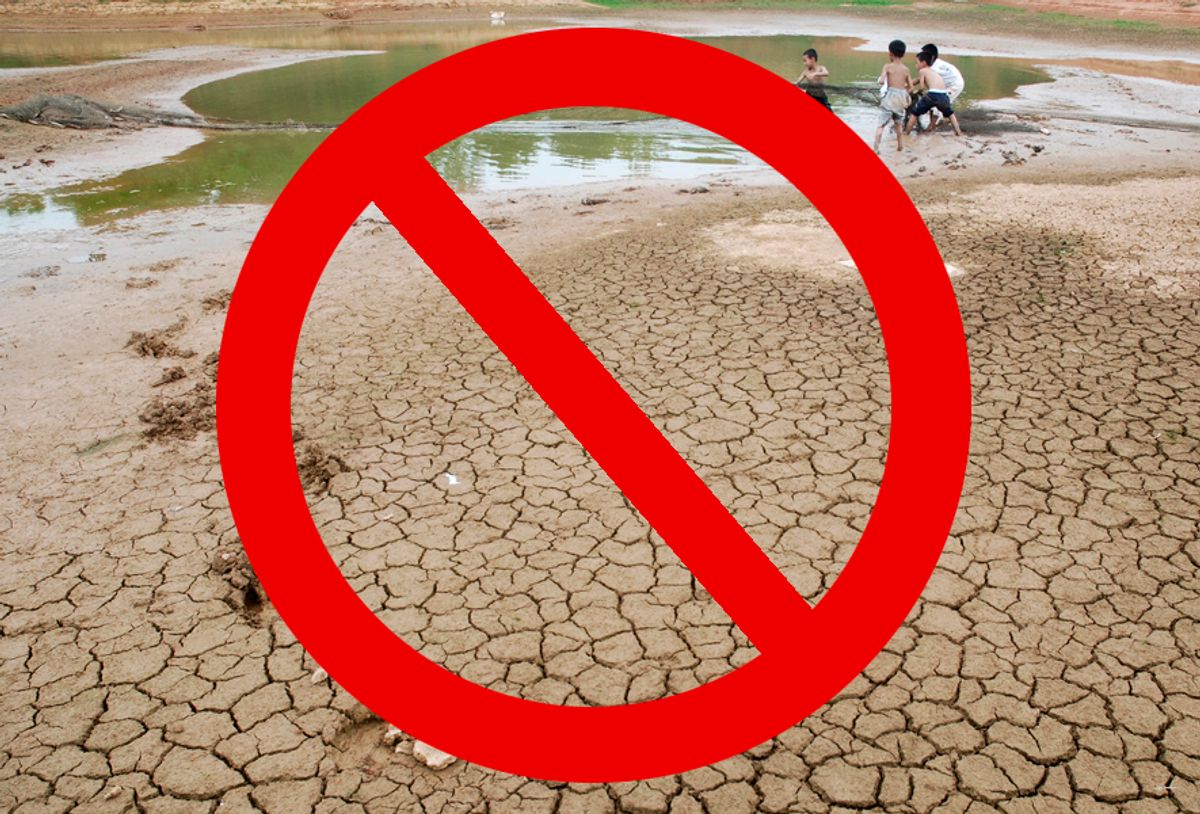
Children try to catch fish at a partially dried-up pond in Yingtan, Jiangxi province August 13, 2009. China will make "controlling greenhouse gas emissions" an important part of its development plans, the government said, blaming global warming for increasing droughts and floods and melting glaciers. REUTERS/Stringer (CHINA ENVIRONMENT SOCIETY) CHINA OUT. NO COMMERCIAL OR EDITORIAL SALES IN CHINA(Credit: © Stringer Shanghai / Reuters) The spread of secondary and latterly tertiary education has created a large population of people, often with well-developed literary and scholarly tastes, who have been educated far beyond their capacity to undertake analytical thought. –P.B. Medawar
So what’s next? A series of essays by Sarah Palin about the Large Hadron Collider and the mysteries of dark matter? An MIT lecture series by Rush Limbaugh regarding the thermodynamics of black holes? A Festschrift of Sean Hannity’s scholarly articles on plate tectonics and volcano formation? Glenn Beck performing live heart-lung transplants on Fox News?
Everybody understands that these things couldn’t happen. That when it comes to serious scientific endeavor, years of study and professional apprenticeship are required. In a word, expertise.
Ex-beauty contestants, drive-time DJs, TV sports announcers, hairstylists, newspaper columnists — basically anybody whose math skills topped out in the 10th grade — rarely have anything substantive to add to the sum of technical and scientific knowledge. That’s what they most resent about it.
It’s not impossible that such persons could educate themselves sufficiently to have an informed opinion, but it’s rare. Most of us, most of the time, are like historian and blogger Josh Marshall: “The fact that the vast majority of people with specialized knowledge in the field think there’s a problem is good enough for me,” he wrote. “I can’t be knowledgeable about everything. And I’m comfortable with the modern system in which the opinions of really knowledgeable people with expertise counts more in cases like this than people who know nothing at all.”
Unless and until, that is, scientific endeavor impinges upon either A) religious belief, or B) the ability of tycoons to keep making money in precisely the way they or their ancestors have always made their money. Then it’s every man and woman a climatologist, and every genuine expert an “elitist” enemy of God and the American way — creationism with a thermometer.
Charles P. Pierce describes what he calls the “three great premises” of talk-radio populism in his acerbic book “Idiot America”:
First Great Premise: Any theory is valid if it moves units … Second Great Premise: Anything can be true if someone says it loudly enough … Third Great Premise: Fact is that which enough people believe. Truth is measured by how fervently they believe it.
So it was after thousands of private e-mails hacked from the University of East Anglia Climatic Research Unit in England emerged via the right-wing noise machine into the British and American press. Caught red-handed acting like, well, like professors — ambitious, idealistic, petty, egotistical, dogged and pedantic — climate researchers soon got caught up in a media storm rivaling that surrounding golfer Tiger Woods.
Within days, representatives of various Exxon- and Koch Industries-funded propaganda shops like the Heritage Foundation and Competitive Enterprise Institute started braying about “Climate-gate.” Fox News headlined “Global Warming’s Waterloo.” Hannity told viewers, “Now we find out that this institute is hiding from the people of Great Britain and the world that, in fact, climate change is a hoax, something I’ve been saying for a long time.”
Taking time off from her book tour, Sarah Palin wrote a Washington Post piece charging the “e-mails reveal that leading climate ‘experts’ deliberately destroyed records, manipulated data to ‘hide the decline’ in global temperatures, and tried to silence their critics by preventing them from publishing in peer-reviewed journals.”
Note the scare quotes around “experts.” Palin’s evidence for this conspiracy? Here’s the worst of it: A 10-year-old e-mail from professor Phil Jones to Penn State colleague Michael Mann. You’ve seen it 10 times on television. “I’ve just completed Mike’s Nature trick of adding in the real temps to each series for the last 20 years … to hide the decline.”
Read it twice. So Jones brags about hiding a decline in global temperatures by “adding in the real temps”? The allegation’s nonsensical on its face. If you read the entire message, Jones is talking about plotting a more accurate graph by throwing out inferential evidence from tree ring studies known since the 1960s to be less reliable. There’s an elaborate scientific debate about why. Not one reputable scientist who’s looked into this matter has judged otherwise. What’s crucial to understand is that if Jones were proved to be faking data, his scientific career would end at once, along with that of anybody who helped him.
Scientists can be jerks too. However, the kind of worldwide conspiracy conjured by global climate change deniers like Palin, Hannity and the rest — that is, as an evidence-free, religio-political cult that’s the mirror image of their own movement — simply can’t exist in a scientific context. Meanwhile, Arctic sea ice is vanishing, glaciers melting, sea levels rising, droughts and floods increasing, and the past decade — according to the World Meteorological Organization — was the warmest in recorded history.
But hey, look over there: some elitist e-mails!
© 2009 Gene Lyons. Distributed by Newspaper Enterprise Association
Arkansas Times columnist Gene Lyons is a National Magazine Award winner and co-author of "The Hunting of the President" (St. Martin's Press, 2000). You can e-mail Lyons at eugenelyons2@yahoo.com. More Gene Lyons.
Republican climate folly
As temperatures break records, the GOP holds firm: The less we know about global warming, the better
Frank Gehrke, chief of snow surveys for the Department of Water Resources, stands in a snow-free meadow at Echo Summit, Calif. Warm spring weather, combined with lower then normal precipitation, caused the statewide snowpack water content to be only 40 percent of normal for this time of year. (Credit: AP/Rich Pedroncelli) Whatever adjective you choose — ironic? tragic? ludicrous? — the outcome of a series of budget votes held in the GOP-controlled House on Tuesday was definitely interesting. The chamber was wrangling over a series of amendments to an appropriations bill for the Departments of Commerce and Justice. The battle line was drawn between senior Republicans trying to resist further spending cuts, and young Turks looking to slash and burn.
In every case but one, the senior Republicans (with the help of Democrats) proved victorious. The lone exception? An amendment proposed by Maryland’s Andy Harris, cutting $542,000 in funding for a climate website at the National Oceanic and Atmospheric Administration.
Continue Reading Close
Andrew Leonard is a staff writer at Salon. On Twitter, @koxinga21. More Andrew Leonard.
Global warming hits home
After a year of freakish and destructive weather, Americans are finally waking up to the dangers of climate change
Houses were severely damaged after Hurricane Irene came through Bethel, Vt. on August 28, 2011 (Credit: U. S. Fish and Wildlife Service - Northeast Region / CC BY 2.0) The Williams River was so languid and lovely last Saturday morning that it was almost impossible to imagine the violence with which it must have been running on August 28, 2011. And yet the evidence was all around: sand piled high on its banks, trees still scattered as if by a giant’s fist, and most obvious of all, a utilitarian temporary bridge where for 140 years a graceful covered bridge had spanned the water.
The YouTube video of that bridge crashing into the raging river was Vermont’s iconic image from its worst disaster in memory, the record flooding that followed Hurricane Irene’s rampage through the state in August 2011. It claimed dozens of lives, as it cut more than a billion-dollar swath of destruction across the eastern United States.
Continue Reading CloseBill McKibben is the Schumann Distinguished Scholar at Middlebury College, and founder of the global climate campaign 350.org. His latest book is "Eaarth: Making a Life on a Tough New Planet.". More Bill McKibben.
Every country for itself
As American power wanes, we're being faced with a dangerous new power vacuum. An expert explains what's next
For the first time in nearly a century, the world doesn’t have a clear set of leaders. A generation ago, the G-7 – France, Germany, Italy, Japan, United Kingdom, United States and Canada – not only powered the global economy, they also, for better or worse, made the decisions that determined the outcome of the entire world. But over the last several years, the dynamic has changed.
According to a widely discussed 2010 report by London’s Standard Chartered Bank, the world has entered a new “‘super-cycle” in which traditional economic hierarchies are being upended. Ever since the financial crisis, the U.S. has lost the economic strength and force of will to be the world’s policeman. The number of Americans, for example, who believe the U.S. should “mind its own business internationally” has spiked to a level unseen since the 1950s. Meanwhile, new powers, like China, India and Brazil, have been unwilling to fill the power vacuum the U.S. has left behind. One could argue that this is a nice change from America’s aggressive past interventionism, but it has also helped create the global stalemate on everything from global warming to humanitarianism in Syria. And it’s a fact that has the potential to radically affect our future, both in positive and negative ways.
Continue Reading Close
Thomas Rogers is Salon's Arts Editor. More Thomas Rogers.
The Maldives’ ousted president on climate change and tyranny
Ousted in a February coup, Mohamed Nasheed talks global warming, Islamic radicals and "The Island President"
Mohamed Nasheed in "The Island President" It would be too optimistic to claim that the 2009 Copenhagen Summit represented a breakthrough or turning point in the battle against climate change. But it was the first moment when the United States, China and India — the world’s biggest polluters — all agreed in principle to reduce carbon emissions, and as symbolic statements go, that one was pretty big. Copenhagen also catapulted a most unlikely head of state to pop-star status, at least within the worldwide environmental movement. Mohamed Nasheed, who was then the president of the Maldives — Asia’s smallest country, both in area and population — emerged as the developing world’s most charismatic and dynamic spokesman on the causes, and the costs, of global warming.
Continue Reading CloseThe ugly delusions of the educated conservative
Better-educated Republicans are more likely to doubt global warming and believe Obama's a Muslim. Here's why
(Credit: AP Photo/Ross D. Franklin) I can still remember when I first realized how naïve I was in thinking—hoping—that laying out the “facts” would suffice to change politicized minds, and especially Republican ones. It was a typically wonkish, liberal revelation: One based on statistics and data. Only this time, the data were showing, rather awkwardly, that people ignore data and evidence—and often, knowledge and education only make the problem worse.
Someone had sent me a 2008 Pew report documenting the intense partisan divide in the U.S. over the reality of global warming.. It’s a divide that, maddeningly for scientists, has shown a paradoxical tendency to widen even as the basic facts about global warming have become more firmly established.
Chris Mooney is the author of four books, including "The Republican War on Science" (2005). His next book, "The Republican Brain: The Science of Why They Deny Science—and Reality," is due out in April. More Chris Mooney.
Page 1 of 107 in Global Warming