
Patti Smith

The last bohemian

Patti Smith's memoir of her youth with Robert Mapplethorpe testifies to a rare and ferocious innocence

  • more
    • All Share Services

The last bohemian

When Patti Smith first began to release albums in the late 1970s, she seemed to have magically eluded all of the shackles imposed on women in the rock ‘n’ roll world. She was neither angelic muse nor bad-girl sexpot, a tomboy willing to be photographed in a pale peach slip, flashing a patch of unshaven armpit hair that shocked the record-store boys I knew more than just about anything any girl had ever done. Rumors went around that she claimed to masturbate to photographs of herself, a concept that baffled me; I was so naive I didn’t understand yet that people (i.e., men) masturbated to photographs, and the idea of being sufficiently aroused by one’s own image to do so was unfathomable. Fascinated, I turned out to see this intimidating person at an in-store appearance, only to have my copy of “Easter” signed by a soft-spoken urchin with a luminous smile.

“Just Kids,” Smith’s new memoir of her early life and close relationship with the photographer Robert Mapplethorpe, helps explain this and other apparent contradictions. In relating her (very) gradual evolution into a rock singer, Smith gives an account of her first poetry reading accompanied by guitarist Lenny Kaye, at St. Mark’s Church in the East Village. Ordinarily self-conscious, she discovered a “submerged arrogance” that only came out in performance, “a whole other side” of herself who behaved, to her dismay, like “a young cock.” It’s impossible to imagine the Patti Smith who narrates “Just Kids” boasting about her autoerotic practices. Instead, this version of Smith is circumspect to the point of demureness as she describes her adventures in the decadent carnival of New York in the 1960s and ’70s. She is as innocent in her own way as I was when I bought that first copy of “Easter,” ferociously earnest and irresistibly moving.

As much as Smith loves rock ‘n’ roll, “Just Kids” confirms that she identifies fundamentally as a poet, specifically as an acolyte of the French symbolist Arthur Rimbaud, who died in 1891. The opening chapters of the book — with their descriptions of sitting on the stoop of the Chicago rooming house where her mother took in ironing, “waiting for the iceman and the last of the horse-drawn wagons” — have the flavor of another age, with their slightly antiquated diction and vocabulary. (Smith was born in 1946.) “I lived in my own world, dreaming about the dead and their vanished centuries,” she writes of her earliest years living with Mapplethorpe in Brooklyn, N.Y., in the late ’60s.

Her life before that, at least as she tells it, resembles nothing so much as a Hardy or Lawrence novel, with working-class parents who read Plato and supported the civil rights movement, but who couldn’t afford to take the entire family to an art museum more than once during her childhood. After graduating from high school, Smith labored at grueling nonunion factory jobs and slept in a cot in her parents’ laundry room, clutching her sketchbook and treasured copy of Rimbaud’s “Illuminations.” At 20, she got pregnant by a boy “so inexperienced he could hardly be held accountable” and gave the child up for adoption, then decided to start all over from scratch in the big city. Arriving at a New Jersey bus station, she learned that the fare to New York was twice what she had expected or could afford, but then she found a purse containing $32 in a telephone booth and made it anyway, interpreting this “last piece of encouragement” as a “thief’s good-luck sign” from an “unknown benefactor.”

In New York she slept rough for a few weeks, then finally landed a bookstore job, befriended Mapplethorpe and moved in with him. They were so broke that when an art exhibit interested them, only one would pay to go inside, absorbing the details to report back to the other afterward. They had lengthy debates over whether they could afford to buy chocolate milk, which cost a dime more than regular milk. They spent their evenings drawing together, using art supplies Smith shoplifted, and vowed never to part.

Although “Just Kids” is Smith’s tribute to Mapplethorpe, she’s the more arresting character of the pair. The child of aspiring middle-class Catholics, Mapplethorpe was an understandable tangle of ambivalence and self-doubt, craving wealth and entree into “high society” but equally driven to violate propriety with his sexually explicit and homoerotic photographs. He dragged Smith to in-spots like Max’s Kansas City, hoping to encounter his own idol, Andy Warhol, and, once he began to make a name for himself as an artist, to tony dinner parties where they rubbed elbows with the likes of Bianca Jagger. Smith had no interest in Warhol (“His work reflected a culture I wanted to avoid”) and embarrassed Mapplethorpe with her table manners, but she went along for his sake, and often made friends in the unlikeliest places.

Sex remains something of a mystery in this story; Smith and Mapplethorpe were lovers and lived together off and on for several years even as he came to accept his attraction to men. Smith mostly skirts the topic of their physical relationship, making fleeting references to “intimacy” and “passion.” She admits that at first she “knew nothing of the reality of homosexuality” and thought that she had failed to “save him” from it. For Mapplethorpe’s part, he seems to have never entirely let go of the idea of the two them as a couple (he let his parents believe they were married for years) and, on one of their last meetings before he died of AIDS in 1989, he lamented the fact that they had never had children.

Hatchet-faced, pale and thin as a rail, a mercurial combination of ugliness and beauty, Smith has always exerted a potent, androgynous charisma. Her other lovers included playwright Sam Shepard, poet-musician Jim Carroll and Blue Oyster Cult keyboardist Allen Lanier, and in 1980 she married the guitarist Fred “Sonic” Smith, with whom she had two children; even Allen Ginsberg once tried to pick her up at an automat, mistaking her for “a very beautiful boy.” But she also found platonic friends and champions readily, particularly when she and Mapplethorpe lived in Manhattan’s famed Chelsea Hotel and she spent hours in the lobby, scribbling poems in her notebooks. Luminaries and big shots ranging from poet Gregory Corso to rock goddess Janis Joplin to music producer Sandy Pearlman struck up conversations and alliances with her there.

What attracted them, and what surely lay at the root of Mapplethorpe’s love for her, is Smith’s striking purity. “Just Kids” is a book utterly lacking in irony or sophisticated cynicism, and if Smith writes reverently of such personal demigods as Bob Dylan and the Rolling Stones, it is not their celebrity that entrances her; she sees them only as modern-day counterparts to her adored Rimbaud. Their names are talismans and amulets in her personal cult of art. The sensation caused by her early performances with Kaye led to offers of a record deal, but she turned it down on the grounds that it had come too easily and that another of her heroes, Crazy Horse, advised against “taking spoils that were not rightfully mine.” Instead, she tried to talk Mapplethorpe’s patron into flying her to Africa so that she could search for the lost Rimbaud manuscript she’d seen in a dream.

For someone as conflicted and ambitious as Mapplethorpe, who was dazzled by glitz and often pursued for his looks, who struggled with his sexuality and believed himself to be divided into good and evil halves, Smith was surely an emotional North Star. She looked into him and saw the only thing that mattered to her and the one part of himself he believed in unwaveringly: that he was an artist. Smith’s idea of what that meant was permanently fixed in the image of 19th-century bohemia, of the starving poet as blessed, perpetual outsider. Extravagantly idealistic, she also appeared to be physically fragile, like the living embodiment of the flickering, uncorrupted creative impulse that the artists and musicians and writers around her had all felt at some point in their pasts, and hoped they hadn’t entirely lost. No wonder near-strangers felt an impulse to shelter, help and encourage her.

Ironically, Smith wound up surviving not only Mapplethorpe, but also her husband, Carroll, her younger brother and other important men in her life. “My temperament was sturdier,” she observes in “Just Kids,” explaining why she didn’t mind being the breadwinner during the first years of her partnership with Mapplethorpe, so that he could quit a job that left him too tired to make art. In that toughness, at least (and pace Dylan), she was indeed just like a woman: a whole lot stronger than she looked.

Laura Miller

Laura Miller is a senior writer for Salon. She is the author of "The Magician's Book: A Skeptic's Adventures in Narnia" and has a Web site, magiciansbook.com.

Patti Smith wins National Book Award for nonfiction

The rocker's nonfiction win takes her by surprise, while Jaimy Gordon's "Lords of Misrule" is an upset in fiction

  • more
    • All Share Services

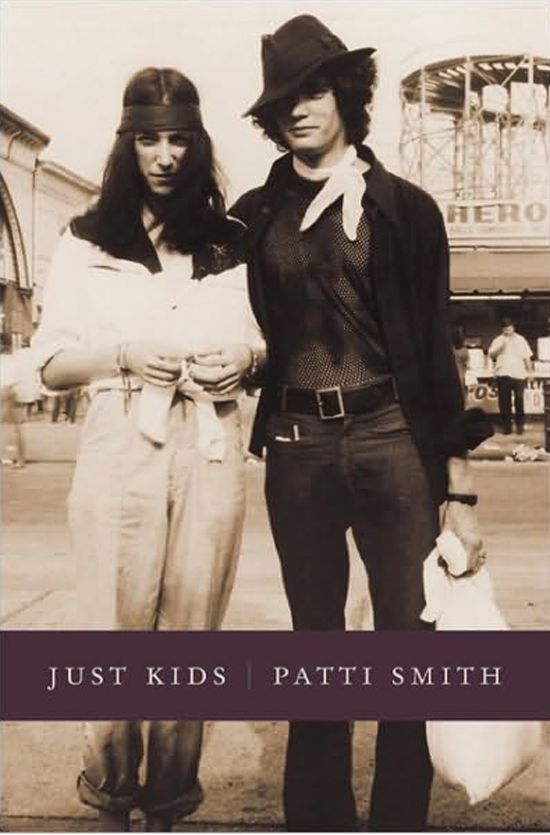
Patti Smith wins National Book Award for nonfictionPatti Smith and Robert Mapplethorpe on the cover of her National Book Award-winning "Just Kids"

The winners seemed stumped at the National Book Awards.

There were few prepared speeches on Wednesday night as most recipients managed few words beyond thanking the usual suspects. Patti Smith, who has some experience before audiences, became tearful as she accepted the nonfiction prize for “Just Kids,” a bittersweet look back to New York City in the 1960s, when anything really could happen and Smith and photographer Robert Mapplethorpe were just a couple of young artists out to break the rules. (Read Laura Miller’s review of “Just Kids” here.)

Smith became the rare rock star to win a competitive literary award (Bob Dylan has win an honorary Pulitzer) and the one-time punk rocker offered an old-fashioned tribute to books. She begged publishers not to let the printed page die in the electronic age and recalled working decades ago at a Scribner’s bookstore, stacking the National Book Award winners and wondering how it would feel to win one.

“So thank you for letting me find out,” said Smith, 63, who now claims an award previously given to Rachel Carson, Gore Vidal and Joan Didion.

The fiction prize Wednesday night was a surprise, Jaimy Gordon’s “Lord of Misrule,” a wry, hard-luck racetrack comedy chosen over such better known works as Lionel Shriver’s “So Much for That” and Nicole Krauss’ “Great House.”

Gordon herself is a story of luck turning. For years, she has written books released by small publishers, most recently, McPherson & Company, based north of Manhattan in Kingston, N.Y. She spoke briefly, acknowledged she had not expected to win and mentioned friends who told her that she had given them hope just by being nominated.

Gordon’s fate has already changed. The paperback of “Lord of Misrule” has been acquired by Vintage Books, an imprint of Random House, Inc. Her next novel will be published by another Random House imprint, Pantheon. Meanwhile, the head of McPherson, Bruce McPherson, handed out business cards after the ceremony and remembered meeting Gordon when both were studying at Brown University in the early 1970s.

“She certainly stood out,” McPherson said.

Kathryn Erskine’s “Mockingbird,” inspired in part by “To Kill a Mockingbird” and by the Virginia Tech shootings, was cited for young people’s literature. Awarded for a story featuring an 11-year-old girl with Asperger’s, Erskine praised parents who encourage their children to ask questions and teachers who inspire students to read and to “think for themselves.”

Terrance Hayes, whose “Lighthead” won for poetry, thanked his wife and editor Paul Slovak at Penguin for being “the best kind of partner,” one “who lets you be imperfect.”

Winners in the competitive categories for the 61st annual awards each received $10,000. The black-tie ceremony was hosted by humorist Andy Borowitz and held under the towering columns of Cipriani Wall Street.

Honorary medals were presented to “Bonfire of the Vanities” novelist Tom Wolfe and to one of the creators of “Sesame Street,” Joan Ganz Cooney. Smith did not sing Wednesday, but there was music on stage, as the white-suited Wolfe crooned a few lines from “The Girl of Ipanema,” part of a long, leisurely talk that made up for the brevity of the other winners. He shared memories of his early newspapers days and of the party thrown by Leonard Bernstein and attended by members of the Black Panthers, a gathering immortalized by Wolfe as “radical chic.”

The celebrated “New Journalist” well exceeded his declared deadline of six minutes to tell his story. Midway through his speech, the last before dinner was served, waiters began approaching tables and some of his words were hard to hear over the clatter of plates being set down.


Continue Reading Close

Jesus died for somebody’s sins … but not hers

A dazzling, dizzying documentary captures rock pioneer Patti Smith during her comeback years, surrounded by death and life.

  • more
    • All Share Services

Jesus died for somebody's sins ... but not hers

Steven Sebring

Patti Smith

Almost at the beginning of Steven Sebring’s documentary “Patti Smith: Dream of Life,” a film and art installation and photography book that have been 12 years in the making, we hear a narration from the eponymous rock goddess-poet, declaiming a short version of her life story in her husky, incantatory contralto. As Sebring shows us black-and-white images of a train journey, perhaps suggestive of the journey Smith once took from rural southern New Jersey, where she grew up, to New York, where she would make her name — and perhaps suggestive of the journey from birth to death — Smith breaks it down.

Quite a life it has been: This androgynous Jersey girl obsessed with Rimbaud and Shelley and Whitman came to the big city 40 years ago and became the muse and friend and partner of Robert Mapplethorpe (no adequate English word exists to describe their relationship), became a poet and then a performance poet and then an underground rock musician and then a rock star, left the stage and the city for life in Michigan as a wife and mother, and then, after the 1994 death of her husband Fred “Sonic” Smith, returned to New York, to music, to poetry and to political activism. Sebring’s film, so long in gestation that it became a major life event for both its director and its subject — one observer opined that the film would only be finished when one or the other of them died — offers an intimate, impressionistic portrait of this later Patti Smith, a woman still blazing her own trail through late middle age, a woman who has seen and suffered much loss and who is perhaps the only major surviving link from the beat era to the ’70s Manhattan art scene to the birth of punk to the present.

Whether this is a flaw is up to you, but Smith’s opening narration provides the only backdrop or exposition we ever get in “Patti Smith: Dream of Life.” Sebring offers a concert film — capturing parts of Smith’s 2005 London performance of her first album, “Horses” — and a travelogue and a chronological voyage; much of his footage (most of it in black-and-white) is beautiful and Smith herself, so often described as a prickly or difficult person, is delightful company. But we often don’t know where she is in space or time, and if we figure that out, we’re not sure what she’s doing there or why. It’s a disorienting whirl from New York to Tokyo to London to Paris to Rome to Atlanta to New Jersey, which I guess is the point.

You could almost say that the tremendous passage of time in the film is itself the point. Smith is visibly, almost geologically older in what appears to be the film’s present tense, an interview in her room at the Chelsea Hotel. (She’s now 61.) Her two children, Jackson and Jesse, are scraggly moppets in some scenes and almost adults in others. Smith’s visit to south Jersey is of course a trip to see her elderly and charming mom and dad, still living in the same aluminum-sided Cape Cod where she grew up. Except that they’re not anymore; both of them died before Sebring could finish the film. (It goes unmentioned here that Smith’s biggest hit, “Because the Night,” was co-written with another New Jerseyite from nearby Asbury Park, so I’ll bring it up for no special reason.)

That’s what goes with the passage of time, of course; everybody gets older and all of them eventually die. Smith talks about her relationships with William Burroughs and Allen Ginsberg and Gregory Corso and her husband Fred Smith and her brother Todd Smith and her keyboard player Richard Sohl, all of them gone. (We hear Fred Smith singing one of his wife’s songs, in a home recording made during his final illness.) She visits Corso’s grave in Italy and Rimbaud’s grave in France and Shelley’s grave in England; the title of Sebring’s movie, and of Smith’s 1988 album, comes from Shelley’s oft-quoted “Adonais”: “Peace, peace! he is not dead, he doth not sleep — he hath awakened from the dream of life.” (Isn’t that exactly what Mick Jagger read onstage at the Hyde Park concert after Brian Jones’ death? It’s not just poetry, it’s rock history!)

Perhaps for comic relief, another living megasaur of ’70s counterculture, Sam Shepard, shows up briefly to jam, atrociously, with Smith on acoustic guitar. Honestly, I don’t know what that scene is doing here; it’s the one moment — well, along with hugging Jesse Jackson backstage at an antiwar rally — that feels like conventional rockumentary. Smith’s activist career gets fairly short shrift in the movie, although it’s an important facet of her recent life. Sebring may not want to remind people how avidly Smith campaigned for Ralph Nader in 2000.

“Patti Smith: Dream of Life” is frequently beautiful and intermittently haunting and could be called a meditation on aging and mortality, an intimate study of a peculiar variety of fame and a portrait of a genuinely remarkable person. It has played at Sundance and Berlin and all over the film festival world, at least in part because everyone’s so amazed it actually got finished. Still, while “Dream of Life” succeeds on its own terms, I can’t help feeling there’s a missed opportunity here, an opportunity to make clear to younger women and men just how amazing Patti Smith’s journey has been. (Maybe, like Julien Temple’s wonderful “Joe Strummer: The Future Is Unwritten,” that kind of film can’t be made while the subject is alive — but I’m not quite sure why that would be so.)

Two decades before the riot grrrls, Smith behaved as if she never even knew that women weren’t supposed to rock, weren’t supposed to have big egos and sexual adventures and write thundering, self-indulgent post-beat poetry. Her albums “Horses” and “Radio Ethiopia” were far ahead of the ’70s rock curve, and to this day remain among the rare fully successful hybrids of rock and poetry. Even as she was being a feminist trailblazer, the younger Smith had a unique Manhattan-hipster ability to be at the center of the action, whether that meant Mapplethorpe’s studio or Burroughs’ booze sessions or Shepard’s plays or CBGB’s with the Ramones, Television and Talking Heads. (She closed that club forever with a three-and-a-half-hour performance in October 2006.) Almost none of that — OK, none at all — is visible in this film, except by inference and reference. If you don’t already think that Patti Smith and the people she hung out with are awesome, this movie won’t tell you about it.

One of the greatest things that can be said about Patti Smith, I think, is that although she was either an inventor or a precursor of punk (depending on how you look at it), it rapidly bored her and she moved on. She couldn’t be contained by any movement or ethos or ism, and anyway was always closer to being Rimbaud or Ginsberg than to being Billy Idol (or, for that matter, Joan Jett), and by the early ’80s she was married and living in suburban Detroit. Her great triumph was not that she was a female rock revolutionary, or that she left music for a domestic life, or that she came back to it when that domestic life ended. It was that she never questioned her right to live her life exactly as she saw fit, to make it up as she went along in the great tradition of all those dead white male artists she worshiped. As Sebring’s film makes clear, she’s still doing that today.

“Patti Smith: Dream of Life” is now playing at Film Forum in New York, and opens Sept. 19 in Columbus, Ohio, and Denver; Oct. 2 in St. Louis; Oct. 17 in Los Angeles and San Francisco; and Oct. 24 in San Diego, with more cities to be announced.

Continue Reading Close

Blue Glow

Salon's TV picks for
Tuesday, April 11, 2000

  • more
    • All Share Services

Series

Buffy the Vampire Slayer (8 p.m., WB) has another rerun; it’s the one in which Buffy and Riley try to deal with each other’s secret identities. Biography (8 p.m., A&E) has a new profile of George Carlin. Will & Grace (9 p.m., NBC) reruns the episode in which Grace and Jack get their knickknacks appraised on “Antiques Roadshow.” Angel (9 p.m., WB) is a rerun, too; Cordelia has one date with a guy and wakes up hugely pregnant. The new sitcom Talk to Me (9:30 p.m., ABC) stars Kyra Sedgwick as a kooky New York radio personality. Beverly D’Angelo costars as a Dr. Laura knockoff named Dr. Debra. A job-related tragedy pushes the fragile Danny’s buttons on NYPD Blue (10 p.m., ABC).

Specials

Divas 2000: A Tribute to Diana Ross (9 p.m., VH1) gathers up Mariah Carey, Donna Summer, Faith Hill and other high-maintenance stars for a benefit concert honoring a textbook diva if there ever was one. Meanwhile, over in Nashville, Barry Manilow does Manilow Country (9 p.m., The Nashville Network), a concert of his songs sung as duets with country artists like Trisha Yearwood, Gillian Welch and Lila McCann. He writes the songs that make the whole world sing.

Sports

Basketball:

Spurs at Kings (8 p.m., TNT)

Talk

Rosie O’Donnell (syndicated) Christina Aguilera, Omar Epps

David Letterman (CBS) Jenna Elfman, Children of Uganda dance troupe

Jay Leno (NBC) Lucy Lawless, D.L. Hughley, Patti Smith

Politically Incorrect (ABC) Eric Idle, Elizabeth Perkins

Conan O’Brien (NBC) Tom Arnold, Heidi Klum

Continue Reading Close

Joyce Millman is a writer living in the Bay Area.

Real Life Rock Top 10

  • more
    • All Share Services

April 3, 2000

1) Lou Reed “Possum Time” from “Ecstasy” (Reprise)

It’s 18 minutes long and you can play it all day long. A huge fuzztone that sounds more like a construction site than a guitar sets an implacable, unsatisfiable zigzag line in play. “It’s possum time!” a slightly demented, definitely pleased man announces. “I feel like a possum in every way!” In fact he sounds like a man who won’t back down, and you follow him, at a distance, on a nighttown walk. When it ends it’s as if the sun is coming up — so soon? Already? You’ve seen nothing that isn’t ugly, but the walk has its own rewards. “The only one left standing,” Reed says, sounding tired. He’s grown all the way into his role as bad conscience — his own and the nation’s. He may even grow out of it, but not yet. When, in the Velvet Underground, in another era, a young man who sounded old sang with fright and nausea of “all the dead bodies piled up in mounds,” who’d have thought that more than three decades later he’d still be prowling the streets looking for more of them, more bodies, more mounds, like a detective of the obvious?

2) Phil Collins “You’ll Be in My Heart” best original song (Academy Awards, Mar. 26)

Given that as an original song “You’ll Be in My Heart” barely exists, Collins sang the hell out of it — while wearing the night’s best-looking suit.

3) Nick Tosches “The Devil and Sonny Liston” (Little, Brown)

This short, clean book about the St. Louis Stagger Lee who in 1964, in one of the most shocking upsets in boxing history, lost the heavyweight championship to Cassius Clay (Muhammad Ali, soon enough), is a keen reminder of the limits of biography — limits biographers almost never respect. That is: The biographer’s subject has no inner life. No matter how many letters, diaries or suicide notes the subject leaves behind, all you have are lies. You can’t know what goes on in someone else’s head — unless you are a novelist, and are willing to imagine another’s inner life, at which point biography ceases and fiction begins. So as you pass through this account of a man whose notoriety probably bought him only a few more years than he could have expected from a life on the street, don’t wonder what, in the depths of his soul, he really thought. As Tosches tries to decide why Liston was found dead in his house in Las Vegas in 1971 — dead, probably, for a week — think about what Tosches calls “the unseen sediment, detritus, and sludge beneath the course of this book.” He means the world of manipulation and enforcement, murder and fraud, that the biographer’s illusion that we can know what makes a person tick allows us to ignore.

4 & 5) Patti Smith “Gung Ho” (Arista) & Angie Aparo “The American” (Arista)

Two albums from the same label with the American flag imprinted on the discs. Aparo is a shaved-head guy who poses in front of urban wreckage but sings like a sensitive ’70s troubadour; Smith bleeds for all humankind, but she’s noisier. On “Strange Messengers” she condemns slavery. Just as she once confidently declared herself a “Rock ‘n’ Roll Nigger,” now she slumps to the ground as the whip cuts her flesh and her children are sold down the river. “History sends such strange messengers,” she announces: Guess who? With her band just a megaphone and her singing merely a flag to wave, she pulls out all the stops, shouting: “My people!/I speak to you!/I burned, I swung, I toiled for you and your children!” But now all her people do is “burn out your lives on crack and sorrowful stories,” betraying their ancestors, betraying her. (By the way, what’s wrong with sorrowful stories?) She hasn’t even gotten to Vietnam yet, or the sneering twist she gives the words “Colonial-ism, imperial-ism,” as if the real purpose of history were to confirm the hipster’s superiority to it. “Donna, donna, donna/I’m the world’s Madonna,” National Lampoon’s “Radio Dinner” once had Joan Baez warble; Smith has taken over, but somehow lost Baez’s fab sense of humor along the way.

6) Dennis Miller “Rant on Patriotism” “Dennis Miller Live” (HBO, Mar. 24)

“You want to dwell on this country’s fuck-ups? Be my guest … But you might want to remember that when you stomped into CIA headquarters waving your Freedom of Information Act permission slip you were not summarily hustled into a damp sub-basement where a jackbooted sadist with one eyebrow and tinted aviators Elvis wouldn’t even fucking wear is smoking unfiltered cigarettes that smell like a skunk getting a perm as he clamps jumper cables on your nipples and starts humming the love theme from ‘Midnight Express.’” Too true. On the other hand, there’s that scene in “Top Secret!” where Val Kilmer is being tortured by East German secret police. Delirious, he sees himself wandering the empty halls of his all-American high school: He registered for a class, he forgot all about it, now he’s trying to get to the final, but school was over last week, and … and then he comes to. The East Germans crank the juice on the jumper cables, but a satisfied smile spreads over Kilmer’s face: It was only a dream.

7) Surveillance Camera Players “1984″ on “Surveillance Camera Players” ($15 cash only, to Not Bored!, POB 1115, New York, NY 10009-9998)

This small troupe stages plays in front of surveillance cameras, often in subways, then films the action off public monitor screens. Here, with four actors, eight minutes (out of a 45-minute video) and a pidgin comic-book script (signs held up by a man in a grinning death’s-head mask, I.D. placards around the necks of Winston and Julia), the story comes across: Because it’s so familiar a few slogans and the right setting can call the whole thing back, especially when weird organ-like music is leaking in from another corridor, people pass by the show as if it’s invisible, and the primitivism of the dramaturgy reduces Orwell’s prophecy to the scale of litter. “WE ARE THE DEAD” reads the lovers’ sign; Death’s Head holds up the novus ordo seclorum Masonic pyramid from the dollar bill. “Can I ask you what you’re doing here?” says a man with a security guard’s menacing politeness. “Taping this,” says a woman. “Do you have a permit for this?” Death’s Head holds up “ROOM 101.” “You don’t need a permit to do this,” the woman says. “You don’t?” “Why are you guys doing this?” says a second man. “To show that surveillance cameras are everywhere,” says the woman. “Yeah,” the man laughs, “but who doesn’t know that?” Death’s Head shoots Winston in the head; from somewhere, there’s applause.

8) “They Can’t Sing … But They Can Play” (Oakland Athletics TV commercial)

The team’s youngest ballplayers take turns on a ratty high school auditorium stage where a bored, smiling, middle-aged music teacher is playing the organ. With cracking voices and expressions of absolute sincerity they apply themselves to a song that was a hit well before any of them were born: Simon and Garfunkel’s “Scarborough Fair,” here killed deader in under a minute than countless karaoke bars have managed in decades.

9) Rosie and the Originals “The Best of Rosie and the Originals” (Ace)

For the 1960 “Angel Baby”; a lovely, previously unreleased cover of the Students’ 1958 “I’m So Young” (“Can’t marry no one”); and a study of how a group with one perfect moment in it tries to stave off the inevitable.

10) Ass Ponys “Swallow You Down” from “Some Stupid with Flare Gun” (Checkered Past)

This is what the Twin Cites’ TwinTone sound of the 1980s was for — the Replacements, H|sker D|, Soul Asylum and Babes in Toyland using guitars to render ordinary stuff heroic, tragic, a thrill — but now it’s 20 years later in Ohio and the guys in the band are promising a suicidal friend they won’t walk away, not ever. They build the music until it’s too good to let loose, so they let it sweep them up, riding a sunny, rising melody for “I won’t let them swallow” — and then crashing hard for “you down,” paying off the loan the first five words took out on a pledge easier to make than to keep. This is what it’s all for.

Continue Reading Close

The Rude Mechs' theatrical adaptation of Greil Marcus' book "Lipstick Traces" will play Jan. 30-Feb. 1 at DiverseWorks in Houston. For more columns by Greil Marcus, visit his column archive.

Sharps & Flats

Patti Smith explodes on "Gung Ho," the best record since she returned to rock. Joni Mitchell, meanwhile, collapses under jazz pretense and a ravaged voice.

  • more
    • All Share Services

Sharps & Flats

Joni Mitchell and Patti Smith were born three years apart, Mitchell in 1943 and Smith in 1946. Their debuts were separated by seven years: Mitchell’s flowery, eponymous first album was released in 1968; Smith’s fiery “Horses,” in 1975. Both have grown into roles as elder stateswomen of rock, with Smith serving as den mother for angry, young post-punks and Mitchell’s “Blue” acting as a cornerstone for successive generations of waifish songwriters.

Their new albums were released on the same day this week. The parallels end there: Smith’s “Gung Ho,” featuring a baker’s dozen of new songs and her longtime backing band, is a wild burst of adrenalin and beauty; Mitchell’s overwrought “Both Sides Now” is an orchestral collection of standards (and a pair of Mitchell’s own classics) that collapses under the weight of her jazz pretensions and decimated voice.

“Gung Ho” is Smith’s third release since she returned after a long hiatus from recording music with “Gone Again” (1996). It’s a fuller, more exhilarating effort than that album or “Peace and Noise,” both of which focused on death and loss. On “Gung Ho,” Smith sings, screams, moans, groans and roars about Mother Teresa, Ho Chi Minh, slavery, Gen. George Custer, Salome, war, redemption and honor. And with a sharper, more focused band than she has had since her heady CBGB days in the mid- and late 1970s, Smith’s musical vision matches her poetics. With the band — longtime collaborators Lenny Kaye (guitars) and Jay Dee Daugherty (drums), Tony Shanahan (bass) and Smith’s boyfriend, Oliver Ray (guitars) — Smith veers from anthems to open-ended jams to downright funky ditties. And the handful of guests, such as Television’s Tom Verlaine and R.E.M.’s Michael Stipe (both of whom lend a hand on the charging, radio-friendly alterna-rock number “Glitter in Their Eyes”), always adds to the mix.

But it’s Smith’s voice that is the best instrument of all. On “New Party,” a funked-up tune that wouldn’t sound out of place in the Red Hot Chili Peppers’ repertoire, Smith reaches back to her neo-bop roots, scatting free verse, reaching down to growl and leaping up to soar. On “Lo and Beholden,” she plays a timeless seductress performing the dance of seven veils, purring about how her seventh and last veil “will cost you.” On the Mother Teresa-inspired “One Voice” (a tune she introduced at this year’s Tibet House benefit) Smith brays with such conviction that she manages to make lines about the garden of consciousness and fertile seeds of charity sound inspiring instead of overwrought. Even Smith’s missteps — “Strange Messengers,” in which the singer fashions herself as the ghost of African-American slaves admonishing today’s crackheads, is one — are noteworthy for their passion. Twenty-five years have passed since Smith first began singing her poetry on New York’s Lower East Side, and her voice is still rich with power and conviction and fresh with vigor and life.

And then there’s Mitchell. Her voice was always a more precious instrument than Smith’s often blunt one, and it has aged far less gracefully. The contrast is painful: Whereas Smith has preserved her voice and found new ways to communicate her passions, Mitchell has ravished her once otherworldly soprano with years of heavy smoking. She’s now a dusty-voiced alto without her old vocal reach or stamina. On “Both Sides Now,” Mitchell’s range is not so much truncated as it is decimated. At times, you can hear her gasping for breath. And while there is ample precedent for an aging singer’s refashioning her voice to powerful effect (Billie Holiday is the one Mitchell’s publicist is pushing), Mitchell’s scratchy roughness just sounds like wasted talent.

The arrangements don’t help, either. The London Symphony Orchestra’s florid string sections and stray piccolos in “You’re My Thrill” and “Stormy Weather” are schlocky. And Mitchell, an artist who once used jazz musicians like Jaco Pastorius to such great effect on her pop albums, squanders guests like Wayne Shorter on “Don’t Worry ‘Bout Me” and Herbie Hancock on “Sometimes I’m Happy.”

Mitchell’s own compositions provide the lowest moments. Her album is intended to “trace the arc of a modern romantic relationship,” but the lyrics from “Both Sides Now” (“I’ve looked at clouds from both sides now”) are hardly on a par with words by Harold Arlen or Rodgers and Hart. The other tune, “A Case of You,” just shows how far gone her voice is. On the original version of “A Case of You,” Mitchell wrapped her voice around the word “Canada” and stretched it into describing the whole tortured history of a dysfunctional relationship. On the new version the word is a brusque drop-off, a quick throwaway.

The adage says you shouldn’t judge a book by its cover, but it would be an oversight not to mention the images on both albums. The cover of Mitchell’s new album is a self-portrait of the singer, cheek in hand, cigarette between her fingers, a glass of booze in front of her. It’s a defiant gesture, but ultimately self-involved and more interesting to the artist than the audience. Smith’s new album, for the first time, does not feature a picture of the sinewy singer; instead, there’s a wartime photo of Smith’s recently deceased father, who, Smith says, was “gung-ho” when he left for World War II. It’s a complicated gesture — Smith is nothing if not a pacifist — but also a confrontational, challenging and touching one. And that’s the difference.

Continue Reading Close

Seth Mnookin is a writer living in New York.

Page 1 of 3 in Patti Smith