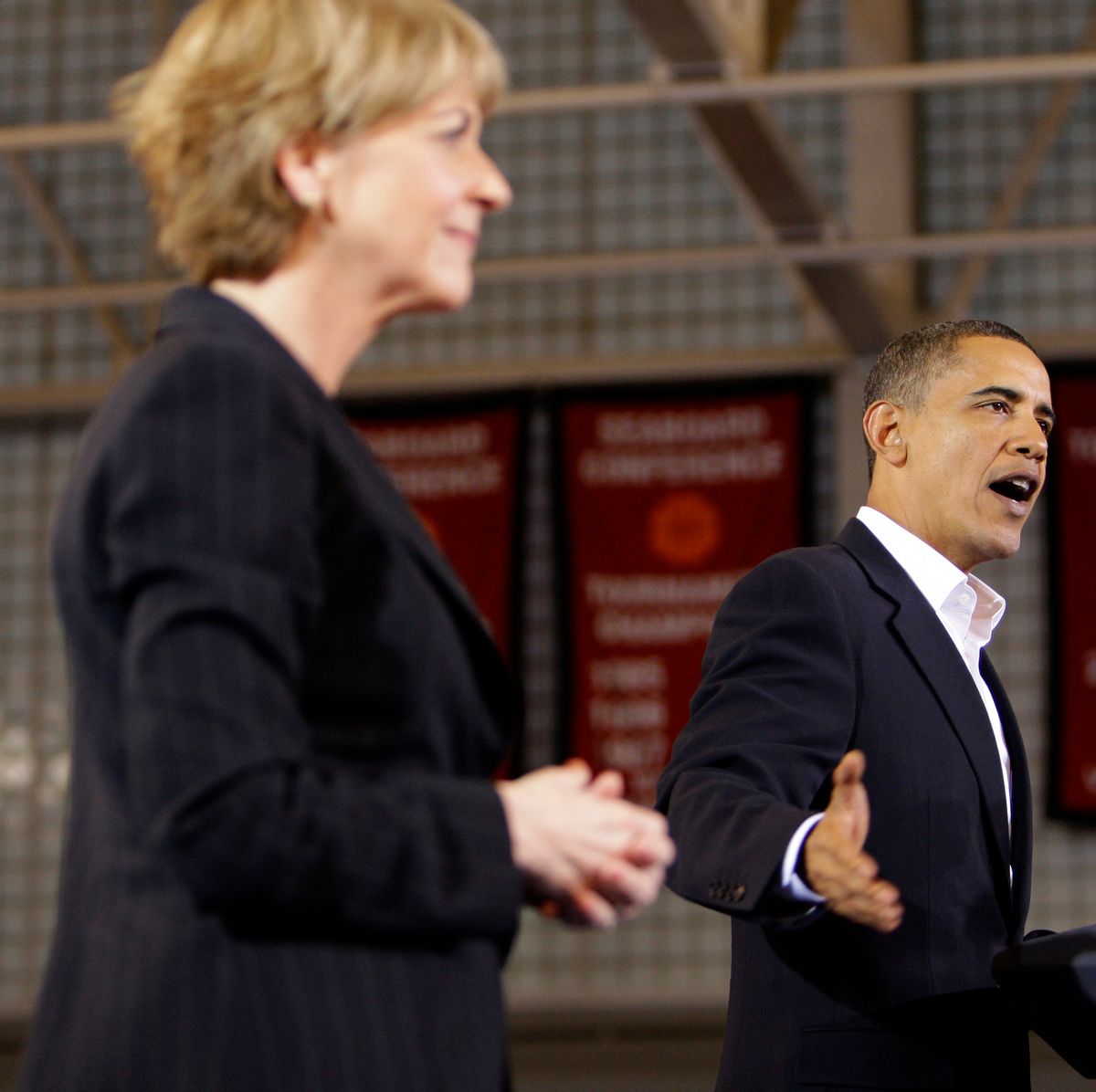
What strange forces conspired to schedule a crucial, down-to-the-wire Senate race that Democrats can't afford to lose, almost exactly a year to the day after Barack Obama's historic inauguration? For Obama supporters, there's no time to commemorate the glorious events of a year ago. All that joy and promise has turned to dread and doubt, as a defeat for Martha Coakley on Jan. 19 could block Obama's signature policy initiative, health care reform. If she loses, Obama wakes up Jan. 20 to endless news cycles declaring his presidency, having lost its 60-vote Senate majority, either impotent or doomed. What a difference a year makes.
Against that backdrop, it was fascinating to watch the president take time to preach Sunday morning (just hours before stumping for Coakley in Boston) at Vernon Avenue Baptist Church in Washington, D.C., the legendary black church that hosted Rev. Martin Luther King Jr. in December, 1956. I was surprised to see Obama lay out parallels between the struggles of King's movement, and his own.
Surprised, because almost a year after his inauguration, I've stopped seeing Obama's career as having much to do with a movement. That's not to deny that the election of our first black president was a huge civil right milestone, and owed an enormous debt to that movement's hard work and heroes. It was, and it did. But the Obama White House has mostly seemed to shed the "movement" trappings that elected him in 2008, to the chagrin of progressives of every race who saw his campaign as the highest expression of the social justice and civil rights movement, and who made his election the cause of their lifetimes.
On Sunday Obama seemed to be trying to get that movement mojo back, and reassure disillusioned liberals that change requires compromise as well as a long view of social progress -- and I found myself wondering, was it desperation? Manipulation? A rare glimpse inside the way Obama thinks about the arc of social justice, and his place in it? Maybe it doesn't matter: We all turn (back) to faith and the community in times of trouble, and Obama is in some trouble right now. It gave me a lot to think about.
--------------------------------------------------------------------------------------------------------------
Did a "movement" elect Obama? And if so, what became of it in a year that saw the president attacked by Birthers, Deathers, Tea Party extremists and flat-out racists? Movement or no movement, Democrats were taken by surprise by the virulent, near violent opposition the once hugely popular president has had to face in his first year.
Last week Tech President's Micah Sifry wrote critically in these pages questioning how real the Obama "movement" ever was. His people-power campaign certainly benefited from an outpouring of money and gruntwork from starry-eyed progressives, many of them young, to get elected. But he also relied on the largesse of the financial, insurance and real estate sector as well as and the votes of independents who weren't necessarily embracing the liberal agenda advanced by Obama's "movement" voters – they just wanted change, and fast. Sifry sees the Obama team's failure to develop an early and far-reaching agenda for its grassroots supporters as proof that they never cared about movement-building, merely about getting elected. I mostly share that view, and yet Obama's sermon today – it wasn't really a speech – provoked a few second thoughts.
One thing is clear: the "movement" elements behind Obama bear as much blame for their own disillusionment as Obama does, and maybe more. Progressives who became Obama zealots should have known that the left-wing messiah they were anointing, the man whose "very biography," to use Tom Hayden's phrase, they believed could usher in an age of progressive globalization politics, was just too good to be true. They sold themselves a vision that simply wasn't Obama – he's a solid centrist corporate Democrat – and they failed to recognize that they didn't have the political strength to even try to make him espouse the policies they hoped he would, on civil liberties, banking reform, the health care bill, economic policy and the stimulus. Obama was a gift that the underorganized left in 2008 simply didn't deserve.
I also believe the progressive hysteria over Obama, acting like he was a Messiah, "The One," helped lead to the hysteria the president now faces from a paranoid, re-energized right wing. Here the Obama campaign is to blame, too: It sold him as a blank slate, a Rohrshach test, someone who would pull together GOP Obamacans and the progressive left, a leader who could find the good in Dr. King and Ronald Reagan. Now Obama's right wing enemies have taken that blank slate and projected their own version of the president – he's Hitler, he's the Joker, he's the illegitimate son of Malcolm X, he's a Marxist, he's a Muslim. Some of these people would be saying crazy things about the president no matter what his supporters had done, but I think Obama and his fans left too much room to let the other side define him. (Max Blumenthal lays out this point I've been groping to make at great length and conviction here.)
But maybe most important, it's true that the president's defining message was change. I was a curmudgeon and criticized his often policy-free appeal at the time. But I had to admit, the change message won big. Unfortunately, the president's early moves -- on banking regulations and legislation that really doesn't threaten the power of the finance industry, and health care reform that likewise leaves the power of the insurance and pharmaceutical sectors barely touched – don't look like change.
Those moves left open to being defined, by the left as well as the right, as a friend of the powerful, the man of Wall Street and not Main Street. At a time when financial collapse created an opening for truly progressive regulation of the industries that caused the meltdown, Obama and his economic advisors seemed to cozy up to the guys who made the mess. Even as President Clinton, campaigning for Martha Coakley, urged Democrats to embrace the Tea Parties, it's hard to do that effectively when party leadership (even under Clinton) decided success lay in raising cash from and courting fatcats. (Of course, the GOP is trying to co-opt tea party energy while courting fatcats even more shamelessly, but for now they seem to be getting away with it.)
So a year into Obama's presidency – a year after one of the most joyous weeks of my life, seeing Pete Seeger and Bruce Springsteen sing "This Land is Your Land," standing in the bright bitter cold beneath Aretha Franklin and the president himself, getting teary watching our first black president dance with his first lady at the Illinois-Hawaii inaugural ball, sure that this was what a lifetime of working for social justice had finally delivered -- I had to count myself among the disheartened by his achievements as this anniversary approached. I was glad I happened to watch his speech at Vermont Avenue Baptist Church, though. Like church does, it made me see things a little bit differently.
---------------------------------------------------------------------------------------------------------------
Obama spent a lot of time comparing the time period around Dr. King's 1956 visit to today. The Montgomery Bus Boycott was over, but it hadn't fully yielded the change black leaders wanted. So much more was necessary, he recalled:
It wasn't clear how we were going to reach the Promised Land. Because segregation was still rife; lynchings still a fact. Yes, the Supreme Court had ruled not only on the Montgomery buses, but also on Brown v. Board of Education. And yet that ruling was defied throughout the South -- by schools and by states; they ignored it with impunity. And here in the nation's capital, the federal government had yet to fully align itself with the laws on its books and the ideals of its founding.
So it's not hard for us, then, to imagine that moment. We can imagine folks coming to this church, happy about the boycott being over. We can also imagine them, though, coming here concerned about their future, sometimes second-guessing strategy, maybe fighting off some creeping doubts, perhaps despairing about whether the movement in which they had placed so many of their hopes -- a movement in which they believed so deeply -- could actually deliver on its promise.
Likewise, Obama noted, a year after his inauguration, "many people are legitimately feeling doubt, even despair, about the future. Like those who came to this church on that Thursday in 1956 [when King spoke] folks are wondering, where do we go from here?" He asked his audience to think about what they/we can learn from King's generation, and one point was particularly powerful:
Our predecessors were never so consumed with theoretical debates that they couldn't see progress when it came. Sometimes I get a little frustrated when folks just don't want to see that even if we don't get everything, we're getting something. (Applause.) King understood that the desegregation of the Armed Forces didn’t end the civil rights movement, because black and white soldiers still couldn't sit together at the same lunch counter when they came home. But he still insisted on the rightness of desegregating the Armed Forces. That was a good first step -- even as he called for more. He didn’t suggest that somehow by the signing of the Civil Rights that somehow all discrimination would end. But he also didn’t think that we shouldn’t sign the Civil Rights Act because it hasn’t solved every problem. Let's take a victory, he said, and then keep on marching. Forward steps, large and small, were recognized for what they were -- which was progress.
Of course, I heard those words, and I thought about colleagues on the left who are pushing to scuttle the health care reform because it's too corporate and lost many of the measures progressives were fighting for. I share their frustration but I remain someone who believes we should support even a Senate bill. There is a danger that people on the left who worked so hard to elect Obama are going to be turning their guns on one another – the battle between FireDogLake's Jane Hamsher and some other lefty bloggers makes me worry about where this movement is going.
Obama's speech reminded me: Truly progressive change is hard. Changing our politics and our economy to create meaningful opportunity for everyone is hard. Again, Obama was a gift the left hadn't earned yet. And while his election was a joyous occasion because he's our first black president, without rigorous work on the progressive agenda, at every level of politics and community Obama was never going to magically undo the abuses of the Bush years (or even promote greater equity under the more prosperous economy of the Clinton years.) This is hard work and we can't be quitters. Obama's sermon got me off the pity couch and back to optimism. The leaders and foot soldiers of the movement that brought us here deserve no less from me. As Obama said:
So, yes, we're passing through a hard winter. It's the hardest in some time. But let's always remember that, as a people, the American people, we've weathered some hard winters before. This country was founded during some harsh winters. The fishermen, the laborers, the craftsmen who made camp at Valley Forge -- they weathered a hard winter. The slaves and the freedmen who rode an underground railroad, seeking the light of justice under the cover of night -- they weathered a hard winter. The seamstress whose feet were tired, the pastor whose voice echoes through the ages -- they weathered some hard winters. It was for them, as it is for us, difficult, in the dead of winter, to sometimes see spring coming. They, too, sometimes felt their hopes deflate. And yet, each season, the frost melts, the cold recedes, the sun reappears. So it was for earlier generations and so it will be for us.
Oh boy, I like this guy so much better than the one who spit at his lefty base, telling the Washington Post, "I never campaigned on a public option." People will stay loyal to an Obama who puts this struggle in the context of the long push for justice in America. They will turn their backs on the guy who sometimes seems to think his charisma is how he got here.
--------------------------------------------------------------------------------------------------------------
It's probably no coincidence, but it was a populist, fired-up "movement" Obama who arrived in Boston a few hours later, to try to save the candidacy of Martha Coakley. The nominee herself had not yet ignited the crowd when the president appeared. He came out ready to make the case that Coakley fights for average people, and "her opponent" – he wouldn't say Scott Brown's name, but did work Brown's campaign truck into several lines -- fights from the rich.
Coming out strong for the bank fees he's promoting this week, to the delight of many Democrats, in order to recoup some TARP funds, Obama made a lot of Brown's opposing the idea. "Martha's got your back, her opponent's got Wall St.'s back," Obama told the crowd. "Bankers don't need another vote in the United States Senate," he added, and joked that Brown "parked his truck on Wall Street."
It was a high-energy rally, but it was marred by some anti-abortion hecklers; the disturbance went on much longer than most such incidents do, and people looked chagrined, if not terribly alarmed (the hecklers were a father and son team, and they were escorted out for questioning for the Secret Service.) The nasty spirit of the summer's "Town Halls" was in the hall; in fact Tea Partiers had planned to show up at the Obama rally on their Facebook page. Luckily this time, no one seemed to be wearing a gun.
I don't know if Obama's fiery speech will be enough to galvanize Democrats to vote on Tuesday. The issue of Democratic disillusionment is real; it kept people home in New Jersey and Virginia last November; the party is working overtime – maybe belatedly – to ensure it doesn't happen again. If Coakley loses, we'll be debating what it means for months. But if she wins, we need to have the same debate, about why so many progressives and Democrats seem about to check out of politics, which could make for an ugly November, no matter what happens Tuesday night.
Shares