Faddy foods
Meet the miracle noodle
Nearly calorie and carb free, they may actually help you lose weight. But will shirataki noodles last?
What is it?
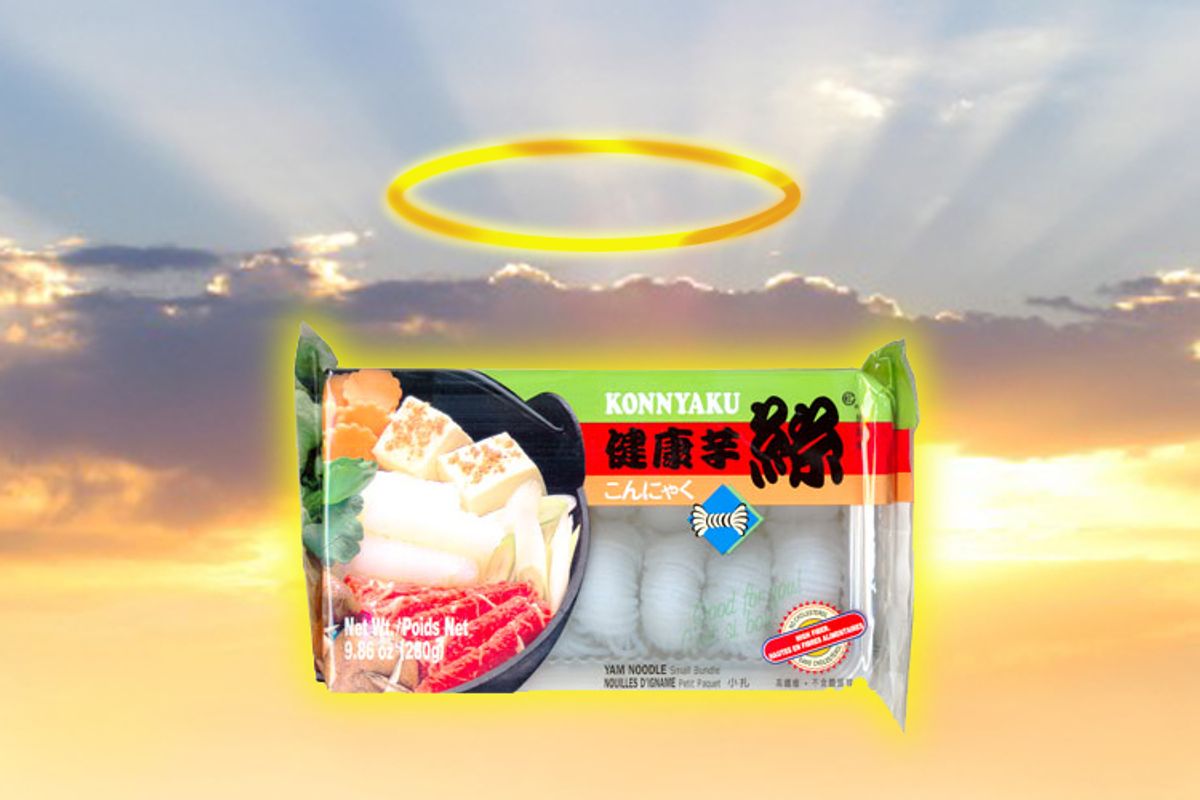
For dieters, it’s the ultimate dream: a food that’s nearly calorie-free, filling to eat and ridiculously easy to make. The shirataki noodle, a product that’s recently been gaining notoriety, is being advertised as just that. Made from the plant fiber of the konjac plant (more dramatically known as “devil’s tongue”), an Asian species that looks like a casually misplaced elephant tusk, the thin, nearly transparent noodle’s main ingredients are water and a dietary fiber called glucomannan. The noodles are incredibly low in carbohydrates and calories, and studies have found that glucomannan helps reduce cholesterol and can aid weight loss. They have almost no flavor (but will absorb flavors from sauces or soups), have a texture like firm, springy gelatin, and cook almost instantly.

Where does it come from?
Shirataki noodles come from Asia, where they’ve long been popular in China and Japan, where they’re often eaten like sashimi, in slices. They’ve also been available in Asian specialty stores in the United States, but more recently, a modestly titled company, Miracle Noodle (“like Dustin Hoffman in ‘Rain Man’ was with numbers, we are with noodles”), has begun selling them online. Miracle Noodle offers shirataki in several shapes, including angel hair, fettuccine and rigatoni (the angel hair is kosher). They’re also on sale at some more conventional grocery stores, including Trader Joe’s and Safeway.
While they been known in the United States among dieters for years (there are YouTube recipe videos dating back to at least 2007) the noodles were featured in Men’s Health magazine in 2008, citing a study claiming that the noodles help prevent fat storage, and they have even popped up on local newscasts. But the noodles finally hit it big earlier this month, when Rocco DiSpirito included them as one of his “must-try” foods for 2010 on the Rachael Ray show, catapulting “shirataki” into Google’s hot top-10 search trends.
Who’s eating it?
Aside from Rocco DiSpirito, the noodles are popular in the Asian community, dieters and, based on YouTube, a cross-section of folks looking for a quick, healthy, labor-unintensive meal and a second career as an online cooking show host.
Longevity rating: 5 (out of 10)
It’s hard to imagine that a tasteless calorie-free noodle holds much appeal for people beyond those who are watching their weight, consciously thinking about their health, or suffering a disastrous aversion to flavor — but its long popularity in Asia suggests that’s there’s more to this noodle than meets your taste buds.
Thomas Rogers is Salon's Arts Editor. More Thomas Rogers.
Pop Torn: 10 pieces of culture we’re feeling iffy about
From "True Blood" to Mark Zuckerberg killing a goat to a purse made out of jerky, this week is all about meat
Memorial Day weekend, you guys! I know that I will be happy to wear all my white clothing again, because nothing says “I’ve been to a summer barbeque” like visible condiment sauce all over my clothing.
And with this warm weather comes tons of pop culture news stories that are just to the right of funky. We’ve rounded up some of the stranger stuff that we missed this week, and leave it up to you to decide if maybe being raptured wasn’t such a bad idea.
1. People who think the Onion’s headlines are real: Oh, it happens. And now it’s a Tumblr. (Expect a book deal in the near future.)
Continue Reading CloseDrew Grant is a staff writer for Salon. Follow her on Twitter at @videodrew. More Drew Grant.
How do “natural” non-sugar sweeteners stack up?
With Nutrasweet and Splenda taking a hit, we look into -- and taste -- trendy alternatives like agave syrup
Now that the artificial sweetener aspartame (Nutrasweet) has attracted suspicion, you might be thinking twice about that daily Diet Coke or Splenda (sucralose) in your coffee. Not that this is surprising; even without the stroke and cancer warnings, the word “artificial” alone conjures up images of shadowy figures in lab coats concocting solutions destined for your stomach. Much more reassuring are images of freshly plowed farms tucked in the mountains, like the one on the jar of Lundberg Family Farms’ organic brown rice syrup.
Continue Reading CloseAviva Shen is an editorial fellow at Salon. More Aviva Shen.
The utter ridiculousness of hip food trends
A chef describes how suddenly hot ingredients -- like razor clams -- hurt the consumer in the end
A razor clam So here are some tweets from this week, from longtime restaurant critic Gael Greene and NBC’s thefeast.com food editor Matt Duckor:
Gael Greene We had razor clams three nights in a row last week. John Dory, Bar Basque, Dressler. Good but not a match for Esca’s.
mattduckor @GaelGreene Casa Mono’s razor clams predate the trend and are excellent.
Continue Reading CloseEddie Huang is chef and owner of BaoHaus restaurant in New York City. He writes the blog, Fresh Off the Boat. More Eddie Huang.
America: It’s time to win the future (of cooking vegetables)
Meat debauchery was so 2010 (and every year before that). Chefs are having fun with vegetables, and you can too
Tomato, Many Complementary Flavors from the restaurant Alinea I’ve heard it and read it — and said it myself — over and over: Vegetables will be the hot food trend in 2011. Of course, I say that with the wincing pain that comes with the knowledge that the words leaving your mouth sound stupid. I mean, it’s like saying air will be the new hotness in breathing. But here’s the thing: Despite our ever-increasing culinary sophistication and our interest in vegetarianism, veganism and just plain-old eating less meat for health or environment or whatever, Americans have most assuredly not won the future on the creative, enthusiastic cooking of vegetables. Yet.
Continue Reading CloseFrancis Lam is Features Editor at Gilt Taste, provides color commentary for the Cooking Channel show Food(ography), and tweets at @francis_lam. More Francis Lam.
Police arrest Kobayashi for hot dog contest outburst
A former eating champion illegally stage rushes the famous Coney Island competition's award ceremony
Hot dog!
Competitive eater Joey Chestnut has held on to his title at the annual July Fourth hot dog eating contest at New York’s Coney Island, but one of his biggest rivals tried to crash the celebration and has been taken into custody.
Chestnut chomped down on 54 hot dogs in 10 minutes on Sunday to win the annual Nathan’s International Hot Dog Eating Contest for the fourth year in a row.
Watching from the crowd was six-time champion Takeru Kobayashi (tah-KEH’-roo koh-bah-YAH’-shee), who has not signed a contract with Major League Eating to be free to compete in contests sanctioned by other groups.
But Kobayashi went on stage after the competition. Police officers grabbed him, and he tried to hold onto police barricades as they took him into custody.
Page 1 of 4 in Faddy foods
The facts: Beloved by raw food enthusiasts, agave syrup has become one of the easiest alternative sweeteners to find in grocery stores. It’s derived from the Mexican succulent plant agave, of which there are several varieties. It has to be processed to become sweet, and depending on that process, it can be comparable in composition to the dreaded high fructose corn syrup. True, agave has a low glycemic index — meaning it releases glucose into the blood stream at a slower rate than refined sugar — so it can help keep blood sugar levels stable. Eating agave as a “healthy” alternative to sugar, however, is pointless; the two have the same number of calories, no nutritional value whatsoever, and, even though it doesn’t spike blood sugar, the primary sugar in agave, fructose, has been linked to cancer and cholesterol problems when consumed in large quantities.
The facts: Brown rice syrup is what happens when cooked brown rice meets barley malt enzymes. The sweetness comes from starchy complex carbohydrates, which take a couple of hours to digest. As a result, the glucose is released gradually into the bloodstream, providing a steady supply of energy rather than the rush — and crash — of cane sugar. Plus, the syrup maintains some of the nutrients in brown rice, like protein, so it’s not a total nutritional bust like most sweeteners are.
The facts: Stevia’s not technically a sugar; it’s extracted from a sweet herb of the same name. Therefore it has no calories and doesn’t raise blood sugar. Though the FDA labeled it a “dangerous food additive” in 1991 after an “anonymous industry complaint” (read: shadowy figures in lab coats), stevia is now back on the market as a “dietary supplement.” In the rest of the world, particularly Japan, widespread use of stevia has been going on for decades.
The facts: Date sugar is so low-tech it’s kind of funny — it’s just dehydrated dates that have been ground into a powder. That means it’s completely unprocessed and retains all the nutrients in dates. It’s high in fiber and protein, and has lots of vitamins and minerals like iron and potassium. Plus, it qualifies as a raw food. It still contains sucrose, fructose and glucose, so it’s not a good alternative for diabetics or people looking to control their blood sugar.