SALON

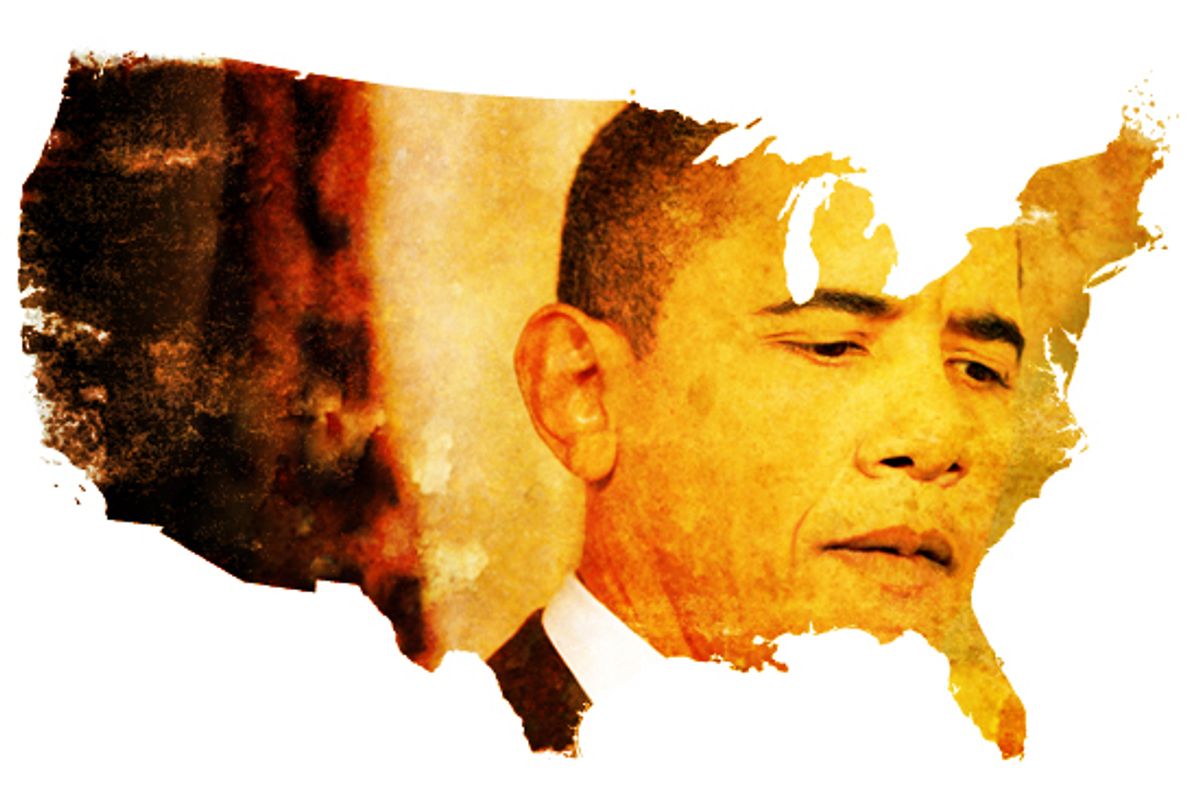
The tragedy of Obama

Obama's minimalist caution falls short in a time of great need

Topics: Obama's First Year, Barack Obama

The tragedy of Obama

The key to understanding Barack Obama is one simple fact: He received more Wall Street money than his Republican rival John McCain and his rivals for the Democratic primary nomination. What did the investment bankers and hedge fund tycoons think they were getting for their investment? Progressive supporters of Obama might have hoped that he would turn the clock back before Reagan and promote a new New Deal. But Obama’s financial backers had no problems with the “Reagan settlement” that Bill Clinton had ratified in two terms, just as Eisenhower in two terms had ratified the “Roosevelt settlement.” Obama’s supporters in the corporate elite thought that the country had taken the wrong course, not in 1980, with the election of Ronald Reagan, but in 2000, with the election of George W. Bush. The second Bush had destabilized the post-1980 system, by becoming — to the surprise of everyone who thought he would be like his father — the tribune of the wacky neo-Confederate right. Obama’s task was to bring about a restoration of the pre-W status quo that would be acceptable to center-right Democrats and moderate Republicans, while keeping the wingnuts at bay and buying off the progressives with rhetoric and token gestures.

In foreign policy, despite grumbling by progressives, Obama’s caution has served the country well, following the reckless militarism of the Bush years. But in domestic policy Obama’s New Democrat version of Rockefeller Republicanism is utterly unsuited to the challenges of our time. The central idea of the post-1980 Reagan settlement, shared with the “reinventing government” ideology of Clinton and Gore, has been corporatism — the outsourcing of public functions, including war, to for-profit corporations. With the exception of his student loan initiative, Obama has pursued a corporatist agenda that includes achieving universal healthcare by forcing more Americans to buy defective products from predatory insurance companies, and trying to address global warming by creating a rigged market for carbon that would enrich speculators while raising energy prices for American citizens and productive businesses.

The tragedy of Obama is that his kind of cautious minimalism would be a virtue in an era of peace and prosperity, but is a vice in an age of national and global crisis. Our times call for determined and, if necessary, crude leaders willing to knock down rotten structures that can no longer be patched up. It remains to be seen whether Obama’s tragedy is America’s as well. 

Michael Lind is the editor of New American Contract at the New America Foundation.

Michael Lind

Michael Lind is the author of Land of Promise: An Economic History of the United States and co-founder of the New America Foundation.

Next Article

Featured Slide Shows

Gripping photos: The people of the Turkey protests (slideshow)

close X
  • Share on Twitter
  • Share on Facebook
  • Thumbnails
  • Fullscreen
  • 1 of 11
  • The protests take on a festive element as police forces move out of the park and square. Wearing a gas mask, this young man dances to traditional Turkish music in front of Taksim Square’s Ataturk Monument.

  • In Gezi Park since March 31st, this protester, originally caught off-guard by the Government’s teargas and water cannons, went out and bought a Russian army mask from WWII, preparing for what was to come.

  • This rambunctious boy seems to be enjoying the chaos. After taking this picture he threw a stone at the already destroyed building in the background.

  • Forming a line, the police face off directly with protesters in Taksim Square. After a while, they retreated and there was a general cheer – a back-and-forth dance that has been common since the beginning of this protest.

  • An elderly woman in Gezi Park reads the news. The tent community occupying the park was violently destroyed on June 16th.

  • Many different groups had set up booths to promote their cause in Taksim Square and Gezi Park. Standing in front of one, this man waves his flag while posing with conviction.

  • Many home-remedies are used to minimize the effects of tear gas. This woman has put a milky solution on her face, removing her mask after the tear gas dissipated. Before sunrise, the police came again for another round of teargasing.

  • People capitalize on the uprising -- selling flags, beer, gas masks, sky lanterns and spray paint to name just a few of the popular items.

  • On Monday morning, June 11, the police execute a strong offensive. Many plain-clothed police officers, like the ones seen here, clash with protesters in the side streets away from the main stand-off in Taksim.

  • The authorities seem to be most aggressive in the night, pushing protesters away from the square and park. After being teargassed this young woman catches her breath with other protesters on Siraselviler Street.

  • Recent Slide Shows

  • Share on Twitter
  • Share on Facebook
  • Thumbnails
  • Fullscreen
  • 1 of 11

Comments

68 Comments

Comment Preview

Your name will appear as username ( settings | log out )

You may use these HTML tags and attributes: <a href=""> <b> <em> <strong> <i> <blockquote>